• 검색 결과가 없습니다.

Optimization of Heavy-Duty Diesel Engine Operating Parameters Using Micro-Genetic Algorithms

N/A
N/A
Protected

Academic year: 2021

Share "Optimization of Heavy-Duty Diesel Engine Operating Parameters Using Micro-Genetic Algorithms"

Copied!
7
0
0

로드 중.... (전체 텍스트 보기)

전체 글

(1)

C o p y r ig h t 2 0 0 5 K S A E 1 2 2 5 - 6 3 8 2 / 2 0 0 5 / 0 7 4 - 1 4 T r a ns a c tio ns o f K SA E , V o l. 1 3 , N o . 2 , p p .1 0 1 -1 0 7 (2 0 0 5 )

N o m e nc lature 1 )

A T D C : a fte r to p d e a d c e n te r

B S F C : b ra k e s p e c ific fu e l c o n s u m p tio n , g /k W -h r B T D C : b e fo re to p d e a d c e n te r

E V O : e x h a u s t v a lv e o p e n IV C : in ta k e v a lv e c lo s e

.G A : m ic ro g e n e tic a lg o rith m S O I : s ta rt o f in je c tio n

1 .

*

T o w h o m c o rr e s p o n d e n c e s h o u ld b e a d d re s s e d . m a n s h ik @ e r c .w is c .e d u

S o o t N O x .

.

.

C F D .

.

*

M ike P . L ie c hty R o lf D . R e itz

Engine Research Center, University of Wisconsin-Madison

Optimization of Heavy-Duty Diesel Engine Operating Parameters Using Micro-Genetic Algorithms

Manshik Kim

*

Mike P. Liechty Rolf D. Reitz

Engine Research Center, University of Wisconsin-Madison, 1500 Engineering Drive, Madison, Wisconsin 53706, USA (Received 6 September 2004 / Accepted 6 December 2004)

A b s trac t : In th is p a p e r, o p tim iz e d o p e ra tin g p a ra m e te rs w e re fo u n d u s in g m u lti-d im e n s io n a l e n g in e s im u la tio n s o ftw a re (K IV A -3 V ) a n d m ic ro -g e n e tic a lg o rith m fo r h e a v y d u ty d ie s e l e n g in e . T h e e n g in e o p e ra tin g c o n d itio n c o n s id e re d w a s a t 1 ,7 3 7 re v /m in a n d 5 7 % lo a d . E n g in e s im u la tio n m o d e l w a s v a lid a te d u s in g a n e n g in e e q u ip p e d w ith a h ig h p re s s u re e le c tro n ic u n it in je c to r (H E U I) s y s te m . T h re e im p o rta n t p a ra m e te rs w e re u s e d fo r th e o p tim iz a tio n - b o o s t p re s s u re , E G R ra te a n d s ta rt o f in je c tio n tim in g . N u m e ric a l o p tim iz a tio n id e n tifie d H C C I-lik e c o m b u s tio n c h a ra c te ris tic s s h o w in g s ig n ific a n t im p ro v e m e n ts fo r th e s o o t a n d N O x e m is s io n s . T h e o p tim iz e d s o o t a n d N O x e m is s io n s w e re re d u c e d to 0 .0 0 5 g /k W -h r a n d 1 .3 3 g /k W -h r, re s p e c tiv e ly . M o re o v e r, th e o p tim u m re s u lts m e t E P A 2 0 0 7 m a n d a te s a t th e o p e ra tin g p o in t c o n s id e re d .

K e y w o rd s : O p tim iz a tio n ( ), M ic ro g e n e tic a lg o rith m ( ), K IV A -3 V c o d e (K IV A -3 V ),

D ie s e l e n g in e ( )

(2)

M ik e P . L ie c h ty R o lf D . R e itz

.

.

1 )

,

2 -4 )

W ic k m a n

3 )

C F D .

K IV A -3 V

5 )

. K IV A -3 V

.

2 .

2 .1

, E n g in e R e s e a rc h C e n te r (U W -M a d is o n ) ,

, , K IV A -3 V

.

K H -R T

6 )

S h e ll .

7 )

S o o t

H iro y a s u

8 )

N a g le a n d S tric k la n d -C o n s ta b le

9 )

N O x Z e l’d o v ic h

1 0 )

.

. 2 .4 4

. 1 ,7 3 7 re v /m in ,

5 7 % (M o d e 5 ) .

6 0 .1 5 8 m m

. (IV C -E V O )

6 6 0 °

. C

1 4

H

3 0

M o d e 5 .

.

1 1 )

F ig . 1

B T D C 3 0 ° . T a b le 1

.

Fig. 1 Computational grid for the Caterpillar engine at BTDC 30°

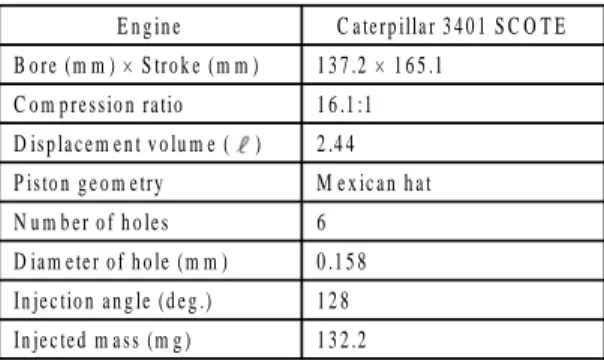
Table 1 Specifications of heavy duty diesel engine and injector

E n g in e C a te rp illa r 3 4 0 1 S C O T E B o re (m m ) × S tro k e (m m ) 1 3 7 .2 × 1 6 5 .1

C o m p re s s io n ra tio 1 6 .1 :1 D is p la c e m e n t v o lu m e ( ) 2 .4 4 P is to n g e o m e try M e x ic a n h a t N u m b e r o f h o le s 6

D ia m e te r o f h o le (m m ) 0 .1 5 8 In je c tio n a n g le (d e g .) 1 2 8 In je c te d m a s s (m g ) 1 3 2 .2

2 .2

S e n e c a l

2 )

.G A (M icro

g e n e tic a lg o rith m ) .

.

0 1

(3)

. .G A 5

1

(E litis t p re s e rv in g

s e le c tio n ) 4

4 C P U

.

.

(1)

N O x S o o t

. o

E P A 2 0 0 7 .

1 2 )

(P M : 0 .0 1 3 4 g /k W -h r, N O x + H C : 1 .7 9 6 g /k W -h r, B S F C : 2 5 6 g /k W -h r)

, .

(T o u rn a m e n t s e le c tio n )

(C ro s s o v e r) .

. , E G R

T a b le 2 .

Table 2 Variation of engine operating parameters B o o s t p re s s u re (k P a ) 1 3 0 ~ 2 2 0 , 4 s te p s E G R ra te (% ) 0 .0 ~ 5 0 .0 , 3 2 s te p s S O I tim in g (A T D C d e g .) -6 0 .0 ~ 2 0 .0 , 3 2 s te p s

3 .

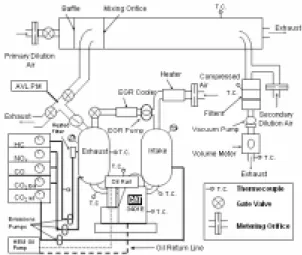
F ig . 2 K IV A -3 V . E G R 5 0 %

Fig. 2 Engine laboratory setup with dilution tunnel and EGR system

.

S o o t, H C , N O x

. E G R 0 %

-3 .5 ° A T D C 5 .5 ° A T D C 2 ° C A

-5 .5 ° A T D C E G R 0 %

~ 2 3 .5 % .

4 .

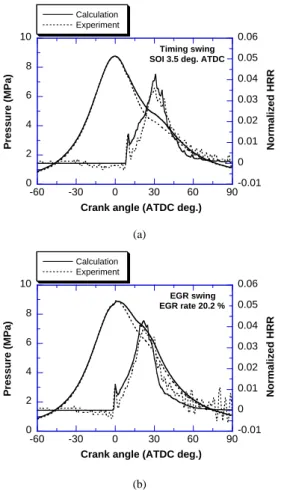
4 .1 F ig . 3

. F ig . 3 (a ) 3 (b ) E G R

.

.

. F ig . 4

.

S o o t N O x

.

(4)

M an s h ik K im M ik e P . L ie c h ty R o lf D . R e itz

0 2 4 6 8 10

-0.01 0 0.01 0.02 0.03 0.04 0.05 0.06

-60 -30 0 30 60 90

Timing swing SOI 3.5 deg. ATDC Calculation

Experiment

Pressure (MPa) Normalized HRR

Crank angle (ATDC deg.) (a)

0 2 4 6 8 10

-0.01 0 0.01 0.02 0.03 0.04 0.05 0.06

-60 -30 0 30 60 90

EGR swing EGR rate 20.2 % Calculation

Experiment

Pressure (MPa) Normalized HRR

Crank angle (ATDC deg.)

(b)

Fig. 3 Cylinder pressure and heat release rate comparison between the experiment and calculation

0 0.5 1 1.5 2 2.5

0 5 10 15 20 25 30

Timing swing (expt.) Timing swing (cal.) EGR swing (expt.) EGR swing (cal.)

Soot (g/kg-f)

NOx (g/kg-f)

Fig. 4 Comparison of emission characteristics

4 .2 F ig . 5

0 100 200 300 400 500 600

0 50 100 150 200

Maximum merit value

Generation number Fig. 5 Mode 5 three-factor GA merit vs. generation

-5 0 5 10 15 20

-600 0 600 1200 1800 2400

-60 -40 -20 0 20 40 60

Pressure (MPa) Rate of heat release (J/deg.)

Crank angle (ATDC deg.)

Fig. 6 Cylinder pressure and heat release rate of the optimum case

. 5

7 4

. 7 4

.

2 2 0 k P a , E G R 4 6 .6

% , -6 0 ° A T D C . F ig . 6

.

. S o o t

E G R N O x

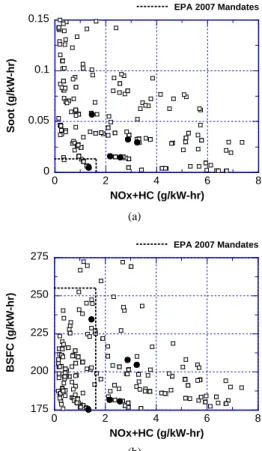
(S o o t : 0 .0 0 5 g /k W -h r, N O x + H C : 1 .3 3 g /k W -h r). F ig .

7 (a ) N O x + H C - S o o t, (b )

N O x + H C - B S F C

(5)

O p tim iz atio n o f H e av y - D u ty D ie s e l E n g in e O p e ratin g P aram e te rs U s in g M ic ro - G e n e tic A lg o rith m s

. E P A

2 0 0 7

.

N O x E G R

N O x S o o t H C C I

-6 0 ° A T D C . F ig . 8

. -6 0 ° A T D C -2 7 ° A T D C

. 1 5 0 M P a

.

0 0.05 0.1 0.15

0 2 4 6 8

Soot (g/kW-hr)

NOx+HC (g/kW-hr)

EPA 2007 Mandates

(a)

175 200 225 250 275

0 2 4 6 8

BSFC (g/kW-hr)

NOx+HC (g/kW-hr)

EPA 2007 Mandates
(b)

Fig. 7 (a) Soot vs. NOx + HC (b) BSFC vs. NOx + HC data from the optimization study including the optimi- zation start point, intermediate optimum and global optimum (not all points are shown due to scaling)

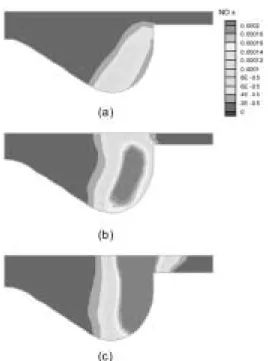
F ig . 9 ~ F ig . 1 1

, N O x

Fig. 8 Predicted fuel vapor concentration for the optimum case (-40° ATDC, -30° ATDC, -27° ATDC and -24°

ATDC from top to bottom)

Fig. 9 In cylinder temperature distribution at (a) -10° ATDC

(b) TDC (c) 10° ATDC

(6)

M ik e P . L ie c h ty R o lf D . R e itz

Fig. 10 In cylinder NOx distribution at (a) -5° ATDC (b) TDC (c) 10° ATDC

Fig. 11 In cylinder soot distribution at (a) -10° ATDC (b) TDC (c) 10° ATDC

S o o t .

. N O x

S o o t ,

S o o t .

.

S o o t N O x H C C I

. 4 6

. 4 6 7 4

1 9 0 k P a -5 2 ° A T D C

1 6 M P a . .G A

.

5 .

.G A . 1 )

K IV A -3 V .G A

.

2 ) 1 ,7 3 7 re v /m in , 5 7 %

2 2 0

k P a , E G R 4 6 .6 % , -6 0

o

A T D C

H C C I .

3 ) S o o t

(7)

0 .0 0 5 g /k W -h r, N O x 1 .3 3 g /

k W -h r .

4 )

.

.

P o s t-d o c . .

R e fe re nc e s

1 ) D . E . G o ld b e r g , G e n e tic A lg o r ith m s in S e a r c h , O p tim iz a tio n , a n d M a c h in e L e a r n in g , A d d is o n - W e s le y , 1 9 8 9 .

2 ) P . K . S e n e c a l a n d R . D . R e itz , “ S im u lta n e o u s R e d u c tio n o f E n g in e E m is s io n s a n d F u e l C o n s u m p tio n U s in g G e n e tic A lg o r ith m s a n d M u lti- D im e n s io n a l S p r a y a n d C o m b u s tio n M o d e lin g ,” S A E 2 0 0 0 - 0 1 - 1 8 9 0 , 2 0 0 0 .

3 ) D . D . W ic k m a n , H . Y u n a n d R . D . R e itz ,

“ S p lit- S p r a y P is to n G e o m e tr y O p tim iz e d f o r H S D I D ie s e l E n g in e C o m b u s tio n ,” S A E 2 0 0 3 - 0 1 - 0 3 4 8 , 2 0 0 3 .

4 ) T . S . K im , D . H . L e e a n d J . J . K im , “ O p tim u m D e s ig n o f S u s p e n s io n S y s te m s U s in g a G e n e tic A lg o r ith m ,” T r a n s a c tio n s o f th e K S A E , V o l.8 , N o .5 , p p .1 3 8 - 1 4 7 , 2 0 0 0 .

5 ) A . A . A m s d e n , “ K I V A - 3 V : A B lo c k - S tr u c - tu r e d K I V A P r o g r a m f o r E n g in e s w ith V e r tic a l o r C a n te d V a lv e s , L o s A la m o s N a tio n a l L a b o - r a to r y R e p o r t N o . L A - 1 3 3 3 - M S , 1 9 9 7 .

6 ) M . A . P a tte r s o n a n d R . D . R e itz , “ M o d e lin g th e E f f e c ts o f F u e l S p r a y C h a r a c te r is tic s o n D ie s e l E n g in e C o m b u s tio n a n d E m is s io n s ,” S A E 9 8 0 1 3 1 , 1 9 9 8 .

7 ) S . C . K o n g , Z . H a n a n d R . D . R e itz , “ T h e D e v e lo p m e n t a n d A p p lic a tio n o f a D ie s e l I g n itio n a n d C o m b u s tio n M o d e l f o r M u ltid i- m e n s io n a l E n g in e S im u la tio n s ,” S A E 9 5 0 2 7 8 , 1 9 9 5 .

8 ) K . N is h id a a n d H . H ir o y a s u , “ S im p lif ie d T h r e e - D im e n s io n a l M o d e lin g o f M ix tu r e F o r m a tio n a n d C o m b u s tio n in a D . I . D ie s e l E n g in e ,” S A E 8 9 0 2 6 9 , 1 9 8 9 .

9 ) J . N a g le a n d R . F . S tr ic k la n d - C o n s ta b le ,

“ O x id a tio n o f C a r b o n b e tw e e n 1 0 0 0 - 2 0 0 0 ° C ,”

P r o c . o f th e F if th C a r b o n C o n f ., V o l.1 , p .1 5 4 , 1 9 6 2 .

1 0 ) C . T . B o w m a n , “ K in e tic s o f P o llu ta n t F o r m a - tio n a n d D e s tr u c tio n in C o m b u s tio n ,” P r o g r e s s o f E n e r g y C o m b u s tio n S c ie n c e , V o l.1 , p p .3 3 - 4 5 , 1 9 7 5 .

1 1 ) D . D . W ic k m a n , “ H S D I D ie s e l E n g in e C o m - b u s tio n C h a m b e r G e o m e tr y O p tim iz a tio n ,” P h . D . T h e s is , U n iv e r s ity o f W is c o n s in - M a d is o n , 2 0 0 3 .

1 2 ) E m is s io n S ta n d a r d s : U S A H e a v y - D u ty T r u c k

a n d B u s E n g in e s : h ttp ://w w w .d ie s e ln e t.c o m /

s ta n d a r d s /u s /h d .h tm l

수치

Table 1 Specifications  of  heavy  duty  diesel  engine  and  injector E n g in e C a te rp illa r 3 4 0 1  S C O T E B o re (m m ) ×  S tro k e (m m ) 1 3 7 .2  ×  1 6 5 .1 C o m p re s s io n  ra tio 1 6 .1 :1 D is p la c e m e n t v o lu m e  ( ) 2 .4 4
Table 2 Variation of engine operating parameters B o o s t p re s s u re  (k P a ) 1 3 0   ~   2 2 0 , 4  s te p s E G R  ra te  (% ) 0 .0   ~   5 0 .0 , 3 2  s te p s S O I tim in g  (A T D C  d e g .) -6 0 .0  ~  2 0 .0 , 3 2  s te p s   3
Fig. 3 Cylinder  pressure  and  heat  release  rate  comparison  between the experiment and calculation
Fig. 8 Predicted  fuel  vapor  concentration  for  the  optimum  case (-40° ATDC, -30° ATDC, -27° ATDC and -24°
+2

참조

관련 문서

This study was carried out to select superior soybean cultivars for forage production and to determine the optimum plant density and phosphate rate for

Objective: This study was conducted to identify the association between vitamin D and osteosarcopenia among all adults in Korea using data from the Korea National Health

 After a bundle adjustment converges properly, the standard deviations for both exterior orientation parameters and ground coordinates of pass points are obtained using

For each of several tests, elastic, plastic, and total strain data points are plotted versus life, and fitted lines are also

- Relate the mixing length to velocity gradient using the similarity rule - Turbulent fluctuations are similar at all point of the field of flow. - Velocity is characteristics

Objective: This study was conducted to identify the association between vitamin D and Sarcopenia among all adults in Korea using data from the National Health and

traditional techniques for general nonconvex problems involve compromises local optimization methods (nonlinear programming). • find a point that minimizes f 0 among

These days, the shipping companies and shipyards are required a optimization hull form design according to improved fuel efficiency and application of EEDI.. In the present