수수(Sorghum bicolor L.)는 일년생식물로 화본과(Poaceae) 이며, 밀, 옥수수, 보리, 쌀과 함께 세대 5대 곡류작물이고 환경에 잘 적응해 열대지역, 아열대지역, 온대기후와 같은 지역에서 광범위하게 재배되고 있다(Dillon et al., 2007).
현재 주요 재배지역은 우리나라, 중국, 아프리카, 미국, 인도 와 호주 등이며, 식용이나 사료용으로 주로 사용되고 있다 (Afify et al., 2011; Elkhalifa et al., 2005; Murty & Kumar, 1995).
우리나라에서의 주요 재배지역은 충청북도와 강원도 지 방이며, 우리나라에서 수수의 생산액은 1980년대부터 지속 적으로 하락하고 있는 추세이다(Choi et al., 1996). 또한 우 리나라에서 수수의 재배면적은 2018년 기준 약 1,535 ha를 나타내고 있으며 생산량은 약 2,700톤을 유지하고 있다. 다 른 식량 작물에 비해 생산량은 증가와 감소가 반복적으로 나타나는 추세이며, 많지는 않으나 꾸준하게 생산되는 작물 이다(FAOSTAT, 2018). 최근 들어 한국의 기후는 불규칙적
인 단기 집중호우의 영향으로 보다 다습한 아열대성 기후로 의 변화가 일어나고 있다.(Fraedrich et al., 2001; Beck et al., 2006) 하지만 수수는 건조기후에 보다 적합하고, 내건성이 강한 작물이다(Ahn et al., 2012; Khosla et al., 1995; Park et al., 1999). 이로 인해, 수수 종자는 재배기간 중에 다양한 병원체에 의해 오염이 될 수 있다(Choi et al., 2013; Min et al., 2017). 포장에서 병으로 발생할 경우, 전염원의 역할과 농작물 생산에 큰 피해를 주게 된다. 그러므로 종자생산 단 계에서부터 전염원의 차단이 매우 중요하다. 종자는 농산 물의 품질과 수량을 결정할 뿐만 아니라 경작과정에서 발 생할 수 있는 병·해충의 피해, 환경장해 등에 대응하는 저 항성의 정도를 결정하기 때문에 모든 생산과정에 전반적인 영향을 준다. 그와 더불어 수수는 영양 및 생식생장기에는 내건성이 강하지만 그와 별개로 유전적이나 환경적인 요인 으로 발아율은 불량하다(Younesi & Moradi, 2009). 그러므 로 수수 파종 전 수수종자에 대한 소독이 중요하다.
소독제의 침지시간 및 희석농도가 수수 발아 및 오염율에 미치는 영향
김경민
1
・ 최세현1
・ 김창수1,2,†
Concentration- and Time-Dependent Effect of Disinfectant Treatment on Sorghum Seeds
Kyeongmin Kim
1
, Se-Hyun Choi1
, and Changsoo Kim1,2,†
ABSTRACT Sorghum (Sorghum bicolor L.) is an annual crop belonging to Poaceae, and is the fifth-largest crop after maize, wheat, rice, and barley. This study was conducted to establish an efficient seed sterilization method to manage fungal or bacterial infections of germinating sorghum seeds. Two varieties of sorghum seeds (BTx623 and SAP317) were treated with benomyl- thiram and thiophanate-methyl triflumizole which are known to be effective disinfectants for sorghum seeds. For SAP317, the highest germination rate was accomplished with 24-hour treatment of both chemicals at a 200× dilution rate. For BTx623, the highest germination rate was observed after 24-hour treatment at a 200×/400× dilution rate for benomyl-thiram and control/200×
for thiophanate-methyl triflumizole. Consequently, the optimal treatment for the seed disinfection in sorghum seeds may be at the dilution rate of 200× or 400× for 24 hours.
Keywords : contamination rate, germination rate, seed disinfection, seed sterilization, sorghum DOI : https://doi.org/10.7740/kjcs.2020.65.2.124
Original Research Article
ⓒ 본 학회지의 저작권은 한국작물학회지에 있으며, 이의 무단전재나 복제를 금합니다.
This is an Open-Access article distributed under the terms of the Creative Commons Attribution Non-Commercial License (http://creativecommons.org/licenses/by-nc/3.0) which permits unrestricted non-commercial use, distribution, and reproduction in any medium, provided the original work is properly cited.
1)충남대학교 식물자원학과 연구원 (Researcher, Department of Crop Science, Chungnam National University, Daejeon 34134, Republic of Korea)
2)충남대학교 스마트농업시스템학과 교수 (Professor, Department of Smart Agriculture Systems, Chungnam National University, Daejeon 34134, Republic of Korea)
†Corresponding author: Changsoo Kim; (Phone) +82-42-821-5721; (E-mail) [email protected]
<Received 5 February, 2020; Revised 31 March, 2020; Accepted 2 April, 2020>
수수 종자의 효율적인 소독방법에 대해서는 이전에 연구 보고되었다(Oyebanji et al., 2009; Sim et al., 2018). 그러 나 수수에 대한 세부적인 소독방법에 따른 발아특성 차이 에 관한 연구가 미비한 실정이다. 따라서 본 실험은 수수종 자에 대한 종자소독 방법에 따른 발아율 및 오염률에 대한 연구를 수행한 결과를 토대로 효과적인 수수 종자 소독에 대한 기초자료로 활용하고자 실시하였다.
재료 및 방법 공시재료
공시품종은 2018년 충남대학교에서 채종한 수수 종자 중 수확량이 가장 많은 BTx623과 SAP317를 사용하였다. 처리 약제는 2015년 수수에 등록된 종자 소독제인 베노밀·티람수 화제(benomyl 20%, thiram 20%)와 티오파네이트메틸·트리 플루미졸수화제(thiophanate-methyl 45%, triflumizole 15%) 를 사용하였다.
침지시간에 따른 발아율 검정 및 오염률 조사
베노밀·티람수화제(benomyl 20%, thiram 20%)와 티오파 네이트메틸·트리플루미졸수화제(thiophanate-methyl 45%, tri- flumizole 15%)를 200배액을 기준으로 희석액 6시간, 12시 간, 24시간 침지하였다. 대조구인 무처리는 증류수를 이용하 여 24시간 침지하였다. 직경 9 cm의 petri-dish에 filter paper 를 깔고 침지된 종자 20립씩 치상한 후 항온기(한백과학, HB- 301L-L)에서 25±0.5°C 조건으로 하였고 기계 내부의 습도 가 30% 조건으로 유지되어 수수종자의 발아를 위해 filter paper를 증류수 1 ml로 적신 뒤 발아를 시켰다. 발아기간 중 습도 유지를 위해 매일 1 ml의 증류수를 보충해 주었고, 3 반복 수행하였다. 발아기준은 종자에서 유근 또는 유아가 2 mm이상 출현한 것을 기준으로 하였고, 치상 후 2일부터 7 일까지 발아조사를 실시하였다. 종자의 오염을 판별하기 위해 종자 치상 후, 7일이 지난 시점에 육안으로 확인 가능 한 종자 주변의 박테리아 또는 곰팡이의 오염여부를 조사 하였다.
희석농도에 따른 발아율 검정 및 오염률 조사
실험에 사용된 소독제는 베노밀·티람수화제(benomyl 20%, thiram 20%)와 티오파네이트메틸·트리플루미졸수화제(thio-
아율 검정 및 오염율 조사 방법과 동일하게 수행하였다.
통계분석
본 실험결과는 R (ver 3.6.1)의 aov 함수를 이용한 분산분 석 실시 후 평균간의 유의한 차이가 있어서 사후 검정으로 agricolae 패키지의 던컨의 다중검정을 실행하였다.
결과 및 고찰 침지시간에 따른 발아율과 오염률 평가
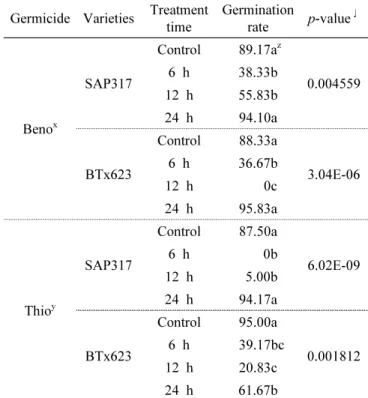
수수 종자소독제의 처리시간에 따른 발아율과 오염률은 각각 3반복하여 평균값을 나타내며, 소수점 셋째자리에서 반올림하여 계산하였다. SAP 317을 베노밀·티람수화제를 처리했을 때, 6시간 및 12시간 처리보다 무처리와 24시간 처리에서 높은 발아율을 보였다. 실험에 사용한 두 소독제 는 24시간 침지가 기준이라 그 이하의 처리는 종자발아의 충분한 침지가 되지 않아 발아율에 영향을 미친 것으로 보 인다. 무처리는 24시간 순수한 물에서 침지한 것으로 소독
Table 1. Germination rate with different treatment times.
Germicide Varieties Treatment time Germination
rate p-value
♩Beno
xSAP317
Control 89.17a
z0.004559
6 h 38.33b
12 h 55.83b
24 h 94.10a
BTx623
Control 88.33a
3.04E-06
6 h 36.67b
12 h 0c
24 h 95.83a
Thio
ySAP317
Control 87.50a
6.02E-09
6 h 0b
12 h 5.00b
24 h 94.17a
BTx623
Control 95.00a
0.001812
6 h 39.17bc
12 h 20.83c
24 h 61.67b
x
benomyl-thiram water dispersible powder
제의 무처리로 오염률이 높게 나타난 것으로 보인다. 티오 파네이트메틸·트리플루미졸수화제를 사용한 경우 결과는 동일하였다(Table 1). BTx623은 베노밀·티람수화제를 처리
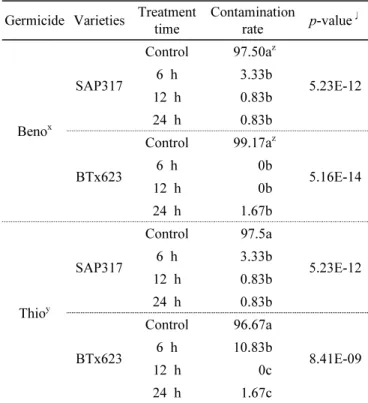
했을 경우 발아율은 6시간, 12시간 처리보다 무처리와 24 시간 처리가 발아율이 다소 높은 것으로 확인되었다. 티오 파네이트메틸·트리플루미졸수화제를 처리한 경우에는 무 처리가 발아율이 가장 높았으며, 다음으로는 24시간 처리 가 높았다(Table 1). SAP317의 오염율은 베노밀·티람수화 제와 티오파네이트메틸·트리플루미졸수화제 두 처리 모두 6시간, 12시간 및 24시간 처리에서 오염률이 확연히 낮아 지는 것을 확인할 수 있었다(Table 2). 오염율은 BTx623의 베노밀·티람수화제를 처리한 경우 무처리를 제외한 모든 처리에서 낮은 것을 확인할 수 있었고, 티오파네이트메틸·
트리플루미졸수화제를 처리한 경우 12시간, 24시간 처리가 가장 낮았다(Table 2).
침지시간, 품종, 농약에 따른 발아율과 오염률의 다원분산 분석
침지시간이 영향을 끼치는지 검증하기 위해 침지시간, 품종, 농약에 따른 발아율과 오염률에 대해 다원분산분석 을 수행하였다. 발아율에 관한 다원 분산분석결과, 침지시 간만 영향을 주지 않고 농약의 종류에 따라서도 발아율에 영향을 주는 것으로 나타난다. 더불어 시간과 품종, 품종과 농약, 시간과 품종과 농약에 각각의 상호작용이 확인된다.
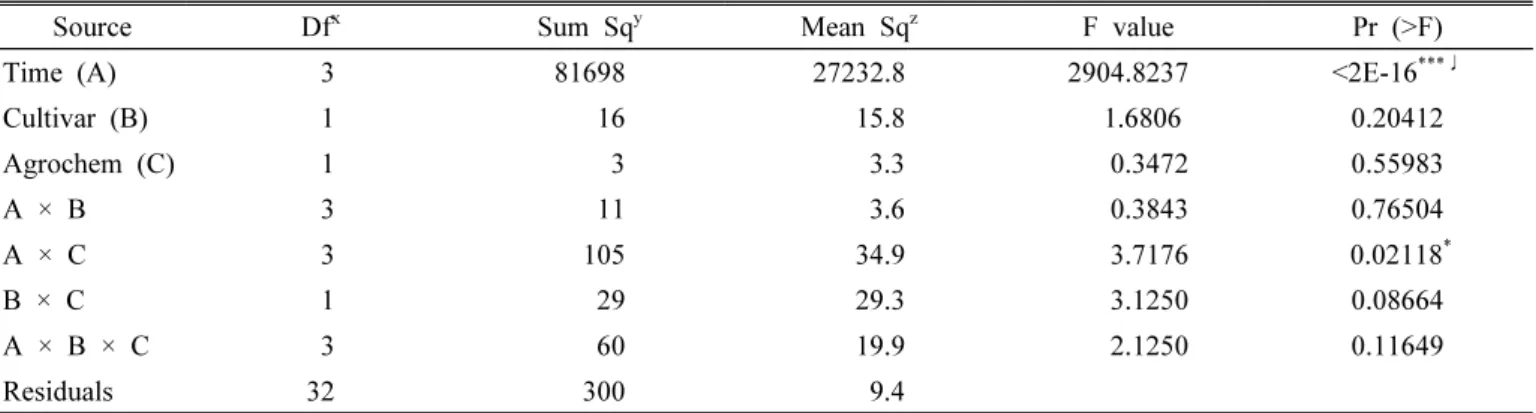
이는 침지시간만으로 영향이 생긴다고 결론을 내리기는 어 렵다(Table 3). 하지만 오염률에 관한 다원 분산분석결과를 살펴보면 침지시간에 따라 오염률에 영향을 주며 침지시간 과 농약의 상호작용을 확인할 수 있다(Table 4).
희석농도에 따른 발아율과 오염률 평가
수수 종자소독제의 처리농도에 따른 발아율과 오염률은
Table 3. Germination rate according to treatment time, variety, and germicide.
Source Df
xSum Sq
yMean Sq
zF value Pr (>F)
Time (A) 3 49240 16413.4 119.4831 <2.2E-16
***♩Variety (B) 1 133 133.3 0.9706 0.3319175
Germicide (C) 1 1692 1692.2 12.3185 0.0013564
**A × B 3 2868 955.9 6.9586 0.0009804
***A × C 3 840 280.0 2.0385 0.1281775
B × C 1 1408 1408.3 10.2521 0.0030812
**A × B × C 3 4622 1540.6 11.2152 3.453E-05
***Residuals 32 4396 137.4
x
Degrees of freedom
y
Sum of squares
z
Mean of squares
♩
Significance codes: 0 ‘
***’; 0.001 ‘
**’; 0.01 ‘
*’
Table 2. Contamination rate with different treatment times.
Germicide Varieties Treatment time Contamination
rate p-value
♩Beno
xSAP317
Control 97.50a
z5.23E-12
6 h 3.33b
12 h 0.83b
24 h 0.83b
BTx623
Control 99.17a
z5.16E-14
6 h 0b
12 h 0b
24 h 1.67b
Thio
ySAP317
Control 97.5a
5.23E-12
6 h 3.33b
12 h 0.83b
24 h 0.83b
BTx623
Control 96.67a
8.41E-09
6 h 10.83b
12 h 0c
24 h 1.67c
x
benomyl-thiram water dispersible powder
y
thiophanate-methyl triflumizole water dispersible powder
z
Means in the columns with different letters are significantly different at the 5% significance level by the Duncan’s multiple range test
♩
p-value: p-values obtained by the Student’s t-test
Table 4. Contamination rate according to treatment time, variety, and germicide.
Source Df
xSum Sq
yMean Sq
zF value Pr (>F)
Time (A) 3 81698 27232.8 2904.8237 <2E-16
***♩Cultivar (B) 1 16 15.8 1.6806 0.20412
Agrochem (C) 1 3 3.3 0.3472 0.55983
A × B 3 11 3.6 0.3843 0.76504
A × C 3 105 34.9 3.7176 0.02118
*B × C 1 29 29.3 3.1250 0.08664
A × B × C 3 60 19.9 2.1250 0.11649
Residuals 32 300 9.4
x
Degrees of freedom
y
Sum of squares
z
Mean of squares
♩
Significance codes: 0 ‘
***’; 0.001 ‘
**’; 0.01 ‘
*’
Table 5. Germination rate with different treatment concentrations.
Germicide Varieties Treatment
concentration Germination
rate p-value
♩Beno
xSAP317
Control 93.33a
z0.001104
100× 62.50b
200× 94.17a
400× 87.50a
BTx623
Control 87.50b
z1.34E-05
100× 74.17c
200× 95.83a
400× 96.67a
Thio
ySAP317
Control 90.83a
0.000376
100× 8.33c
200× 83.33a
400× 32.50b
BTx623
Control 88.33a
0.036539
100× 37.50b
200× 73.33ab
400× 47.50b
x
benomyl-thiram water dispersible powder
y
thiophanate-methyl triflumizole water dispersible powder
z
Means in the columns with different letters are significantly different at the 5% significance level by the Duncan’s multiple range test
♩
p-value: p-values obtained by the Student’s t-test
Table 6. Contamination rate with different treatment concentrations.
Germicide Varieties Treatment
concentration Contamination
rate p-value
♩Beno
xSAP317
Control 100a
z2.96E-15
100× 0.83b
200× 0b
400× 0b
BTx623
Control 94.17a
z4.15E-10
100× 0.83c
200× 0.83c
400× 10.83b
Thio
ySAP317
Control 91.67a
9.48E-11
100× 0b
200× 2.50b
400× 1.67b
BTx623
Control 100a
7.87E-10
100× 1.67c
200× 1.67c
400× 10.83b
x
benomyl-thiram water dispersible powder
y
thiophanate-methyl triflumizole water dispersible powder
z
Means in the columns with different letters are significantly different at the 5% significance level by the Duncan’s multiple range test
♩
p-value: p-values obtained by the Student’s t-test
희석은 약효가 강해 이 경우에는 오히려 발아율을 낮추는 것으로 보인다. 티오파네이트메틸·트리플루미졸수화제 처리 에서는 무처리와 200배액 처리에서 발아율이 높았다(Table 5). BTx623의 발아율은 베노밀·티람수화제를 200배와 400 배액 처리에서 발아율이 높은 것을 알 수 있었다. 티오파네 이트메틸·트리플루미졸수화제 처리는 무처리에서 발아율은 88%로 가장 높았으며, 그 다음으로 200배 처리에서 73%로 높았다(Table 5). SAP317의 오염률은 베노밀·티람수화제와 오파네이트메틸·트리플루미졸수화제 모두에서 100배, 200 배, 400배를 처리했을 때 오염률이 낮은 것을 볼 수 있었다 (Table 6). BTx623의 오염률을 조사한 결과 무처리가 오염 률 94%로 가장 높았으며 베노밀·티람수화제 100배와 200 배액 처리에서 오염률이 낮은 것을 알 수 있었다(Table 6).
희석농도, 품종, 농약에 따른 발아율과 오염률의 다원분산 분석
Tables 3과 4와 같이 희석농도, 품종, 농약에 따른 발아 율과 오염률에 대해 다원분산분석을 수행하였다. 농도, 품 종, 농약에 따른 발아율 결과, 희석농도만 영향을 주는 것 이 아니라 농약의 종류에 따라서도 발아율에 영향을 준다 고 나타난다. 이외에 농도와 농약의 상호작용이 확인되었 으며, 이는 농도만으로 영향이 생긴다고 결론을 내리기에 는 어려움이 있다(Table 7). 오염률은 희석농도에 따라 오 염률에 영향을 주나 품종도 영향을 미치는 것으로 보여진 다. Table 3과 마찬가지로 농도와 품종, 품종과 농약, 농도 와 품종과 농약의 상호작용이 확인되었다. 앞선 결과와 마 찬가지로 희석농도만으로 영향이 생긴다고 결론을 내리기 어렵다 (Table 8). 즉, 침지시간과 희석농도 모두 영향을 끼
Table 7. Germination rate according to treatment concentration, variety, and germicide.
Source Df
xSum Sq
yMean Sq
zF value Pr (>F)
Concentration (A) 3 15242.7 5080.9 32.4097 8.081E-10
***♩Variety (B) 1 438.0 438.0 2.7940 0.10437
Germicide (C) 1 9918.8 9918.8 63.2691 4.444E-09
***A × B 3 1354.7 451.6 2.8804 0.05112
A × C 3 5242.7 1747.6 11.1473 3.624E-05
***B × C 1 42.2 42.2 0.2691 0.60750
A × B × C 3 323.4 107.8 0.6877 0.56620
Residuals 32 5016.7 156.8
x
Degrees of freedom
y
Sum of squares
z
Mean of squares
♩
Significance codes: 0 ‘
***’; 0.001 ‘
**’; 0.01 ‘
*’
Table 8. Contamination rate according to treatment concentration, variety, and germicide.
Source Df
xSum Sq
yMean Sq
zF value Pr (>F)
Concentration (A) 3 79404 26467.8 4148.4286 <2.2E-16
***♩Variety (B) 1 110 109.5 17.1633 0.0002341
***Germicide (C) 1 1 1.2 0.1837 0.6711063
A × B 3 197 65.8 10.3061 6.681E-05
***A × C 3 14 4.6 0.7279 0.5429041
B × C 1 29 29.3 4.5918 0.0398304
*A × B × C 3 127 42.5 6.6599 0.0012739
**Residuals 32 32 204 6.4
x
Degrees of freedom
y
Sum of squares
z
Mean of squares
♩
Significance codes: 0 ‘
***’; 0.001 ‘
**’; 0.01 ‘
*’
치며, 위와 같은 결과를 토대로 수화제 농도를 200배액으 로 희석하고 침지시간을 24시간 동안 처리해서 수수종자의 발아율을 높이고 오염률을 줄여 시간적, 경제적으로 효율 적인 사용방법이 농가에 보급된다면 수수생산량 증대에 기 여할 것으로 보인다.
적 요
본 연구는 수수 종자에 소독제를 이용하여 알맞은 종자 소독방법을 확립하고자 수행되었으며, 수행된 결과를 요약 하면 아래와 같다.
종자소독 실험에 있어 희석액 200배 기준으로 침지시간에 따른 발아율은 SAP317과 BTx623 두 품종 모두 베노밀·티 람수화제를 처리하지 않는 무처리와 소독제에 24시간 침지 처리에서 발아율이 가장 높았다. 오염률은 무처리를 제외하 고 약제소독 처리에서 효과가 있는 것으로 나타났다. 티오파 네이트메틸·트리플루미졸수화제 또한 같은 결과를 나타냈 다. 베노밀·티람수화제를 24시간 침종 처리한 후 SAP317 품 종에서의 발아율은 무처리와 200배, 400배액에서 가장 높 았으며, BTx623 품종에서의 발아율은 200배와 400배액에 서 높았다. 티오파네이트메틸·트리플루미졸수화제를 24시간 침종 처리한 후 SAP317과 BTx623 두 품종에서의 발아율은 무처리와 200배 처리에서 가장 높았다. 오염률은 SAP317 품종에서는 두 소독제 모두 무처리를 제외하고 모든 농도 처리에서 효과가 있는 것으로 나타났으며, BTx623 품종에 서는 두 소독제 모두 100배와 200배 처리에서 효과가 있는 것으로 나타났다.
수수 종자소독 시 활용가능한 기초자료를 정립하기 위해 실시한 실험결과를 종합하여 볼 때 수수종자의 발아율 향 상 및 오염률을 줄이기 위해서는 베노밀·티람수화제와 티 오파네이트메틸·트리플루미졸수화제 소독제를 200배 희석 하여 24시간 침지 하는 것이 수수 종자소독에 가장 효율적 이었다.
사 사
본 연구는 충남대학교 학술연구지원사업(2018-1028-01) 에 의하여 수행되었음.