1. Introduction
Hydrogen gas has been in wide use as a fuel for quite a long time. Additionally, enormous quantities of hydrogen are used increasingly as a raw material in a wide range of applications in the chemical in- dustry, particularly in the upgrading of conventional fuel resources [1,2].
Hydrogen as a renewable fuel resource can be produced through the expenditure of energy to re- place increasingly the depleting sources of conven- tional fossil fuels. Accordingly, research into all as- pects of hydrogen technology, especially in recent years has been truly massive and diversified. A con- cise statement and discussion of the positive features of hydrogen as a fuel and the associated limitations that are impeding its wide application as an engine
fuel are both necessary and needed [3,4].
Hydrogen is the only fuel that can be produced entirely from the plentiful renewable resource through the expenditure of relatively much energy. Its com- bustion in oxygen produces uniquely only water but in air it also produces some oxides of nitrogen. These features make hydrogen an excellent fuel to poten- tially meet the ever increasingly stringent environ- mental controls of exhaust emissions from combus- tion devices, including the reduction of green house gas emissions [5-7].
The viability of hydrogen as a fuel in general and in engine applications in particular, is critically de- pendent on the effective, economic and satisfactory solution of a number of remaining key limiting problems.
Hydrogen has some remarkably high values of the key properties for transport processes, such as kine- matic viscosity, thermal conductivity and diffusion coefficient, in comparison to those of the other two fuels. Such differences together with its extremely
†
To whom corresponding should be addressed.
Department of Mechanical & Automotive Engineering, Induk University, 12 Choansan-ro, Nowon-gu, Seoul 139-749, Korea.
Tel : 02-950-7545 E-mail : [email protected]
A Study on the Prediction of Hydrogen Vehicle by the Thermodynamic Properties
Sung Bin Han
†Department of Mechanical & Automotive Engineering, Induk University (Received 2 February 2015, Revised 20 May 2015, Accepted 22 May 2015)
Abstract
Hydrogen has long been recognized as a fuel having some unique and highly desirable properties, for application as a fuel in engines. Hydrogen has some remarkably high values of the key properties for transport processes, such as kinematic viscosity, thermal conductivity and diffusion coefficient, in comparison to those of the other fuels. Such differences together with its extremely low density and low luminosity help to give hydrogen its unique diffusive and heat transfer characteristics. The thermodynamic and heat transfer characteristics of hydrogen tend to produce high compression temperatures that contribute to improvements in engine efficiency and lean mixture operation.
Key words : Hydrogen, thermodynamic properties, unburned mixture, relative air-fuel ratio, specific heat at constant pressure, specific heat at constant volume
http://dx.doi.org/10.5855/ENERGY.2015.24.2.079
low density and low luminosity help to give hydro- gen its unique diffusive and heat transfer charac- teristics. The thermodynamic and heat transfer char- acteristics of hydrogen tend to produce high com- pression temperatures that contribute to improve- ments in engine efficiency and lean mixture opera- tion.
2. Thermodynamic properties
Some of the key overall properties of hydrogen that are relevant to its employment as an engine fuel are listed in Table 1.
Hydrogen has some remarkably high values of the key properties for transport processes, such as kine- matic viscosity, thermal conductivity and diffusion coefficient. The chemical kinetics of the combustion of hydrogen in air are well understood at present and its oxidation reaction rates and the associated temporal variation of the concentrations of the re- active species can be predicted well. Mainly rela- tively fast and nearly thermally neutral branching chain reactions are involved. Hydrocarbon fuels oxi- dation on the other hand, involves normally ther- mally significant chain reactions that contain rela- tively slower endothermic reaction steps that are as- sociated with fuel breakdown. These differences to-
gether with those in the thermodynamic and trans- port properties of hydrogen, contribute in a big way to the substantially different combustion character- istics of hydrogen from those of other common fuels.
The use of hydrogen as an engine fuel has been attempted on very limited basis with varying degrees of success by numerous investigators over many decades, and much information about their findings is available in the open literature. However, these reported performance data do not necessarily display consistent agreement between various investigators.
There is also a tendency to focus on results ob- tained in specific engines and over narrowly changed operating conditions.
3. Hydrogen fueled engine applications
Moreover, the increasingly greater emphasis being placed on the nature of emissions and efficiency considerations often renders much of the very early work fragmentary and mainly of historical value.
For a thermodynamics cycle such as this, the ther- mal efficiency is
Property Unit Hydrogen Dry air
Molecular weight kg/kmol 2.016 28.964
Gas constant kJ/kgK 4.125 0.287
Diffusion coefficient in air cm2/s 0.611 -
Density kg/m3 0.083 1.293
Specific heat at con. pressure kJ/kgK 14.420 1.004
Specific heat at con. volume kJ/kgK 10.234 0.716
Specific heat ratio - 1.409 1.4000
Viscosity Pa s 8.34 17.11
Boiling point ℃ -252.8 99.2
Thermal conductivity W/mK 0.175 0.024
Table 1. Thermodynamic properties of gaseous hydrogen versus dry air at 0℃ and 1 atm [1].
where
= heat rejection
= heat addition
= work rejection
= compression ratio
= ratio of specific heats
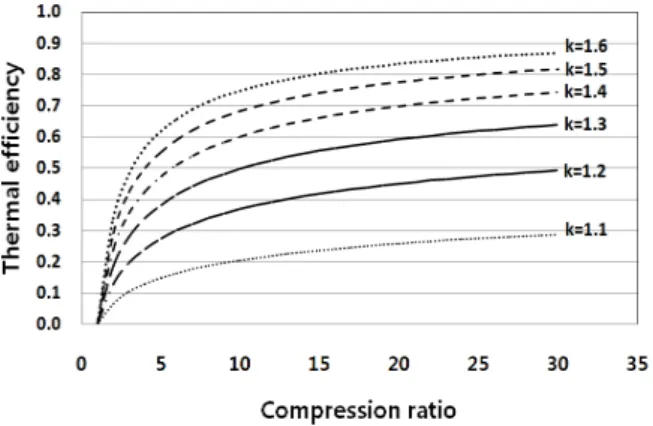
The efficiency of the Otto cycle depends on the specific heat ratio and on the compression ratio. A plot of efficiency over the same range of compression ra- tios found in ideal engines is shown in Fig. 1. The value of the thermal efficiency of the Otto cycle de- pends on the compression ratio and not the temper- ature in the cycle. To make a comparison with a re- al engine, only the compression ratio needs to be specified. And we need to select the bigger ratio of specific heats to increase the thermal efficiency.
4. Thermodynamic properties for mixtures
When a chemical reaction occurs, the bonds with- in molecules of the reactants are broken, and atoms and electrons rearrange to form products. In com- bustion reactions, rapid oxidation of combustible ele- ments of the fuel results in energy release as com- bustion products are formed.
The balanced chemical reaction equation is
×
where is excess air factor, (1 + ) = , and
is relative air/fuel ratio.
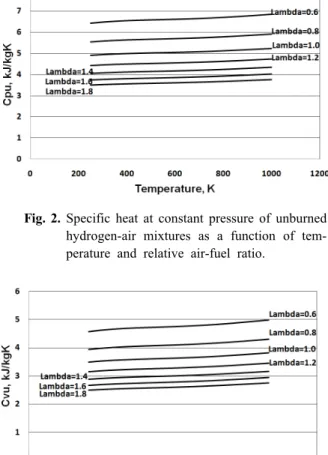
In the following expression for the unburned spe- cific heat at constant pressure is
where
= mole fraction of component i
= specific heat at constant pressure of compo- nent i
The specific heat ratio is estimated using NASA interpolations of specific heats at constant pressure.
The interpolating polynomials are given on a form
The specific heat ratio of unburned hydrogen-air mixture can then be calculated [8-11].
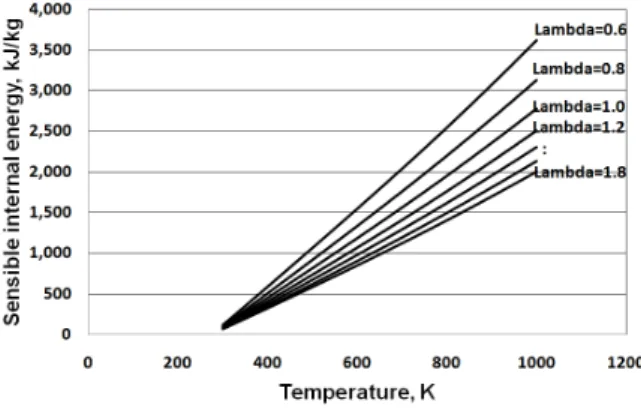
The unburned specific heat at constant volume is
![Table 1. Thermodynamic properties of gaseous hydrogen versus dry air at 0℃ and 1 atm [1].](https://thumb-ap.123doks.com/thumbv2/123dokinfo/5595902.488029/2.892.97.797.793.1089/table-thermodynamic-properties-gaseous-hydrogen-versus-dry-air.webp)