냉장고 내 온도와 상대습도가 포장 한우 등심의 품질 및 저장 특성에 미치는 영향
설국환1*ㆍ김기현1ㆍ김영화1ㆍ염경은2ㆍ이무하3
1농촌진흥청 국립축산과학원, 2서울대학교 식품동물생명공학부, 3알시대학교
Effect of temperature and relative humidity in refrigerator on quality traits and storage characteristics of Pre-packed Hanwoo loin
Kuk-Hwan Seol1*, Ki Hyun Kim1, Young Hwa Kim1, Kyung Eun Youm2, Mooha Lee3
1National Institute of Animal Science, Rural Development Administration, Suwon 441-706, Korea
2Department of Animal and Food Biotechnology, Seoul National University, Seoul 151-921, Republic of Korea
3School of Agriculture, Arsi University, Asella, Ethiopia
Received on 31 July 2014, revised on 3 November 2014, accepted on 4 November 2014
Abstract : This study was carried out to determine the effect of storage condition, such as temperature or relative humidity (RH) in home-style refrigerator, on the change of quality traits and storage characteristics of Hanwoo M. longissimus to find out the condition for prolongation of shelf-life with maintaining the meat quality for consumers. Samples were sliced in 1±0.2 cm thickness, and packed in foamed polystyrene tray with linear low-density polyethylene (LLD-PE) film to simulate the pre-packed Hanwoo loin sold in retail market, then stored in home-style refrigerator (5℃/17% RH, Control), and chambers of 5℃/55% RH (T1), 5℃/85% RH (T2), and –1℃/99% RH (T3), respectively. Quality traits (color, pH, water holding capacity, shear force and grilling loss) and storage characteristics (thiobarbituric acid reactive substances, volatile basic nitrogen and total microbes) were measured at 1, 4, 7, 14 and 21 days after storage. Lightness of Hanwoo loin stored in T1, T2 and T3 were higher than that of control until 14 days of storage, however at the end of storage (21 days) control showed significantly higher than other treatments (p<0.05). Redness and Yellowness of Hanwoo loin samples stored in T1 and T3 were significantly higher than others during all storage period (p<0.05). The water holding capacity (WHC) of control was significantly higher than others until 14 days of storage (p<0.05), however, Hanwoo loin stored in T2 was the highest (63.64±7.62 kg/cm2) at 21 days of storage. Hanwoo loin stored in T1 showed significantly lower shear force than others during all storage period (p<0.05). There was no consistent tendency in pH and grilling loss during storage in all treatments. Hanwoo loin stored in T1 showed lower TBARS value than others during storage period, however there was a rapid increase to 0.34±0.27 mg malonaldehyde/kg meat at 21 days of storage. And, all the treated samples (from T1 to T3) showed significantly lower VBN values at 21 days of storage (p<0.05). The population of total aerobic microbes were significantly increased in all treatments as storage period increasing, and the population of T3 (2.28±0.57 logCFU/g) was the lowest at 21 days of storage (p<0.05). From those results, it could be predicted the better storage condition to maintain the meat quality and prolong the shelf-life of Hanwoo loin by lowering the temperature and adjusting the humidity about 55%.
Key words : Hanwoo loin, Storage condition, Quality traits, Storage characteristics
*Corresponding author: Tel: +82-41-580-3444 E-mail address: [email protected]
I. 서 론
한우는 우리나라에서 기원전 200여년부터 농경용과 물 자운반용으로 사육되어온 인도원우(Bos Indicus)와 유럽
원우(Bos Primigenius)의 교잡종으로, 북쪽 만주지역을 통해 이동하여 동종번식에 의해 우리나라에 토착화된 품종 이다. 1980년대부터 한우는 역용의 목적보다는 비육으로 사육의 목적이 변경되면서 현재는 국내 비육산업의 주품종 으로 자리 잡고 있다. 소득의 증대와 식생활의 서구화로 인하여 증가하던 쇠고기 소비량은 최근 소비자들의 건강에
대한 관심 증가와 경기침체로 인하여 소비가 정체되어 있 으며, 국제 곡물가격 인상에 따른 사료비 증가와 축산선진 국인 영연방 국가들과의 FTA 타결 또한 앞두고 있어 한우 산업은 사면초가의 어려운 실정이다.
기존 국내의 한우육 관련 연구는 한우육의 품질 구명 (Kim et al., 2000; Kim and Lee, 2003; Moon et al., 2006; Rhee and Kim, 2001; Park et al., 2002)과 수입육 에 대비하여 한우육의 육질 및 상강도 등이 우수하며 맛 성분 함량이 높다는(Hwangbo et al., 2001; Kim et al., 2000; Kim et al., 2000; Park et al., 1994; Yang et al., 2007; Lee et al., 2009) 연구들이 주를 이루었다. 그러나 생산된 우수한 한우육의 품질을 소비자가 섭취할 때 까지 유지시키는 것 또한 고품질 한우육의 생산 못지않게 중요 하다고 할 수 있다. 식육의 저장기간을 연장하기 위한 방법 으로는 온도의 조절, 포장방법의 선정, 보존료 처리 등이 있으며, 저장 중 식육의 품질은 이화학적, 미생물학적, 관 능적 변화 등에 의해 좌우된다. 소비자들은 냉장고의 낮은 상대습도로 인한 식육의 표면 건조와 미생물 증식에 의한 부패 등의 저장한계로 인하여 구입한 포장육의 저장성을 증진시키기 위한 방법으로 동결처리를 가장 널리 이용되고 있다. 그러나, 이는 해동 과정에서 근섬유의 파괴와 육즙의 손실, 식육 단백질의 변성 등을 초래하여 식육의 품질을 저 하시키는 것으로 알려져 있다(Winger and Fennema, 1976;
Yamamoto and Samejima, 1977; Miller et al., 1980).
Joo 등(2002)은 현재 국내에서 시행되고 있는 한우육의 저 장이 습도가 조절되지 않아 매우 건조한 상태인 4℃ 일반 공기순환냉장고에서 이루어지고 있기 때문에 많은 건조감 량이 발생하며, 이러한 일반 냉장고를 식육소매점에서도 많이 사용하고 있기 때문에 잦은 개폐로 인하여 온도 유지 가 어려워 식육의 숙성에 있어 육즙감량을 피할 수 없다고 보고하였다. 따라서 소비자들이 한우육의 품질 저하 없이 비동결상태로 저장할 수 있는 기간을 연장시킬 수 있는 방 법에 대한 연구가 필요한 실정이다.
본 연구는 소비자들이 가정에서 포장된 한우육을 보다 오래 저장할 수 있는 저장고 내 조건을 제시하기 위한 기초 연구로서 한우 등심을 온도와 습도가 조절된 조건 하에 저 장하며 저장기간에 따른 품질 및 저장성의 변화를 비교하 기 위하여 수행하였다.
II. 재료 및 방법
1. 공시재료
강원도 원주소재 축산물 종합처리장에서 도축 후 등급판 정을 마친 1등급 한우의 배최장근(M. Longissimus)을 분 할하여 실험실로 운반한 후, 약 1±0.2 cm 두께로 절단하여 시중의 식육매장에서 사용되는 발포 폴리스티렌 접시(foamed polystyrene tray)에 담아 식품포장용 저밀도 폴리에틸렌 랩(LLD-PE wrap)으로 함기포장 하였다. 포장된 한우 등 심은 5±1℃/상대습도 55%(T1, 중간습도), 5±1℃/상대습 도 85%(T2, 높은 습도), -1±1℃/상대습도 99%(T3, 포화 상대습도)로 온도와 습도를 조절한 항온항습기에 저장하였 고, 대조구는 일반 가정용 냉장고의 조건으로 5±1℃/상대 습도 17%인 냉장고(R-B141GD, LG electronics, Korea) 에 저장하였다. 저장된 시료는 도축 후 1일, 4일, 7일, 14 일, 21일에 육질, 관능 및 지방산 조성 분석을 수행하였다.
2. 품질 분석
1) 육색(Color)
육색의 측정은 colorimeter (Model CR-210, Minolta Co. LTD., Japan)를 사용하여 각 시료의 측정표면을 달리 하여 시료 당 3반복으로 CIE (L*, a*, b*)값을 측정하였다.
이때 표준 백색판(Calibration plate)의 측정값은 L*=97.69, a*=-0.43, 그리고 b*=+1.98 이었다.
2) pH
시료의 pH는 시료 5 g에 증류수 20 ㎖을 가하여 Ultra- turrax (Janken & kunkel, Model No. T25, West Germany) 를 이용하여 8,000 rpm에서 1분 동안 균질한 후, 유리전극 pH Meter (Origin, Model 710A, USA)로 시료 당 3회 측정 하였다.
3) 보수력(WHC, water holding capacity) 시료의 보수력 측정은 Grau와 Hamm(1953)의 filter paper press 법을 변형하여 수행하였다. Desiccator에 보관한 whatman No.
1 여과지 위에 시료 200 mg을 정량한 후, plexiglass plate 중앙 에 여과지를 놓고 그 위에 나머지 plexiglass plate 1개를 포개 어 2분 동안 일정한 압력으로 압착하였다. 그 후 여과지에 묻어
나온 육조직의 면적과 빠져나온 수분에 젖은 총면적을 각각 compensating polar planimeter (Planix EX, TAMIYA, Japan) 로 측정하여 계산하였다.
보수력 (%) = 육조직 면적 / 수분 총 면적 × 100
4) 전단력(Shear force value)
시료의 전단력은 전기그릴(Tefal, Model Ry type 1550 series 4, USA)에서 시료의 심부 온도가 75℃가 될 때까지 가열하고 30분간 방냉한 후 근섬유와 평행한 방향으로 시 료를 절단하여(∅ 10 mm) blade set (Warner Bratzler blade)가 장착된 Texture Analyser (TA-XT2i, Stable Micro systems, UK)를 이용하여 측정하였다.
5) 가열감량(Grilling loss)
저장기간에 따라 처리구별 시료를 채취하여 가열감량을 측정하였다. 가열 전 시료의 중량을 측정하여 전기그릴 (TEFAL, Model Ry type 1550 series 4, USA)을 이용하여 시료의 심부온도가 75℃에 도달할 때까지 가열하고, 상온 에서 30분간 방랭한 후 중량을 측정하였다. 가열 전 중량과 가열 후 중량 차이로 가열감량을 계산하였다.
Grilling loss (%) = [(가열 전 무게 – 가열 후 무게) / 가열 전 무게] × 100
6) 지방산패도(TBARS, thiobarbituric acid reacting substance)
저장기간에 따른 시료의 지방산패도는 Witte 등(1970) 의 방법을 이용하여 시료 당 2회씩 반복하여 측정하였다.
시료 10 g에 0.3% BHA 50 ㎕를 가한 후 extracting solution [20% TCA (trichloroacetic acid) in 2M phosphoric acid solution] 25 ml과 함께 균질하고, 증류수를 이용하여 50 ml로 mass up 하였다. 이 추출액을 whatman No.1 여과지 를 이용하여 여과한 후 0.02 M TBA 용액과 1:1로 혼합하여 암실에서 15시간동안 반응시켰다. 반응 후 발색된 용액을 spectrophotometer (TU-1800, Human Co. LTD., Kore a)를 이용하여 531 nm에서 측정된 흡광도를 이용하여 TBA RS값을 계산하였다. TBARS수치는 mg malonaldehyde/kg 으로 나타내었다.
7) 단백질변패도(VBN, volatile basic nitrogen) 저장기간에 따른 각 시료의 단백질변패도 측정은 conway
미량 확산법(高坂和久, 1975)을 이용하여 측정하였다. 시 료 5 g과 증류수 45 ㎖을 균질화한 후 whatman No.1 여과 지를 이용하여 여과하였다. 여과된 추출액 1 ml을 conway 미량확산용기의 외실에 넣고, 0.01N H3BO3 1 ml과 conway reagent (Methyl red : Bromocresol green = 1 : 1) 50 μl를 내실에 넣은 후 외실에 K2CO3 포화용액 1 ml을 가하여 용기의 뚜껑을 닫은 후 37℃에서 120분간 반응시켰다. 반 응 후 0.02N H2SO4을 이용하여 내실의 붕산용액에 적정하 고 다음의 공식으로 VBN 수치를 계산하였다.
VBN (mg%) = [(a – b) × f × 0.02 × 14.007] / S × 100 × 100
(a, 본시험 적정치 ㎖; b, 공시험 적정치 ㎖; f, 0.02N H2SO4 표준화 지수; S, 시료 중량)
8) 총 호기성 미생물 수(Total aerobic microbes) 저장기간에 따른 시료의 총 미생물 수는 A.O.A.C의 Standard plate counts 방법을 일부 변형하여 실시하였다.
시료 5 g을 45 ml의 1% 멸균 peptone (Difco Labratories, USA) 용액에 넣어 Bag Mixer (Interscience, France)를 이용하여 균질한 후 적정 배율로 희석하였다. 시료 중 총 호기성 미생물 수는 pouring method법을 이용하였으며, 희석액 1 ml과 plate count agar (Difco Laboratories, USA)를 petri dish에 혼합한 후 37℃ incubator (HK-IBO 25, 한국종합기기, Korea)에서 48시간 동안 배양하여 성장 한 집락의 수를 계수하여 측정하였다.
3. 통계분석
모든 실험 결과는 SAS 프로그램(9.1, 2012)의 일반선형 회귀모형(general linear model, GLM)을 이용하여 분산 분석을 수행하였고, 평균간 유의성은 Duncan의 다중검정 (multiple range test)을 이용하여 분석하였다.
III. 결과 및 고찰
1. 육색(Meat color)
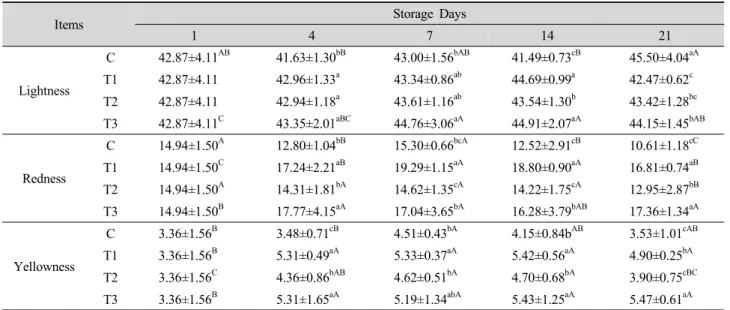
육색은 소비자가 구매의사를 결정짓는 가장 중요한 외관 적 특징으로(Maher et al., 2005), 한우 등심의 저장기간 과 조건에 따른 육색의 변화는 Table 1에 나타내었다. 저장
Table 1. Changes in color of Hanwoo M. longissimus stored under different storage conditions.
Items Storage Days
1 4 7 14 21
Lightness
C 42.87±4.11AB 41.63±1.30bB 43.00±1.56bAB 41.49±0.73cB 45.50±4.04aA T1 42.87±4.11 42.96±1.33a 43.34±0.86ab 44.69±0.99a 42.47±0.62c T2 42.87±4.11 42.94±1.18a 43.61±1.16ab 43.54±1.30b 43.42±1.28bc T3 42.87±4.11C 43.35±2.01aBC 44.76±3.06aA 44.91±2.07aA 44.15±1.45bAB
Redness
C 14.94±1.50A 12.80±1.04bB 15.30±0.66bcA 12.52±2.91cB 10.61±1.18cC T1 14.94±1.50C 17.24±2.21aB 19.29±1.15aA 18.80±0.90aA 16.81±0.74aB T2 14.94±1.50A 14.31±1.81bA 14.62±1.35cA 14.22±1.75cA 12.95±2.87bB T3 14.94±1.50B 17.77±4.15aA 17.04±3.65bA 16.28±3.79bAB 17.36±1.34aA
Yellowness
C 3.36±1.56B 3.48±0.71cB 4.51±0.43bA 4.15±0.84bAB 3.53±1.01cAB T1 3.36±1.56B 5.31±0.49aA 5.33±0.37aA 5.42±0.56aA 4.90±0.25bA T2 3.36±1.56C 4.36±0.86bAB 4.62±0.51bA 4.70±0.68bA 3.90±0.75cBC T3 3.36±1.56B 5.31±1.65aA 5.19±1.34abA 5.43±1.25aA 5.47±0.61aA
a-c Means±SD with different superscripts in the same column significantly differ at 5% level.
A-C Means±SD with different superscripts in the same row significantly differ at 5% level.
Con, 5℃/17%RH; T1, 5℃/55%RH; T2, 5℃/85%RH; T3, -1℃/99%RH.
Table 2. Changes in pH of Hanwoo M. longissimus stored under different storage conditions.
Items Storage Days
1 4 7 14 21
C 5.65±0.16A 5.44±0.04cB 5.47±0.08cB 5.64±0.01abA 5.62±0.02bA
T1 5.65±0.16AB 5.57±0.01bAB 5.61±0.02aAB 5.53±0.02cB 5.70±0.16bA
T2 5.65±0.16BC 5.56±0.03bC 5.56±0.02bC 5.71±0.07aB 6.19±0.19aA
T3 5.65±0.16A 5.61±0.04aAB 5.60±0.07abAB 5.58±0.09bcB 5.62±0.07bAB
a-c Means±SD with different superscripts in the same column significantly differ at 5% level.
A-C Means±SD with different superscripts in the same row significantly differ at 5% level.
Con, 5℃/17%RH; T1, 5℃/55%RH; T2, 5℃/85%RH; T3, -1℃/99%RH.
기간에 따른 한우 등심의 명도는 T1과 T2에서는 저장기간 이 증가함에 따라 유의적인 차이는 없었으나, T3에서 저장 4일째에 43.35±2.01을 보이며 7일까지 명도가 점차 증가 함을 나타내었다. 저장조건별로는 저장 21일째에 대조구 (C)에서 45.50±4.04의 수치를 나타내며 명도가 저장 초기 에 비하여 증가하였으나(p<0.05), 5℃에서 저장한 처리구 (T1과 T2)에서는 비슷한 수준으로 감소한 것으로 나타났 다. 한편 T1과 T3의 적색도는 저장 21일에 1일차 (14.94±1.50)보다 높아져 각각 16.81±0.74와 17.36±1.34 의 수치를 나타낸 반면, 대조구와 T2의 수치는 저장 1일째 보다 유의적으로 감소하여 각각 10.61±1.18와 12.95±2.87 의 수치를 나타내었다(p<0.05). 이는 저장기간이 경과할 수록 육색의 변화에 있어 metmyoglobin 형성율이 증가하 기 때문에 명도와 적색도가 감소하여 육색이 퇴색된다는
Ledward와 Macfarlane(1971)의 보고와 유사한 결과를 보 였다. 황색도의 경우 적색도와 마찬가지로 저장기간 동안 T1과 T3 처리구에서 다른 처리구에 비하여 유의적으로 높 게 나타났다(p<0.05). 이러한 육색의 변화는 식육의 저장 시 온도 뿐만 아니라 상대습도 또한 식육의 품질에 영향을 미치는 중요한 요인이 됨을 의미한다.
2. 수소이온농도(pH)
Table 2는 저장기간과 조건에 따른 포장 한우 등심의 pH 변화를 나타낸 것이다. 포장된 한우 등심의 pH는 저장 1일 차 5.65±0.16에서 저장 7일까지 모든 처리구에서 다소 감 소하다가 그 이후 서서히 증가하는 경향을 보였으며, 이는 우육을 11일간 저장하였을 때 저장 초기 pH값 5.5에서 점
Table 3. Changes in WHC (water holding capacity) of Hanwoo M. longissimus stored under different storage conditions
Items Storage Days
1 4 7 14 21
C 52.64±7.70B 57.36±9.22aAB 58.91±2.99aAB 59.96±2.48aAB 61.50±2.73abA
T1 52.64±7.70 50.08±5.23b 50.73±2.21b 54.02±4.26b 56.44±5.20b
T2 52.64±7.70B 48.74±4.57bB 47.98±6.23bB 47.57±4.58cB 63.64±7.62aA
T3 52.64±7.70A 48.13±8.64bB 47.77±5.39bB 46.36±4.18cB 45.03±5.66cB
a-c Means±SD with different superscripts in the same column significantly differ at 5% level.
A-C Means±SD with different superscripts in the same row significantly differ at 5% level.
Con, 5℃/17%RH; T1, 5℃/55%RH; T2, 5℃/85%RH; T3, -1℃/99%RH.
차 상승하였다는 Kim(1994)의 보고와 일치하였다. T2는 저장기간과 처리구별 pH에서 모두 유의적인 차이를 나타 내었는데, 저장 14일부터 21일까지 pH가 유의적으로 증가 하였으며 최종 pH는 6.19±0.19였다(p<0.05). 그러나 본 연구에서 pH의 변화는 일관된 경향을 보이지 않았으며, 이 는 저장 온도와 상대습도가 한우 등심의 pH 변화에 직접적 인 영향을 미치지 않았기 때문으로 사료된다.
도축 후 식육은 근육 내의 glycogen이나 ATP가 해당작 용에 의해 고갈될 때까지 젖산이 생성되어 pH가 저하되나, 저장기간이 증가함에 따라 단백질의 분해로 인하여 염기태 물질이 생성되어 pH가 다시 상승하게 되는데, pH의 저하 와 상승의 속도는 저장조건에 따라 달라지게 된다(Bendall, 1978). 식육의 pH는 육색에 영향을 미치며(Guignot et al., 1994), 또한 연도와 보수력, 조직감에도 영향을 미친다 (Dutson, 1983). 도축 후의 높은 pH는 세균이 증식하는데 용이하고, 연도를 증가시키나 풍미를 감소시킨다는 보고가 있었으며(Watanabe et al., 1996), pH가 저하되면 보수성 이 감소한다는 보고도 있다(Bouton et al., 1983). 한편, Briskey(1964)는 pH값이 높으면 일반적으로 암갈색(dark color)을 나타낸다고 보고하였다.
3. 보수력(WHC, water holding capacity)
저장기간과 조건에 따른 포장 한우 등심의 보수력의 변 화는 Table 3에 나타낸 바와 같다. 본 실험에서 사용한 한 우 등심육의 저장 1일차 보수력은 52.64±7.70%로 나타났 다. 대조구는 저장기간이 경과함에 따라 보수력이 증가하 였으며, T1과 T2도 저장 21일차에는 증가하는 결과를 보였 다. 특히 T2는 저장 14일과 21일째에서 각각 47.57±4.58%
및 63.64±7.62%로 나타나 저장 후기에 급격한 보수력의
증가를 보였고, T3는 유의적인 차이는 보이지 않았으나 저 장 4일째부터 보수력이 점차 감소하여 마지막 21일에는 45.03±5.66%를 나타내어 보수력이 가장 낮은 것으로 나타 났다(p<0.05). 이러한 결과는 식육의 pH가 높을수록 보수 력도 높아진다는 Hamm(1982)의 보고와 일치하였다. 처리 구별로는 저장 4일과 7일에 대조구와 처리구 간의 확연한 유의차가 나타났는데 T1, T2, T3의 보수력은 모두 감소하 는 반면 대조구는 증가하였고, 저장 14일째에 T3와 비슷한 수치를 보였던 T2는 21일째에 유의적인 차이를 보이며 급 격히 증가하여 대조구의 최종 보수력 수치보다도 높은 값 을 나타내었다(p<0.05).
4. 전단력(Shear force)
저장기간과 조건에 따른 포장 한우 등심의 전단력의 변 화는 Table 4에 나타내었다. 저장 1일차에 한우 등심의 전 단력 수치는 5.04±1.53 kg/cm2이었는데, 대조구와 T1은 저장 14일에 각각 3.64±0.83 kg/cm2과 3.18±0.45 kg/cm2 로 감소하였으며, T2는 저장 21일에 2.97±0.36 kg/cm2의 수치를 보이며 유의적으로 낮아졌으나(p<0.05), T3에서 는 저장기간에 따른 유의적 차이는 보이지 않았다(p>0.05).
한편 T3는 저장 4일째에 3.99±1.43 kg/cm2의 수치를 나타 내며 대조구와 모든 처리구와 비교하여 가장 낮은 수치를 나타내었으나, 저장 21일에는 4.65±1.18 kg/cm2로 다른 처리구와 비교하여 유의적으로 높은 수치를 나타내었다(p
<0.05). Huff와 Farrish(1993)는 저장기간이 경과할수록 전단력이 감소한다고 보고하였고, Weatherly 등(1998)은 strip loin과 short loin의 적정 저장기간이 13일이라고 보 고하였으며, Shackelford 등(1999)은 사후 24시간에서 14 일까지는 전단력가가 감소한다고 보고하여 본 연구결과와
Table 4. Changes in shear force values of Hanwoo M. longissimus stored under different storage conditions.
Items Storage Days
1 4 7 14 21
C 5.04±1.53A 4.58±0.94abAB 5.06±1.02abA 3.64±0.83bB 3.92±0.75bAB
T1 5.04±1.53A 4.06±0.63bAB 4.22±0.59bA 3.18±0.45bBC 2.93±0.52cC
T2 5.04±1.53A 5.48±2.26aA 5.56±1.73aA 4.87±0.95aA 2.97±0.36cB
T3 5.04±1.53AB 3.99±1.43bC 5.18±1.53abA 4.42±1.20aBC 4.65±1.18aABC
a-c Means±SD with different superscripts in the same column significantly differ at 5% level.
A-C Means±SD with different superscripts in the same row significantly differ at 5% level.
Con, 5℃/17%RH; T1, 5℃/55%RH; T2, 5℃/85%RH; T3, -1℃/99%RH.
Table 5. Changes in grilling loss of Hanwoo M. longissimus dorsi stored under different storage conditions.
Items Storage Days
1 4 7 14 21
C 25.20±3.47 24.87±4.24 29.97±3.35a 24.72±3.46 30.00±6.66
T1 25.20±3.47 24.51±2.00 28.96±7.46ab 27.57±3.26 26.56±3.83
T2 25.20±3.47 26.16±3.63 24.45±3.52b 25.97±6.54 27.07±2.65
T3 25.20±3.47B 29.87±5.64A 26.23±2.87abB 29.43±4.18A 32.15±5.28A
a-c Means±SD with different superscripts in the same column significantly differ at 5% level.
A-C Means±SD with different superscripts in the same row significantly differ at 5% level.
Con, 5℃/17%RH; T1, 5℃/55%RH; T2, 5℃/85%RH; T3, -1℃/99%RH.
일치하였다. Grouber 등(2006)은 쇠고기 등심을 2℃에서 28일간 숙성하였을 때 연도가 유의적으로 향상되었다고 보 고하였으나, 본 연구의 –1℃에서 저장한 T3 처리구에서는 동일한 효과가 발견되지 않았으며, 이는 식육을 과냉각온 도에 저장했을 시 연화효소의 활성저하에 따른 근섬유의 소편화가 지연되었기 때문으로 사료된다.
5. 가열감량(Grilling loss)
저장기간과 조건에 따른 포장 한우 등심의 가열감량 변 화는 Table 5에 나타낸 바와 같다. 본 연구에서 저장기간에 따른 가열감량은 T3를 제외한 대조구와 처리구에서 유의적 인 차이를 보이지 않았다(p>0.05). 그러나, T3에서는 저 장 7일에 26.23±2.87%로 감량이 다소 감소하는 경향을 보 이다가 저장 21일까지 지속적으로 증가하여 32.15±5.28%
의 감량을 보였다. 포장 한우 등심의 저장조건에 따른 유의 적인 차이는 저장 7일째에 나타났는데, 대조구와 T2 사이 에서 각각 29.97±3.35% 및 24.45±3.52%의 유의적인 감 량의 차이를 보였다(p<0.05). 이러한 결과는 Boaky와 Mittal(1993)의 소 등심을 16일간 저장한 실험에서 저장기 간이 길어질수록 가열감량이 유의적으로 증가하였다는 결
과와 차이가 있었다. 저장 21일차에 유의적인 차이는 나타 나지 않았으나 대조구에 비교하여 T1과 T2의 가열감량이 낮게 나타나 보수력과 유사한 결과를 보였으며(p>0.05), 이는 저장실 내의 상대습도가 55%와 85%로 대조구의 17%
에 비하여 높아 식육 표면의 건조에 의한 수분의 손실을 방지하였기 때문으로 사료된다.
6. 지방산패도(TBARS, thiobarbituric acid reacting substance)
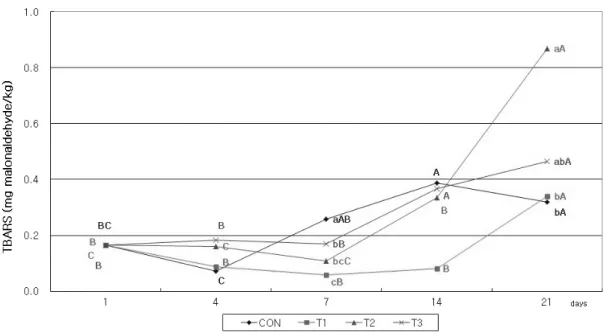
저장기간과 조건에 따른 한우 등심의 지방산패도 변화는 Fig. 1에 나타내었다. 저장기간이 증가함에 따라 모든 처리 구에서 지방산패도가 증가하는 경향을 보였으며, 저장 14 일과 21일에 대조구에 비하여 T1과 T2에서 지방산패도가 유의적으로 낮게 나타났다(p<0.05). Witte 등(1970)은 소 고기에서 저장 기간이 증가함에 따라 TBARS 수치가 상승 한다고 보고하였고, Demeyer 등(1974)은 저장기간 중에 식육의 지방은 지방분해효소에 의한 가수분해적 변화와 미 생물 대사에 의한 산화적 변화가 진행되면서 cabonyl complex, alcohol, ketone, aldehyde 등의 부산물로 변화된다고 보 고하였다. 또한 Kanner(1994)의 보고에 의하면 식육의 지
Fig. 1. Changes in TBARS values of Hanwoo M. longissimus stored under different storage conditions. Con, 5℃/17%RH; T1, 5℃
/55%RH; T2, 5℃/85%RH; T3, -1℃/99%RH.
방산화는 식육의 향과 연도, 영양학적 가치와 육색을 저하 시킨다고 하였으며, 지방의 산화가 활성된 metmyoglobin 에 의해 유도된다는 보고도 있다(Batifoulier et al., 2002). Yin과 Faustman(1993)은 지방의 산화에 의해서 야기된 myoglobin의 산화율이 식육의 변색도와 밀접한 상 관관계가 있다고 보고하였다. TBARS값이 0.20 mgMA/kg 이하에서는 식육이 비교적 신선한 상태로 평가한다는 보고 가 있었고(Brewer, 1992), Turner 등(1954)은 TBARS값이 0.46 mgMA/kg이하까지 가식권이며 1.2 mgMA/kg이상은 산패된 것이라고 보고하였다. 본 실험에서 저장 14일까지 의 대조구와 모든 처리구가 가식범위 안에 속하여 있는 것 으로 나타났으나, 저장 21일에 대조구의 TBARS 값이 0.87±0.37 mgMA/kg의 수치를 나타내어 지방의 산패가 진행된 것으로 나타났으며, T1과 T2는 저장 21일에도 가식 범위를 초과하지 않아 식육 중 지방분해효소의 활성이 온도 뿐만 아니라 상대습도에도 영향을 받는 것으로 사료된다.
7. 단백질변패도(VBN, volatile basic nitrogen)
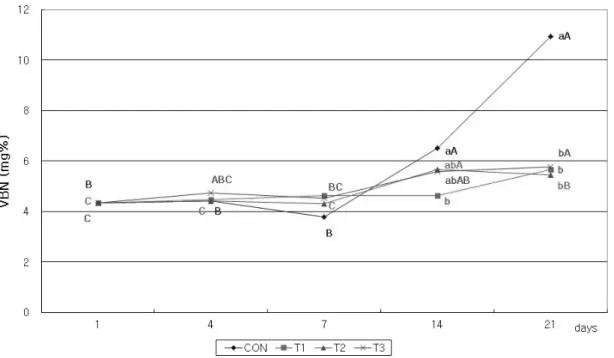
저장기간과 조건에 따른 한우 등심의 단백질변패도는 Fig. 2에 나타낸 바와 같다. 모든 처리구에서 저장기간이 증가함에 따라 휘발성 염기태 질소(VBN)의 함량도 증가하 는 경향을 보였으나 저장 21일에도 신선육의 기준치로 보 고된 20 mg%(高坂, 1975)를 초과하지 않았다. 저장기간
중 대조구의 VBN값은 저장 14일과 21일에 6.51±0.98과 10.93±2.50 mg%으로 처리구들에 비해 유의적으로 높은 함량을 보였다(p<0.05). 단백질의 변패는 미생물의 증식 과 관련이 있으며 대조구가 저장기간 중 14일과 21일에 가 장 높은 미생물수를 보인 결과와 일치하였다. 高坂(1975) 은 육류의 변패가 진행됨에 따라 육단백질은 아미노산과 암모니아태 질소로 분해된다고 보고하였고, Byun 등 (1985)은 육류의 저장기간이 증가함에 따라 휘발성 염기태 질소의 함량이 증가한다고 보고하여 본 실험의 결과와 일치 하였다.
8. 총 호기성 미생물 수(Total microbes)
저장기간 동안 저장고 내 온도와 상대습도를 다르게 하 였을 때 대조구 및 처리구의 총 호기성 미생물 수 변화는 Fig. 3에 나타내었다. 모든 처리구에서 저장기간이 증가함 에 따라 미생물 수도 증가하는 경향을 보였으며, 특히 대조 구는 저장기간이 경과함에 따라 다른 처리구들과 유의적인 차이를 보이며 급격히 증가하여 저장 21일에는 가장 높은 수치인 6.17±0.13 logCFU/g을 나타내었다(p<0.05). 그 러나 T3는 저장 21일에 2.28±0.57 logCFU/g로 저장 1일 차(1.59±0.81 logCFU/g)에 비하여 소폭 증가하여 대조구 및 다른 처리구에 비하여 미생물의 생육이 억제된 것으로 나타났으며, T1과 T2에서도 저장 21일에 4.34±0.14와
Fig. 2. Changes in VBN values of Hanwoo M. longissimus stored under different storage conditions. Con, 5℃/17%RH; T1, 5℃/55%RH;
T2, 5℃/85%RH; T3, -1℃/99%RH
Fig. 3. Changes in the number of total aerobic microbes of Hanwoo M. longissimus stored under different storage conditions. Con, 5℃/17%RH; T1, 5℃/55%RH; T2, 5℃/85%RH; T3, -1℃/99%RH
4.15±0.73 logCFU/g으로 대조구에 비하여 유의적으로 낮 은 미생물수를 보였다(p<0.05). 이러한 결과는 식육에서 미생물의 성장이 저장고의 온도뿐만 아니라 상대습도에도 영향을 받기 때문인 것으로 사료된다. 식육에서 미생물은 부패의 원인으로 품질향상을 위해서는 저장기간 중에 미생
물의 수를 충분히 억제시켜야 한다. Ayres(1960)와 Gill(1982) 은 육류의 부패수준을 107~108 CFU/cm2라고 보고하였는 데, 저장 21일에 모든 처리구에서 총 미생물수가 102~104 CFU/cm2로 분석되어 미생물학적으로 보았을 때 대조구보 다 안전한 상태임을 알 수 있다.
IV. 적 요
본 연구에서는 포장 한우 등심의 저장 시 각각 다른 저장 고 내 온도와 상대습도가 저장 기간별 이화학적 품질과 저 장성에 미치는 영향을 살펴보았다. 한우 등심의 냉장저장 시 저장온도와 상대습도는 육색을 포함한 식육의 품질특성 에 영향을 미치며, 식육의 지방산패와 미생물 증식속도에 도 영향을 미치는 것으로 나타났다. 본 연구의 결과 포장된 한우육의 저장 시 온도를 낮추며 상대습도를 55% 수준으로 유지하는 것이 품질을 유지하면서 저장기간을 연장하는데 도움이 되는 것으로 사료되며, 추후 온․습도 뿐 만 아니라 저장고 내의 여러 조건들의 조절을 통하여 소비자가 고품 질의 한우육을 장기간 보관하며 섭취할 수 있는 방안을 제 시하는 것이 향후 한우 소비의 증진을 위해 필요할 것으로 사료된다.
감사의 글
본 논문은 농촌진흥청 지원사업(세부과제명 : 축산물의 기능성 펩타이드 정량 및 동정기술 개발, 세부과제번호:
PJ00858501)의 지원에 의해 이루어진 것임.
참 고 문 헌
A.O.A.C. 2000. American Official Analytical Chemists. 16th ed, Association of Official Analytical Chemists, Washington DC.
Ayres, JC. 1960. Temperature relationships and some other characteristics of the microbial flora developing on refrigerated beef. Food Research 25:1-8.
Batifoulier, F, Mercier, Y, Gatellier, P, Renerre, M. 2002.
Influence of vitamin E on lipid and protein oxidation induced by H2O2-activated MetMb in microsomal membranes from turkey muscle. Meat Science 61:389-395.
Bendall, JR, Restall, DJ. 1983. The cooking of single myofibres, small myofibre bundles and muscle strips from beef M.
psoas and M. sternomandibularis muscles at varying heating rates and temperatures. Meat Science 8:93-117.
Boaky, K, Mittal, GS. 1993. Changes in pH and water holding properties of Longissimus dorsi muscle during beef ageing.
Meat Science 34:335-349.
Bouton, PE, Carrol, FD, Fisher, AL, Harris, PV. Shothose, WR.
1983. Influence of pH and fiber contraction state up on factors affecting the tenderness of bovine muscle. J. Food Science 38:404.
Brewer, MS, Harbers, CAZ. 1992. TBA values, sensory char-
acteristics, and volatiles in ground pork during long-term frozen storage : Effect of packaging. Journal of Food Science 57(3):558-563.
Briskey, EJ. 1964. Etiological status and associated in studies of pale, soft, exudative porcine musculature. Advances in Food Research 13:89-105.
Byun, MW, Kwon, JH, Cho, HO, Lee, MK, Kim, JG. 1985.
Physicochemical changes of gamma-irradiated chicken.
Korean Journal of Food Science and Technology 17:186-191.
Demeyer, D, Hoozee, J, Mesdom H. 1974. Specificity of lipolysis during dry sausage ripening. Journal of Food Science 39(2):293-296.
Dutson, TR. 1983. Relationship of pH and temperature to disruption of specific muscle proteins and activity of liposomal proteases. Jounal of Food Biochemistry 7:233-245.
Gill, CO. 1982. Microbial interaction with meats, in Meat Microbiology, (ed. MH. Brown). Applied Science, London.
225-264.
Grau, R. and Hamm, R. (1953) Eine einfache methode zur bestimmung der wasserbindung in muskel. Naturwissenschaften 40:29-30.
Grouber, SL, Tatum, JD, Scanga, JA, Chapman, PL, Smith, GC, and Belk, KE/ 2006. Effeects of postmortem aging and USDA quality grade on Warner-Blatzler shear force values of seventeen individual beef muscles. Journal of Animal Science 84:3387-3396.
Guignot, F, Tourraille, C, Ouali, A, Renerre, M, Monin, G.
1994. Relationships between post-mortem pH changes and some traits of sensory quality in veal. Meat Science 37:
315-325.
Huff, EJ. Jr. Farrish, FC. 1993. Bovine longissimus muscle tenderness as affected by postmortem ageing time, age and sex. Journal of Food Science 58:713-716.
Hwangbo, S, Rhim, TJ, Koh KC. 2001. Identification of species- specific components between Hanwoo and Aberdeen angus meat. Korean Journal of Animal Science 46:941-948.
Joo, ST, Lee, HK, Kang, GH, Shin, CW, Yang, HS, Moon, SS, Lee, JI, Kim, YH, Park, GB. 2002. Effects of submersion aging in chilled water on tenderness and microbial growth of vacuum-packed Hanwoo Meat. Korean Journal for Food Science of Animal Resources 22(3):228-233.
Kanner, J. 1994. Oxidative process in meat and meat products:
Quality implications. Meat Science 36:169-189.
Kim, BC, Joo, ST, Park, GB, Sung, SK, Lee, M, Lee, SK, Jung, MS, Choi, YI. 1998. Science of muscle foods pp.
71-91. Seonjin publishers.
Kim, CJ. 1994. Studies on the cold and frozen storage for the production of high quality meat of Korean Native Cattle I.
Effects of cold and frozen storage on the meat color, sarcomere length and tenderness in Korean Native Cattle.
Korean Journal for Food Science of Animal Resources 14:
151-154.
Kim, CJ. Lee, ES. 2003. Effects of quality grade on the chemical, physical and sensory characteristics of Hanwoo
(Korean native cattle) beef. Meat Science 63:397-405.
Kim, IS, Lee, SO, Byun, JS, Kang, SN, Min, JS, Lee, M. 2000.
Physicochemical, microbiological, and sensory characteristics of frozen loins of Hanwoo and importe. Korean Journal of Animal Science 42:117-124.
Kim, IS, Lee, SO, Lee, JM, Kim, JH, Kim, YG. 2000.
Physicochemical, microbiological, and sensory characteristics of chilled chuck rolls of Hanwoo. Korean Journal of Animal Science 42:109-116.
Kim, KH. Kim, YS. Lee, YK. Baik, MG. 2000. Postmortem muscle glycolysis and meat quality characteristics of intact male Korean native (Hanwoo) cattle. Meat Science 55:
47-52.
Ledward, DA, Macfarlane, JJ. 1971. Some observations on myoglobin and lipid oxidatin in frozen beef. Journal of Food Science 36:987-990.
Lee, JM, Kim, TW, Kim, JH, Cho, SH, Seong, PN, Jung, MO, Cho, YM, Park, BY, Kim, DH. 2009. Comparison of chemical, physical and sensory traits of Longissimus Lumborum Hanwoo Beef and Australian Wagyu Beef. Korean Journal for Food Science of Animal Resources 29:91-98.
Maher, SC, Mullen, AM, Buckley, DJ, Kerry, JP, Moloney, AP.
2005. The influence of biochemical differences on the variation in tenderness of M. longissimus dorsi of Belgian Blue steers managed homogenously pre and post-slaughter. Meat Science 69:215-224.
Miller, AJ, Ackerman, SA, Palumbo, SA. 1980. Effect of frozen storage on functionality of meat for processing. Journal of Food Science 45:1466-1471.
Moon, SS, Yang, HS, Park, GB, Joo, ST. 2006. The relationship of physiological maturity and marbling judged according to Korean grading system to meat quality traits of Hanwoo beef females. Meat Science 74:516-521.
Park, GB, Moon SS, Ko, YD, Ja, JK, Lee, JG, Chang, HH, Joo, ST. 2002. Influence of slaughter weight and sex on yield and quality grades of Hanwoo (Korean native cattle) carcasses.
Journal of Animal Science 80:129-136.
Rhee, MS, Kim, BC. 2001. Effect of low voltage clectrical stimulation and temperature conditioning on postmortem
changes in glycolysis and calpains activities of Korean native cattle (Hanwoo). Meat Science 58:231-237.
SAS/STAT. 2012. SAS user's guide. SAS Institute Inc., Cary, NC.
Shackelford, SD, Wheeler, TL, Koohmaraie, M. 1999. Tenderness classification of beef: Ⅱ. Design and analysis of a system to measure beef longissimus shear force under commercial processing conditions. Journal of Animal Science 77:
1474-1481.
Turner, E.W.; Paynter, W.D.; Montie, E.J.; Bessert, M.W.; Struck, G.M. and Olson, F.C. (1954): Use of the 2-Thiobarbituric acid reagent to measure rancidity in frozen pork. Food Technology 8:326-330.
Watanabe, A, Daly, CC, Devine, CE. 1996. The effects of the ultimate pH of meat on tenderness changes during aging.
Meat Science 42:67-78.
Weatherly, BH, Lorenzen, CL, Savell, JW. 1998. Determining optimal aging times for beef subprimals. Journal of Animal Science 76(Suppl. 1):598. (Abstract)
Winger, RJ, Fennema, O. 1976. Tenderness and water holding properties of beef muscle as influenced by freezing and subsequent storage at –3 or 15℃. Journal of Food Science 41:1433-1438.
Witte, VC, Krause, GF, Bailey, ME. 1970, A new extraction method for determining 2-thiobarbituric acid values of pork and beef during storage. Journal of Food Science 35:
582-585.
Yamamoto, K, Samejima, K. 1977. A comparative study of the change in hen pectoral muscle during storage at 4℃ and –20℃. Journal of Food Science 42:1642-1645.
Yang, SY, Lim, SD, Jeon, KH, Nam, KB, Kwon, SA, Park, JE.
2007. Comparison of vitamin A, E, and cholesterol contents and the sensory properties of chilled Hanwoo and Australian Beef . Korean Journal for Food Science of Animal Resources 27:262-266.
Yin, M. Faustman, C. 1993. a-Tocopherol and ascorbate delay oxymyoglobin and phospholipid oxidation in vitro. Journal of Food Science 58:1273-1276.
高坂和久. 1975. 肉製品の 鮮度保侍と測定. 食品工業 18:257.