DOI : http://dx.doi.org/10.5394/KINPR.2018.42.2.87
Design of a Sliding Mode Control-Based Trajectory Tracking Controller for Marine Vehicles
Zhi-Zun Xu*․Heon-Hui Kim**․Gyei-Kark Park***․†Taek-Kun Nam
*School of Marine Technology Newcastle University, Newcastle upon Tyne, United Kingdom
**Division of Marine Engineering, Mokpo Maritime University, Mokpo 530-729, Republic of Korea
***Division of International Maritime Transportation Science, Mokpo Maritime University, Mokpo 530-729, Republic of Korea
†Division of Marine Engineering, Mokpo Maritime University, Mokpo 530-729, Republic of Korea
Abstract : A trajectory control system plays an important role in controlling motions of marine vehicle when a series of way points or a path is given. In this paper, a sliding mode control (SMC)-based trajectory tracking controller for marine vehicles is presented. A small-sized unmanned ship is considered as a control object. Both speed and heading angle of a ship should be controlled for tracking control. The common point of related researches was to separate ship's speed and heading angle in control methods. In this research, a new control law from a general sliding mode theory that can be applied to MIMO (multi input multi output) system is derived and both speed and heading angle of a ship can be controlled simultaneously. The propulsion force and rudder force are also applied in modeling stage to achieve accurate simulation. Disturbance induced by wind is also tackled in the dynamics considering robustness of the proposed control scheme. In the simulation, we employed a way-point method to generate ship's trajectory and applied the proposed control scheme to ship's trajectory tracking control. Our results confirmed that the tracking error was converged to zero, thus demonstrating the effectiveness of the proposed method.
Key words : Ship, Trajectory Tracking Control, SMC(Sliding Mode Control), MIMO System, Disturbance
†Corresponding author, [email protected] (061)240-7225
* [email protected] +44-07380-297248
** [email protected] (061)240-7256
*** [email protected] (061)240-7164
Note) This paper is based on dissertation master’s thesis of Zhizun Xu, titled ‘Design of a SMC-Based Trajectory Tracking System for Unmanned Ships’.
1. Introduction
The motion control system of marine vehicles is generally composed of three essential parts which are guidance, navigation, and control systems(Robert et al., 2003). The navigation system is applied to control the marine vehicle by analyzing its dynamic motion states using an optimal route design method(Lee, 2005). The guidance system is employed for the vehicle's motion control, which provides a series of reference inputs continuously to the control system (Bhattacharyya et al, 2014; Gierusz et al., 2007). A trajectory control system(P.H. Nguyen et al., 2006) plays an important role in controlling the motions of the marine vehicle when a series of way points or a path is given. The trajectory control system has an effect on the overall performance and stability of the marine vehicle in practical applications in which various environmental disturbances exist.
This paper mainly deals with a trajectory tracking control method for controlling both speed and heading
angle of unmanned ships. There exist various methods for trajectory tracking control especially in ship’s autopilot system. In general, the control problem in this case can be handled by separating the surge speed and heading angle (Cimen et al., 2004). In this case, the two different control laws for the surge speed and heading angle are required.
This can be regarded as a natural scenario where ship’s speed is set to be full speed during voyage on outsea in practical applications. In fact, many researches have been focused on the control algorithm in which surge speed and heading angle are controlled separately (Jun Wu et al., 2012). However, if we concerned with an autopilot system for small-sized ships or unmanned ships, both speed and heading angle should be controlled simultaneously. This is because two control variables are correlated especially in following curved trajectory. In addition, when the ship moves at the narrow water, the surge speed of ship should be controlled (Roberts, 2008).
As a control system for ship’s trajectory tracking, sliding mode control theory has been widely studied. Ashrafiuon et
al.(2008) proposed a sliding mode control law which was implemented for trajectory tracking of under-actuated autonomous surface ship with camera feedback technology.
Cheng et al.(2007) suggested the sliding mode method in which the earth-fix reference coordinates are applied directly to control law. Koshkouei et al.(2007) carried out a comparative study between sliding mode and PID controller in view of the roll stabilization of ships, and concluded that two controllers had their respective advantages. Referring to the aforementioned work, surge speed and rudder angle were assumed to be controlled separately, and the propulsion force and thrust force with respect to a ship were not clearly illustrated. In addition, the relationship between forward speed and thrust was not exposed explicitly.
This paper proposes a SMC(sliding mode control)-based trajectory tracking method for a small-sized unmanned ship to achieve two control objectives(i.e., surge speed and heading angle) in only one control law. To do so, we derive a new control law from a general sliding mode theory, and design a SMC-based controller for ship’s trajectory tracking purpose. Furthermore, the propulsion force came from propeller and rudder force caused by rudder are also clarified in this study. The proposed controller is also designed with considering environmental disturbances in order to improve robustness. The performance of our control method is finally evaluated and discussed through a series of simulation results.
This paper is organized as follows. Section 2 describes mathematical models including ship’s dynamics/kinematics and environmental disturbance. Section 3 explains the guidance system and the proposed control system. Some simulation results are shown and discussed in section 4, and conclusions are made in section 5.
2. Mathematical models
2.1 Ship model
Even though a marine vehicle has 6-DOFs(degrees of freedom) motions, only the ship motions on the horizontal-plane are generally considered for course- keeping or track-keeping problem in practical applications.
Due to that, 6-DOFs model is simplified to 3-DOFs model in this paper.
Ship dynamics is obtained by applying Newton’s laws.
In this paper, it is assumed that i)the coordinate of
body-fixed frame origin is placed in the center line of the ship ( ), ii)the mass distribution is homogeneous, and iii)the xz—plane is symmetrical, and iv)the influence of motion in z—direction (heave) and rotational motions by x
—axis(roll) and y—axis(pitch) are neglected. Then, the nonlinear dynamic ship model can be linearized by the additional assumption that higher order perturbation can be neglected. The external force , , are considered as the forces along -axis, -axis and moment along with -axis respectively (Lee, 2005 and Chae, 2016). The disturbance force caused by environment is described in section 3.2. Let , , , and be the added mass in surge, drag force coefficient surge, propeller thrust, and the revolution of shaft, respectively. The surge speed equation can now be expressed as (Fossen, 1994)
(1)
where and stand for thrust deduction number and loss term (or added resistance), respectively. We put these two factors into nonlinear part of state space equation.
The linear steering dynamics is written as;
(2)
(3)
where the symbols stand for added mass derivatives, and indicate hydrodynamic damping coefficients. The symbols stand for the rudder force and rudder moment, respectively. The details of these forces are derived as;
cos, (4)
cos, (5)
∆
∆
. (6)
For a ship moving at constant path, the variation of rudder angle is small, which results in the following approximations:
cos ≈ , (7)
sin≈ . (8)
Therefore, the rudder force and moment are expressed as
, (9)
. (10)
The the parameters and are defined by
∆
∆
, (11)
∆
∆
, (12)
where is angle of rudder, is area of ship’s stern, and is flow speed of sea water passing through the rudder. In practice, has a little bit difference with total speed of ship, thus we consider it as the total speed. The symbol is distance from the gravity center to the stern, is density of seawater, and ∆ is the ratio between the height of ship and beam of ship.
Hence, the equations of ship’s steering motion can be written as (13)-(15).
(13)
(14)
(15)Here, and . The symbol stands for the revolution of the propeller, is angle input for steering engine, and and are the nominal surge and sway speed of ship, respectively. Also, and are denoted by inertia matrix and hydrodynamic damping matrix.
Combining the speed equation and steering equations into one equation, the ship's dynamic equation can be described in state space form of
(16)
where
, (17)
, (18) , (19)
. (20)
In (16), the function is related to the nonlinear part that involves the thrust deduction number, loss term, and external disturbances.
The elements of and are determined by (21)-(27).
(21)
det
(20)
det
(21)
det
(22)
(23)
det
(24)
det
(25)
Here, the determinants of and are obtained by (26) and (27).
det (26) det (27)
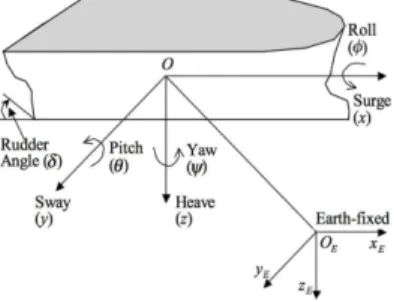
The above dynamic equations are based on the body-fixed frame. In consideration of kinematics equations, the earth-fixed frame as shown in Fig. 2 should be considered. In order to transform the state variables from the body-fixed frame to the earth-fixed frame, a 3-DOFs transformation matrix is employed as expressed in (28).
cos sin sin cos
. (28)2.2 Environment Disturbance model
The types of environmental disturbances can be divided into wave, wind, and ocean current. Among many possible external disturbances acting on a ship, only a disturbance is considered in this paper. Since the wave caused by wind influences the performance of the autopilot system
Fig. 1 The coordinate system for a ship Fig. 2 The earth-fixed reference
dominantly, the other environmental disturbances are neglected in this paper. The wave model can be described by (Fossen, 1994)
(29)
where is a zero-mean Brownian process noise. The function is second order wave transfer function which is expressed as
(30)
where , , and are a wave frequency, a damping coefficient, and a gain constant. Here, the gain constant is defined by where is the wave intensity. The wave frequency generated by wind for Pierson-Moscowitz sepectrum is defined by
(31)
where is a wind speed and is acceleration of gravity. For a ship moving with forward speed , the wave frequency is modified to encounter frequence
as (32).
(32)
Here, is the acceleration of gravity, is the total speed of ship, and is the angle between the heading and the direction of the wave. Considering the encountered frequency, wave model can be derived as (33).
(33) The state space model of wave can be written as (34) and (35).
(34)
. (35)Here, is white Gaussian noise. In this model, the frequency of motion caused by the wave is much higher than the bandwidth of the controller. By appling the wave model, the ship’s final heading angle, which is influenced by wave, is determined from (35).
3. SMC-based tracking controller
In this paper, a waypoints-based method is employed as a guidance system to lead the ship to the path by computing the desired heading angle. Since such a guidance system can be simply implemented, this paper concentrates more on the trajectory control system.
A sliding mode control is known well as a robust control methodology which can be applied to nonlinear control systems in practical applications. In the ship’s trajectory control field, the sliding mode control also can be applied.
However, trajectory tracking involves forward thrust part used to control surge speed and the rudder control part applied to minimize tracking error. This requires to control the propulsion force and rudder angle at same time. Other researchers generally utilized the separated control laws to remedy such an issue. This paper proposes an alternative to control both speed and angle by only a control law. In order to realize it, regarding Healey’s sliding method as an original method and referring to the sliding mode control of invertible systems, we modify the original one by using
vector method to extend the control input dimensions. To illustrate, the Healey's SMC is also called SMC using eigenvalue decomposition, as the name implied, in this method, pole placement method is applied to obtaining the desired eigenvalue in order to simplify the control algorithm. In addition, using pole placement method to choose the proper pole can make the state variable stable at the steady-state response. The sliding mode control of invertible systems was investigated by Tustomu Mita (Bartolini et a.l, 2009).
3.1 Modified SMC algorithm
The modified sliding mode control is described as follows. Let be a state error vector for a given desired state vector such that . First, the sliding surface is defined
⊤ (36)
where is multiple dimensions matrix. In fact, it is
∈ × matrix where indicates the number of the control input (for example if we want to define the number of control input as 3, then we can set =3). In this way, would become a ∈ × matrix. Using the SMC, we want the sliding surface to approach to zero, which indicates the error() would be zero.
We assume that the dynamic and kinematic model are described as
(37)
where ∈ and ∈. The function
should be interpreted as a nonlinear function that describes the deviation from linearity in terms of disturbances and unmodeled dynamics. In this paper, these disturbances are the deviation of parameters in the state equation caused by surge speed variation. In addition, the experiments of Healey and co-authors showed that this model could be used to describe a large number of vessel conditions. The feedback control law is composed of two parts
. (38)
Compared with the original one, the feedback control law becomes a vector. This can be written in the matrix
form of ∈ × , and the nominal part is chosen as
⊤ (39)
where is the feedback gain vector. Substituting (39) into state equations, we yield the closed-loop dynamics:
, (40)
where ⊤. (41)
In this way, we can obtain the desired eigenvalue of by adjusting gain value of using pole placement method.
To prove convergence of , the Lyapunov candidates function is applied in form of
⊤. (42)
Differentiation of with respect to time must meet
⊤ . (43)
Because only if differentiation of is negative, the sliding surface can approach to zero which means
lim
→ ∞
, we call it globally asymptotically stable. The derivative of can be obtained as
⊤ ⊤⊤ ⊤. (44)
To make (44) simplified, we choose (assuming that
⊤≠ ) as
⊤ ⊤ ⊤ sgn (45)
where is an estimate of and is
⊤ sgn ⊤∆ (46)
where ∆ . We want to make ⊤ equal zero. Referring to the knowledge of linear algebra, we know a nonzero vector ∈ that satisfies
(47)
where ∈ is an eigenvalue of and is called to be a right eigenvector of for . This trick indicates that if the eigenvalue is equal to zero, the ⊤ for specific right eigenvector will be zero too. As mentioned before, we can get the desired eigenvalue of
by adjusting . Therefore, we are able to make of eigenvaleus equal to zeros by using pole placement method. The is the number of control inputs. Thus we have
⊤
⊤
⋮ ⋮
⊤
(48)
where ∀ while ∀ consists of specific values. We can compute by
⊤ (49)
where
is right eigenvectors of ⊤. With this choice of , ⊤ is eliminated and the -dynamics is reduced to sgn ⊤∆. (50)
Because the sliding surface is multi-dimension vector, sgn should replace by ∥∥
. Thus, the derivative of
can be rewritten as
⊤∥∥
⊤∆
∥∥ ⊤∆
≤ ∥∥ ∥∥
(51)
Due to globally- and asymptotically-stable conditions, must be selected to meet
≤ (52)
Hence, in order to make sliding space asymptotic, we must ensure to meet the following requirement as (53).
∥∥∥∆∥ (53)
This method is similar to Healey’s SMC theory in which the control input is dealt with only for one dimension. However, our method can be extended to multiple dimensions so that we can design a general controller regardless the number of control inputs.
3.2 Design of trajectory tracking controller based SMC When the proposed control algorithm is employed to handle with the problem stated in this paper, according to practical conditions, the control inputs are selected by rudder angle and revolution of engine. We choose the state variable as
, (54)
, (55)
. (56)The nonlinear part is shown as following, and is environment noise following gaussian distribution.
(57)Therefore the control law is derived from (58).
⊤ ⊤
⊤ ⊤
(58) Here, is state vector of ship model, is constant matrix obtained by pole-placement algorithm, and is constant matrix obtained by (34). Also, is revolution of engine (unit: rps) and is the rudder angle (unit:radian).
In this paper, we assume
(59)where , are estimator of and , respectively.
Fig. 3 The proposed control procedures
-0.00184 -0.00110
-0.01160 -0.08078
0.00499 0.00278
-0.00166 -0.00139
-0.00264 0.001636
0.00798 -0.02300
0.00869 0.00251
0.00278 0.00871
4. Simulation results
4.1 Simulation setup
Our target ship is a small-sized ship whose length and beam are 10m and 5m, respectively. For simulations, we utilized the model parameters by referring to the Prime System as follows:
Table 1 Parameters of ship
With those ship model parameters, the control law could be calculated by using (59). The desired route was divided into a set of points so that it was convenient to apply way-points method for obtaining the designed angle. In fact, this angle is regard as the control input for the sliding mode controller. In this simulation, the wave disturbance induced by wind was considered. We also used the wave state space model to put influence on heading angle. The wave model parameters used in the simulation were set to be , , , and ∼ , respectively.
Fig. 3 depicts the procedure of trajectory tracking control for the target ship. In this figure, represents a reference vector consisting of desired speed() and heading angle(), which can be determined by the guidance system. The SMC-based control system outputs
revolution() and rudder angle() acted on the ship model, from the error vector() input. Heading angle of ship is affected by the wave, which is considered as the feedback.
The output vector is modified by the transformation matrix, and earth coordinates are generated.
4.2 Heading angle and speed control simulation We verified the steering control and surge speed control firstly. The initial condition of ship’s speed and heading angle were zeros. We set two constant desired values as speed command and heading angle command to validate the performance of SMC controller under the disturbance caused by environment noise.
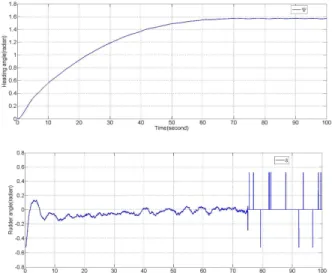
Fig. 4 Simulation result of heading angle control: the top is the variation of heading angle and the bottom is variation of rudder angle considered as control input
Fig. 5 Simulation result of speed control: the top is surge speed of ship and bottom is engine rpm
Fig. 4 shows the simulation results of steering control.
In this simulation, the desired heading angle of ship was 1.55 radians that means 100 degrees. After 60 seconds, the heading angle reached at the desired angle. The heading angle shows stable since the disturbance including wave force rejected by control inputs. The rudder angle regarded as the control input of steering control is shown in Fig. 5.
The variation of rudder angle is not smooth from 75 seconds. At this point the heading angle and surge speed are converged to desired value.
Fig. 5 displays the situation of speed control. In this simulation, the desired speed was 5m/s, and surge speed of ship approached to the desired value within 75 seconds, after that the surge speed was stable. For the real ship using the diesel engine, we controlled the surge speed by adjusting the revolution of shaft in practice. The revolution unit is rpm(revolution per minute). As shown in Fig. 5, the revolution increased when the ship is just started. After the ship moved at constant speed, the control input was changed to bang-bang control for rejecting disturbances.
Due to the good robustness of proposed SMC, surge speed deviation was near zero. This results present that the speed can be controlled well with steering control together.
4.3 Ship's trajectory control simulation
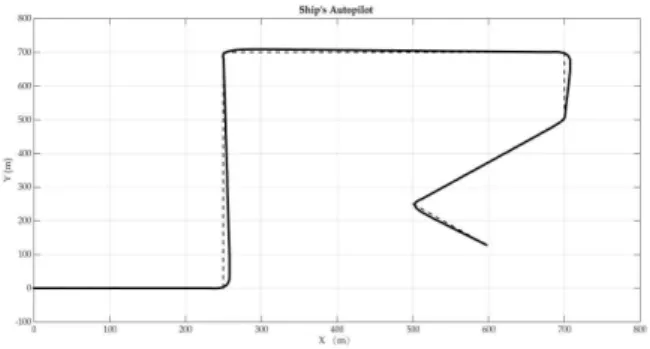
The next simulation is related to ship’s trajectory tracking control. A way–point method was applied to the simulation. In this simulation, the influence of noise was eliminated by controller instead of low pass filter. Also, six points of path were used as a series of way points that are (250,0), (250,700), (700,700), (700, 500), (500, 250) and (625, 125), respectively. Ship’s initial position was set to be (0, 0). In addition, the environment noise was imposed during the process of simulation. In order to validate the speed control performance, the ship moved at slowly speeds on every turning. The results are described at from Fig. 6 to Fig. 8.
Fig. 6 depicts the ship’s path on 2-dimensional space.
Based on our way-point strategy, after the ship’s position approached to the designed point, the next point was selected through the guidance system. In this manner, the target ship could move along the given path with slight cross-tracking error as shown in Fig. 6. In addition, SMC-based controller suppressed the affect caused by environment noise effectively.
Fig. 6 Simulation result of ship's trajectory control: the dotted line is reference trajectory and full line is ship's path
Fig. 7 The variation of heading angle during trajectory control
Fig. 7 shows the variation of heading angle. The heading angle is changed efficiently during turning, which implies that the SMC-based controller works well. In this simulation, the behaviour of the target ship was designed to move at slow speed on the turning. Initial speed and general speed were set to be 0m/s and 5m/s, respectively.
We also confirm that the ship could move at the desired speed as we expected. Consequently, it is confirmed that the proposed SMC controller and guidance system can be applied to carry out ship’s trajectory control task precisely and efficiently.
5. Conclusions
This paper has dealt with ship's speed and heading angle control that could cope with the ship's trajectory control problem. In our ship model, the prolusion force came from propeller and rudder force caused by rudder were clarified. The environment disturbance especially for wave caused by wind was also involved in the ship model.
In order to control surge speed and heading angle simultaneously, a modified sliding mode control law was
proposed. The proposed method was tested through a series of simulations based on the linear ship model and a way-point guidance framework. As the simulation results showed, for the speed and heading angle control, the error deviation was close to zero. For ship's trajectory control, we confirmed that the target ship could pass through the way-points accurately and ship’s speed could be controlled as we expected.
Although the effectiveness of the proposed method was verified through realistic simulations, it would be required to test through real situations. Further work includes such experiments together with enhancing our method.
Acknowledgement
This research was supported by Basic Science Research Program through the National Research Foundation of Korea(NRF) funded by the Ministry of Science, ICT &
Future Planning(NRF-2015R1C1A1A01053126)
Reference
[1] Chae C. J.(2016), "A Study on Dynamic Positioning System IMO class upgrade requirements", Journal of Korean Navigation and Port Research, Vol. 39, No. 3, pp. 103-110.
[2] Fossen T. I. (1994), “Guidance and control of ocean vehicles”, John Wiley & Sons Inc.
[3] G. N. Robert, R. Sutton, A. Zirilli and A. Tiano(2003),
“Intelligent ship autopilots—A historical perspective”, Mechatronics, Vol. 13, No. 10, pp. 1091-1103.
[4] G. N. Roberts(2008), “Trends in marine control systems”, Annual Reviews in Control, Vol. 3, No.2, pp. 263-269.
[5] Giorgio Bartolini, Elisabetta Punta and Tullio Zolezzi (2009), “Simplex sliding Mode Control of Multi-Input Systems with Chattering Reduction and Mono-Directional”
Actuators, Vol. 47, No. 11, pp. 2433-2437.
[6] Hshem Ashrafiuon, Member, IEEE, Kenneth R. Muske, Member, IEEE, Lucas C. McNinch, Member IEEE, and Reza A. Soltan, Member, IEEE(2008), “Sliding-Mode tracking Control of surface Vessels”, Transaction On Industrial Electronic, IEEE, Vol, 55, No. 11, pp.
556-561.
[7] Jun Wu, Hui Peng, Kohei Ohstu, Genshiro Kitagawa and Tohru Itoh(2012), “Ship’s tracking control based on nonlinear time series model”, Applied Ocean Research, Vol. 36, pp. 1-11.
[8] J. Cheng, J. Yi and D. Zhao(2007), “Design of a sliding mode controller for trajectory tracking problem of marine vessels”, Control Theory & Application, IET, Vol. 1, No. 1, pp. 233-237.
[9] J. Koshkouei, K. J. Burnham and Y. Law(2007), “A comparative study between sliding mode and proportional integrative derivative controllers for ship roll stabilization”, Control Theory & Application, IET.
Vol. 1, No. 5, pp. 1266-1275.
[10] Lee B. K. and Kim J. H.(2005), "A Proposal of an LOS Guidance System of a Ship for Path Following”, Journal of the Korean Society of Marine Engineering, Vol. 11, No. 4, pp. 363-368.
[11] Lee Y. H. and So M. O.(2016), "Speed Control of Marine Gas Turbine Engine using Nonlinear PID Controller". Journal of Korean Navigation and Port Research, Vol. 39, No. 6, pp. 103-110.
[12] Nguyen P. H. and Jung Y. C.(2006), "Improved Adaptive Neural Network Autopilot for Track-keeping Control of Ships:Design and Simulation", Journal of Korean Navigation and Port Research, Vol. 30, No. 5, pp.
259-265.
[13] S. K. Bhattacharyya and Deepak Kumar Gupta(2014),
“Target Path Iteration method for trajectory control of ships”, Applied Ocean Research, Vol. 48, pp. 55-65.
[14] Tayfun Cimen and Stephen P. Banks(2004), “Nonlinear optimal tracking control with application to super-tankers for autopilot design”, Automatia, Vol. 40, No. 11, pp.
429-443.
[15] Witold Gierusz, Nguyen Cong Vinh, Andrzej Rak (2007), “Maneuvering control and trajectory tracking of very large crude carrier”, Ocean Engineering, Vol.
34, No. 7, pp. 932-945.
Received 21 September 2017 Revised 4 January 2018 Accepted 8 January 2018