www.earticle.net
거세 및 비거세 사슴육으로 제조한 반건조 육포의 이화학적 특성
김상우1# ∙ Dicky Tri Utama2#∙ 김명직1 ∙ 조영무1 ∙ 박성복1 ∙ 김관우1 ∙ 이성기2*
농촌진흥청 국립축산과학원1, 강원대학교 동물생명과학대학2
Physicochemical Properties of Semi-dried Jerky Made from Uncastrated and Castrated Deer Meat
Sang Woo Kim1#, Dicky Tri Utama2#, Myeong Jik Kim1, Yeong Moo Jo1, Seong Bok Park1, Kwan Woo Kim1 and Sung Ki Lee2*
1National Institute of Animal Science, Rural Development Administration, Namwon 55717, Korea,
2College of Animal Life Sciences, Kangwon National University, Korea, Chuncheon 24341, Korea
ABSTRACT1)
This research was conducted to evaluate the physicochemical properties of semi-dried jerky made from uncastrated (U) and castrated (C) deer meat. The jerky was manufactured by mixing the ground lean meat with spices followed by drying process, packed and stored aerobically at 25℃ for 20 days. The pH of uncastrated raw meat was significantly (p<0.05) higher than that of castrated meat as well as the pH of the jerky. No effects were found on color, hardness and sensory scores of jerky. Castrated jerky had higher fat content than uncastrated jerky (p<0.05), after 20 days of storage, its TBARS (thiobarbituric acid reactive substances) value was higher than uncastrated jerky (p<0.01). These results suggest that castration contributed to higher fat content and lipid oxidation of semi-dried venison jerky than the uncastrated, without any significant effects on texture and sensory attributes. However, proper packaging should be considered to inhibit lipid oxidation.
(Key words: Castration, Deer Meat, Lipid Oxidation, Venison Jerky)
Ⅰ. INTRODUCTION
In deer farming, especially antler production in bucks, castration plays important role to control their growth and behavior. The effect of castration on antler development varies, depending on the age class of the deer and the stage of antler growth when the castration
occurs. Castration can be used on animals prior to slaughter, and this is mostly done with fallow deer bucks, with the intention of preventing the vigorous fighting that is typical when entire fallow bucks are yarded for transport to an abattoir (Kierdorf et al., 1995;
Li et al., 2014). Moreover, castration also contributes to meat quality attributes. Meat obtained from castrated
* Corresponding author: Sung Ki Lee, Animal Products and Food Science Program, Division of Animal Applied Science, College of Animal Life Sciences, Kangwon National University, Chuncheon 24341, Korea. Tel: +82-33-250-8646, E-mail: [email protected]
# These authors contributed equally in this study.
This is an Open Access journal distributed under the teams of the Creative Commons Attribution Non-Commercial License (http://creativecommons.org/licenses(by-nc/3.0) which permits unrestricted non-commercial use, and reproduction in any medium, provided the original work is properly cited.
[Provider:earticle] Download by IP 118.70.52.165 at Monday, December 20, 2021 7:56 PM
www.earticle.net
animals had higher fat content, less moisture and less sex-related odor such as boar taint in pork from uncastrated boar (Destefanis et al., 2003; Pauly et al., 2010). Those attributes may influence the characteristics of the processed products.
In recent years, consumer demand for low-fat meat products has gained an increasing popularity. Deer meat or venison has lower calories, cholesterol and fat content compared with beef, pork or mutton (Hoffman et al., 2006). It should be noted that venison is also a perishable products that is quickly spoiled and it has a relatively short shelf-life. Making intermediate moisture products such as dried meat (jerky) is one of the oldest way to turn perishable product into a protein-rich and shelf-stable snack. Traditionally, jerky has been made from finely sliced whole lean meats which have been marinated and then dried to extend shelf life. This hurdle technology has been considered to tenderizing, flavoring and inhibiting microbial growth (Chawla and Chander, 2004; Leistner, 2000). Drying for food preservation has commonly used in meat industry. It lowers the water activity to the point where microorganisms are no longer able to access sufficient water for their growth. Furthermore, drying changes chemical composition, structure and physical properties of foods. The heating process and water loss cause stresses in the cellular structure that lead to changes in microstructure and also develop lipid oxidation (Gandemer, 2002; Simal et al., 2003).
Study on the effects of castration on the quality attributes of dried meat products is still limited. Hence, the aim of this research was to evaluate the physicochemical properties of venison jerky made from castrated and castrated deer meat.
Ⅱ. MATERIALS AND METHODS
1. Jerky Manufacturing
The selected animals were from the same breed and age, consisting of two male deers (bucks) and two
castrated deers, grown under the same condition at National Institute of Animal Science, Suwon. The animals were slaughtered at the abattoir using standard procedure. Round muscle was obtained from each animal and stored until required at -24℃ separately.
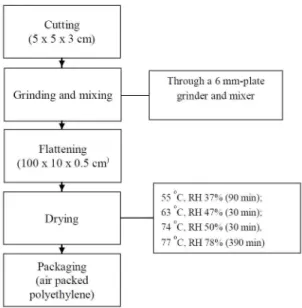
The jerky was made in two batches for each treatment (Fig. 1). Each batch was using meat from single animal.
Frozen meats were thawed at 2±2℃ in chilling room for 36 h until internal temperature of 2±2℃ was reached.
The connective tissue and subcutaneous fat were removed to obtain lean meat. The meat was cut into cubes with size of 5×5×3 cm, ground through a 6-mm plate meat grinder and mixer (HeavyDuty 5KPM50, KitchenAid, USA) and then mixed with water (6.31%), salt (0.7%), all spices (1.1%), sodium erythorbate (0.6%), Prague powder (0.29%), soy sauce (10.1%), sugar (0.22%), and smoke oil (0.5%) for 5 min. The proportion is based on the weight of the meat. The mixture was then flattened into approximately 100×10×0.5 cm. The jerky was dried in drying chamber (VC 2057, Votsch Industritechnik, Germany) under set temperature and humidity presents in Table 2 until its water activity of 0.88 was reached. The semi dried jerky were then cooled down at room temperature for 30 min, packed in low density polyethylene (PE) bags and stored at 24℃ for 20 days in incubator.
Fig. 1. Flow chart of semi-dried venison jerky manufacturing.
[Provider:earticle] Download by IP 118.70.52.165 at Monday, December 20, 2021 7:56 PM
www.earticle.net
2. Water activity, moisture contents and drying yield
A total of 5 g chopped sample was placed in an aw-cup, subjected to water activity (aw) analysis. It was measured during drying time (0, 3, 6 and 9 h) using the Aquaspector (AQS-2, Nagy, Germany). AOAC methods (AOAC, 1995) was used for determining moisture contents with modification in triplicate. Briefly, 2 g chopped samples were placed in dried aluminum cap and dried using oven at 105℃ for 24 h. Moisture contents was expressed as moisture loss percentage during drying. For drying yield, a total of 10 g jerky samples were weighed before (initial) and after (final) drying. Drying yield was expressed as the percentage of final weight divided by initial weight (10 g).
3. pH and crude fat contents
For pH determination, a 5 g of sample was added with 50 mL of distilled water and then homogenized at 10,000 rpm for 60 s using a homogenizer (PH91, SMT, Japan). The pH value of the homogenized samples was measured using a pH meter (SevenEasy pH, Mettler- Toledo GmbH, Switzerland). Crude fat contents was measured according to AOAC (1995).
4. Instrumental surface color
The surface color was recorded by measuring CIE lightness (L*), redness (a*) and yellowness (b*) using a chromameter (CR-400, Konica Minolta Sensing, Japan).
The light source of illuminant C (2o observer) was standardized with a white plate (Y=93.6, X=0.3134, y=0.3194). Each sample was assessed 5 times.
5. Textural properties
Textural properties was measured according to Lee and Kang (2003) with slightly modification in sample preparation. After drying and cooling down, jerky strips were selected randomly, cut into 2×1 cm2and subjected to analysis using TA-XT2i Plus (Stable Micro Systems, UK) with self-tightening roller grips. Maximum tensile
force or hardness (N), elongation capacity (mm) and tensile work (N×mm) were measured automatically. Each sample was assessed eight times.
6. Lipid oxidation measurement
Lipid oxidation was evaluated using TBARS method as described by Sinhuber and Yu (1977) at 0, 10 and 20 days of storage. An absorbance of supernatant of sample was measured at 532 nm using a spectrophotometer (UV-mini-1240, Shimadzu Corp., Japan). The results were calculated as mg malondialdehyde (MA) per kg dry matter (DM) sample.
7. Sensory evaluation
For sensory evaluation, 12 semi-trained panelists were evaluating aroma, color and texture of venison jerky at day 0 using a nine-point quantitative hedonic method, ranging from extremely dislike (score 1) to extremely like (score 9).
8. Statistical analysis
A 2×3 factorial design with three replicates each batch was employed for statistical analysis. Two way-analysis of variance (ANOVA) was performed to analyze the effect of castration and storage time on lipid oxidation, while the remaining data were subjected to one way- ANOVA using R-version 3.1.2 with “Agricolae” library (The R-foundation for Statistical Computing, Vienna, Austria). Sensory evaluation data were analyzed using Kruskal-Wallis rank test. All data were expressed as the mean±SD. The statistical significance of the differences between means from different treatments was determined by Duncan’s multiple range test with p<0.05.
Ⅲ. RESULTS AND DISCUSSION
1. Changes in water activity during drying
Jerky is known as one of shelf-stable meat products
[Provider:earticle] Download by IP 118.70.52.165 at Monday, December 20, 2021 7:56 PM
www.earticle.net
Table 1. Changes in water activity of semi-dried venison jerky during drying.
Item Drying time (h)
0 3 6 9
Uncastrated 0.92±0.002 0.92±0.002 0.91±0.003 0.87±0.003
Castrated 0.92±0.002 0.91±0.010 0.91±0.007 0.87±0.010
due to low water activity. Quinton et al. (1997) mentioned that to achieve stability, jerky should be dried until awof 0.75 to 0.85 is reached. Combining curing and drying contributes to inhibit microbial growth in jerky (Calicioglu et al., 2003). In this study, drying under controlled condition over 9 hours decreased the water activity of jerky from the raw batter of 0.92 to 0.87 in dried product (Table 1). However, no differences were found among treatments. Previous studies found that the water activity of semi-dried jerky made from pork was around 0.80 to 0.86 (An et al., 2010; Choi et al., 2008), which was slightly lower than our results. In case of semi-dried jerky, the water activity is higher than common venison dried jerky, as Kim et al. (2006) found that their venison jerky had water activity between 0.53 and 0.67 with different drying times.
2. Physicochemical properties and sensory evaluation
Moisture content is closely related to water activity and a crucial factor affecting the shelf life of intermediate moisture foods, such as jerky. Typical semi-dried pork jerky had moisture content ranging from 34 to 36% (An et al., 2010; Choi et al., 2008), whereas jerky in this study had higher moisture contents (Table 2). This differences may be due to different drying conditions and ingredients.
The aims of castration on deer are similar to those on pig, sheep, goat and cattle, which are to gain better carcass traits, higher intramuscular fat and eliminate typical odor (Field, 1971; Prescott and Lamming, 1964;
Asher et al., 2011). The effects of castration was clear on crude fat content and pH in raw meat (p<0.05). The pH of castrated deer jerky was significantly lower than the control. From previous studies, pH of commercial jerky varied, ranging from 5.40 to 6.28, which was affected by
different ingredients and drying conditions (Yang and Lee, 2002; Lim et al., 2012). Lee et al. (1997) further suggested that high temperature causing meat protein denaturation and increasing pH.
The drying yield was also affected by the formulation of meat products and moisture content of the meat (Sindelar et al., 2010). No differences were found among treatments in this study, however, jerky made from castrated deer meat had slightly lower moisture content and higher drying yield as its crude fat content was significantly higher than the control (p<0.05).
The instrumental surface color of jerky made from uncastrated and castrated deer meat is presented in Table 3. No differences were found on color parameters among treatments. Castrated jerky had slightly higher lightness and yellowness due to higher fat contents.
However, drying conditions (temperature and drying time) may influence the color of jerky instead of castration as Lim et al. (2012) found that different drying methods affecting the instrumental color of beef jerky.
Texture is one of the most important sensory properties of meat and meat products. Lee et al. (2004) mentioned that jerky has unique characteristics, thus, attracts the market and determines the preferences of consumer. Table 4 presents the instrumental textural attributes of jerky in this study. No differences were found on hardness and tensile work. However, uncastrated jerky was significantly (p<0.05) more elastic than castrated jerky as revealed by higher elongation capacity. Different fat content might contribute to this attribute like the intramuscular fat of beef does. Caine et al. (2003) reported that springiness and resilience, which related to elongation capacity, might be highly associated to intramuscular fat content in beef steak.
[Provider:earticle] Download by IP 118.70.52.165 at Monday, December 20, 2021 7:56 PM
www.earticle.net
Table 2. Effects of castration on physicochemical properties of semi-dried venison jerky.
Parameters Raw meat Jerky
Uncastrated Castrated Uncastrated Castrated
Moisture (%) 79.89±0.96 78.14±0.59 50.38±0.81 46.08±0.71
Crude fat (% DM) 1.99±0.12b 3.15±0.33a 5.01±0.64b 9.98±0.81a
pH 6.20±0.07a 5.73±0.01b 6.01±0.06a 5.82±0.02b
Drying yield - - 51.75±3.66 57.87±2.83
a,b Different superscripts in the same row indicate differences among uncastrated and castrated (p<0.05). DM=dry matter.
Table 3. Effects of castration on instrumental surface color of semi-dried venison jerky.
Parameters Uncastrated Castrated
L* (Lightness) 30.84±1.65 33.21±1.90
a* (Redness) 1.35±0.22 1.23±0.18
b* (Yellowness) 0.93±0.10 1.04±0.12
Table 4. Effects of castration on textural properties of semi-dried venison jerky.
Item Hardness (N) Elongation (mm) Tensile work (N x mm)
Uncastrated 42.21±1.20 15.10±0.98a 315.39±1.10
Castrated 42.20±1.93 13.39±0.95b 309.80±1.89
a,b Different superscripts in the same column indicate differences among uncastrated and castrated (p<0.05).
Table 5. Effects of castration on sensory attributes of semi-dried venison jerky.
Parameters Uncastrated Castrated
Aroma 6.17±1.95 6.00±1.95
Taste 5.92±1.88 5.50±2.39
Color 4.33±1.61 4.58±2.07
Texture 6.58±1.68 5.92±1.62
Overall acceptance 6.00±1.48 5.92±2.11
Table 5 shows that castration had no effects on sensory attributes of the venison jerky. Jerky made from uncastrated deer meat had slightly higher preferences on aroma, taste, texture and overall acceptance, whereas castration led to slightly higher preferences on color of the venison jerky. This may be caused by processing conditions and the use of spices, which eliminated the undesirable aroma meat from uncastrated deer meat.
3. Lipid oxidation during storage
Lipid oxidation is one of major quality deterioration in
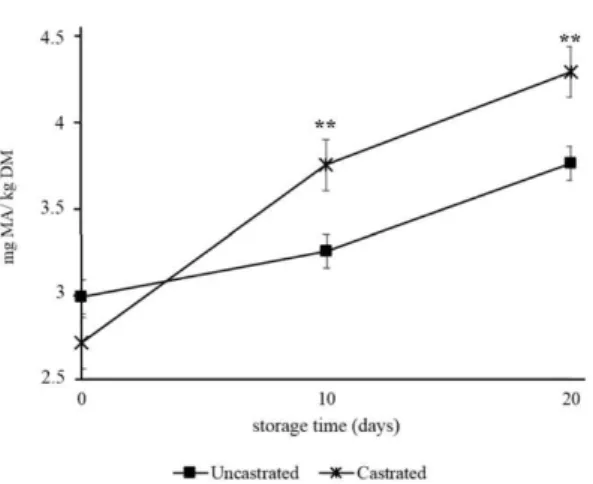
meat and meat products. The level of malondialdehyde contents is the common indicator used in lipid oxidation analysis, in which the higher the content, the higher the degree of lipid oxidation occurs. Changes in TBARS values of venison jerky during storage are shown in Fig.
2. No differences were found on initial day of storage, however, TBARS values increased during 20 d of storage (p<0.001) and castration significantly elevated the degree of lipid oxidation (p<0.01) higher than the control at d 10 and d 20. Interaction between treatments was very significantly affected the degree of lipid oxidation (p<0.001).
[Provider:earticle] Download by IP 118.70.52.165 at Monday, December 20, 2021 7:56 PM
www.earticle.net
Fig. 2. Effects of castration on TBARS (mg MA/kg dry matter) of semi-dried venison jerky during storage at room temperature (24℃). MA; malondialdehyde, DM; dry matter.
** Indicates differences between uncastrated and castrated (p<0.01).
Changes in TBARS value in meat products during storage is a common phenomenon and has different pattern depending on storage condition and the ingredients of the cooked meat products. Several endogenous factors affecting lipid oxidation in jerky are fat contents, the degree of unsaturated fatty acids, aw, salt content and antioxidant capacity of the products (Chen et al., 2002; Yang et al., 2009; Kong et al., 2011), in which jerky made from castrated deer meat had significantly higher crude fat contents. Other external factors affecting the development of lipid oxidation such as drying temperature and time were pointed out by Lee et al. (1997). In contrast, Lim et al. (2012) found that drying methods only had slight influences in Hanwoo beef jerky. Our results suggest that castration affects lipid oxidation in venison jerky.
Ⅳ. CONCLUSIONS
This study showed that castration contributed to higher fat content and lipid oxidation of semi-dried venison jerky, without any significant effects on texture and sensory attributes. Proper packaging (e.g. vacuum or modified atmosphere) may be applied to inhibit lipid
oxidation particularly for jerky made from castrated deer. Further study is also needed to assure the microbiological safety of jerky made from venison.
ACKNOWLEDGEMENT
This work was carried out with the support of
“Cooperative Research Program (Project No. PJ010229)”, Rural Development Administration, Republic of Korea.
Ⅴ. REFERENCES
1. An, K. I., Choi, J. H., Choi, Y. S., Han, D. J., Kim, H.
Y., Lee, M. A., Kim, S. Y., Kim, T. H. and Kim, C. J.
2010. Effects of kimchi powder on quality characteristics of semi-dried pork Jerky. Korean J.
Food Sci. Anim. Resour. 30(2):198-205.
2. AOAC. 1995. Official methods of analysis. 15th ed.
Association of Official Analytical, Washington, DC, USA.
3. Asher, G. W., Archer, J. A., Ward, J. F., Mackintosh, C. G. and Littlejohn, R. P. 2011. The effect of prepubertal castration of red deer and wapiti-red deer crossbred stags on growth and carcass production.
Livestock Sci. 137:196-204.
4. Caine, W. R., Aalhus, J. L., Best, D. R., Dugan, M. E.
R. and Jeremiah, L. E. 2003. Relationship of texture profile analysis and Warner-Bratzler shear force with sensory characteristics of beef rib steaks. Meat Sci. 64 (4):333-339.
5. Calicioglu, M., Sofos, J. N. and Kendall, P. 2003.
Influence of marinades on survival during storage of acid-adapted and nonadapted Listeria monocytogenes inoculated post-drying on beef jerky. Int. J. Food Microbiol. 86(3):283-292.
6. Chawla, S. P. and Chander, R. 2004. Microbiological safety of shelf-stable meat products prepared by employing hurdle technology. Food Control 15:559- 563.
7. Chen, W. S., Lin, D. C. and Chen, M. T. 2002.
[Provider:earticle] Download by IP 118.70.52.165 at Monday, December 20, 2021 7:56 PM
www.earticle.net
Determination of quality changes throughout processing steps in Chinese-style pork jerky. Asian Australas. J. Anim. Sci. 17(5):700–704.
8. Choi, J. H., Jeong, J. Y., Han, D. J., Choi, Y. S., Kim, H. Y., Lee, M. A., Lee, E. S., Paik, H. D. and Kim, C.
J. 2008. Effects of pork/beef levels and various casings on quality properties of semi-dried jerky. Meat Sci.
71:278-286.
9. Destefanis, G., Brugiapaglia, A., Barge, M. T. and Lazzaroni, C. 2003. Effect of castration on meat quality in Piemontese cattle. Meat Sci. 64(2):215-218.
10. Field, R. A. 1971. Effect of castration on meat quality and quantity. J. Anim. Sci. 32:849–858.
11. Gandemer, G. 2002. Lipids in muscles and adipose tissues, changes during processing and sensory properties of meat products. Meat Sci. 62:309-321.
12. Hoffman, L. C. and Wiklund, E. 2006. Game and venison – meat for the modern consumer. Meat Sci.
74:197-208.
13. Kierdorf, U., Kierdorf, H. and Knuth, S. 1995. Effects of castration on antler growth in fallow deer (Dama dama L.). J. Exp. Zool. 273:33–43.
14. Kim, B. S., Jin, S. K., Park, K. H., Kim, D. H., Hah, K. H., Park, S. T., Kwuak, K. R., Park, J. K. and Kang, Y. S. 2006. Changes in quality characteristics of venison jerky manufactured under different dry time during storage. Korean J. Food Sci. Anim.
Resour. 26(2):166-174.
15. Kong, J., Perkins, L. B., Dougherty, M. P. and Camire, M. E. 2011. Control of lipid oxidation in extruded salmon jerky snacks. J. Food Sci. 76:8-13.
16. Lee, S. G., Kim, S. T., Kim, H. J. and Kang, C. G.
1997. Effects of temperature and time on physicochemical properties of Korean goat meat jerky during drying. Korean J. Food Sci. Anim.
Resour. 17:184-189.
17. Lee, S. W. and Kang, C. S. 2003. Effects of moisture content and drying temperature on the physicochemical properties of ostrich jerky. Nahrung 47:330–333.
18. Lee, S. W., Lee, B. S., Cha, W. S., Park, J. H., Oh, S.
L., Cho, Y. Je., Kim, J. K., Hong, J. H. and Lee, W. Y.
2004. Diffusion of salt and drying characteristics of beef jerky. Korean J. Food Preserv. 11(4):508-515.
19. Leistner, L. 2000. Basic aspects of food preservation by hurdle technology. Int. J. Food Microbiol.
55:181-186.
20. Li, C., Zhao, H., Liu, Z. and McMahon, C. 2014. Deer antler–A novel model for studying organ regeneration in mammals. Int. J. Biochem. Cell. Biol.
56:111-122.
21. Lim, D. G., Lee, S. S., Soe, K. S., Nam, K. C. 2012.
Effects of different drying methods on quality traits of Hanwoo beef jerky from low-valued cuts during storage. Korean J. Food Sci. Anim. Resour. 32 (5):531-539.
22. Pauly, C., Spring-Staehli, P., O'Doherty, J. V., Kragten, S. A., Dubois, S., Messadène, J. and Bee, G.
2010. The effects of method of castration, rearing condition and diet on sensory quality of pork assessed by a trained panel. Meat Sci. 86:498-504.
23. Prescott, J. H. D. and Lamming, G. E. 1964. The effects of castration on meat production in cattle, sheep and pigs. J. Agri. Sci. 63:341-357.
24. Quinton, R. D., Cornforth, D. P., Hendricks, D. G., Brennand, C. P. and Su, Y. K. 1997. Acceptability and composition of some acidified meat and vegetable stick products. J. Food Sci. 62:1250–1254.
25. Simal, S., Femenia, A., Garcia-Pascual, P. and Rosselló, C. 2003. Simulation of the drying curves of a meat-based product: effect of the external resistance to mass transfer. J. Food Eng. 58:193-199.
26. Sindelar, J. J., Terns, M. J., Meyn, E. and Boles, J. A.
2010. Development of a method to manufacture uncured, no-nitrate/nitrite-added whole muscle jerky. Meat Sci. 86(2):298-303.
27. Sinhuber, R. O. and Yu, T. C. 1977. The 2- thiobarbituric acid reaction, an objective measure of the oxidative deterioration occurring in fat and oil. J.
Oleo Sci. 26:259-267.
28. Yang, C. Y. and Lee, S. H. 2002. An evaluation of quality of the marketing jerky in domestic-I.
Investigation of outward appearance, food additives, nutrient content and sanitary state. Korean J. Food
[Provider:earticle] Download by IP 118.70.52.165 at Monday, December 20, 2021 7:56 PM
www.earticle.net
Nutr. 15:197-202.
29. Yang, H. S., Hwang, Y. H., Joo, S. T. and Park, G. B.
2009. The physicochemical and microbiological characteristics of pork jerky in comparison to beef
jerky. Meat Sci. 82(3):289-294.
(Received 16 June 2015, Revised 02 November 2015, Accepted 16 November 2015)
[Provider:earticle] Download by IP 118.70.52.165 at Monday, December 20, 2021 7:56 PM