1. INTRODUCTION
Computer networks are becoming more complex than ever and we still rely on them to transport data across globe in seconds. Although it works well, there are some foreseen issues need to be addressed. Firstly, interrupted connectivity prob- lem has become more common because band- width-consumed applications such as peer-to-peer or video streaming are more popular. Moreover, bottleneck link performance is degraded seriously due to bad interaction between transport protocols at transport layer and queue scheduling at link layer. Some recent articles put forward the case for renewed research in the development of queue management policies for the Internet [1,2]. The au- thors in [2] have stated that "Unmanaged buffers are more critical today since buffer sizes are larger, delay-sensitive applications are more prevalent,
and large (video streaming) downloads are common." The continued existence of large delays at bottleneck link could readily impact the growth of new applications, which makes a strong case for further analysis and design of active queue man- agement (AQM) policies.
To compensate bad performance of bottleneck link due to large buffer existence in Internet equip- ments, AQM algorithms has been recommended to set up with new devices [3]. Most of AQM designs exploit the classical control theory and fluid-flow model to consider additive increase - multiplicative decrease (AIMD) feature of transport control pro- tocol TCP (e.g., TCP Reno, Newreno, Sack, etc.) and bottleneck queue evolution through time. Some of the promising proposals for AQMs are drop-tail, random early detection (RED) [4], and CoDel [2]
as a few recent proposals. However, none of these are currently implemented, and the drop-tail policy
Queue Management using Optimal Margin method to Improve Bottleneck Link Performance
Amr Radwan
†ABSTRACT
In network routers, buffers are used to resolve congestion and reduce packet loss rate whenever congestion occurs at bottleneck link. Most of the existing methods to manage such buffers focus only on queue-length-based control as one loop which have some issues of low link utilization and system stability. In this paper, we propose a novel framework which exploits two-loop control method, e.g.
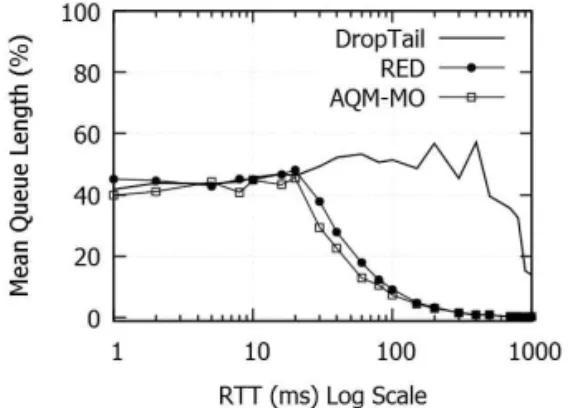
queue-length and congestion window size, combined with optimal margin method to facilitate parameter choices. Simulation results in ns-2 demonstrate that bottleneck link performance can be improved with higher link utilization () and shorter queue length () than the current deployed scheme in commercial routers (RED and DropTail).
Key words: AQM, Optimal Margin, Cascade Control, Fluid Flow.
※ Corresponding Author : Amr Radwan, Address : (621-749) Obangdong, Gimhae, Gyeongnam, Korea, TEL
: +82-55-320-3847, FAX : +82-55-322-6275, E-mail : [email protected]
Receipt date : Aug. 31, 2015, Revision date : Oct. 14, 2015 Approval date : Oct. 19, 2015
†
Dept. of Information and Communication System, Inje University, Gimhae, Gyeongnam, Korea
※ This research was supported by the Inje University.
continues to be widely used in Internet routers due to its simplicity - but drop-tail also has implicit issues such as long queue if buffer size is large, which results into high latency and affects to user-experience with delay-sensitive applications (e.g., web browsing, video conference, etc.)
Leading from the prior works, in this paper, we propose an AQM design from control theoretical aspect, but using optimal margin method to choose the best coefficients of controllers. We realize that the existing models of AQM in control theory heavily concentrated on one-loop control to track the queue length reference, which have issues of difficult to adjust parameters and guarantee stability. By adding more loop to control congestion window size, we should improve the total bottle- neck link performance in term of packet loss, link utilization and average queue length. The optimal margin method for our proposed active queue man- agement scheme (AQM-MO) is used at both loops to make decision on sampling time and coefficients of inner and outer controllers. Our main con- tributions can be summarized as following:
∙ We propose an active queue management scheme using optimal margin (AQM-MO) in fre- quency domain which has two loops for control.
The first loop gets information from congestion window size and bottleneck link capacity while the second one maintains queue length as desired value. An interesting result is that we can obtain close-form expressions to derive coefficients of controller easily (Section IV).
∙ We develop a simulation model to verify our proposal AQM-MO using ns-2. The proposed scheme is added at the same level to other existing schemes in ns-2 code (DropTail and RED).
Simulation results are also provided with bottle- neck link statistics: packet drop rate, queue length and link utilization (Section V).
The remainder of this paper is organized as follows. We present related works in section II. In section III and IV, we describe the system model
and the dynamic feedback controller design specific steps. Section V gives our simulation results of the proposed scheme and section VI finally concludes the paper.
2. RELATED WORKS
Several models and algorithms have been pro- posed using control theoretic with the core line- arized TCP model by Hollot et al. [5] which con- tributed a large portion to de-bloat research field [6]. The purpose firstly was to support more con- crete design for RED parameters and an insight knowledge about its behavior under changing of network conditions such as propagation delay, of- fered load such as number of TCP flows and bot- tleneck link capacities. Here we make the classi- fication into two main approaches: classical control and robust control.
From classical methods, proportional-integral- derivative (PID) controller-based algorithms have been designed to meet various requirements of bottleneck link in the Internet. Hollot et al. [5] in- terpreted RED as I-controller and proposed two variants of RED, the proportional (P) controller.
and the proportional integral (PI) controller to im- prove RED. The stable region of control gains is determined for dynamic-RED (DRED) using Routh stability test in [7] with load-dependent probability to randomly discard packets whenever the buffer at bottleneck link grows excessively. The advant- age of classical methods is that we can maintain queue size close to a pre-determined threshold val- ue and do not have to collect state information of individual data flows. Nevertheless, most of the existing methods in classical control for AQM only use one-loop feedback of queue length.
Robust control method was also used to study
AQM and bottleneck link performance. In [8], the
issue of large delay was addressed by DC-AQM
algorithm based on internal mode compensation
(IMC) principle. Using the derived IMC controller,
they tried to tune the coefficient controller
to reduce end-to-end packet delay. Continuing to contend with large delay, a Gain Adaptive Smith Predictor with PI controller (GAS-PI) in [9] was proposed to gain more robustness of the TCP/
AQM system. Then in [10], a predictive PID con- troller was proposed to determine suitable values for controller coefficients so that they can adapt with changes of offered load, round-trip time, etc.
Recently, authors in [11] proposed a globally opti- mal solution using network optimization frame- work to resolve contention of packets under fast- fading wireless ad-hoc network environments.
During recent years, main directions has been transferred to more and more sophisticated robust control techniques, based on classical models (fluid-flow model of TCP/AQM) or queuing mod- els with impatient customer feature [12]. Contrib- uting to this research trend, we propose a two-loop control using optimal margin method which has not been considered in literature of AQM research field yet. Though this method can implicitly be a little bit complex with two additional controllers, we are going to demonstrate that the performance is much better in terms of packet loss and more link utilization than implemented schemes such as DropTail and RED.
3. SYSTEM MODEL
3.1 The classic fluid-flow model for TCP/AQM interaction
The TCP/AQM fluid-flow model described by
nonlinear differential equations has been used to study interaction between TCP transport protocols and AQM schemes [5,8,10,13]. This model can cap- ture the additive increase multiplicative decrease (AIMD) feature from TCP (Fig. 1) and queue length evolution from AQM, without slow start and time-out mechanisms [14]. However, this lacking affects initial start-up of the system only, once the system reach stable point, the differential equations solver can track changes in the network.
In detail, this model is firstly used for TCP Reno for intermediate and small buffers operating a DropTail queue policy. In TCP Reno, the con- gestion window size at time increases by one packet per acknowledgement, and decreases by half per packet drop. The rate at which packets are emitted at time is approximately , so the rate at which acknowledgements or loss indications are received at time is
. Let be the packet drop probability which is decided by AQM scheme.
The fluid model for congestion avoidance phase of AIMD of TCP Reno is [15]:
Note: this is an approximation model of TCP/
AQM network at bottleneck link only. However, it is still a good approximation when compared to packet-level simulation software, because there are enough flows in the network to saturate bottle- neck link so that we can neglect aspects like time-out, slow start, fast recovery of different TCP
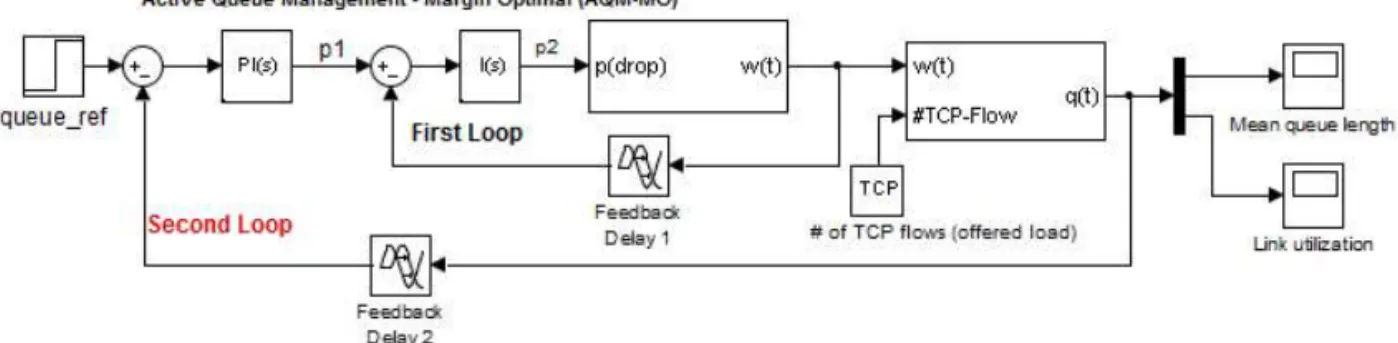
Fig. 1. Active queue management using optimal margin model (AQM-MO).
variants.
3.2 Self-similar bursty traffic generator model In order to generate traffic to bottleneck link, we consider the following self-similar burst traffic generation model. This model is implemented based on the on-off period of Pareto distribution.
One of the important requirements for the simu- lation experiment is to model the network traffic as close to reality as possible. At the moment, our networks usually experience bursty traffic or self-similarity which is a main characteristic of Internet traffic now and future [16]. It has been shown in the literature that self-similar traffic can be generated by multiplexing multiple sources of Pareto-distributed on-off periods. In this context, on periods correspond to a series of bursts sent one after another, and off periods are periods of silence.
The more details can be seen on [17]. Here we summarized the most important result that we will use for our simulation model development later.
. (1)
During the on period of the on-off source, bursts are sent back to back. is average load of each on-off source. is shape parameter, is the dis- tribution of on-off periods. Equation (1) is used to support the implemented code of the self-similar traffic generator module in our simulator.
4. ACTIVE QUEUE MANAGEMENT USING OPTIMAL MARGIN (AQM-MO)
4.1 The transfer function of bottleneck link We follow the fluid-flow approach to model the congested bottleneck link in network router as:
(2)
where
is the bottleneck link capacity (Mbps), R is the round trip time (seconds), N is
number of TCP flows (offered load) and is the round-trip time propagation delay (since con- gestion happens until a sender knows via receiving explicit congestion notification (ECN) bits).
The stable operating point of model (2) can be derived by setting and . Then we obtain:
Doing linearizing around operating point
and using small signal model in control theory, we can get the TCP/AQM transfer function in Laplace domain which model the bottleneck link as follows:
(3)
where
4.2 Designing controllers using optimal margin method
Two controllers for two loops are designed us- ing optimal margin method in control theory. The main transfer function (3) is then decomposed into two parts for designing purpose. The first one con- trols dropping probability
based on traffic in- formation while the second one controls dropping probability
based on the difference between measured average queue length and reference sig- nal (Fig. 1).
F irst loop: the requirement for this loop is fast response to input changes. From [18], the objective function for this loop can be represented by a linear first-order function:
; where
and are integrator coefficient and
sampling time interval, respectively. The close-
loop transfer function of the first loop follows:
(4)
To satisfy the system quality of (4), the output should be nearly same to the input signal. In the other words, the controller
should make the image in frequency domain , ∀ . This is called optimal margin method in control theory. However, due to several practical reasons (disturbance, noises, complex systems. etc.), this requirement is rarely satisfied for all frequencies
. An acceptable design is that ≈ in a wide band of low frequencies as possible. We do experi- ment and then propose the sampling time interval of
such that
. This heuristic of close-form expression of
can be used to make decision for design the first loop control.
Second loop: the second loop design can be ap- proached in the same way. We have the closed- loop transfer function of the second loop as equa- tion (5).
sec
sec
(5)
The difference from the first loop is that the ob- jective function here is a linear third-order type, due to include of . Hence, we should choose a proportional-integral-derivative PID controller, and by using optimal margin, ≈ . Then the controller of the second loop is derived as follow- ing:
where