178 This is an Open-Access article distributed under the terms of the Creative Commons Attribution Non-Commercial License (http://
creativecommons.org/licenses/by-nc/3.0) which permits unrestricted non-commercial use, distribution, and reproduction in any medium, provided the original work is properly cited.
J. Mushrooms 2017 December, 15(4):178-182 http://dx.doi.org/10.14480/JM.2017.15.4.178 Print ISSN 1738-0294, Online ISSN 2288-8853
© The Korean Society of Mushroom Science
*Corresponding author E-mail : [email protected] Tel : +82-41-584-5884 Received November 19, 2017 Revised November 27, 2017 Accepted November 29, 2017
GAP 양송이버섯 재배를 위한 위해물질 분석
이병의1,* · 김태현1 · 이찬중2 · 김용균3 · 이병주3
1순천향대학교 산학협력단 지역혁신센터
2농촌진흥청 국립원예특작과학원 인삼특작부 버섯과
3충청남도농업기술원 작물연구과3
Good Agricultural Practices (GAP) analysis of hazardous materials in button mushroom (Agaricus bisporus)
Byung-Eui Lee1,*, Tae-Hyun Kim1, Chan-Jung Lee2, Yong-Gyun Kim3, and Byung-Joo Lee3
1RIC, Industry Academy Cooperation Foundation, Soonchunhyang University, Asan 31538, Korea
2Mushroom Research Division, NIHHS, RDA, Eumseong 27709, Korea
3Crop Research Division, Chungcheongnam-do Agricultural Research & Extension Services, Yesan 32418, Korea
ABSTRACT: Good Agricultural Practices (GAP) is the world's leading quality certification for food safety. Since its introduction in Korea in 2006, its importance has been increasing every year. In particular, food safety issues are becoming increasingly important in society, and food safety is directly linked to health. The core of GAP certification is the traceability of the production, distribution, and consumption of hazardous materials, including pesticide residues, heavy metals, and microbes. In the present study, pesticides and heavy metals in button mushroom (Agaricus bisporus) and associated cultivation materials were analyzed. Tricyclozole (0.0144 ppm), flubendiamide (0.147 ppm), and trifloxystrobin (0.0340 ppm) were detected in rice straw and wheat straw, and carbendazim (0.0142 ppm) was detected in mixed wheat straw and rice straw medium. Lead and cadmium were detected at levels higher than the standard level in rice straw and mixed medium. However, lead and cadmium were not detected in mushrooms, and levels of arsenic and mercury were below the safety limit. Therefore, it was confirmed that the residual pesticides and heavy metals are safely managed in the investigated mushroom species. The results of the present study suggest that if these materials are adequately managed in the surroundings during cultivation, all hazardous materials can be managed during mushroom production.
KEYWORDS: Button mushroom, GAP, Hazarous materials, Heavy Metals, Residual pesticides
서 론
GAP 농산물 인증은 농산물의 생산단계에서 소비자에게
전달되는 판매단계까지의 농산식품 안전관리체계를 구축 하여 소비자에게 안전한 농산물을 공급하고, 우리 농산물 의 안전성확보를 통한 국내 소비자 신뢰제고 및 세계시장 에서 우리 농산물의 경쟁력 강화로 저투입의 지속가능한 농업을 통한 농업환경 보호하고자 하여 2006년 도입되었 다(FAO's Strategy towards a Food Chain Approach for Food Safety and Quality).
버섯은 대표적인 건강식품으로서 전 세계적으로 다양한 버섯류가 매일 식탁에 오르고 있는데 특히 양송이버섯은 가장 넓게 분포되어 재배되는 버섯이다(Hood et al, 2004). 버섯류 중에서 단백질 매우 높고, 식이섬유와 비타 민 D2, D4가 풍부하여 현대인의 건강에 매우 유익한 버 섯으로(Irazoqui et al, 1997; Nasiri et al, 2013, Urbain et al 2016). 약리학적으로는 혈당과 콜레스테롤을 낮추고 그밖에 항산화, 면역력증강 및 항암효과 등이 알려져 있
다(Jeong et al, 2010; Kent et al, 2003; Barros et al, 2008; Jagadish et al, 2009).
국내의 양송이버섯의 재배는 1960년대 후반부터 볏짚 을 이용한 재배가 이루어지고 있는데 현재까지 재배방식 이 기존의 재배방식으로 생산되고 비하여 양송이재배 선 진국인 유럽, 미국 등 외국에서는 발효방식 및 시설이 선 진화되어 위생적이고 친환경적인 환경시스템이 보급되어 있어 GAP 인증에 따른 관리가 편리하게 시행되고 있으나 대부분의 국내 양송이버섯 재배환경은 시설과 인식에 대 한 부족으로 아직도 선진국들과는 차이가 있어 이러한 요 인 등으로 국내 양송이버섯의 GAP 인증이 5% 수준에 머 무르고 있으므로 날로 GAP 인증에 대한 중요성이 국내·
외적으로 증가하고 소비자의 인식도 농산물 안전에 대한 관심이 높아지고 있다(Kim et al, 2010). 특히 GAP 인증 은 이력추적제를 기반으로 다른 인증보다도 잔류농약ㆍ중 금속 및 미생물에 대한 위해물질관리가 핵심사항이다. 잔 류농약과 중금속은 국내 소비자들이 농산물의 안전에서 가장 중요하게 생각하는 요소이며 미생물에 대한 위해성 도 농산물의 위해성도 위험성이 높은 항목이므로 GAP 인 증의 중요성은 점차 높아질 현실이다.
이렇게 GAP 인증에 대한 중요성으로 많은 재배농가에 서 인증에 대한 관심은 많지만 선뜻 도입하기에 어려움이 있기에 본 연구에서는 GAP의 인증을 취득하고 지속적으 로 관리할 수 있는 기초자료로 활용되도록 본 연구를 수 행하였다.
재료 및 방법
본 연구는 사용한 주원료 볏짚은 국내산(충남 부여, 경 기 김포), 밀짚은 파키스탄산을 사용하였으며 그밖에 솜 과 옥수수대는 중국산을 사용하였으며, 양송이버섯은 동 일 재배농가에서 재배한 버섯을 사용하였다.
잔류농약 및 무기물 분석
잔류농약의 GC 기기분석조건은 NAQS의 GC 기기분석 조건을 사용하였고, Culumn은 DB-5(30 m ×0.25 mm(i.d), 0.25 um)를 사용하였다. 표준용액은 0.05, 0.1, 0.2, 0.5 및 1.0 mg/kg으로 총 5point를 사용하여 표준검량곡선을 그 렸다. 사용장비는 Agilent GC 7890으로 GC의 micro- ECD검출기를 사용하여 시료를 1 uL씩 GC에 주입하여 나타난 chromatogram 상의 peak 면적을 표준검량선과 비 교하여 농약의 잔류량을 산출하였다.
잔류농약의 LC-MS/MS 분석기기는 Finnigan Surveyor HPLC system with autosampler를 사용하였으며, Culumn 은 Capcell PAK MGII (100 × 2.0 mm, 3 µm, Shiseido) 를 사용하였다. 표준용액은 0.01, 0.02, 0.05, 0.1, 0.2, 0.5, 1.0 및 2.0 mg/kg으로 총 8point를 사용하여 표준검 량곡선을 그렸다. 사용장비는 Thermo사의 TQS Quantum
Discorvery MAX으로 LC-MS/MS검출기를 사용하여 시 료를 5 uL씩 주입하여 나타난 chromatogram 상의 peak 면적을 표준검량선과 비교하여 농약의 잔류량을 산출하 였다.
무기물(중금속)분석
무기물(중금속)의 분석은 ICP(Perkin Elmer) 기기를 사용하였다. 분석을 위한 전처리 과정으로는 검체를 건 조시킨 후 분쇄하여 극초단파분해용 용기에 검체 0.2 g 달아 넣은 후 질산 7 ml 를 넣어 극초단파 분해장치에 장착하여 최고온도 200oC에서 30분간 분해한 후 상온으 로 식힌 다음 분해물을 50mL 용량플라스크에 옮기고 용 기 및 뚜껑을 씻어 넣고 물을 넣어 전체량을 50 mL로 조절하였으며, 공시험액도 검액과 동일한 조건으로 처리 하였다.
볏짚과 밀짚의 잔류농약 분석결과 볏짚에서는 Tricyclazole 0.0104ppm과 Flubendiamide 0.147 ppm이 검출되었으며 밀짚에서는 Trifloxystrobin 성분이 0.0340 ppm이 검출되었 으나 Tricyclazole과 Flubendiamide의 잔류농약 최대 허용 기준이 기타농산물 기준 0.05 ppm이며, Trifloxystrobin의 잔류농약은 최대 허용기준이 0.2 ppm이므로 검출된 성분 및 항목과는 관련이 없으므로 버섯재배용 원재료로 적합 한 것으로 판단되었다.
볏짚과 밀짚, 옥수수대, 솜의 등의 혼합배지에 대한 1, 2차 잔류농약 분석결과 Tricyclazole는 볏짚 70% + 밀짚 30% 시료군에서 최대 0.0306 ppm 검출되어 기준치 이하 였으며, Flubendiamide도 볏짚 80% + 솜 20% 시료군에 서 최대 0.0280 ppm 검출되어 기준치 이하였다. 살진균제 성분인 Carbendazim은 밀짚 80% + 볏짚 20% 시료군에 서만 0.0142 ppm 검출되었다. Carbendazim은 강한 독성 을 가지고 있어 세계보건기구의 기준치는 0.01 ppm 이하 로 규정되어 있어 버섯으로의 이행 또는 검출이 중요하다 고 판단되었다.
볏짚과 밀짚의 중금속 분석결과 볏짚은 납(Pb)은 최대 14.43 ppm, 카드뮴은 15.74 ppm 검출었으며, 비소(As)는 최대 3.02 ppm과 수은(Hg) 0.05 ppm 검출되었다. 양송이 버섯의 중금속 기준치가 납과 카드뮴 모두 0.3 ppm이라 규정되어 있어 버섯으로의 이행 또는 검출이 중요하다고 판단되었다.
볏짚과 밀짚, 옥수수대, 솜의 등의 혼합배지에 대한 1, Table 1. Analysis of residual pesticides in rice straw and straw
Type(ppm) Rice straw Straw
Tricyclazole 0.0104 -
Flubendamide 0.0147 -
Trifloxystrobin - 0.0340
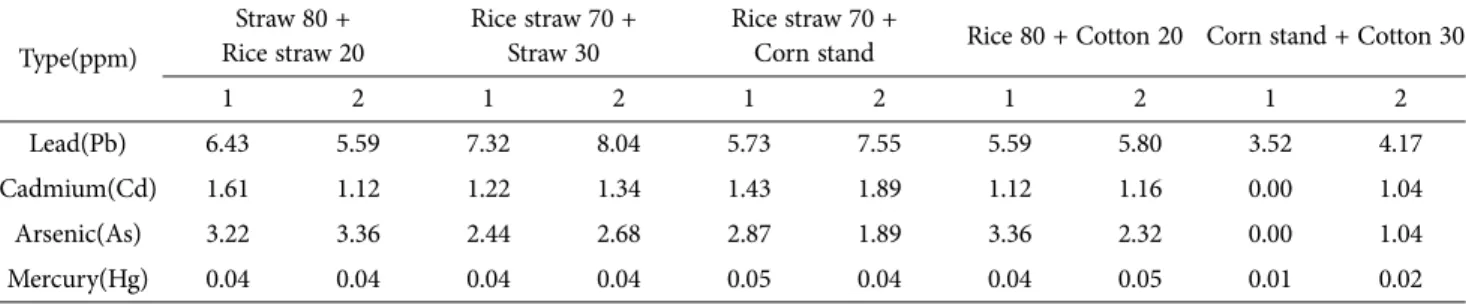
2차 중금속 분석결과 납(Pb)이 볏짚 70% + 밀짚 30% 시 료군에서 최대 8.04 ppm 검출되었으며, 카드뮴(Cd)은 볏 짚 70% + 옥수수대 30% 시료군에서 최대 1.89 ppm 검 출되어서 혼합배지에서 납과 카드뮴의 주 검출 원인는 볏 짚으로 판단되었으며, 그밖에 비소(As)와 수은(Hg)은 볏 짚 시료 수준에서 검출되었다. 혼합배지에서도 납과 카드
뮴의 검출함량이 양송이버섯의 중금속 기준보다 높아 버 섯으로의 이행 또는 검출이 중요하다고 판단되었다.
볏짚배지와 볏짚, 밀짚, 옥수수대, 솜 등의 혼합배지에 서 생산된 양송이버섯을 잔류뇽약 245종에 대한 분석을 실시하였다. 분석결과 6종의 양송이버섯 시료 전부 잔류 농약이 검출되지 않았다(검출한계 0.002 ppm). 따라서 배 지에서 일부 검출된 잔류농약은 버섯으로의 이행이 없음 을 확인하였다.
볏짚배지와 볏짚, 밀짚, 옥수수대, 솜 등의 혼합배지에 서 생산된 양송이버섯을 중금속 분석을 실시하였다. 분석 결과 6종의 양송이버섯 시료 전부 양송이버섯 중금속 기 준인 납과 카드뮴은 검출되지 않았으며 비소도 불검출 되 었으며 수은만이 최대농도 0.02 ppm 수준으로 검출되어 배지에 함유된 중금속이 버섯으로의 이행 없이 안전함을 확인하였다.
Table 2. Analysis of residual pesticides in mixed media
Type(ppm) Straw 80
+ Rice straw 20
Rice straw 70 + Straw 30
Rice straw 70
+ Corn stand Rice 80 + Cotton 20 Corn stand + Cotton 30
Tricyclazole 0.0017 0.0270 0.0279 0.0182 0.0021
Flubendamide 0.0168 0.0153 0.0049 0.0231 -
Carbendazim 0.0071 - - - -
Table 3. Analysis of heavy metal contents in rice straw and straw
Type(ppm) Rice straw
Straw
1 2
Lead(Pb) 14.43 7.54 0.00
Cadmium(Cd) 1.31 1.51 0.00
Arsenic(As) 1.31 3.02 0.00
Mercury(Hg) 0.04 0.05 0.01
Table 4. Analysis of heavy metal contents in mixed media Type(ppm)
Straw 80 + Rice straw 20
Rice straw 70 + Straw 30
Rice straw 70 +
Corn stand Rice 80 + Cotton 20 Corn stand + Cotton 30
1 2 1 2 1 2 1 2 1 2
Lead(Pb) 6.43 5.59 7.32 8.04 5.73 7.55 5.59 5.80 3.52 4.17
Cadmium(Cd) 1.61 1.12 1.22 1.34 1.43 1.89 1.12 1.16 0.00 1.04
Arsenic(As) 3.22 3.36 2.44 2.68 2.87 1.89 3.36 2.32 0.00 1.04
Mercury(Hg) 0.04 0.04 0.04 0.04 0.05 0.04 0.04 0.05 0.01 0.02
Table 5. Analysis of residual pesticides in button mushroom
Type(ppm) Button mushroom
1 2 3 4 5 6
Residual Pesticide ND ND ND ND ND ND
*ND : Not detection
Table 6. Analysis of heavy metal contents in button mushroom
Type(ppm) Button mushroom
1 2 3 4 5 6
Lead(Pb) ND ND ND ND ND ND
Cadmium(Cd) ND ND ND ND ND ND
Arsenic(As) ND 0.88 0.94 0.98 ND ND
Mercury(Hg) 0.020 0.016 0.015 0.010 0.014 0.006
*ND : Not detection
결과 및 고찰
GAP 양송이버섯 재배를 위한 위해물질 환경설정을 위 한 원재료와 양송이버섯의 잔류농약과 중금속 분석결과 원재료인 볏짚에서는 잔류농약 성분으로 도열병 방제약제 인 Tricyclazole이 0.0104 ppm이 검출되었으며 볏짚과 옥 수수대의 혼합배지에서는 0.0279 ppm 검출되었다. 살충 제성분인 Flubendiamide는 볏짚에서 0.0147 ppm 검출되 었으며 볏짚과 솜의 혼합배지에서는 0.0231 ppm 검출되 었다. Trifloxystrobin은 밀짚에서만 0.0340 ppm 검출되었 으며 Carbendazim은 밀짚과 볏짚의 혼합배지에서만 0.0071 ppm 검출되었다. 그러나 동일배지로 재배한 양송이버섯 6종은 모두 잔류농약이 불검출되어 배재단계에서의 배지 와 버섯의 잔류농약 연관성이 없음을 확인하였다. 중금속 은 볏짚을 비롯한 혼합배지에서 납과 카드뮴이 모두 검출 되었으며 납은 볏짚 시료에서 14.43 ppm으로 가장 높게 검출되었으며 카드뮴은 밀짚과 볏짚의 혼합시료에서 1.61 ppm으로 가장 높게 검출되었다. 비소는 밀짚과 볏짚 혼합배지에서 3.37 ppm으로 가장 높게 검출되었으며 수 은은 볏짚과 옥수수대 혼합배지에서 최대 0.05 ppm과 옥 수수대와 솜의 혼합배지에서 0.01 ppm으로 가장 적게 검 출되었으며 대부분 0.04 ppm 수준으로 검출되었다. 따라 서 중금속 성분은 식품공전상 양송이버섯의 중금속 기준 은 느타리버섯, 큰느타리버섯, 표고, 송이버섯, 팽이버섯, 목이버섯과 동일한 0.3 ppm 이하이나 배지에서 기준치 이 상보다 월등히 높게 검출된 시료군들이 많아서 배지에 함 유된 중금속과 이러한 배지에서 재배한 양송이버섯의 이 행간계가 매우 중요하였으나 6종의 양송이버섯 시료군 모두 중금속 검사항목인 납과 카드뮴이 불검출되었으며 비소는 최대 1 ppm 이하로 검출되었으며 수은도 최대 0.02 ppm 이하에서 검출되어 양송이버섯의 위해 중금속 은 매우 안전한 것으로 확인되었다.
GAP 양송이버섯 재배를 위한 위해물질 환경설정에 대 한 연구결과 양송이버섯의 잔류농약과 중금속은 GAP 기 준에 매우 적합하게 위해물질이 관리됨으로 안전한 농산 물임을 확인하였다.
적 요
GAP는 식품안전에 대한 세계적인 품질인증으로서 2007년 국내에서 도입된 이래 식품안전에 대한 중요성이 사회적인 이슈로서 해마다 국가 및 소비자의 관심이 커지 고 있다. 최근에는 살충제가 검출된 달걀이 일부 시중에 시판됨으로서 식품안전에 대한 관심이 식탁에 오르는 모 든 식품과 식자재에 대한 관심과 불안으로 이어지고 있어 본 연구에서 국산 양송이버섯에 대한 안전성을 검증하고 재배과정에부터 잔류농약과 중금속 등 위해물질을 관리 함으로서 재배자의 건강부터 소비자의 안전까지 확보할
있는 GAP 기준의 양송이버섯 재배는 현시점에 매우 중 요하다. 연구결과 양송이버섯의 잔류농약 검사항목인 Diflubenzuron과 Prochloraz의 불검출과 245종 잔류농약 분석결과 6종의 양송이버섯 모두 불검출로 확인되어 잔류 농약에 대한 안전성을 확인하였다. 그러나 연관된 연구결 과 재배과정에서 농약의 사용 시 일부 잔류농약이 검출될 가능성이 있으므로 재배과정에서는 농약사용을 근본적으 로 제어할 수 있도록 재배사 및 주변 환경관리를 철저히 하는 것이 매우 중요하다. 중금속 분석결과도 배지에서는 양송이버섯의 중금속 분석기준인 납과 카드뮴이 모두 기 준치 이상으로 검출되어 버섯으로의 이행에 대한 결과가 매우 중요하였으나 6종의 양송이버섯 시료군 모두 납과 카드뮴이 불검출 되었으며 비소와 수은도 안전한 수준으 로 확인되어 양송이버섯의 안전성을 확인하였다.
결과적으로 잔류농약과 중금속에 대한 국내산 양송이버 섯의 안전성은 충분히 검증되어 GAP 인증 수준에서 적절 하게 관리되고 있으며 재배과정에서의 각종 오염원, 물관 리 등 모든 주변관리는 잔류농약 및 중금속에 대한 위해 성을 충분히 관리할 수 있을 뿐만 아니라 GAP 인증에서 위해요소인 미생물관리에도 연관되어 있으므로 재배자와 재배사 및 재배환경에 대한 전반적인 상시관리는 GAP 양 송이버섯 재배에서 매우 중요한 요소로 판단한다.
감사의 글
본 연구는 농촌진흥청 공동연구과제(PJ011125042017) 에 의하여 수행된 연구결과입니다.
References
Barros L, Falcao S, Baptista P, Freire C, Vilas-Boas M, Ferreira ICFR. 2008. Antioxidant activity of Agaricus sp. mushrooms by chemical, biochemical and electrochemical assays. Food Chem 111:61-66.
FAO's Strategy towards a Food Chain Approach for Food Safety and Quality. Food and Agriculture Organization of the United Nations.
Food industry dictionary. 2011. KFDA
Kim HK, Lee BJ, Kim YG, Yun YU, Yang ES, Kim HG.. 2010.
Study of the composting method using wheat straw on Agaricus bisporus cultivation. J mushroom sci product. 8: 33- 36.
Hood IA, Beets PN, Kimberley MO, Gardner JF, Oliver GR, Pearce S. 2004. Colonisation of podocarp coarse woody debris by decomposer basidiomycete fungi in an indigenous forest in the central North Island of New Zealand. Forest Ecol Manag 196:311-325.
Irazoqui FJ, Zalazar FE, Nores GA, Vides MA. 1997. Agaricus bisporus lectin binds mainly O-glycans but also N-glycans of human IgA subclasses. Glycoconjugate J 14:313-319.
Jagadish LK, Krishnan VV, Shenbhagaraman R, Kaviyarasan V.
2009. Comparative study on the antioxidant, anticancer and
antimicrobial property of Agaricus bisporus (J. E. Lange) Imbach before and after boiling. Afr J Biotechnol 8:654-661.
Jeong SC, Jeong YT, Yang BK, Lslam R, Koyyalamudi SR, Pang G, Cho KY, Song CH. 2010. White button mushroom(Agaricus bisporus) lowers blood glucose and cholesterol levels in diabetic and hypercholesterolemic rats. Nutri Research 30:49- 56
Kent D, Sheridan C, Tomkinson HA, White S, Hiscott P, Grierson I. 2003. Edible mushroom (Agaricus bisporus) lectin modulates human retinal pigment epithelial cell behaviour in vitro. Exp Eye Res 76:213-219.
Llarena-Hemandez CR, Largeteau ML, Ferrer N, Regnault-Roger C, Savoie JM. 2014. Optimization of the cultivation conditions for mushroom production with European wild strains of Agaricus subrufecens and Brazilian cultivars. J Sci Food Agric. 15, 94:77-84.
MRLs for Pesticides in Foods. 2012. KFDA
Urban P, Valverde J, Jakobsen J. 2016. Impact on Vitamin D2, Vitamin D4 and Agaritine in Agaricus bisporus Mushrooms after Artifical and Natural Solar UV Light Exposure. Plant Foods Hum Nutr. 71:314-321.