Introduction
Coral reef fishes are well known for their high species diversity. On many reef habitats, diffe- rent families or guilds are represented by as many as 20~50 different species of the wrasse (La- bridae), groupers (Serranidae) and dam-selfishes (Pomacentridae). Many species of these families
seem to be similar in appearance to each other and frequently there is considerable apparent overlap in general habitats and foods (Randall, 1967; Hobson, 1974).
Of the coral reef fishes, damselfishes (Teleost- ei: Pomacentridae) are a diverse and widespread family. They are found throughout the tropical oceans and form a major component of coral reef communities (Allen, 1975), but some species are also found in temperate regions (Allen, 1989).
Species Identification and Molecular Phylogenetic Position of Korean Damselfishes (Pomacentridae: Chrominae)
Based on DNA Bioinformation
Jeong Rack Koh* and Yung Chul Park
1Fisheries Resources Restoration Development and Management Center,
National Fisheries Research & Development Institute (NFRDI), Gijang-gun, Busan, Korea
1
Research Institute of EcoScience, Ewha Womans University, Seodaemun-gu Daehyun-dong 11-1, Seoul 120-750, Korea
The subfamily Chrominae of damselfishes (Teleostei: Pomacentridae) includes the genus Chromis and Dascyllus. They are found throughout the tropical oceans and form a major component of coral reef communities. There are 5 species of the Chro- minae currently recognized in Korea. This study was conducted to infer phylogenet- ic position of two Korean Chromis species and one Dascyllus species within general category of their each genus in worldwide level. This study also includes one species of Japanese Dascyllus. In the phylogenetic analysis, the Japanese D. aruanus group- ed with D. aruanus previously reported from French Polynesia. Korean Chromis fumea grouped with Australian C. nitida and the p-distance value between the two species is relatively very low (0.047). Korean C. notatus grouped together with C.
flavomaculata (New Caledonia). In the sequence analysis of some Korean and Japan- ese damselfishes, there was no sequence variation between D. melanurus (Jeju, Korea) and D. melanurus (Indo-Pacific), but the sequences of the two populations were different in only one nucleotide sites from that of D. melanurus in Indonesian Archipelago. The sequences of Dascyllus aruanus (Japan) were different in two nu- cleotide sites from it in French Polynesia. There were high difference between the sequences of two Korean species, Chromis fumea and Korean C. notatus. The varia- tions among mitochondrial cytochrome b sequences indicate that the gene sequence could be used as DNA barcode for identification of local populations of D. aruaus and D. melanurus as well as species level.
Key words : damselfishes, Chrominae, Chromis, Dascyllus, Chromis notatus, Chromis fumea, Pomacentridae
*Corresponding author: [email protected]
─
─ 274 ─ ─
Since most of the pomacentrid species live in coral reefs and tidal zones, their habitats are usually located in shallow water (within 20 m below the water surface) of near shore, though several species live in deeper zones than 100 m (Allen, 1975).
Pomacentridae is currently recognized as a mem- ber of the perciform suborder Labroidei (Nelson, 1994) including the families Cichlidae, Embioto- cidae, and Labridae (Kaufman and Liem, 1982;
Stiassny and Jensen, 1987), but the monophyly of this suborder has been questioned by recent molecular studies (Rosen and Patterson, 1990;
Johnson, 1993; Streelman and Karl, 1997). There are approximately 350 pomacentrid species recog- nized in worldwide and they belong to 29 genera of the following four subfamilies: Amphiprioni- nae, Chrominae, Lepidozyginae, and Pomacentri- nae (Allen, 1975, 1991). The majority of pomacen- trid diversity is dependant on two subfa-milies of the Chrominae (over 80 species) and Pomacen- trinae (over 200 species).
The species relationships within the subfamily Chrominae have ever been inferred in the recent studies conduced to understand phylogenetic rela- tionship of pomacentrid fishes (Tang, 2001; Jang- Liaw et al., 2002; Quenouille et al., 2004). The subfamily Chrominae includes four genera of Chromis, Dascyllus, Acanthochromis and Mec- aenichthys, and its monophyly has been support- ed to date based on morphological characters (Allen, 1975). Since the recent analyses of the molecular dataset (Tang, 2001; Jang-Liaw et al., 2002; Quenouille et al., 2004) indicated that the genera Mecaenichthys and Acanthochromis, two putative members of Chrominae, were posited within the subfamily Pomacentrinae, their mono- phyly appeared to be doubt. Within the subfam- ily Chrominae, there was strong support for the monophyly of the clades of Chromis and Dascy- llus, and the genus Chromis within the clade was found to be paraphyletic relative to the genus Dascyllus.
In Korea, the phylogenetic relationship of Kore- an Chrominae has been poorly known to date. In Korea, 16 species of Pomacentridae have been described to date, 5 species of them belong to the subfamily Chrominae (C. notatus, C. analis, and C. fumea of the genus Chromis and D. trimacula- tus and D. melanurus of the genus Dascyllys) (Koh et al., 1997; Kim et al., 2005). Recent accumu- lation of molecular data provides an opportunity to infer phylogenetic relationship of Korean
Chrominae in a broader view, extending beyond regional fauna.
Aim of this study is to infer the phylogenetic position of three Chrominae species of two gene- ra (C. notatus, C. fumea and D. melanurus) and one species of Japanese Dascyllus. We sequenced mitochondrial cytochrome b sequences from the Chrominae species, and to infer the phylogenetic position of Korean species in world wide point of view we combined our sequences with ones previ- ously reported from various regions. National consortium for construction of DNA barcode sys- tem has been increasing importance in the identifi- cation of organism (Larson, 2007). DNA barcode is short sequences that could be used for identi- fication of organisms in various levels like indivi- duals, populations and species. We discuss utility of cytochrome b sequences as DNA barcode for identification of local populations and species.
Materials and Methods
1. Taxon collection and DNA extraction We collected two species of the genus Chromis (C. fumea and C. notatus) and one species of the genus Dascyllus (D. melanurus) from the costal water of Jeju-do (island) (Table 1). Two individu- als from each species were used for DNA extrac- tions. Tissues for DNA extractions were severed from bodies of samples preserved in 100% ethanol, and then were dried on a heating block several times to remove excess ethanol. The genomic DNA was extracted using the chloroform with some modifications of the methods in Park et al. (2004).
After vortexing for 1 min, body tissues were wash- ed in 1.5 mL microcentrifuge tube containing 500 µ L of cold (4� C) 5% citric acid. After centrifuga- tion at 8,000 rpm for 5 min, the tissues were homo- genized with a pair of dissecting scissor in 1.5 mL microcentrifuge tube containing 500 µL of lysis buffer (100 mM Tris-HCl, 5 mM EDTA, 0.2%
SDS, 200 mM NaCl) and 50 µ L of proteinase K.
The mixtures were digested overnight at 56� C.
Total genomic DNA was extracted with an equal volume of chloroform, precipitated with an equal volume of isoprophyl alcohol (isopropanol), and dissolved in 40 µ L of distillized water.
2. DNA amplification, purification and sequencing
The fragments of mitochondrial cytochrome b
sequences were amplified using polymerase Chain Reaction (PCR). Primer sequences for the amplifications of the gene sequence are as fol- lows: GULDG (5 ′ -tgacttgaaraaccaycgttg-3 ′ ) (Palumbi, 1996) and H16460 (5 ′ -cgaycttcggatta- caagaccg-3′) (Quenouille et al., 2004). The poly- merase chain reaction was carried out in 20 µ L volumes, using 2.0 µ L of 1 to 10 dilution of geno- mic DNA as template. The PCR reactions includ- ed 2.0 µ L of 5 mM each primer, 2.0 µ L of dNTPs at 10 mM, 2.0 µL of 25 mM MgCl
2, 2.0 µL of 10X buffer and 1 units of Taq Polymerase. The tempera- ture profile for amplifying the cytochrome b sequences was as follows: a denaturation at 94� C for 10 min, and 35 cycles of 94� C for 30s, 48~52� C
for 40s, and 72� C for 40s followed by a final exten- sion of 72� C for 2 min. PCR products were puri- fied using UltraClean PCR Clean-up Kit (MO BIO Laboratories, Inc.), and sequenced in Bio- nics in Korea (http://www. bionicsro.co.kr/).
3. Data analysis
Sequences were aligned using the Clustal X program package (Thompson et al., 1997) and manually edited using SeAl 1.0a (Rambaut, 1996).
We sequenced the size of 517 bp in Dascyllus melanurus and D. aruanus and 642 in two Chro- mis species, and the sequences of the Korean taxa were aligned together with 37 previously
Table 1. Species used in this study, with collection locality, GenBank accession numbers for sequences and references
Species Collection locality Accession No. References
Dascyllus aruanus* Japan EU267222 Current study
D. aruanus French Polynesia AF119399 Bernardi and Crane, 1999
D. melanurus* Jeju Island, Korea EU267221 Current study
D. melanurus Indonesian Archipelago AF119395 Bernardi and Crane, 1999
D. melanurus Indo-Pacific AF097924 Elliott et al., 1999
D. flavicaudus French Polynesia AF119394 Bernardi and Crane, 1999
D. albisella Kona, Hawaii AF119396 Bernardi and Crane, 1999
D. carneus Indian Ocean AF119397 Bernardi and Crane, 1999
D. marginatus Red Sea AF119398 Bernardi and Crane, 1999
D. reticulatus Western Pacific AF119400 Bernardi and Crane, 1999
D. trimaculatus French Polynesia AF119393 Bernardi and Crane, 1999
D. trimaculatus Maldives AY208545 Quenouille et al., 2004
Chromis fumea* Jeju Island, Korea EU267219 Current study
C. notatus* Jeju Island, Korea EU267220 Current study
C. agilis New Caledonia AY208522 Quenouille et al., 2004
C. amboinensis New Caledonia AY208523 Quenouille et al., 2004
C. atrilobata Panama AY208524 Quenouille et al., 2004
C. atripectoralis Australia AY208525 Quenouille et al., 2004
C. atripes New Caledonia AY208526 Quenouille et al., 2004
C. chromis France AY208527 Quenouille et al., 2004
C. chromis Orbetello, Italy AF119392 Bernardi and Crane, 1999
C. chrysura New Caledonia AY208528 Quenouille et al., 2004
C. cyanea Jamaica AY208529 Quenouille et al., 2004
C. flavomaculata New Caledonia AY208530 Quenouille et al., 2004
C. iomelas French Polynesia AY208531 Quenouille et al., 2004
C. margaritifer New Caledonia AY208532 Quenouille et al., 2004
C. multilineata Jamaica AY208533 Quenouille et al., 2004
C. nitida Australia AY208534 Quenouille et al., 2004
C. retrofasciata New Caledonia AY208535 Quenouille et al., 2004
C. viridis Japan AY208536 Quenouille et al., 2004
C. weberi Australia AY208537 Quenouille et al., 2004
C. xanthopterygia Gulf of Oman AY208538 Quenouille et al., 2004
C. caudalis Republic of Palau AY289557 Johns and Somero, 2004
C. punctipinnis California, USA AY289559 Johns and Somero, 2004
C. xanthochira Republic of Palau AY289561 Johns and Somero, 2004
Abudefduf sordidus Ascension Isl. AY208556 Quenouille et al., 2004
A. taurus Panama AY208559 Quenouille et al., 2004
*Species marked with an asterisk are to be sequenced for this study.
published sequences of the Chrominae from other regions (Table 1). The sequence alignment of 37 individuals including two outgroup species generated a dataset of 642 bp in length.
We used maximum parsimony (MP) and NJ analyses and Bayesian analysis, to infer the phylogenetic positions of the Korean Chrominae within the subfamily Chrominae in worldwide.
We performed MP and NJ analyses implemented in PAUP4.0* version beta 10 (Swofford, 2002) Bay- esian analysis was performed by using MrBayes version 3.0b4 (Huelsenbeck and Ronquist, 2001).
Neighbor-joining analyses was also conducted for calculating pairwise genetic distance (p-dis- tance). The p-distances were corrected using the model obtained from the model test. NJ trees were produced under the model obtained from the model test, and topological reliability of the NJ trees was explored using 1,000 pseudorepli- cates.
In MP analyses, topological space was explored using a heuristic search, with 10 random sequ- ence additions holding 5 trees at each step, and with TBR branch swapping. Bootstrap support was calculated using 1,000 pseudoreplicates with the same searching protocol as for the heuristic search.
We determined the most appropriate substi- tutional model using a series of hierarchical like- lihood ratio tests implemented with Model Test 3.06 (Posada and Crandall, 1998). Bayesian analy- sis was performed to estimate under the best-fit model determined by Model test. In the analysis of the dataset using Mr. Bayes v. 3.04b, Monte Carlo Markov chains were run for 200,000 genera- tions. Trees were sampled every 100 generations where the Markov chain reached stationarity, leaving 5,000 trees for analysis.
Results
1. Phylogenetic analyses
The MP and Bayesian analyses were conducted for the combined dataset of the two generea. The tree topologies did not differ in both the analyses (Fig. 1 and 2). For the dataset, Model test 3.06 identified a likelihood setting from best-fit model
⁄GTR
++I
++G¤. Likelihood details identified by the Model test are the following: Base= =0.2763 (A), 0.3821 (C), 0.1241 (G), 0.21740 (T); Nst= =6 (G- TR); Rmat= = 0.7682, 8.5588, 1.0136, 0.3319,
8.7650; Rates= =gamma (shape= =1.9147); Pinvar= = 0.5991. We used the MrBayes default settings to establish the initial heating values for four Mar- kov chains, and default settings were also used to initially parameterize the GTR model. The four differentially heated Markov chains were initiated from random trees, run simultaneously, and were sampled every 100 cycles. Preliminary runs were performed to monitor the fluctuating value of the likelihoods of the Bayesian trees, and we found that stationarity was consistently observed before 5,000 generations for the data- set. The Markov chain analyses used to infer Pomacentridae phylogenies were run for 200,000 cycles for the dataset. All sampled trees prece- ding stationarity were discarded (“burnin”= =5,000), and the remaining tree samples were used to generate a 50% majority rule consensus tree (= =1,501 trees). The posterior probability of each
Fig. 1. The tree topologies of the genus Dascyllus derived from MP and NJ analyses. Since the topologies of MP and NJ trees are similar, only MP trees are shown. Numbers above/below branches indicate MP/NJ bootstrap values, respectively. In the MP analysis of the genus Dascyllus, a most single parsimonious tree was produced (Tree length= = 344, CI: 0.695, RI: 0.756, RC: 0.525, HI: 0.305). Of 642 characters, 454 characters were constant, and 141 characters were parsimony-informative char- acters. The species marked with asterisk (*) were sequenced in this study.
100 100
70 81 61
53
100 99
100 100 93 90
100 99
74 -
D. melanurus*
D. melanurus D. melanurus D. aruanus*
D. aruanus D. marginatus D. flavicaudus D. albisella D. trimaculatus D. trimaculatus D. reticulatus D. carneus A. sordidus A. taurus 69
- 100 100
Dascyllus a Dascyllus b
clade is provided by the percentage of trees iden- tifying the clade and these are true probabilities given the assumptions of the GTR model. The 95% credibility intervals (CI) for the nucleotide substitution were calculated from the trees sam- pled after the Markov chain analysis reached stationarity.
2. Phylogenetic position of Korean Dascyllus species
Species of the genus Dascyllus grouped togeth- er well by the MP and NJ analyses (100%/ 100%
in MP and NJ, respectively), but within the group, the species formed two main clades (Dascyllus a and b: Fig. 1). Dascyllus melanurus formed a sister to D. aruanus clades with high supporting
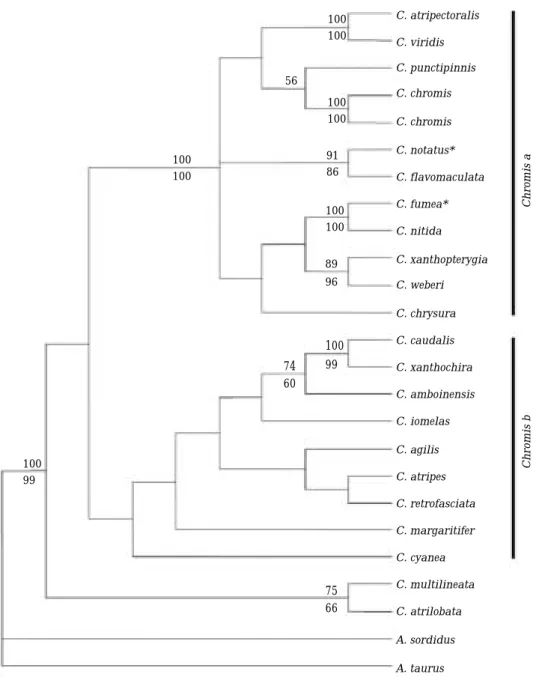
Fig. 2. The tree topologies of the genus Chromis derived from MP and NJ analyses. Since the topologies of MP and NJ trees are similar, only MP trees are shown in each genus. Numbers above/below branches indicate MP/NJ bootstrap values, respectively. The MP analysis of the genus Chromis produced stric consensus of three equally most- parsimonious trees resulting from an equally weighted analysis of the cytochrome b sequences (Tree length= =884; CI:
0.399, RI: 0.516, RC: 0.206, HI: 0.601). In MP analysis, 405 of 642 characters were constant, and number of parsimony-informative characters was 206. The species marked with asterisk (*) were sequenced in this study.
89 96
100 74 99 60
75 66 91 86
100 99
100 100 56 -
100 100
C. atripectoralis C. viridis C. punctipinnis C. chromis C. chromis C. notatus*
C. flavomaculata C. fumea*
C. nitida C. xanthopterygia C. weberi C. chrysura C. caudalis C. xanthochira C. amboinensis C. iomelas C. agilis C. atripes C. retrofasciata C. margaritifer C. cyanea C. multilineata C. atrilobata A. sordidus A. taurus 100
100
100 100
Chromis a Chromis b
value (93%). The Korean D. melanurus grouped well with D. melanurus (Indonesian Archip- elago). Sequence analysis revealed that there is no sequence variation between the two individu-
als. Japanese D. aruanus, which was newly add- ed in this study, also grouped with D. aruanus from French Polynesia.
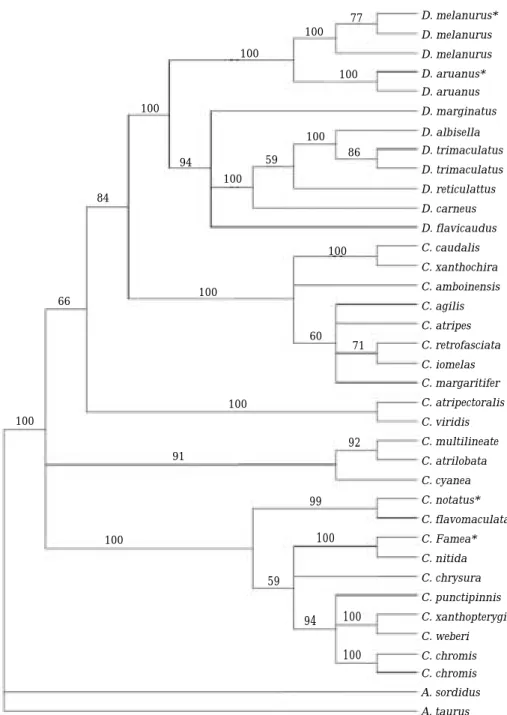
Fig. 3. The 50% majority-rule consensus tree from the Bayesian analysis of the dataset of the cytochrome b sequences representing Chromis and Dascyllus. The Bayesian tree was derived from the consensus topology of 1,500 trees sampled from Bayesian analysis assuming GTR model. All sampled trees preceding stationarity were discarded (“burnin”= =5,000), and the remaining tree samples were used to generate a 50% majority rule consensus tree (= =1,501 trees). The posterior probability of each clade is provided by the percentage of trees identifying the clade and these are true probabilities given the assumptions of the GTR model (Huelsenbeck and Ronquist, 2001).
Numbers on the branches indicate posterior probabilities (PPs) from a consensus a consensus tree of all post burn- in topologies visited by the Markov chain. The species marked with an asterisk (*) were sequenced in this study.
100
100 94 59
99
100 92
77 100
100
100 59 86
100 94
100
100
84
66
100
91
100 100
100
60 71
100
D. melanurus*
D. melanurus D. melanurus D. aruanus*
D. aruanus D. marginatus D. albisella D. trimaculatus D. trimaculatus D. reticulattus D. carneus D. flavicaudus C. caudalis C. xanthochira C. amboinensis C. agilis C. atripes C. retrofasciata C. iomelas C. margaritifer C. atripectoralis C. viridis C. multilineate C. atrilobata C. cyanea C. notatus*
C. flavomaculata C. Famea*
C. nitida
C. chrysura
C. punctipinnis
C. xanthopterygia
C. weberi
C. chromis
C. chromis
A. sordidus
A. taurus
Fig. 4. Nucleotide v ariation in sequence alignments of Dascyllus a ruanus individuals, Dascyllus m elanurus individuals a nd two K orean Chromis species, C. fumea (Jeju) and C. notatus (Jeju).
Table 2. Pairwise genetic distance among the genus Chromis species 1 2 3 4 5 6 7 8 9 10 11 12 13 14 15 16 17 18 19 1 C. atripectoralis - 2 C. caudalis 0.351 - 3 C. multilineata 0.305 0.280 - 4 C. cyanea 0.284 0.232 0.166 - 5 C. amboinensis 0.321 0.076 0.273 0.248 - 6 C. notatus 0.296 0.306 0.212 0.204 0.306 - 7 C. fumea 0.241 0.253 0.217 0.211 0.288 0.175 - 8 C. agilis 0.387 0.126 0.334 0.247 0.091 0.293 0.286 - 9 C. atripes 0.339 0.110 0.282 0.268 0.095 0.322 0.309 0.092 - 10 C. chrysura 0.269 0.263 0.206 0.172 0.265 0.126 0.118 0.260 0.255 - 11 C. punctipinnis 0.357 0.404 0.325 0.309 0.417 0.189 0.296 0.451 0.480 0.216 - 12 C. retrofasciata 0.304 0.155 0.323 0.307 0.127 0.383 0.303 0.129 0.106 0.290 0.493 - 13 C. iomelas 0.358 0.115 0.300 0.256 0.095 0.337 0.323 0.115 0.107 0.282 0.467 0.118 - 14 C. nitida 0.297 0.333 0.275 0.241 0.384 0.199 0.047 0.336 0.373 0.161 0.314 0.335 0.370 - 15 C. xanthopterygia 0.309 0.389 0.270 0.246 0.425 0.214 0.170 0.372 0.422 0.170 0.226 0.372 0.372 0.188 - 16 C. margaritifer 0.328 0.130 0.316 0.284 0.133 0.288 0.262 0.115 0.123 0.259 0.431 0.127 0.117 0.306 0.403 - 17 C. atrilobata 0.268 0.258 0.116 0.176 0.245 0.182 0.212 0.297 0.282 0.161 0.298 0.274 0.270 0.269 0.234 0.266 - 18 C. chromis 0.328 0.385 0.291 0.246 0.358 0.235 0.240 0.333 0.344 0.185 0.216 0.387 0.387 0.303 0.221 0.340 0.272 - 19 C. weberi 0.264 0.330 0.221 0.223 0.368 0.184 0.148 0.328 0.332 0.141 0.177 0.373 0.351 0.176 0.073 0.322 0.209 0.177 - 20 C. chromis 0.314 0.385 0.285 0.244 0.360 0.230 0.215 0.326 0.350 0.190 0.216 0.393 0.398 0.273 0.213 0.354 0.281 0.014 0.171 21 C. viridis 0.130 0.348 0.296 0.268 0.354 0.268 0.262 0.380 0.339 0.265 0.337 0.310 0.353 0.330 0.362 0.326 0.232 0.274 0.301 22 C. flavomaculata 0.245 0.281 0.168 0.194 0.298 0.072 0.154 0.338 0.319 0.115 0.193 0.346 0.342 0.193 0.191 0.283 0.157 0.202 0.158 23 C. xanthochira 0.362 0.009 0.291 0.226 0.078 0.322 0.277 0.135 0.121 0.282 0.422 0.160 0.126 0.361 0.407 0.134 0.251 0.409 0.348 24 A. sordidus 0.387 0.493 0.258 0.365 0.406 0.298 0.363 0.458 0.375 0.267 0.330 0.477 0.451 0.404 0.472 0.480 0.262 0.363 0.384 25 A. taurus 0.443 0.448 0.278 0.319 0.430 0.304 0.345 0.410 0.392 0.272 0.342 0.419 0.382 0.372 0.348 0.439 0.283 0.350 0.341 Thep -distances values were corrected using the likelihood model (GTR model) obtained from the model test.
20 21 22 23 24 25 - 0.275 - 0.193 0.246 - 0.409 0.374 0.299 - 0.339 0.392 0.253 0.520 - 0.356 0.430 0.273 0.480 0.197 -
3. Phylogenetic position of Korean Chromis species
The MP and NJ analyses showed that the genus Chromis is paraphyletic (Fig. 2) and the two- main clades occurred (Chromis a and b: Fig. 2).
Korean Chromis species belong to Chromis b group.
Some terminal branches were supported by high bootstrap values, but most of the branches were collapsed. Korean C. fumea grouped with C. niti- da, supported by high bootstrap values (100%/
100%). The p-distance value between the two species is relatively very low (0.047) (Table 2).
Korean C. notatus and New Caledonian C. flavo- maculata also grouped together, with relatively high supporting values as well.
Phylogenetic relationship was inferred from the combined dataset of the genus Dascyllus and Chromis by the Bayesian analysis (Fig. 3). The Bayesian analysis based on the combined dataset derived a little higher supporting values of each node than the previous analysis. The monophyly of Dascyllus was supported strongly (BP= =100%) and two main clades also still occurred within the genus. The genus Dascyllus formed a sister clade to Chromis b group except C. cyanea. As in MP and NJ analyses, C. notatus was a sister to C.
flavomaculata (BP= =99%) and C. fumea was a sis- ter to C. nitida (BP= =100).
4. Cytochrome b sequence-based species identification
Sequence analysis was conducted for utility of cytochrome b as DNA barcode at eastern Asian local population level or species level (Fig. 4).
There was no sequence variation between D. mela- nurus (Jeju, Korea) and D. melanurus (Indo-Paci- fic), but the sequences of the two populations were different in only one nucleotide sites from that of D. melanurus in Indonesian Archipelago. Accord- ing to sequence identity matrix, the sequence iden- tity between D. aruanus individuals of Korea and Indonesian Archipelago was 0.998 (sequence length= =517 nucleotides).
The sequences of Dascyllus aruanus (Japan) were different in two nucleotide sites from it in French Polynesia. The sequence identity between D. aruanus individuals of the two localities was 0.996 (sequence length= =593 nucleotides).
There was high variation between the sequen- ces of two Korean species, Chromis fumea and Korean C. notatus. The sequence identity of the two species was 0.888 (sequence length= =643
nucleotides).
Discussion
This study was conducted to investigate phyloge- netic position of two Korean Chromis species and one Dascyllus species within general category of their each genus. Monophyly of the subfamily Chrominae was not supported in the previous studies based on molecular datasets. For exam- ple, the genus Acanthochromis (A. polyacanthus) formed a sister clade to the genus Neoglyphi- dodon (Pomacentrinae) (Jang-Liaw et al., 2002;
Quenouille et al., 2004), or Neoglyphidodon and Amblyglyphidodon (Pomacentrinae) (Jang-Liaw et al., 2002). Phylogenetic position of Acantho- chromis was placed in ingroup of Chrysiptera (Pomacentrinae) (Jang-Liaw et al., 2002; Quen- ouille et al., 2004). In case of Mecaenichthys, its phylogenetic position was more basal than the other genera of the subfamily Chrominae, and placed within the subfamily Pomacentrinae as well (Jang-Liaw et al., 2002). This study includes all of the published sequences of the genus Chro- mis and genus Dascyllus, with the exception of the two genera above.
The damselfish genus Dascyllus (Pomacen- tridae) comprises 10 species restricted to the coral reefs in the Indo-West Pacific (Randall and Allen, 1977; Randall and Randall, 2001), and seven species of which occur at islands of Ocea- nia. Our MP and NJ analyses showed well-group- ing of the genus Dascyllus species, but within the group, the species formed two main clades of Dascyllus a and b (Fig. 1). Dascyllus aruanus is widespread throughout the Indo-West Pacific, while D. melanurus has a range embedded in the D. aruanus range, within the Indonesian Archip- elago and south to the Great Barrier Reef. Thus, the grouping of the two species is in agreement with the overlapping habitat distribution of the two species (Planes et al., 1993).
In Korea, two species of Dascyllus (D. trimacu-
latus and D. melanurus) have been reported to
date (Koh et al., 1997; Kim et al., 2005). The
Korean D. melanurus used in this study grouped
well with D. melanurus (Indonesian Archipela-
go). Japanese D. aruanus, which was newly added
in this study, also grouped with D. aruanus
previously reported from French Polynesia
(Bernardi and Crane, 1999). Dascyllus trimacula-
tus, D. albisella and D. reticulates, which have
adjacent ranges (Godwin, 1995; Bernardi and Crane, 1999), grouped together and is a sister group to D. carneus.
There are about 80 Chromis species in world- wide (Allen, 1991), 23 individual of 22 Chromis species were used in this study (Table 1). In Korea, three Chromis species (C. notatus, C.
analis, and C. fumea) occur in the sea near Jeju Island (Koh et al., 1997; Kim et al., 2005). Of the two Korean species used in this study, C. fumea grouped with C. nitida and C. notatus grouped with C. flavomaculata.
Interestingly, p-distance value between C. xan- thochira and C. caudalis was very low (0.009), and the p-value was even lower than that (0.014) between individuals of C. chromis (Table 2). Thus, the taxonomic review appears to be required between the two species. Most of the branches were collapsed in the analysis of the combined dataset of the genus Chromis (Fig. 2), probably because the dataset includes only 25% of total species comprising the genus Chromis.
We investigated the utility of cytochrome b sequences as DNA barcode at eastern Asian local population level or species level. DNA barcode is a new technique for organism identification at various levels, like individuals, local populations and species. It uses a short DNA sequence from a standardized and agreed-upon position in the genome as a molecular diagnostic for organism identification with quick and easy methods. The variations among mitochondrial cytochrome b sequences indicate that the gene sequence could be used as DNA barcode for identification of local populations as well as species level. Sequence size from nucleotide site 100 to 500 was recom- mended for detection of Japanese D. aruanus and Korean D. melanurus (Fig. 4).
Acknowledgements
This work was supported by NFRDI (National Fisheries Research and Development Institute).
The work was also supported by Ewha Womans University Research Grant 2007.
References
Kim, I.S., Y. Choi, C.L. Lee, Y.J. Lee and B.J. Kim. 2005.
Illustrated book of Korean fishes. Kyo Hak Pub. Co., Seoul. pp. 615 (In Korean).
Allen, G.R. 1975. Damselfishes of the South Seas. T. F. H.
Publications, Neptune City, NJ.
Allen, G.R. 1991. Damselfishes of the World. Mergus Publishers, Germany.
Bernardi, G. and N.L. Crane. 1999. Molecular phylogeny of the Humbug Damselfishes (Dascyllus, Pomacentridae) inferred from mtDNA sequences. J. Fish Biol., 54 : 1210~1217.
Elliott, J.K., S.C. Lougheed, B. Bateman, L.K. McPhee and P.T. Boag. 1999. Molecular phylogenetic evidence for the evolution of specialization in anemonefishes. Proc.
R. Soc., Lond., 266 : 677~685.
Felsenstein, J. 1981. Evolutionary trees from DNA seque- nces: a maximum likelihood approach. J. Mol. Evol., 17 : 368~376.
Godwin, J. 1995. Phylogenetic and habitat influences on the mating system structure in the humbug damsel- fishes (Dascyllus, Pomacentridae). Bull. Marine Sci., 57 : 637~652.
Hasegawa, M., H. Kishino and T. Yano. 1985. Dating the humanape splitting by a molecular clock of mitochon- drial DNA. J. Mol. Evol., 22 : 160~174.
Hobson, E.S. 1974. Feeding relationships of teleostean fishes on coral reefs in Kona. Hawaii Fish Bull., 72 : 915
~1031.
Huelsenbeck, J.P. and F. Ronquist. 2001. MRBAYES. Bay- esian inference of phylogeny. Bioinformatics, 17 : 754
~755.
Jang-Liaw, N.H., K.L. Tang, C.F. Hui and K.T. Shao. 2002.
Molecular phylogeny of 48 species of damselfishes (Per- ciformes: Pomacentridae) using 12S mtDNA sequences.
Mol. Phylogenet. Evol., 25 : 445~454.
Johns, G.C and G.N. Somero. 2004. Evolutionary Conver- gence in Adaptation of Proteins to Temperature: A4-La- ctate Dehydrogenases of Pacific Damselfishes (Chromis spp.) Mol. Biol. Evol., 21 : 314~320.
Johnson, G.D. 1993. Percomorph phylogeny: progress and problems. Bull. Mar. Sci., 52 : 3~28.
Jukes, T.H. and C.R. Cantor. 1969. Evolution of protein molecules. In: Munro HM ed. Mammalian protein meta- bolism. New York: Academic Press, 21~132.
Kaufman, L.S. and K.F. Liem. 1982. Fishes of the suborder Labroidei (Pisces: Perciformes): phylogeny, ecology, and evolutionary significance. Breviora, 472 : 1~19.
Kimura, M. 1980. A simple method for estimating evolutio- nary rates of base substitutions through comparative studies of nucleotide sequences. J. Mol. Evol., 16 : 111
~120.
Koh, J.R., J.G. Myung and Y.U. Kim. 1997. Morphological study on the fishes of the Family Pomacentridae. I. A taxonomical revision of the Family Pomacentridae (Pi- sces; Perciformes) from Korea. Korean J. Syst. Zoo., 13 : 173~192.
Larson, B.M.H. 2007. DNA barcoding: the social frontier.
Frontiers in Ecology and the Environment, 5 : 8~437.
Nelson, J.S. 1994. Fishes of the World, third ed. Wiley, New York.
Palumbi, S.R. 1996. Nucleic acids II: the polymerase chain reaction. In: Hillis DM, Moritz C, Mable BK ed. Mole- cular Systematics. MA: Sinauer Associates, 205~247.
Park, Y.C., K. Maekawa, T. Matsumoto, R. Santoni and
J.C. Choe. 2004. Molecular phylogeny and biogeogra- phy of the Korean woodroaches Cryptocercus spp. Mol.
Phylogenet. Evol., 30 : 450~464.
Quenouille, B., E. Bermingham and S. Planes. 2004. Mole- cular systematics of the damselfishes (Teleostei: Poma- centridae): Bayesian phylogenetic analyses of mito- chondrial and nuclear DNA sequences. Mol. Phyloge- net. Evol., 31 : 66~88.
Randall, J.E. 1967. Food habits of reef fishes of the West Indies. Stud. Trop. Oceanog., 5 : 655~847.
Planes, S., F. Bonhomme and R. Galzin. 1993. Genetic structure of Dascyllus aruanus populations in French Polynesia. Marine Biol., 117 : 665~674.
Rosen, D.E. and C. Patterson. 1990. On Muller’s and Cuvier’s concepts of pharyngognath and labyrinth fishes and the classification of percomorph fishes, with an atlas of percomporph dorsal gill arches. Am. Mus.
Nov., 2983 : 1~57.
Posada, D. and K.A. Crandall. 1998. MODELTEST: testing the model of DNA substitution. Bioinformatics, 14 : 817
~818.
Rambaut, A. 1996. Se-Al: Sequence Alignment Editor.
Available at http://evolve.zoo.ox.ac.uk/
Randall, H.A. and G.R. Allen. 1977. A revision of the da- mselfish genus Dascyllus (Pomacentridae) with des- cription of a new species. Res. Austral. Mus., 31 : 349~
385.
Randall, J.E. and H.A. Randall. 2001, Dascyllus auripi- nnis, a New Pomacentrid Fish from Atolls of the Cen- tral Pacific Ocean. Zool. Stud., 40 : 61~67.
Stiassny, M.L.J. and J.S. Jensen. 1987. Labroid interrela- tionships revisited: morphological complexity, key inno- vations, and the study of comparative diversity. Bull.
Mus. Comp. Zool., 151 : 269~319.
Streelman, J.T. and S.A. Karl. 1997. Reconstructing la- broid evolution with singlecopy nuclear DNA. Proc. R.
Soc. Lond., B 264 : 1011~1020.
Swofford, D.L. 2002. PAUP*, Phylogenetic Analysis Using Parsimony (*and other Methods), Version 4. Sinauer Associates, Sunderland, MA.
Tang, K.L. 2001. Phylogenetic relationships among da- mselfishes (Teleostei: Pomacentridae) as determined by mitochondrial DNA data. Copeia, 3 : 591~601.
Tompson, J.D., T.J. Gibson, F. Plewniak, F. Jeanmougin and D.G. Higgins. 1997. The CLUSTAL X windows interface: flexible strategies for multiple sequence align- ment aided by quality analysis tools. Nucleic Acids Res., 25 : 4879~4882.
Yang, Z., N. Goldman and A. Friday. 1994. Comparison of models for nucleotide substitution used in maximum- likelihood phylogenetic estimation. Mol. Biol. Evol., 11 : 316~324.
Received : October 1, 2007
Accepted : November 28, 2007
DNA
생물정보를 이용한 한국산 자리돔과 어류의 분류 및 분자계통학적 위치 고 정 락*, 박 영 철1국립수산과학원, 1이화여자대학교
자리돔과