Effect of Occlusal Stabilization Appliance on Driving Distance in Golf
Tae-Hoon Kwon, DMD, MSD, PhD1, Sang-Wan Shin, DDS, MPH, PhD, MSc2, Jae-Jun Ryu, DDS, MPH, PhD2, Richard Sung-bok Lee, DMD, MSD, PhD3,
Su-Jin Ahn, DDS, MSD, PhD3, Yeo-Jin Choi4
1Saehan S.A.F.E. Dental Clinic, 2Department of Prosthodontics, Graduate School of Dentistry, Korea University,
3Department of Biomaterials & Prosthodontics, East-West Neo Medical Center Dental Hospital, Kyung Hee University School of Dentistry, 4Korean Ladies Professional Golf Association (KLPGA)
Many athletes have been using occlusal stabilization appliances to improve their performance. Few studies have examined the benefits of such an appliance in golf. We determined the effect of such appliances on the masticatory muscle activities and driving distances of professional golf players. The appliances were customized for each player and adjusted using a computerized device. The electromyographic muscle activities and driving distances with and without the appliance were measured and compared using the K7 Analyzer and the GolfAchiever II assembly. A paired t-test was used for statistical analysis. The muscle activities of the temporo-frontal and masseter muscles with the appliance were significantly more stable than those without the appliance, and the driving distances with the appliance were significantly different from those without it. Although there were intra-individual differences, professional golf players with temporomandibular disorders showed a greater improvement in performance.
Key words: professional golf players, occlusal stabilization appliance, temporomandibular disorders, muscle activity, driving distance
(Journal of Dental Rehabilitation and Applied Science 2010:26(2):157~168)
INTRODUCTION
Sports dentistry currently involves 2 aspects: the study of how sports injuries can be prevented by
Correspondence to : Dr. Richard Sung-bok Lee
Professor & Chair, Department of Biomaterials & Prosthodontics, East-West Neo Medical Center Dental Hospital,
Kyung Hee University School of Dentistry, Seoul, South Korea
Address; #149 Sangil-Dong, Gangdong-Gu, Seoul 134-727, South Korea.
Tel: +82-2-440-7520, Fax: +82-2-440-7549, E-mail: [email protected]
Received: April 25, 2010, Last Revision: May 15, 2010, Accepted: June 25, 2010
using mouth guards made of smooth material and the study of how dental function is correlated with general sports performance when occlusal stabilization appliances made of hard material are
used. Occlusal appliances are used to maintain a stable joint position, create an optimum occlusal condition with minimal abnormal muscle activity, and protect the teeth and supportive structures from parafunctional forces. An occlusal appliance in itself is not important; the mandibular position obtained by an appliance is.1,2 Therefore, mandibular position is not uniform among all people and should be customized on a personal basis.
Occlusion plays a significant role in the entire masticatory system.3 However, normal occlusion is not observed in many people. It has been reported that about 95% of people have malocclusion, and many have physiological occlusion with a risk of non-physiological occlusion.4 These data indicate that occlusal and temporomandibular conditions can vary widely. From the standpoint of the stability or comfort of the masticatory musculature, it is more important to achieve equilibrium of the entire masticatory system (teeth, temporomandibular joints (TMJs), and musculature) than to develop an ideal class I stereotype that requires displacement of the TMJs to achieve maximum intercuspation.5
Lerman reported that occlusal and masticatory forces can correlate optimally only when the mandible is in a position where muscle stress is at its absolute minimum. Further, a hydrostatic method is required to create the special occlusal conditions (i.e., those not existing naturally) essential for optimally integrating occlusion, mandibular placement, and muscle forces.6
In most sports, dental appliances are used for protection against external injury. They have also begun to be used by many professional sportspeople, including golf players, for improving performance by stabilizing intraoral muscular forces. Golf, a non-contact sport, is a physical activity involving smooth swinging motions and walking. Most golf techniques consist of swinging movements. The 2
most important hallmarks of a successful golf swing are long distance and correct direction.7 Therefore, the main objective of a player is to generate maximum power by using a certain amount of strength in the most efficient way.8 Golf launch monitors provide the following information on a player's performance: ball speed, launch angle, backspin, club face impact position, club speed, flight time, and carry distance. This information helps many golfers monitor their improvement and enables golf instructors to help professional golf players improve their golf game by suggesting proper club fitting. Thus, this new technology allows professionals to study their swing in a more effective and useful manner than was possible in the past.
It is well known that head position is very important in sports, including golf. In this respect, it is important that muscular balance be achieved vis--vis masticatory muscles. Further, the activities of masticatory muscles with correct occlusion is also important for maintaining an appropriate head posture. Study using animal models has shown that improper occlusal conditions affect head position9 and another that occlusal support is closely related to head position.10 It has also been reported that occlusal changes might result in changes in the mandibular position, which might in turn affect body posture.11,12 TMJ disorders or loss of vertical dimension of occlusion can be treated effectively by establishing the correct maxillomandibular relationship.13,14
An occlusal stabilization appliance is a removable device, usually made of hard acrylic, that fits over the occlusal and incisal surfaces of the teeth in 1 arch, creating precise occlusal contact with the teeth of the opposing arch. It is commonly referred to as a bite guard, night guard, interocclusal appliance, or even an orthopedic device.15 Occlusal stabilization appliances have several uses, one of which is to
provide a more stable or functional joint position.16 They can also be used to create an optimal occlusal condition that facilitates neuromuscular reflex activity, which in turn reduces abnormal muscle activity and encourages normal muscle function.17,18 In theory, occlusal stabilization appliances ensure stable occlusion and reduce neuromuscular and temporomandibular stress during sports activities.
The purpose of this study was to investigate the changes in masticatory muscle activity and driving distance with or without an occlusal stabilization appliance.
MATERIALS AND METHODS This study comprised 10 Korean professional right-handed golfers, including 2 women and 8 men.
Their average age was 26.7 (SD, 1.25), and the average number of career years was 12.5 (1.89).
Each subject was evaluated for overall dental health and TMJ problems. The occlusal features related to TMJ disordersanterior open bite, 5 or more missing teeth, unrestored molar teeth, midline deviation of 2 mm or more, excessive overbite and overjet of 4 mm or more, and vertical sliding of 2 mm at least and horizontal sliding of 0.5 mm at least from the retruded contact position to the intercuspal contact positionwere measured for occlusion anaysis.19,20TMJ sounds, muscular and joint pain on palpation, and mandibular deviation and pain while opening or closing the mouth were classified according to Helkimo's clinical dysfunction index21 to determine whether the subject had TMJ disorder.
Occlusal stabilization appliances were constructed and customized for each player. Impressions were obtained using addition silicone rubber impression material, and a cast was prepared to obtain accurate maxillary and mandibular models of the subjects.
The subjects were directed to hold a cotton roll
between teeth for 20 min to allow complete seating of the TMJ by eliminating the interferences caused by defective occlusion. Therefore, muscular forces against the teeth were excluded at the time of locating the centric relation (CR) or adapted centric posture (ACP) by using Dawson's bilateral manipulation method.3 A maxillary model was attached to a semi-adjustable articulator by using a facebow. We constructed an appliance of maxillary coverage type that was composed of heat-cured acrylic resin; this appliance increased the occlusal height by 3 mm at the position of the canines in CR or ACP.14,22,23 Unlike appliances that maintain CR, our appliance was designed such that each cusp in CR fitted into a 1-mm depression in the appliance, which thus helped establish the desired mandibular position. Each occlusal stabilization appliance was fabricated and adjusted with the subject in the supine and upright positions. The subject's occlusion was assessed for occlusal arch half force equality and the trajectory of the center of force (COF) by using a computerized occlusal analysis system (T-scan III;
Tekscan Inc., Boston, MA, USA). The appliance was then installed and adjusted to correct the COF trajectory, arch half imbalance, and overloading in any area of the appliance. The special occlusal force conditions thus generated (which do not exist naturally) enable the muscles to maintain the mandible in a position where muscle stress is at its absolute minimum (Fig. 1).
The resting electromyographic (EMG) activity of temporo-frontal and masseter muscles with or without the appliance was measured using the K7 Analyzer (Myotronics Inc., Seattle, WA, USA), and the changes in muscle activities were analyzed (Fig.
2). The tests were carried out 4 times day. On the first day, resting EMG activities were measured without the appliance and 30 min after rest with the appliance. On the second day, the testing order (with
Fig. 1. Each occlusal stabilization appliance was adjusted using a computerized occlusal analysis system (T-scan III; Tekscan Inc., Boston, MA, USA). (a) Occlusal adjustment with T-scan III. (b) T-scan recording without appliance. (c) T-scan recording with appliance after occlusal adjustment.
Fig. 2. Electromyographic activities of the temporo-frontal and masseter muscles with or without the appliance were measured using the K7 Analyzer (Myotronics Inc., Seattle, WA, USA). (a) Electrode placement. (b) Natural dentition, resting. (c) Resting, 30 min after insertion of the appliance.
and without appliance) was changed.
For the measurement of performance, the driving distances were measured using a launch monitor (GolfAchiever II; Focaltron Co., CA, USA) with a screen golf system as an aiming target; the settings were selected to simulate normal golf conditions, with the exception of weather (Fig. 3). The accuracies of the measurements were as follows:
launch angle, 99.9%; azimuth angle, 99.9%; ball speed, 99.75%; and carry distance, 95.94%. The accuracies were calculated using proprietary computer algorithms. All measured and interpolated resolutions were verified using a robot and a high-speed camera and by golfers, and fitted for actual data accuracy. The driving distances of each golfer were measured each day for 4 days, 10 times with the appliance and 10 times without it; thus, the total number of measurements per subject was 80
Fig. 3. Driving distance with or without the occlusal stabilization appliance in golf swing using a driver were measured using an indoor launch monitor with the GolfAchiever II assembly (Focaltron Co., CA, USA).
(Table I). The appliance was worn at least 30 min before each test. To minimize placebo effect, we used a cross-over design, in which the number of measurements of the performance with and without the appliance was increased compared to that in the previous experiment: 40 measurements per day for 4 days.
Testing Sequence
First day 10 times without appliance 30-min rest 10 times with appliance Second day 10 times with appliance 30-min rest 10 times without appliance
Third day 10 times without appliance 30-min rest 10 times with appliance Fourth day 10 times with appliance 30-min rest 10 times without appliance Table I. Testing Schedule
To analyze the changes in muscle activity and driving distance with or without the appliance, we performed Kolmogorov-Smirnov's test of normality, followed by a paired-sample t-test. All data were analyzed using SPSS version 10.0 (SPSS Inc., Chicago, USA).
RESULTS
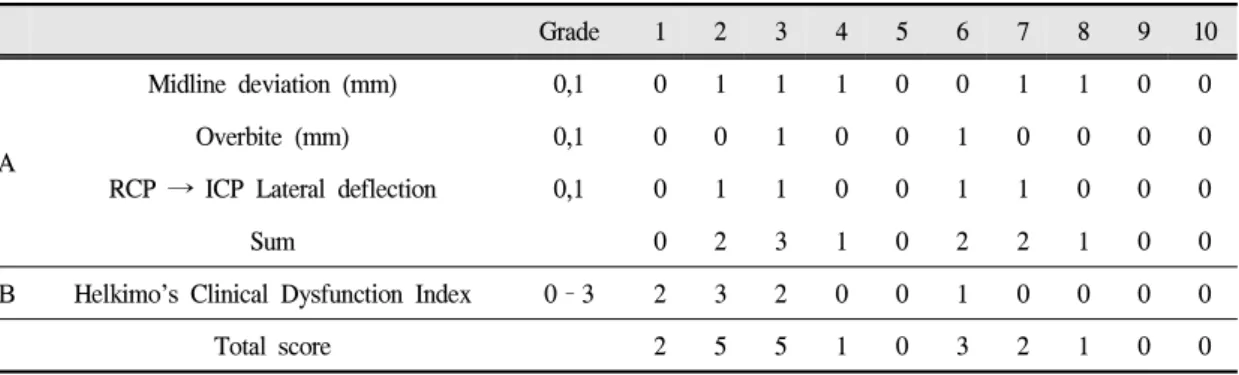
The occlusion analysis revealed that no subject had an anterior open bite, 5 or more missing teeth, and unrestored molar teeth. Five subjects had a midline deviation of 2 mm or more at the maxillary and mandibular central incisors. All the subjects had normal overjet, but 2 had an overbite of at least 4 mm. Four subjects had horizontal sliding of at least 0.5 mm from the retruded contact position to the intercuspal contact position, and none had vertical sliding of at least 2 mm (Table Ⅱ).
Radiography with lateral transcranial projection revealed that all the subjects had normal patterns of mandibular condyle. In the clinical examination, TMJ sounds were observed in 4 subjects, and temporomandibular pain on palpation was observed in 2 subjects, 1 of whom also reported simultaneous pain in the masseter muscle. Therefore, according to Helkimo's clinical dysfunction index, 6 subjects were classified as having DI0; 1, as having DI1; 2, as having DI2; and 1, as having DI3. After abnormal
Grade 1 2 3 4 5 6 7 8 9 10
A
Midline deviation (mm) 0,1 0 1 1 1 0 0 1 1 0 0
Overbite (mm) 0,1 0 0 1 0 0 1 0 0 0 0
RCP → ICP Lateral deflection 0,1 0 1 1 0 0 1 1 0 0 0
Sum 0 2 3 1 0 2 2 1 0 0
B Helkimo’s Clinical Dysfunction Index 0–3 2 3 2 0 0 1 0 0 0 0
Total score 2 5 5 1 0 3 2 1 0 0
A, Occlusal analysis score; B, TMD analysis score
Table Ⅱ. Abnormality scores calculated from various examinations and analyses
numerical representation of analyses, 2 subjects had the highest score of dysfunction (Table Ⅱ).
The electromyographic results showed that the average muscle activity of the temporofrontal muscle without and with the appliance was, respectively, 2.23 (0.52) V and 1.64 (0.75) V in the right, and 1.64 (1.04) V and 1.18 (0.55) V in the left. The muscle activity of the masseter muscle without and with the appliance was 2.21 (1.40) V and 1.63 (0.86) V in the right, and 1.93 (0.86) V and 1.51 (0.62) V in the left. The muscles that were tested exhibited hyperactivity, with the mandible in the resting
Right Left
M (μV) SD p value (paired
t-test) M (μV) SD p value (paired t-test)
TM W/O 2.53 0.52 3.005
(0.015)
1.64 1.04 2.769
(0.022)
W 1.64 0.75 1.18 0.55
MM W/O 2.21 1.40 2.809
(0.007)
1.93 0.86 3.302
(0.009)
W 1.63 0.86 1.51 0.62
TM, temporo-frontal muscle; MM, masseter muscle; W/O, without appliance; W, with appliance Table Ⅲ. Mean values of muscle activity with or without the stabilization appliance
position, but 30 min after insertion of the appliance, the activity reduced in all of the muscles (p < 0.05) (Table Ⅲ).
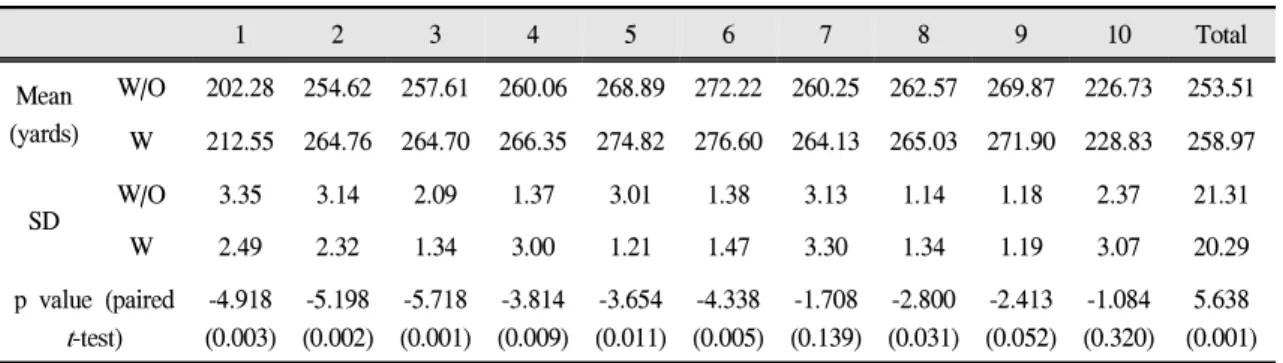
There were significant intra-individual differences in the driving distance with and without the appliance (p < 0.05), except in 3 subjects. Of these 3 subjects, 2 did not have any occlusal and TMJ problems (Table Ⅳ).
The mean values of driving distance without and with the appliance were 253.14 (21.90) and 258.27 (20.93) yards on the first day, 253.05 (23.42) and 258.71 (21.06) yards on the second day, 259.71
1 2 3 4 5 6 7 8 9 10 Total Mean
(yards)
W/O 202.28 254.62 257.61 260.06 268.89 272.22 260.25 262.57 269.87 226.73 253.51 W 212.55 264.76 264.70 266.35 274.82 276.60 264.13 265.03 271.90 228.83 258.97
SD W/O 3.35 3.14 2.09 1.37 3.01 1.38 3.13 1.14 1.18 2.37 21.31
W 2.49 2.32 1.34 3.00 1.21 1.47 3.30 1.34 1.19 3.07 20.29
p value (paired t-test)
-4.918 (0.003)
-5.198 (0.002)
-5.718 (0.001)
-3.814 (0.009)
-3.654 (0.011)
-4.338 (0.005)
-1.708 (0.139)
-2.800 (0.031)
-2.413 (0.052)
-1.084 (0.320)
5.638 (0.001) W/O, without appliance; W, with appliance
Table Ⅳ. Mean values of driving distance with or without the appliance
(20.78) and 253.52 (22.45) yards on the third day, and 254.33 (20.85) and 259.17 (21.66) yards on the last day. The average driving distance of the subjects with the appliance was significantly better than that without it (258.97 (21.02) yards vs 253.51 (SD) 22.07 yards; p < 0.001; Table Ⅳ).
DISCUSSION
Previous studies have shown that the prevalence of functional disorders in the masticatory system is high: a conservative estimate of the number of people with TMD in the general population is 40%
to 60%.15 This high incidence was reflected in our study by the fact that although the study population was as less as 10, only 3 subjects had normal occlusion and TMJ function. In 2 of these 3 subjects, there were no significant intra-individual differences in the driving distance with and without the appliance. Occlusal conditions strongly influence the muscular control of the mandibular position.
Therefore, a musculoskeletally stable joint position can be maintained only when it is in harmony with a stable occlusal condition. In this study, occlusal stabilization appliances were customized for each subject to ensure equalization of occlusal forces and
a balance between the muscular forces on the right and left sides and to ensure that the musculo- skeletally stable position of the condyles (CR or ACP) coincided with the maximum intercuspal position of the teeth (ICP). These adjustments were performed using a computerized occlusal analysis system. A stable occlusal condition should allow for effective functioning while minimizing damage to any components of the masticatory system.
The recent development of electronic devices has led to extensive studies on the effect of occlusal changes on the head and neck. Kerstein24 reported that the simultaneous recording and playback capacity of 2 computer systems (Occlusal Analysis System and Electromyography Recording System) allowed the operator to analyze and correlate specific occlusal moments to specific electromyographic changes that result from these occlusal moments, and this synchronization provided unparalleled evidence for the effect of occlusal contact arrangement on muscle function. Therefore, we used the T-scan III Occlusal Analysis System and the K7 Electromyo- graphy Recording System to evaluate the occlusal conditions and muscle activities of the subjects and analyze the muscle responses to the occlusal conditions. Williamson et al.25 reported that
occlusion with an anterior guidance protects the TMJ and posterior teeth in all mandibular movements and decreases the forces against an anterior tooth. Manns et al.26 reported that the muscle activity was lower during canine guidance than during group guidance in eccentric movements. Therefore, balanced occlusion for the equalization of occlusal forces is a mode of occlusion in which the posterior teeth protect anterior teeth from excessive forces at maximum intercuspation and the anterior teeth disocclude posterior teeth in all mandibular eccentric movements.
In this study, the centric relation (CR) or adapted centric posture (ACP) were measured using Dawson's method.3The appliance was adjusted with the subject in the supine and upright positions, and it increased the occlusal height by 3 mm at the position of canines in CR or ACP to ensure balanced occlusion. As a result, the activities of the temporo-frontal and masseter muscles were stabilized to a greater extent than they would be without the appliance. This EMG finding suggests that in unbalanced occlusion, muscles can neither function nor rest properly, as was observed in Lerman's study.6 The teeth dominate both muscle activity and mandibular placement in maximum intercuspation. In an occlusion where occlusal forces are equalized and a balance is achieved between the muscular forces on the left and right sides, the muscles are free and able to establish the optimal mandibular position. Thus, occlusal stabilization appliances reduce neuromuscular and temporomandi- bular stress during their performance. While the importance of stabilization of the position of these muscles is evident, it is necessary to study the activities of other muscles of the head and neck such as the sternocleidomastoid muscle and their effect on sports performance.
In sports dentistry, the principal objective of a
mouth guard is to protect the teeth and maxillary bone from an external injury. While protection has been the focus of studies since the 1950s, studies since the 1970s have additionally emphasized that a mouth guard or an occlusal appliance can be used to ensure muscular balance, increase muscular strength, and thus improve sports performance.27,28 Hong et al.22 and Bates23 reported that occlusal appliances that increased the occlusal height by approximately 3 mm improved muscle strength.
al-Abbasi et al.14reported that setting the height of the bite plate such that the strength of the deltoid muscles is at its peak elevated the bite by a mean of 2.4 mm (range, 1.53.8 mm). Egret et al.29reported that there were significant differences in the initial ball speed when subjects wore and did not wear mandibular orthopedic repositioning appliances, and that the appliance had an effect on golf swing. In this study, we found that the driving distance was increased as a result of the special occlusal conditions created by the stabilization appliance, which increased the occlusal height by 3 mm at the position of the canines in CR or ACP. The improvement may not be attributable to the increased occlusal height itself, but rather the mandibular position achieved in CR or ACP. This ideal mandibular position differs across individuals, and appliances must be customized to suit each user.1,2 With regard to head position, it is important that the ideal mandibular position and muscular balance be achieved vis--vis masticatory muscles; the activities of masticatory muscles with the correct occlusion are also important in maintaining the correct posture.9,10,11,12 An appropriate head posture can be maintained when all the occlusal and masticatory forces are balanced. An imbalance of these forces can not only lead to difficulty in balancing the head, but also cause overwork of some the supporting muscles. Inappropriate head posture can cause
tension in the neck or cervical muscles and therefore have an indirect effect on occlusion. In this experiment, the driving distance was greater when the subjects wore the appliance than when they did not, although the driving distance chiefly depends on the initial ball speed, launch angle, and spin.8
Improvement in the performance of a professional golf player can be monitored with the help of a launch monitor. Wallace et al.30 used a launch monitor to examine the relationship between driver length and ball launch conditions in an indoor test facility. Launch monitors record the launch conditions of the ball immediately after impact. Ball velocity, launch angle, and backspin are the 3 main types of data obtained; these monitors also provide data on the sidespin (hooking or slicing) and directional angle (push or pull). Launch monitors are suitable for obtaining measurements in indoor hitting nets. They use floor mat detection technology, ball-tracking IR technology, radar technology, high-speed camera technology, and laser technology.
Most monitors use high-speed cameras, Doppler radar, or laser to measure launch conditions.31 High-speed sequential exposure camera technology is by far the only technology that can provide usable data on ball take-off and azimuth angle, backspin, and ball speed. However, the uncertainty inherent in determining key parameters, due to ball compression and oscillation from club impact, remains. Doppler radar technology uses high-frequency impulses to track the return signals from a golf ball and determines the ball speed. However, the resolution of signal detection is limited by many factors, including the signal-to-noise ratio, multi-path signal return, and ball flight angles; the most significant limitation is that this technology tracks ball movement in only one dimension. Laser technology uses a series of emitters to create a sheet of laser beams at a specific distance and angle from the tee.
By using advanced laser technology, information on both the ball and the club can be captured in great detail, thus allowing researchers to acquire the most complete data set with the highest possible accuracy.
No other technology provides such accurate data on ball flight and club swing. In this study, the driving distance was measured using a laser-based monitor and was found to be greater when the subjects wore the appliance than when they did not. Future studies should measure changes in the accuracy of the drive (deviations from virtual fairway midline) when such appliances are used.
Studies by Burkett and Berstein32,33 showed that the use of occlusal appliances improved the muscular strength exerted during the drives of subjects with TMJ disorders. This effect was considered a placebo effect; however, our results were consistent with these results, and in our study, a cross-over design was used to eliminate the placebo effect. In other studies,11,13,14 the effect of occlusal appliances was evident in subjects with malocclusion or TMJ disorders, which implied that increasing occlusal height minimizes stress to the head and neck muscles and helps maintain appropriate head and body postures. In this study, the driving distance with the appliance was greater than that without it. The appliance was especially useful for professional golf players with malocclusion and TMJ disorders: they showed a greater improvement in driving distance.
To minimize placebo effect, a cross-over design was employed; the driving distances with and without the appliance were compared over 4 days. Therefore, the differences in driving distances with or without the appliance were constant during the 4 days. Despite its significant findings, this study has certain limitations. The number of subjects was small (n = 10); that of female subjects, in particular was too small (n = 2) to allow comparison with male subjects. It was difficult to acquire a larger sample
because many professional players were unable to spare time to participate in this experiment.
Moreover, it is necessary to conduct double-blind experiments with a placebo device. Future studies should include more golf players, especially those with TMJ disorders, and should employ both a double-blind test and a cross-over design in order to acquire accurate data.
CONCLUSION
The use of an occlusal stabilization appliance stabilized the muscle activities of masticatory muscles and increased the driving distance. Although there were intra-individual differences, players with abnormal occlusal conditions and TMJ disorders showed greater improvements in their performance.
REFERENCES
1. Forgione AG, Mehta NR, Westcott WL: Strength and bite, Part 1: An analytical review. Cranio 1991: 9:305 -315.
2. Gelb H: The relationship between jaw posture and mandibular strength in sports dentistry: A reappraisal.
Cranio 1996:14:320-325.
3. Dawson PE: Functional occlusion: From TMJ to smile design, St Louis: Mosby, 2007.
4. Proffit WR: Malocclusion and dentofacial deformity in contemporary society. In Contemporary Ortho- dontics, 2nd Ed. St Louis: Mosby, 1992:12-27.
5. Dawson PE: A classification system for occlusions that relates maximal intercuspation to the position and condition of the temporomandibular joints. J Prosthet Dent 1996:75:60-66.
6. Lerman MD. A revised view of the dynamics, physiology, and treatment of occlusion: A new paradigm. Cranio 2004:22:50-63.
7. Hume PA, Keogh J, Reid D: The role of biomechanics in maximising distance and accuracy of golf shots. Sports Med 2005:35:429-49.
8. Chung ST, Jun TW, Woo JH, Chung YS, Chung DJ, Eom WS, Park IR, Park ST: A study on isokinetic concentric torque of knee extensor and flexor in golf players. Exercise Science 2000:9:201-209.
9. Azuma Y, Maehara K, Togunaga T, Hashimoto M, Ieoka K, Sakagami H: Systemic effects of the occlusal destruction in guinea pigs. In Vivo 1999:13:
519-524.
10. Kibana Y, Ishijima T, Hirai T: Occlusal support and head posture. J Oral Rehabil 2002:29:58-63.
11. Sakaguchi K, Mehta NR, Abdallah EF, Forgione AG, Hirayama H, Kawasaki T, Yokoyama A:
Examination of the relationship between mandibular position and body posture. Cranio 2007:25:237-249.
12. Tingey EM, Buschang PH, Throckmorton GS:
Mandibular rest position: A reliable position influenced by head support and body posture. Am J Orthod Dentofacial Orthop 2001:120:614-622.
13. Abdallah EF, Mehta NR, Forgione AG, Clark RE:
Affecting upper extremity strength by changing maxillo-mandibular vertical dimension in deep bite subjects. Cranio 2004:22:268-275.
14. al-Abbasi H, Mehta NR, Forgione AG, Clark RE: The effect of vertical dimension and mandibular position on isometric strength of the cervical flexors. Cranio 1999:17:85-92.
15. Okeson JP: Management of temporomandibular disorders and occlusion. 5th Ed. St Louis: Mosby, 2003.
16. Cohen SG, MacAfee KA 2nd: The use of magnetic resonance imaging to determine splint position in the management of internal derangements of the temporomandibular joint. Cranio 1994:12:167-171.
17. Okeson JP: The effects of hard and soft occlusal splints on nocturnal bruxism. Am J Dent Assoc 1987:114:788-791.
18. Kreiner M, Betancor E, Clark GT: Occlusal stabilization appliances. Evidence of their efficacy. J Am Dent Assoc 2001:132:770-777.
19. Carlsson GE, Egermark I, Magnusson T: Predictors of signs and symptoms of temporomandibular disorders:
A 20-year follow-up study from childhood to adulthood. Acta Odontol Scand 2002:60:180-185.
20. Landi N, Manfredini D, Tognini F, Romagnoli M, Bosco M: Quantification of the relative risk of multiple occlusal variables for muscle disorders of the stomatognathic system. J Prosthet Dent 2004:92:
190-195.
21. Helkimo M: Studies on function and dysfunction of the masticatory system. Index for anamnestic and clinical dysfunction and occlusal state. Sven Tandlak Tidskr 1974:67:101-121.
22. Hong DH, Lee SB, Choi DK: The effect of human appendage muscle strength on increase in vertical dimension from intercuspal position of mandible. J Kor Academy Stomato Func Occl 2003:19:169-183.
23. Bates RE Jr, Atkinson WB: The effects of maxillary MORA's on strength and muscle efficiency tests. J Craniomandibular Pract. 1983:1:37-42.
24. Kerstein RB: Combining technologies: A compu- terized occlusal analysis system synchronized with a computerized electromyography system. Cranio 2004:22:96-109.
25. Williamson EH, Lundquist DO: Anterior guidance: Its effect on electromyographic activity of the temporal and masseter muscles. J Prosthet Dent 1983:49:
816-823.
26. Manns A, Miralles R, Valdivia J, Bull R: Influence of variation in anteroposterior occlusal contacts on electromyographic activity. J Prosthet Dent 1989:61:
617-623.
27. Kaufman A, Kaufman RS: Effects of the MORA on members of a football team. Quintessence Int Dent Dig. 1983:14:677-681.
28. Vergan EM Jr, Groppel JL, Pfautsch EW, Ramseyer GC: The effects of a mandibular orthopedic repositioning appliance on shoulder strength. J Craniomandibular Pract. 1984:2:232- 237.
29. Egret C, Leroy D, Loret A, Chollet D, Weber J:
Effect of mandibular orthopedic repositioning appliance on kinematic pattern in golf swing. Int J Sports Med 2002:23:148-152.
30. Wallace ES, Otto SR, Nevill A: Ball launch condi- tions for skilled golfers using drivers of different lengths in an indoor testing facility. J Sports Sci.
2007:25:731-737.
31. Chou A: How to gain 26 yards (Right Now). Golf Digest 2004:189-194.
32. Burkett LN, Berstein AK: Strength testing after jaw repositioning with a mandibular orthopedic appliance.
Physic Sports Med 1982:10:101-108.
33. Burkett LN, Berstein AK: The Effect of mandibular position on strength, reaction time and movement time on a randomly selected population. NYS Dent J 1983:49:281-285.
교합안정장치가 전문골프선수들의 드라이버 비거리에 미치는 영향
1새한세이프치과, 2고려대학교 임상치의학대학원 보철과,
3경희대학교 치의학전문대학원 보철과, 4한국여자골프협회
권태훈1․신상완2․류재준2․이성복3․안수진3․최여진4
현재 스포츠 치의학은 두가지 방면으로 연구가 진행되고 있는데, 하나는 부드러운 재질로 만든 마우스 가드로 스포츠 외상의 예에 관한 연구이고, 또 하나는 딱딱한 재질로 만든 교합안정장치로, 구강 기능과 전신의 운동능력과 의 상관성에 관한 연구이다. 현재 많은 프로선수들이 운동능력향상을 위해 교합안정장치를 사용해 오고 있다. 그러 나 국내에서는 스포츠 치의학에 대한 관심이 적어 위와 같은 연구가 이루어져 있지 않을 뿐만 아니라 그러한 연구 를 위한 기초 자료조차도 준비되어 있지 않은 실정이다. 또한 소수의 연구에서 실험 대상자의 정확한 분석과 교합 안정장치 장착 전과 후의 변화를 보여주지 못하고 있다. 이에 저자는 골프선수들의 교합분석과 턱관절분석을 시행 하고, 피검자의 상태에 따른 정확한 교합안정장치를 제작하여 장치 장착 전과 후의 저작근의 근활성량의 변화와 드라이버 비거리의 변화를 측정하여 분석하였다. 그 결과 교합안정장치를 장착함으로써 저작근의 근안정이 유도되 고, 드라이버 비거리가 증가되었다. 특히 측두하악장애를 지닌 골프선수일수록 교합균형장치를 사용함으로 드라이 버 비거리의 향상에 도움이 될 것이라고 기대된다.
주요어: 교합안정장치, 측두하악장애, 드라이버 비거리
교신저자:이성복
134-727 서울 강동구 상일동 149번지, 경희대학교 동서신의학병원 치과보철학교실 02-440-7520(전화), 02- 440-7549(팩스), E-mail: [email protected]
원고접수일: 2010년 04월 25일, 원고수정일: 2010년 05월 15일, 원고채택일: 2010년 06월 25일