보 문
한반도 주변 해역으로부터 혐기성 미생물의 분리 및 분리 미생물의 특성 분석
김원덕 ・ 이정현 ・ 권개경*
한국해양과학기술원 해양생명공학연구센터
Isolation and characterization of anaerobic microbes from marine environments in Korea
Wonduck Kim, Jung-Hyun Lee, and Kae Kyoung Kwon*
Marine Biotechnology Research Center, Korea Institute of Ocean Science & Technology, Ansan 15627, Republic of Korea
(Received February 26, 2016; Revised March 30, 2016; Accepted April 8, 2016)
ABSTRACT: Marine bacteria have represented unique physiologies and products which are not discovered from terrestrial organisms.
There has been great interest to utilize and develop marine bacteria in many industrial sectors. Recently, we isolated and characterized anaerobic bacteria from various marine environments in Korea to search organic acids fermenting strains. From our enrichment performed under anaerobic condition, 65 strains were isolated and identified by the 16S rRNA gene sequence analysis.
Among them, eleven strains were selected for phylogenetical and biochemical analysis. All tested strains were affiliated with Class Clostridia except one with Class Bacteroidia. Most of strains produce acetate (6 strains) with butyrate (2 strains) and/or formate (4 strains). Strain MCWD5 transformed 40% of glucose to extracellular polymeric substances. These results indicate that many novel anaerobic microorganisms which have great potential in commercial application are distributed in the marine environments of Korean Peninsula.
Key words: anaerobic marine bacteria, Clostridia, enrichment culture, organic acid production
*For correspondence.
E-mail: [email protected];
Tel.: +82-31-400-6242; Fax: +82-31-406-2495
해양은 지구전체 표면적의 70%, 지각 부피의 90% 이상을 차지하며(Fenical, 1993; Whitehead, 1999), 심해, 갯벌, 연안 과 같은 다양한 환경을 포함하고 있다. 또한 저온, 고압, 고염 과 같은 극한 조건을 가지고 있어 육상환경보다 더 복잡하며 다양한 생물들이 서식하는 것으로 파악되고 있다(Faulkner, 2002). 해양미생물들은 극한 환경에서 생존하기 위해서 육상 생물에 없는 특이한 물질 대사와 생리학적 능력을 소유하고 있는 것으로 알려져 있다. 이러한 특성을 활용하기 위하여 유 용한 화합물을 생산하는 해양세균의 탐색과 배양 연구가 최근 활발히 이루어지고 있다.
해양세균에서 유래된 대사산물(bioactive metabolite)은 의 약품, 화장품, 정밀화학 등의 재료로(Andersen and Williams, 2000), 유해물질의 분해 세균은 생물정화에(Raghukumar et al., 2001; Inoue et al., 2003; Sardessai and Bhosle, 2004) 응용되며,
해양미생물을 이용한 바이오에너지 생산 연구도 진행 중이다 (Cavaleiro et al., 2013). 이 외에도 해양세균 유래 효소(Mohapatra et al., 2003)와 다당류(Manivasagan and Kim, 2014)에 관한 관심이 증대되고 있다. 혐기성 세균들은 오랫동안 연료와 화합물 생산을 포함하는 산업적 활용에 이용되어 왔으며 (Goldstein, 1995; Wolfe, 1999), 넓은 기질 특이성, 독성에 대 한 높은 저항성, 높은 생산성과 수율 등의 특징을 가지고 있는 발효시스템들이 보고된 바 있다(Yazdani and Gonzzales, 2007; Weusthuis et al., 2011; Tracy et al., 2012). 한편, 국내에 서는 혐기성 해양미생물 배양에 대한 연구가 부족한 편으로, 강화도 갯벌로부터의 신종 발굴(Kim et al., 2006, 2007) 외에 는 국내 연안환경으로부터 혐기성 해양미생물 신종을 발굴한 사례가 없다. 이에 본 연구에서는 다양한 한국해양환경에서 혐기성 세균의 분리, 동정, 특성분석을 시도하여 해양미생물 자원을 확보하는 동시에 산업화에 유용한 세균의 탐색 작업을 수행하였다.
Fig. 1. The sample collection locations for isolation of the anaerobic microbes in Korea.
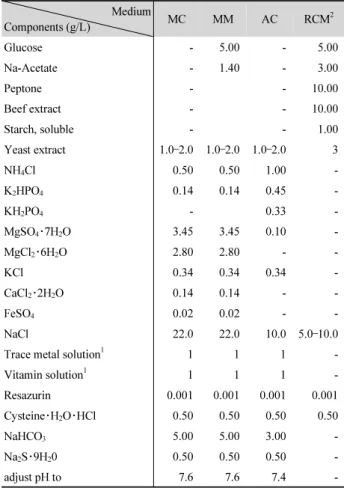
Table 1. The composition of medium used for enrichment culture. MC, Methanogen; MM, Modified methanogen; AC, Acetogen; RCM, Reinforced Clostridium medium
Medium
Components (g/L) MC MM AC RCM
2Glucose - 5.00 - 5.00
Na-Acetate - 1.40 - 3.00
Peptone - - 10.00
Beef extract - - 10.00
Starch, soluble - - 1.00
Yeast extract 1.0 –2.0 1.0–2.0 1.0–2.0 3
NH
4Cl 0.50 0.50 1.00 -
K
2HPO
40.14 0.14 0.45 -
KH
2PO
4- 0.33 -
MgSO
4・7H
2O 3.45 3.45 0.10 -
MgCl
2・6H
2O 2.80 2.80 - -
KCl 0.34 0.34 0.34 -
CaCl
2・2H
2O 0.14 0.14 - -
FeSO
40.02 0.02 - -
NaCl 22.0 22.0 10.0 5.0 –10.0
Trace metal solution
11 1 1 -
Vitamin solution
11 1 1 -
Resazurin 0.001 0.001 0.001 0.001
Cysteine ・H
2O ・HCl 0.50 0.50 0.50 0.50
NaHCO
35.00 5.00 3.00 -
Na
2S ・9H
20 0.50 0.50 0.50 -
adjust pH to 7.6 7.6 7.4 -
1 ml added to a liter of medium. The composition from Balch et al. (1979).
2 Based on ATCC No. 2017 medium.
재료 및 방법
시료 채취 및 처리
2013년 봄부터 2015년 여름까지 인천 북성포구 갯벌, 경기 도 화성 제부도 갯벌, 인천 영흥도 갯벌, 경기도 안산 갈대습지 공원, 전라남도 무안군 만풍염전, 순천만 갈대습지, 동해 울릉 분지 심해저 등의 다양한 한국 해양환경의 퇴적토 시료와 경 상남도 통영에 위치하는 한국해양과학기술원 통영해상과학 기지에서 배양한 다시마를 채집하였다(Fig. 1). 채취된 시료 는 선상에서 바로 접종하거나(울릉분지 시료) 냉장상태로 실 험실로 운반한 다음 0.5–1.0 g 정도를 혐기성 챔버(anaerobic chamber) 내에서 혐기성 배지에 vortexing하여 혼합 한 후 접 종에 사용하였다.
배지 조성, 농후 배양(enrichment culture) 및 단일 균주 분리
혐기성 미생물의 농후배양 및 분리에 사용된 배지는 MC (methanogen), MM (modified methanogen), AC (acetogen), 그리고 RCM (reinforced clostridial medium) 배지이며 그 조 성은 Table 1과 같다. 조성에 따라 준비된 각각의 배지 5 ml를 Hungate tube에 주입한 다음 H2 + CO2 (80:20, V:V, 1 bar) 가스 또는 CO (100% 또는 50%, 1 bar) 가스로 치환하였다. 고체배 지의 경우에는 serum bottle 또는 Petri dish에 배지에 1.5% 한
천을 추가한 다음 위와 동일한 과정을 거쳐 준비하였다.
혐기적 조건에서 10-6–10-8 배로 희석한 시료를 접종한 다음 30°C 또는 55°C에서 농후배양(enrichment culture)을 수행하 였다. 1주일간의 배양 후 최대 희석된 tube에서 자라는 배양액 을 다시 10-6–10-8 배로 희석 배양하는 과정을 2번 반복한 다음 동일 조성의 고체배지에 도말하여 집락(colony)을 획득하였 다. 위 과정을 통하여 얻어진 집락이 서열분석 결과 단일종이 아닌 것으로 판단 될 경우, 희석 배양 또는 도말과정을 다시 수 행하여 순수분리된 균주를 획득하였다. 영흥도 시료의 경우 10-1농도로만 희석하였으며 고온에서 배양한 통영시료의 경 우 희석 없이 농후배양과정을 거친 다음 바로 고체배지에 도 말하였다.
계통분류학적 분석
생성된 집락들을 액체배지에 접종하여 키운 후 Exgene cell
SV kit (GeneAll Biotechnology)를 사용하여 genomic DNA를 추 출하였으며, 각 균주의 16S rRNA 유전자는 bacterial primer set 인 27F와 1492R를 사용하여 증폭시켰다. 얻어진 PCR 산물은 정 제 후 Cosmogentech Inc.에 서열분석을 의뢰하였으며 밝혀진 16S rRNA 유전자 서열을 EzTaxon (http://eztaxon-e.ezbiocloud.net/) database 및 GenBank에서 BLAST search를 통하여 가장 유사 도가 높은 clone이나 배양체, 혹은 표준균주를 검색하였다. 또 한 선별된 균주들의 16S rRNA 유전자 염기서열들은 GenBank 에 기탁하여 KU886093–KU886102번까지의 번호를 부여받 았다.
검색된 균주 또는 clone들의 염기서열을 database에서 내 려받은 다음 ClustalW 프로그램을 이용하여 정렬시켰다. 정 렬된 염기서열은 최종적으로 수동으로 교정하여 정렬을 완료 하였다. 정렬된 염기서열들에 대해 Jukes-Cantor model과 neighbor-joining (NJ) method를 적용하여 계통수(phylogenetic trees)를 작성하였다. 작성된 계통수의 안정성을 확인하기 위 하여 1000번에 걸친 bootstrap 분석을 실시하였다. Maximum- likelihood (ML)와 maximum-parsimony (MP) 방법에 기초한 계통분석도 수행되었다. 계통분석의 전 과정에는 MEGA ver.
5.2 (Tamura et al., 2011)를 사용하였다.
생화학적 분석
균주성장에 필요한 최적온도와 성장률(doubling time)은 온도구배 배양기(TVS126MA, Advantec)를 이용하거나 균주 를 Hungate tube에 접종 후 배양하면서 660 nm에서 24시간 간 격으로 흡광도를 측정하여 구하였다. 흡광도 측정에는 일본 Taitec사의 ODMonitor를 사용하였다. 발효산물은 7일 이상 배 양한 배양액을 ion exclusion column (Shodex RSpak KC811) 이 설치된 high pressure liquid chromatography (HPLC)로 분 석하였으며 각 유기산의 검출시간은 표준물질을 이용하여 검 정하였다. 배양에는 분리배지를 이용하거나 배지에 포도당 (28 mM) 또는 peptone (0.2%)을 추가하여 실시하였다.
결과 및 고찰
본 연구에서는 한국 연안 및 심해로부터 채취된 8개 시료로 부터 농후배양과정을 통해 총 65주의 혐기성 미생물을 분리하 였다. 분리된 미생물들의 부분 16S rRNA 유전자 염기서열 분 석결과에 근거하여(결과 미제시) 신종 또는 유용성이 있다고 판단되는 균주를 선별하여 계통분류 및 특성분석을 실시하였 다. 선별된 균주들의 유연관계 및 계통도는 Table 2와 Fig. 2에
제시하였다.
메탄 생성세균 분리를 목적으로 하는 MC 또는 MM 배지로 부터 분리된 균주는 총 16주였으며 이 중 MCWD3, MCWD4, MCWD5, MCWD6 균주에 대한 특성 분석 결과 및 유사도가 높은 미생물과의 비교 분석 결과는 다음과 같다.
동해 울릉분지 심해 퇴적토로부터 분리된 MCWD3 균주는 표준균주 중 Sporosalibacterium faouarense SOL3f37T (Rezgui et al., 2011)와 가장 높은 16S rRNA 상동성을 보이며(92.8%) 계통분류학적, 생화학적 분석에 근거하여 신속(new genus)으 로 보고 되었다(Kim et al., 2016). 이 균주는 인도네시아 연안의 해수온천 주변의 해초장에서 보고된 clone인 PKS3과 가장 높 은 16S rRNA 유전자의 유사도(97%, data from GenBank)를 보 였으며 고염성 환경의 미생물 mat에서 보고된 clone들과도 비 교적 높은 유사도를 보였다(Isenbarger et al., 2008; Harris et al., 2013) (Fig. 1). 또한 MCWD3 균주의 유전체(GenBank accession No. LOHE01000000)에서는 독립영양(autotrophic) 에 쓰이는 Wood-Ljungdahl pathway의 효소들을 발현하는 operon과 formate dehydrogenase가 발견 되었다. 그러나 여러 번의 반복 실험 결과 이 균주는 H2 + CO2를 이용하는 독립영양 미생물이 아닌 것으로 나타났다. 또한 H2 + CO2가 첨가된 배지 에서 생성되는 acetate 농도도 acetogen 균주들에 비해 매우 낮 았다(2.7 mM). 그러나 MCWD3 균주가 심해에서 분리되었다 는 점을 고려할 때, 고압 등의 다른 조건에서 탄소를 고정 할 수 있을지에 대해서는 더 많은 연구가 필요하다.
경남 통영의 양식해초로부터 분리한 MCWD4 균주는 호열 성(55°C) 조건에서 분리 되었으며 표준균주 중 Brassicibacter thermophilus cel2fT (Wang et al., 2015)와 가장 높은 16S rRNA 유전자 상동성 (98.7%)을 보였다. 그러나 이 균주는 35°C를 최 적온도로 하는 중온성(mesophilic) 균주로서 생리적으로는 근 연종인 Brc. mesophilus BMT (Fang et al., 2012)과 보다 가까울 것으로 생각된다. 한편 MCWD4 균주는 3.7시간의 분열시간 을 보여 비교적 빠른 성장속도를 보였으며 formate (1.8 mM) 와 acetate (5.1 mM)를 생산하였다.
전라남도 무안군 만풍염전 퇴적토에서 분리된 MCWD5 균 주는 Robinsoniella peoriensis PPC31T (Cotta et al., 2009)와 94.6%의 16S rRNA 유전자 상동성을 보였는데, 비배양 clone까 지 확대해서 검색할 경우에도 Robinsoniella peoriensis PPC44 (Cotta et al., 2003)와 95.1%의 유사도를 보이는 것으로 나타 나 일반적인 자연환경에 흔하지 않은 균주인 것으로 판단된다 (Table 2 and Fig. 2). MCWD5 균주의 성장에는 포도당이 필수 적이며 하얀 색의 중합체(polymer)를 세포 바깥으로 배출하 는 것이 관찰 되었다. 중합체의 무게는 배지에 첨가된 포도당
Table 2. List of major anaerobic microbial strains from marine environments in this study with closest neighbors. HA, MC, and CL in the strain names indicate acetogen, (modified) methanogen, and reinforced clostridial medium used for isolation, respectively. All strains except CLWD1 (thermophilic) are mesophilic.
Strain (16S rRNA
gene accession No.) Isolated from
Closest match based on 16S rRNA gene homology
Reference Species or clone name Homology
(%) HAWD1
(KU886096) Buksungpo, Inchon Clostridium aestuari HY-45-18
T96.7 Kim et al. (2007)
Clostridium strain 17cr1 99.0 Janssen (2004)
HAWD2 (KU886100)
Ansan Reed Wetland Park
Clostridium soprosphaeroides DSM 1294
T90.8 Soriano and Soriano (1948) Uncultured SP clone 4-1 99.0 Li et al. (2010)
HAWD3
(KU886094) Jebu-Island Bacteroides thetaiotaomicron VPI-5482
T96.6 Distaso (1912) Uncultured clone LL141-8D1 99.0 Unpublished HAWD4
(KU886093) Yeongheung-island Acetobacterium fimetarium DSM 8238
T96.6 Kotsyurbenko et al. (1995) Uncultured Acetobacterium clone D004011H19 97.0 Pham et al. (2009) HAWD5
(KU886102) Suncheon Terrisporobacter mayombei DSM 6539
T99.5 Kane et al. (1991)
Clostridium sp. C1, C. metallolevans ASI1 100 Meyer et al. (2007); Gao et al. (2014) MCWD3
(KU510224) Ulleung Basin, East Sea Sporosalibacterium faouarense SOL3f37
T92.8 Rezgui et al. (2011)
Uncultured clone PKS3 97.0 unpublished
MCWD4
(KU886095) Tongyung Brassicibacter thermophilus cel2f
T98.7 Wang et al. (2015) Clostridiaceae bacterium SLHBact121 99.2 unpublished
MCWD5
(KU886099) Manpoong Saltern Robinsoniella peoriensis PPC31
T94.8 Cotta et al. (2009) Robinsoniella peoriensis strain PPC44 95.1 Cotta et al. (2003) MCWD6
(KU886101) Manpoong Saltern Clostridium methylpentosum DSM 5476
T90.8 Himelbloom and Canale-Parola (1989) Bacterium enrichment culture clone M426 100 Gao et al. (2014)
CLWD1
(KU886098) Tongyung Moorella thermoacetica DSM 521
T99.7 Fontaine et al. (1942)
Moorella sp. CF5 99.0 unpublished
CLWD3 (KU886097)
Ansan Reed Wetland Park
Closritidum acetobutylicum ATCC 824
T96.7 McCoy et al. (1926)
Clostridium sp. BL-22 99.0 Bowman et al. (2006)
의 약 40% 정도로 계산되어 생체합성과 에너지 대사에 이용 되지 않는 대부분의 포도당이 중합체로 전환되는 것으로 추 정된다.
MCWD5 균주와 함께 분리된 MCWD6 균주는 표준균주 중 Clostridium methylpentosum DSM 5476T (Himelbloom and Canale-Parola, 1989)과 90.8%의 상당히 낮은 16S rRNA 유 전자 상동성을 보였다. MC 배지에서 상당히 낮은 성장률과 biomass yield를 나타내었다. 이 균주의 상동성 탐색을 순수분 리가 되지 않은 미생물까지 확대 해 보면 cellulolytic microbial consortium에 속하는 M426 균주(Gao et al., 2014)와 100% 일 치하는 것으로 나타나 cellulose의 분해와 이용여부가 앞으로 특성 분석 연구에 참고가 될 수 있다고 사료된다.
AC (acetogen) 배지로부터 분리된 균주는 45주였으며 이 중 HAWD1, HAWD2, HAWD3, HAWD4, HAWD5 균주를 대상으로 연구를 진행하였다.
인천 북성포구 퇴적토에서 분리된 HAWD1 균주는 한국 강
화도 갯벌에서 분리된 Clostridium aestuarii HY-45-18T (96.7%, Kim et al., 2007), C. ganghwense HY-42-06T (95.9%, Kim et al., 2006)와 높은 16S rRNA 유전자 상동성을 보이며, New Zealand 갯벌에서 분리된 propanol 합성 균주 Clostridium sp.
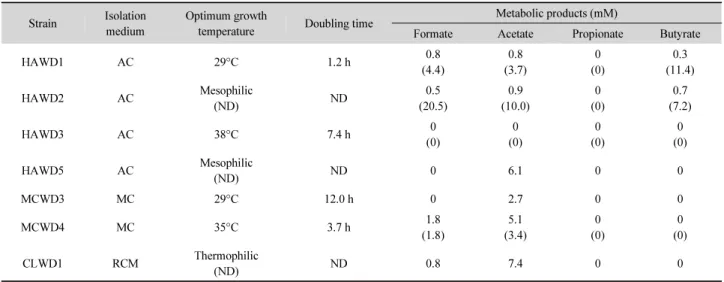
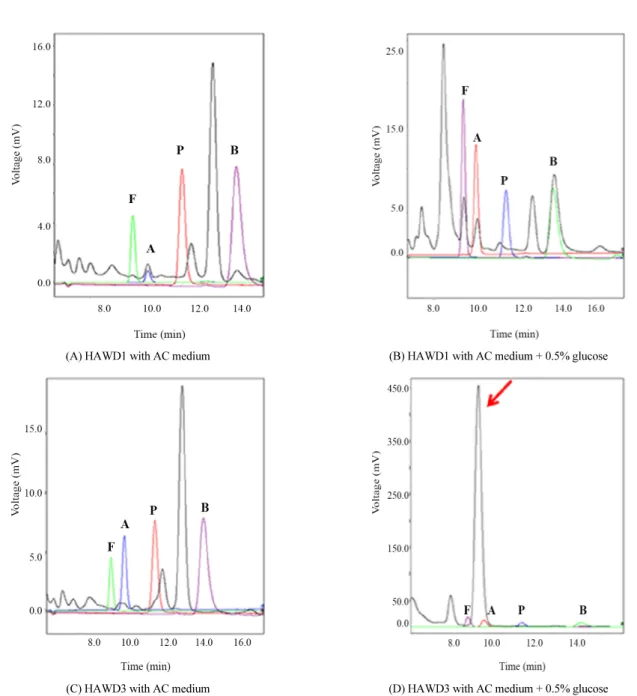
17cr1 (Janssen, 2004)과는 99.0%의 상동성을 보였다(Table 2 and Fig. 2). HAWD1 균주는 doubling time이 1.2시간으로 성 장속도가 매우 빠르며, 배지에 포도당이 첨가될 경우 formate (4.4 mM), acetate (3.7 mM), butyrate (11.4 mM) 등을 비교적 높은 농도로 생산하는 것이 확인되었다(Table 3 and Fig. 3A–
B). 이상의 결과로 볼 때 HAWD1 균주는 포도당 또는 아미노 산으로부터 유기산이나 알콜 생산에 이용될 수 있을 것으로 생각된다.
안산갈대습지공원에서 분리된 HAWD2 균주는 Clostridium soprosphaeroides DSM 1294T (Soriano and Soriano, 1948)와 가장 높은 16S rRNA 유전자 상동성(90.8%)을 보이며 탄수화 물과 peptone으로부터 수소생산을 목적으로 하는 생물반응기
Fig. 2. Phylogenetic tree of isolated strains with closely related sequences and closest type strains. The tree was constructed by neighbour-joining method
with Jukes-Cantor algorithm. Bootstrap value higher than 50% calculated from 1,000 resamplings was described at each node. ( ★) Recovered from
maximum likely hood and parsimony tree with higher than 70% bootstrap value, ( ●) Recovered from maximum likely hood and parsimony tree, (○)
Recovered from maximum likely hood tree.
Table 3. Characteristics of the seven selected strains isolated from this study. The numbers in parenthesis indicate concentrations of the products from medium containing 28 mM glucose (or 0.2% peptone for MCWD4 strain).
Strain Isolation medium
Optimum growth
temperature Doubling time Metabolic products (mM)
Formate Acetate Propionate Butyrate
HAWD1 AC 29°C 1.2 h 0.8
(4.4)
0.8 (3.7)
0 (0)
0.3 (11.4)
HAWD2 AC Mesophilic
(ND) ND 0.5
(20.5)
0.9 (10.0)
0 (0)
0.7 (7.2)
HAWD3 AC 38°C 7.4 h 0
(0)
0 (0)
0 (0)
0 (0)
HAWD5 AC Mesophilic
(ND) ND 0 6.1 0 0
MCWD3 MC 29°C 12.0 h 0 2.7 0 0
MCWD4 MC 35°C 3.7 h 1.8
(1.8)
5.1 (3.4)
0 (0)
0 (0)
CLWD1 RCM Thermophilic
(ND) ND 0.8 7.4 0 0
ND, Not Determined
에서 탐지된 SP 4-1 clone (Li et al., 2010)과는 99.0%의 상동성 을 가진다. 이 균주는 포도당이 기질로 주어질 경우 formate (20.5 mM), acetate (10.0 mM), butyrate (7.2 mM) 등을 비교적 높은 농도로 생산하였다. 한편, 포도당과 같은 유기물이 제 공되지 않는 전통적인 AC 배지에서는 매우 낮은 성장률과 biomass yield를 나타냈다.
HAWD3 균주는 제부도 갯벌에서 분리되었으며 Bacteroides thetaiotaomicron VPI-5482T (Distaso, 1912)와 96.6% 상동성 을 가진다. 최적성장온도를 38°C로 하는 HAWD3 균주는 포도 당을 기질로 하였을 때 propionate와 butyrate 사이에 위치하는 미확인된 화합물을 대량 생산하는 것으로 나타났다(Fig. 3D).
영흥도 갯벌에서 분리 된 HAWD4 균주는 acetogen인 Acetobacterium fimetarium DSM 8238T (Kotsyurbenko et al., 1995)와 가장 높은 16S rRNA 유전자 상동성(96.6%)을 보인 다. 표준균주가 아닌 경우에는 Alaska의 유정에서 검출된 Acetobacterium sp. clone D004011H19 (Pham et al., 2009)와 97.0% 상동성을 보였다. 이 균주는 H2 + CO2보다는 CO (50%) 가스를 주된 성장기질로 이용하는 것으로 확인되었다.
순천만 갈대습지에서 분리된 HAWD5 균주는 acetogen으 로 알려진 Terrisporobacter mayombei DSM 6539T (Kane et al., 1991)와 99.5%의 높은 상동성을 나타냈으며 H2 + CO2로 부터 6.1 mM의 acetate를 생산하였다.
고농도의 유기물을 포함하는 RCM 배지로부터 분리된 균 주는 acetogen인 Moorella thermoacetica DSM 521T (Fontaine et al., 1942)와 높은 16S rRNA 유전자 상동성(99.7%)을 보였
다. 이 균주는 H2 + CO2 조건에서 비교적 높은 농도의 acetate 를 생산하였는데(7.4 mM) 이와 같은 유기산 생산 조건에 대해 서는 앞으로 더 많은 연구가 필요하다.
안산갈대습지공원에서 분리된 CLWD3균주는 Acetone- Butanol-Ethanol (ABE) 발효를 하는 Closritidum acetobutylicum ATCC 824T (McCoy et al., 1926)과 가장 높은 상동성(96.7%) 을 보였으며 유기염소 화합물로 오염된 지하수로부터 분리된 Clostridium sp. BL-22 (Bowman et al., 2006)와는 99.0%의 유 사도를 보였다. 이상의 결과로 볼 때 CLWD3 균주는 유기염소 화합물을 분해할 가능성을 지니며, ABE 발효의 유무에 대해 서는 추가 연구가 필요하다.
본 연구를 통해 다양한 해양환경으로부터 시료를 확보하여 65주의 혐기성 미생물을 분리하였다. 이들 미생물 중 16S rRNA 유전자 기준으로 신규성이 높은 11주를 선정하여 근연 종을 포함한 계통분석, 성장률, 유기산 생산 능 등을 평가하였 다. 이와 같은 결과를 보고된 균주와의 유연관계, 유전체 해독 이 진행 된 균주의 유전체 정보를 포함하여 해석함으로써 acetogen, ABE 발효세균, 다당류 합성 세균, 유기물질 합성 세 균 등을 직접적으로 확인 또는 간접적으로 예상 할 수 있었다.
이것은 한국의 다양한 해양환경에 다양한 유용미생물이 서식 하고 있는 것을 의미한다. 이 연구를 통하여 다양한 국내 미생 물 자원을 확보하였으며, 미생물 분리 및 분석 기술들은 미래 의 미생물자원 수집, 확보, 응용 과정에 주요한 기반을 제공 해 줄 것으로 기대된다.
(A) HAWD1 with AC medium (B) HAWD1 with AC medium + 0.5% glucose
(C) HAWD3 with AC medium (D) HAWD3 with AC medium + 0.5% glucose
Fig. 3. HPLC chromatograms of selected strains for organic acids analysis. F, A, P, and B indicates standard peak for formate, acetate, propionate, and butyrate. Arrow shows the unidentified peak.
적 요
유기산을 생산하는 발효미생물을 획득하기 위해 갯벌, 심해, 염전 등의 퇴적토와 해초시료 등의 시료에 대해 methanogen 배지, acetogen 배지, Clostridium용 배지 등을 이용하여 농후 배양을 실시하였다. 총 8개 시료로부터 65주의 혐기성 미생 물을 분리하였으며 이 중 신규성이 높거나 활용성이 높다고 알려진 11종에 대해 계통분석, 성장 양식(growth pattern), 유 기산 생산 평가 등을 시도하였다. 분석이 수행된 균주 중
Bacteroidia 강에 속하는 1주 외에는 모두 Clostridia 강에 속하 였으며 성장속도는 1.2 h-1 이상이었다. 분석이 수행된 7종 중 6종은 아세트산을 생성하였으며, 부가적으로 2균주는 부틸산 을, 4균주는 개미산을 생산하였다. 또한 MCWD5 균주는 제공 된 포도당의 약 40%를 세포외 고분자물질로 전환시키는 것으 로 나타났다. 본 연구를 통하여 국내 연안해역에서 분리된 신 규 혐기성 미생물들은 유기산, 고분자 다당류를 생산하는 등 높은 응용성을 지님을 확인할 수 있었다.
감사의 말
본 연구는 한국해양과학기술원 기관고유과제(PE99314) 의 지원을 받아 수행되었습니다.
References