서 언
퇴비는 작물과 토양미생물의 주요 양분 및 에너지 공 급원으로서 토양개량의 기능을 한다 퇴비 시용은 토양. 미생물 개체군의 활성, 다양성 및 크기를 증가시키고 (Bastida et al., 2008; Bunemann et al., 2006; Ros 토양의 이화학적 특성에 영향을 미치며 et al., 2003),
토양 (Caravaca et al., 2002; Tejada et al., 2009), 비옥도를 향상시켜 (Doran et al., 1988; Eriksen,
작물 생산성을 증가 2005; Randhawa et al., 2005)
시키는 것으로 보고되었다 (Singh et al., 2007).
토양미생물 개체군과 활성은 유기물 분해 영양소 순, 환 토양구조 형성 및 안정성 등을 매개하므로 토양의, 질을 유지하는데 필수적이다 이에 따라 기능성 유용미. 생물이 작물에 미치는 영향에 관한 연구는 다양하게 진 행되고 있다 근류균 인산가용화균 균근균 등은 식물. , ,
생육 촉진뿐만 아니라(Suh et al., 2009) 다양한 길항 성 물질 분비를 통해 식물병에 대한 생물적 방제의 가 능성을 보여주고 있으나 (Diaz et al., 2005; Diby et 그 al., 2005; Jetiyanon, 2007; Kim et al., 2008), 효과는 작물 토양 및 퇴비 시용량 등에 따라 상이할 수, 있다고 알려지고 있다 (Chiarini et al., 1998; Rasche 그러므로 특정 et al., 2006; Saison et al., 2006).
작물 재배지에서 퇴비 시용에 따른 토양의 생물학적 지 표의 변화를 구명하는 것은 퇴비의 토양개량 효과를 판 정하는 중요한 척도가 될 수 있다.
고추는 채소 작물 중에서 재배면적이 가장 넓은 작물 로 (Ministry for Food, Agriculture, Forestry, and 그 품종수가 다양하고 재배기간이
Fisheries, 2009), ,
길어서 퇴비 시용에 의한 토양 개량과 지속적 양분 공 급의 필요성이 높은 작물이다 고추 재배지에서 퇴비 시. 용량은 30 Mg ha-1로 추천되고 있으나 이는 양분공급 측면을 고려한 것이고 퇴비 시용에 따른 토양미생물 및 생물학적 지표의 변화에 관한 연구는 거의 없는 실정이 다. Park et al. (2008)은 고추품종과 퇴비 시용량을 달 리하여 토양 화학성과 미생물상을 비교 연구한 결과, 품
고추재배지에서 퇴비시용에 따른 토양 미생물의 인지질지방산 변화
박기춘 김수정· 1*
농촌진흥청, 1동국대학교 바이오환경과학과
Changes of Soil Microbial Phospholipid Fatty Acids as Affected by Red Pepper Cultivation and Compost Amendment
Kee-Choon Park, and Su-Jung Kim1*
Rural Development Adminstration, Chungbuk, 369-873, Korea
1Department of Biological & Environmental Science, Dongguk Univ. Seoul, 100-715, Korea
Compost as a soil amendment is of importance in enhancing the soil chemical and microbial qualities;
however, soil microbial community can vary depending on the composition, and the amount of compost applied to plant in the soil. Responses of soil microbial properties to compost applications with 0, 30, and 60 Mg ha-1were investigated in silt loam soils where red pepper(Capsicum annuum L.) was mainly cultivated in Yeongyang, Gyeongbuk, Korea. The analysis of phospholipid fatty acids (PLFAs) extracted from soil showed that compost amounts significantly increased PLFAs representing as bacteria, fungi, and VAM-fungi as well as the ratio of fungi/bacteria, and monounsaturated/saturated PLFAs. Increasing the amount of compost significantly increased Gram-/Gram+ PLFAs’ ratio, but significantly decreased monounsaturated/saturated PLFAs’ ratio. Therefore, this result shows that compost would vary to a limited extent the microbial community in red pepper field. However, increase in compost application would change the subgroup structure of microbial community only.
Key words: Compost, Soil microbial community, Phospholipid fatty acids
접수: 2010. 2. 4 수리: 2010. 4. 10 연락저자
* : Phone: +82222603323, E-mail: [email protected]
종간의 차이는 없었으나 퇴비 시용량의 증가에 따라 토 양 칼륨 함량이 증가하였고 미생물의 활성도 측면에서,
와 수화도가 증
dehydrogenase fluorescein diacetate 가하였다고 보고하였다.
최근 토양미생물 군집 (community)의 조성을 연구하 는 다양한 방법이 제시되고 있다 이 중 인지질지방산. 분석법은 토양미 (Phospholipid Fatty Acids: PLFAs)
생물 군집의 구조를 밝히고 토양의 생물학적 질을 평가 하는 생물지표로 활용하고 있다 (Bååth and Ander-
또한 함량은
son, 2003; Li et al., 2006). , PLFAs 대부분의 미생물 생체에 존재하고 있기 때문에 미생물 을 세균 사상균 방선균 균근균 등으로 구분하여 정량, , , 할 수 있으므로 퇴비 시용과 같이 영농방안의 차이에 따른 미생물의 군집 수준에서의 변화와 생물학적 질의 변화를 평가하는데 활용될 수 있다 본 연구는 고추 재. 배지에서 퇴비 시용에 따른 토양 미생물의 군집 특성과 미생물의 PLFAs함량을 분석하여 추천퇴비 시용량이 토 양의 생물학적 질 개량 효과에 미치는 기초자료를 제공 하고자 수행되었다.
재료 및 방법
퇴비 시용에 따른 토양미생물의 인지질지방산의 변화 를 구명하기 위해 포장시험 경북 영양군 수비면 을 년( ) 2 간 ( 07- 08)’ ’ 수행하였다. 시험설계는 난괴법이었으며 기타 포장시험의 처리 및 방법은Park et al. (2008)이 보고한 것과 같다 공시토양은 미사질양토이며. , pH와 EC 는 초자전극법과 전기전도도법 유기물은, Tyurin ,법 유효 인산은Lancaster ,법 치환성 양이온은 1M NH4OAc (pH
침출법으로 분석하였다 공시토양
7.0) (NIAST, 2000).
의 화학적 특성은 Table 1과 같다.
공시재료 공시 퇴비는 수피 우분 짚 왕겨 순으로, , , 의 비율로 혼합 퇴적하여 년간
6:22.5:2:2 (w:w:w:w) 1
부숙시킨 것을 사용하였다 고추정식 전에 공시퇴비를. 0, 30, 60 Mg ha-1으로 처리하여 고랑과 이랑을 만들고 검은 비닐로 피복하였다 퇴비의 화학성은. pH 7.2, EC 33.0 dS m-1, 유효인산 5,585 mg kg-1, 칼륨 34.2 cmolc kg-1, 칼슘 20.2 cmolc kg-1, 마그네슘 10.8
cmolc kg-1이었다. 2월 초에 파종상자에 파종한 고추묘 (Capsicum annuum L.; 고은 신젠타 를, ) 4월 하순에
이랑에 줄 간격으로 정식하였다
1.5 m 2 , 40 cm .
토양시료 채취 및 보관 토양시료는 7월 하순 시험구 당 3개 지점에서 채취하여 혼합하여 2 mm 체로 거른 후에 토양화학성과 미생물상의 분석을 위해-80℃냉동 고와 4℃ 냉장고에 보관하였다.
인지질 지방산 (phospholipid fatty acids, PLFAs) 및 지표 지방산 분석 PLFAs를 이용한 토양미생물의 군 집에 대한 분석방법 (Peacock et al., 2001)을 요약하 면, -80℃에 보관된 토양 시료를 동결 건조한 후, 5 g 의 토양시료와 chloroform: methanol: buffer solu-
을 로 혼합하여 인지질 지방산을
tion 1: 2: 0.8 (v:v:v)
추출한 다음 silica가 결합된 column을 사용하여 중성 지질 당지질 인지질로 분리하였다 이중에서 인지질을, , . 메칠화 하여 메칠화된 지방산에 fatty acid methyl
를 내부 표준물질로 넣은 후
ester (19:0) , MIDI
Sherlock Microbial Identification System (MIDI 으로 정성 정량하여 토양미 Inc., Newark, DE, USA) ,
생물의 군집과 구조적 특성을 분석하였다 탄소수가. 10 에서 20개인 지방산을 분리하여 각 인지질 지방산 값, 을 총 PLFAs의 퍼센트 비율로 표시하였다 시용한 퇴. 비량에 따른 토양의 미생물상 차이를 구명하기 위해
에서와 같이 미생물을 인지질지방산 지표
Table 2 (bio-
를 이용하여 세균 사상균 방선균 균근균으로
marker) , , ,
분류하였고 각 미생물의 인지질지방산의 함량과 종류의, 변화를 생물학적 지표로 활용하였다 (Li et al., 2006).
통계분석 퇴비 시용에 따른 토양의 미생물상의 변화 는 분산분석을 통해 평가하였고, PLFAs 변화는 다변량 주성분 분석 (multivariate principal component analysis:
을 통해 평가하였다 통계 프로그램은
PCA) . SAS (ver.
를 이용하였다 9.1.3; SAS Inst., Cary, NC, USA) .
결과 및 고찰
인지질지방산 변화 토양에서 추출된 각 지방산을
로 분석하여 검출된 중에서 탄소수가
GC-MIDI peak
Table 1. Chemical properties of the experimental soil.
pH EC OM Av. P2O5
Ex. Cation
K Ca Mg
1:5 dS m-1 g kg-1 mg kg-1 --- cmolc kg-1 ---
6.8 1.0 44.4 930.0 1.3 9.8 1.6
에서 개인 인지질 지방산 값을 총 의 퍼센
10 20 PLFAs
트 비율로 표시하였다 (Peacock et al., 2001). 5개 이 상의 시료에서 동시에 검출된 지방산의 종류는 모두 38 개였다 제시되지 않음( ). 이것을 다변량 분석법의 하나 인 주요인 분석법을 이용하여 PC1과 PC2로 나누어 분 석한 결과 PC1과 PC2는 처리에 따른 인지질지방산들의 변이를74.5%와12.6%로 각각 설명하였다(Fig. 1).
각각의 주요인들이 검출된 인지질지방산에 대한 영향 을 Fig. 2에서 보여주고 있다 퇴비의 시용량. 30 Mg ha-1 과 60 Mg ha-1 은 무처리와 각각 비교하였을 때 세균 사상균 균근균의 인지질지방산에 유의성 있는 차, , 이를 보였으나 시용량의 증가는 미생물 군집 모두에서, 변화가 없었다 (Fig. 2). 퇴비의 시용량 60 Mg ha-1은
무처리의 세균 사상균 균근균의 인지질지방산과 비교, , 하여 각각1.2, 1.3, 1.2배 증가했다.
는 토양시료에서 가장 많이 추출된 주요 인 Table 3
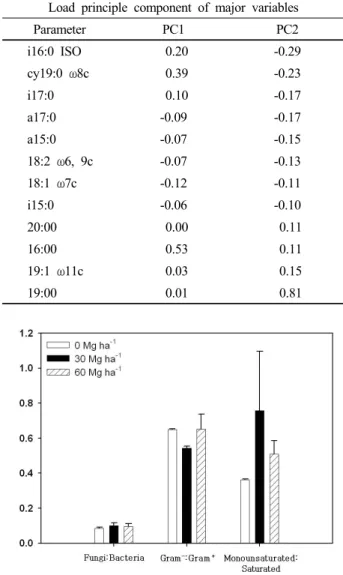
지질지방산들의PC1과 PC2의 값을 보여주고 있다. PC1 과 PC2 각각은 부 또는 정의 상관관계를 가지지 않으 나, 지방산 a17:0, a15:0, 18:2 ω6, 9c, 18:1 ω7c,
은 과 모두에서 부의 상관관계를 보였다
i15:0 PC1 PC2 .
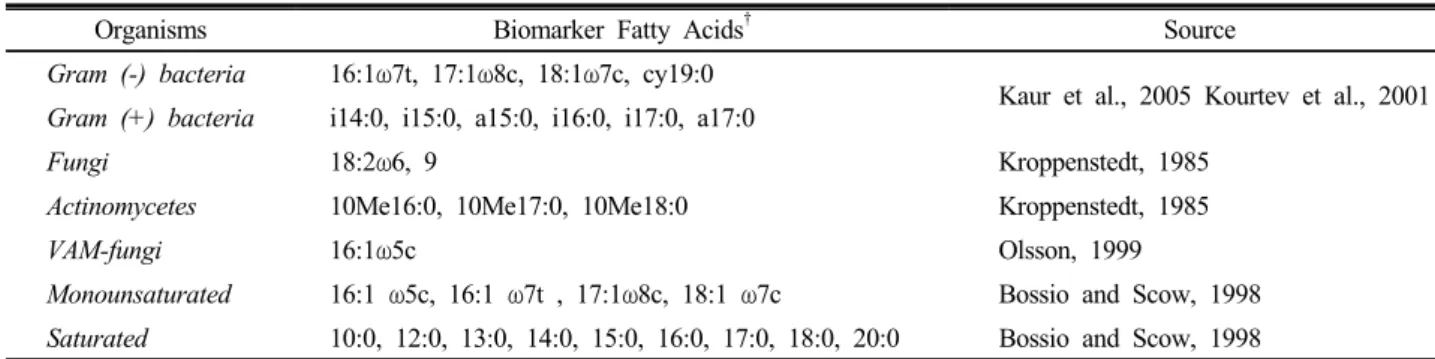
이 지방산들은 세균과 사상균을 대표하는 인지질지방산 으로 PC1과 PC2에서 이들 사이에 부의 상관관계가 있 음을 의미한다 (Table 2; Table 3). 이 결과는 Fig. 2 에서 모든 퇴비 시용량에서 유의성 있는 차이를 보이지 않은 것과 설명을 같이하고 있다 결국 퇴비처리는 미. , 생물 군집에 영향을 줄 수 있으며 이는 방선균 보다 세 Table 2. The phospholipid fatty acids (PLFAs) as biomarkers used for description of the soil microbial communities in red-pepper cultivated soils amended with compost.
Organisms Biomarker Fatty Acids† Source
Gram (-) bacteria 16:1 7t, 17:1 8c, 18:1 7c, cy19:0ω ω ω
Kaur et al., 2005 Kourtev et al., 2001 Gram (+) bacteria i14:0, i15:0, a15:0, i16:0, i17:0, a17:0
Fungi 18:2 6, 9ω Kroppenstedt, 1985
Actinomycetes 10Me16:0, 10Me17:0, 10Me18:0 Kroppenstedt, 1985
VAM-fungi 16:1 5cω Olsson, 1999
Monounsaturated 16:1 5c, 16:1 7t , 17:1 8c, 18:1 7cω ω ω ω Bossio and Scow, 1998 Saturated 10:0, 12:0, 13:0, 14:0, 15:0, 16:0, 17:0, 18:0, 20:0 Bossio and Scow, 1998
†The abbreviations nomenclature to describe the fatty acids are as follows. Number before the colon indicates the number of carbons in fatty acid. Number after the colon indicates the number of carbon-carbon double bonds in fatty acid chain. Position of the initial unsaturation is indicated by the number of carbon units from the methyl, or ω, end of the molecule. The geometry of the double bond is shown by c for cis and t for trans. Methyl branching can be indicated as iso (i; the second carbon from the methyl end) or anteiso (a; the third carbon) or just br (branch) if the position is unknown. When a branch is known but not in the i or a position, it is indicated by the position from the carboxyl end followed by Me before the carbon chain length (e.g., 10Me18:1 ω 3). Cyclopropane fatty acids are indicated as cy.
Fig. 1. Ordination plot from principal component analysis of phospholipid fatty acids extracted from soils amended with various amount of compost in red pepper field.
Fig. 2. Relative abundance of phospholipid fatty acids (PLFAs) of bacteria, fungi, actinomycetes and VAM- fungi to total PLFA in the red pepper cultivated soils as affected by compost application. Error bars indicate stan- dard deviation.
균과 균근균을 포함한 사상균에 의한 차이로 볼 수 있 다 (Park et al., 2008). 퇴비 시용에 따른 토양에서 유 효태 인산의 증가는 세균과 사상균의 지표 지방산을 증가 시켰고 (Demoling et al., 2008; Gr nli et al., 2005;ø
토양 가 토양 미생물의
Wallenstein et al., 2006), pH
군락에 영향을 미치며 일반적으로 세균과 방선균을 증, 가시키는 결과들과 부분적으로 일치한다 (Fierer and Jackson, 2006; Nilsson et al., 2007).
미생물상의 구조 38개의 지표 지방산에서 세균, 사상균 방선균 균근균이 포함하는 지방산은 일부분이, , 므로 Fig. 2는 주요인 분석의 결과를 설명하기에 부족 하다 그러므로 화학적으로 서로 다른 인지질지방산을.
그람특성과 탄화수소화합물의 포화도로 분류하여 미생물 상의 구조를 설명할 수 있다 (Zells, 1999).
은 퇴비 시비에 따른 미생물상의 구조의 변 Figure 3
화를 설명하기 위해서 사상균 세균과 그람/ -/그람+ 및 불 포화 포화 지방산의 비를 분산분석한 결과이다 퇴비를/ . 60 Mg ha-1시용하여 사상균 세균과 불포화 포화 지방/ / 산의 비를 무처리구와 비교하였을 때 유의성 있는 증가 를 보였다 이는 사상균과 세균 불포화지방산의 양과. , 포화지방산의 양 모두가 증가하였고, (Bossio and Scow, 비교적 사상균과 불포화지방산이 세균과 포화지 1998),
방산 보다 더 증가하였음을 의미한다 그러나 그람. -/그 람+ 세균 지방산의 비는 퇴비 시용량 30 Mg ha-1에서 감소하였고 시용량 60 Mg ha-1에서는 증가하였다 이. 결과는 불포화 포화 지방산의 비와 상반되는 것이다/ .
불포화지방산이 그람-와 그람+ 세균의 지표 지방산에 모두 포함될 수 있지만 (Table 2), 일반적으로 그람-세 균의 지표로서 사용된다는 연구와 상이한 결과였다 다만 유의성 있는 (Ratledge and Wilkinson, 1988). ,
차이는 보이지 않았으나 퇴비 시용에 따른 방선균 지표 지방산의 변화와 포화지방산의 변화가 어느 정도 유사 하였다 이것은 포화지방산이 방선균을 포함한 그람. +세 균의 지표지방산과 상관관계가 있다는 연구 결과를 뒷 받침한다 (Brennan, 1988).
고추 재배지에서 추천하는 퇴비 시용량인 30 Mg ha-1은 토양의 칼륨함량과 미생물의 군락을 부분적으로 증가시켰으나 시용량의 증가는 토양의 유효인산과 미생, 물 군락의 세부적인 특성을 지닌 구조만을 변화시켰다.
요 약
퇴비 등의 유기물 시용은 화학적 생물적 토양 특성, 을 변화시킬 수 있으나 그 성분함량과 시용량에 따라 다를 수 있다 고추 주산지인 경북 영양의 미사질 양토. 에서 퇴비 0, 30, 60 Mg ha-1를 시용하였을 때 토양의 미생물상의 변화를 인지질지방산 분석을 통해 분석하였 다 퇴비 시용량. 30과 60 Mg ha-1 을 무처리와 각각 비교하였을 때 세균 사상균 균근균 지표지방산의 양은, , 유의성있는 증가를 보였으며 사상균 세균의 지방산 비/ 와 불포화 포화지방산의 비도 각각 증가하였다 그러나/ . , 퇴비 시용량의 증가는 그람-/그람+ 세균 지방산의 비는 증가시켰으나 불포화 포화지방산의 비는 감소시켰다 퇴/ . 비는 토양의 화학성과 미생물 군락을 부분적으로 증가 시킬 수 있으나 퇴비량의 증가는 미생물 군락의 구조만, 을 변화시킬 수 있었다.
Table 3. Principal components loading matrix of each PLFAs after multivariate analysis.
Load principle component of major variables
Parameter PC1 PC2
i16:0 ISO 0.20 -0.29
cy19:0 8cω 0.39 -0.23
i17:0 0.10 -0.17
a17:0 -0.09 -0.17
a15:0 -0.07 -0.15
18:2 6, 9cω -0.07 -0.13
18:1 7cω -0.12 -0.11
i15:0 -0.06 -0.10
20:00 0.00 0.11
16:00 0.53 0.11
19:1 11cω 0.03 0.15
19:00 0.01 0.81
Fig. 3. Ratios of Fungi PLFA: Bacteria PLFA; Gram- PLFA: Gram+ PLFA; and total monounsaturated PLFA:
total saturated PLFA in soils amended with compost.
Error bars indicate standard deviation.
인 용 문 헌
MFAFF. 2009. Agricultural and forestry statistical yearbook. Ministry for food, agriculture, forestry and fisheries. p. 89. Seoul, Korea.
Bastida, F., E. Kandeler, J.L. Moreno, M. Ros, C. Garcia, and T. Hernandez. 2008. Application of fresh and composted organic wastes modifies structure, size and activity of soil microbial community under semiarid climate. Appl. Soil Ecol. 40:318-329.
Bossio, D.A., and K.M. Scow. 1998. Impacts of carbon and flooding on soil microbial communities:
phospholipid fatty acid profiles and substrate utilization patterns. Microbiol. Ecol. 35:265-278.
Brennan, P.J. 1988. Mycobacterium and other actinomy- cetes. p 204-298. In C. Ratledge et al. (ed.). Microbial lipids, vol 1. Academic Press, London.
Bunemann, E.K., G.D. Schwenke, and L. Van Zwieten.
2006. Impact of agricultural in pot on soil organism: a review. Austrian J. Soil Res. 44:379-406.
Caravaca, F., C. Garcia, M.T. Hernandez, and A. Roldan.
2002. Aggregate stability changes alter organic amend- ment and mycorrhizal inoculation in the afforestation of a semiarid site with Pinus Halepensis. Appl. Soil Ecol.
19:199-208.
Chiarini, L., A. Bevivino, C. Dalmastri, C. Nacamulli, and S. Tabacchioni. 1998. Influence of plant development, cultivar and soil type on microbial colonization of maize roots. Appl. Soil Ecol. 8:11-18.
Demoling, F., L.O. Nilsson, and E. Baath. 2008. Bacterial and fungal response to nitrogen fertilization in three coniferous forest soils. Soil Biol. Biochem. 40:370-379.
Diaz, J., C. Silvar, M.M. Varela, A. Bernal, and F. Merino.
2005. Fusarium confers protection against several mycelial pathogens of pepper plants. Plant Pathol.
54:773-780.
Diby, P., K.A. Saju, P.J. Jisha, Y.R. Sarma, A. Kumar, and M. Anandaraj. 2005. Mycolytic enzymes produced by Pseudomonas fluorescens and Trichoderma spp.
against Phytophthora capsici, the foot rot pathogen of black pepper (Piper nigrum L.). Ann. Microbial. 5:129- 133.
Doran, J.W., D.G. Fraser, M.N. Culik, and W.C.
Liebhardt. 1988. Influence of alternative and conven- tional agricultural management on soil microbial process and nitrogen availability. Am. J. Altern. Agric. 2:99-106.
Eriksen, J. 2005. Gross sulphur mineralization-immobilization turnover in soil amended with plant residues. Soil Biol.
Biochem. 37:2216-2224.
Fierer, N., and R.B. Jackson. 2006. The diversity and biogeography of soil bacterial communities. Proceedings
of the National Academy of Sciences of the United States of America. 103:626-631.
Gronli, K.E., A. Frostegard, L.R. Bakken, and M. Ohlson.
2005. Nutrient and carbon additions to the microbial soil community and its impact on tree seedlings in a boreal spruce forest. Plant Soil. 278:275-291.
Jetiyanon, K. 2007. Defensive-related enzyme response in plants treated with a mixture of Bacillus strains (In937a an In937b) against different pathogens. Biol. Control 42:
178-185.
Kaur, A., A. Chaudhary, A. Kaur, R. Choudhary, and R.
Kaushik. 2005. Phospholipid fatty acid - a bioindicator of environment monitoring and assessment in soil ecosystem. Current Science 89:1103-1112.
Kim, Y.C., H. Jung, K.Y. Kim, and S.K. Park. 2008. An effective biocontrol bioformulation against Phytophthora blight of pepper using growth mixtures of combined chitinolytic bacteria under different field conditions. Eur.
J. Plant Pathol. 120:373-382.
Kourtev, P.S., J.G. Ehrenfeld, and M. Haggblom. 2002.
Exotic plant species alter the microbial community structure and function in the soil. Ecology 83:3152-3166.
Kroppenstedt, R.M., 1985. Fatty acid and menaquinon analysis of actinomycetes and related organisms. p.
173-199. In M. Goodfellow et al. (ed.), Chemical methods in bacterial systematics. Academic Press, London.
Li, W.H., C.B. Zhang, H.B. Jiang, G.R. Xin, and Z.Y.
Yang. 2006. Changes in soil microbial community associated with invasion of the exotic weed, Mikania micrantha HBK. Plant Soil. 281:309-324.
NIAST. 2000. Analysis of soil plants. National Institute of Agricultural Science and Technology. Suwon, Korea.
Nilsson, L.O., E. Baath, U. Falkengren-Grerup, and H.
Wallander. 2007. Growth of ectomycorrhizal mycelia and composition of soil microbial communities in oak forest soils along a nitrogen deposition gradient.
Oecologia. 153:375-384.
Olsson, P.A. 1999. Signature fatty acids provide tools for determination of the distribution and interactions of mycorrhizal fungi in soil. FEMS Microbiol. Ecol.
29:303-310.
Park, K., T. Kwon, K. Jang, and Y. Kim. 2008. Short-term effects of cultivars and compost on soil microbial activities and diversities in red pepper field. Kor. J.
Environ. Agri. 27:1-5.
Peacock, A.D., M.D. Mullen, D.B. Ringelberg, D.D. Tyler, D.B. Hedrick, P.M. Gale, and D.C. White. 2001. Soil microbial community responses to diairy manure or ammonium nitrate applications. Soil Biol. Biochem.
33:1011-1019.
Randhawa, P.S., L.M. Condron, H.J. Di, S. Sinaj, and
R.D. McLenaghen, 2005. Effect of green manure addition on soil organic phosphorus mineralization. Nurr.
Cycl. Agroecosyst. 73:181-189.
Rasche, F., R. Trondl, C. Naglreiter, T.G. Reichenauer, and A. Sessitsch. 2006. Chilling and cultivar type affect the diversity of bacterial endophytes colonizing sweet pepper (Capsicum anuum L.). Can. J. Microbiol. 52:
1036-1045.
Ratledge, C., and S.G. Wilkinson. 1988. Microbial lipids.
Academic Press, London.
Ros, M., M.T. Hernanadez, and C. Garcia. 2003. Soil microbial activity after restoration of a semiarid soil by organic amendments. Soil Biol. Biochem. 35:463-469.
Saison, C., V. Degrange, R. Oliver, P. Millard, C. Com- meaux, D. Montange, and X. Le Roux. 2006. Alteration and resilience of the soil microbial community following compost amendment: effects of compost level and compost-borne microbial community. Environ. Microbiol.
8:247-257.
Singh, K.P., T.K. Srivastava, P.N. Singh, and A. Suman.
2007. Enhancing soil fertility, microbial activity and sugarcane (Saccharum officinarum) Productivity through organics in subtropical conditions. Indian J. Agri. Sci.
77:84-87.
Suh, J.S., T.M. Sa, and S.Y. Yun. 2009. Soil microbiology. Kor. J. Soil Sci. Fert. 42:126-152.
Tejada, M., M.T. Hernandez, and C. Garcia. 2009. Soil restoration using composted plant residues: effects on soil properties. Soil Till. Res. 102:109-117.
Wallenstein, M.D., S. McNulty, I.J. Fernandez, J. Boggs, and W.H. Schlesinger. 2006. Nitrogen fertilization decreases forest soil fungal and bacterial biomass in three long-term experiments. Forest Ecol. Manag.
222:459-468.
Zelles, L. 1999. Fatty acid patterns of phospholipids and lipopolysaccharides in the characterisation of microbial communities in soil- a review. Biol. Fertil. Soils 29:111-129.