• 검색 결과가 없습니다.

Thermoelectric Properties of Half-Heusler ZrNiSn<sub>1-x</sub>Sb<sub>x</sub> Synthesized by Mechanical Alloying Process and Vacuum Hot Pressing

N/A
N/A
Protected

Academic year: 2021

Share "Thermoelectric Properties of Half-Heusler ZrNiSn<sub>1-x</sub>Sb<sub>x</sub> Synthesized by Mechanical Alloying Process and Vacuum Hot Pressing"

Copied!
5
0
0

로드 중.... (전체 텍스트 보기)

전체 글

(1)

DOI: http://dx.doi.org/10.4150/KPMI.2011.18.5.401

Thermoelectric Properties of Half-Heusler ZrNiSn

1-x

Sb

x

Synthesized by Mechanical Alloying Process and Vacuum Hot Pressing

Soon-Chul Ur *

Department of Materials Science and Engineering/RIC-ReSEM, Chungju National University, 50 Daehangno, Chungju, Chungbuk 380-702, Korea

(Received June 19, 2011; Revised July 5, 2011; Accepted July 25)

Abstract Half-heusler phase ZrNiSn is one of the potential thermoelectric materials for high temperature application. In an attempt to investigate the effect of Sb doping on thermoelectric properties, half-heusler phase ZrNiSn

1-x

Sb

x

(0 x 0.08) was synthesized by mechanical alloying of stoichiometric elemental powder com- positions, and consolidated by vacuum hot pressing. Phase transformations during mechanical alloying and hot consolidation were investigated using XRD. Sb doped ZrNiSn was successfully produced in all doping ranges by vacuum hot pressing using as-milled powders without subsequent annealing. Thermoelectric properties as functions of temperature and Sb contents were evaluated for the hot pressed specimens. Sb doping up to x=0.04 in ZrNiSn

1-x

Sb

x

was shown to be effective on thermoelectric properties and the figure of merit (ZT) was shown to reach to the maximum at x=0.02 in this study.

Keywords: Half-Heusler, Zr-Ni-Sn, Sb doping, Thermoelectric, Mechanical Alloying

1. Introduction

Half-Heusler compounds (ABC compounds) have been taken great attention as potential thermoelec- tric conversion materials [1-2]. Candidates having this ABC structure for the investigation would be categorized into the combination of (Ti/Zr/Hf)(Co/

Ni/Pt)(Sb/Sn/Bi) [3, 4]. ZrNiSn belongs to a half- Heusler structure and it is expected to be a promis- ing thermoelectric material having relatively high figure of merit value, especially for power genera- tion [3-5]. The figure of merit is defined as ZT=

α

2

σ T/ κ , where α is the Seebeck coefficient, σ is the electrical conductivity, κ is the thermal conductivity and T is the temperature in Kelvin. Undoped ZrNiSn shows intrinsic n-type conduction [3-5]. Although high performance was anticipated in the system, the compound itself could not provide high ZT due to relatively higher lattice thermal conductivity [1, 3-5].

ZrNiSn compound has narrow band gap energy

(order of 0.4 eV) [4]. Doping on this system was found to be effective in thermoelectric property enhance- ment via band structure forming, and the substitution on the A, B and/or C sites was shown to be decrease in thermal conductivity via point defect phonon scatter- ing [3-7]. Considerable property enhancements were shown by substitution in ZrNiSn alloys, such as Ti(Hf) substitutions for Zr, Sb substitution for Sn, and vice versa [4-7].

ZrNiSn is generally prepared by induction melt- ing, powder metallurgy with hot pressing or spark plasma sintering, and/or hybrid methods of these [3, 5, 7]. Homogenous, single phase half-Heuslers are inherently difficult to produce in case of contain- ing low melting point elements such as Sn or Sb, due to their easy of sublimation during high temper- ature processes [3, 5-8]. In order to address these problems, mechanical alloying (MA) process as a solid state synthesis was applied in this study [8]. It was reported that MAed materials having a fine

*Corresponding Author : [Tel : +82-43-841-5385; E-mail : [email protected]]

(2)

grain size may improve thermoelectric conversion efficiency by the reduction in lattice thermal conduc- tivity [9]. In this work, we adopt Sb substitution for Sn on the synthesis of ZrNiSn by MA process. A nominal composition ZrNiSn

1-x

Sb

x

(0 x 0.08) have been synthesized by MA of elemental powders, fol- lowed by vacuum hot pressing (VHP) in this study.

Thermoelectric properties including thermal conduc- tivity were measured and compared with the results of analogous studies. Temperature dependences were also evaluated and their correlations to phase trans- formation were examined.

2. Experimental procedure

Appropriate elemental powder mixtures of Zr (-325 mesh, 99.9%), Ni (-325 mesh, 99.9%), Sn (-325 mesh, 99.9%) and Sb (-250 mesh, 99.9%) for stoichiometric ZrNiSn

1-x

Sb

x

(0 x 0.08) were pre- pared and mechanically alloyed in a Spex mill (8000D) up to for 48 hours. Zirconia balls of 5 mm diameter were used for the milling, and the ball to powder ratio was 10:1. The milling operation was carried out inside a dedicated glove box under an Ar atmosphere, and the rotation speed was 1,750 rpm.

As-milled powders were hot pressed in a cylindrical high strength graphite die at 1073K with a stress of 70 MPa for 2 hours in vacuum. In order to investi- gate the phase transformation during synthesis, X- ray diffraction (XRD; Bruker AXS ADVANCE D-8) analyses using Cu K

α

radiation were carried out for the powders as well as hot pressed samples. Densi- ties after hot consolidation were measured using a He pycnometer. In order to observe microstructures e-SEM (FEI, Quanta-400) were employed. Thermo- electric properties in terms of Seebeck coefficient, electrical resistivity and thermal conductivity were measured from 300K to 1023K, and ZT was evalu- ated. Here, hot pressed specimens were cut into the size of 3 × 3 × 10 mm

3

for Seebeck coefficient and electrical resistivity measurements, and into 10 φ× 1 mm for thermal conductivity measurement. Seebeck

coefficient and electrical resistivity was measured by the differential and 4-point probe methods (Ulvac- Riko ZEM2-M8). Thermal conductivity was evalu- ated from the measurements of thermal diffusivity, specific heat and density by the laser flash method (Ulvac-Riko TC7000).

3. Results and discussion

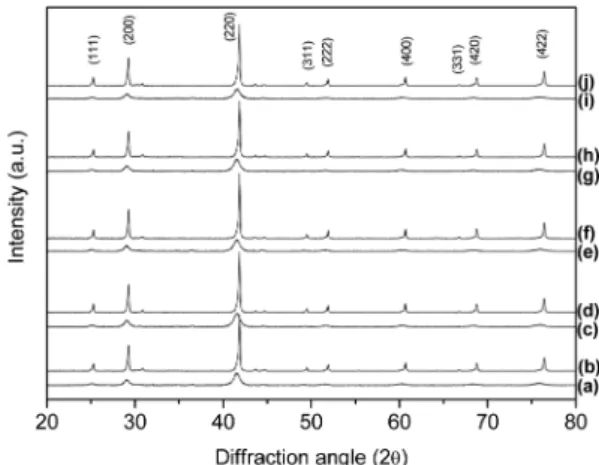
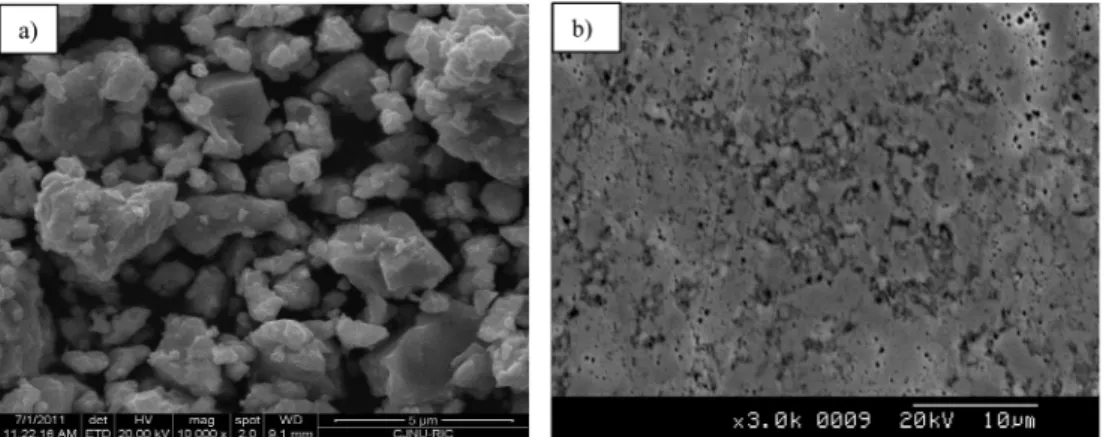
XRD analysis revealed that half-Heusler phase formation was shown to be accomplished after 48 hrs of MA, and phase separation was not observed after VHP for 2hrs in all prepared compositions, as shown in Fig. 1. A bit of off-symmetry in as-milled powders was shown in the XRD patterns. It is com- monly observed in MA process [9]. It can be consid- ered that the lattice distortion induced by severe ball- to powder collision during the MA process could result in the peak shift. As-milled powder size after 48 hrs was typically less than 8 µ m, as shown in Fig.

2(a). Meta-stable MA powders are quite frequently observed in other thermoelectric compounds such as skutterudites, which need to have further powder annealing for a long time in order to transform to the

Fig. 1. XRD patterns of MA ZrNiSn

1-x

Sb

x

powders and hot

pressed samples(referring to ICDD No. 700-023-1281); (a)

x=0, MA for 48hrs, (b) x=0, VHP for 2hrs, (c) x=0.02, MA

for 48hrs, (d) x=0.02, VHP for 2hrs, (e) x=0.04, MA for

48hrs, (f) x=0.04, VHP for 2hrs, (g) x=0.06, MA for 48hrs,

(h) x=0.06, VHP for 2hrs, (i) x=0.08, MA for 48hrs, and (j)

x=0.08, VHP for 2hrs.

(3)

single phase one [9]. Here, half-Heusler phase for- mation seems to be produced without further anneal- ing process. For densification, MAed ZrNiSn

1-x

Sb

x

powders were vacuum hot pressed (VHPed) at 1073 K with a stress of 70 MPa for 2 hrs. VHP process results in 83%~85% of theoretical density. SEM observation revealed no microcracks, but some voids

were unavoidable, as shown in Fig. 2(b). Though compacted powders were exposed to relatively high temperature during VHP, Sn sublimation or phase separation was not observed, as presented in Fig. 1.

Thermoelectric properties as a function of temper- ature were evaluated. Seebeck coefficients in all the specimens at test range showed negative values, rep- Fig. 2. SEM micrograph of MA ZrNiSn

0.98

Sb

0.02

; (a) MA powders after 48 hrs of milling and (b) Vacuum hot pressed at 1073K for 2hrs (Nital etched).

Fig. 3. Thermoelectric properties of VHPed MA ZrNiSn

1-x

Sb

x

(where (1) x=0.0, (2) x=0.02, (3) x=0.04, (4) x=0.06, and (5)

x=0.08); (a) Seebeck coefficient, (b) Electrical conductivity, (c) Thermal conductivity, and (d) Figure of merit, ZT.

(4)

resenting n-type conductivity, as presented in Fig.

3(a). Absolute value of Seebeck coefficients in undoped state (x=0) are compatible to analogue studies [3, 5], but doping did not induce significant enhancement, possibly due to carrier compensation by Sb doping.

Absolute value of Seebeck coefficients increases with increasing temperature up to 530 K and decreases afterwards in undoped state, as in similar studies [10], and doped specimens show gradual increase with temperature. Electrical conductivity showed gradual increase with temperature in undoped state, representing an intrinsic semiconductor, but all of doped specimens showed a degenerate semiconduc- tor behavior, as presented in Fig. 3(b). Change to degenerating semiconductors were thought to be due to the decrease in the Fermi level and the increase in the hole concentration by adding Sb [11]. Electrical conductivity values in dope states are very similar to analogue studies [3, 5]. Here, it seems to be quite difficult to rationalize electrical conductivity with doping contents, but it can be considered that electri- cal conductivity can be increased by doping in gen- eral.

Thermal conductivities of MA ZrNiSn

1-x

Sb

x

as a function of temperature up to 1023 K were pre- sented in Fig. 3(c). Thermal conductivities of all specimens were shown to be relatively lower than those in analogue studies [3, 5-6]. This is possibly attributed to the increasing phonon scattering in the typical MA materials having ultra fine microstruc- ture, leading to low the lattice thermal conductivity [9]. Thermal conductivity was also shown to be low- ered by doping as reported in analogue studies [3, 5], and it was the lowest at x=0.02.

It is generally recognized that Seebeck coefficient and thermal conductivity tend to decrease with dop- ing level [3, 5]. Overall tendency seems to be simi- lar in this study, except the cases of x=0.02 and x=0.04 in Seebeck coefficients. This is possibly due to that there might be an increase in scattering fac- tor, in addition to the effect of carrier compensation by Sb doping.

From the values of σ , α and κ obtained above, ZT values were possible to calculate, as presented in Fig. 3(d). ZT values obtained in this undoped state showed to be compatible to other analogue studies [3, 5]. It can be noticed that MA process in this materials system created a nanostructure, leading to effectively reducing thermal conductivity, resulting in relatively high ZT values [9]. It was shown that doping up to x=0.04 resulted in enhancement of ZT and the maximum value was found to be 0.10 at 1023 K in x=0.02. Here, it should be speculated that doping did not show significant increase in ZT com- parison to multi doping cases, at which Hf and Sb or Y and Sb were doped [3, 5]. This is possibly attrib- uted to relatively lower value of Seebeck coefficients in doped state, and to relatively lower densities as well.

Thus, it can be speculated that introducing multi dopants into the ZrNiSb system along with produ- cing ultra fine microstructure by mechanical alloying process can be a more effective process for the high performance materials and devices.

4. Conclusions

Half-Heusler, ZrNiSn

1-x

Sb

x

(0 x 0.08) compounds

have been successfully synthesized by mechanical

alloying of elemental powders, and consolidated by

VHP using as-milled powders without Sn sublima-

tion or phase separation. Seebeck coefficients in all

the specimens at test range showed negative values,

representing n-type conductivity. Absolute value of

Seebeck coefficient is relatively high in undoped

state, comparison to analogue studies, but doping did

not induce enhancement, possible due to carrier

compensation. Change from intrinsic to degenerate

semiconductor by Sb doping was found. Electrical

conductivity value in dope state is very similar to

analogue studies, and is increased by doping. Ther-

mal conductivity was shown to be lowered by dop-

ing and was the lowest at x=0.02. It was shown that

doping up to x=0.04 resulted in enhancement of ZT

and the maximum value was found to be 0.10 at

(5)

1023 K in x=0.02. However, doping did not show significant increase in ZT comparison to multi dop- ing cases. It can be speculated that introducing multi dopants into the ZrNiSb system along with produ- cing ultra fine microstructure by mechanical alloying process can be a more effective process for the high performance materials and devices.

Acknowledgement

This research was supported by the Regional Inno- vation Center (RIC) Program which was conducted by the Ministry of Knowledge Economy of the Korean Government.

References

[1] C. Uher, J. Yang, S. Hu, D. T. Morelli and G. P. Meis- ner: Phys. Rev. B., 59 (1999) 8615.

[2] W. Jeitschko: Metall. and Mater. Trans. B, 1(11) (1970)

1073.

[3] S. Katsuyama, R. Matsuo and M. Ito: J. Alloys and Comp., 428 (2007) 262.

[4] J. Tabola and J. Pierre: J. Alloys and Comp., 296 (2000) [5] C. Yu, T.-J. Zhu, R.-Z. Xhi, Y. Zhang, X.-B. Zhao and 243.

J. He: Acta Mater., 57 (2009) 2757.

[6] D. Fruchart, V. A. Romaka, Y. V. Stadnyk, L. P. Romaka, Y. K. Gorelenko, M. G. Shelyapina and V. F. Chekerin:

J. of Alloys and Comp., 438 (2007) 8.

[7] Y. Xia, S. Bhattacharya, V. Ponnambalam, A.L Pope, S. J. Poon and T. M. Tritt: J. of Appl. Phy., 88 (4) (2000) 1952.

[8] I.-H. Kim, J.-C. Kwon, Y.-G. Lee, M.-S. Yoon, S.-L. Ryu, W.-G. Kim and S.-C. Ur: Materials Science Forum, 658

(2010) 33.

[9] S.-C. Ur, J.-C. Kwon and I.-H. Kim: J. of Alloys and Comp., 442 (2007) 358.

[10] K. Kurosaki, H. Muta and S. Yamanaka: J. of Alloys and Comp., 384 (2004) 51.

[11] D. Mandrus, A. Migliori, T. W Darling, M. F. Hund- ley, E. J. Peterson and J. D. Thompson: Phys. Rev.,

B52 (1995) 4926.

수치

Fig. 1. XRD patterns of MA ZrNiSn 1-x Sb x  powders and hot pressed samples(referring to ICDD No
Fig. 3. Thermoelectric properties of VHPed MA ZrNiSn 1-x Sb x  (where (1) x=0.0, (2) x=0.02, (3) x=0.04, (4) x=0.06, and (5) x=0.08); (a) Seebeck coefficient, (b) Electrical conductivity, (c) Thermal conductivity, and (d) Figure of merit, ZT

참조

관련 문서