Vol. 25, No. 10 (2015)
566
Structural, Dielectric and Field-Induced Strain Properties of La-Modified Bi
1/2Na
1/2TiO
3-BaTiO
3-SrZrO
3Ceramics
Ali Hussain
1, Adnan Maqbool
1, Rizwan Ahmed Malik
1, Arif Zaman
1,2, Jae Hong Lee
1, Tae Kwon Song
1, Jae Hyun Lee
1, Won Jeong Kim
3and Myong Ho Kim
1†1School of Advanced Material Engineering, Changwon National University, Gyeongnam 641-773, Korea
2Department of Physics, Abdul Wali Khan University, Mardan, KPK, Pakistan
3Department of Physics, Changwon National University, Gyeongnam 641-773, Korea
(Received July 27, 2015 : Revised August 25, 2015 : Accepted September 8, 2015)
Abstract Bi0.5Na0.5TiO3 (BNT) based ceramics are considered potential lead-free alternatives for Pb(Zr,Ti)O3(PZT) based ceramics in various applications such as sensors, actuators and transducers. However, BNT-based ceramics have lower electromechanical performance as compared with PZT based ceramics. Therefore, in this work, lead-free bulk 0.99[(Bi0.5Na0.5)0.935Ba0.065](1-x)LaxTiO3-0.01SrZO3 (BNBTLax-SZ, with x = 0, 0.01, 0.02) ceramics were synthesized by a conventional solid state reaction The crystal structure, dielectric response, degree of diffuseness and electric-field-induced strain properties were investigated as a function of different La concentrations. All samples were crystallized into a single phase perovskite structure. The temperature dependent dielectric response of La-modified BNBT-SZ ceramics showed lower dielectric response and improved field-induced strain response. The field induced strain increased from 0.17 % for pure BNBT-SZ to 0.38 % for 1 mol.% La-modified BNBT-SZ ceramics at an applied electric field of 6 kV/mm. These results show that La- modified BNBT-SZ ceramic system is expected to be a new candidate material for lead-free electronic devices.
Key words lead-free, piezoelectric, relaxor, BNT-BT.
1. Introduction
New lead-free piezoceramics with enhanced electro- mechanical properties are required for environmentally benign commercial piezoelectric applications.1) Many research efforts have been devoted to the solid solutions of bismuth-based perovskite ceramics.2-6) Among these systems, the Bi1/2Na1/2TiO3-BaTiO3 (BNT-BT) is considered a good candidate for technical applications because its properties can be easily engineered through proper chemical modifications.7-10)
The binary system of BNT-BT exhibits a morphotropic phase boundary (MPB) around 5-7 mol% BT,7) and show good electromechanical properties. The high piezoelectric coefficient and low permittivity make it superior candi- date for high-frequency ultrasonic applications and piezo- electric actuator devices. Numerous researchers have fo- cused to modify this system with perovskite solid solutions to achieve improved electromechanical properties.11-13)
Among them many efforts have been concentrated on A- and/or B-site doping to improve the electromechanical performance.14-16) It has been reported that either replacing Bi on the A-site or all A-site cations in BNT-based ceramics are effective strategies for enhancing the elec- tromechanical properties.17,18) Compositional modifications with aliovalent cations are scientifically interesting since small dopants can considerably enhance the electrome- chanical properties because of the cation vacancy formation.
La has been used to modify several archetypal perovskites, such as Pb(Zr,Ti)O3, and Ba1/2Na1/2TiO3.19-21) Isovalent doping has shown to be a reliable approach to tailor the dielectric and electromechanical properties of the BNT- based ceramics.18,19) However, to examine the effect of aliovalent doping in BNT-based ceramics, this work was carried out on the conventional synthesis of La doping in the BNBT-SZ ceramic system. Furthermore, the effect of La doping on crystal structure, dielectric, relaxor pro-
†Corresponding author
E-Mail : [email protected] (M. H. Kim, Changwon Nat'l Univ.)
©Materials Research Society of Korea, All rights reserved.
This is an Open-Access article distributed under the terms of the Creative Commons Attribution Non-Commercial License (http://creative- commons.org/licenses/by-nc/3.0) which permits unrestricted non-commercial use, distribution, and reproduction in any medium, provided the original work is properly cited.
perties and field-induced strain properties of BNBT-SZ ceramics were investigated in detail.
2. Experimental
0.99[(Bi0.5Na0.5)0.935Ba0.065TiO3]-0.01SrZO3 (BNBT-SZ) system was selected as a base material and La was in- troduced according to the chemical formula 0.99[(Bi0.5- Na0.5)0.935Ba0.065](1-x)LaxTiO3-0.01SrZO3 in composition range x = 0-0.02. All samples were produced by a conventional solid state method using Bi2O3 (99.90 %), Na2CO3 (99.95
%), BaCO3 (99.0 %), SrCO3 (99.90 %), TiO2 (99.99 %) ZrO2 (99.99 %) and La2CO3 (99.99 %) as raw materials (Sigma Aldrich Co. St. Louis, MO). The powders were first dried in an oven at 100oC for 24 h. The dried powders were then weighed according to the stoichio- metric formula and ball-milled with zirconia ball as media for 24 h in ethanol. The dried slurries were calcined at 850oC for 2 h and ball-milled again to dissociate the agglomerates. After further drying, the pow- ders were pulverized, passed through a sieve with a 150 mesh, and mixed with an aqueous polyvinyl alcohol (PVA) solution as a binder for granulation. The granulated powders were subsequently pressed into green disks of diameter 10 mm at 150 MPa. The green bodies were embedded in a powder of the same composition to minimize the evaporation of the volatile elements (Bi, Na); all the compositions were then sintered at 1160oC for 2 h in air.
The crystal structure of the sintered samples was characterized using an X-ray diffractometer (XRD: Mini- flex II Rigaku). To measure the electrical properties, silver paste was coated on both polished faces of the sintered samples and fired at 650oC for 0.5 h to form electrodes. The dielectric constant and loss of samples were measured using an automatic acquisition system with an impedance analyzer (Agilent HP4292A, USA) in the temperature range of 25-500oC. Field-induced strain curves were measured using a contact type displacement
sensor (Millitron: Model 1240) at 50 mHz.
3. Results and Discussion
Fig. 1 shows the X-ray diffraction (XRD) patterns of BNBTLa-SZ ceramics. All sample showed a single phase perovskite structure without any evidence of secondary phases. This indicates that La is successfully diffused into BNBT-SZ lattice to form a complete solid solution.
The symbol (*) in the XRD pattern shows Si peak that is used as an internal standard for clarifying the peaks shifting behavior of different samples. The diffraction peaks of pure BNBT-SZ ceramics show tetragonal sym- metry evident by splitting (002)/(200) at 2θ angle 46o. This splitted (002)/(200) at 2θ angle 46o merge into a single peak (002) of a pseudo-cubic symmetry with increasing amount of La content. This result is consistent with the previous reports found in the literature for similar lead-free materials.22-24) When La is substituted into BNBT-SZ lattice, it is possible to form either cation vacancies, reduced concentration of oxygen vacancies or Fig. 1. X-ray diffraction patterns of La-modified BNBT-SZ ceramics.
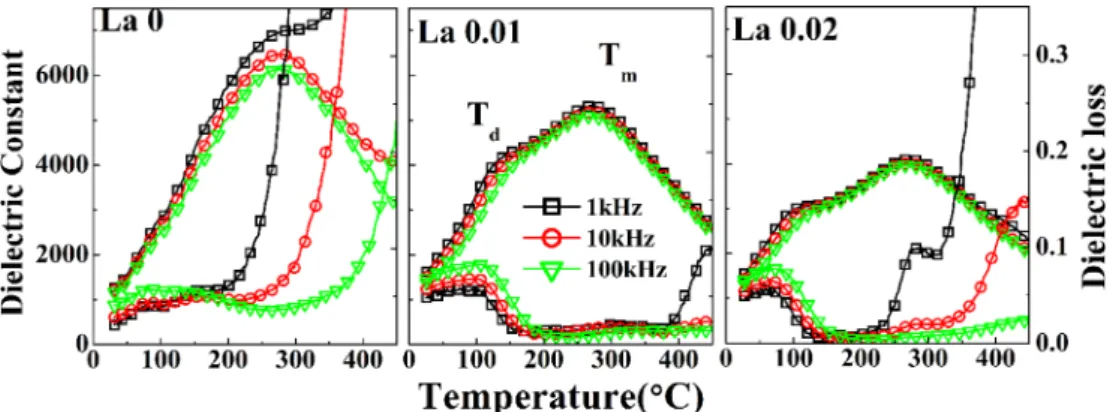
Fig. 2. Temperature dependence of dielectric constant and dielectric loss of La-modified BNBT-SZ ceramics at different frequencies.
form free electrons during the incorporation process25,26) to compensate the charge of the aliovalent La dopant. It is assumed that La3+ would replace Bi3+ cations on the A-site taking into account similar radii (Bi3+~ 1.36, La3+
~ 1.34 Å)27) and oxidation states along with a non- negligible volatilization of Bi3+ during calcination and sintering.28)
Fig. 2 shows the temperature-dependent dielectric con- stant (εr) and loss (tanδ) of La-modified BNBT-SZ ceramics measured at different frequencies (1, 10 and 100 kHz). Two dielectric anomalies, a depolarization tem- perature (Td) below 100oC and a maximum dielectric constant peaks at temperature (Tm) were observed below 300oC in La-modified BNBT-SZ ceramics. Dielectric peaks at Tm gradually broadened and maximum per- mittivity (εr) decreased with increasing amount of La concentration which is consistent with previous reports.29,30) The room temperature dielectric loss slightly increased and the broad dispersion at high temperature (200oC and above) slightly decreased as compared with pure BNBT- SZ ceramics. The diffused character in the La-modified
BNBT-SZ ceramics could be due to La substitution on the A-site, which could be the sources of random fields that break the long-range order of BNBT-SZ and stabilize the polar nanoregions at low temperature and zero field in a way similar to that proposed for other BNT-based ceramics.7,31) The observed diffuse and/or relaxor behavior could be attributed to the disordering of the A-site cations and the compositional fluctuation in the present work.
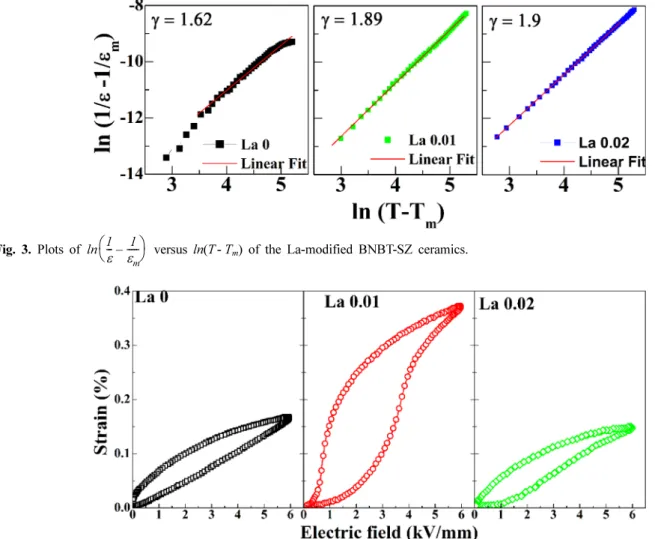
The dielectric constant curves of BNBT-SZ ceramics became flaten (more diffuse) with increasing amounts of La substitution. The degree of diffuseness was charac- terized for all samples and are shown in Fig. 3. Modified Curie-Weiss law32) was used to calculate γ values according to following equation.
Where Tm is the temperature at which the dielectric constant reaches maximum and εm is the maximum dielectric constant, γ the diffusivity for phase transition
1ε --- 1
εm ---
– (T T– m)γ
--- 1 γ 2c , ≤ ≤
= Fig. 3. Plots of 1 versus ln(T - Tm) of the La-modified BNBT-SZ ceramics.
ε--- 1 εm ---
⎝ – ⎠
⎛ ⎞
ln
Fig. 4. Bipolar field-induced strain curves of La-modified BNBT-SZ ceramics.
(which indicates the degree of dielectric relaxation), and c the Curie constant. When γ = 1, the materials are said to be normal ferroelectrics; when γ = 2, the materials are termed as relaxor ferroelectrics. The values of γ and c are both materials constants that depend on the composition and structure of materials. The γ values as a function of La concentrations were plotted at 1 kHz. The γ was found to be 1.62, 1.89 and 1.90 for x = 0, 0.01, and 0.02, respectively; which shows that the diffuse and relaxor character increased with increasing amount of La addition.
Fig. 4 shows the field-induced unipolar strain loops of the BNBTLa-SZ ceramics at measuring frequency of 50 mHz. Pure BNBT-SZ ceramics show a maximum strain (Smax) of 0.17 % at an applied electric field of 6 kV/mm. However, introduction of La in BNBT-SZ, brought a significant enhancement in the field induced strain response. A large unipolar strain of 0.38 % was observed for x = 0.01 sample. Beyond this composition, the maximum strain decreased. This enhanced strain response for x = 0.01 composition can be attributed to the ferroeletric and relaxor phase transition facilitated by the structural phase transition from the tetragonal phase to a pseudo-cubic phase. This behavior is consistent with previous reports of BNT-based ceramics modified on A- site.18,26) This finding of field induced strain is promising from the view point of electromechanical actuator appli- cations.
4. Conclusions
The crystal structure, dielectric, relaxor and field- induced strain properties of La-modified BNBT-SZ ceramics were investigated as a function of different La concentration. Replacing A-site of BNBT-SZ by La changed the crystal structure from tetragonal to a pseudo- cubic symmetry. The temperature dependent dielectric response revealed relaxor behavior which increased with increasing amount of La concentration. The unipolar field-induced strain curves show enhancement with La- modification. A maximum field-induced strain 0.17 % was observed for pure BNBT-SZ ceramics which increased to 0.38 % for 1 mol% La-modified BNBTLa-SZ ceramics.
Acknowledgements
This work is supported by the National Research Foundation of Korea (NRF) grant funded by the Korean government, Ministry of Education (MOE) (2013R1A1- A2058345) and Basic Research program through the National Research Foundation of Korea (NRF) funded by Ministry, Science and Technology (MEST) (2011-0030058).
References
1. Directive 2002/95/EC of the European Parliament and of the Council of 27 January 2003, Off. J. Eur. Union L37, 19 (2003).
2. J. Rödel, K. G. Webber, R. Dittmer, W. Jo, M. Kimura and D. Damjanovic, J. Eur. Ceram. Soc., 35, 1659 (2015).
3. K. Yoshii, Y. Hiruma, H. Nagata and T. Takenaka, Jpn. J.
Appl. Phys., 45, 4493 (2006).
4. X. X. Wang, H. L. W. Chan and C. L. Choy, J. Am.
Ceram. Soc., 86, 1809 (2003).
5. Y. Hiruma, H. Nagata and T. Takenaka, J. Appl. Phys., 104, 124106 (2008).
6. A. B. Kounga, S. T. Zhang, W. Jo and J. Rödel, Appl.
Phys. Lett., 92, 222902 (2008).
7. T. Takenaka, K. Maruyama and K. Sakata, Jpn. J. Appl.
Phys., Part 1 30, 2236 (1991).
8. C. Xu, D. Lin, and K. W. Kwok, Solid State Sci., 10, 934 (2008).
9. M. Chen, Q. Xu, B. H. Kim, B. K. Ahn, J. H. Ko, W. J.
Kang, and O. J. Nam, J. Eur. Ceram. Soc., 28, 843 (2008).
10. E. Dul’kin, E. Mojaev, M. Roth, S. Greicius, and T.
Granzow, Appl. Phys. Lett., 92, 012904 (2008).
11. A. B. Kounga, S. T. Zhang, W. Jo and J. Rödel, Appl.
Phys. Lett., 92, 222902 (2008).
12. S. T. Zhang, A. B. Kounga, E. Aulbach, H. Ehrenberg and J. Rödel, Appl. Phys. Lett., 91, 112906 (2007).
13. F. Wang, M. Xu, Y. Tang, T. Wang, W. Shi and C. M.
Leung, J. Am. Ceram. Soc., 95, 1955 (2012).
14. G. Yao, X. Wang, Y. Wu and L. Li, J. Am. Ceram. Soc., 95, 614 (2012).
15. R. Zuo, C. Ye, X. Fang and J. Li, J. Eur. Ceram. Soc., 28, 871 (2008).
16. S. K. Acharya. B. G. Ahn, C. U. Jung, J. H. Koh, I. H.
Choi and S. K. Lee, J. Alloy. Compd., 603, 248 (2014).
17. W. Lu, Y. Wang, G. Fan, X. Wang and F. Liang, J. Alloy.
Compd., 509, 2738 (2011).
18. T. H Dinh, H. Y Lee, C. H Yoon, R. A Malik, Y. M.
Kong, J. S Lee and V. D. N. Tran, J. Korean Phys. Soc., 62, 1004 (2013).
19. Q. Zheng, C. Xu, D. Lin, D. Gao and K. W. Kwok, J.
Phys. D Appl. Phys., 41, 125411 (2008).
20. X. Dai, Z. Xu and D. Viehland, Phil. Mag. B, 70, 33 (1994).
21. J. K. Lee, J. Y. Yi and K. S. Hong, J. Appl. Phys., 96, 1174 (2004).
22. A. Hussain, C. W. Ahn, J. S. Lee, A. Ullah and I. W.
Kim, Sens. Actuators A, 158, 84 (2010).
23. R. A. Malik, J. K. Kang, A. Hussain, C. W. Ahn, H. S.
Han and J. S. Lee, Appl. Phys. Exp., 7, 061502 (2014).
24. A. Maqbool, A. Hussain, J. U. Rahman, T. K. Song, W.
J. Kim, J. H. Lee and M. H. Kim, Ceram. Int., 40, 11905 (2014).
25. J. Y. Yi, J. K. Lee and K. S. Hong, J. Am. Ceram. Soc., 85, 3004 (2002).
26. M. Acosta, N. Liu, M. Deluca, S. Heidt, I. Ringl, C.
Dietz, R.W. Stark and W. Jo, J. Appl. Phys., 117, 134106 (2015).
27. R. Shannon, Acta Cryst. A 32, 751 (1976).
28. A. Popovi , L. Bencze, J. Koruza, B. Mali and M.
Kosec, Int. J. Mass Spectrom., 309, 70 (2012).
29. A. Zaman, Y. Iqbal, A. Hussain, M. H. Kim and R. A.
Malik, J. Mater. Sci., 49, 3205 (2014).
30. J. U. Rahman, A. Hussain, A. Maqbool, G. H. Ryu, T. K.
Song, W. J. Kim and M. H. Kim, J. Alloy. Compd., 593, 97 (2014).
31. N. B. Do, H. B. Lee, C. H. Yoon, J. K. Kang and J. S.
Lee, Trans. Electr. Electron. Mater., 12, 64 (2011).
32. K. Uchino and S. Nomura, Ferroelectrics Lett., 44, 55 (1982).
cê
cê