674 Corresponding author: [email protected]✽
한국 남해산 유해조류
Chattonella marina
와C. ovata
(Raphidophyceae)의 영양염에 대한 성장동력학노일현・오석진1・박종식・신현호・윤양호✽
전남대학교 해양기술학부, 1부경대학교 해양과학공동연구소
Growth Kinetics on the Nutrient of the Harmful Algae Chattonella marina and C. ovata (Raphidophyceae)
Isolated from the South Sea of Korea
Il Hyeon Noh, Seok Jin Oh1, Jong Sick Park, Hyeon Ho Shin and Yang Ho Yoon✽
Faculty of Marine Technology, Chonnam National University, Yeosu 550-749, Korea
1Korea Inter-University Institute of Ocean Science, Pukyong University, Busan 608-737, Korea
Recently, the occurrence of harmful algae blooms from the Chattonella group has been increasing and expanding in the southern and western seas of Korea. We investigated the relationship between growth kinetics and nutrients in the harmful algae Chattonella marina and Chattonella ovata of the South Sea, Korea. As a result; high concentrations of ammonium (30 μM and above) was not effective to the growth of C. ovata, while C. marina displayed good growth at concentration of 100 μM. The half-saturation constant () of C. marina for ammonium (2.51 μM), nitrate (5.36 μM) and phosphate (0.75 μM) was higher than C. ovata (1.85, 4.01, and 0.61 μM, respectively). This indicates that C. ovata can achieve higher cell densities than C. marina under lower nutrient conditions. These values were comparatively higher than those of diatoms and other flagellates previously reported. Therefore, our results indicate that the growth of C. marina and C. ovata is less adapted to lower nutrient environments than other competition species, such as Skeletonema costatum and Cochlodinium polykrikoides.
Key words : Chattonella marina, Chattonella ovata, Nutrient, Growth kinetics, Half-saturation constant
서 론
침편모조류에 속하는 유해조류 (Harmful Algae Blooms, HABs)는 Chattonella, Fibrocapsa 및 Heterosigma 등 3속이 범지구적으로 알려지며, Chattonella 속을 포함한 7종이 유해 생물로 기록되어 있다 (UNESO, 2003). 이 중 Chattonella 종들 은 열대, 아열대 및 온대해역에 광역으로 출현하며, 대발생시 해양생물 및 수산자원생물에 막대한 경제적 손실과 사회문제 를 유발시키는 대표적인 적조생물이다 (Imai et al., 1998;
Vrieling et al., 1995; Lu and Hodgkiss, 2001; Mikhail, 2001;
Barraza-Guardado et al., 2004; Zhang et al., 2006).
특히, Chattonella marina (Subrahmanyn) Hara et Chihara는 유리지방산 (free fatty acids)과 활성산소 (reactive oxygen)에 의해 어류를 폐사시키는 종으로 (Oda et al., 1992; Marshall et al., 2003; Tang et al., 2005), 적조발생은 인도 Malabar 해역에 서 처음 보고 되었다 (Subrahmanyan, 1954). 그 이후 1970~80년 대에는 일본 Seto 내해의 대표적인 적조 원인종으로 양식어류, 특히 대형 방어양식장에 치명적 피해를 발생시키는 종으로
알려졌다 (Imai et al., 2006).
Chattonella ovata Y. Hara et Chihara는 2001년 아열대성 해역인 중국 남부의 Dapeng만에서 최초 적조발생 기록을 보 였으며 (Lu and Hodgkiss, 2001), 이후, 2003년 멕시코의 Kun Kaak만 (Gulf of California)에서 출현된 C. marina와 함께 자연 산 어패류의 대량폐사를 발생시킨 원인종일 가능성이 제기 되었다 (Barraza-Guardado et al., 2004). 그리고 2004년에 일본 Seto 내해의 Kagawa현 인근인 Suo-nada에서 본 종에 의한 적조가 발생, 약 20,000여 마리의 양식어류가 폐사되면서 어류 치사가 확인되었다 (Hiroishi et al., 2005).
우리나라 연안 및 내만해역에서는 1983년 남해동부의 진동 만에서 Chattonella sp.에 의한 적조가 처음으로 보고되었다 (Park et al., 1988). 그리고 최근 남해해역을 중심으로 C.
marina, C. ovata와 C. antiqua 및 C. globosa의 출현빈도와 세포밀도가 점차 증가되고 있으며 (Kim et al., 2005), 남해서부 의 완도와 장흥연안 및 서해중부의 태안반도 주변해역에서 이들의 출현이 고밀도로 상습화 하는 경향을 보이고 있다 (NFRDI, 2005, 2007, 2008).
일본 Seto 내해에서 하계 Chattonella 적조발생의 경년변화
양상은 해수 중 영양염류 농도의 변화와 밀접한 관련이 있었 으며 (Yanagi, 1989; Imai et al., 1998, 2006), 극심한 부영양화 해역인 멕시코의 Kun Kaak만에서도 C. marina와 C. ovata의 대발생 기간에 해역의 인산염 농도가 급격히 감소하는 (Barraza-Guardado et al., 2004) 등, Chattonella 종의 성장과 대발생에 영양염의 변화는 중요한 요인으로 보고되어 있다.
그러나 지금까지 C. marina 및 C. ovata의 영양염에 관련한 생리․생태적 연구는 일본 Osaka만에서 C. marina의 성장을 조절하는 영양염류에 대한 연구 (Yamochi, 1984), C. marina의 활성산소 생산에 미치는 영양염류의 영향 (Liu et al., 2007), 그리고 일본 Hiroshima만에서 분리한 C. ovata의 영양염에 대한 성장동력학적 연구와 용존 유기 질소와 인원의 이용에 대한 연구 (Yamaguchi et al., 2008) 등이 보여 지고 있으나, 최근 급증하는 한국연안에서 이 종들을 대상으로 한 연구는 전무한 실정이다.
국내에서 아직까지 Chattonella 속의 적조발생에 의한 수산 피해는 없지만, 앞으로 본 종들에 의한 적조발생 및 양식어류 에 대한 수산피해 가능성은 매우 크다고 할 수 있다. 따라서 본 연구에서는 남해연안에서 분리한 C. marina와 C. ovata의 영양염류에 대한 성장 동력학적 특성을 파악하여, 우리나라 연안해역에서 이들의 적조발생 메커니즘을 이해하는 기초자 료로 제공하고자 한다.
Fig. 1. Cultured vegetative cells of Chattonella marina (A) and Chattonella ovata (B).
재료 및 방법
Chattonella marina와 Chattonella ovata의 분리와 유지배양 2004년 7월 한국 남해 중앙부의 가막만 화태도 인근해역과 2005년 8월 남해 장흥 연안해역의 표층해수에서 pasteur pipette (ca. ∅ 50-100 ㎛)을 이용하여 C. marina와 C. ovata를 분리하였다. 두 종의 성장 세포는 Fig. 1과 같이 형태적으로 엽록체 (chloroplasts) 분포와 특징에 있어 확연한 차이(Hara et al., 1994)를 보이며, 일반적으로 C. ovata가 C. marina보다 세포 크기가 더욱 크다. 분리된 세포는 여과해수 (Membrane filter, pore size 0.2 ㎛; 32.5 psu)를 이용 3-5회 반복 세척한 다음 배양튜브 (Costal Co., NY-14831)에 이식하였다. 이들 세포들은 항생물질 혼합액 AM 9을 이용해 무균화 작업을 수행하고 (Provasoli et al., 1959), DAPI (4', 6-diamidino-2- phenylinodole) 검사를 통한 검증 과정을 거쳤다. 유지배양에 사용된 배지는 남해 외양수 바탕의 개량형 SWM-3 배지 (Itoh and Imai, 1987)로 pH는 6N-HCl과 1N-NaOH를 이용해 8.1~8.2 로 조정하였다. 유지배양시 온도와 염분 및 광 조건은 25℃, 30 psu, 그리고 130 μmol photons/㎡/s (12L:12D; cool-white fluorescent lamp)에서 실시하였다. 모든 실험기구는 고압멸균 (202 kpa, 20 min) 및 건조멸균 (120℃, 3 hr)하여 사용하였으며, 모든 실험은 clean bench에서 수행하였다.
형광광도계를 통한 in vivo chlorophyll 형광값과 세포수 의 관계
정치배양을 통한 영양염 농도별 성장속도 파악은 현미경을 이용한 직접 검경이 아닌, in vivo chlorophyll 형광값과 세포수 의 관계로 평가하였다. C. marina와 C. ovata를 수온 25℃, 염분 30 psu 그리고 광량 130-150 μmol photons/㎡/s의 조건에 서 세포밀도를 약 13-18×103 cells/mL까지 증식시킨 후, 희석을 통하여 여러 단계의 세포밀도를 조제하고, 이를 형광광도계 (Model 10-AU, Turner Designs, USA)로 in vivo chlorophyll 형광 값을 측정하였다. 또한 현미경 검경을 통해 각 단계의 형광값에 대한 세포밀도를 파악하였다. 대상종의 in vivo chlorophyll 형광 값과 세포밀도 사이에 Fig. 2의 관계식이 성립하여 in vivo chlorophyll 형광값을 세포수로 환산하였다.
정치배양 (batch culture)을 통한 성장실험
영양염 농도에 따른 성장속도를 파악하기 위해 쓰시마난류 수 (80%)와 남해 외양수 (20%)를 바탕 (30 psu, pH 8.1-8.2, DIN과 DIP가 각각 1.0 μM과 0.1 μM 이하)으로 한 SWM-3 배지를 여과멸균 (pore size 0.2 ㎛, Millex Millipore Co., USA) 하여 사용하였다. 배양액내 암모니아염 (NH4Cl)의 최종농도 는 1, 2, 4, 8, 10, 20, 30, 50 및 100 μM의 9단계, 질산염 (NaNO3) 은 1, 3, 5, 10, 20, 50, 100 및 200 μM의 8단계, 그리고 인산염 (NaH2PO4)은 0.5, 1, 2, 4, 6, 12, 15 및 20 μM의 8단계 농도로 작성하였다. 세포내 질소와 인을 고갈시키기 위해 질소와 인을 첨가하지 않은 배지에 대수성장기 세포를 접종하여 매일 현미 경을 통해 이들의 성장여부를 관찰하였으며, 50 mL 용적의 배양 tube에 각각의 농도로 조제된 배지 25 mL에 성장이
Fig. 2. Relationship between cell density and in vivo chlorophyll fluorescence of Chattonella marina and Chattonella ovata.
정지된 대수성장기 후기 (약 8-14일 소요, DIN과 DIP가 각각 <0.2 μM, <0.02 μM)의 세포를 첨가하여 최종 밀도가 약 100-120 cells/mL이 되도록 접종하였다. 배양시 온도와 광 조건은 25℃, 130~150 μmol photons/㎡/s (12L:12D; cool-white fluorescent lamp)에서 실시하였으며, 접종직후를 포함해 매일 같은 시간 (C. marina : 14:00, C. ovata : 15:00)에 형광광도계를 이용하여 in vivo chlorophyll 형광값을 측정하고 Fig. 2에 나타 난 관계식을 통해 세포수로 환산하였다. 모든 실험은 duplicate 로 수행하였으며, 성장속도는 대수성장을 보이는 기간 동안의 세포수로 환산된 값을 이용하여 아래의 식(1)에 의해 계산되 었다.
∆
(1)
: 대수성장기의 초기와 t시간 (day) 후의 세포밀도 (cells/mL)
∆ : 대수성장기 배양시간 (day)
성장속도와 영영염의 관계는 Monod 식(2)에 대입하여 농도 의 의존성을 정량적으로 파악하였으며 (Dugdale, 1967), 변수 값은 비선형최소자승법으로 계산하였다.
maxㆍ
(2)
: 성장속도 (specific growth rate/day)
max : 최대 성장속도 (maximum specific growth rate/day)
: 반포화상수 (half-saturation constant; μM)
: 영양염 농도 (nutrient concentration; μM)
결 과
Chattonella marina (Subrahmanyn) Hara et Chihara C. marina의 암모니아염 농도에 따른 최대 세포밀도는 1 μM에서 237±58 cells/mL이며 100 μM에서 6,022±71 cells/mL 로 농도가 증가할수록 최대 세포밀도는 증가하였다 (Fig. 3, A). 농도에 따른 최대 성장속도는 1 μM에서 0.20±0.04/day이 고 20 μM에서 0.58±0.04/day로 농도증가와 함께 성장속도는 증가하였다. 하지만, 30 μM 이상의 농도에서는 최대 성장속 도가 0.60±0.04/day에서 0.64±0.03/day로 유사하였다. 암모니 아염 농도에 의해 유도된 성장식으로부터 max와 는 각각 0.68/day, 2.51 μM로 나타났다 (Fig. 3, B).
Fig. 3. Growth curve (A) and specific growth rate (B) of Chattonella marina as a function ammonium concentration.
The values (A) are represented with means of duplicates.
The curve (B) was fitted to the observed values (●) using a non-linear least square method.
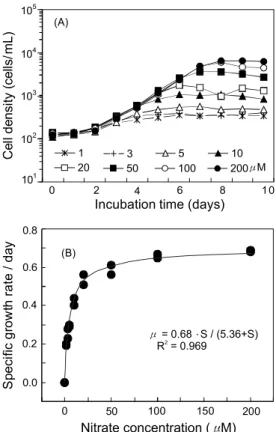
질산염 농도에 따른 최대 세포밀도는 암모니아염 첨가구와 같이 1 μM에서 367±44 cells/mL이며 200 μM에서 6,502±581 cells/mL로 농도가 증가할수록 최대 세포밀도가 증가하였다
Fig. 4. Growth curve (A) and specific growth rate (B) of Chattonella marina as a function nitrate concentration. The values (A) are represented with means of duplicates. The curve (B) was fitted to the observed values (●) using a non-linear least square method.
(Fig. 4, A). 농도에 따른 최대 성장속도는 1 μM에서 0.20±0.01/day에서 20 μM에서 0.54±0.04/day로 크게 증가하였 으나, 50 μM 이상의 농도에서 성장속도는 0.59±0.04/day에서 0.69±0.01/day로 유사하였다. 질산염 농도에 의해 유도된 성장 식으로부터 max와 는 각각 0.68/day, 5.39 μM로 나타났다 (Fig. 4, B).
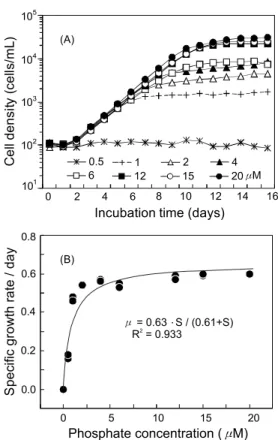
인산염 농도에 따른 최대 세포밀도도 0.5 μM에서 233±21 cells/mL이며 20 μM에서 14,129±780 cells/mL로 농도가 증가 할수록 최대 세포밀도가 증가하였다 (Fig. 5, A). 농도에 따른 최대 성장속도는 0.5 μM에서 0.14±0.01/day이고 2 μM에서 0.59±0.01/day로 크게 증가하였으나, 4 μM 이상의 농도에서 성장속도는 0.60±0.01/day에서 0.62±0.01/day로 유사하였다.
인산염 농도에 의해 유도된 성장식으로부터 max와 는 각 각 0.67/day, 0.75 μM로 나타났다 (Fig. 5, B).
Chattonella ovata Y. Hara et Chihara
C. ovata의 암모니아 농도에 따른 최대 세포밀도는 1 μM에 서 253±65 cells/mL이며 20 μM에서 2,961±187 cells/mL로 농 도가 증가할수록 최대 세포밀도가 증가하였으나, 30 μM은 902±11 cells/mL, 50 μM은 133±20 cells/mL, 그리고 100 μM은 85±18 cells/mL로 최대 세포밀도가 급격히 감소하였다 (Fig.
Fig. 5. Growth curve (A) and specific growth rate (B) of Chattonella marina as a function phosphate concentration.
The values (A) are represented with means of duplicates.
The curve (B) was fitted to the observed values (●) using a non-linear least square method.
6, A). 농도에 따른 최대 성장속도는 1 μM에서 0.19±0.00/day 이고 20 μM에서 0.46±0.00/day로 꾸준히 증가하여 가장 높은 성장속도를 나타내었으나, 30 μM에서 50 μM은 0.32±0.09/
day에서 0.21±0.04/day로 농도가 증가할수록 성장속도가 감소 하는 성장저해가 나타났으며, 100 μM에서는 전혀 성장이 이루어지지 않았다. 따라서 20 μM까지의 암모니아염 조건에 의해 유도된 성장식으로부터 max와 는 각각 0.68/day, 2.51 μM로 나타났다 (Fig. 6, B).
질산염 농도에 따른 최대 세포밀도는 1 μM에서 421±34 cells/mL이며 200 μM에서 11,668±504 cells/mL로 농도가 증가 할수록 최대 세포밀도가 증가하였다 (Fig. 7, A). 농도에 따른 최대 성장속도는 1 μM에서 0.21±0.01/day이고 50 μM에서 0.61±0.01/day로 꾸준히 증가하였으나, 100 μM은 0.62±
0.01/day, 그리고 200 μM은 0.63±0.01/day로 50 μM 이상의 농도에서 성장속도는 유사하였다. 질산염 조건에 의해 유도된 성장식으로부터 max와 는 각각 0.64/day, 4.01 μM로 나타 났다 (Fig. 7, B).
인산염 농도에 따른 최대 세포밀도는 0.5 μM에서 131±28 cells/mL이며 20 μM에서 31,412±1,008 cells/mL로 농도가 증 가할수록 최대 세포밀도가 증가하였다 (Fig. 8, A). 농도에 따른 최대 성장속도는 0.5 μM에서 0.17±0.01/day이고 2 μM에
Fig. 6. Growth curve (A) and specific growth rate (B) of Chattonella ovata as a function ammonium concentration.
The values (A) are represented with means of duplicates.
The curve (B) was fitted to the observed values (●) using a non-linear least square method.
Fig. 7. Growth curve (A) and specific growth rate (B) of Chattonella ovata as a function nitrate concentration. The values (A) are represented with means of duplicates. The curve (B) was fitted to the observed values (●) using a non-linear least square method.
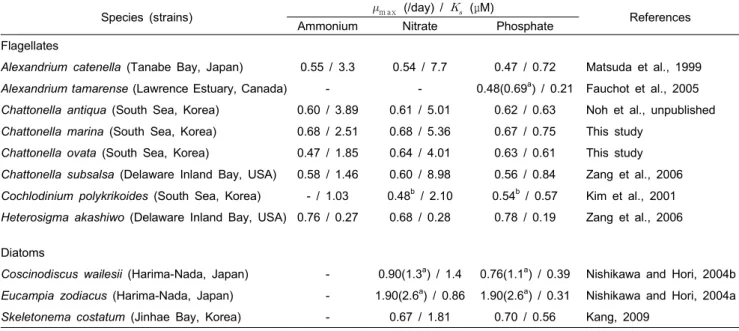
Table 1. Comparison of half-saturation constants () for nitrogen and phosphate and maximum specific growth rates (max) reported for Chattonella species and various phytoplankton
Species (strains) m ax (/day) / (μM)
References
Ammonium Nitrate Phosphate
Flagellates
Alexandrium catenella (Tanabe Bay, Japan) 0.55 / 3.3 0.54 / 7.7 0.47 / 0.72 Matsuda et al., 1999 Alexandrium tamarense (Lawrence Estuary, Canada) - - 0.48(0.69a) / 0.21 Fauchot et al., 2005 Chattonella antiqua (South Sea, Korea) 0.60 / 3.89 0.61 / 5.01 0.62 / 0.63 Noh et al., unpublished Chattonella marina (South Sea, Korea) 0.68 / 2.51 0.68 / 5.36 0.67 / 0.75 This study
Chattonella ovata (South Sea, Korea) 0.47 / 1.85 0.64 / 4.01 0.63 / 0.61 This study Chattonella subsalsa (Delaware Inland Bay, USA) 0.58 / 1.46 0.60 / 8.98 0.56 / 0.84 Zang et al., 2006 Cochlodinium polykrikoides (South Sea, Korea) - / 1.03 0.48b / 2.10 0.54b / 0.57 Kim et al., 2001 Heterosigma akashiwo (Delaware Inland Bay, USA) 0.76 / 0.27 0.68 / 0.28 0.78 / 0.19 Zang et al., 2006
Diatoms
Coscinodiscus wailesii (Harima-Nada, Japan) - 0.90(1.3a) / 1.4 0.76(1.1a) / 0.39 Nishikawa and Hori, 2004b Eucampia zodiacus (Harima-Nada, Japan) - 1.90(2.6a) / 0.86 1.90(2.6a) / 0.31 Nishikawa and Hori, 2004a Skeletonema costatum (Jinhae Bay, Korea) - 0.67 / 1.81 0.70 / 0.56 Kang, 2009
a Original paper (division/day), b maximum specific growth rate by semi-continuous culture.
Fig. 8. Growth curve (A) and specific growth rate (B) of Chattonella ovata as a function phosphate concentration. The values (A) are represented with means of duplicates. The curve (B) was fitted to the observed values (●) using a non-linear least square method.
서 0.54±0.00/day로 크게 증가하였으나, 4 μM에서 20 μM은 0.54±0.01/day에서 0.60±0.00/day로 유사한 성장속도를 나타 내었다. 인산염 조건에 의해 유도된 성장식으로부터 max와
는 각각 0.63/day, 0.61 μM로 나타났다 (Fig. 8, B).
고 찰
해양환경에서 식물플랑크톤 군집의 출현, 분포 및 성장에는 다양한 무생물 및 생물학적 인자가 관여한다. 특히 해수 중의 용존 무기영양염 농도는 식물플랑크톤의 성장, 종천이, 그리고 대발생에 직접적으로 영향을 미치는 중요한 요인이며 (Tilman, 1982; Donaghay and Osborn, 1997), 이를 정량적으로 평가하기 위한 영양염 흡수 및 성장 동력학 실험은 영양염에 대한 종 경쟁을 종합적으로 평가하는데 중요한 지표가 되고 있다.
식물플랑크톤 성장 동력학 실험에서 도출된 는 제한 영 양염에 대한 친화성을 나타내는 값으로, 일반적으로는 규조류 와 침편모조류가 낮고, 와편모조류가 보다 높은 값을 보이 는 것으로 알려져 있다 (Eppley et al., 1969; Qasim et al., 1973;
Margalef, 1978; Nakamura and Watanabe, 1983). 즉, 값이 낮을수록 저농도의 영양염 조건에서 성장에 유리한 생리특성 을 가진다고 할 수 있다 (Dugdale, 1967; Eppley and Coatsworth,
1968). 그러나 C. marina와 C. ovata에서 얻어진 값은 규조류 인 Skeletonema costatum 및 일부 종이나, 동일 침편모조류에 속하는 Heterosigma akashiwo보다 높을 뿐만 아니라, 유해성 외편모조류인 Alexandrium tamarense, Cochlodinium polykrikoides보다도 높은 를 보여 영양염에 대한 친화성이 다른 식물플랑크톤 보다 낮은 것으로 판단되었다 (Table 1).
그리고 종별로는 C. ovata는 C. marina보다 질산염과 인산염에 대해 약 20~25%, 그리고 또 다른 한국산 C. antiqua 보다도 낮은 값을 나타내기에 (Table 1), 낮은 영양염의 현장에서는 다른 Chattonella 종보다 C. ovata 성장이 유리할 것으로 판단 되었다.
이와 같은 결과는 Yamaguchi et al. (2008)이 C. ovata (일본 Hiroshima만 분리주)의 반연속배양 (semi-continuous culture) 실험을 통해 얻어진 질소와 인의 세포내 최소 함유량 (minimum cell quota, Q0; 각각 5.5 pmol N/cell, 0.48 pmol P/cell) 이 C. antiqua (일본 Seto 내해 분리주)의 Q0 (각각 7.70 pmol N/cell, 0.60 pmol P/cell; Nakamura, 1985)보다 약 25~30% 정도 낮아 동일한 영양염 조건하에서 C. ovata가 더욱 높은 세포밀 도로 도달할 수 있음을 지적한 것과 같은 결과이다.
최근 남해 중앙부에 위치한 여수 인근해역에서 Chattonella 의 출현빈도와 세포밀도가 증가하는 하계 (6월부터 9월) 표층 해수의 DIN 농도는 평균 4.36~5.43 μM, DIP 농도는 평균 0.37~0.45 μM의 범위로 보고되었다 (Kang, 2009; Kim, 2009).
이와 같은 영양염 농도는 S. costatum과 C. polykrikoides 등 여러 경쟁 종들의 보다 높지만, C. marina와 C. ovata의 DIP에 대한 보다는 낮은 농도이다 (Table 1). 과거 극심한 부영양화에 의해 유해 적조발생이 빈번했던 일본의 Seto 내해 에서 Chattonella 속의 적조발생은 해역으로 유입되는 총 인의 부하량과 인산염 농도 증가에 매우 밀접한 관련을 보였다 (Imai et al., 2006). 더욱이 자연적인 계절 용승작용과 양식 산업체의 잉여부산물 등에 의해 비정상적인 영양균형 상태와 영양염 농도를 보이는 멕시코의 Kun Kaak 만에서 C. marina와 C. ovata에 의한 적조발생 전후의 영양염 농도 변화는 질산염 이 0.0~200 μM에서 1,400~1,500 μM로 증가한 반면, 인산염은 540~3,000 μM에서 300 μM 이하로 급감하여 이들의 대발생에 인산염의 중요성을 지적하였다 (Barraza-Guardado et al., 2004). 따라서 C. marina와 C. ovata는 영양염 요구량이 높아 영양염 농도가 낮은 환경에서는 다른 경쟁 종들에 비해 상대 적으로 성장이 제한될 수 있는 생리적 단점을 가진 종이며, 특히 여수 인근해역과 같이 상대적으로 인산염 농도가 C.
marina와 C. ovata의 보다 낮은 해역의 경우 이들의 성장에 인산염이 중요한 제한요인으로 작용할 것으로 판단되었다.
한편, 본 연구에서 max는 C. marina가 0.67~0.68/day를, C. ovata는 암모니아염에 대해 0.47/day로 비교적 낮았지만 질산염과 인산염에 대해 0.63~0.64/day를 나타내어, 일반적으 로 규조류보다 낮지만, H. akashiwo를 제외한 다른 여러 편모 조류보다 높았다 (Table 1). 따라서 C. marina와 C. ovata는 수주내 영양염이 충분하더라도 성장속도가 월등히 빠른 규조
류와의 종간 경쟁에 많은 제약을 받을 수 있다. 하지만 여러 편모조류와 함께 Chattonella속 역시 빛과 영양염의 효율적인 이용을 위해 주야수직이동을 하며 (Watanabe et al., 1991, 1995), 이들은 이러한 유영능력을 통해 부족한 표층의 영양염 을 대신해 저층의 풍부한 영양염을 성장에 적극 이용할 수 있음은 물론, 수주혼합 등 이류ㆍ확산이 활발하여 운동성이 거의 없는 규조류의 개체군 확산이 탁월한 해역에서 표층으로 의 집적을 통한 성장에 유리할 수 있다. 이와 같은 유영능력은 영양염에 대한 친화성이 높은 규조류와의 종간 경쟁으로부터 생리적 단점을 극복할 수 있는 하나의 생존전략으로 제시되고 있다 (Smayda, 1997). 더욱이 C. marina와 C. ovata는 C.
polykrikoides 등을 포함한 다른 여러 편모조류보다 성장속도 가 높기 때문에 영양염 고갈 등 다양한 요인에 의해 규조류의 소멸이 두드러진 시기에 본 연구에서 제시된 이들의 값보 다 높은 농도의 영양염이 일정기간 공급ㆍ유지되면 이들은 다른 편모조류보다 높은 세포밀도로 빠르게 성장할 수 있을 것이다. 실제로 일본 Seto 내해에서 Chattonella는 하계 규조류 대발생과 영양염 공급이 제한된 조건에서는 낮은 세포밀도로 거동하지만, 규조류의 급격한 소멸과 함께 수주혼합 등의 물 리적 요인에 의한 저층으로부터 영양염 공급요인이 이들의 적조발생 메커니즘에 대한 중요부분으로 인식되고 있다 (Yanagi, 1989; Imai et al., 1998).
질소원 중에서 질산염과 암모니아염이 동시에 존재할 때 암모니아염은 식물플랑크톤에 의해 선택적으로 흡수되며 쉽 게 이용되기에 식물플랑크톤 성장에 질소원으로서 중요한 역할을 한다 (Thomas, 1966; Wheeler and Kokkinakis, 1990).
본 연구에서 암모니아염에 대한 성장실험 결과 100 μM에서 높은 성장속도를 보인 C. marina와는 달리 C. ovata는 30 μM 이상의 농도에서 성장이 크게 저해되어 두 종간에 암모니아 이용에 대한 생리적 차이가 크게 나타났다 (Fig. 3, 6). 이는 일본 Hiroshima만에서 분리한 C. ovata가 250 μM의 암모니아 염에서 같은 농도의 질산염 대비 80~100% 이상의 높은 성장률 을 보인 것 (Yamaguchi et al., 2008)과 많은 차이를 보였다.
또한 한국 남해에서 분리한 C. antiqua는 100 μM 이상의 암모 니아염에서 성장이 저해되었다 (Noh et al., unpublished). 이와 같이 종에 따라 또는 동일종이지만 분리주에 따른 암모니아염 에 대한 내성의 차이는 여러 연구에서 보여 지고 있다. H.
akashiwo 역시 strains에 따라 그 차이가 크게 나타나, 일본 Osaka만과 Tokyo만의 분리주의 경우 1 μM까지는 농도에 비례해서 성장하지만, 1 μM을 초과하는 농도에서는 성장이 저해 (Watanabe et al., 1982; Hosaka, 1992)된 반면, 미국 Kalaloch WA 분리주는 각각 50 μM의 질산염과 암모니아염 중 암모니아염에서 더욱 높은 성장속도를 나타내었다 (Herndon and Cochlan, 2007). 또한 와편모조류인 Karenia mikimotoi는 일본 Gokasho만 분리주의 경우 21 μM 이상의 암모니아염에서 성장이 저해 (Iwasaki et al., 1990)된 반면, Suo-Nada 분리주는 250 μM의 농도에서도 높은 성장률을 보 였으며 (Yamaguchi, 1994), 한국 남해에서 분리된 C.
polykrikoides는 약 121 μM 이상의 농도에서 (Kim et al., 2001),
일본 Yatsushiro 해역의 분리주는 250 μM 이상의 농도에서 성장저해가 나타났다 (Kim, 2003). 즉, 각 식물플랑크톤의 암 모니아에 대한 성장저해 및 내성은 strains에 따른 생리적 차이 로 그것을 수용하는 환경요인에 따라 각기 다른 생리적 특이 성을 나타낸다고 할 수 있으며, 이러한 생리적 차이는 동일 종이라 할지라도 개체군 특성을 구별하는 중요한 인자로 작용 할 수 있다.
이상의 연구결과 우리나라 연안에 출현하는 C. marina와 C. ovata는 규조류에 비해 영양염에 대한 친화성이 낮지만, 이들은 유영능력을 통해 영양염의 효율적 이용이 가능한 생태 적 특성과 다른 여러 편모조류보다 빠른 성장속도에 기인하여 대발생에 대한 충분한 잠재력이 갖춘 종들로 파악되었다. 특 히, 최근 우리나라 연안에서 Chattonella에 의한 출현과 적조발 생이 상습화 되고 있는 점을 고려할 때, 이들의 국내산 분리주 에 대한 영양염 흡수와 다양한 질소・인원에 대한 이용 및 성장, 그리고 다른 여러 종과의 종간 경쟁 등의 생존전략적 특성에 대한 집약적인 데이터 축적이 필요하며, 이를 통해 이들의 적조발생 메커니즘을 파악하기 위한 노력이 매우 중요 하다고 할 수 있다.
사 사
이 논문은 2008년도 전남대학교 연구년 교수연구비 지원에 의하여 연구되었음
참고문헌
Barraza-Guardado R, Cortés-Altamirano R and Sierra- Beltrán A. 2004. Marine die-offs from Chattonella marina and Ch. cf. ovata in Kun Kaak Bay, Sonora in the Gulf of California. Harmful Algae News 25, 7-8.
Donaghay PL and Osborn TR. 1997. Toward a theory of biological-physical control of harmful algal bloom danamics and impacts. Limnol Oceanogr 42, 1283-1296.
Dugdale RC. 1967. Nutrient limitation in the sea: dynamic, identification, and significance. Limnol Oceanogr 12, 685-695.
Eppley RW and Coatsworth JL. 1968. Uptake of nitrate and nitrite by Ditylum brightwellii - Kinetics and mechanisms. J Phycol 4, 151-156.
Eppley RW, Rogers JN and McCarthy JJ. 1969. Half- saturation constants for uptake of nitrate and ammo- nium by marine phytoplankton. Limnol Oceanogr 14, 912-920.
Fauchot J, Levasseur M, Roy S, Gagnon R and Weise AM. 2005. Environmental factors controlling Alexandrium tamarense (Dinophyceae) growth rate during a red tide event in the St. Lawrence Estuary (Canada). J Phycol 41, 263-272.
Hara Y, Doi K and Chihara M. 1994. Four new species of Chattonella (Raphidophyceae, Chromophyta) from Japan. Jpn J Phycol 42, 407-420.
Herndon J and Cochlan WP. 2007. Nitrogen utiliz- ation by the raphidophyte Heterosigma akashiwo:
Growth and uptake kinetics in laboratory cultures.
Harmful Algae 6, 260-270.
Hiroishi S, Okada H, Imai I and Yoshida T. 2005. High toxicity of the novel bloom forming species Chattonella ovata (Raphidophyceae) to cultured fish.
Harmful Algae 4, 783-787.
Hosaka M. 1992. Growth characteristics of a strain of Heterosigma akashiwo (Hada) Hada isolated from Tokyo Bay, Japan. Bull Plankton Soc Japan 39, 49-58.
Imai I, Yamaguchi M and Hori Y. 2006. Eutrophication and occurrences of harmful algae blooms in the Seto Inland Sea, Japan. Plankton Bonthos Res 1, 71-84.
Imai I, Yamaguchi M and Watanabe M. 1998. Ecoph- ysiology, life cycle, and bloom dynamics of Chattonella in the Seto Inland Sea, Japan. In:
Physiological Ecology of Harmful Algal Blooms.
Anderson DM, Cembella AD and Hallegraeff GM, eds. Springer-Verlag, Berlin, 95-112.
Itoh K and Imai I. 1987. Rapido So (Raphidophyceae).
In: A guide for studies of red tide organisms.
The Japan Fisheries Resources Conservation Association, ed. Shuwa, Tokyo, 122-130.
Iwasaki H, Kim CH and Tsuchiya M. 1990. Growth characteristics of a dinoflagellate Gymnodinium nagasakiense Takatama et Adachi. Jpn J Phycol 38, 155-161.
Kang IS. 2009. Optical characteristic and growth kinetics for nitrate and phosphate by the planktonic diatom Skeletonema costatum and bentic diatom Nitzschia sp.. MSc. Thesis, University of Chonnam, Yeosu, Korea.
Kim D-I. 2003. Physiological and ecological studies on harmful red tide dinoflagellate Cochlodinium polykrikoides (Margalef). Ph.D. Thesis, University of Kyushu, Fukuoka, Japan.
Kim D-I, Noh IH and Yoon YH. 2005. Chattonella spp. (Raphidophyceae), a novel species responsible for the potentially harmful algal blooms in Korean coastal waters. In: Proceeding of the Korean Society for Marine Environmental Engineering Fall Annual Meeting, 127-131.
Kim DY. 2009. Short-term variation of phytoplankton assemblages and environmental conditions from
coastal waters in Dolsan located in the central coast of South Sea, Korea. MSc. Thesis, University of Chonnam, Yeosu, Korea.
Kim HC, Lee CK, Lee SG, Kim HG and Park CK.
2001. Physico-chemical factors on the growth of Cochlodinium polykrikoides and nutrient utilization.
J Korean Fish Soc 34, 445-456.
Liu W, Au DWT, Anderson DM, Lam PKS and Wu RSS. 2007. Effects of nutrients, salinity, pH and light:dark cycle on the production of reactive oxygen species in the alga Chattonella marina. J Exp Mar Biol Ecol 346, 76-86.
Lu S and Hodgkiss IJ. 2001. More raphidophyte blooms in South China waters. Harmful Algae News 22, 1-2.
Margalef R. 1978. Life-forms of phytoplankton as survival alternatives in an unstable environment.
Oceanol Acta 1, 493-509.
Marshall JA, Nichols PD, Hamilton B, Lewis RJ and Hallegraeff GM. 2003. Ichthyotoxicity of Chattonella marina (Raphidophyceae) to damselfish (Acanthochromis polycanthus): the synergistic role of reactive oxygen species and free fatty acids. Harmful Algae 2, 273- 281.
Matsuda A, Nishijima T and Fukami K. 1999. Effects of nitrogenous and phosphorus nutrients on the growth of toxic dinoflagellate Alexandrium catenella. Nippon Suisan Gakkaishi 65, 847-855.
Mikhail SK. 2001. Toxic red tide species are on rise in Alexandria waters (Egypt). Harmful Algae News 22, 5.
Nakamura Y. 1985. Ammonium uptake kinetics and interactions between nitrate and ammonium uptake in Chattonella antiqua. J Oceanogr Soc Japan 41, 33-38.
Nakamura Y and Watanabe MM. 1983. Growth charac- teristice of Chattonella antiqua Part 2. Effects of nutrients on growth. J Oceanogr Soc Japan 39, 151-155.
NFRDI (National Fisheries Research & Development Institute). 2005. Harmful algal blooms in Korean coastal waters in 2005. 1-149.
NFRDI (National Fisheries Research & Development Institute). 2007. Harmful algal blooms in Korean coastal waters in 2006. 1-97.
NFRDI (National Fisheries Research & Development Institute). 2008. Harmful algal blooms in Korean coastal waters in 2007. 1-127.
Nishikawa T and Hori Y. 2004a. Effect of nitrogen, phosphorus and silicon on the growth of the diatom
Eucampia zodiacus caused bleaching of seaweed Porphyra isolated from Harima-Nada, Seto Inland Sea, Japan. Nippon Suisan Gakkaishi 70, 31-3.
Nishikawa T and Hori Y 2004b. Effect of nitrogen, phosphorus and silicon on a growth of a diatom Coscinodiscus wailesii causing Porphyra bleaching isolated from Harima-Nada, Seto Inland Sea, Japan.
Nippon Suisan Gakkaishi 70, 872-878.
Oda T, Ishimatsu A, Shimada S, Takeshita S and Mur- amatsu T. 1992. Oxygen-radical-mediated toxic effects of the red tide flagellate Chattonella marina on Vibrio alginolyticus. Mar Biol 112, 505- 509.
Park JS, Kim HG and Lee SK. 1988. Red Tide occur- rence and succession of its causative organisms in Jinhae Bay. Bull Fish Res Dev Agency 41, 1- 26.
Provasoil L, Shiraishi K and Lance JR. 1959. Nutritional idiosyncrasies of Artemia and Tigriopus in mono- xenic culture. Ann NY Sci 77, 250-261.
Qasim SZ, Bhattathiri PM and Devassy VP. 1973.
Growth kinetics and nutrient requirements of two tropical marine phytoplanktons. Mar Biol 21, 299- 304.
Smayda TJ. 1997. Harmful algal blooms: Their ecoph -ysiology and general relevance to phytoplankton blooms in the sea. Limnol Oceanogr 42, 1137- 1153.
Subrahmanyan R. 1954. On the life-history and ecology of Hornellia marina gen. et sp. nov., (Chloromonadineae), causing green discoloration of the sea and mortality among marine organisms off the Malabar Coast.
Indian J Fish 1, 182-203.
Tang JY, Anderson DM and Au DW. 2005, Hydrogen peroxide is not the cause of fish kills associated with Chattonella marina: cytological and physiol- ogical evidence. Aquat Toxicol 72, 351-360.
Thomas WH. 1966. Surface nitrogenous nutrients and phytoplankton in the northeastern tropical Pacific Ocean. Limnol Oceanogr 11, 393-400.
Tilman D. 1982. Resource competition and community structure. Princeton University Press Princeton, 1-269.
Yamaguchi M. 1994. Physiological ecology of the red tide flagellate Gymnodinium nagasakiense (Dinophyceae) - Mechanism of the red tide occurrence and its prediction. Bull Nansei Nat'l Fish Res Inst 27, 251-394.
Yamaguchi H, Sakamoto S and Yamaguchi M. 2008.
Nutrition and growth kinetics in nitrogen- and phosphorus-limited cultures of the novel red tide
flagellate Chattonella ovata (Raphidophyceae).
Harmful Algae 7, 26-32.
Yamochi S. 1984. Nutrient factors involved in controlling the growth of red tide flagellates Prorocentrum micans, Eutreptiella sp. and Chattonella marina in Osaka Bay. Bull Plankton Soc Japan 31, 97- 106.
Yanagi T. 1989. Physical parameters of forecasting red tide in Harima-Nada, Japan. In: Red tides:
Biology, environmental science, and toxicology.
Anderson DM and Nemoto T, eds. Elsevier, New York, 149-152.
UNESCO. 2003. IOC Taxonomic Reference List of Toxic Plankton Algae. Retrieved from hattp://www.bi.ku.dk/
ioc/grop4.asp on June.
Vrieling EG, Koeman RPT, Nagasaki K, Ishida Y, Peperzak L, Gieskes WWC and Veenhuis M. 1995.
Chattonella and Fibrocapsa (Raphidophyceae):
First observation of, potentially harmful, red tide organisms in Dutch coastal waters. Netherlands J Sea Res 33, 183-191.
Watanabe M, Kohata K and Kimura T. 1991. Diel vertical migration and nocturnal up-take of nutrients by Chattonella antiqua under stable stratification.
Limnol Oceanogr 36, 593-602.
Watanabe M, Kohata K, Kimura T, Takamatsu T, Yamaguchi S and Ioriya T. 1995. Generation of a Chattonella antiqua bloom by imposing a shallow nutricline in a mesocosm. Limnol Oceanogr 40, 1447-1460.
Watanabe M, Nakamura Y, Mori S and Yamochi S.
1982. Effect of physico-chemical factors and nutrients on the growth of Heterosigma akashiwo Hada from Osaka Bay, Japan. Japan J Phycol 30, 279-288.
Wheeler PA and Kokkinakis SA. 1990. Ammonium recycling limits nitrate use in the oceanic subarctic Pacific. Limnol Oceanogr 35, 1267-1278.
Zhang Y, Fu FX, Whereat E, Coyne KJ and Hutchins DA. 2006. Bottom-up controls on a mixed-species HAB assemblage: A comparison of sympatric Chattonella subsalsa and Heterosigma akashiwo (Raphidophyceae) isolates from the Delaware Inland Bays, USA. Harmful Algae 5, 310-320.
2009년 9월 21일 접수 2009년 11월 30일 수정 2009년 12월 15일 수리