결합재와 베니어세라믹이 금속-세라믹 보철물의 전단결합강도와 계면특성에 미치는 영향
김 민 정, 최 성 민, 정 인 성 부산가톨릭대학교 보건과학대학 치기공학과
The Influence of Bonding Strength and Interface Characteristics to Bonding Agent and Veneer Ceramics on Metal-Ceramic Prosthetics
Min-Jung Kim, Sung-Min Choi, In-Sung Chung College of Health Science, Catholic University of Pusan
[Abstract]
Purpose: In this study, for the reasons of observing the changes when using bonding agent with Ni-Cr alloy and
Co-Cr alloy and using VM13 and Vintage MP ceramic which have the disparity in coefficient of thermal expansion, it is carried out to evaluate the characteristics of the bonding agent through the analysis of the interface between metal and ceramic and the analysis of bond strength by variable.
Methods: The surface treatment was performed on the two kinds of alloy(Ni-Cr alloy and Co-Cr alloy)
specimens, which were sandblasted and were treated with bonder application. The metal-ceramic interfaces were analyzed with EPMA in order to ionic diffusion, and the shear test was performed.
Results: As a result of observation of metal-ceramic interfacial properties, it was observed that Cr atoms were
spread from the alloy body to the ceramic floor in the specimen of Group B. It was also seen that Cr, W atoms were spread from the alloy body to the ceramic floor in the specimen of Group S. In consequence of observing Shear bond strength, it was calculated that the specimen of BSV was 27.75( 11.21) , BSM was 27.02( 5.23) , BCV was 30.20( 5.99) , BCM was 27.94( 10.76) , SSV was 20.83( 2.58) , SSM was 23.98( 3.94) , SCV was 32.32( 4.68) , and SCM was 34.54( 10.63) .
Conclusion: In the metal-ceramic interface of Bellabond plus sample group, diffusion of Cr atoms was incurred
and diffusion of C Cr atoms and W atoms in the sample group of Starloy C was observed. Using bonding agent
showed the higher bond strength than using the sand blasting treatment. In the Bellabond plus alloys, the specimen
group with the use of binding materials showed higher shear bond strength, but didn’t show statistically significant
differences (p>0.05). In the Starloy C alloys, the specimen group with the use of binding materials showed higher
shear bond strength and statistically significant differences(p<0.05). In terms of VM13 ceramic, it was in the
Bellabond plus alloys that the high shear bond strength was showed, but there’s no statistically significant differences
Ⅰ. 서 론
전치부 수복물은 심미성에 대한 환자의 요구가 증가하 면서 전부 세라믹보철에 대한 관심은 늘어나지만 금속- 세라믹 보철의 사용은 지속적이다(Azer et al, 2006;
Erhardt et al, 2006).
금속-세라믹 보철은 하부구조인 금속에 상부구조인 세 라믹을 소성하여 결합하게 된다. 그래서 금속-세라믹 보 철의 평가에는 금속과 세라믹간의 결합력이 중요한 요소 이다(Craig et al, 1997; McCabe, 1994). 금속-세라믹간 의 결합기전은 일반적으로 기계적인 결합력과 화학적 결 합력과 열팽창계수 차이로 발생하는 열 수축에 의한 결합 력 그리고 분자간의 인력에 의한 결합력이 대표적이다 (Turan Korkmaz et al, 2009). 이러한 결합력을 향상시 키기 위하여 많은 연구가 이루어졌다.
결합을 증대 시키는 방법으로는 금속 표면을 불규칙하 게 처리하여 기계적 유지를 증대시키는 샌드 블라스팅을 법을 시행하고 있고, opaque을 소성하기 전에 결합재를 degassing 한 금속의 표면에 코팅하여 금속 특유의 색조 를 차단해서 심미성을 높이고 금속-세라믹간의 결합력도 증진시키는 연구들이 보고되었다(Goeller et al, 1972;
Bondioli et al, 2004).
Sand Blasting법과 결합재인 Deck gold, Gold bonder로 표면처리를 달리하여 전단결합력을 측정한 연 구가 보고되었다(김성수, 2009). 전치 치경부의 심미성을 높여주기 위하여 opaque 세라믹을 도포하기 전에 gold color를 띄는 bonding agent를 도포하여 심미성을 높이 는 방법도 사용되었으며, 심미성과 쉬운 조작을 위하여 paste opaque과 bonding agent를 사용하여 하여도 결 합력에는 문제가 없는 것으로 보고되었다(김사학, 2000).
열팽창계수의 차이가 적을수록 금속-세라믹간의 결합 강도가 더 크다고 하였고, 열팽창계수는 금속-세라믹과
미치며 금속의 열팽창계수가 세라믹보다 높아야 압축응 력이 작용한다고 보고하였다(Craig et al, 1997; Reyes et al, 2001; Steiner et al, 1997).
세라믹 종류에 따른 금속-세라믹 간 결합에 관한 보고 에서 두 가지 세라믹의 종류에 따른 Tilite V합금과 세 라믹결합강도는 Omega900 을 사용한 경우가 Vintage (Regular) 를 사용한 경우 보다 높은 결합을 보였으며 유의차가 있고, 이는 Omega900 에서 Tilite V합금과 세라믹간의 열팽창계수의 차이가 Vintage(Regular) 에 서의 경우보다 적어서 결합강도가 더 큰 것으로 보고되어 졌다(김철만, 2005).
BioPontoStar(Au-Pt-Zn)14.4×10⁻⁶·K-1, Wirobond C(Co-Cr) 14.2×10⁻⁶·K-1, Wiron 99(Ni-Cr) 14.0×10⁻⁶· K-1의 열팽창률을 가지며 CeramcoⅡ는 BioPontoStar에 서 가장 큰 결합강도를 보였고, Wirobond C (Co-Cr)합 금은 Omega 900과 IPS Classic porcelain에서 높은 결 합강도를 보였다. 또한 Wiron 99(Ni-Cr)합금에서는 Omega 900, Finesse 와 IPS Classic 세라믹에서 높은 결합강도를 보였다고 보고되어졌다(Turan Korkmaz et al., 2009). 금속-세라믹의 결합강도의 차이는 세라믹성 분의 차이 또는 합금의 열팽창계수의 차이로 생각된다.
베릴륨이 포함되지 않은 Ni-Cr 합금과 Co-Cr합금에 결합재의 사용과 베니어세라믹의 종류에 따른 금속-세라 믹 간 결합강도와 파절양상 그리고 계면특성에 관한 연구 는 부족한 상황이다.
이에 본 연구에서는 베릴륨이 포함되지 않은 Ni-Cr 합 금과 Co-Cr 합금(2종)의 금속에 결합재의 사용유무에 따 라 VM13, Vintage MP 세라믹 분말을 사용하여 80개의 전단결합강도 측정용 시편과 8개의 계면 특성 관찰용 시 편을 제작하여 결합재의 사용에 따른 금속-세라믹 간 결 합강도차이와 계면 특성을 분석하고자 한다.
Ⅱ. 연구 방법
1. 실험 재료
실험에 사용된 합금이 Ni-Cr 합금인 Bellabond plus(Bego, Germany)와 Co-Cr 합금인 StarLoy
C(Dentsply, Germany)를 사용했으며, sandblasting에 Cobra 110㎛(Renfert, Germany)를 사용하였다. 그리고 결합재로는 Ceram bond(Bredent, Germany)를 사용했 으며, 베니어세라믹은 VM13 (VITA, Germany)과 Vintage MP(Shofu, Japan)를 사용하였다(Table 1).
Table 1. Materials of specimens
name manufacture
Ni-Cr alloy Co-Cr alloy aluminium oxide
opaque bonding agent veneer porcelain
Bellabond plus StarLoy C cobra 110㎛
VM13 vintage MP ceram bond
VM13 vintage MP
bego, germany dentsply, germany
renfert, germany VITA, germany
shofu, japan bredent, germany
VITA, germany shofu, japan
2. 실험 방법
1) 시편 형태시험을 위한 금속시편은 직경 7㎜, 두께 2㎜의 disc의 형태로 disc의 가운데 직경 3㎜, 길이 10㎜의 원기둥이 연 결된 형태로 제작하였다(Fig. 1).
2) 시편 제작
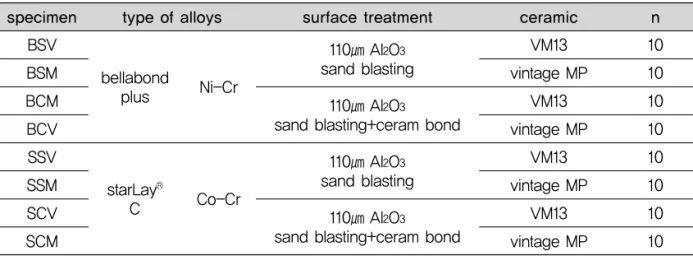
금속과 세라믹간의 계면특성 관찰과 전단결합강도의 관 찰을 위하여 계면관찰 시편과 전단결합강도 관찰 시편을 제작하였다(Table 2).
계면관찰 시편과 전단결합강도 관찰시편은 준비된 납형 을 lost wax법을 이용하여 주조체를 제작하고, 표면을 400, 600, 800, 1000, 1200grit의 silicone carbide sand paper를 이용하여 표면을 가공하고 diamond paste를 이용하여 연마를 하였다. 그리고 분류에 따라 표 면처리 후 세라믹을 시편의 중앙부에 5㎜, 높이 2㎜로 축 성하여 소성하여 시편을 준비하였다(Fig. 1).
Fig. 1. Shape of specimens
Table 2. Specimens group and testing method
specimen type of alloys surface treatment ceramic n
BSV
BSM BCM BCV
bellabond
plus Ni-Cr
110㎛ Al
2O
3sand blasting
110㎛ Al
2O
3sand blasting+ceram bond
VM13 vintage MP
VM13 vintage MP
10
10
10
10
금속-세라믹간의 계면을 관찰하기 위하여 EPMA (electrone probe X-ray microanalyzer)를 이용하여 계 면의 결합형태와 이온확산 양상을 정성분석을 실시하였다.
4) 전단결합강도 관찰 실험
전단결합강도 관찰 시편을 만능시험기 (858 Test System, MTS, USA)의 전단시험용 jig를 이용하여 전단 력에 의한 세라믹의 파절강도를 측정하고 파절강도를 세 라믹과 금속간의 결합력으로 산출하였다.
5) 파절면 관찰
금속-세라믹간의 파절양상을 관찰하기 위하여 전단시 험 후 금속과 세라믹 사이의 파단면을 광학현미경을 사용 하여 관찰하였다. 관찰된 면을 분석하여 파절양상을 분류 하였다.
6) 통계 처리
실험결과 자료는 0.05 유의수준으로 통계프로그램 (SPSS Inc, ver 19.0k)을 이용하여 집단간의 일원배치 분산분석(one way ANOVA)을 실시 후 사후 검정분석 (Scheffe)을 실시하였다.
Ⅲ. 결 과
1. 금속-세라믹 계면특성 관찰
2종의 합금을 결합재의 사용 유무와 2종의 세라믹으로 소성 결합한 금속-세라믹의 계면을 관찰하기 위하여 EPMA의 X-ray dot mapping을 실시하여 계면의 특성 을 정성적인 결과를 관찰하였다.
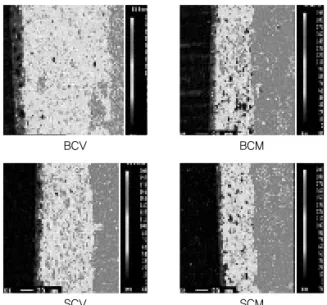
그 결과에서 결합재를 사용한 시편에 Si 원소를 함유한 결합재 층이 관찰되었다.
금속-세라믹 계면의 X-ray dot mapping 결과에서 각 시편의 원소변화를 정성적으로 관찰한 결과를 분석하였 다. B시편군의 시편들에서 Cr 원소가 합금체에서 세라믹 층으로 확산되는 것을 관찰할 수 있었다.
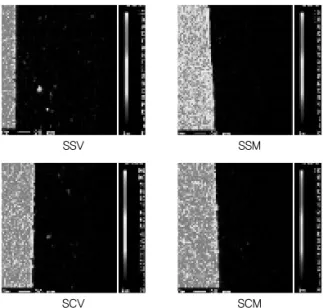
S시편군의 시편들에서 Cr, W 원소가 합금체에서 세라 믹층으로 확산되는 것을 관찰할 수 있었다.
BCV BCM
SCV SCM
Fig. 2. Bonding agent layer EPMA image of Si element
BSV BSM
BCV BCM
Fig. 3. Cr element EPMA image of B specimens
2. 전단결합강도
2종의 합금을 결합재의 사용 유무와 2종의 세라믹을 소 성 결합한 금속-세라믹의 전단강도를 측정하고 단면적을 이용하여 전단결합강도를 산출하였다. 그 결과 BSV시편 이 27.75(±11.21)㎫, BSM시편이 27.02(±5.23)㎫, BCV 시편이 30.20(±5.99)㎫, BCM시편이 27.94(±10.76)㎫
으로 산출되었으며, SSV시편이 20.83(±2.58)㎫, SSM 시편이 23.98(±3.94)㎫, SCV시편이 32.32(±4.68)㎫,
전단결합강도 결과를 국제표준규격(ISO 9693:치과용 금속-세라믹 수복재)의 금속-도재간의 결합력인 25㎫
(CON)을 이용하여 일원배치 분산분석과 사후검정을 실 시하였다. 그 결과 B시편군에서 국제규격인 CON에 대하 여 모든 시편이 유의차가 나타나지 않았다 (p>0.05). S시 편군에서 SCV시편이 SSV시편과 SSM시편에 대하여 유
SSV SSM
SCV SCM
Fig. 4. Cr element EPMA image of S specimens
SSV SSM
SCV SCM
Fig. 5. W element EPMA image of S specimens
shear bonding strength
specimen shear bonding
strength specimen
BSV BSM BCV BCM
27.75(±11.21) 27.02(±5.23) 30.20(±5.99) 27.94(±10.76)
20.83(±2.58) 23.98(±3.94) 32.32(±4.68) 34.54(±10.63) SSV
SSM SCV SCM
Table 4. Shear bonding strength of specimens
(Unit. ㎫)
Fig. 6. Shear bonding strength of B specimen
Fig. 7. Shear bonding strength of S specimen
2종의 합금을 결합재의 사용유무와 2종의 세라믹을 소 성 결합한 금속-세라믹의 전단강도를 측정하고 파절면을 분석한 결과 모든 군에서의 파절양상은 복합파절로 나타 났다.
Ⅳ. 고 찰
치과 세라믹용 합금으로 Ni-Cr계 합금과 Co-Cr계 합 금을 널리 사용되고 있다. 세라믹용합금은 간의 결합을 위한 여러 가지 기전이 있다. 금속과 세라믹간의 결합은 일반적으로 기계적인 결합력과 화학적 결합력과 열팽창 계수 차이로 발생하는 열 수축에 의한 결합력 그리고 분 자간의 인력에 의한 결합력이 대표적이다(Turan Korkmaz et al, 2009).
금속-세라믹간의 결합기전의 기계적인 결합과 열수축 에 의한 결합은 물리적인 힘에 의한 결합력이고 합금의 산화물에 의하여 결합하는 화학적 결과와 분자간의 인력
로 비귀금속 합금에서는 화학적 결합에 의한 결합이 병행 되어 결합력에 도움을 준다.
Be의 유해성으로 인해 논 베릴륨인 Ni-Cr계 합금과 Co-Cr계 합금의 사용을 권장함으로써 논 베릴륨과 베릴 륨의 성분차이에 따른 결합강도를 비교한 실험들이 보고 되고 있다.
Ni-Cr-Be 합금은 Be의 독성 유발가능성과 Ni의 알레 르기 유발가능성에도 불구하고 인기를 유지했던 이유는 Be성분이 금속의 과도한 산화막 생성을 억제하여 결합강 도를 높여주기 때문이다. 논 베릴륨인 Ni-Cr계 합금과 Co-Cr계 합금의 사용으로 이런 낮은 결합력의 단점을 보 완하기 위하여 Be성분 없이 금속-세라믹간 결합력을 높 일 수 있는 방안들이 연구 중이며, 논 베릴륨 합금에서 결 합재의 사용이 금속-세라믹간의 결합강도에 미치는 영향 에 대해서 알아보고자 하였고, 더 나은 결합강도를 위해 적절한 세라믹 선택에 대해 알아보고자 하였다.
이에 본 연구에서는 X-ray dot mapping 분석 결과에 서는 Ni-Cr-Mo 합금인 B시편 군에서는 Cr원소만 확산 되는 것을 관찰할 수 있었으며, Co-Cr-W 합금인 S시편 군에서는 Cr원소와 W원소의 확산이 관찰 되었으며, W 원소가 Cr 원소 보다 확산이 많은 것으로 관찰되었다.
Mclean (1983)은 비 귀금속의 과도한 산화막은 자체의 강도가 약하여 파절되기 쉽고 세라믹내로 확산된 Cr2O3 가 계면 세라믹의 열팽창계수를 감소시켜 압축응력에 의 한 세라믹 균열을 야기하여 낮은 세라믹 결합력을 보인다 고 보고하였다. 본 연구에서의 Cr의 확산은 산화막의 형 성과 관련이 있다고 생각 되어 진다.
B(Bellabond plus)시편과, S (StarLoy C)시편에 결 합재를 사용한 군에서 전단 결합강도가 높게 나타났다.
이것은 여러 종류의 결합재 사용시 세라믹과 합금과의 결 합강도에 관한 연구 내용과 일치하며 결합재의 사용으로 써 금속-세라믹간의 성공여부를 높일 수 있다고 생각한 다(Yesil et al, 2007). 또한 결합재의 성분 중 Si 성분이 금속과 세라믹의 연결자 역할을 하여서 금속-세라믹간의 결합강도를 높여 준 것으로 생각된다.
두 가지 세라믹의 종류에 따른 Bellabond plus(Ni- Cr-Mo)합금의 세라믹 결합강도는 VM13 파우더를 사용
BSV SSV
BCV SCV
BSM SSM
BCM SCM
Fig. 8. Aspects of fracture
한 경우가 Vintage MP 파우더를 사용한 경우보다 다소 높은 경향을 보였으나 국제규격인 25㎫과 유의한 차는 없 었고 (P>0.05), StarLoy C(Co-Cr)합금의 세라믹 결합 강도는 Vintage MP 파우더를 사용한 경우가 VM13 파우 더를 사용한 경우보다 높은 결합강도를 보였고 유의한 차 이가 있었다(P<0.05). 결합강도의 차이는 세라믹성분의 차이 또는 금속-세라믹간의 열팽창계수의 차이로 생각 된다. Anusavice (1985) 등은 도재의 열팽창계수는 13~14×10-6·K-1이며 금속과의 열팽창계수 차이가 1.7~2.2×10⁻⁶·K-1이상의 부조화를 보이는 경우 세라믹 의 균열이나 결합강도의 감소를 보일 수 있기 때문에 세 라믹의 열팽창계수는 금속의 열팽창계수보다 0.5×10⁻⁶· K-1만큼 낮아야 한다고 보고하였다.
금속-세라믹간의 열 적합성은 합금보다 세라믹에 의한 영향이 더 크게 작용한다고 하였는데(Vermilyea et al, 1983; Anusavice, 1985), VM13에서는 Bellabond plus 와 세라믹간의 열팽창계수의 차이가 Vintage MP에서의 경우보다 더 적어서 결합강도가 큰 것으로 생각되며, Vintage MP에서는 StarLoy C와 열팽창계수의 차이 가 VM13에서의 경우보다 더 적어서 결합강도가 큰 것으 로 생각된다.
전단 결합강도의 분석 결과와 파절양상을 분석한 결과 에서도 SCM시편에 많은 양의 세라믹이 금속 표면에 부 착되어 있다는 점과 SSV시편의 경우 세라믹의 부착정도 가 미미하였고, B군 시편보다 SCM시편, SCV시편의 세 라믹 부착정도가 큰 것으로 봐서 금속-세라믹간의 전단 결합 강도를 예상 할 수 있었다..
금속-세라믹보철의 조성에 따른 세라믹의 결합강도에 관한 연구로 Wu 등 (1991)은 beryllium이 포함 되지 않 은 Ni-Cr합금은 Ni-Cr-Be 합금보다 결합강도가 낮은 것으로 보고되었으며, O'Connor등 (1996)은 beryllium 이 포함된 Ni-Cr합금은 Co-Cr합금 보다 전단결합강도 가 우수했으나 beryllium 대신 Mo이 포함된 Ni-Cr합금 은 Co-Cr합금보다 전단결합강도가 낮다고 보고하였다.
에서 Ni-Cr-Mo과 Co-Cr합금을 비교 했을 때 Co-Cr이 Ni-Cr-Mo보다 전단 결합강도가 높음으로써 O’Connor 등 (1996)은 베릴륨 대신 Mo이 포함된 Ni-Cr합금은 Co-Cr합금보다 전단결합강도가 낮다고 보고한 내용과 일치한다.
본 연구에서 결합재의 사용유무와 베릴륨의 포함유무에 따라 금속-세라믹간의 전단결합강도를 비교해서 결과를 도출했으면 하는 아쉬움이 남고, 금속-세라믹용 결합재 에 대한 연구가 부족하여 정량화된 자료의 활용을 위한 여러 측면에서 결합재의 효과를 입증할 필요성이 있을 것 이다. 그리고 임상 적용 시 금속-세라믹간의 성공적인 보 철물을 위해 세라믹의 성분과 열팽창을 고려한 세라믹의 선택이 필요하다고 생각되어진다.
Ⅴ. 결 론
결합재의 사용유무와 세라믹 종류에 따른 금속-세라믹 수복물의 전단결합강도와 계면특성을 알기위해 Ni-Cr- Mo합금, Co-Cr합금과 2종의 세라믹 분말을 사용하여 결 합재의 사용유무를 달리하여 80개의 시편을 제작한 다음 비 귀금속 합금과 세라믹과의 계면관찰 실험과 전단결합 강도 실험을 통해 Ni-Cr-Mo합금, Co-Cr합금의 차이점 을 규명하고, 결합재의 사용으로 금속-세라믹의 결합강 도에 미치는 영향을 파악하며, 서로 다른 금속-세라믹간 의 결합강도를 비교 분석하고자 하였다. 그 결론은 다음 과 같다.
1. Bellabond plus합금 시편의 금속-세라믹간 계면에 서는 Cr원소의 확산이 발생되며, StarLoy C합금 시편 군에서는 Cr원소와 W원소의 확산이 관찰되었다.
2. Bellabond plus합금과 StarLoy C합금에서는 sandblasting보다 결합재의 사용시 결합강도가 높게 나
세라믹을 소성한 군에서 결합력이 가장 높았고 통계적 유 의차는 없었다 (P>0.05).
4. StarLoy C합금에 결합재를 사용하고, Vintage MP 세라믹을 소성한 군에서 결합력이 가장 높았고 통계 적 유의차가 있었다 (P<0.05).
5. 금속-세라믹의 전단결합강도를 측정하고 파절면을 분석한 결과 모든 군에서의 파절양상은 복합파절로 나타 났다.
참 고 문 헌
김사학. Opaque 도재의 도포 방법에 따른 금속-도재의 결합강도에 미치는 영향에 관한 실험적 연구. 대한 치과기공학회지, 22⑴, 39-47, 2000.
김성수. 도재용착용 비귀금속합금의 표면처리방법에 따 른 열가압성형도재의 전단결합강도 비교연구. 부 산가톨릭대학교 생명과학대학원 치기공학과, 이학 석사학위논문, 2009.
김철만. 도재전장금관용비귀금속합금의결합강도에관한 연구. 단국대학교대학원, 석사학위논문, 2005.
Anusavice KJ. Noble metal alloys for metal- ceramic restorations. Dent Clin North Am, 29, 789-803, 1985.
Azer SS, Ayash GM, Johnston WM, Khalil MF, Rosenstiel SF. Effect of esthetic core shades on the final color of IPS Empress all- ceramic crowns. J Prosthet Dent, 96, 397- 401, 2006.
Bondioli IR, Bottino MA. Evaluation of shear bond strength at the interface of two porcelains and pure titanium injected into the casting mold at three different temperatures. J Prosthet Dent, 91, 541-547, 2004.
Craig RG, Ward ML. Restorative dental materials.
484-99, 1997.
DeMelo RM, Travassos AC, Neisser MP. Shear bond strengths of a ceramic system to alternative metal alloys. J Prosthet Dent, 93, 64-69, 2005.
Goeller I, Meyer JM, Nally JN. Comparative study of three coating agents and their influence on bond strength of porcelain-fused-to gold-alloys. J Prosthet Dent, 28, 504-511.
McCabe JF. Applied dental materials. 7th ed, Mass Publishing Co, 71-78, 1994.
Mclean JW. The metal-ceramic restoration. Dent Clin North Am, 27, 747-61, 1983.
O’connor RP, Mackert JR, Myers ML, Parry EE.
Castability, opaque masquing, and porcelain bonding of 17 porcelains-fusedto-metal alloys. J Prosthet Dent, 75, 367-374, 1996.
Pisani PJ, Erhardt MC, Valandro LF, Guitierrez AG, Bottino MA. Bolanos CMV, Castillo SR.
Influence of ceramic surface conditioning and resin cements on microtensile bond strength to a glass ceramic. J Prosthet Dent, 94, 412- 417, 2006.
Reyes MJD, Oshida Y, Andres CJ, Barco T, Hovijitra S, Brown D. Titanium porcelain system. PartⅢ: Effects of surface modification on bond strengths. Bio-Med Mater Eng, 11, 117-36, 2001.
Steiner PJ, Kelly RJ, Giuseppeti AA. Compatibility of ceramic-ceramic systems for fixed prosthodontics. Int J Prosthodont, 10, 375- 80, 1997.
Turan K, Volkan A. Comparative evaluation of bond strength of various metal-ceramic restorations.
J Prosthet Dent, 445-451, 2009.
Vermilyea SG, Kuffler MJ, Tamura JJ. Casting accuracy of base metal alloys. J Prosthet
Dent, 50, 651-653, 1983.
Wu Y, Moser JB, Jameson LM, Malone WF. The effect of oxidetion heat treatment of porcelain bond strength in selected base metal alloys. J Prosthet Dent, 66, 439-444, 1991.
Yesil ZD, Serpil K, Samil MA, Nilgun S. Evaluation of the bond strength of different composite resins to porcelain and metal alloy. J Prosthet Dent, 27, 258-262, 2007.