팔공산 선본사 관봉 석조여래좌상 및 삼층석탑의 석재에 대한 연구
문성우·좌용주*
경상대학교 지질과학과 및 기초과학연구소, 660-701, 경상남도 진주시 진주대로 501
A Study on the Stone Materials from Gwanbong Seokjoyeoraejwasang and Three-storied Stone Pagoda in Seonbonsa Temple, Mt. Palgongsan, Korea
Sung Woo Moon and Yong-Joo Jwa*
Department of Geological Sciences and Research Institute of Natural Sciences, Gyeongsang National University, Jinju 660-701, Korea
Abstract: The rock materials from the two stone heritages in the Seonbonsa temple, Gwanbong Seokjoyeoraejwasang (stone Buddha) and three-storied Stone Pagoda, show almost identical petrographic characteristics. They are greyish white porphyritic granites which mainly consist of plagioclase, alkali feldspar, quartz, biotite, hornblende, and chlorite. The rocks from the both heritages are petrographically similar to those from the outcrops of the Palgongsan granite near the temple.
Modal compositions exhibit that the rocks from the stone Buddha belong to monzogranite, whereas those from the pagoda and the outcrop near the temple correspond to syeno- to monzo granite. Whole rock magnetic susceptibility data indicate that the rocks from the stone Buddha, the pagoda, and the outcrop have nearly the same susceptibility values ranging 9-16 (×10−3 SI). Gamma spectrometer data obtained from these rocks also demonstrate the same value range. In conclusion the two stone heritages in the Seonbonsa temple were made of the Palgongsan granite surrounding the temple.
Keywords: Seonbonsa temple, Gwanbong Seokjoyeoraejwasang, three-storied stone pagoda, Palgongsan granite
요 약: 선본사의 두 석조문화재 관봉 석조여래좌상과 삼층석탑의 석재들은 암석기재적으로 거의 동일한 특징을 보인다.
즉, 회백색의 조립질로서 반상조직을 보이는 화강암이며, 주 구성광물은 사장석, 알칼리장석, 석영, 흑운모, 각섬석, 녹 니석 등으로 이루어져 있다. 이런 기재적 특징들은 선본사가 위치한 팔공산 화강암체 서남부의 화강암 노두에서 확인되 는 것과도 유사다. 모드조성에서는 석조여래좌상의 경우 몬조화강암에 속하나 삼층석탑 및 인근 화강암 노두의 암석은 섬장화강암과 몬조화강암의 양쪽 조성을 나타낸다. 전암대자율 측정값을 보면 관봉석조여래좌상, 삼층석탑, 선본사 인근 화강암 노두에서 각각 10-14, 10-15, 9-16(×10−3 SI)의 범위를 보여 거의 동일하며, 자철석계열의 팔공산 화강암을 나타 낸다. 감마스펙트로미터 측정값에서도 세 암석에서 K, eU, eTh의 함량들이 거의 유사한 범위에 속한다. 결론적으로 선 본사의 관봉 석조여래좌상과 삼층석탑은 팔공산 화강암으로 만들어졌으며, 주변 지역의 화강암체가 그 원산지라고 추정 된다.
주요어: 선본사, 관봉 석조여래좌상, 삼층석탑, 팔공산 화강암
서 론
선본사(禪本寺)는 경상북도 경산시 와촌면 대한리 팔공산(八公山)의 관봉(冠峯) 아래에 위치한 대한불교 조계종 직영사찰이다. 절에는 보물 제 431호로 지정 된 경산 팔공산 관봉 석조여래좌상(흔히 갓바위 석불 이라 불림)과 시도유형문화재 제 115호 선본사 삼층
*Corresponding author: [email protected]
*Tel: +82-55-772-1475
*Fax: +82-55-772-1479
This is an Open-Access article distributed under the terms of the Creative Commons Attribution Non-Commercial License (http://
creativecommons.org/licenses/by-nc/3.0) which permits unrestricted non-commercial use, distribution, and reproduction in any medium, provided the original work is properly cited.
팔공산도 그 중 하나로 여겨지고 있다.
오악신앙의 특징 중 하나로 산 정상부에 석불 내 지 제단을 조성하고, 산 하부에 사찰을 건축한 것을 들 수 있다. 잘 알려진 토함산의 경우 석굴암의 석불 과 불국사의 예가 그렇고, 팔공산의 경우 관봉 석조 여래좌상과 선본사를 비롯한 여러 사찰이 그러하다.
그 외에도 다수의 사례가 보고되고 있다(Kim, 2013).
석불 및 석탑과 같은 석조문화재의 경우 어떤 석 재를 사용하였는지는 그 당시의 역사적, 문화적 배경 과도 밀접한 관계가 있다. 가령 경주 석굴암의 석불 은 토함산 화강암으로 이루어져 있으나 불국사의 대 부분의 석조문화재는 토함산 화강암이 아닌 경주 남 산의 화강암 석재를 사용하였고(Jwa et al., 2000), 감 포 감은사지의 석탑들은 조금 떨어진 와읍분지 내의 화산암류를 사용하였으며(Jwa et al., 2006), 익산 미 륵사지의 석탑은 인근 미륵산의 화강암 석재를 사용 하였다는 것(Cho and Jwa, 2005) 등은 당시의 석재 사용에 관련된 배경을 알려준다. 따라서 선본사의 석 조문화재의 경우도 그 구성 석재를 파악함으로써 석 조문화재 건축의 배경을 이해할 수 있는 기회가 된다.
한편, 석조문화재는 오랜 기간의 야외 노출로 인해 그 구성 암석이 지속적인 풍화를 받게 된다. 따라서 풍화로 인한 훼손을 방지하기 위해서는 석조문화재의 보존과학적 연구가 필요하며, 그 출발점은 석조문화 재를 이루고 있는 석재의 암질, 즉 암석의 종류를 파 악하는 것이다. 또한 암석의 원산지를 규명함으로써 향후 보존처리에 활용하는 것이 바람직하다.
이 연구는 팔공산 선본사의 관봉 석조여래좌상(이 하 석조여래좌상)과 선본사 삼층석탑(이하 삼층석탑) 을 이루고 있는 암석의 재질을 판별하고, 그 암석의 원산지를 규명하기 위한 것이다.
연구방법
석조여래좌상과과 삼층석탑은 각각 보물 제 431호 와 시도유형문화재 제 115호로 지정되어 있기 때문
I=k·H 로 정의된다. 여기서 I는 자화강도(Intensity of magnetization), H는 자기장(Magnetic field)이며, k는 대자율이다. 따라서 대자율은 광물들의 조합으로 이 루어진 암석의 외부 자기장에 대한 자화강도를 뜻한 다. 암석의 대자율 값은 강자성을 나타내는 자철석 (magnetite)의 함량에 크게 의존한다. 암석의 종류에 따라 함유된 자철석의 양이 다르기 때문에 대자율 측정은 육안으로 판단하기 힘든 암석시료의 구분에 아주 유용하게 사용될 수 있다. 본 연구에서는 체코 제 전암 대자율 측정기(모델: GF instrument社, SM 30, Fig. 1A)를 사용하였다.
감마스펙트로미터측정에 사용되어진 GRM-260은 NaI(Tl) 단채널 분석기 시스템이다(Fig. 1B). 이 시스 템에서 4개 창이 선택적으로 기록하는 것은 (1) 특정 한계치(threshold) 이상의 전체 카운트 수 (2) K 창에 대한 카운트 수 (3) U 창에 대한 카운트 수 (4) Th 창에 대한 카운트 수이다. 이 방법은 원칙적으로 현 장에서 암석과 토양 내의 K, U, Th의 함량과 전체 감마선 활동도를 얻기 위해 사용된다(Ward, 1981).
하지만, 신뢰할 수 있는 데이터를 얻기 위해서는 3가 지 기본 조건이 충족되어야 한다. 첫째, 시료가 어느 정도 균질해야 하고, 둘째, 붕괴 계열이 지속적으로 평형이어야 하며, 셋째, 시료 형태가 일정하게 유지 되어야 한다.
석조여래좌상 석재에 대한 암석기재 및 비파괴검사 결과
석조여래좌상에 사용된 석재에 대한 암석기재 석조여래좌상에 사용된 석재의 육안관찰과 경하관 찰을 실시한 결과 전반적으로 회백색의 조립질이며 큰 사장석 반정의 반상조직을 가지는 화강암으로, 주 구성광물은 사장석, 알칼리장석, 석영, 녹니석, 흑운 모, 각섬석 등으로 이루어져 있다(Fig. 2). 사장석은 자형과 반자형으로 산출되며 직경 5-11 mm의 크기를 가진다. 알바이트 쌍정을 보이며 누대조직을 가진다.
알칼리 장석은 5 mm 이하의 타형으로 퍼싸이트 조 직이 우세하게 나타나며 칼스바드 쌍정을 보인다. 석 영은 5-10 mm 크기로 알칼리 장석과 연정을 이루며
융식구조를 가진다. 흑운모는 2 mm 크기 이하로 뚜 렷한 벽개를 가지는 자형과 반자형으로 나타나며 다 소 녹니석으로 변질되어 있다. 각섬석은 1 mm 이하 의 크기로 칼스바드 쌍정을 보인다(Fig. 2).
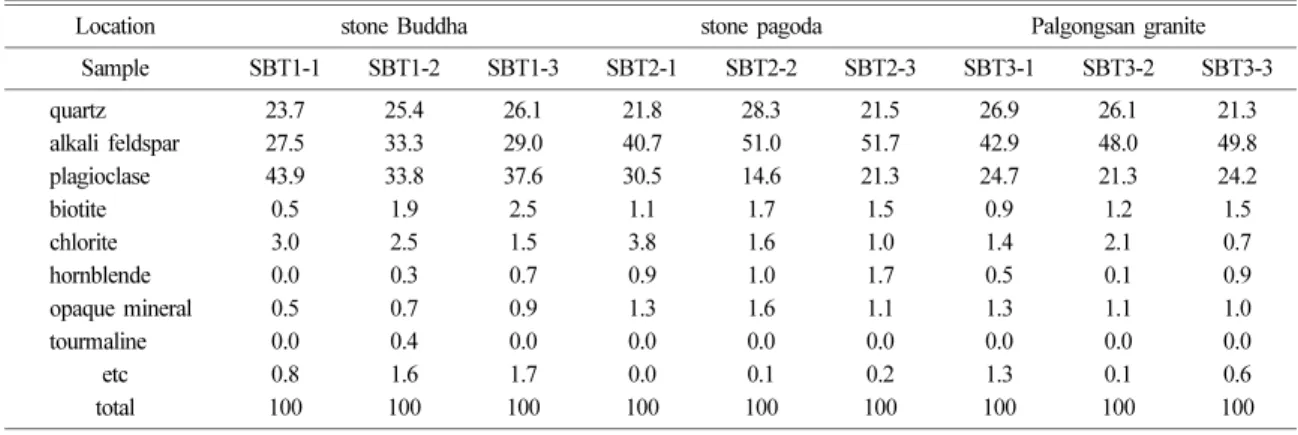
세 개의 시료에 대한 모드 분석결과 석영은 23.7- 26.1 vol.%, 알칼리 장석은 27.5-33.3 vol.%, 사장석은 33.8-43.9 vol.%, 흑운모는 0.5-2.5 vol.%, 녹니석은 1.5-3.0 vol.%, 각섬석은 0.3-0.7 vol.%, 불투명광물은 0.5-0.9 vol.%, 전기석은 0.4 vol.%, 기타 변질광물 0.8- 1.7 vol.%로 이 모드 자료를 QAP 도표에 도시해본 결 과 몬조화강암 영역에 해당한다(Table 1, Fig. 6).
석조여래좌상에 대한 대자율 및 감마스펙트로미터 측정 결과
석조여래좌상에 대한 대자율은 이 석불의 앞면과 뒷면 그리고 석불의 갓에 해당하는 보개와 석불 주 변의 암체를 대상으로 측정하였다. 그 결과 앞면은 10-14(×10−3 SI), 뒷면은 10-14(×10−3 SI), 보개는 10-13 (×10−3 SI), 석불 주변암체는 10-14, 10-13(×10−3 SI) 의 값으로 평균적으로 10-14(×10−3 SI)의 범위를 가 진다(Table 2).
Fig. 2. Petrological features of the stone Buddha. (A) Gwanbong Seokjoyeoraejwasang (stone Buddha), (B) the rock surface of the stone Buddha, (C and D, crossed and open nicols respectively) microphotographs of thin sections.
Abbreviations: Q, quartz; Pl, plagioclase; A-f, alkali feld- spar; Chl, chlorite; Hb, hornblende; Bt, biotite; Opq, opaque minerals.
Fig. 1. Analyses of magnetic susceptibility and γ -ray spectrometer. (A) SM 30 magnetic susceptibility meter, (B) GRM 260 γ - ray spectrometer, (C) in situ measurement of γ -ray spectrometer.
Table 1. Mode data for the stone Buddha, the stone pagoda, and the Palgongsan granite near the temple (vol.%)
Location stone Buddha stone pagoda Palgongsan granite
Sample SBT1-1 SBT1-2 SBT1-3 SBT2-1 SBT2-2 SBT2-3 SBT3-1 SBT3-2 SBT3-3
quartz 23.7 25.4 26.1 21.8 28.3 21.5 26.9 26.1 21.3
alkali feldspar 27.5 33.3 29.0 40.7 51.0 51.7 42.9 48.0 49.8
plagioclase 43.9 33.8 37.6 30.5 14.6 21.3 24.7 21.3 24.2
biotite 0.5 1.9 2.5 1.1 1.7 1.5 0.9 1.2 1.5
chlorite 3.0 2.5 1.5 3.8 1.6 1.0 1.4 2.1 0.7
hornblende 0.0 0.3 0.7 0.9 1.0 1.7 0.5 0.1 0.9
opaque mineral 0.5 0.7 0.9 1.3 1.6 1.1 1.3 1.1 1.0
tourmaline 0.0 0.4 0.0 0.0 0.0 0.0 0.0 0.0 0.0
etc 0.8 1.6 1.7 0.0 0.1 0.2 1.3 0.1 0.6
total 100 100 100 100 100 100 100 100 100
석조여래좌상에 대한 감마스펙트로미터 측정을 실 시하였다. 이 측정의 경우 일정한 면적과 두께가 요 구되기 때문에 보개는 접근이 가능한 곳에서 1회만 측정하였고 석불과 석불 주변암체를 대상으로는 3회 씩 측정하였다. 측정 결과 석불의 K값은 4.5-4.9%, eU은 2.8-6.4 ppm의 범위를 보이며, eTh은 15.5-20.9 ppm이다. 보개의 K값은 6.0%, eU은 4.9 ppm, eTh은 22.2 ppm이다. 석불 주변암체의 K값은 4.0-5.7%의
삼층석탑에 사용된 석재의 육안관찰과 석탑의 탈락 부분으로 사료되는 전석으로 박편을 제작하여 경하관 찰을 실시한 결과, 전반적으로 회백색의 조립질이며 자형의 장석반정이 많이 관찰되는 반상조직을 가지고, 주 구성광물은 알칼리장석(퍼싸이트), 석영, 사장석, 녹니석, 흑운모가 관찰되며, 소량의 각섬석, 불투명광 물이 관찰된다. 알칼리장석은 대부분 타형으로서 석 영과 연정을 이룬다. 석영은 알칼리 장석과 연정을 이루며 융식되어 나타나며, 직소광과 파동소광을 보 인다. 사장석은 10 mm 이하의 크기를 가지며 자형과 반자형으로 산출된다. 알바이트 쌍정을 가지며 일부 누대조직을 가진다. 전반적으로 풍화를 받아 견운모 화 되었다. 흑운모는 대부분 변질 받아 녹니석화 되 었다. 각섬석은 1-2 mm 크기를 가지며 칼스바드 쌍 정을 보인다(Fig. 3).
세 개의 시료에 대한 모드 분석결과 석영은 21.5- 28.3 vol.%, 알칼리장석은 40.7-51.7 vol.%, 사장석은 14.6-30.5 vol.%, 흑운모는 1.1-1.7 vol.%, 녹니석은 Fig. 3. Petrological features of the stone pagoda. (A) Seon-
bonsa three-storied pagoda, (B) the rock surface of the stone pagoda, (C and D, crossed and open nicols respectively) microphotographs of thin sections. Abbreviations are the same as in the Fig. 2.
Table 2. Magnetic susceptibility data for the stone Buddha, the stone pagoda, and the Palgongsan granite near the temple (×10−3 SI unit)
stone Buddha stone pagoda Palgongsan
granite
location body bogae rear side rear base side lower base
upper base
upper
cover first body first okgae
second body
second okgae outcrop 1 12.6 10.3 14.3 11.2 12.6 12.1 12.3 13 13.3 13.7 13.2 12.9 15.1 11.7 2 11.7 12.4 13.9 13.8 10.1 11.5 12.3 13 13.7 14.4 13.2 12.4 15 10.8 3 13.9 12.4 14.6 13.3 12.9 12.6 10.4 12.6 13.4 14.5 13.6 13.1 13.1 11.8 4 12.9 12.1 10.3 12.1 13.2 13.7 12.2 12.1 13.9 14.1 15.4 12.5 13.6 11.1 5 14.3 13.9 10.3 12.5 12 12.6 10.4 12.6 13 - 14 12 13.3 10.7 6 13 13.3 10.9 14.3 10.9 14.8 11.9 12.6 13.5 - 15.1 14.7 12.5 10.5 7 13.4 10.5 12.9 14.2 12.7 11.7 12.2 12.6 14.6 - 14.1 14.6 14.2 9.03 8 10.7 10.8 10.6 10.6 10.7 12.3 14.7 12.4 14 - 12.8 15.4 14.4 11.1 9 14 10.9 11.6 11.6 11.8 11.7 14.9 14.1 13.1 - 13.7 13.9 - 12.8 10 12.9 - 13.1 12.9 13.3 11.8 13.8 13.4 13.6 - 13.3 14.2 - 14.5
11 - - 12.1 12.7 - 10.8 11.5 15.6 14.8 - 13 15.4 - 15.6
12 - - - - - 12.5 13.4 15 14.2 - 13.1 14.3 - 16.3
13 - - - - - 11.8 9.75 13.4 11.8 - 13.1 14.6 - -
14 - - - - - 12.8 13.4 - 13.5 - - 12.6 - -
15 - - - - - 12.7 12.3 - 13.4 - - - - -
1.0-3.8 vol.%, 각섬석은 0.9-1.7 vol.%, 불투명광물은 1.1-1.3 vol.%, 기타 변질광물 0.1-0.2 vol.%로 이 모드 자료를 QAP 도표에 도시하면 섬장화강암(syenogranite) 과 몬조화강암(monzograntie)영역에 해당한다(Table 1, Fig. 6).
삼층석탑에 대한 대자율 및 감마스펙트로미터 측 정결과
삼층석탑에 대한 대자율은 석탑의 하층기단, 상층 기단, 상층기단갑석, 일층탑신, 일층옥개석, 이층탑신, 이층옥개석을 대상으로 각 10회 이상 측정하였다. 그 Fig. 4. Geological map around the Palgongsan granite and the location of the Seonbonsa Temple (modified after Choe and Jwa, 2004).
Fig. 6. QAP diagram for the rocks from the stone Buddha, the stone pagoda, and the Palgongsan granite. SBT1, stone Buddha; SBT2, stone pagoda; SBT3, outcrop near the Seon- bonsa Temple; PG, the Palgongsan granite from Choe and Jwa (2004).
Fig. 5. Petrological features of the outcrops near the Seon- bonsa Temple (A) The outcrop examined, (B) the rock sur- face of the outcrop, (C and D, crossed and open nicols respectively) microphotographs of thin sections. Abbrevia- tions are the same as in the Fig. 2.
결과 하층기단석은 10-15(×10−3 SI), 상층기단석은 9- 14(×10−3 SI), 상층기단갑석은 12-15(×10−3 SI), 일층 탑신은 13-14(×10−3 SI), 일층옥개석은 12-15(×10−3 SI), 이층탑신은 12-15(×10−3 SI), 이층옥개석은 12-15 (×10−3 SI)의 범위를 가진다(Table 2).
삼층석탑에 대한 감마스펙트로미터 측정은 하층기 단석, 상층기단석, 상층기단갑석, 일층탑신, 일층옥개 석, 이층탑신을 대상으로 각 1회 측정하였다. 그 결 과 하층기단석의 K값은 3.4%, eU은 3.5 ppm, eTh은 16.9 ppm이다. 상층기단석의 K값은 5.1%, eU은 3.0 ppm, eTh은 21.2 ppm이며, 상층기단갑석의 K값은 3.8%, eU은 4.5ppm, eTh은 12.0 ppm이다. 일층탑신 부의 K값은 4.5%, eU은 6.2 ppm, eTh은 17.5 ppm이 다. 일층옥개석의 K값은 3.7%, eU은 3.9 ppm, eTh은 13.5 ppm이다. 이층탑신부의 K값은 4.73%, eU은 5.7
ppm, eTh은 17.5 ppm의 다양한 범위를 가진다(Table 3).
선본사 주변지역의 지질학적 특징
선본사 주변 지역의 지질
대구 북동부에 위치한 선본사 주변의 팔공산에는 백악기 팔공산 화강암체가 위치한다. 이곳은 경상분 지의 중북부 지역에 해당하며 팔공산 화강암체가 경 상누층군의 퇴적암류와 화산암류를 북서-남동 방향의 암주상으로 관입하고 있다. 기반암인 백악기 경상누 층군은 본 암체와의 접촉부에서 열변성 작용을 받아 혼펠스화 되어 있다. 야외조사 결과 팔공산 화강암은 조립질 반상 흑운모-각섬석 화강암, 중립질 흑운모 화강암, 반화강암으로 구성되나 전자의 두 화강암은
outcrop
5.74 1.98 21.69 second body 4.73 5.72 17.53 3.99 3.52 13.39
Palgong-san
4.85 4.66 17.60
4.32 4.85 13.51 4.67 5.61 17.87
5.52 5.41 18.95 5.19 4.9 17.11
Fig. 7. XRD analytical results for the stone Buddha, the stone pagoda and the Palgongsan granite near the temple.
점이적이며 반화강암과는 점이적이거나 관입관계를 보인다(Fig. 4).
팔공산 암체의 암석기재적 특징
선본사 아래의 팔공산 암체에 대하여 육안관찰과 박편을 제작하여 경하관찰을 실시하였다. 전반적으로 담홍색으로, 조립질이며 석영과 알칼리장석(퍼싸이트) 의 반정이 많이 나타나는 반상조직을 보인다. 주 구 성광물은 알칼리장석, 석영, 사장석, 녹니석, 흑운모 이고, 소량의 각섬석, 불투명광물이 관찰된다. 알칼리 장석은 대부분 석영과 연정을 이루며, 석영은 융식되 어 나타나고 직소광과 파동소광을 보인다. 사장석은 6mm 이하의 자형에서 반자형으로서 알바이트 쌍정 과 누대조직을 나타낸다. 흑운모와 각섬석은 대부분 변질 받아 녹니석화 되었다(Fig. 6.)
세 개의 시료에 대한 모드분석 결과 석영은 21.3- 26.9 vol.%, 알칼리장석은 42.9-49.8 vol.%, 사장석은 21.3-24.7 vol.%, 흑운모는 0.9-1.5 vol.%, 녹니석은 0.7-2.1 vol.%, 각섬석은 0.1-0.9 vol.%, 불투명광물은 1.0-1.3 vol.%, 기타 변질광물 0.1-1.3 vol.%로 QAP 도표에 도시하면 섬장화강암과 몬조화강암영역에 해 당한다(Table 1, Fig. 6). 즉 선본사 주변의 팔공산 화 강암은, 타 지역 팔공산 화강암의 분류 범위 내에 속 한다(Fig. 6에서 PG).
팔공산 암체에 대한 비파괴 분석 결과
선본사가 위치해 있는 팔공산의 화강암에 대한 대 자율은 선본사아래 신선한 노두에서 10회 이상 측정 하였다. 그 결과 팔공산화강암은 9-16(×10−3 SI)의 범
위를 가진다. 감마스펙트로미터는 3회 측정하였다.
그 값은 K값은 4.8-5.2%, eU은 4.7-5.6 ppm, eTh은 17.1-17.9 ppm의 범위를 가진다.
고찰 및 결론
선본사의 두 석조문화재 석조여래좌상과 삼층석탑 의 석재들은 암석기재적으로 거의 동일한 특징을 보 인다. 즉, 회백색의 조립질이며 반상조직을 보이는 화강암이며, 주 구성광물은 사장석, 알칼리장석, 석영, 녹니석, 흑운모, 각섬석 등으로 이루어져 있다. 이런 기재적 특징들은 선본사가 위치한 팔공산 화강암체 서남부의 화강암 노두에서 확인되는 것과도 조화적이 Fig. 8. Histogram of magnetic susceptibility data for the
stone Buddha, the stone pagoda, and the Palgongsan granite near the temple.
Fig. 9. Histogram of γ -ray spectrometer data for the stone Buddha, the stone pagoda, and the Palgongsan granite near the temple.
모드 조성을 가지고 있기 때문에(Fig. 6) 모드 조성 에서의 미약한 차이는 암상이 다름을 의미하지는 않 는다.
전암대자율 측정값을 보면 석조여래좌상, 삼층석탑, 선본사 인근 화강암 노두에서 각각 10-14, 10-15, 9- 16(×10−3 SI)의 범위를 보여 거의 동일하며, 자철석계 열의 팔공산 화강암을 나타낸다(Fig. 8). 감마스펙트 로미터 측정값에서는 비록 인근 화강암 노두의 자료 가 제한적이기는 하나, 세 암석에서 K, eU, eTh의 함량들이 거의 유사한 범위에 속한다고 볼 수 있다 (Fig. 9).
결론적으로 선본사의 관봉 석조여래좌상과 삼층석 탑은 팔공산 화강암의 특징에 부합되며, 주변 지역의 화강암체가 그 원산지라고 추정된다.
사 사
이 논문에 대해 세심한 지적을 해주신 한국지질자 원연구원의 조등룡 박사님, 홍세선 박사님 그리고 조 선대학교의 안건상 교수님께 감사드린다.
geochemical evidences for magma mixing in the Palgongsan Pluton. Geosciences Journal, 8, 343-354.
Jwa, Y.-J., Kim, K.-K., Ko, S.-B., and Kim, J.-S., 2006, Source area of the rocks using the west stone pagoda of Gameunsaji temple site, Korea. Journal of the Petrological Society of Korea, 15, 128-138. (in Korean with English abstract)
Jwa, Y.-J., Lee, S.W., Kim, J.-S., and Sohn, D.W., 2000, Source area of stones used for the stone buildings of Bulguksa temple and Seokguram grotto. Journal of the Geological Society of Korea, 36, 335-340. (in Korean) Kim, C.S., 2013, Type characteristics and establishment
background of the Palgongsan Gwanbong Seokjoyeorae- jwasang. Seonbonsa Gatbawui Budda, Seonbonsa. In Research Institute of Buddhist Cultural Heritage (ed.), Proceedings of the symposium on Palgongsan Seonbonsa Gatbawuibulsang gwa Bulgyomunhwajae. Seoul, Korea, 21-39. (in Korean)
Lee, G.B., 1972, Establishment of Shilla five mountains and its meaning. Jindanhakbo, 33, 5-24. (in Korean) Shin, Y.C., 2013, Consideration on stone cultural heritage
in the Palgongsan Seonbonsa. Seonbonsa Gatbawui Budda, Seonbonsa. In Research Institute of Buddhist Cultural Heritage (ed.), Proceedings of the symposium on Palgongsan Seonbonsa Gatbawuibulsang gwa Bulgyomunhwajae. Seoul, Korea, 40-53. (in Korean) Ward, S.H., 1981, Gamma-ray spectrometry in geological
mapping and uranium exploration. Economic Geology, 75th Anniversary Volume, 840-849.
Manuscript received: November 13, 2014 Revised manuscript received: December 3, 2014 Manuscript accepted: December 9, 2014