• 검색 결과가 없습니다.

Development and Practical Application of a Psychological Skill Training Program for National Wheelchair Curling Players -Frontal EEG Asymmetry

N/A
N/A
Protected

Academic year: 2021

Share "Development and Practical Application of a Psychological Skill Training Program for National Wheelchair Curling Players -Frontal EEG Asymmetry"

Copied!
16
0
0

로드 중.... (전체 텍스트 보기)

전체 글

(1)

Development and Practical Application of a Psychological Skill Training Program for National Wheelchair Curling Players

-Frontal EEG Asymmetry

Sung-Woon Kim 1 , Seok Lip Choi 2 , Han-Cheol Kim 3*

1

Professor, Dept. of Physical education, Kyungpook National University

2

Professor, Dept. of Sports rehabilitation, Daegu Health College

3

Professor, Dept. of Special Physical education, Yeungnam University

휠체어컬링 국가대표선수의 경기력 향상을 위한 심리기술훈련 프로그램의 개발 및 적용

-EEG 뇌파활용 연구

김성운1, 최석립2, 김한철3*

1경북대학교 체육교육학과 교수, 2대구보건대학교 스포츠재활과 교수,

3영남대학교 특수체육교육학과 교수

Abstract The present study aimed to develop a sports psychological skill training program and to test its applicability to improve the performance of national wheelchair curling players. A total of 4 participants completed the study. Subjects have been to 12 sessions of 6 different psychological skills training programs (routine training, attentional focus training, writing practice training in diary, relation training, self-control training, and positive self-talk training). The effectiveness of psychological skills training has been evaluated with 6 questionnaires and EEG measurement. The result was that psychological skills training had improved coping with adversity, peaking under pressure, and concentration, self-management and reduced anxiety of Korean national wheelchair curling player. The result was that the EEG inter-hemispheric asymmetry index showed negative emotional states before psychological skill training but positive emotional states after. The result implies that psychological skill training plays an important mediating role in bringing about positive effects in the psychological elements and competitiveness in national wheelchair curling players.

Key Words : national player, wheelchair curling, psychological skill program, EEG, frontal asymmetry

요 약 본 연구의 목적은 휠체어컬링 국가대표선수와 팀의 요구에 기초하여 현장 활용도와 시합 및 훈련 기여도가 높은 스포츠심리기술훈련 프로그램을 개발하고 그 적용 가능성을 평가해 보는데 있다. 본 연구의 대상자는 현재 휠체어컬링 국 가대표선수 4명을 대상으로 하였다. 상담은 내담자와 편안한 분위기에서 일주일에 1회씩 매 60-90분 총 12회를 실시하였다.

측정도구는 스포츠심리기술 질문지, 운동선수 자기관리행동 질문지, 한국판수행전략검사지, 기분상태프로파일질문지, 경쟁 상태불안 검사지, 경기 참여 휠체어컬링 수행결과 변화, 심리기술훈련 평가질문지, EEG 대뇌반구 비대칭 차이지표 분석 등을 측정하였다. 본 연구결과는 다음과 같다. 첫째, 심리기술훈련은 사전단계에서 연구대상자의 문제점으로 지적되었던 3개의 하위 요인인 각성조절, 걱정, 주의집중을 긍정적으로 변화시킨 것으로 나타났다. 둘째, 심리기술훈련은 휠체어컬링 대표선수들의 수행변화에도 긍정적인 영향을 미치는 것으로 나타났다. 셋째, 개방형질문지 분석결과 연구대상자는 심리기 술훈련 프로그램에 대한 필요성을 인식하고 경기력에도 도움이 된다고 인식하고 있는 것으로 나타났다. 넷째, 스포츠심리 기술훈련 처치 전에는 EEG대뇌반구비대칭 차이지표가 부정적 정서 상태를 보였지만 처치 후 긍정적 정서 상태를 보였다.

이것은 뇌 과학적 접근인 EEG 뇌파분석을 통해 심리기술훈련이 휠체어컬링 대표선수들의 심리적 상태에 긍정적인 영향을 미친다는 것을 과학적이고 객관적으로 검증하였다.

주제어 : 국가대표선수, 휠체어컬링, 심리기술훈련, 뇌파, 대뇌반구비대칭 차이지표

*This work was supported by the Ministry of Education of the Republic of Korea and the National Research Foundation of Korea (NRF-2015S1A5B5A07041680)

*Corresponding Author : Han-Cheol Kim ([email protected]) Received January 28, 2019

Accepted March 20, 2019

Revised March 6, 2019 Published March 28, 2019
(2)

1. Introduction

Wheelchair curling is a sport enjoyed by individuals with physical disabilities who use wheelchairs. It requires a high level of strategy, as can be inferred from its nickname of "chess on ice," and is characterized by adrenaline-filled tension from fast thinking and psychological battle with the opposite team, necessitating cooperation among team players.

Additionally, to play wheelchair curling, players must possess fundamental techniques and physical ability[1].

In wheelchair curling, two teams, each consisting of 4 players (lead, second, third, and skip), compete by pushing a round granite stone on ice to send it closer to the goal (button) within a target area called the house, which is a bullseye with a diameter of 1.83 m[1,2]. The regulations of wheelchair curling are similar to those of regular curling, but the game rules are different[2]. In regular curling, a player throws the curling stone by hand while sliding; in wheelchair curling, a player can throw the curling stone using the hand or an extender cue with the wheelchair fixed in place. Specifically, because the sweeping technique (i.e., sweeping the ice in front of the stone) is not used in wheelchair curling, throwing is closely tied to the game outcome[3]. Another difference from regular curling is that a wheelchair curling team must be gender-mixed with one or more female players on a team[2,4,5].

In the Vancouver 2010 Paralympic Winter Games, Korea's overall ranking was 18th out of 45 participating countries, but the wheelchair curling team participating in Paralympic Games for the first time won a silver medal. The outcome led wheelchair curling to be widely known as a Paralympic game[3,4].

Additionally, in the Chuncheon 2012 Wheelchair Curling World Championship, the Korean national team won a silver medal again, demonstrating strong likelihood that they would win a gold medal in the World Championships in the future[6]. The Korean national wheelchair curling team has demonstrated a limitless possibility on the global stage, and players have

developed at a fast pace. Thus, wheelchair curling is highly likely to be a strategic game in the coming PyeongChang 2018 Paralympics[3]. However, government funding and facility support continue to be insufficient as well as sports science support that can help improve wheelchair curling players' competitiveness[3,4,6,7,8].

A review of recent studies on curling shows the following diverse types of research: studies analyzing curling games[9-12], studies on physical strength and sports biomechanics[14,15], and study on psychological factors[16]. However, most previous studies focused on improving the competitiveness of curling players without disabilities, and research that could help improve the competitiveness of wheelchair curling players remains insufficient. In a study analyzing the 2012 Wheelchair Curling World Championship games played by 4 national teams, Park et al.[3] argued that research should be conducted to improve Korean wheelchair curling players' competitiveness and to increase the probability of winning. In any sport, for players to perform at their highest level and show maximum competitiveness, players' physical, physiological, biomechanical, and psychological factors should be optimally harmonized[17]. Researcher[18]

argue that, especially as competitiveness has recently

been enhanced in elite sports of the Olympics and

World Championships, win or lose and ranking are

determined by such psychological factors as anxiety

and tension rather than body size, physical strength,

and technique. For example, some players lose a game

because they cannot overcome psychological problems

occurring in an intense game situation even though

they have physical strength appropriate for the game or

possess outstanding techniques while other players win

because they can remain in the optimal psychological

state in the face of an opponent with an equal or even

better skill level[19]. This demonstrates very well that,

aside from players' physical ability and skills, the

ability to maintain the optimal psychological state in a

game situation is a crucial element for excellent

(3)

performance and suggests that it is difficult for players to display their maximum performance without the ability to control their minds in the presence of various factors extrinsic to the game. Therefore, players should strengthen and improve various psychological elements to excel in a competitive sport and maintain the optimal psychological state to ultimately enhance competitiveness[19,20]. Like players without disabilities, it is very important for players with disabilities, too, to maintain the optimal psychological state for maximum performance in a game situation[7].

In recent years, with the change in perception of the need for psychological skill training to maintain the optimal psychological state, such training has spread widely to players without disabilities[21,22,23]. In Korea, too, research is actively underway on diverse topics regarding the development and practical application of psychological skill training programs.

Training methods for sub-factors of psychological skills (sports performance strategy, anxiety control, intrinsic motivation, confidence, motivation, and so on) were studied by Park, Kwon, and Lee[24], Lee, Shin, and Osamitsu[25], Hahn[26], Park, Kim, and Moon[27], Cheong[28], and others. Several studies, including Lee and Yoo[29]; Kwon[30]; Lee and Park[31]; Park and Kim[32]; Shin, Choi, and Kwon[33]; and Kim[34], developed psychological skill training programs appropriate to yacht, golf, track and field, tennis, fencing, and archery, respectively, and attempted to apply the programs in the sports field. However, very little research has been conducted so far to test the effect of psychological skill training on the improvement of competitiveness of players with disabilities. Accordingly, it would be highly significant to conduct a study with wheelchair curling players preparing for international games such as World Championships and the Olympics, going beyond the existing studies that focused on elite players without disabilities. In addition, because, in wheelchair curling, a one-time shot determines the flow and outcome of the game and win or lose in that end, it is highly

critical from a field perspective of the sport to help players to maintain the optimal psychological state achieved through psychological skill training in each end. Park et al.[3] also argued for the need of research to develop a psychological skill and focusing training program to help players maintain a high level of focused attention in the cold wheelchair curling field.

Moreover, because players with disabilities, who play a game with physical disabilities, experience psychological difficulties more than players without disabilities do, psychological skill training will become a critical part of their training to improve performance.

Psychological elements are considered critically influential in players' competitiveness particularly in wheelchair curling, which requires self-control skills, i.e., closed skills.

Previous studies investigated the effect of psychological skill training by conducting survey research or qualitative research. Recently, however, Han, Park and Woo[35] argued in a study titled "The Effect of Sport Psychological Skill Training Based on Positive Psychology via Analysis of Frontal EEG Asymmetry" that, to understand the mechanism through which psychological skill training influences players' competitiveness and psychology, multidimensional analysis should be conducted by measuring psychophysiological variables such as vital signs or brain activity. If the effect of psychological skill training is objectively and scientifically investigated via EEG analysis, important information can be provided regarding the effect of psychological skill training on the psychological state of national wheelchair curling players.

Accordingly, the present study aimed to develop a

sports psychological skill training program based on

the needs of national wheelchair curling players and

teams to have high levels of practical application and

contribution to competitive games as well as training

and to assess the possibility to apply the program in

practice. An additional purpose was to investigate the

effect of psychological skill training on the

(4)

psychological state of national wheelchair curling players using EEG analysis and provide basic brain physiological data to help increase competitiveness.

2. Methods

2.1 Participants

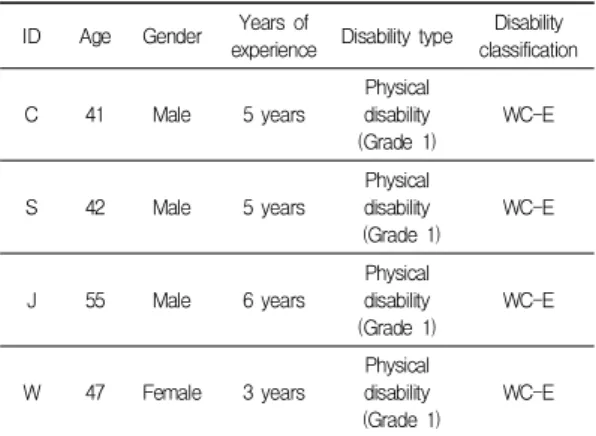
Initially, a total of 7 subjects out of all national wheelchair curling players participated in the study, but, during the course of the study, 3 participants withdrew because of sudden replacements of Korea Wheelchair Curling Association national players or personal reasons. Thus, a total of 4 participants completed the study. Study participants' characteristics are shown in Table 1.

Table 1. Participant characteristics

ID Age Gender Years of

experience Disability type Disability classification

C 41 Male 5 years

Physical disability (Grade 1)

WC-E

S 42 Male 5 years

Physical disability (Grade 1)

WC-E

J 55 Male 6 years

Physical disability (Grade 1)

WC-E

W 47 Female 3 years

Physical disability (Grade 1)

WC-E

2.2 Counselor

The counselor in the study is certified by Korean Society of Sport Psychology as a Level 1 Sport Psychology Counselor and completed the educational curriculum for counseling techniques (psychoanalysis, interpersonal relationship, and cognitive behavioral therapy) offered by the Korean Counseling Psychological Association. The counselor began sport psychology counseling services in 2001 to improve the performance of players on a university female soccer team and later widened the horizon to diverse types of sports (golf, shooting sports, body building, track and

field, soccer, baseball, and so on) to improve performance of players without disabilities. Recently, the counselor has been involved in sport psychology counseling for archery players and shooters with disabilities and a wheelchair basketball team. Thus, the counselor was considered to be an expert who could very well identify psychological characteristics of players with disabilities.

2.3 Measurement Tools and Methods 2.3.1 Counseling Process and Approach The counselor met with each client a total of 12 times once a week for 60–90 minutes. Counseling was conducted in a comfortable atmosphere, and the techniques (psychoanalysis and cognitive behavioral therapy) to induce self-insight with ease were used during counseling. In the present study, not only objective but also subjective data collected in interviews were included in the analysis to obtain psycho-behavioral data relevant to players' performance from a wide perspective. To do so, a structured interview (conducted with predetermined formats and questions regarding the study participant’s experience as a player, motivation, future plan, psychological issues, and so on), semi-structured interview (conducted while flexibly applying predetermined interview contents), and unstructured interview (conducted in an open conversation format) were mixed. To elevate the ethics of the counseling, the interview program progressed under the principles that the counselor should form a trusting relationship with the client, not engage in multiple relationships with or exploitation of the client, and protect all confidential information disclosed during counseling.

2.3.2 Psychological Skill Questionnaire in Sports (PSQS)

To evaluate sports psychological skill of players

with disabilities, the PSQS developed by Yoo and

Huh[19] was used.

(5)

2.3.3 Questionnaire for Players' Self- Management Players' self-management behavior was assessed with the questionnaire for players' self-management used in a previous study[36].

2.3.4 Korean Version of the Test of Performance Strategies (TOPS)

To assess overall psychological skills and strategies that players use in a game situation, the Korean version of the TOPS[37] was used.

2.3.5 Profile of Mood States (POMS)

The POMS was used to measure players' mental health and mood states.

2.3.6 Competitive State Anxiety Inventory (CSAI-2)

To assess the intensity and direction of competitive state anxiety, the revised CSAI-2 was used.

2.3.7 Change in the Performance Outcome of Wheelchair Curling Games

The outcome of the games in which the national wheelchair curling players participated was measured for the "performance" variable.

2.3.8 Questionnaire to Assess the Perception of Psychological Skill Training

To assess players' perception of the psychological skill training program, an assessment tool consisting of 2 items was used.

2.3.9 Analysis of EEG Inter-Hemispheric Asymmetry Index

The EEG inter-hemispheric asymmetry index was analyzed to examine the emotional states of national wheelchair curling players in a brain science approach.

2.4 Procedure

In-depth interviews were first conducted to derive the factors related to psychological skills national

wheelchair curling players thought influenced their everyday or game performance. Then, a psychological skill training program was developed based on the results of in-depth interviews and administered for 12 weeks around wheelchair curling training and game schedules in consultation with the team leadership. The effect of psychological skill training was analyzed quantitatively and qualitatively through questionnaires, journals, and counseling conducted before and after the application of the training program. In the pre-program phase, basic background information and personal information of participants were collected, a rapport was formed between counselor and client, and baseline conditions of the psychological variables were explored.

During the training phase, field guides of the psychological skill training program were provided for 4–12 sessions and counseling for 60–90 minutes.

After the application of the training program and the completion of psychological counseling, follow-up assessments (1 and 4 weeks after the completion of the training program) were made to analyze and evaluate the long-term effect of the psychological skill training program. The follow-ups were conducted to investigate the effect of psychological skill training that study participants continued to apply by themselves without a direct training guide on psychological skill.

To examine the change in psychophysiological areas in the national wheelchair curling players, EEGs were examined. EEGs were measured in a light- and sound-proof laboratory with no metals that could interfere with measurement. An electro-cap (EM1) was placed on top of a participant’s head when it was determined that the participant sufficiently understood the experimental procedure, and the EEG was recorded using the BIOPAC system (U.S.A) in the following sites: F3, F4, F7, F8, and Fz. The reference electrode was attached to the earlobe, and the ground electrode was placed between frontal lobe and forehead.

Following the first EEG measurement, participants participated in the psychological training program.

Overall, EEG was measured a total of 4 times, i.e., a

(6)

day before beginning counseling, after the 12th session of the psychological training program, and 1 and 4 weeks after the completion of the training program.

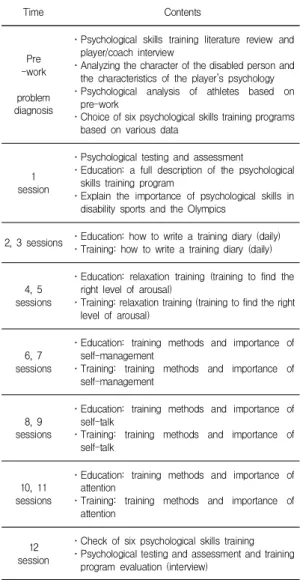
2.5 Programs of Psychological Skills Training

Table 2. Progams of psychological skills training

Time Contents

Pre -work problem diagnosis

․Psychological skills training literature review and player/coach interview

․Analyzing the character of the disabled person and the characteristics of the player’s psychology

․Psychological analysis of athletes based on pre-work

․Choice of six psychological skills training programs based on various data

1 session

․Psychological testing and assessment

․Education: a full description of the psychological skills training program

․Explain the importance of psychological skills in disability sports and the Olympics

2, 3 sessions ․Education: how to write a training diary (daily)

․Training: how to write a training diary (daily)

4, 5 sessions

․Education: relaxation training (training to find the right level of arousal)

․Training: relaxation training (training to find the right level of arousal)

6, 7 sessions

․Education: training methods and importance of self-management

․Training: training methods and importance of self-management

8, 9 sessions

․Education: training methods and importance of self-talk

․Training: training methods and importance of self-talk

10, 11 sessions

․Education: training methods and importance of attention

․Training: training methods and importance of attention

12 session

․Check of six psychological skills training

․Psychological testing and assessment and training program evaluation (interview)

2.6 Statistical Analysis

The data obtained from this study were analyzed using qualitative and quantitative research techniques in combination. The data obtained from qualitative research techniques were submitted to triangulation and inductive content analysis performed by a sport

psychologist and a wheelchair curling expert to preserve the researchers' subjectivity and the objectivity of qualitative data. To test the effect on the application of psychological skill training, the data obtained from quantitative research techniques were analyzed by computing the mean factor scores of the sport psychological skill questionnaires in the baseline and conducting repeated measure analysis of variance on pre- and post-program and follow-up test results to examine the change following psychological skill training. Internal validity increased by examining emotional changes in participants in a brain psychophysical approach by analyzing EEG inter-hemispheric asymmetry index.

3. Results

3.1 Pre-Program Psychological Tests

Pre-program tests consisted of interviews with leaders and players, testing using psychological questionnaires, and EEG measurement.

3.1.1 Analysis of the Interviews with Leaders As a preliminary work to identify overall performance and psychological ability of the players and to develop a psychological skill training program tailored to individual players, the leaders were interviewed. Additionally, during the interviews, the background and psychological state of each player were examined from the leaders' perspectives.

3.1.2 The Results of Analysis on Players' Psychological States in the Pre-Program Phase

Based on the interviews conducted with leaders and

participants as well as psychological questionnaires, the

biggest problems experienced by all players (C, S, J,

and W) among various problems were psychological

issues occurring during wheelchair curling training,

anxiety during games, and inability to focus attention

(7)

at critical moments in a game. Players C, S, J, and W have shown good performances, but problems involving the environment affected them in maintaining their psychological conditions. The environmental problems they experienced were as follows:

accumulated fatigue because they always started training late at night and continued until the dawn in the absence of a field devoted to wheelchair curling and physical dysfunctions due to spinal injury like lack of blood circulation and pain because, during wheelchair curling, they did not move much and had to sit in a wheelchair for a long time, and the indoor temperature was low. These environmental problems were shown to add to the anxiety players already felt and interfere with their ability to focus. Hence, it was determined that players C, S, J, and W required trainings to control their awareness level and to focus their attention to maintain their performance patterns without being conscious of their condition. Because wheelchair curling is not an individual sport, a good outcome cannot be expected if players on a team do not trust or understand or are not interested in and considerate of one another or if they have a negative mindset due to lack of self-control due to the cold. Therefore, it was found that teamwork should be built, and lively and positive exercise attitudes should be encouraged through conversation and interaction among players.

3.2 Selection of a Psychological Skill Training Program

Baseline measurements, interviews with leaders and players conducted at an early training stage, conferences with experts, and previous research findings were analyzed. Based on the analysis, the following training items were determined to be most needed by players C, S, J, and W: keeping a training journal, relaxation, identifying optimal awareness level, self-management, and positive self-talk and focused attention.

3.3 Application of the Psychological Skill Training Program

The psychological skill training program for players C, S, J, and W was created by integrating previous research on psychological skill training in wheelchair curling and the results of the conferences with experts (coaches and researchers). Psychological skill training was provided after both physical strength and technique training were finished and lasted between 1 and 1.5 hours including interviews and the training.

Psychological skill training was provided around the wheelchair curling training schedule, once weekly for a total of 12 weeks. Players C, S, J, and W were instructed to apply the psychological skill training they learned in each session in the next wheelchair curling training and everyday life and to write down the details in a training journal so that they would continue using psychological skills even outside of the psychological skill training sessions. Players were also instructed to keep records of hand-outs from the researcher during the psychological skill training sessions and of the applications of psychological skill training in wheelchair curling training and everyday life, which were utilized in the next training session to review what they had learned. Lastly, they were told to make records of questions they had during training and to ask the researcher later.

3.4 Post-Program Tests (the effect of psychological skill training and changes in psychological skills)

3.4.1 Players C, S, J, and W 3.4.1.1 PSQS

After sports psychological skill training, overall

psychological skills improved. Specifically, the training

had positive effects on confidence, focus, goal setting,

team harmony, imagery, will power, and anxiety

control [Table 2].

(8)

Table 2. Mean scores of sports psychological skill sub-factors before and after sports psychological skill training

3.4.1.2 Players' Self-Management

After sport psychological skill training, overall self-management abilities improved. Specifically, willpower managements, life management, training management, and body management improved after sport psychological skill training [Table 3].

Table 3. Mean scores of self-management sub- factors before and after sports psychological skill training

3.4.1.3 Korean Version of TOPS

After sport psychological skill training, performance on the Korean version of the TOPS improved in the areas of imagery and goal-setting, relaxation, and emotional control. Thus, sport psychological skill training positively influenced performance strategies [Table 4].

Table 4. Mean scores of the Korean version of TOPS sub-factors before and after sports psychological skill training

Sub factors

Partici -pants

Pre -program

Post -program

1 week post -program

4 weeks post -program

Self -talk

C 2.63 3.00 2.75 2.50

S 2.50 3.00 2.50 2.25

J 2.63 3.00 2.50 2.25

W 2.63 3.25 2.75 2.25

Condition control

C 2.50 2.71 2.57 2.43

S 1.86 3.14 2.43 2.57

J 1.86 2.29 2.00 1.71

W 1.64 3.57 2.86 2.43

Imagery and goal -setting

C 2.90 3.60 3.60 3.40

S 2.90 3.60 3.20 3.40

J 3.10 3.40 2.60 2.60

W 3.10 3.60 3.00 2.60

Relaxation

C 2.50 4.50 4.00 4.00

S 2.25 4.25 3.75 4.00

J 2.25 3.25 2.75 3.00

W 2.38 3.50 3.00 2.75

Emotional control

C 2.25 3.50 3.25 2.75

S 2.13 3.75 3.25 3.00

J 2.25 3.00 2.50 2.75

W 2.25 3.25 3.00 2.50

3.4.1.4 POMS

After sport psychological skill training, performance

Sub factors

Partici- pants

Pre- program

Post- program

1 week post -program

4 weeks post -program Will

power management

C 2.88 4.00 3.75 3.75

S 2.31 4.00 3.75 3.75

J 2.38 3.13 3.25 3.13

W 2.50 3.63 3.25 3.00

Life management

C 3.25 3.88 3.63 3.50

S 3.20 3.88 3.63 3.50

J 3.20 3.38 3.13 3.00

W 3.20 4.00 3.50 3.25

Unique behavior management

C 3.30 3.40 3.20 3.00

S 3.30 4.00 3.60 3.40

J 3.30 3.80 3.60 3.40

W 3.20 4.00 3.60 3.00

Training management

C 2.59 3.67 3.50 3.33

S 3.59 4.33 4.17 4.00

J 3.42 4.17 3.83 3.67

W 3.17 4.33 4.00 3.67

Interpersonal relationship management

C 4.17 4.00 3.67 3.33

S 3.88 4.00 4.00 3.33

J 3.75 4.00 4.00 3.33

W 3.17 3.67 3.33 3.00

Body management

C 3.20 4.00 3.80 3.60

S 3.20 4.00 3.80 3.60

J 3.40 4.20 3.80 3.40

W 2.60 3.60 3.20 3.00

Sub factors

Partici- pants

Pre- program

Post- program

1 week post -program

4 weeks post -program

Confidence

C 1.63 3.25 3.00 2.50

S 2.25 3.00 3.00 2.50

J 2.00 2.50 2.75 2.50

W 2.75 4.00 3.50 2.75

Focus

C 2.88 3.75 3.50 3.25

S 3.00 4.00 3.75 3.25

J 3.00 3.50 3.25 3.25

W 3.00 3.75 3.50 3.00

Goal setting

C 2.75 3.75 3.25 3.25

S 2.88 3.75 3.25 3.00

J 2.63 3.00 2.75 3.00

W 2.63 3.50 3.25 3.25

Team harmony

C 3.00 3.50 3.25 3.25

S 2.88 4.00 3.25 3.25

J 2.88 4.50 3.75 3.25

W 2.88 4.25 4.00 3.50

Imagery

C 2.75 3.00 3.00 3.00

S 2.88 3.25 3.00 2.75

J 2.75 3.00 3.00 2.50

W 2.88 3.50 3.25 2.75

Will power

C 2.88 3.75 4.00 3.75

S 3.00 4.00 3.75 3.75

J 3.00 3.25 3.50 3.75

W 2.88 3.75 3.50 3.75

Anxiety control

C 1.50 3.00 3.00 3.25

S 1.38 2.75 3.00 2.75

J 1.38 2.50 2.75 2.50

W 1.38 3.00 3.00 3.00

(9)

strategies improved as measured by POMS, specifically in tension, depression, and vigor. Additionally, the results of POMS administered before sports psychological skill training were in a reverse radial shape, suggesting poor mental health, but the POMS results after the training showed a return to normality [Table 5].

Table 5. Mean scores of POMS sub-factors before and after sports psychological skill training

Sub factors

Partici -pants

Pre -program

Post -program

1 week post -program

4 weeks post -program

Tension

C 65.00 56.00 58.00 54.00

S 65.00 59.00 62.00 58.00

J 66.00 60.00 59.00 58.00

W 69.00 58.00 59.00 58.00

Depression

C 69.00 54.00 55.00 52.00

S 69.00 57.00 60.00 58.00

J 68.00 61.00 60.00 58.00

W 69.50 60.00 61.00 56.00

Anger

C 73.50 70.00 69.00 64.00

S 73.50 68.00 71.00 66.00

J 72.00 62.00 60.00 62.00

W 73.00 64.00 62.00 58.00

Vigor

C 48.50 68.00 65.00 64.00

S 48.50 70.00 66.00 65.00

J 53.00 65.00 62.00 64.00

W 57.00 68.00 65.00 64.00

Fatigue

C 71.00 67.00 70.00 72.00

S 71.00 70.00 73.00 72.00

J 68.00 72.00 75.00 74.00

W 60.00 60.00 63.00 60.00

Confusion

C 56.00 60.00 62.00 65.00

S 56.00 62.00 66.00 63.00

J 59.00 60.00 66.00 63.00

W 62.50 61.00 64.00 63.00

3.4.1.5 EEG Inter-Hemispheric Asymmetry Index The EEG inter-hemispheric asymmetry index showed negative emotional states before sports psychological skill training but positive emotional states after the treatment [Table 6].

Table 6. Mean scores of EEG inter-hemispheric asymmetry index (log R-log L) before and after sports psychological skill training

3.4.1.6 CSAI-2

When the players attended a game before they participated in the sports psychological skill training program, they experienced high levels of anxiety in both cognitive and physical perspectives of intensity.

From the perspective of direction, too, their performances were influenced by the anxiety. However, after participating in the training program, cognitive and physical anxiety levels decreased, and the players perceived the intensity of the anxiety as a factor motivating performance. Additionally, confidence improved after the sports psychological skill training in terms of intensity and was perceived as a factor facilitating performance [Table 7].

Table 7. Mean scores of CSAI-2 sub-factors before and after sports psychological skill training

Sub factors

Partici -pants

Pre -program

Post -program

1 week post -program

4 weeks post -program Cognitive

anxiety -Intensity

C 3.17 2.44 2.78 2.89

S 3.45 2.67 2.56 2.22

J 3.33 2.78 2.56 2.22

W 3.39 2.33 2.44 2.22

Physical anxiety -Intensity

C 3.33 2.11 2.22 2.56

S 3.39 2.22 2.00 2.22

J 3.39 2.22 2.11 2.22

W 3.39 2.11 2.11 2.11

Con -fidence -Intensity

C 2.84 3.33 3.11 3.22

S 2.84 3.44 3.22 3.33

J 3.17 3.22 2.89 2.78

W 3.33 3.44 3.22 3.00

Cognitive anxiety -Direction

C -1.12 0.11 0.11 -0.11

S -1.12 0 -0.22 -0.56

J -1.29 0.22 0.11 -0.44

W -1.29 0.22 0.11 -0.33

Physical anxiety - Direction

C -1.32 0.11 -0.11 -0.22

S -1.32 0.22 -0.11 -0.22

J -1.32 0.22 0.11 -0.11

W -1.32 0.22 0.11 0

Con -fidence -Direction

C 1.72 2.22 2.56 2.44

S 1.95 2.67 2.22 2.00

J 1.95 2.22 2.00 1.78

W 2.06 2.22 2.11 1.89

Factor Partici -pants

Pre -program

Post -program

1 week post -program

4 weeks post -program

Asymmetry C -0.54 1.31 0.80 0.34

index

S -1.56 2.33 -1.45 -1.32

J -2.28 1.87 0.89 0.11

W -1.86 2.75 1.12 1.35

(10)

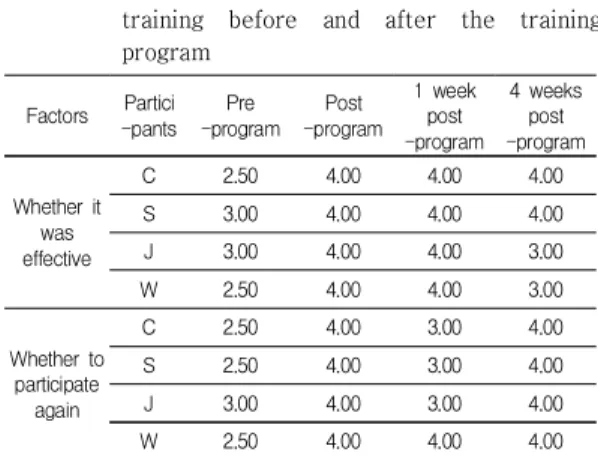
3.4.1.7 Content Analysis on the Open-Ended Questionnaire to Assess the Perception of the Psychological Skill Training Program Before sports psychological skill training, the scores assessing the perception of such training program were low. However, the scores increased after the treatment and remained high in follow-up tests. Changes in the scores assessing the sports psychological skill training program are shown in table 8.

Table 8. Changes in the scores assessing the perception of sports psychological skill training before and after the training program

Factors Partici -pants

Pre -program

Post -program

1 week post -program

4 weeks post -program

Whether it was effective

C 2.50 4.00 4.00 4.00

S 3.00 4.00 4.00 4.00

J 3.00 4.00 4.00 3.00

W 2.50 4.00 4.00 3.00

Whether to participate

again

C 2.50 4.00 3.00 4.00

S 2.50 4.00 3.00 4.00

J 3.00 4.00 3.00 4.00

W 2.50 4.00 4.00 4.00

3.5 Testing the Effect of Sports Psychological Skill Training (analysis of performance outcomes in the games before and after the training)

The performances by players C, S, J, and W in an international game in which they participated as a team before sports psychological skill training were not good due to a lack of confidence and low focus. However, in the international games played after sports psychological skill training, they won a bronze medal, suggesting that their performances improved. The games in which players C, S, J, and W participated and the game outcomes are displayed in Table 9.

Table 9. Wheelchair curling games and outcome changes before and after sports psychological skill training

4. Discussion

The goals of the present study were to develop, based on the needs of national wheelchair curling players and the team, a sports psychological skill training program with high levels of practical applicability and contribution to wheelchair curling training and competitive games and to evaluate the program's field applicability. An additional goal was to provide basic data on brain physiology to help improve players' competitiveness by analyzing the effect of psychological skill training on the psychological states of national wheelchair curling players using EEG analysis (a brain science approach recently used in sports psychology research with players without disabilities to examine objectively and scientifically whether they are in a state to maximize performance in a game).

In the present study, the pre-program assessment based on the interviews with leaders and study participants and psychological testing results revealed that the greatest problems experienced by all participants (players C, S, J, and W) were psychological issues during wheelchair curling training, anxiety during games, and difficulty in focusing their attention at critical moments in a game. Players C, S, J, and W had good performance abilities, but environmental problems were found to exert sizable influences on maintenance of their psychological conditions at optimum. An examination of environmental problems showed the following: they were always fatigued because wheelchair curling training started late at night and went on until the dawn due to a lack of a field

Pre-program Post-program

Chuncheon 2014 World Wheelchair Curling

Qualification (September 2014)

2016 Wheelchair Curling World

Championship

(February 2016)

Did not win any medal Won a bronze medal

(11)

devoted specifically to the wheelchair curling, and they experienced physical dysfunctions induced by spinal injury such as lack of blood circulation and pain because, during training, they did not move much and sat in a wheelchair for a long time, and the indoor temperature was very low. Such environmental problems added to players' anxiety and interfered with their ability to focus. Thus, it was determined that players C, S, J, and W needed training on focused attention to control their awareness level, not to be conscious of the conditions during game, and to maintain their performance patterns. Wheelchair curling is not an individual sport, so, if players do not trust and understand other players on the team, are not interested in and considerate of them, or have a negative mindset because they cannot control themselves due to the cold, a positive game outcome cannot be expected. Accordingly, it was also determined that teamwork should be built and that more lively and positive attitudes toward exercise should be encouraged through conversation and interaction among the players. To do so, in the beginning of the study, the baseline was measured, interviews with leaders and players were conducted, conferences were held with experts, and previous studies were reviewed. A psychological skill training program was developed that consisted of the components determined as most needed by players, C, S, J, and W, i.e., keeping records in the training journal, relaxation training, training to identify optimal awareness level, self-management, positive self-talk, and training to focus attention. The program was administered for a total of 12 sessions. A long-term effect of the psychological skill training program was examined and evaluated by conducting follow-up tests after the application of the training program and psychological counseling were complete (1 and 4 weeks after the completion of the training program). Below, we discuss the study findings.

First, sports psychological skill training positively influenced players' sports psychological skills such as

confidence, focus, goal-setting, imagery, willpower, and anxiety control. The finding is supported by previous study findings that psychological skill training programs have positive effects on players' psychological skills [38,39,41,42,43,44]. The improvements are believed to be a consequence of the players believing in psychological skill training and steadily making efforts to apply what they learned in practice.

Second, sport psychological skill training had positive effects on sub-factors of self-management, such as willpower management, life management, training management, and body management. Thus, after the training program, overall self-management abilities seemed to improve. This finding is supported by the finding of Kim and Kim[38], who investigated the effect of a psychological skill training program on improving the competitiveness of female Korean shooting national players and reported a positive change in the self-management behaviors of female Korean shooting national team members with disabilities after they received psychological skill training. In general, players with good self-management are superior to those with poor self-management in the areas of commitment to success, effective training toward the goal, preparation to simulate an actual game, game preparation strategy, and planning to cope with uncertain situations in a game and have better game outcomes[45]. As shown above, whether sports players' self-management began with their own or others' intention, it continuously exerts influence in everyday life, training, and competitive games and has a long-term influence in the physical or mental area until they retire from the sport[39,46]. Therefore, self-management is crucial to any player. The present study's finding is believed to show that the psychological skill training continuously influenced players C, S, J, and W.

Third, the sport psychological skill training had

positive effects on sub-factors of the Korean version of

the TOPS such as self-talk, condition control, imagery

(12)

and goal-setting, relaxation, and emotional control.

Thus, sports psychological skill training improved overall performance strategies. This is consistent with the finding of previous studies that psychological skill training positively changes players' performance strategy[38,46,47,48,49,50]. These findings together have a foundation in the results of Porter and Foster[51], who reported that win or lose in all sports games is determined by the harmony between physical and psychological abilities and specifically that at least 50% of the winning condition in a sports game is determined by psychological skills. Considering that psychological elements constitute the performance strategies players establish before a game to win the game, it is suggested that psychological skill training may be an effective way to improve performance strategies.

Fourth, before sports psychological skill training, the POMS results showed a reverse radial shape, indicating quite poor mental health. However, the results after the training showed a return to normality. This finding is supported by previous studies reporting that psychological skill training programs have positive effects in players' moods[38,52,53,54,55]. It is speculated that the psychological skill training used in the present study (counseling) provided psychological stability for players C, S, J, and W, who constantly played the sport, such that depression and anxiety were decreased, competitiveness improved, and their emotions became positive.

Fifth, before the psychological skill training, players C, S, J, and W displayed high-intensity anxieties in both cognitive and physical aspects while playing a competitive game. Additionally, from the perspective of direction, the anxieties interfered with performance.

However, after they received psychological skill training, the intensities of cognitive and physical anxieties decreased and the anxieties were perceived as a facilitator of competitiveness. As well, confidence increased and was perceived as a factor to enhance performance. These findings support Lastella et

al.’s[52] finding that psychological skill training decreased players' cognitive and physical state anxieties and increased confidence. All these findings indicate that anxiety, awareness, and confidence are appropriately modulated by psychological skills—i.e., one's ability to control one’s own psychological state to maximize performance during a game—and are based on the results from Nicholls and Jones[56] and Beaumont, Maynard, and Butt[57] that psychological skills are a crucial factor in achieving the highest performance level. The present study finding that anxiety and confidence changed positively after psychological skill training compared to before is believed to be a consequence of the rapport formed between the researcher and players C, S, J, and W (i.e., a prerequisite for the successful implementation of a psychological skill training program) through continual formal interviews and everyday conversations. These findings suggest that psychological skill training, which can positively influence competitive state anxiety, may be effectively applied to a sport requiring closed skills like wheelchair curling.

Sixth, the EEG inter-hemispheric asymmetry index showed negative emotional states before psychological skill training but positive emotional states after. This finding is similar to the results obtained by Kim and Kim[38], who tested the effect of psychological skill training in shooters by analyzing frontal EEG inter-hemispheric asymmetry. Particularly, Park and Woo[35] speculated that psychological skill training helps players overcome psychological pressure by increasing the activation in the brain areas related to positive emotions rather than decreasing negative emotions. Variables affecting the outcome of a wheelchair curling game are diverse, and so are players' characteristics and situational features.

Therefore, considering the change in game record as

the program treatment effect is problematic from the

viewpoint of internal validity. Accordingly, it is

believed that the effect of psychological skill training

on the psychological states of national wheelchair

(13)

curling players was demonstrated objectively and scientifically by conducting EEG analysis (i.e., a brain science approach).

Seventh, when players C, S, J, and W participated as a team in international games before the sports psychological skill training, their performance was not so good because of lack of confidence and focus.

However, in an international wheelchair curling competition in which they participated after the sports psychological skill training, they showed improved performance and won a bronze medal. The result is consistent with a previous study finding that psychological skill training helped improve performance[58,59,60]. The finding shows that psychological skill training can be effective in improving the competitiveness of shooters with disabilities. It is expected that they will obtain superb outcomes in future games, too, if they continue to apply what they learned from the psychological skill training program.

Eighth, the analysis of the open-ended questionnaire showed that participants were aware of the need for a psychological skill training program and perceived such a program as helpful in enhancing performance. In other words, the score assessing the psychological skill training program was low before the training program but increased afterwards and was also found to remain high during follow-up. This finding supports the findings reported by Kim and Kim[38] and Kim and Shin 7that shooters with disabilities evaluated psychological skill programs as effective and expressed a strong intention to participate in such programs again. These findings suggest that players with disabilities, as well as players without disabilities, are aware of the need for psychological skill training and the importance of psychology in game performance.

5. Conclusion

To summarize all findings of the present study,

psychological skill training plays an important mediating role in bringing about positive effects in the psychological elements and competitiveness in national wheelchair curling players. In particular, the fact that the application of psychological skill training in the highest elite national players is effective in enhancing game performance is confirmed by the present study as well as previous studies. To maximize game performance in not only players without but also players with disabilities, systematic and effective psychological skill training should be provided so that players can self-control and self-manage those psychological elements that affect game performance and keep them in an optimal psychological state.

However, most existing studies on psychological skill training have focused on players without disabilities, and research has been very rarely conducted on the application of psychological skill training to improve the performance of players with disabilities.

Accordingly, the present study is of high significance in that it went beyond focusing on elite players without disabilities and expanded the research to elite players with disabilities preparing for international competitions such as the Olympics and World Championships.

REFERENCES

[1] Korea Disabled Sports Association. (2011). Encyclopedia for Sports for People with Disabilities, Seoul: Korean Media.

[2] Korea Wheelchair Curling Association. (2012).

Competition & Status, 2012.

[3] S. G. Park, B. K. Hwang, & H. S. Lee. (2013). A play content analyses of 2012 World Championship Games by the four selected national wheelchair curling teams.

Korean Journal of Adapted Physical Activity, 21(2), 15-26.

[4] Korean Paralympic Committee. (2010). The 10th Vancouver Disabled Winter Olympics.

[5] World Curling Federation. (2012). Rules and regulation.

[6] B. K. Hwang, S. G. Park, & H. S. Lee. (2014). Grounded

theory approach on the participation process and

participation meanings of wheelchair curling. Korean

(14)

Journal of Physical Education, 53(2), 603-618.

[7] S. H. Kim, & J. T. Shin. (2010). The effects of psychological skills training on psychological skills and performance of Korea national shooting athletes with disabilities. Korean Journal of Sport Science, 21(3), 1355-1367.

[8] C. O. Cho, J. H. Jang, & K. M. Koo. (2013). Causal relationship of coaching knowledge, performance strategies, recognized performance in athletes with disabilities. Korean Journal of Adapted Physical Activity, 21(3), 43-55.

[9] C. H. Kim, & H. K. Yoon. (2008). The analysis on the world curling games for the improvement in performance ability. Korean Journal of Physical Education, 17(2), 47-57.

[10] H. K. Kim. (2009). The analysis on result of junior curling games. The Korean Society of Sports Science, 18(1), 1109-1117.

[11] K. I. Park. (2001). An analysis on the game content of curling athlete. Unpublished master's thesis. Graduate School of Social Physical Education, Korea National Sport University. http://www.riss.kr/link?id=T7904338 [12] J. H. Lee. (2005). Comparative Analysis of Curling Game

Tactics: Focusing on 2000 and 2005. Unpublished master's thesis. Graduate School of Education, Suwon University. http:// www.riss.kr/link?id= T10533773 [13] K. J. Cho, & J. C. Baek. (2003). A comparative of the

strategy in curling game based on individual team’s level. Korean Sport Research, 14(5), 993-1002.

[14] M. Komori, T. Kobayashi, M. Hyodo, & N. Yanagihara.

(2012). Modified microslicing chnique for auricular cartilage to reduce curling. The Laryngoscope, 122(3), 622- 623.

[15] K. Paquette, & P. Sullivan. (2012). Canadian curling coaches' use of psychological skills training. The Sport Psychologist, 26(1), 29-42.

[16] J. B. Yang, & J. S. Chae. (2011). The effects of inner motivation factors on curling players socializing agents and situational characteristics. The Korean Journal of Sport, 9(2), 127-138.

[17] J. E. Chung, D. W. Yook, & B. H. Kim. (2007). The effects of psychological skills training on competitive state anxiety, performance of national figure skaters.

Korean Society of Sport Psychology, 18(1), 33-55.

[18] J. H. Huh, & Y. B. Park. (2010). The case of sport psychology counseling and supporting junior golfers.

Journal of Coaching Development, 12(4), 127-138.

[19] J. Yoo, & J. H. Hur. (2002). Development and validation

of the psychological skill questionnaire in sport. Korean Journal of Physical Education, 41(3), 41-50.

[20] K. Paquette, & P. Sullivan. (2012). Canadian curling coaches' use of psychological skills training. The Sport Psychologist, 26(1), 29-42.

[21] D. Birrer, & G. Morgan. (2010). Psychological skills training as a way to enhance an athlete’s performance in high-intensity sports. Scaninavian Journal of Medicine

& Science in Sports, 20(suppl. 2): 78-87.

[22] J. B. Hayslip, T. A. Petrie, M. M. Macintire, & G. M.

Jones. (2010). The Influences of Skill Level, Anxiety, and Psychological Skills Use on Amateur Golfers’

Performances. Journal of Applied Sport Psychology, 22, 123–133.

[23] R. C. Thelwell, I. A. Greenlees, & N. J. V. Weston.

(2009). The Influence of Game Location and Level of Experience on Psychological Skill Usage. International Journal of Sport and Exercise Psychology, 7, 203-211.

[24] H. J. Park, M. H. Kwon, & G. Y. Lee. (2012). The effect of applying sport psychological skills training program on performance strategy and group cohesion of high school baseball athletes. Korean Journal of Sport Science, 23(3), 529-541.

[25] W. Y. Lee, J T. Shin, & S. Oamitsu. (2008). The competitive state anxiety and internal motivation of male collegiate soccer players by psychological training program in class period. Korean Journal of Sport Science, 19(3), 128-139.

[26] M. W. Han. (2004). The effects of Han’s psychological skills training program (PSTP) for a college rhythmic calisthenics player in a single subject design. Korean Journal of Sport Science, 15(4), 99-114.

[27] H. J. Park, S. W. Kim, & D. H. Moon. (2008). The case study of self-confidence improvement for middle school tennis athlete with injuries through sport psychology counseling. Secondary Education Research, 56(3), 333-358.

[28] Y. J. Jeon. (2004). The effect of psychological skills training on curling performance improvement.

Unpublished master's thesis. Kyung Hee University School of Education. http://www.riss.kr /link?id

=T9690170

[29] Y. T. Lee, & J. I. Yoo. (2011). Study on the yacht player’s level of sports psychological skills. Korean Society of Sport Psychology, 22(2), 65-76.

[30] S. H. Kwon. (2009). The effects of psychological skills

training on golf performance: A case study. Korean

Society of Sport Psychology, 20(1), 129 -145.

(15)

[31] Y. T. Lee, & J. I. Yoo. (2011). Study on the yacht player’s level of sports psychological skills. Korean Society of Sport Psychology, 22(2), 65-76.

[32] H. J. Park, & S. W. Kim. (2009). The effect of applying mental skill training to reality therapy counseling on performance and self-confidence recovery of middle school tennis athlete with sports injuries: single subject case study. Korean Journal of Physical Education, 48(4), 123-135.

[33] J. T. Shin, J. C. Choi, & S. M. Kwon. (2009). The effects of psychological skill training program on psychology and performance of Korea national fencing players participated 2008 Beijing Olympic. Korean Journal of Sport Science, 20(2), 360-371.

[34] B. H. Kim. (2010). The effects of self-monitor training on the psychological states during the archery field training and event. Korean Society of Sport Psychology, 21(2), 47-61.

[35] S. H. Han, H. J. Park, & M. J. Woo. (2014). The effect of sport psychological skill training based on positive psychology via analysis of frontal EEG asymmetry.

Korean Society of Sport Psychology, 25(4), 27-42.

[36] B. J. Kim. (2003). Measuring self-management practices in Korea athletes. Korean Journal of Sport Science, 14(4), 125-140.

[37] B. J. Kim, & S. H. O. (2002). Preliminary validation of the Korean version of the test of performance strategies (TOPS): Item development and factor structure. The Korean Journal of Measurement and Evaluation in Physical Education and Sport Science, 4(1), 13-29.

[38] S. W. Kim, & H. C. Kim. (2015). A case study of psychological skills training for a Korea National shooting athletes with disabilities in the 2012 London Paralympic: Frontal EEG asymmetry. Korean Journal of Adapted Physical Activity, 23(2), 33-54.

[39] D. Gill, L. Williams, & E. Reifsteck. (2017).

Psychological dynamics of sport and exercise. Human Kinetics.

[40] A. Murray, A. M. Hall, G. C. Williams, S. M.

McDonough, N. Ntoumanis, I. M. Taylor, & C. Lonsdale.

(2015). Effect of a Self-determination Theory–Based Communication Skills Training Program on Physiotherapists' Psychological Support for Their Patients With Chronic Low Back Pain: A Randomized Controlled Trial. Archives of physical medicine and rehabilitation, 96(5), 809-816.

[41] M. S. Osborne, D. J. Greene, & D. T. Immel. (2014).

Managing performance anxiety and improving mental

skills in conservatoire students through performance psychology training: a pilot study. Psychology of Well-Being, 4(1), 18-26.

[42] R. S. Weinberg, & D. Gould. (2014). Foundations of Sport and Exercise Psychology. 6E. Human Kinetics.

[43] S. M. Rice, R. Purcell, S. De Silva, D. Mawren, P. D.

McGorry, & A. G. Parker. (2016). The mental health of elite athletes: a narrative systematic review. Sports Medicine, 46(9), 1333- 1353.

[44] S. J. Hardcastle, M. Tye, R. Glassey, & M. S. Hagger.

(2015). Exploring the perceived effectiveness of a life skills development program for high-performance athletes. Psychology of Sport and Exercise, 16, 139-149.

[45] J. Jacobson, & L. Matthaeus. (2014). Athletics and executive functioning: How athletic participation and sport type correlate with cognitive performance.

Psychology of Sport and Exercise, 15(5), 521-527.

[46] A. Baltzell, N. Caraballo, K. Chipman, & L. Hayden.

(2014). A qualitative study of the mindfulness meditation training for sport: Division I female soccer players’

experience. Journal of Clinical Sport Psychology, 8(3), 221-244.

[47] M. Berking, D. Ebert, P. Cuijpers, & S. G. Hofmann.

(2013). Emotion regulation skills training enhances the efficacy of inpatient cognitive behavioral therapy for major depressive disorder: a randomized controlled trial.

Psychotherapy and Psychosomatics, 82(4), 234- 245.

[48] A. W. Blanchfield, J. Hardy, H. M. De Morree, W.

Staiano, & S. M. Marcora. (2014). Talking yourself out of exhaustion: the effects of self-talk on endurance performance. Med Sci Sports Exerc., 46(5), 998-1007.

[49] D. P. Broadbent, J. Causer, A. M. Williams, & P. R. Ford.

(2015). Perceptual-cognitive skill training and its transfer to expert performance in the field: Future research directions. European journal of sport science, 15(4), 322-331.

[50] J. L. Van Raalte, A. Vincent, & B. W. Brewer. (2016).

Self-talk: Review and sport-specific model. Psychology of Sport and Exercise, 22, 139-148.

[51] K. Poter, & J. Foster. (1986). The Mental Athlete: Inner Training for Peak performance. WMC. C. Brown, Publishers.

[52] M. Lastella, G. P. Lovell, & C. Sargent. (2014). Athletes' precompetitive sleep behaviour and its relationship with subsequent precompetitive mood and performance.

European journal of sport science, 14(sup1), S123-S130.

[53] A. Macnamara, & D. Collins. (2013). Do mental skills

make champions? Examining the discriminant function

(16)

of the psychological characteristics of developing excellence questionnaire. Journal of sports sciences, 31(7), 736-744.

[54] R. E. E. P. C. Miranda, H. K. M. Antunes, J. R. Pauli, E.

F. Puggina, & A. S. R. Da Silva. (2013). Effects of 10-week soccer training program on anthropometric, psychological, technical skills and specific performance parameters in youth soccer players. Science & Sports, 28(2), 81-87.

[55] S. Winter, & D. Collins. (2015). Why do we do, what we do? Journal of Applied Sport Psychology, 27(1), 35-51.

[56] A. R. Nicholls, & L. Jones. (2013). Psychology in sports coaching: Theory and practice. International Journal of Sports Science & Coaching, 8(1), 255-257.

[57] C. Beaumont, I. W. Maynard, & J. Butt. (2015). Effective ways to develop and maintain robust sport-confidence:

Strategies advocated by sport psychology consultants.

Journal of applied sport psychology, 27(3), 301-318.

[58] A. Hatzigeorgiadis, E. Galanis, N. Zourbanos, & Y.

Theodorakis. (2014). Self-talk and competitive sport performance, Journal of Applied Sport Psychology, 26(1), 82-95.

[59] A. P. Moran. (2016). The psychology of concentration in sport performers: A cognitive analysis. Psychology Press.

[60] C. Swann, A. Moran, & D. Piggott. (2015). Defining elite athletes: Issues in the study of expert performance in sport psychology. Psychology of Sport and Exercise, 16, 3-14.

김 성 운(Sung-Woon Kim) [종신회원]

․2006년 2월 : 경북대학교 체육학과 (이학박사: 스포츠심리전공)

․2002년 3월 ~ 현재 : 경북대학교 체육교육학과 강의교수

․2018년 3월~현재 : 대구보건대학 교 스포츠재활과 초빙조교수

․관심분야 : 스포츠심리, 스포츠심리상담, 특수체육

․E-Mail : [email protected]

최 석 립(Seok Lip Choi) [정회원]

․1993년 2월 : 한국체육대학교 체 육학과(체육학사)

․2002년 8월 : 계명대학교 운동처 방(체육석사)

․2010년 3월 ~ 현재 : 대구보건대 학교 스포츠재활과 교수

․관심분야 : 운동처방, 스포츠재활

․E-Mail : [email protected]

김 한 철(Han-Cheol Kim) [정회원]

․2003년 8월 : 영남대학교 체육학 과(이학박사)

․2005년 3월 ~ 현재 : 영남대학교 특수체육교육학과 교수

․관심분야 : 특수체육, 장애인스포 츠, 운동생리

․E-Mail : [email protected]

수치

Table  1.  Participant  characteristics
Table  2.  Progams  of  psychological  skills  training
Table  3.  Mean  scores  of  self-management  sub-  factors  before  and  after  sports  psychological  skill  training
Table  6.  Mean  scores  of  EEG  inter-hemispheric  asymmetry  index  (log  R-log  L)  before  and  after  sports  psychological  skill  training
+2

참조

관련 문서

Third, the results of examining the correlation between music interest and psychological well-being showed that the psychological well-being is obtained more firmly by

Factors influencing nurses' intention to care for patients with COVID-19: Focusing on positive psychological capital and nursing

Changes in body, flexibility, and physical strength levels of women participating in Pilates have a significant influence on psychological chan ges.. Summarizing

As the results from this study, it proved the usefulness of color psychological counseling through the effect of color stimuli on brain waves to

The results of analysis on the difference of psychological happiness according to frequency of participation of external physical activity of female middle school

For the gender, while training and direction, democratic direction, positive regard, and autocratic direction of leadership type sub-factors were perceived as high in

This study aims to analyse various psychological elements inherent in adolescents and to identify what effect art activities using collage have on mental

The purpose of this study is a comprehensive analysis for curriculum training excellent teachers, by comparing and analyzing the training program for