Exercise and Neuroplasticity: Benefits of High Intensity Interval Exercise
Ji Sun Hwang1, Tae Young Kim1, Moon-Hyon Hwang2 and Won Jun Lee1*
1Department of Exercise Science, College of Health Sciences, Ewha Womans University, Seoul 120-808, Korea
2Division of Health and Exercise Science, Incheon National University, Incheon 406-772, Korea Received May 15, 2015 /Revised June 24, 2015 /Accepted June 24, 2015
Exercise increases the expression and interaction of major neurotrophic factors such as brain-derived neurotrophic factor (BDNF), insulin-like growth factor-1 (IGF-1), and vascular endothelial growth fac- tor (VEGF) at both central and peripheral tissues, which contributes to improved brain and neural plasticity and cognitive function. Previous findings have been to understand the effect of light or moderate intensity aerobic exercise on neurotrophic factors and cognitive function, not that of high intensity aerobic exercise. However, recent findings suggest that high intensity interval training is a safe, less time-consuming, efficient way to improve cardiorespiratory fitness and weight control, thus American College of Sport Medicine (ACSM)’s guidelines for exercise prescription for various adult populations also recommend the application of high intensity interval training to promote their overall health. High intensity interval training also enhances the expression of BDNF, IGF-1, and VEGF at the brain and peripheral tissues, which improves cognitive function. Increased frequency of inter- mittent hypoxia and increased usage of lactate as a supplementary metabolic resource at the brain and neural components are considered a putative physiological mechanism by which high intensity inter- val training improves neurotrophic factors and cognitive function. Therefore, future studies are re- quired to understand how increased hypoxia and lactate usage leads to the improvement of neuro- trophic factors and what the related biological mechanisms are. In addition, by comparing with the iso-caloric moderate continuous exercise, the superiority of high intensity interval training on the ex- pression of neurotrophic factors and cognitive function should be demonstrated by associated future studies.
Key words : Cognitive function, high-intensity interval exercise, hypoxia, lactate, neurotrofic factors
*Corresponding author
*Tel : +82-2-3277-2563, Fax : +82-2-3277-2846
*E-mail : [email protected]
This is an Open-Access article distributed under the terms of the Creative Commons Attribution Non-Commercial License (http://creativecommons.org/licenses/by-nc/3.0) which permits unrestricted non-commercial use, distribution, and reproduction in any medium, provided the original work is properly cited.
Journal of Life Science 2016 Vol. 26. No. 1. 129~139 DOI : http://dx.doi.org/10.5352/JLS.2016.26.1.129
서 론
운동은 신경세포 수준으로부터 기억 및 인지기능 향상에 이르기까지 뇌의 구조적 기능적 개선에 긍정적인 영향을 미치 며, 이는 뇌혈관 및 신경조직 개선을 통해 나타나는 향상된 뇌의 가소성(Plasticity)을 반영한다[17, 63]. 운동과 관련된 뇌 신경가소성의 변화는 중추와 말초의 각종 성장인자(growth factor)들의 상호작용으로 이루어진다고 알려져 있으며, 대표 적인 성장인자로 뇌유래 신경성장 인자(brain-derived neuro- trophic factor, BDNF), 인슐린 유사 성장 인자(insulin like growth factor-1, IGF-1), 혈관 내피세포 성장 인자(vascular endothelial growth factor, VEGF)를 들 수 있다[17, 46, 54, 60, 69, 75]. 이런 성장 인자들의 체내 발현은 주로 인간의 말초 혈액을 분석하여 평가하며, 뇌 조직에서의 발현은 주로 동물
연구를 통해서 이루어지고 있다. 운동은 근육이나 뇌에서 성 장 인자들의 발현을 촉진시키고, 발현된 성장 인자들은 혈액 을 통해 체내 순환하는 것으로 여겨진다.
운동으로 촉진된 뇌신경체계 성장 인자들의 발현은 신경세 포를 활성화 시키며, 활성화된 신경세포는 뇌의 에너지 대사 및 산소 요구량을 증가시켜 뇌 혈류량의 상승을 유도한다[15, 35, 56]. Pereira 등(2007)은 동물과 사람을 대상으로 저·중강도 유산소 운동의 효과를 증명하였다. 쥐(C57BL/6 mice)를 대상 으로 2주간의 자발적인 바퀴돌리기 운동은 해마치상회의 대 뇌혈류량을 증가시켰으며, 이는 신경조직형성(neurogenesis) 과 상관성을 보였다. 또한 사람(20-40대)을 대상으로 3개월간 의 저·중강도 유산소 운동 후 증가된 해마치상회의 대뇌혈류 량은 유산소성 체력 및 인지기능의 향상과 정적 상관관계를 보였다. 노인을 대상으로 한 몇몇 연구에서도 3개월 이상 장기 간의 규칙적인 저·중강도의 유산소 운동은 해마의 부피를 증 가시키며 뇌의 고등적 인지기능을 담당하는 영역 간의 상호 연결성을 증진시키는 것으로 보고되고 있다[21, 57, 69].
운동과 뇌신경체계 성장인자 및 인지기능 개선에 관련된 연구들은 대부분 광범위한 연령층을 대상으로 한 저·중강도 지속성 유산소 운동의 긍정적인 효과에 대한 연구[8, 11, 13, 20, 21, 22, 37, 41, 44, 47, 57, 59, 69]로 고강도 운동에 따른
- Review -
효과에 대한 연구는 미흡한 실정이다. 미스포츠의학회(ACSM) 및 미심장협회(AHA)에서 권고하는 성인의 신체활동 지침에 는 고강도 운동이 포함, 강조되고 있으며, 특히 고강도와 중강 도 운동의 복합적인 형태인 고강도 인터벌 운동 수행을 권장 하고 있다[29].
고강도 인터벌 운동은 중강도 지속성 운동에 비해 짧은 시 간으로 동일한 생리적 효과를 얻을 수 있는 효율성뿐 아니라, 심폐지구력 개선에 더욱 효과적인 운동방법이다. 또한 운동 후 초과산소소비량(excess post- exercise oxygen consumption, EPOC)이 더 크기 때문에 칼로리 소모량이 더 많아 체중감소 에 더욱 효과적이다[25]. 최근 고강도 인터벌 운동이 뇌신경체 계 성장 인자들의 발현 및 인지기능 향상에 기여하고[1, 60, 65, 71], 고강도 운동 중 발생하는 저산소화(hypoxia)가 VEGF 발현을 촉진시키며[63], 고강도 운동으로 인해 증가된 혈중 젖 산이 뇌의 대사과정에서 2차적인 에너지원이 된다는 선행 연 구 결과[53]는 고강도 인터벌 운동이 뇌신경가소성과 인지기 능 개선에 효과적인 전략으로 사용될 수 있음을 시사하고 있 다. 따라서 본 연구는 운동형태 및 강도가 뇌신경체계 성장인 자들의 발현 및 인지기능 개선에 미치는 효과를 선행연구를 바탕으로 살펴보고, 고강도 인터벌 운동으로 인한 뇌신경성장 인자의 발현 및 인지기능 개선에 어떤 생리학적 기전이 관여 하는지에 대해 고찰해보고자 한다.
운동과 인지기능
신경전달물질 및 신경가소성 증가, 뇌의 부피 증가, 수상돌 기의 성장, 해마신경 신생과 같이 뇌에서 일어나는 일련의 해 부·생리학적 변화는 뇌신경가소성 및 인지 기능의 향상 (cognitive enhancement)에 기여한다[69]. 신체활동 및 운동은 사람과 동물을 대상으로 한 연구를 통해 밝혀졌듯이 신경가소 성을 촉진시키고, 인지기능을 향상시키는 역할을 한다[33].
신체활동의 인지기능 개선효과는 뇌신경성장인자들의 분 자적인 메커니즘을 통해 이루어지며[54], 대표적인 뇌신경성 장인자로서 BDNF, IGF-1, VEGF는 기존의 동물과 사람을 대 상으로 한 다양한 연구에서 뇌신경가소성 및 인지기능 개선에 관여하는 것으로 입증되었다[17, 46, 54, 60, 69, 75]. BDNF는 뇌신경가소성을 조절하는 대표적인 단백질 분자로 많은 연구 에서 인지기능을 평가하는 지표로 사용되고 있으며[22, 23, 27, 57], 특히 Vayman 등(2004)은 해마에서 BDNF 생성의 유지 및 개선이 인지기능의 향상에 있어 가장 중요한 부분임을 입 증하였다. 세포 성장에 관여하는 IGF-1은 주로 골격근에서 발 현되지만, 뇌혈관 장벽(blood-brain barrier: BBB)을 투과할 수 있기 때문에 뇌에서의 IGF-1 발현 및 해마에서의 BDNF 발현 에도 영향을 미치며, 따라서 뇌신경가소성 및 인지기능을 조 절하는 대표적인 성장인자로 알려져 있다[9, 66]. VEGF는 해 마와 골격근에서 주로 발현되어 주변 혈관조직 형성(angio-
genesis)을 자극하며, IGF-1과 함께 신경조직 및 혈관조직 형 성을 촉진시켜 기억 및 인지기능 개선에 중추적인 역할을 한 다[17, 69]. VEGF에 의해 새롭게 형성된 혈관망을 통해 뇌와 신경의 영양분 공급이 원활히 이루어져, 뇌 부피 및 뇌에서의 BDNF 생성 또한 증가하게 되고, 이는 신경세포인 뉴런의 생 성과 활성을 증가시켜 뇌의 인지기능 향상에 영향을 주는 것 으로 사료된다.
장기간의 저·중강도 유산소 걷기 운동과 스트레칭의 운동 형태에 따른 노인의 인지기능의 효과를 비교한 연구에 의하 면, 유산소 걷기 운동 집단에서 산소섭취량의 증가와 해마의 부피 증가 및 인지기능(특히, 실행 기능, 공간 기억)향상의 결 과를 보였다[22, 37]. 또한 Colcombe와 Kramer (2003)는 1996 년부터 2001년까지의 관련 연구들의 메타분석을 통해 유산소 성 운동이 노인의 인지기능(특히, 실행기능) 개선에 효과적임 을 밝혔다. 일회성 고강도 저항운동과 중강도 저항운동을 비 교한 연구에서는 고강도 및 중강도 저항운동 후 혈청 IGF-1이 증가되고, 인지기능이 향상되었음을 보고하였다[67].
최근 고강도 인터벌 운동에 따른 뇌신경성장인자들의 변화 와 인지기능 개선 효과에 대해 연구한 Tonoli 등(2015)은 제1 형 당뇨환자를 대상으로 일회성 고강도 인터벌 운동을 실시한 결과, 혈청 BDNF 및 IGF-1 증가와 함께 인지기능이 개선되었 음을 보고하였다. 또한, Skriver 등(2014)은 일회성 고강도 인 터벌 운동 후, 혈청 BDNF, IGF-1, VEGF의 증가와 함께 운동기 능 습득 및 지연 개선에 효과가 있음을 밝혔다. Dery 등(2013) 은 6주간의 고강도 인터벌 운동을 통해 체력 증가 및 인지기능 향상(correctly identify lure)의 결과를 보고하였다.
인지기능 개선을 목적으로 저·중강도 유산소 운동을 적용 했을 경우, 상대적으로 장시간이 운동이 필요하지만, 고강도 인터벌 운동의 경우 일회성 훈련만으로도 인지기능 향상에 긍정적인 효과가 나타나는 것으로 보여진다. 하지만, 장기간 의 고강도 인터벌 운동을 적용했을 시 뇌신경성장인자 및 인 지기능 개선에 부가적인 이점을 제공하는지에 대한 연구는 현재까지 이루어지지 않았으며, 운동 종류, 강도 및 기간에 따라 개선된 인지기능 유지 기간이 어떻게 다른지에 대한 연 구 또한 전무한 상태이므로 추후 이에 대한 연구가 이루어져 야 할 것이다.
운동과 뇌성장인자
운동과 BDNF
대표적인 뇌신경성장인자인 BDNF는 뇌, 근육, 지방조직 등 에 걸쳐 광범위하게 분포되어 있으며[10, 50], BDNF 수용체인 TrkB (tropomyosin receptor kinase B) 활성 정도에 따라 뇌의 증식, 분화 및 생존, 신경조직 형성, 시냅스 가소성에 영향을 미쳐 결과적으로 뇌신경가소성 및 인지기능 발달에 중요한 역할을 수행한다[30, 43, 50]. 따라서 뇌에서 BDNF 생성 및
활동을 조절하는 요인이 무엇인지 이해하는 것은 뇌의 건강 및 기능 개선을 위한 전략을 수립하는데 있어 매우 중요하다 [3]. 신체활동은 신경성장인자를 조절하는 비약학적(non- pharmachological)인 방법 중 하나로[17], 최근에는 사람을 대 상으로 다양한 신체활동이 혈중 BDNF 수준 변화에 어떤 영향 을 미치는지에 대한 연구가 이루어지고 있다.
최초로 신체활동과 BDNF의 관련성을 밝힌 Neeper 등(1995) 은 쥐에게 자발적인 바퀴운동(voluntary wheel-running)을 적 용했을 때, 소뇌, 꼬리피질 및 해마 치상회에서 BDNF mRNA 발현 수준이 증가하였음을 보고하였다. 짧게는 수일 혹은 일 주일 동안의 운동 만으로도 해마에서의 BDNF 유전자 및 단백 질 발현의 증가를 일으킬 수 있으며, 그 효과는 운동 종료 후 최대 2주까지 유지되는 것으로 나타났다. 뇌에서의 BDNF 수 준은 운동량에 의존적으로 변화한다고 알려져 있으며[69], 수 동적, 강제적 운동보다는 능동적, 자발적 운동 시 해마에서의 BDNF mRNA 및 단백질 수준이 더욱 증가하는 것으로 나타났 다[16, 44]. 사람을 대상으로 한 연구에서도, 1회성 유산소 운동 만으로도 혈중 BDNF 수준이 증가하는 것으로 나타났으며[7, 23], 운동량과 더불어 운동 강도 또한 BDNF 수준을 결정하는 주요 요인으로 보고되고 있다[23, 42, 55]. 특히, 고강도 운동은 혈중 BDNF 농도 증가와 그로 인한 인지기능 개선에 기여하는 것으로 알려져 있다. Ferris 등(2007)은 환기역치 이상의 단발 성 고강도 운동 후, 혈중 BDNF 농도의 유의한 증가와 인지기 능 평가도구 중 하나인 스트룹 색체-단어 검사점수가 증가한 다는 것을 입증하였다. 같은 맥락으로, Winter 등(2007)은 중강 도와 고강도 운동의 비교연구를 통해 고강도 운동 후, 혈청 BDNF 수준이 더욱 증가하였으며 더욱 효과적인 인지기능 개 선이 있었음을 보고했다. 또한, Brunelli 등(2012)은 10명의 건 강한 젊은 남성을 대상으로 최대강도(MAX)와 무산소성 역치 수준(IAT)에서 사이클 운동을 시켰을 때, 말초혈액 단핵세포 에서의 pro-BDNF 수준이 모두 증가하며, BDNF 단백질 수준 은 최대강도보다는 무산소성 역치 수준에서의 운동 시 더욱 증가한다고 보고하였다. 또한 효과의 지속성 측면에서도 운동 후 60분이 지난 시점에서 무산소성 역치 수준에서의 운동이 더 높은 수준의 BDNF 유지에 기여한다는 것을 보고하였다.
최근 고강도 인터벌 운동은 중강도 유산소 운동보다 BDNF 발현 및 이용성에 더 긍정적인 영향을 미치는 것으로 나타나 고 있다[1]. Tonoli 등(2015)과 Skriver 등(2014)의 연구에서도 고강도 인터벌 운동 후에 혈중 BDNF가 증가하는 결과를 보였 으며, 이는 고강도 운동 중 발생하기 쉬운 저산소화(hypoxia) 때문인 것으로 사료된다. 저산소화는 혈관조직 내에서 산화스 트레스(oxidative stress)와 염증유발 물질(pro-inflammatory markers)을 증가시키며, 이는 대뇌 혈관내피세포(vascular en- dothelium)로부터 BDNF 분비를 촉진시키는 것으로 보고되고 있다[53, 74]. 지속적인 저산소 스트레스(hypoxic stress) 보다 는 간헐적인 저산소 스트레스 상태일 경우 뇌혈관 내피세포로
부터 BDNF가 더 많이 방출(release) 된다는 연구[74]로 미루어 볼 때, 간헐적 저산소 상태를 유발하는 고강도 인터벌 운동 형태가 혈중 BDNF 수준을 더욱 증가시키는 것으로 사료된다.
운동과 IGF-1
인슐린 유사성장인자-1(insulin-like growth factor 1: IGF-1) 은 성장과 대사에 관여하는 물질로[48] 주로 단백질 동화를 통해 골격근 비대(skeletal muscle hypertrophy)에 기여하는 주요 성장인자로 알려져 있다. 운동은 근육에서의 IGF-1 생성 을 자극하며[79], 골격근의 질량 및 기능을 유지시키는데 중요 한 역할을 한다[19]. 또한 혈중 IGF-1의 수준과 근력은 정적 상관관계를 지니며[2], 운동은 혈중뿐 아니라 해마에서의 IGF-1 수준 또한 증가시킨다[11]. 특히, 뇌혈관 장벽(blood- brain barrier: BBB)을 쉽게 투과할 수 있기 때문에, 신경세포의 성장[61], 신경 가소성[9], 뇌신경조직 형성 및 인지기능 발달 에 영향을 미친다[11, 45].
IGF-1은 BDNF 및 VEGF와 함께 신경 및 혈관조직 형성에 관여함으로써 뇌의 시냅스 가소성(synaptic-plasticity)을 조절 한다[9, 17, 20, 66]. IGF-1은 중추신경계에서 pro-BDNF를 BDNF로 전환시키며[20], BDNF의 수용체인 TrkB를 활성화시 켜 BDNF의 발현 및 활동을 조절하는 것으로 보인다[9, 66].
Ding 등(2006)의 연구를 통해 IGF-1 수용체를 blocking 했을 때, 해마에서의 BDNF mRNA 수준이 증가되지 않음을 발견함 으로써, IGF-1이 BDNF의 발현을 조절하는 요인이라는 것이 확인되었다. 또한 VEGF와 상호작용하여 뇌혈관 형성 및 재건 에 기여하며, 이는 뇌신경체계의 긍정적인 해부·생리학적 변 화를 유도한다[40].
운동에 따른 IGF-1의 변화를 살펴보면, 주로 일회성 혹은 단기간의 저항운동 후 IGF-1 수준이 유의하게 증가하는 것으 로 보인다[5, 26, 67]. Tsai 등(2014)이 일회성 고강도 및 중강도 저항운동에 따른 혈청 IGF-1 수준의 변화를 비교한 결과, 중·
고강도 일회성 저항운동은 모두 IGF-1 수준을 증가시키며, 특 히 고강도 저항운동 후 IGF-1 수준의 더 큰 증가가 나타났음을 확인하였다. 또한 IGF-1 수준의 변화는 인지기능(주로, 실행 영역)의 개선과 밀접한 연관성이 있음을 발견하였는데, 6주간 실험용 쥐를 대상으로 트레드밀 운동 및 자발적 바퀴돌리기 운동을 시켰을 때, 혈액 및 해마에서의 IGF-1 수준이 증가하였 고[11], 다소 짧은 5일간의 자발적인 바퀴돌리기 운동만으로도 쥐 해마의 IGF-1 mRNA 수준이 증가한다는 것을 보고하였다 [20]. 하지만 사람을 대상으로 한 연구에서는 3주 이상 지속된 저·중강도 유산소 운동이 혈청 IGF-1의 수준을 증가시키지 못 하는 것으로 나타났다[27, 69].
운동강도에 따라 IGF-1 발현 수준에 차이가 나타나는 것으 로 보이는데, 일회성 고강도 사이클 운동(젖산역치 수준 이상) 후, 혈장 IGF-1 수준이 유의하게 증가한다는 선행연구 결과[8]
및 10분 간의 일회성 저강도와 고강도 사이클 운동 모두 비운
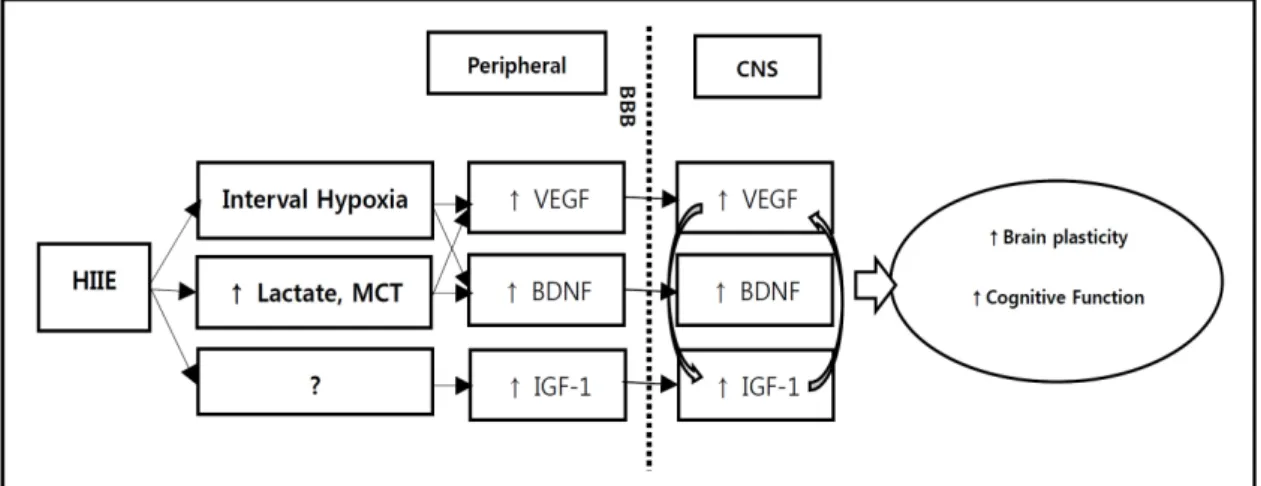
Fig. 1. Putative mechanistic pathways by which high-intensity interval exercise(HIIE) influences brain plasticity and cognitive function via increased central and peripheral growth factor level.
동 대조군에 비해 혈장 IGF-1 수준을 증가시키며 특히, 고강도 운동 후 더욱 큰 증가를 나타냈다는 연구 결과[59]는 단기간의 고강도 유산소 운동으로 체내 IGF-1 수준을 유의하게 증가시 킬 수 있다는 것을 보여준다. 고강도 인터벌 운동 또한 혈청 IGF-1 수준을 증가시키는 것으로 나타났으며, 특히 운동 시작 후 10분이 경과한 시점에서부터 유의하게 증가하는 경향을 보였다[60, 65].
고강도 인터벌 운동을 적용했을 시 운동기간 및 운동량 증 가가 혈중 IGF-1 수준에 어떤 영향을 미치는가에 대한 후속 연구를 통해 고강도 운동에 따른 IGF-1 수준의 변화가 단기적 인 반응인지 아님 지속적으로 효과가 유지되는 장기적인 반응 인지 검증할 필요가 있다고 사료된다.
운동과 VEGF
혈관 내피세포 성장 인자(vascular endothelium growth factor, VEGF)는 혈관내피세포 성장에 관여하여 골격근 모세 혈관의 재생 및 신생을 조절하기 때문에 운동에 의한 혈관조 직 형성(angiogenesis)에서도 중요한 역할을 담당한다[70].
VEGF는 자극에 의해 해마, 골격근, 폐에서 발현이 증가되는 것으로 알려져 있으며[63], 운동 시 말초 골격근 세포 내 VEGF 주머니로부터 유리된 VEGF는 세포 간질액과 모세혈관을 거 쳐[31], 혈액을 통해 이동한 후, 뇌혈관장벽(blood-brain bar- rier: BBB)을 투과함으로써 뇌신경체계로 유입된다[40]. 운동 시 골격근 세포에서 손실된 VEGF는 골격근 세포 내 VEGF mRNA의 동시적 발현 증가로 보충되며[31] 뇌신경체계로 유 입된 VEGF는 IGF-1과 상호작용하여 신경조직 형성(neuro- genesis) 및 혈관조직 형성(angiogenesis)에 관여하는 것으로 알려져 있다[17].
6개월 이상의 저·중강도 유산소 운동으로 증가된 혈중 VEGF 수준은 대뇌 주변 혈관망을 개선시켜 해마와 대뇌의 전두엽 및 측두엽의 부피를 증가시키고[14, 22], 원활한 영양분 공급을
보장하여 해마의 치상회를 포함한 뇌조직으로부터의 BDNF 생성 또한 증가시키게 된다. 결국 증가된 BDNF는 신경세포의 생성 및 활성을 증가시켜 뇌의 인지기능 향상에 긍정적인 영 향을 주는 것으로 보여진다. 선행연구 결과 또한 VEGF 발현에 대한 유산소 운동의 긍정적 효과를 뒷받침 해주고 있다. 우선 동물연구를 살펴보면, 노화된 쥐(21개월령)의 8주간 고강도 유 산소 운동은 해마에서 VEGF mRNA 발현을 증가시키는 경향 을 보였으며[39], 운동 강도간 비교에서 젊은 쥐(5주령)에게 고강도와 저강도 유산소 운동을 일주일 동안 적용했을 때, 고 강도보다 저강도 운동 시 해마에서 더 높은 VEGF mRNA 발 현이 나타났음이 보고되었다[41]. 6주간의 중·고강도 유산소 운동 후 쥐에게 심근경색(Post-myocardial Infarction)을 유발 했을 때, 운동을 시키지 않은 그룹보다 운동을 시킨 두 그룹 모두에서 유의하게 개선된 혈중 VEGF 수준 및 혈관신생이 나타났지만, 운동 강도간 VEGF 발현의 차이는 나타나지 않았 다[63]. 사람을 대상으로 한 선행연구에서는 고강도 유산소 운 동이 VEGF 발현 증가에 효과적임을 보여주고 있다. 일회성 고강도 인터벌 운동 후 혈중 VEGF 수준이 유의하게 증가하는 것으로 나타나고 있으며[71, 72], 심폐지구력 개선이 동반된 6주간의 고강도 사이클 운동은 VEGF 수용체의 mRNA 발현 을 증가시키는 것으로 나타났다[64]. 고강도 인터벌 운동 시 휴식의 형태도 VEGF 발현에 영향을 미치는 것으로 보이는데, 운동 간 수동적 휴식보다 능동적 휴식을 취한 그룹이 일회성 고강도 유산소 인터벌 운동 직후 유의하게 증가된 VEGF 발현 수준을 보여주었다[71]. 따라서, Suzuki와 Breen 등이 제시한 중강도 즉, 최대산소섭취량의 50-60% 수준에서 근육 내 모세 혈관의 밀도를 약 30%까지 증가시키지만[62], 고강도에서는 VEGF 발현이 유도되지 않는다고 한 VEGF 발현의 역치 이론 은 실제와 다소 차이가 있음을 알 수 있다[6, 24, 27].
Hoppeler 등(2001)은 저산소화 상태에서 6주간의 고강도 유산소 트레이닝이 일상적 산소 농도에서의 동일한 트레이닝
보다 VEGF mRNA 발현에 더 효과적이라는 것을 입증했으며, 최근 Tang 등(2010)은 VEGF가 저산소에 반응하는 유전자 (hypoxia-responsive gene)를 지니고 있으며, 따라서 고강도 운동 시 혹은 단기 저산소증(hypoxia; FIO2=0.06) 유도는 뇌에 서의 VEGF 발현을 자극한다고 보고하였다. 따라서 장시간 지 속되는 최대하 운동 혹은 고강도 인터벌 운동 시 유도될 수 있는 저산소증 상태[60]는 뇌신경 조직에서의 VEGF 발현을 촉진시키며, 이는 뇌조직 주변 혈관망 발달, 뇌신경 조직의 성장, 뇌신경성장인자 생성 및 분비를 촉진시키고 그로 인한 뇌신경가소성 및 인지기능 개선에 기여할 것으로 사료된다.
고강도 운동과 젖산 그리고 저산소화
운동은 뇌의 대사 활동을 자극하며, 특히 고강도 운동은 대 뇌 혈류를 더욱 증가시킨다[35]. 고강도 운동은 저·중강도 운 동에 비해 뉴런의 에너지 요구량 뿐만 아니라, 혈중 젖산 농도 또한 증가시키며, 이러한 젖산은 뇌의 대사활동에 매우 중요 한 역할을 수행한다[38]. 젖산은 최대산소섭취량의 60%에 다 다를 때까지 안정시와 비슷한 수준을 유지하다가 그 이후 급 격히 증가한다[23]. 운동 강도가 높아짐에 따라 혈중 젖산 농도 의 증가와 더불어 혈액으로부터 세포질 내부로 젖산을 이동시 키는 MCT (monocarboxylate transporter)의 밀도 또한 증가 된다[36, 49]. 이렇게 증가된 젖산은 뇌신경체계에서 혈중 글루 코스를 보충해주는 2차적인 에너지원의 역할을 하는 것으로 알려지고 있다[35]. 비훈련자와 비교할 때, 훈련자의 근육 내 젖산 수준이 낮은데 그 이유는 젖산이 근세포막에 있는 MCT 를 경유하여 말초 혈액으로 이동한 후 원거리에 있는 다른 세포체로 이동하여 에너지원으로 사용된다는 것을 의미한다 [4, 51]
최근 젖산이 뇌신경세포 기능을 향상시키는 주요 기질로 사용되어[77] 시냅스가소성 관련 유전자(synaptic plasticity- related genes)의 발현을 촉진시킨다는 흥미로운 연구결과가 발표되었다[78]. 고강도 운동 수행 후 증가된 혈중 젖산 농도와 함께 나타나는 혈중 BDNF 수준의 증가는 젖산이 뇌신경성장 인자의 형성에 관련되어 있음을 시사하고 있다[12, 23, 58].
고강도 운동 중 발생하는 저산소화(hypoxia)는 대표적인 뇌 신경성장인자인 BDNF와 VEGF의 발현을 촉진시키는 것으로 알려지고 있다[52, 63, 74]. BDNF는 지속적인 저산소 스트레스 (hypoxic stress) 보다는 간헐적인 저산소 스트레스 상태에서 뇌혈관 내피세포로부터 더 많이 방출(release) 된다[74]. 이는 고강도 운동 중 저산소 상태에 의한 산화 스트레스가 뇌에서 의 BDNF 농도 증가에 잠재적인 영향을 미친 결과로 보여진다 [52]. 최근 간헐적인 저산소화를 유발하는 고강도 인터벌 운동 후, 혈중 및 뇌에서의 BDNF 수준이 증가되었으며[1, 55, 60, 65], 중강도 지속성 운동과 비교했을 때, 고강도 인터벌 운동은 뇌의 BDNF 농도를 더욱 증가시키며, 이는 뇌의 H2O2 및 TNF-
α (tumor necrosis factor-alpha)의 증가와 관련이 있는 것으로 보여진다[1]. BDNF와 유사하게도 VEGF 또한 저산소에 반응 하는 유전자를 지니고 있으며, 저산소 유도는 뇌에서의 VEGF 발현을 자극한다[63]. 일회성 고강도 인터벌 운동 후 혈중 VEGF 수준이 유의하게 증가하는 것으로 나타나고 있으며[71, 72], 고강도 인터벌 운동 시 능동적인 휴식을 취한 그룹의 경우 운동직후 유의하게 증가된 VEGF 발현 수준을 보여주었다 [71]. 이는 고강도 인터벌 운동의 특징인 최대능력을 요하는 고강도 운동을 여러 번의 세션으로 반복 수행하는 것이 신경 성장인자 발현에 긍정적인 영향을 미치는 것으로 보여진다[1].
따라서, 고강도 운동 후 근육에서 생성된 젖산은 혈액을 통 해 순환하여 뇌신경체계의 부가적인 에너지원으로서 뇌 및 신경대사에 중요한 역할을 하며[38], 고강도 인터벌 운동 중에 발생하는 간헐적인 저산소화는 뇌신경성장인자인 BDNF와 VEGF의 발현을 더욱 촉진시킴으로써 그 결과 뇌신경가소성 및 인지기능 개선에 긍정적인 영향을 미칠 수 있을 것으로 생각된다. 하지만, 고강도 인터벌 운동 중에 발생하는 간헐적 인 저산소화 및 운동 직후 증가된 혈중 젖산 수준이 기억 및 인지기능과 어떤 상관관계가 있는지는 아직까지 명확하게 밝 혀지지 않았으며, 젖산의 증가나 저산소화 상태에서의 뇌신경 성장인자(BDNF, VEGF)의 발현 증가에 대한 분자생물학적 기 전 또한 아직까지 밝혀지지 않았으므로, 이와 관련된 후속 연 구가 절실히 필요하다.
결 론
앞서 본문에서 살펴보았듯이, 고강도 인터벌 운동은 뇌에서 의 뇌신경성장인자(BDNF, IGF-1, VEGF)의 이용성을 개선시 키고 그로 인한 인지기능 발달에 기여한다. 고강도 인터벌 운 동 중 발생할 수 있는 일시적이지만 빈번한 뇌의 저산소화 (hypoxia)는 뇌혈관조직 형성에 기여하는 VEGF의 혈중 순환 을 촉진시켜 뇌조직 유지 및 성장에 기여하고, 이는 뇌에서의 BDNF 생성 및 이용을 개선시킬 수 있다. 또한 고강도 인터벌 운동 시 점진적으로 증가하는 혈중 젖산 농도가 혈중 글루코 스와 함께 뇌신경 대사의 부가적인 에너지원이 될 수 있다는 과학적 사실은 고강도 인터벌 운동이 동일한 운동량을 가진 유산소 운동보다 뇌가소성 및 인지기능 개선에 더 효과적일 수 있다는 가능성을 제시하고 있다. 과거 일시적인 심혈관계 의 부담 증가로 운동처방 시 고강도 유산소 운동보다 동일한 운동량을 가진 저·중강도 유산소 운동을 선호하는 경향이 있 었으나 최근의 과학적 증거들은 고강도 인터벌 운동의 우수한 시간 효율성, 안전성, 건강증진 및 생체기능 개선의 효과성을 보고하고 있으며, 최신 미스포츠의학회(ACSM)의 운동지침에 따르면 일반인, 노인, 다양한 대사성 질환자에게 고강도와 중 강도 운동의 복합적인 형태인 고강도 인터벌 운동을 권고하고 있다. 따라서 앞으로 운동기간에 따른 고강도 인터벌 운동의
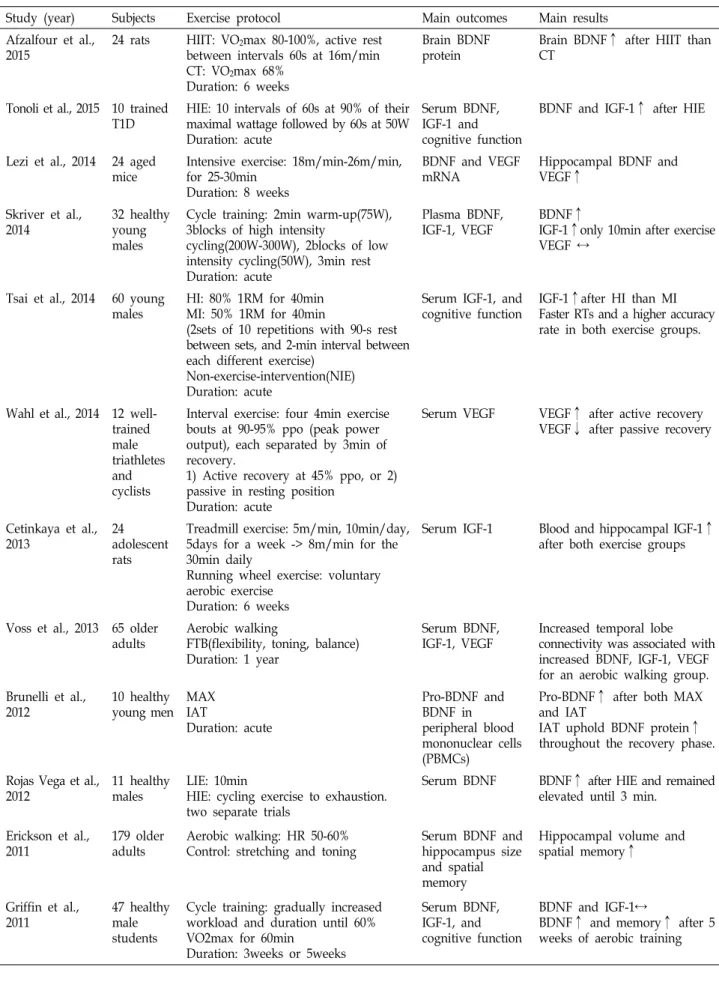
Table 1. Summary of studies on the effects of exercise on BDNF, IGF-1 and VEGF
Study (year) Subjects Exercise protocol Main outcomes Main results
Afzalfour et al., 2015
24 rats HIIT: VO2max 80-100%, active rest between intervals 60s at 16m/min CT: VO2max 68%
Duration: 6 weeks
Brain BDNF protein
Brain BDNF↑ after HIIT than CT
Tonoli et al., 2015 10 trained T1D
HIE: 10 intervals of 60s at 90% of their maximal wattage followed by 60s at 50W Duration: acute
Serum BDNF, IGF-1 and cognitive function
BDNF and IGF-1↑ after HIE
Lezi et al., 2014 24 aged mice
Intensive exercise: 18m/min-26m/min, for 25-30min
Duration: 8 weeks
BDNF and VEGF mRNA
Hippocampal BDNF and VEGF↑
Skriver et al., 2014
32 healthy young males
Cycle training: 2min warm-up(75W), 3blocks of high intensity
cycling(200W-300W), 2blocks of low intensity cycling(50W), 3min rest Duration: acute
Plasma BDNF, IGF-1, VEGF
BDNF↑
IGF-1↑only 10min after exercise VEGF ↔
Tsai et al., 2014 60 young males
HI: 80% 1RM for 40min MI: 50% 1RM for 40min
(2sets of 10 repetitions with 90-s rest between sets, and 2-min interval between each different exercise)
Non-exercise-intervention(NIE) Duration: acute
Serum IGF-1, and cognitive function
IGF-1↑after HI than MI Faster RTs and a higher accuracy rate in both exercise groups.
Wahl et al., 2014 12 well- trained male triathletes and cyclists
Interval exercise: four 4min exercise bouts at 90-95% ppo (peak power output), each separated by 3min of recovery.
1) Active recovery at 45% ppo, or 2) passive in resting position
Duration: acute
Serum VEGF VEGF↑ after active recovery VEGF↓ after passive recovery
Cetinkaya et al., 2013
24 adolescent rats
Treadmill exercise: 5m/min, 10min/day, 5days for a week -> 8m/min for the 30min daily
Running wheel exercise: voluntary aerobic exercise
Duration: 6 weeks
Serum IGF-1 Blood and hippocampal IGF-1↑
after both exercise groups
Voss et al., 2013 65 older adults
Aerobic walking
FTB(flexibility, toning, balance) Duration: 1 year
Serum BDNF, IGF-1, VEGF
Increased temporal lobe connectivity was associated with increased BDNF, IGF-1, VEGF for an aerobic walking group.
Brunelli et al., 2012
10 healthy young men
MAX IAT
Duration: acute
Pro-BDNF and BDNF in peripheral blood mononuclear cells (PBMCs)
Pro-BDNF↑ after both MAX and IAT
IAT uphold BDNF protein↑
throughout the recovery phase.
Rojas Vega et al., 2012
11 healthy males
LIE: 10min
HIE: cycling exercise to exhaustion.
two separate trials
Serum BDNF BDNF↑ after HIE and remained elevated until 3 min.
Erickson et al., 2011
179 older adults
Aerobic walking: HR 50-60%
Control: stretching and toning
Serum BDNF and hippocampus size and spatial memory
Hippocampal volume and spatial memory↑
Griffin et al., 2011
47 healthy male students
Cycle training: gradually increased workload and duration until 60%
VO2max for 60min
Duration: 3weeks or 5weeks
Serum BDNF, IGF-1, and cognitive function
BDNF and IGF-1↔
BDNF↑ and memory↑ after 5 weeks of aerobic training
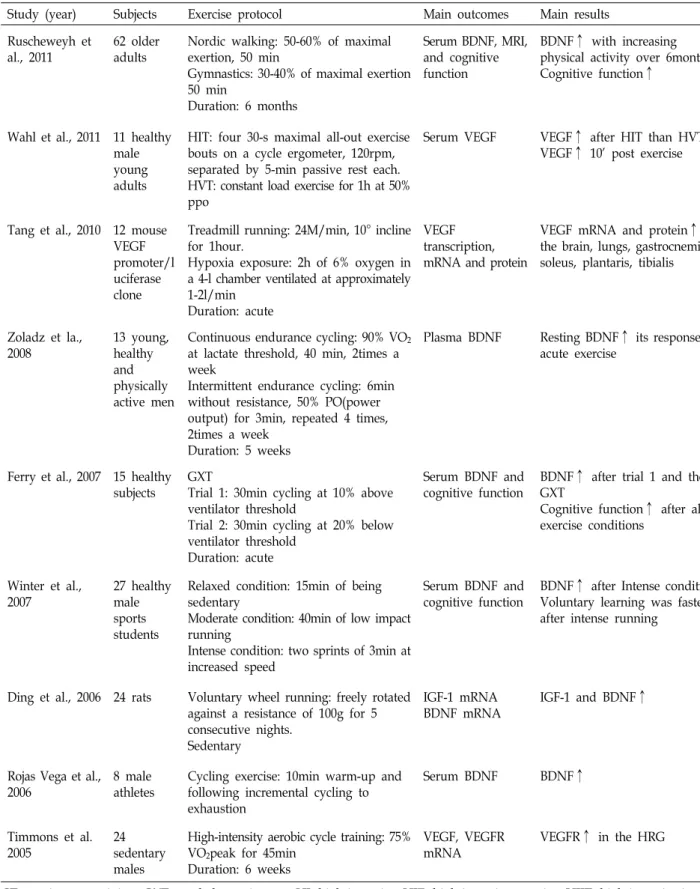
Table 1. Continued
Study (year) Subjects Exercise protocol Main outcomes Main results
Ruscheweyh et al., 2011
62 older adults
Nordic walking: 50-60% of maximal exertion, 50 min
Gymnastics: 30-40% of maximal exertion 50 min
Duration: 6 months
Serum BDNF, MRI, and cognitive function
BDNF↑ with increasing physical activity over 6months.
Cognitive function↑
Wahl et al., 2011 11 healthy male young adults
HIT: four 30-s maximal all-out exercise bouts on a cycle ergometer, 120rpm, separated by 5-min passive rest each.
HVT: constant load exercise for 1h at 50%
ppo
Serum VEGF VEGF↑ after HIT than HVT VEGF↑ 10’ post exercise
Tang et al., 2010 12 mouse VEGF promoter/l uciferase clone
Treadmill running: 24M/min, 10° incline for 1hour.
Hypoxia exposure: 2h of 6% oxygen in a 4-l chamber ventilated at approximately 1-2l/min
Duration: acute
VEGF transcription, mRNA and protein
VEGF mRNA and protein↑ in the brain, lungs, gastrocnemius, soleus, plantaris, tibialis
Zoladz et la., 2008
13 young, healthy and physically active men
Continuous endurance cycling: 90% VO2
at lactate threshold, 40 min, 2times a week
Intermittent endurance cycling: 6min without resistance, 50% PO(power output) for 3min, repeated 4 times, 2times a week
Duration: 5 weeks
Plasma BDNF Resting BDNF↑ its response to acute exercise
Ferry et al., 2007 15 healthy subjects
GXT
Trial 1: 30min cycling at 10% above ventilator threshold
Trial 2: 30min cycling at 20% below ventilator threshold
Duration: acute
Serum BDNF and cognitive function
BDNF↑ after trial 1 and the GXT
Cognitive function↑ after all exercise conditions
Winter et al., 2007
27 healthy male sports students
Relaxed condition: 15min of being sedentary
Moderate condition: 40min of low impact running
Intense condition: two sprints of 3min at increased speed
Serum BDNF and cognitive function
BDNF↑ after Intense condition Voluntary learning was faster after intense running
Ding et al., 2006 24 rats Voluntary wheel running: freely rotated against a resistance of 100g for 5 consecutive nights.
Sedentary
IGF-1 mRNA BDNF mRNA
IGF-1 and BDNF↑
Rojas Vega et al., 2006
8 male athletes
Cycling exercise: 10min warm-up and following incremental cycling to exhaustion
Serum BDNF BDNF↑
Timmons et al.
2005
24 sedentary males
High-intensity aerobic cycle training: 75%
VO2peak for 45min Duration: 6 weeks
VEGF, VEGFR mRNA
VEGFR↑ in the HRG
CT, continuous training; GXT, graded exercise test; HI, high-intensity; HIE, high-intensity exercise; HIIT, high-intensity interval training; HRG, high-responder group: peak rate of oxygen consumption increased; HVT, High-volume endurance training;
IAT, exercised at individual anaerobic threshold; LIE, Low-intensity exercise; MI, Moderate intensity; MIE, moderate intensity exercise; MAX, Cycling incremental test to exhaustion; ↑, increased; ↔, no change.
뇌신경가소성 및 인지기능 개선에 미치는 효과를 밝히는 후속 연구들이 지속적으로 진행되어 충분한 과학적 증거를 제공해 야 할 것이라 사료된다.
References
1. Afzalphuor, M. E., Chadorneshin, H. T., Foadoddini, M. and Eivari, H. A. 2015. Comparing interval and continuous ex- ercise training regimens on neurotrophic factors in rat brain.
Physiol. Behav. 147, 78-83.
2. Barbieri, M., Ferrucci, L., Ragno, E., Corsi, A., Bandinelli, S., Bonafe, M., Olivieri, F., Giovagnetti, S., Franceschi, C., Guralnik, J. M. and Paolisso, G. 2003. Chronic Inflammation and the effect of IGF-1 on muscle strength and power in older persons. Am. J. Physiol. Endocrinol. Metab. 284, E481- E487.
3. Berchtold, N. C., Chinn, G., Chou, M., Kesslak, J. P. and Cotman, C. W. 2005. Exercise primes a molecular memory for brain-derived neurotrophic factor protein induction in the rat hippocampus. Neuroscience 133, 853-861.
4. Bergersen, L. H. 2007. Is lactate food for neurons? Compar- ison of monocarboxylate transporter subtypes in brain and muscle. Neuroscience 145, 11-19.
5. Borst, S. E., De Hoyos, D. V., Garzarella, L., Vincent, K., Pollock, B. H., Lowenthal, D. T. and Pollock, M. L. 2001.
Effects of resistance training on insulin-like growth factor-I and IGF binding proteins. Med. Sci. Sports. Exerc. 33, 648-653.
6. Breen, E. C., Johnson, E. C., Wagner, H. M., Tseng, M., Sung, L. A., and Wagner, P. D. 1996. Angiogenic growth factor mRNA responses in muscle to a single bout of exercise. J.
Appl. Physiol. 81, 355-361.
7. Brunelli, A., Dimauro, I., Sgro, P., Emerenziani, G. P., Magi, F., Baldari, C., Guidetti, L., Luigi, L. D., Parisi, P. and Capor- ossi, D. 2012. Acute exercise modulates BDNF and pro- BDNF protein content in immune cells. Med. Sci. Sports Exerc. 44, 1871-1880.
8. Cappon, J., Brasel, J. A., Mohan, S. and Cooper, D. M. 1994.
Effect of brief exercise on circulating insulin-like growth fac- tor I. J. Appl. Physiol. 76, 2490-2496.
9. Carro, E., Nunez, A., Busiguina, S. and Torres-Aleman, I.
2000. Circulating insulin-like growth factor I mediates ef- fects of exercise on the brain. J. Neurosci. 20, 2926-2933.
10. Cassiman, D., Denef, C., Desmet, V. J. and Roskams, T. 2001.
Human and rat hepatic stellate cells express neurotrophins and neurotrophin receptors. Hepatology 33, 148-158.
11. Cetinkaya, C., Sisman, A. R., Kiray, M., Camsari, U. M., Gencoglu, C., Baykara, B., Aksu, I. and Uysal, N. 2013.
Positive effects of aerobic exercise on learning and memory functioning, which correlate with hippocampal IGF-1 in- crease in adolescent rats. Neurosci. Lett. 549, 177-181.
12. Coco, M., Alagona, G., Rapisarda, G., Costanzo, E., Calogero, R. A. and Perciavalle, V. 2010. Elevated blood lactate is asso- ciated with increased motor cortex excitability. Somatosens Mot. Res. 27, 1-8.
13. Colcombe, S. and Kramer, A. F. 2003. Fitness effects on the
cognitive function of older adults: a meta-analytic study.
Psychol. Sci. 14, 125-130.
14. Colcombe, S. J., Erickson, K. I., Scalf, P. E., and Kim, J. S., Prakash, R., McAuley, E., Elavsky, S., Marquez, D. X., Hu, L. and Kramer, A. F. 2006. Aerobic exercise training in- creases brain volume in aging humans. J. Gerontol. A. Biol.
Sci. Med. Sci. 61, 1166-1170.
15. Colier, W. N., Quaresima, V., Oeseburg, B. and Ferrari, M.
1999. Human motor-cortex oxygenation changes induced by cyclic coupled movements of hand and foot. Exp. Brain. Res.
129, 457-461.
16. Cotman, C. W. and Berchtold, N. C. 2002. Exercise: a behav- ioral intervention to enhance brain health and plasticity.
Trend. Neurosci. 25, 295-301.
17. Cotman, C. W., Berchtold, N. C. and Christie, L. A. 2007.
Exercise builds brain health: key roles of growth factor cas- cades and inflammation. Trends Neurosci. 30, 464-472.
18. Dery, N., Pilgrim, M., Gibala, M., Gillen, J. and Wojtowicz, J. M. 2013. Adult hippocampal neurogenesis reduces memo- ry interference in humans: opposing effects of aerobic ex- ercise and depression. Front. Neurosci. 7, 66.
19. DeVol, D. L., Rotwein, P., Sadow, J. L., Novakofski, J. and Bechtel, P. J. 1990. Activation of insulin-like growth factor gene expression during work-induced skeletal muscle growth. Am. J. Physiol. 259, E89-E95.
20. Ding, Q., Vaynman, S., Akhavan, M., Ying, Z. and Gomez-Pinilla, F. 2006. Insulin-like growth factor I interfaces with brain-derived neurotrophic factor-mediated synaptic plasticity to modulate aspects of exercise-induced cognitive function. Neuroscience 140, 823-833.
21. Erickson, K. I. and Kramer, A. F. 2009. Aerobic exercise ef- fects on cognitive and neural plasticity in older adults. Br.
J. Sports Med. 43, 22-24.
22. Erickson, K. I., Voss, M. W., Prakash, R. S., Basak, C., Szabo, A., Chaddock, L., Kim, J. S., Heo, S., Alves, H., White, S.
M., Wojcicki, T. R., Mailey, E., Vieira, V. J., Martin, S. A., Pence, B. D., Woods, J. A., McAuley, E. and Kramer, A. F.
2011. Exercise training increases size of hippocampus and improves memory. Proc. Natl. Acad. Sci. USA 108, 3017- 3022.
23. Ferris, L. T., Williams, J. S. and Shen, C. L. 2007. The effect of acute exercise on serum brain-derived neurotrophic factor levels and cognitive function. Med. Sci. Sports Exerc. 39, 728- 734.
24. Gavin, T. P. and Wager, P. D. 2001. Effect of short-term ex- ercise training on angiogenic growth factor gene responses in rats. J. Appl. Physiol. 90, 1219-1226.
25. Greer, B. K., Sirithienthad, P., Moffatt, R. J., Marcello, R.
T. and Panton, L. B. 2015. EPOC comparison between iso- caloric bouts of steady-state aerobic, intermittent aerobic, and resistance training. Res. Q. Exerc. Sport. 86, 190-195.
26. Gregory, S. M., Spiering B. A., Alemany, J. A., Tuckow, A.
P., Rarick, K. R., Staab, J. S., Hatfield, D. L., Kraemer, W.
J., Maresh, C. M. and Nindl, B. C. 2013. Exercise-induced insulin-like growth factor I system concentrations after training in women. Med. Sci. Sports Exerc. 45, 420-428.
27. Griffin, E. W., Mullally, S., Foley, C., Warmington, S. A., O’Mara, S. M. and Kelly, A. M. 2011. Aerobic exercise im- proves hippocampal function and increases BDNF in the se- rum of young adult males. Physiol. Behav. 104. 934-941.
28. Gustafsson, T., Adrian, P., Lennart, K., Eva, J. and Carl, J.
S. 1999. Exercise-induced expression of angiogenesis-related transcription and growth factors in human skeletal muscle.
Am. J. Physiol. 276, H679-H685.
29. Haskell, W. L., Lee, I. M., Rate, R. R., Powell, K. E., Blair, S. N., Franklin, B. A., Macera, C. A., Heath, G. W., Thompson, P. D. and Bauman, A. 2007. Physical activity and public health: updated recommendation for adults from American College of Sports Medicine and the American Heart Association. Med. Sci. Sports Exerc. 39, 1423-1434.
30. Hofer, M. M. and Barde, Y. A. 1988. Brain-derived neuro- trophic factor prevents neuronal death in vivo. Nature 331, 261-262.
31. Hoier, B. and Hellsten, Y. 2014. Exercise-induced capillary growth in human skeletal muscle and the dynamics of VEGF. Microcirculation 21, 301-314.
32. Hoppeler, H. and Vogt, M. 2001. Hypoxia training for sea-level performance. Training high-living low. Adv. Exp.
Med. Biol. 502, 61-73.
33. Hotting, K. and Roder, B. 2013. Beneficial effects of physical exercise on neuroplasticity and cognition. Neurosci. Biobehav.
Rev. 37, 2243-2257.
34. Huang, T., Larsen, K. T., Ried-Larsen, M., Moller, N. C. and Andersen, L. B. 2014. The effects of physical activity and exercise on brain-derived neurotrophic factor in healthy hu- mans: A review. Scand. J. Med. Sci. Sports 24, 1-10.
35. Ide, K., Horn, A. and Secher, N. H. 1999. Cerebral metabolic response to submaximal exercise. J. Appl. Physiol. 87, 1604- 1608.
36. Juel, C., Klarskov, C., Nielsen, J. J., Krustrup, P., Mohr, M.
and Bangsbo, J. 2003. Effect of high-intensity intermittent training on lactate and H+ release from human skeletal muscle. Am. J. Physiol. Endocrinol. Metab. 286, E245-E251.
37. Kramer, A. F., Hahn, S., Cohen, N. J., Banich, M. T., McAuley, E., Harrison, C. R., Chason, J., Vakil, E., Bardell, L., Boileau, R. A. and Colcombe, A. 1999. Ageing, fitness and neuro- cognitive function. Nature 400, 418-419.
38. Larrebee, M. G. 1995. Lactate metabolism and its effects on glucose metabolism in an exercised neural tissue. J.
Neurochem. 64, 1734-1741.
39. Lezi, E., Burns, J. M. and Swerdlow, R. H. 2014. Effect of high-intensity exercise on aged mouse brain mitochondria, neurogenesis, and inflammation. Neurobiol. Aging. 35, 2574- 2583.
40. Lopez-Lopez, C., LeRoith, D. and Torres-Aleman, I. 2004.
Insulin-like growth factor I is required for vessel remodeling in the adult brain. Proc. Natl. Acad. Sci. USA 101, 9833-9838.
41. Lou, S. J., Liu, J. Y., Chang, H. and Chen, P. J. 2008. Hippo- campal neurogenesis and gene expression depend on ex- ercise intensity in juvenile rats. Brain Res. 1210, 48-55.
42. Maren, S. K., Sarah, S., Sascha, O., Christian, T., Alexandra, D., Jorn, L. and Jochen, K. 2012. Kinetics of serum brain-de-
rived neurotrophic factor following low-intensity versus high-intensity exercise in men and women. Neuroreport 23, 889-893.
43. Monteggia, L. M., Barrot, M., Powell, C. M., Berton, O., Galanis, V., Gemelli, T., Meuth, S., Nagy, A., Greene, R. W.
and Nestler, E. J. 2004. Essential role of brain-derived neuro- trophic factor in adult hippocampal function. Proc. Natl.
Acad. Sci. USA 101, 10827-10832.
44. Neeper, S. A., Gomez-Pinilla, F., Choi, J. and Cotman, C.
1995. Exercise and brain neurotrophins. Nature 373, 109.
45. Pareja-Galeano, H., Brioche, T., Sanchis-Gomar, F., Montal, A., Jovani, C., Martinez-Costa, C., Gomez-Cabrera, M. C.
and Vina, J. 2013. Impact of exercise training on neuro- plasticity-related growth factors in adolescents. J. Musculos- kelet. Neuronal Interact. 13, 368-371.
46. Paul, D. L., Skyla. M. H., Bradley. J. C. and Timothy, D.
N. 2013. Physical activity and the brain: A review of this dynamic, bi-directional relationship. Brain Res. 1539, 95-104.
47. Pereira, A. C., Huddleston, D. E., Brickman, A. M., Sosnuov, A. A., Hen, R., McKhann, G. M., Sloan, R., Gage, F. H., Brown, T. R. and Small, S. A. 2007. An in vivo correlate of exercise-induced neurogenesis in the adult dentate gyrus.
Proc. Natl. Acad. Sci. USA 104, 5638-5643.
48. Phillips, C., Baktir, M. A., Srivatsan, M. and Salehi, A. 2014.
Neuroprotective effects of physical activity on the brain: a closer look at trophic factor signaling. Fornt. Cell Neurosci.
170, 1-15.
49. Pilegaard, H., Domino, K., Noland, T., Juel, C., Hellsten, Y., Halestrap, A. P. and Bangsbo, J. 1999. Effect of high-in- tensity exercise training on lactate/H+ transport capacity in human skeletal muscle. Am. J. Physiol. 276, E255-261.
50. Poo, M. M. 2001. Neurotrophins as synaptic modulators.
Nat. Rev. Neurosci. 2, 24-32.
51. Quistorff, B., Secher, N. H. and van Leishout, J. J. 2008.
Lactate fuels the human brain during exercise. FASEB J. 22, 3443-3449.
52. Rasmussen, P., Brassard, P., Adser, H., Pedersen, M. V., Leick, L., Hart, E., Secher, N. H., Pedersen, B. K. and Pilegaard, H. 2009. Evidence for a release of brain-derived neurotrophic factor from the brain during exercise. Exp.
Physiol. 94, 1062-1069.
53. Rasmussen, P., Wyss, M. T. and Lundby, C. 2011. Cerebral glucose and lactate consumption during cerebral activation by physical activity in humans. FASEB J. 25, 2865-2873.
54. Ratey, J. J. and Loehr, J. E. 2011. The positive impact of physical activity on cognition during adulthood: a review of underlying mechanisms, evidence and recommendations.
Rev. Neurosci. 22, 171-185.
55. RojasVega, S., Struder, H. K., Vera Wahrmann, B., Schmidt, A., Bloch, W. and Hollmann, W. 2006. Acute BDNF and cortisol response to low intensity exercise and following ramp incremental exercise to exhaustion in humans. Brain Res. 1121, 59-65.
56. Rooks, C. R., Thom. N. J., McCully, K. K. and Dishman, R. K. 2010. Effects of incremental exercise on cerebral oxy- genation measured by near-infared spectroscopy: A system-
atic review. Prog. Neurobiol. 92, 134-150
57. Ruscheweyh, R., Willemer, C., Kruger, K., Duning, T., Warnecke, T., Sommer, J., Volker K., Ho, H. W., Mooren, F., Knecht, S. and Floel, A. 2011. Physical activity and mem- ory functions: and interventional study. Neurociol. Aging 32, 1304-1319.
58. Schiffer, T., Schulte, S., Sperlich, B., Achtzehn, S., Fricke, H.
and Struder, H. K. 2011. Lactate infusion at rest increases BDNF blood concentration in humans. Neurosci. Lett. 488, 234-237.
59. Schwartz, A. J., Brasel, J. A., Hintz, R. L., Mohan, S. and Cooper, D. M. 1996. Effect of brief low- and high-intensity exercise on circulating insulin-like growth factor (IGF) I, II, and IGF-binding protein-3 and its proteolysis in young healthy men. J. Clin. Endocrinol. Metab. 81, 3492-3497.
60. Skriver, K., Roig, M., Lundbye-Jensen, J., Pingel, J., Helge, J. W., Kiens, B. and Nielsen, J. B. 2014. Acute exercise im- proves motor memory: Exploring potential biomarkers.
Neurobiol. Learn. Mem. 116, 46-58.
61. Sonntag, W. E., Ramsey, M. and Carter, C. S. 2005. Growth hormone and insulin-like growth factor-1 (IGF-1) and their influence on cognitive aging. Ageing Res. Rev. 4, 195-212.
62. Suzuki, J., Gai, M., Batra, S. and MUsch, T. 1997. Effects of treadmill training on the arteriolar and venular portions of capillary in soleus muscle of young and middle-aged rats.
Acta. Physiol. Scand. 159, 113-121.
63. Tang, K., Xia, F. C., Wagner, P. D. and Breen, E. C. 2010.
Exercise-induced VEGF transcriptional activation in brain, lung and skeletal muscle. Respir. Physiol. Neurobiol. 170, 16-22.
64. Timmons, J. A., Jansson, E., Fischer, H., Gustafsson, T., Greenhaff, P. L., Ridden, J., Rachman, J. and Sundberg, C.
J. 2005. Modulation of extracellular matrix genes reflects the magnitude of physiological adaptation to aerobic exercise training in humans. BMC Biol. 3, 19.
65. Tonoli, C., Heyman, E., Buyse, L., Roelands, B., Piacentini, M. F., Bailey, S., Pattyn, N., Berthoin, S. and Meeusen, R.
2015. Neurotrophins and cognitive functions in T1D com- pared with healthy controls: effects of a high intensity exercise. Appl. Physiol. Nutr. Metab. 40, 20-27.
66. Trejo, J. L., Carro, E. and Torres-Aleman, I. 2001, Circulating insulin-like growth factor I mediates exercise-induced in- creases in the number of new neurons in the adult hippocampus. J. Neurosci. 21, 1628-1634.
67. Tsai, C. L., Wang, C. H., Pan, C. Y., Chen, F. C., Huang, T. H. and Chou, F. Y. 2014. Executive function and endo- crinological responses to acute resistance exercise. Front.
Behav. Neurosci. 8, 262.
68. Vayman, S., Ying, Z. and Gomez-Pinilla, F. 2004. Hippocam- pal BDNF mediates the efficacy of exercise on synaptic plas- ticity and cognition. Eur. J. Neurosci. 20, 2580-2590.
69. Voss, M. W., Erickson, K. I., Prakash, R. S., Chaddock, L.,
Kim, J. S., Alves, H., Szabo, A., Phillips, S. M., Wojcicki, T. R., Mailey, E. L., Olson, E. A., Gothe, N., Vieira-Potter, V. J., Martin, S. A., Pence, B. C., Cook, M. D., Woods, J.
A., McAuley, E. and Kramer, A. F. 2013. Neurobiologycal markers of exercise-related brain plasticity in older adults.
Brain Behav. Immun. 28, 90-99.
70. Wagner P. D., Olfert, I. M., Tang, K. and Breen, E. C. 2006.
Muscle-targeted deletion of VEGF and exercise capacity in mice. Respir. Physiol. Neurobiol. 151, 159-166.
71. Wahl, P., Mathes, S., Achtzehn, S., Bloch, W. and Mester, J. 2014. Active vs. passive recovery during high-intensity training influences hormonal response. Int. J. Sport Med. 35, 583-589.
72. Wahl, P., Zinner, C., Achtzehn, S., Behringer, M., Bloch, W.
and Mester, J. 2011. Effects of acid-base balance and high or low intensity exercise on VEGF and bFGF. Eur. J. Appl.
Physiol. 111, 1405-1413.
73. Wahl, P., Zinner, C., Achtzehn, S., Bloch, W. and Mester, J. 2010. Effect of high- and low-intensity exercise and meta- bolic acidosis on levels of GH, IGF-I, IGFBP-3 and cortisol.
Growth Horm. IGF Res. 5, 380-385.
74. Wang, H., Ward, N., Boswell, M. and Katz, D. M. 2006.
Secretion of brain-derived neurotrophic factor from brain microvascular endothelial cells. Eur. J. Neurosci. 23, 1665- 1670.
75. Whiteman, A. S., Young, D. E., He, X., Chen, T. C. and Wagenaar, R. C. 2014. Interaction between serum BDNF and aerobic fitness predicts recognition memory in healthy young adults. Behav. Brain Res. 259, 302-312.
76. Winter, B., Breitenstein, C., Mooren, F. C., Voelker, K., Fobker, M., Lechtermann, A., Krueger, K., Fromme, A., Korsukewitz, C., Floel, A. and Knecht, S. 2007. High impact running improves learning. Neurobiol. Learn Mem. 87, 597- 609.
77. Wyss, M. T., Jolivet, R., Buck, A., Magistretti, P. J. and Weber, B. 2011. In vivo evidence for lactate as a neuronal energy source. J. Neurosci. 31, 7477-7485.
78. Yang, J., Ruchti, E., Petit, J. M., Jourdain, P., Grenningloh, G., Allaman, I. and Magistretti, P. J. 2014. Lactate promotes plasticity gene expression by potentiating NMDA signaling in neurons. Proc. Natl. Acad. Sci. 111, 12228-12233.
79. Zanconato, S., Moromisato, D. Y., Moromisato, M. Y., Woods, J., Brasel, J. A., Leroith, D., Roberts, C. T. and Cooper, C. M. 1994. Effect of training and growth hormone suppression on insulin-like growth factor I mRNA in young rats. J. Appl. Physiol. 76, 2204-2209.
80. Zoladz, J. A., Pilic, A., Majerczak, J., Grandys, M., Zapart- Bukowska, J. and Duda, K. 2008. Endurance training in- creases plasma brain-derived neurotrophic factor concen- tration in young healthy men. J. Physiol. Pharmacol. 59, 119-132.
초록:운동과 뇌신경가소성: 고강도 인터벌 운동의 효과성 고찰
황지선1․김태영1․황문현2․이원준1*
(1이화여자대학교 체육과학과, 2인천대학교 운동건강학부)
운동은 중추와 말초의 각종 성장인자(BDNF, IGF-1, VEGF)들의 상호작용에 의해 뇌신경가소성을 증진시키고 인지기능을 향상시킨다. 지금까지 저·중강도 지속성 유산소 운동의 효과를 검증하는 선행연구가 주로 이루어졌기 때문에 고강도 운동에 따른 뇌신경성장인자의 발현 및 인지기능 개선 효과에 대한 연구는 미흡한 실정이다. 하지 만 최근의 과학적 증거들은 고강도 인터벌 운동이 시간 효율성, 안전성, 심폐지구력 개선 및 체중 감소에 효과적 임을 암시하고 있으며, 미스포츠의학회(ACSM)에서 권장하는 일반인을 위한 운동지침에서도 무리가 되지 않는 수준에서 고강도 인터벌 운동 수행을 강조하고 있다. 특히 최근에 발표된 선행 연구에서 고강도 인터벌 운동은 말초조직과 뇌에서의 BDNF, IGF-1, VEGF의 발현을 증가시키고 그로 인한 인지기능 발달에 기여한다는 것을 보 고하였으며, 관련된 유력한 생리학적 기전으로 고강도 인터벌 운동으로 인한 뇌의 저산소화와 뇌신경대사의 부가 적인 에너지원이 될 수 있는 젖산 이용성 증가가 대두되고 있다. 따라서 향후 저산소화 및 젖산 이용성 증가에 따른 뇌신경성장인자 발현 개선에 어떤 분자생물학적 기전이 관여하는지를 탐구할 필요가 있으며, 또한 동일한 운동량을 가진 저·중강도 지속성 유산소 운동과의 비교 연구를 통해 뇌신경성장인자의 발현 및 인지기능 개선에 있어 고강도 인터벌 운동의 우수성을 입증하는 연구가 요구된다.