The Effects of Aerobic Exercise Training on Blood Lipid Profiles, Fibrinolytic Activities, and Nitric Oxide Levels in High-fat-diet induced Rats
Won-Mok Son1, Do-Yeon Kim1, Ki-Dong Sung1, Yi-Sub Kwak2, Yeong-Ho Baek1 and Song-Young Park3*
1Department of Physical Education, Pusan National University, Busan 609-735, Korea
2Department of physical education, Dong-Eui University, Busan 614-714, Korea
3School of Medicine, Boston University, Boston, USA
Received October 14, 2015 /Revised November 6, 2015 /Accepted November 18, 2015
Although exercise training has been utilized to improve vascular function in animals and humans, the impact of moderate intensity exercise training on fibrinolytic activities and nitric oxide (NO) bioavail- ability has not been well documented. Therefore, the purpose of the current study was to examine the impact of moderate intensity aerobic exercise training on fat mass, blood lipid profiles, fibrinolytic activity, and NO levels in high-fat-diet induced rats. The body weight, fat mass, blood lipid profiles, fibrinolytic activity, and nitrite/nitrate were measured pre- and postexercise (10 weeks) training. The body weight and fat mass reduced significantly in the exercise (EX) group compared to the control (CON) group. Blood lipid profiles and low-density lipoprotein were unchanged in the EX group com- pared to the CON group. However, triglyceride and free fatty acid were significantly lower in the EX group compared to the CON group, and high-density lipoprotein was significantly greater in the EX group compared to the CON group. In addition, fibrinolytic activity and nitrite/nitrate were sig- nificantly greater in the EX compared to the CON group. These results suggest that 10 weeks of the moderated intensity aerobic exercise training improves blood lipid profiles, fibrinolytic activity, and the nitrite/nitrate ratio, which may improve vascular health and reduce obesity-related cardiovascular disease risks in high-fat- diet induced rats.
Key words : Blood lipid profiles, fat mass, fibrinolytic activity, nitric oxide
*Corresponding author
Tel : +82-10-2886-6819, Fax : +82-51-515-1991 E-mail : [email protected]
This is an Open-Access article distributed under the terms of the Creative Commons Attribution Non-Commercial License (http://creativecommons.org/licenses/by-nc/3.0) which permits unrestricted non-commercial use, distribution, and reproduction in any medium, provided the original work is properly cited.
Journal of Life Science 2015 Vol. 25. No. 12. 1432~1438 DOI : http://dx.doi.org/10.5352/JLS.2015.25.12.1432
Introduction
Obesity has been known as a high risk factor of car- diovascular disease [27], and defined as disorder of energy imbalance which is highly dependent upon variations in both dietary energy intake and energy expenditure [3].
Research suggested that obesity is the major risk factor of metabolic syndrome such as the diabetes, hypertension and dyslipidemia and coronary arterial diseases [12].
A person with obesity has elevated total cholesterol (TC), triglyceride (TG), and low density lipoprotein cholesterol (LDL-C) but lower high density lipoprotein cholesterol (HDL- C) [35] and these altered lipid profiles are associated with increased risks of thrombosis and cardiovascular disease [18].
In human body, blood coagulation and anticoagulation is relatively well balanced but in general anticoagulation suppresses coagulation for normal circulation of blood [38].
However, damage on the endothelial layer in the blood ves- sels which is mainly derived from increased triglyceride and fibrinogen level results from high fat diet, stress, lack of ex- ercise may cause a formation of thrombosis [47].
Endothelial dysfunction is a common phenomenon in obese individuals which is characterized by an imbalance between Nitric Oxide (NO) and Endothelin-1 (ET-1) [10, 15, 44].
NO is soluble gas has half-life of 3~6 sec, and consistently synthesized by a series of reaction in L-arginine, and NO synthase (NOS) dependent enzyme calcium–calmodulinein endothelial cell. Vascular endothelial cell plays an important role in the regulation of vascular function, specifically, endo- thelial mediated vasodilation by producing vasoactive sub- stances NO [36].
Exercise has been known as a non-pharmacological meth- od for reducing and preventing cardiovascular risk factors.
Additionally, regular exercise has positive effects on improv- ing blood lipid profile and cardiovascular health [23, 33].
Table 1. Physical characteristics of experimental rats
Group Age
(weeks)
Body weight(g)
4 weeks 10 weeks 14 weeks
A(n=8) 14 79.06
±5.86
265.25
±33.14
302.04
±44.67
B(n=8) 14 78.81
±5.71
263.13
±19.51
312.14
±28.38 Values are M±SD
A: exercise group, B: control group
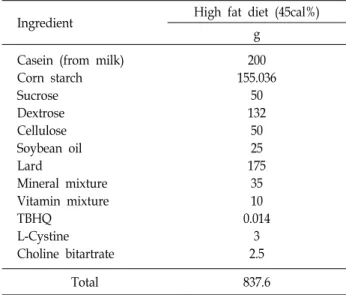
Table 2. Composition of the high fat diet
Ingredient High fat diet (45cal%)
g Casein (from milk)
Corn starch Sucrose Dextrose Cellulose Soybean oil Lard
Mineral mixture Vitamin mixture TBHQ
L-Cystine Choline bitartrate
200 155.036
50 132 50 25 175 35 10 0.014
3 2.5
Total 837.6
Furthermore, it has been well documented that regular prac- tices of planned exercise improves blood lipid profiles [43], fibrinolytic activities [42], and nitric oxide level [31].
Although the impact of exercise on blood lipid profiles has been studies in last decade, there are only limited data are available for the effect of aerobic exercise on fibrinolytic activities and nitric oxide production. Therefore, the purpose of this study is to investigate the effects of aerobic exercise on blood fibrinolytic activities, nitric oxide levels and blood lipid profiles in rats.
Materials and Methods
Animals
All experiments were performed in accordance with pro- tocols approved by the Institutional Animal Care and Use Committee (IACUC) of the Pusan national University (PNU- 2012-0082). Sixteen male Sprague Dawley at 3 weeks of age were purchased from Hyochang Science Co, Daegu, Korea.
Rats were housed at 22°C with a 12 hr light, 12 hr dark cycle. Rats were separated into two groups: control group (n=8) and exercise group (n=8). (Table 1). The animals were fed either standard diet or high fat diet for 10 weeks.
Aerobic training
Four week old rats were performed aerobic training as described previously [7]. Briefly, exercise group performed an exercise intensity at 55% of VO2max (14-15m/min) for 30min for the first week. For week 2 and 3, an exercise in- tensity at 50-60% of VO2max (15-16m/min) for 35min was utilized. In the week 4, a exercise intensity at 50-60% of VO2max (16-17m/min) for 40min was performed. Control group was on the treadmill with only noise and shakes to mimic the same condition of the exercise group.
Fat weight
Fat mass was measured using epididymal fat after dis-
sected and cleansed in the phosphate buffered saline (PBS).
Blood lipid profile
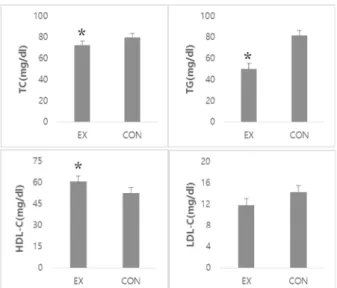
TC, TG, HDL-C and LDL-C were measured using spec- trophotometric methods with chemistry analyzer (TBA- 80FR, Toshiba, Japan).
Fibrinolytic activity
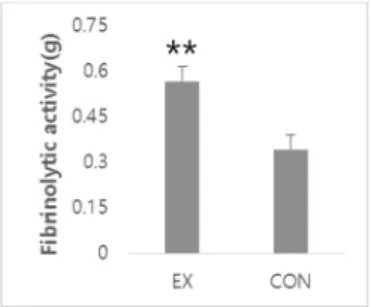
Fibrinolytic activity was determined using the fibrin plate method [4]. Briefly, in the petri dish, 10 ml of 0.6% plasmi- nogen-rich fibrinogen (Sigma, St. Louis, MO, USA) solution in 10 mM phosphate buffered saline (pH 7.8) was mixed with an equal volume of 2% agarose solution and 0.1 ml of thrombin solution (100 NIH units/ml; Sigma). The petri dish was left to stand at room temperature for 30 min to allow a fibrin clot layer to be formed. 50 ul of ME of oil was dropped into a hole on the plate that was made with a Pasteur pipette. The plate was incubated at 37℃ for 24 hr. Fibrinolytic activity of sample was calculated based on the plasmin activity. The size of the clear zone formed by the sample was compared with the area created by 0.5 U/ml of plasmin. The activity was expressed as gram.
Nitric oxide
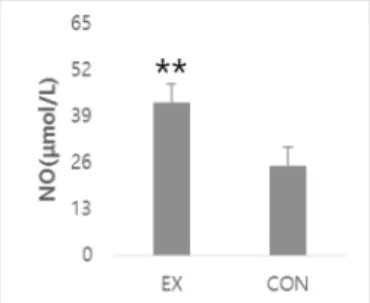
NO has an extremely short half-life and is rapidly oxi- dized to nitrite and nitrate in the presence of oxygen. Hence, one of the most common methods used to assess NO pro- duction is to measure total nitrite/nitrate concentration us- ing griess reagent. In the present study, we utilized a griess assay kit from Cayman Chemical (Ann Arbor, MI, USA).
Fig. 1. Change in fat weight after 4 weeks treadmill exercise. Fig. 2. Change in blood profile after 4 weeks treadmill exercise.
Sodium nitroprusside (SNP) was utilized as a NO donor.
Samples containing SNP (200 μM) and various concen- trations of MHY-794 were loaded into the wells of a 96-well transparent microplate. After adding the enzyme cofactor mixture and nitrate reductase mixture, the plate was in- cubated at room temperature for 1 hr, and then 50 μl of a 1% solution of sulfanilamide in 5% phosphoric acid and 50 μl of a 0.1% solution of N-(1-napthyl) ethylene-diamine in H2O were added to each well. The amount of nitrite/ni- trate produced in the reaction mixture was determined spec- trophotometrically at 540 nm (OD540) using a microplate reader [14].
Data analysis
Data are presented as mean ± SD. Statistical analyses were performed with independent t-test by SPSS 20.0 version soft- ware (SPSS Science, Chicago, IL, USA) analysis. Data (mean±
SD) was considered statistically significant at a value of p<0.05.
Results and Discussion
Fat weight
Fat weight was lower in exercise group compared to con- trol group (p<0.01; Fig. 1).
Obesity is defined as a pre-disease condition which results from excessive body fat accumulation due to the energy in- take that exceeds the energy requirement of the body, and it is a critical risk factor for various diseases. A large quantity of fat accumulation which refers to the increased number and size of adipocytes. Additionally, this increased size of adipocytes may cause dysfunction of adipocytes such as over production of inflammatory cytokines and adipokines [32]. However, aerobic exercise training reduces expression of genes related to lipogenesis, thus inhibiting lipid accumu- lation in tissues [8].
Previous studies suggested that obesity-induced rats were
subjected to treadmill running, 30 min/day, 5 times a week, for 8 weeks, and the fat mass were decreased significantly [45]. In the present study, we could not measure the size of adipose tissues but EX had significantly lower fat mass than that of the control group; this maybe the consequence of the increased energy expenditure which results from the increased physical activity by the aerobic exercise training.
Blood lipid profile
TC and TG were lower in exercise group compared to control group (p<0.05). However, HDL-C was greater in ex- ercise group compared to control group (p<0.05; Fig. 2).
Obesity is accompanied with elevation of body fat, TG, and LDL-C, and reduction of lean mass and HDL-C, result- ing in artery diseases, including atherosclerosis and hyper- lipidemia [9, 15]. However, it was reported that medium in- tensity aerobic exercise regulates lipid metabolism by re- ducing levels of plasma triglycerides and free fatty acids and increasing HDL-C levels, thus having a preventative effect against cardiovascular disease [2, 40].
TC is a useful indicator for cardiovascular diseases be- cause it exists in all cells and helps in maintaining cholester- ol homeostasis [1]. Previous studies reported that obesity-in- duced rats were subjected to treadmill exercises 60 min per day, speed at 8-15 m/min, 5 times a week, for 6 weeks, fat mass significantly lower [34]. These previous studies are well aligned with our findings, the exercise group had sig- nificantly lower TC than that of the control group; which is considered to be due to the increased catabolism of choles- terol in the body by exercise training.
Fig. 3. Change in fibrinolytic activity after 4 weeks treadmill exercise.
Although TG is mostly affected by diets, exercise training reduces it by 20-60% [41]. Previous studies reported that obe- sity-induced rats were trained for treadmill exercises 60 min per day, speed at 5-15 m/min, 6 times a week, for 6 weeks and TG significantly lower [29]. Our findings further confirm the previous findings, the EX had significantly lower TG than that of the control group. This finding can be explained by increased lipolysis during exercise. Additionally, we uti- lized moderate exercise intensity which has been known as a useful exercise intensity to increase lipolysis but does not occur any adverse effects on cardiovascular system [13].
HDL-C has been known as a good cholesterol which in- hibits accumulation of body cholesterol and removes choles- terol buildup in arteries. Additionally, it is considered as a preventive factor for atherosclerotic disease or an anti-cho- lesterol factor [21]. Previous studies reported that SD rats were subjected to treadmill exercises 25~30 min/day, 5 times a week, for 2 weeks, HDL-C significantly higher [6] and Similar to these previous studies, the present study found that the EX had significantly higher HDL-C than that of the control group. This finding can be explained by increased lipoprotein lipase activity (LPLA) in the plasma activated by aerobic exercise, increasing the conversion ratio from cho- lesterol to chylomicron, and from VLDL and LDL to HDL;
furthermore, total and hepatic triglyceride lipase activity (HTGLA) increased by exercise which reduces catabolism of HDL [16].
Increased LDL-C has been known as a risk factor for hy- perlipidemia and atherosclerosis. Also, LDL-C is a trans- porter for cholesterol to peripheral tissues [5]. Many studies suggested that moderate exercise intensity training reduces LDL-C level in the blood [19]. Interestingly, the present study identified that LDL-C was not significantly difference between EX and CON which can be supported by Lee et al [30] which suggested that the moderate intensity of aero- bic exercise may positively affect LDL-C but it does not al- ways reduced, and further suggested that the LDL-C level is the least sensitive markers of exercise induced improved lipid metabolism in rats.
Fibrinolytic activity
Fibrinolytic activity was greater in exercise group com- pared to control group (p<0.01; Fig. 3).
Blood fibrinogen level can be elevated by stress, lack of exercise, and an increased in blood cholesterols or trigly- cerides as a result of increased fat intake [24]. Once blood
fibrinogens promote to thrombosis, the thrombi flow in the blood and block capillaries, and then results in the various arterial occlusive diseases, including myocardial infarction and ischemia [20].
It has been suggested that exercise training reduces levels of platelets and fibrinogens for blood coagulation, and pos- itively affects elevation of anticoagulation components [47].
Elevated levels of fibrinolysis, degradation of fibrins and an- ticoagulation processes, was elevated in people with high aerobic fitness levels compared to people without regular exercise [11]. The exact mechanism responsible for this ele- vated level of fibriolysis results from exercise training has not been well understood, but the increased shear stress dur- ing exercise stimulates mechanoreceptors on the endothelial cell and produces NO which may trigger the activity of fi- brinolytic activity [26].
Previous human studies reported post- menopausal wom- en were subjected to aerobic exercises of intensity 50-70%
HRR and resistance training intensity of 1RM 40-60%, 90 min/day, 4 times a week, for 12 weeks, fibrinolytic activity significantly increased [26]. Similar to these previous human studies, the present study also identified that the exercise group had significantly greater fibrinolytic activity than that of the control group. This finding confirmed that moderated intensity of aerobic exercise training increases fibrinolytic activity.
Nitric oxide
Nitric oxide was greater in exercise group compared to control group (p<0.01; Fig. 4)
Nitric oxide (NO) is a soluble gas with a 3-6 sec half-life [36] and is a potent vasodilation compound that is isolated in the conversion process from L-arginine to citrulline by activation of NOS (nitric oxide synthase) in a Ca2+dependent manner with in vascular endothelial cells [37]. It plays im- portant role in functional and structural development of an-
Fig. 4. Change in NO after 4 weeks treadmill exercise.
ti-inflammation and anti-thrombosis [28].
It has been reported that vascular endothelial dysfunction is an initial stage of atherosclerotic vascular changes and is mostly affected by reduction of NO bioavailability [48] and eNOS was remarkably decreased in rats fed a high fat diet [25]. However, aerobic exercise increases cardiac output and blood flow, which escalated the shear stress load on vascular walls, resulting in increased NO concentration.
Our previous study revealed that fisher rats were sub- jected to treadmill exercises 30~60 min/day, speed at 8~20 m/min (grade 10%), for 8 weeks, and the level of nitric oxide was significantly higher [22]. In the present study, the ex- ercise group showed significantly greater NO markers than that of the control group. This might be due to the increased frequency to expose to increased shear stress induced by ex- ercise training. This increased shear stress during exercise may increase NO production in the endothelial cells which is mediated by exercise induced elevated calcium handling capacity in the vasculature includes both endothelial and smooth muscle cells. This explanation has not been fully un- derstood and warrants further investigations.
This present study demonstrated that the impact of mod- erate intensity of aerobic exercise on fat mass, blood fi- brinolytic activity, lipid profiles, and NO levels and we con- firmed that exercise training improves these cardiovascular risk factors which likely suggest that exercise training is a useful non-pharmacological method to improve car- diovascular health.
References
1. American college of sports medicine. 2006. ACSM's Guide- lines for Exercise Testing and Prescription (7th eds).
Lippinocott, Williams & Wilkins Philadelphis, PA, USA.
2. Andersen, L. B. and Haraldsdottir, J. 1995. Coronary heart disease risk factors, physical activity, and fitness in young
Danes. Med. Sci. Sports Exerc. 27, 158-163.
3. Andrade, A. M., Coutinho, S. R., Silva, M. N., Mata, J., Vieira, P. N., Minderico, C. S., Melanson, K. J., Baptista, F., Sardinha, L. B. and Teixeira, P. J. 2010. The effect of physical activity on weight loss is mediated by eating self-regulation.
Patient Educ. Couns. 79, 320-326.
4. Astrup, T. and Mullertz, S. 1952. The fibrin plate method for estimating fibrinolytic activity. Arch. Biochem. Biophys. 40, 346-351.
5. Beak, I. Y. 2009. Exercise and energy metabolism. Deahan- media, Seoul, Korea.
6. Beak, Y. H. and Lee, S. H. 2010. The effect of aerobic exercise and allium tuberosum intake on blood lipids, MDA and an- tioxidant enzyme in rats. J. Life Sci. 20, 245-252.
7. Bedford, T. G., Tipton, C. M., Wilson, N. C., Oppliger, R.
A. and Glsolfi, C. V. 1979. Maximum oxygen consumption of rats and its changes with various experimental proce- dures. J. Appl. Physiol. Respir. Environ. Physiol. 47, 1278-1283.
8. Coiro, V., Casti, A., Rubino, P., Manfredi, G., Maffei, M.
L., Melani, A., Saccani Jotti, G. and Chiodera, P. 2007. Free fatty acids inhibit adrenocorticotrophic and cortisol secre- tion stimulated by physical exercise in normal men. Clin.
Endocrinol. 66, 740-743.
9. David, C. N., David, W. B., Diane, B., Alan, C. U. and Cathy, C. N. 2002. Reducing diet and/or exercise training decreases the lipid and lipoprotein risk factors of moderately obese women. J. Am. Coll. Nutr. 21, 344-350.
10. De Ciuceis, C., Porteri, E., Rizzoni, D., Corbellini, C., La Boria, E., Boari, G. E., Pilu, A., Mittempergher, F., Di Betta, E., Casella, C., Nascimbeni, R., Rosei, C. A., Ruggeri, G., Caimi, L and Rosei, E. A. 2011. Effects of weight loss on structural and functional alterations of subcutaneous small arteries in obese patients. Hypertension 58, 29-36.
11. El-Sayed, M. S., Sale, C., Jones, P. G. and Chester, M. 2000.
Blood hemostasis in exercise and training. Med. Sci. Sports Exerc. 32, 918-925.
12. Fantuzzi, G. 2005. Adipose tissue, adipokines and in- flammation. J. Allergy Clin. Immunol. 155, 911-919.
13. Figueroa, A., Park, S. Y., Seo, D. Y., Sanchez-Gonzlez, M.
A. and Beak, Y. H. 2011. Combined resistance and endur- ance exercise training improves arterial stiffness, blood pres- sure, and muscle strength in postmenopausal women.
Menopause 18, 980-984.
14. Giovannoni, G., Land, J. M., Keir, G., Thompson, E. J. and Heales, S. J. 1997. Adaptation of the nitrate reductase and griess reaction methods for the measurement of serum ni- trate plus nitrite levels. Ann. Clin. Biochem. 34, 193-198.
15. Glass, C. K. and Witztum, J. L. 2001. Atherosclerosis: The road ahead. Cell 104, 503-516.
16. Goldberg, L., Elliot, D. L., Schultz, R. W. and Kloster, F.
E. 1984. Changers in lipid and lipoprotein levels after weight training. JAMA 252, 504-506.
17. Grassi, G., Seravalle, G., Scopelliti, F., Dell’Oro, R., Fattori, L., Quarti-Trevano, F., Brambilla, G., Schiffrin, E. L. and Mancia, G. 2010. Structural and functional alterations of sub- cutaneous small resistance arteries in severe human obesity.
Obesity 18, 92-98.
18. Haddock, B. L., Hopp Marshak, H. P., Mason, J. J. and Blix, G. 2000. The effect of hormone replacement therapy and exercise on cardiovascular disease risk factors in post- menopausal women. Sports Med. 29, 39-49.
19. Han, S. S. 2001. The effect of regulary aerobic exercise by treadmill on GL, TG, PL and serum lipid in rat. Kor. J. Physi.
Eudc. 40, 953-964.
20. Hawiger, J. J. 2000. Platelets: receptors, adhesion, secretion.
Academic Press. San Diego, USA.
21. Heo, S., Hong, K. Y. and Jang, J. H. 2006. Change of plasma leptin concentrations, obesity and blood lipid profiles ac- cording to the intensity of the exercise on rats. Korea Sport Research 17, 311-320.
22. Husain, K. and Hazelrigg, S. R. 2002. Oxidative injury due to chronic nitric oxide synthase inhibition in rat: effect of regular exercise on the heart. Biochim. Biophys. Acta. 1587, 75-82.
23. Jacobs, K. A., Krauss, R. M., Fattor, J. A., Friedlander, A.
L., Bauer, T. A., Hagobian, T. A., Wolfel, E. E. and Brooks, G. A. 2006. Endurance training has little effect on active muscle free fatty acid, lipoprotein cholesterol, triglyceride net balances. Am. J. Physiol. Endocrinol. Metab. 291, 656-665.
24. Jae, S. Y. and Park, W. H. 1998. The relationship of car- diopulmonary fitness to plasma fibrinogen, plasminogen ac- tivator inhibitor Type-1 (PAI-1), and Lipoprotein (a) [LP(a)]
in healthy postmenopausal women. Kor. J. Sports Med. 16, 282-291.
25. Jungersten, L., Ambring, A., Wall, B. and Wennamalm, A.
1977. Both physical fitness and acute exercise regulate nitric oxide formation in healthy humans. J. Appl. Physiol. 82, 760-764.
26. Kim, S. B. 2013. Effects of combined aerobic and resistance exercise on fibrinolytic factors and carotid intima-media thickness in menopausal women. J. Kor. Soc. Living Environ.
Sys. 20, 479-489.
27. Klein, S., Burke, L. E., Bray, G. A., Blair, S., Allison, D. B., Pi-Sunyer, X., Hong, Y. and Eckel, R. H. 2004. Clinical im- plications of obesity with specific focus on cardiovascular disease: a statement for professionals from the American Heart Association Council on Nutrition, Physical Activity, and Metabolism: endorsed by the American College of Cardiology Foundation. Circulation 110, 2952-2967.
28. Landmesser, U. and Helmut, D. 2007. Endothelial function and hypertension. Curr. Opin. Cardiol. 22, 316-320.
29. Lee, H. H., OH, M. J., Min, D. S., Kim, J. O., Park, S. T., Yoon, J. H. and Jung, I. G. 2005. Effect of treadmill exercise on plasma lipid profile and leptin concentration in high fat fed rats. Kor. J. Physi. Education 44, 507-518.
30. Lee, H. M., Seo, D. Y., Lee, S. H. and Beak, Y. H. 2010.
Effects of exhaustive exercise and aged garlic extract supple- mentation on weight, adipose tissue mass, lipid profiles and oxidative stress in high fat diet induced obese rats. J. Life Sci. 20, 1889-1895.
31. Maeda, S., Miyauchi, T., Kakiyama, T., Sugawara, J., Iemitsu, M., Irukayama-Tomobe, Y., Murakami, H., Kumagai, Y.,
Juno, S. and Matsuda, M. 2001. Effects of exercise training of exercise training of 8 weeks and detraining on plasma levels of endothelium-derived factors, endothelin-1 and ni- tric oxide, in healthy young humans. Life Sci. 69, 1005-1016.
32. Martins, C., Morgan, L. M., Bloom, S. R. and Robertson, M. D. 2007. Effects of exercise on gut peptides, energy intake and appetite. J. Endocrinol. 193, 251-258
33. Mestek, M. L., Carner, J. C., Plaisance, E. P., Taylor, J. K., Alhassan, S. and Grandjean, P. W. 2006. Blood lipid re- sponses after continuous and accumulated aerobic exercise.
Int J. Sport Nutr. Exerc. Metab. 16, 245-254.
34. Min, D. S. 2005. Effect of treadmill exercise on plasma lipid profile and leptin concentration in high fat fed rats. Master’s Thesis, Hannam University. Deajeon, Korea.
35. Mora, S., Lee, I. M., Buring, J. E. and Ridker, P. M. 2006.
Association of physical activity and body mass index with novel and traditional cardiovascular biomarkers in women.
JAMA 295, 1412-1419.
36. Palmer, R. M., Ashton, D. S. and Moncada, S. 1988. Vascular endothelial cells synthesize nitric oxide from L-arginine.
Nature 333, 664-666.
37. Palmer, R. M., Ferrige, A. G. and Moncada, S. 1987. Nitric oxide release accounts for the biologic activity of endothe- lium derived factor. Nature 327, 524-526.
38. Park, H. J. 2007. The effects of the existence and the non- existence of participation of Korean traditional dance pro- grma and β3-adrenergic receptor gene mutation on the function of immune system, inflammatory markers and an- ticoagulant inhibition for elderly women. Ph.d. Dissertation, Sookmyung Women’s university, Seoul, Korea.
39. Richter, E. A. and Ruderman, N. B. 2009. AMPK and the biochemistry of exercise : implications for human health and disease. Biochem. J. 418, 261-275.
40. Scjokman, C. P., Ingrid, H., Rutishauser, E. and Wallace, R.
J. 1990. Pre and post game macronutrient intake of a group of elite Australian football players. Int. J. Sport Nutr. Exerc.
Metab. 9, 60-96.
41. Son, Y. H. 2005. Effects of sports dance training on lipid superoxide production and anti-oxidant capacity in clmacte- rium women. Korea Sport Research 16, 25-34.
42. Sung, J. M., Bang, G. H., Kong, M. A., Kim, J. S. and Kang, H. S. 2012. The effects of aerobic exercise on blood lipids, stress and growth hormones of middle aged women. Exerc.
Sci. 21, 446-455.
43. Virdis, A., Santini, F., Colucci, R., Duranti, E., Salvetti, G., Rugani, I., Segnani, C., Anselmino, M., Bernardini, N., Blandizzi, C., Salvetti, A., Pinchera, A. and Taddei, S. 2011.
Vascular generation of tumor necrosis factor-alpha reduces nitric oxide availability in small arteries from visceral fat of obese patients. J. Am. Coll. Cardiol. 58, 238-247.
44. Woo, S. H., Kang, S. H., Woo, J. H. and Shin, K. O. 2013.
Effects of exercise training on the relationship with brain-de- rived neurotrophic factor expression and leptin mRNA ex- pression in hypothalamus, serum leptin, and anti-obesity in high-fat diet-induced obese rats. J. Kor. Soc. Food Sci. Nutr.
42, 1585-1591.
초록:유산소 운동이 고지방 식이 흰쥐의 지방량, 혈중지질, 혈전용해능 및 산화질소에 미치는 영향
손원목1․김도연1․성기동1․곽이섭2․백영호1․박송영3*
(1부산대학교 체육교육과, 2동의대학교 체육학과, 3보스턴 의과대학)
본 연구는 생후 3주령 Sprague-Dawley계 수컷 흰쥐를 16마리로 6주간 고지방식이를 통해 비만을 유도 후 운동 군(8마리), 대조군(8마리)로 구분하였다. 운동기간 중 운동군과 대조군 모두 고지방식이를 섭취시켰다. 1주차는 14-15 m/min의 속도로 1일 30분, 2, 3주차는 15-16 m/min의 속도로 1일 35분, 4주차는 16-17 m/min의 속도로 1일 40분으로 주 6회 실시한 후 다음과 같은 결론을 얻었다. TC, TG는 운동군이 대조군 보다 유의하게 낮았으며, HDL-C는 운동군이 대조군 보다 유의하게 높았다. 혈전용해능, 산화질소는 운동군이 대조군 보다 유의하게 높았 다. 이상을 종합하여 볼 때 유산소 운동이 혈관기능개선에 도움을 주는 것으로 나타났다.
45. Yoon, C. J., Jeon, W. S., Kim, Y. W. and Moon, K. H. 2006.
Effect of metformin on the expression of nitric oxide syn- thase in high fat fed obese rats. Kor. J. Androl. 24, 44-50.
46. Yoon, E. J., Park, S. H., Lee, H. and An, U. S. 2004. Effects of long-term training on blood coagulation and anti- coagulants of resting and after high-intensity exercise. Kor.
J. Physi. Educ. 43, 521-533.
47. Yoon, E. S., Jung, S. J. and Jae, S. Y. 2010. Effects of exercise training program on carotid intima-media thickness and brachial artery endothelium-dependent flow mediated vaso- dilation in obese adolescents. Exerc. Sci. 19, 165-174.