■Eun-Jung Kim, PT, PhD; Gye-Yeop Kim, VMD
■Department of Physical Therapy, College of Health and welfare, Dongshin University
Purpose: Exercise has been shown to be a simple and economical therapeutic modality that may be considered as an effective aid for diabetic mellitus. For example, exercise training increases insulin sensitivity in type 2 diabetes. But we found no reported of how exercise affect type 1 diabetes. This study investigated the impact of aerobic and graduated treadmill exercise regimens on body weight, glucose and insulin concentrations, lipid profiles, and oxidative stress indicators in rats with streptozotocin (STZ) induced diabetes. Glycosylated hemoglobin (HbA1c) was determined as an indicator of glucose control during exercise.
Methods: In our study, a total of 40 rats were used. Three groups of 10 rats each were given STZ to induce diabetes. The remaining 10 rats became the normal group.
After 28 days we determined biochemical parameters such as glucose, glycosylated hemoglobin (HbA1c), insulin concentration, serum total cholesterol (TC), triglycerides (TG), and high‐density lipoprotein (HDL). Superoxide dismutase (SOD) and catalase activities were also measured.
Results: Concentrations of blood glucose and HbA1c in the moderated exercise groups were significantly decreased after 28 days compared with the control group (p<0.05). There was a significant reduction in serum TC and TG in the experimental groups. The activity of SOD increased significantly by 17.70% and 48.25% respectively.
Conclusion: These results indicate that physical training and exercise training affects body weight, fasting blood glucose, HbA1c, insulin, lipid profiles, and antioxidant status in rats with streptozotocin‐induced diabetes. We suggest that graduated treadmill exercise may have therapeutic, preventative, and protective effects against diabetes mellitusby improving glycemic control, oxidant defenses, and lipid metabolism.
Keywords: Cholesterol, Diabetic mellitus, Glycosylated hemoglobin, Graduated exercise, Oxidative stress Received: September 15, 2010
Revised: November 25, 2010 Accepted: December 1, 2010
Corresponding author: Eun-Jung Kim, [email protected]
Glucose Levels, Lipid Levels and Oxidative Stress in an Animal Model of Type 1 Diabetes Mellitus
The Journal Korean Society of Physical Therapy
I. Introduction
Diabetes mellitus (DM) is a chronic disease characterized by inappropriate glucose metabolism. It is characterized by an absolute or relative insulin deficiency (Type 1 DM) and insulin resistance (Type 2 DM).1 Type 1 DM results from the lack of insulin production by pancreatic cells. Its incidence is increasing rapidly, and it is estimated that by 2030, this number will reach 360 million.2 DM brings enormous health and socioeconomic implications due to medical costs and complications.
Oxidative stress induced by excess reactive oxygen species have the potential to cause damage to critical cellular targets,
such as DNA, proteins, and lipids as a consequence of increased mitochondrial oxygen flux, which is generated by hypergly- caemia.3,4 Oxidative stress arises from an imbalance between the production of free radicals and the physiological system's ability to detoxify reactive intermediates. Also, abnormal lipid profiles significantly contribute to the increased risk of cardiovascular disease and other complications in diabetics.5
Therefore, effective control of blood glucose levels is a key step in preventing or reversing diabetic complications in patients with both type 1 and type 2 diabetes. But, decreasing glucose concentrations or maintaining glycemic control is difficult in most diabetic patients. Moreover, the treatment of diabetes
Experimental design Rats / group (total=40) Initial body weight Final body weight
A Normal group (n=10) 223.4±7.3a 249.2±10.4a
B Control group (n=10) 224.7±9.2a 178.2±12.2b
C Experimental group I (n=10) 223.5±7.5a 201.0±9.6c
D Experimental group II (n=10) 224.2±7.2a 211.2±8.1c
p 0.39 0.01
A: Normal rats fed with no treatment B: Rats with STZ-induced diabetes
C: Rats doing aerobic treadmill exercise for 28 days and maintained in a diabetic state
D: Rats doing aerobic graduated treadmill exercise for 28 days and maintained in a diabetic state All values are shown as mean±SD
a Insignificant difference(p>0.05) between (a) normal and (b) control or other experimental groups
b,c Significant difference(p<0.05) between (a) normal and (b) control or other experimental groups
Table 1. Classification of experimental group and change of body weight mellitus is complex and involves patient lifestyle modification
that involves physical activity, nutrition, and pharmacological therapy to provide the needed support to counteract the imbalance in insulin action.6
Physical activity decreases insulin resistance and can assist in both preventing type 2 diabetes mellitus and promoting glycemic control.7 Proper glycemic control and selection of appropriate physical activity, such as brisk walking or swim- ming, are essential for prevention of associated complications.
Both aerobic and resistance training has been found to be associated with improved glycemic controls by reducing glycosylated hemoglobin(HbA1c), inducing body fat loss, and improving serum lipid profiles and cardiovascular status in patients with type 2 diabetes.8 Exercise may reduce glycemic levels, oxidative stress, HDL-cholesterol, insulin sensitivity, and mitochondrial function in tissues.9,10 But, although physical exercise has been reported to reduce blood glucose and normalizelipid profiles of patients with diabetes mellitus, the effect of exercise on aerobic and graduated exercise in type 1 diabetes has remained unknown.
In this study, we focused on glycosylated hemoglobin (HbA1c) as an indicator of glucose control during exercise and in rats with streptozotocin-induced diabetes. Additionally, we decided to study the effects of exercise interventions on diabetic rats in an attempt to understand the role of lipid profiles and anti-oxidant enzymes in the hypoglycemic mechanisms of exercise.
II. Methods
1. Animals
Forty health male Sprague-Dawley (Orient, Seoul, Korea) rats (body weight 220±10 g, 6 weeks of age) were used in this study.
They were housed in clean cages with controlled temperature (24~26°C, light (12 hr light/dark cycle) and relative air humidity (40~60%). All rats had free access to standard rodent pellet food (NIH #31M. Samtako, Korea), except when fasted before experiments. Each of the four groups was weighed immediately before the experiment and after the experiment.
The University of Dongshin institutional animal care and use committee approved the experimental procedures which followed the principles of laboratory animal care according to National Institutes of Health (NIH) publications.
2. Experimental design
Diabetes was induced in rats by a single intraperitoneal injection of STZ (50 mg/kg body weight, Sigma, USA) freshly dissolved in a 0.1 mol citrate buffer (pH 4.5). Control rats were injected with citrate buffer. Diabetes was confirmed in the STZ-treated rats by measuring fasting blood glucose concentrations 72 hour post-injection. Rats with blood glucose levels above 250 mg/dL were considered diabetic and were used in our experiments. The diabetic rats (n=30) were randomly divided into three groups of 10 each (Table 1).
Normal group (n=10): Normal rats that received no STZ treatment and no exercise program.
Diabetic group (n=30): receiver STZ to induce diabetes.
Control group 0 (n=10): Diabetic rat that received no
Normal group
Control group
Experimental group I
Experimental group II
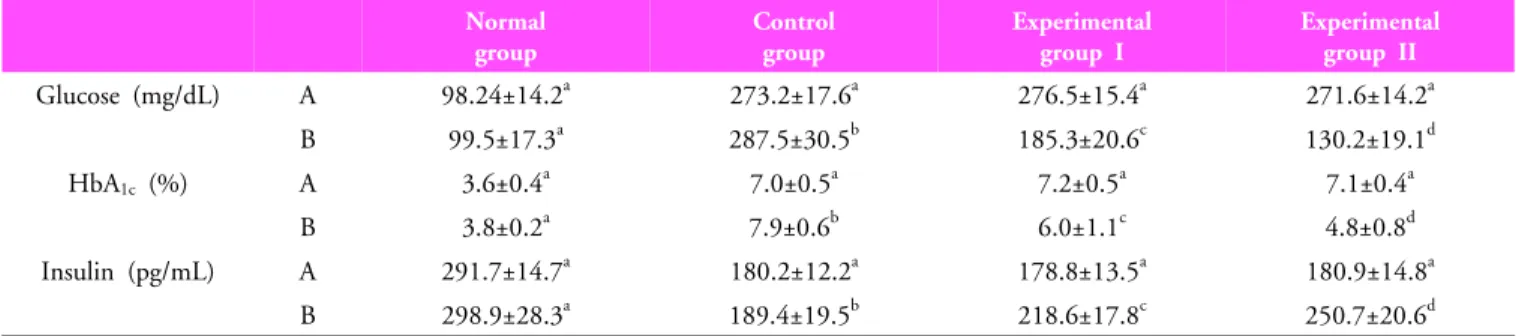
Glucose (mg/dL) A 98.24±14.2a 273.2±17.6a 276.5±15.4a 271.6±14.2a
B 99.5±17.3a 287.5±30.5b 185.3±20.6c 130.2±19.1d
HbA1c (%) A 3.6±0.4a 7.0±0.5a 7.2±0.5a 7.1±0.4a
B 3.8±0.2a 7.9±0.6b 6.0±1.1c 4.8±0.8d
Insulin (pg/mL) A 291.7±14.7a 180.2±12.2a 178.8±13.5a 180.9±14.8a
B 298.9±28.3a 189.4±19.5b 218.6±17.8c 250.7±20.6d
All values are shown as mean±SD
a Insignificant difference(p>0.05) between groups
b,c,d Significant difference(p<0.05) between groups A: pre-experimental value
B: post-experimental value
Table 2. Effect of aerobic exercise and aerobic graduated treadmill exercise on body weight, serum glucose, HbA1c and insulin concentrations
exercise program.
Experimental Group I (n=10): Aerobic treadmill exercise for 28 days and maintained in a diabetic state.
Experimental Group II (n=10): Aerobic graduated treadmill exercise for 28 days and maintained in a diabetic state.
3. Exercise program
Rats in the aerobic treadmill exercise groups followed a 4-week constant training period (20 m/min for 60 minutes). The exercise consisted of a 28 day accommodation phase with increasing exercise intensity (first week: 15 m/min for 30 minutes, second week: 15 m/min for 45 minutes, third week: 20 m/min for 30 minutes, fourth week: 20 m/min for 45 minutes).
Each experimental group had a training session (5 times a week, between 8.00 a.m. and 9.00 a.m.), in which all running rats had a 5-minute warm-up phase with a slowly increasing speed.11
4. Measurement of blood glucose, insulin, HbA1c and serum lipid concentrations
After 28 days of exercise, rats were fasted (overnight for 12 h), sacrificed and blood samples obtained. The rats did not exercise during the 24 h prior to sample taking. About 1 ml blood was withdrawn from a prominent superficial vein using a clean venipuncture with minimal stasis; blood was collected in a tube containing EDTA, centrifuged, and frozen. Blood was allowed to clot and serum was separated by centrifugation at 3,500 rpm for 10 min. Serum glucose, insulin, HbA1c, total cholesterol, triglycerides, and HDL levels were determined. Fasting serum glucose concentrations were determined using Glucotrend plus
glucose (Roche Diagnostick GmbH, Germany). Serum insulin was assayed using enzyme-linked immunosorbent assay kits (ELISA, Boerhringer Mannheim, Germany). Hemoglobin A1c (HbA1c) levels were measured using a DCA2000 analyzer (Siemens, Munich, Germany). The serum total cholesterol, triglycerides, and high density lipoprotein cholesterol were estimated using commercial diagnostic reagents (Bayer, USA) on a biochemical analyser (RM 2060-18, Eltec. Co., Italy).
5. Statistical analysis
All statistical analysis was performed using SPSS ver. 14.0 for windows (Statistical Package for the Social Sciences). All values are expressed as mean ± standard deviation. Comparisons of body weight, glucose, HbA1c, insulin, TC, TG, HDL, and oxidative enzyme levels among the four groups were done using the Kruskal–Wallis test, a nonparametric counterpart to the ANOVA test. The relationship between the pre-experimental and post-experimental value was assessed by use of the Wilcoxon test, a nonparametric test. A P value of < 0.05 was considered to be statistically significant.
III. Result
1. Changes in body weight, glucose, HbA1c, and insulin levels
Table 1 shows the effect of aerobic and graduated treadmill exercise programs on body weight. Baseline weights of rats at the beginning of the study was similar for all experimental groups
Normal group
Control group
Experimental group I
Experimental group II
SOD A 221.4±13.5a 148.6±15.0a 146.0±14.2a 148.2±12.2a
unit/min/mg protein B 224.5±19.2a 157.5±28.4b 185.38±20.6c 230.5±20.2d
CAT A 2.4±0.3a 1.4±0.3a 1.3±0.2a 1.4±0.2a
μmol/min/mg protein B 2.5±0.2a 1.5±0.3b 2.0±0.4c 2.0±0.2c
All values are shown as mean±SD
a Insignificant difference(p>0.05) between groups
b,c,d Significant difference(p<0.05) between groups A: pre-experimental value
B: post-experimental value
Table 4. Effect of aerobic exercise and aerobic graduated treadmill exercise on antioxidant enzymes Normal
group
Control group
Experimental group I
Experimental group II
Total cholesterol A 69.51±12.5a 96.4±11.1b 95.37±13.1b 94.25±10.5b
B 70.5±13.4a 97.8±13.2b 83.6±17.6c 72.5±18.1c
Triglyceride A 76.24±14.0a 104.80±12.2b 105.4±10.8b 103.2±10.2b
B 78.9±15.5a 108.3±25.4b 90.8±18.4c 84.0±16.5c
HDL A 49.7±5.4a 30.2±4.8b 31.8±5.0b 30.9±3.8b
B 50.4±9.2a 32.4±8.5b 39.8±8.4b 46.5±6.9c
All values are shown as mean±SD
a Insignificant difference(p>0.05) between groups
b,c,d Significant difference(p<0.05) between groups A: pre-experimental value
B: post-experimental value
Table 3. Effect of aerobic and aerobic graduated treadmill exercise on lipid profiles (Unit: mg/dL)
(F=0.59, p=0.39). At the end of the experimental period, the diabetic control group presented with weight loss. Treadmill exercised animals did not exhibit a marked change in body weight compared to the control group (F=100.09, p=0.01).
Table 3 shows the effect of aerobic and graduated treadmill exercise on serum glucose, HbA1c, and insulin. In the aerobic exercise group, the glucose concentration decreased to 185.38±20.6 mg/dL, while in the graduated treadmill exercise group it decreased to 130.2±19.1 mg/dL (F=156.64, p=0.03).
The activity of HbA1c, significantly increased by 24.0% and 39.2% in the aerobic and graduated treadmill exercise groups, respectively, (F=43.54, p=0.02). But the differences between exercise groups were not statistically significant. In the aerobic exercise group the insulin concentration decreased to 218.6±17.8 pg/mL, while in the graduated treadmill exercise group it decreased to 250.7±20.6 pg/mL (F=97.43, p=0.001) (Table 2).
2. Changes in total cholesterol and in triglyceride
levels
Table 3 shows the effect of aerobic and graduated treadmill exercise programs on serum total cholesterol (TC), triglycerides (TG), and HDL. TC and TG significantly (TC; F=95.64, p=0.04, TG; F=93.52, p=0.03) decreased; HDL significantly (F=86.00, p=0.03) increased in the experimental groups. There was a significant reduction in serum TC and triglycerides in the aerobic and graduated treadmill exercise groups after 28 days (F=95.64, p<0.05). In the aerobic exercise group the TC concentration decreased to 83.6±17.6 mg/dL, while in the graduated treadmill exercise group it decreased to 72.5±18.1 mg/dL. The mean HDL concentrations significantly differed between the managed exercise group and the control group (F=86.00, p=0.01).
3. Changes in anti-oxidant enzymes
The activity of SOD significantly (F=92.82, p=0.01) increased by 17.70% and 48.25% in the aerobic and graduated treadmill exercise groups, respectively, while it decreased by 29.8% in the
control group after 28 days. There was no significant difference in the activity of SOD in the managed aerobic treadmill exercise compared to the graduated treadmill exercise group. The activity of catalase significantly (F=37.35, p=0.001) increased by 20.0%
and 20.0% in the aerobic and graduated treadmill exercise groups, respectively, but differences with the control group were not statistically significant (Table 4).
IV. Discussion
Type 1 diabetes is responsible for approximately 10% of diabetes-related morbidity.13 Diabetes can also cause severe autonomic dysfunction that can be responsible for several disabling symptoms and even sudden cardiac death.14 Exercise or recreational physical activity has been used as a type of preventive or initial therapeutic approach for DM.15 The aims of the current work were to assess the hypoglycaemic effect of physical training exercise interventions (aerobic and aerobic graduated treadmill exercise) in rats with streptozotocin-induced diabetes. The mechanism of streptozotocin action has been described elsewhere.16 Diabetes induced in rats after a single high dose of STZ is one of the animal models of type 1 diabetes mellitus. In this model, diabetes arises from irreversible destruction of the β-cells of the pancreas, causing a reduction in insulin secretion.17,18 Our results show that that rats with streptozotocin-induced diabetes have significantly decreased blood glucose and increased plasma insulin .This could be due to potentiation of the insulin effect of plasma by increasing the pancreatic secretion of insulin from existing β-cells or its release from bound insulin. Hyperglycemia and dyslipidemia are two major biochemical markers of diabetes.
In the present study, aerobic and graduated treadmill exercise significantly decreased serum glucose, cholesterol, andtrigl- ycerides, and increased serum insulin and HDL levels in diabetic rats compared with controls. Furthermore, improved HbA1c, and normalization of lipid profiles may also contribute to the prevention of vascular complications. Hyperglycemia is asso- ciated with an increase in the oxidation of lipoproteins. Exper- imental evidence indicates that type 1 diabetes mellitus patients are susceptible to increased blood levels of anti-oxidant enzymes, confirmed mainly indirectly by measuring the products of lipid peroxidation.19,20 Hyperglycemia and dyslipidemia are two major biochemical markers of diabetes. Dyslipidemia was
defined as cholesterol >200 mg/dL, HDL-c <35 mg/dL, LDL-c
>160 mg/dL, or triglycerides >150 mg/dL.21 Type 1 DM patients are exposed to increased basal as well as exercise-induced lipid peroxidation, while paradoxically, exercise is recommended in the management of patients with type 1 diabetes.22
A variety of derangements in metabolic systems and in regulatory mechanisms due to insulin deficiency are responsible for the observed accumulation of lipids.23 The increase in insulin secretion results in enhanced metabolism of lipids and movement of lipids from adipose tissue to plasma. Thus, aerobic graduated treadmill exercise has an insulin-like action due to its lower lipid levels and increased oxidative stress has been detected in diabetic patients.24
These results suggests that the hypoglycemic and hypolipidemic effects of exercise interventions (aerobic and aerobic graduated treadmill exercise) are likely due to, at least in part, decreases in glucose and HbA1c or increases in insulin secretion, improved lipid profiles, and increased antioxidant activity. The major finding of this study is that graduated treadmill exercise training accentuates the decreases in indicators of glucose control and antioxidant enzymes. However, proof of this will require further studies. The hypoglycaemic mechanisms of aerobic and aerobic graduated treadmill exercise programs remain unclear and further studies are required to elucidate cellular and tissue mechanisms of therapeutic exercise interventions.
V. Conclusion
The study demonstrates the benefit of aerobic and graduated treadmill exercise on body weight, fasting blood glucose, HbA1c, insulin concentration, lipid profiles, and antioxidative enzyme activity in rats with streptozotocin induced diabetes. The response observed using a graduated treadmill exercise program was similar to that using a conventional physical exercise program. These findings suggest that aerobic graduated treadmill exercise has therapeutic, preventative, and protective effects in type 1 diabetes by decreasing lipid profiles and oxidative stress.
Author Contributions Research design: Kim GY, Kim EJ Acquisition of data: Kim GY, Kim EJ Analysis and interpretation of data: Kim EJ Drafting of the manuscript: Kim GY, Kim EJ Research supervision: Kim GY
References
1. Bhaskarabhatla KV, Birrer R. Physical activity and diabetes mellitus. Comp Ther. 200531(4):291-8.
2. World Health Organization. Diabetes: What is diabetes?
WHO. 2009.
3. Alessio HM. Exercise-induced oxidative stress. Med Sci Sports Exerc. 1993;25(2):218-24.
4. Brownlee M. Biochemistry and molecular cell biology of diabetic complications. Nature. 2001;414(6865):813-20.
5. George P, Ludvik B. Lipids and diabetes. J Clin Basic Cardiol.
2000;3(3):159-62.
6. Paquot N. Deleterious effects of lack of compliance to lifestyle and medication in diabetic patients. Rev Med Liege.
2010;65(5-6):326-31.
7. Bhaskarabhatla KV, Birrer R. Physical activity and type 2 diabetes: tailoring exercise to optimize fitness and glycemic control. Phys Sportsmed. 2004;32(1):13-7.
8. Ciangura C. Physical activity in type 2 diabetes. Rev Prat.
2010;60(4):490-4.
9. Lumini JA, Magalhães J, Oliveira PJ et al. Beneficial effects of exercise on muscle mitochondrial function in diabetes mellitus.
Sports Med. 2008;38(9):735-50.
10. Tucker PS, Fisher-Wellman K, Bloomer RJ. Can exercise minimize postprandial oxidative stress in patients with type 2 diabetes? Curr Diabetes Rev. 2008;4(4):309-19.
11. Brooks GA, White TP. Determination of metabolic and heart rate responses of rats to treadmill exercise. J Appl Physiol.
1978;45(6):1009-15.
12. Boor P, Celec P, Behuliak M et al. Regular moderate exercise reduces advanced glycation and ameliorates early diabetic nephropathy in obese Zucker rats. Metabolism. 2009;58(11):
1669-77.
13. Gero L. Type 1 diabetes mellitus: pathogenesis, symptoms and therapy. Orv Hetil. 2010;151(13):533-9.
14. American Diabetes Association. Diabetes mellitus: a major risk factor for cardiovascular disease. Circulation. 1999;100(10):
1132-3.
15. Shen GX. Oxidative stress and diabetic cardiovascular disorders: roles of mitochondria and NADPH oxidase. Can J Physiol Pharmacol. 2010;88(3):241-8.
16. Matsuda M, Kawasaki F, Mikami Y et al. Rescue of beta-cell exhaustion by diazoxide after the development of diabetes mellitus in rats with streptozotocin-induced diabetes. Eur J Pharmacol. 2002;453(1):141-8.
17. Boitard C, Debray-Sachs M, Bach JF. Autoimmune disorders in diabetes. Adv Nephrol Necker Hosp. 1986;15:281-305.
18. Junod A, Lambert AE, Stauffacher W et al. Diabetogenic action of streptozotocin: relationship of dose to metabolic response.
J Clin Invest. 1969;48(11):2129-39.
19. Santini SA, Marra G, Giardina B et al. Defective plasma antioxidant defenses and enhanced susceptibility to lipid peroxidation in uncomplicated IDDM. Diabetes. 1997;
46(11):1853-8.
20. Griesmacher A, Kindhauser M, Andert SE et al. Enhanced serum levels of thiobarbituric-acid-reactive substances in diabetes mellitus. Am J Med. 1995;98(5):469-75.
21. American Diabetes Association. Management of dyslipidemia in children and adolescents with diabetes. Diabetes Care.
2003;26(7):2194-7.
22. American Diabetes Association. Exercise and NIDDM.
Diabetes Care. 1990;13(7):785-9.
23. Rajalingam R, Srinivasan N, Govindarajulu P. Effects of alloxan induced diabetes on lipid profiles in renal cortex and medulla of mature albino rats. Indian J Exp Biol. 1993;31(6): 577-9.
24. Dave GS, Kalia K. Hyperglycemia induced oxidative stress in type-1 and type-2 diabetic patients with and without nephropathy. Cell Mol Biol (Noisy-le-grand). 2007;53(5):
68-78.