심리적 인슐린저항성 개념분석
송영신
충남대학교 간호대학
J Korean Acad Nurs Vol.46 No.3, 443- 453
대한간호학회지 제46권 제3호, 2016년 6월 http://dx.doi.org/10.4040/jkan.2016.46.3.443
Concept Analysis for Psychological Insulin Resistance in Korean People with Diabetes
Song, Youngshin
College of Nursing, Chungnam National University, Daejeon, Korea
Purpose: The purpose of this study was to define the concept for psychological insulin resistance in the Korean population with diabetes.
Methods: The Hybrid model was used to perform the concept analysis of psychological insulin resistance. Results from both the theoretical review with 26 studies and a field study including 19 participants with diabetes were included in final process. Results: The preceding factors of psychological insulin resistance were uncontrolled blood glucose and change in daily life. The concept of psychological insulin resistance was found to have three categories with 8 attributes such as emotional factors (negative feeling), cognitive factors (low awareness and knowledge, low confidence for self-injection) and supportive factors (economic burden, dependency life, embarrassing, feeling about sup- porters, feeling of trust in, vs mistrust of health care providers). The 8 attributes included 30 indicators. Conclusion: The psychological insulin resistance of population with diabetes in Korea was defined as a complex phenomenon associated with insulin therapy that can be affected by emotional factors, cognitive factors, and supportive relational factors. Based on the results, a tool for measuring psychological insulin re- sistance of Koreans with diabetes and effective programs for enhancing insulin adherence should be developed in future studies.
Key words: Diabetes mellitus; Psychological factors; Insulin resistance
주요어: 당뇨병, 심리적요인, 인슐린 저항성
*이 연구는 2015년도 정부(미래창조과학부)의 재원으로 한국연구재단의 지원을 받아 수행된 연구임(NRF-2015R1A2A2A01002394).
*This work was supported by the National Research Foundation of Korea (NRF) grant funded by the Korea government (MSIP)(NRF-2015R1A2A2A01002394).
Address reprint requests to : Song, Youngshin
College of Nursing, Chungnam National University, 266 Munwha-ro, Jung-gu, Daejeon 35015, Korea Tel: +82-42-580-8334 Fax: +82-42-580-8309 E-mail: [email protected]
Received: October 20, 2015 Revised: December 17, 2015 Accepted: March 30, 2016
This is an Open Access article distributed under the terms of the Creative Commons Attribution NoDerivs License. (http://creativecommons.org/licenses/by-nd/4.0) If the original work is properly cited and retained without any modification or reproduction, it can be used and re-distributed in any format and medium.
서 론 1. 연구의 필요성
제2형 당뇨병은 전 세계 성인인구의 약 6.6%를 차지하며, 국내의 경우 유병율이 10%를 넘으며, 잠재적 당뇨병 환자도 10명 중 3명으 로 추정하고 있어, 향후 2050년에는 당뇨병이 지금보다 2배 증가할 것으로 예측되고 있다[1]. 당뇨병으로 인한 진료비 지출 또한 연간 건강보험의 19.2%로 매년 증가추세이며 이러한 사회경제적 부담을
고려한 체계적 적정관리가 필요한 대표적인 만성질환이다[1].
제2형 당뇨병은 식이와 운동, 체중조절 등 생활습관 개선을 통한 혈당조절과 함께 경구 혈당강하제를 복용하게 되며, 이러한 노력에도 불구하고 결국 인슐린 분비기능이 저하되어 수년 후에는 인슐린 주 사를 처방 받게 되는 단계에 도달하게 된다. 한국의 당뇨병치료지침 에 따르면 경구 혈당강하제를 최대용량으로 사용하거나 두 종류 이 상의 약제를 병용해도 당화혈색소가 7.0% 이상이면 혈당조절이 더 악화되기 전에 인슐린 치료를 권장하고 있다[2]. 그 근거로 당뇨병 진단 당시 이미 인슐린분비 기능이 50% 이하로 저하되어있으며, 6년
여 후에는 베타세포의 인슐린 분비 기능이 25% 정도로 저하되므로 베타세포기능을 보호하기 위하여 조기 인슐린요법 치료를 권장하고 있다[2]. 인슐린을 조기에 시작한 환자는 성공적인 혈당조절로 인해 당뇨합병증의 위험도가 월등히 낮아져 치료에 대한 만족도뿐 아니라 삶의 질이 높아진다는 긍정적인 연구가 보고되고 있다[3].
이러한 장점에도 불구하고 당뇨병 환자의 인슐린거부가 쟁점화되 고 있다. 예를 들어, 영국의 1995년 당뇨조사연구에서는 당뇨병 환 자 중 27%가 인슐린 치료를 거부하고 있음을 보고하였고, 10년 후 자료에서는 거부율이 무려50%로 증가되었음을 보고하면서 그 심각 성에 대해 언급한 바 있다[4]. 동양의 경우 중국에서는 70%의 당뇨 환자가 그리고 우리나라의 경우 67%의 당뇨 환자가 인슐린치료에 거부감을 가진다고 보고하는 등[5,6], 국가마다 인슐린 치료 거부율 이 다양하게 보고되고 있다. 학계에서는 이러한 당뇨병 환자의 인슐 린 치료에 대한 거부나 불안 현상을 심리적 인슐린저항성이라 명명 하고 있는데, 여기에는 단순히 주사에 대한 두려움뿐 아니라 인슐린 치료로 인한 변화되는 개인의 다양한 심리사회적 요인이 포함되어 있다고 알려져 있으며 이러한 요인은 문화적 특성에 따라 조금씩 다 른 속성을 보이고 있다[7].
Polonsky 등[8]은 심리적 인슐린저항성 개념의 속성을 9가지로 구별 하였는데 인슐린에 대한 부작용(expected harm), 질병의 심각성(ill- ness severity), 일상생활에의 제약(restrictiveness), 억울함(lack of fairness), 통증에 대한 걱정(anticipated pain), 저혈당(problematic hypoglycemia), 자기효능감이 낮아짐(low self-efficacy), 실패감(per- sonal failure) 그리고 죽을 때까지 인슐린 치료받아 함(permanance) 으로 설명하였고, Fu 등[5]은 기존의 개념에 가족 등의 지지를 포함하 기도 했다. 이러한 심리적 인슐린저항성은 성별, 인종 등의 특성과 경 제수준 및 문화적 배경과 같은 사회경제적 특성, 그리고 각 개인이 지 각하는 당뇨치료에 대한 신념과 태도, 지식과 의도, 자기효능감, 우 울, 불안, 자기 자책감, 질병 관련 상실감, 공포, 치료에 대한 만족감 등 정서적 특성에 의해 영향을 받는 것으로 보고되고 있다[4,9~13].
그 동안 제2형 당뇨병 환자 대상 인슐린 치료에 대한 국내연구는 주사바늘 사용과 관련된 지식과 자가주사요법 및 그로 인한 통증관리 에 초점을 둔 경우가 대부분이며 인슐린 그 자체에 대한 당뇨병 환자 들의 지각이나 경험이 반영되지 못하고 있다. 즉, 대부분이 인슐린 치 료지연에 대해 주사바늘로 인한 통증이나 두려움 극복을 위한 지식전 달과 수행능력 훈련을 중심으로 접근하고 있으며, 인슐린치료에 대한 심리적인 거부감 현상에 대한 깊이 있는 연구는 미비한 실정이다[6].
따라서, 한국 당뇨병 환자들이 경험하고 인식하고 있는 인슐린 치 료에 대한 정확한 이해가 선행되어야 하며 이를 바탕으로 심리적 인 슐린저항성 개념에 대한 한국적 정의가 필요하고, 이들 개인의 신념 과 가치가 반영된 심리적 인슐린저항성 개념은 결국 인슐린 치료거
부나 지연에 대한 환자이해와 객관적 측정도구의 개발 등에 직접적 인 기여가 될 수 있을 것으로 사료된다.
이에 본 연구에서는 당뇨병 환자의 심리적 인슐린저항성 개념을 분석하기 위해 혼종 모형을 이용하여 ‘심리적 인슐린저항성’의 차원 과 속성 및 지표를 도출하고 이를 분석함으로써 ‘심리적 인슐린저항 성’에 대한 정의를 제시하여 추후 도구개발과 환자이해를 위한 기초 자료로 제공하고자 한다.
연구목적
혼종 모형을 이용한 개념분석을 통해 당뇨병의 ‘심리적 인슐린저항 성’의 차원와 속성을 파악하여 이를 분석함으로써 ‘심리적 인슐린저 항성’에 대한 정의를 명확히 제시하는 것이 목적이다.
구체적인 연구목적은 다음과 같다.
1) 기존문헌에 대한 체계적인 고찰을 통해 심리적 인슐린저항성의 선행요인과 결과, 차원, 속성을 찾아 잠정적 정의를 내린다.
2) 현장조사를 통해 심리적 인슐린저항성의 차원과 속성 및 지표 를 규명한다.
3) 이론적 단계와 현장작업단계에서 도출된 심리적 인슐린저항성 의 속성을 바탕으로 간호실무와 연구에 활용가능 한 최종적인 차원 과 속성 및 지표를 규명한다.
연구 방법 1. 연구 설계
본 연구는 혼종 모형에서 제시하는 이론적-현장작업-최종분석 단계에 따라 ‘심리적 인슐린저항성’의 차원과 속성 및 지표를 도출하 는 개념분석 연구이다.
2. 연구 대상
혼종 모형의 2번째 단계인 현장작업을 위해 선정기준에 부합하는 2형 당뇨병 성인 환자 19명을 눈덩이 표집방법과 편의표출로 선정한 후 면담하여 심리적 인슐린저항성 속성을 도출하였다. 대상자 선정 기준은 다음과 같다.
· 면담에 자발적으로 참여의사를 밝힌 2형 당뇨병 성인 환자
· 정신과적으로 문제가 없고 의사소통이 가능한 2형 당뇨병 성인 환자
· 인슐린 치료가 필요하다고 권고 받았으나 시작하지 않은 2형 당뇨병 성인 환자
된 속성을 확인하는 단계로, 본 연구에서는 제2형 당뇨병을 진단받 고 인슐린 치료를 권고 받고 인슐린치료를 시작하거나 시작하지 못 하고 있는 성인 19명을 대상으로 심리적 인슐린저항성 속성과 개념 을 재확인하였다. 자료 수집기간은 2015년 8월부터 9월까지였으며 자료 수집 전 참여자의 서면동의를 통해 연구 참여 동의를 받았다.
서면동의를 받기 전에 연구목적을 설명하였고, 면담 내용의 녹음 등 연구과정에 대해 설명하고 추가적인 질의/응답 등을 통해 자발적 참 여와 중도포기가 언제든 가능함을 설명하였다. 면담은 이론적 단계 를 통해 작성된 개방적 질문을 이용하여 연구자가 면담을 하였고 이 때 모든 내용은 녹음기를 통해 녹음되었고 현장에서 참가자의 비언 어적 행위 등은 연구보조자가 추가적으로 기록하였다. 위 모든 절차 는 사전에 기관생명윤리위원회의 심의절차를 받고 진행되었다(제 2-1046881-A-N- 01호-201410-HR- 046).
주요 개방적 질문은 ‘평소에 당뇨관리를 어떻게 하셨습니까?’, ‘인 슐린 치료에 대해 어떻게 생각하십니까?’, ‘인슐린 치료가 필요하다 고 권고 받았을 때 어떤 느낌을 받으셨습니까?’, ‘인슐린 치료에 대 한 거부감이 있었다면/없다면 그 이유는 무엇인가요?’, ‘인슐린 치료 를 하기로 한 결정하게 된(혹은 안 하고 있는) 이유는 무엇입니까?’ 등 환자 자신의 경험이나 생각을 면담하였다. 면담시간은 최소 30분 에서 1시간이 소요되었고 면담장소는 병원이나 자택 등 면담이 방해 받지 않는 조용하고 참여자들이 친숙한 장소에서 이루어졌다. 현장 작업에서 도출된 심층면담 자료는 근거이론적 접근방법을 이용하여 분석하였다[16], 즉, 모든 면담내용은 연구보조자에 의해 전사되었 고 두 명의 연구자가 독립적으로 전사된 내용을 바탕으로 주요개념 을 도출하고 영역을 나누었으며 이에 근거한 이론적 표본추출을 적 용하였다. 모든 면담 및 분석과정에 질적 연구 전문가 2인이 자문가 로 참여하였으며, 대상자의 일반적 특성은 Table 2와 같다.
3) 최종분석 단계
최종분석 단계에서는 이론적 단계와 현장작업 단계의 결과를 비 교 분석하여 통합적으로 ‘심리적 인슐린저항성’ 개념을 정의한다 [14]. 즉, 문헌을 통한 이론적 단계와 현장단계의 주요영역에 따라
‘심리적 인슐린저항성’ 개념의 속성과 지표를 종합하였으며 이들 결 과는 당뇨전문가 3명(의사 1, 간호사 2)과 질적 연구 전문가 2명의 내용 타당도를 통해 재확인하였다.
연구 결과 1. 이론적 단계
1) ‘심리적 인슐린저항성’의 사전적 의미
· 인슐린 치료를 권고 받고 인슐린 치료를 수행하고 있는 2형 당 뇨병 성인 환자
3. 연구진행절차 및 분석 방법
혼종 모형에서 제시하고 있는 이론적 단계-현장작업 단계-최종 분석 단계의 3단계의 순환적 과정에 따라 ‘심리적 인슐린저항성’개념 을 분석하였다[14].
1) 이론적 단계
이론적 단계에서는 개념적 정의 속성에 대한 본질적 의미를 고찰 하기 위해 사전적 의미와 학술문헌을 고찰하게 되며 이를 토대로 개 념의 속성과 정의를 비교, 분석함으로써 개념의 조작적 정의가 이루 어 진다[15]. 본 연구에서는 ‘심리적 인슐린저항성’에 대한 개념적 정 의와 속성에 관심을 두고 본질적 의미를 고찰하기 위해 사전적 의미 와 국내외 학술 문헌을 고찰하였다.
국외 학술지에서 심리적 인슐린저항성으로 사용되는 용어는 psy- chological insulin resistance, resistance to insulin therapy, reluc- tance to treat diabetes, treatment refusal., barriers to insulin compliance, barriers initiating insulin, patient reluctance insulin, psychological adjustment diabetes/insulin, acceptance/adherence insulin, patient preference insulin 등 여러 용어가 같은 의미로 사 용되고 있다. 본 연구에서는 이들 용어를 포함하여 needle, injec- tion anxiety, phobia, fear 등의 용어가 들어간 문헌을 추가하여 PubMed, CINAHL, the Cochrane Controlled Trial Register를 통 해 2005년~2015년 기간에 출간된 외국문헌을 검색하였다. 국내의 경우, NDSL와 RISS 데이터베이스를 이용하여 최근 11년간 (2005~2015년) 당뇨병/당뇨, 인슐린, 심리적, 적응, 순응, 치료이 행/치료 이행, 거부, 주사와 같은 용어가 제목, 주제어, 본문에 들어 간 연구논문을 검색하였다, 국내외 167개 검색문헌 중 이중검색문 헌을 제외한 결과143편이 1차 추출되었고 이들 연구논문의 초록을 확인하여 개념이 포함되었는지 선별한 후 정의가 없거나 단순히 인 슐린치료 수행여부만을 측정한 98편의 논문을 제외한 44개의 자료 중 제1형 당뇨병과 일부 체계적 문헌고찰 및 인슐린투여 장치 관련 논문 18편을 제외한 ‘심리적 인슐린저항성’ 개념에 대한 속성과 정의 가 포함된 연구논문 26편(국외 24편, 국내 2편)을 최종 선정하였다.
추출된 26편 연구에서 제시하고 있는 속성은 Table 1과 같다.
2) 현장작업단계
현장작업 단계는 현장조사에서 수집된 자료를 분석함으로써 이론 단계의 분석결과에서 확인된 개념의 속성을 재확인하고 새로 발견
Table 1. Literature regarding Attributors of Psychological Insulin Resistance (N=26)
Authors Attributes
Peyrot et al., 2005 Perceived efficacy of insulin, self-blame for needing insulin
Polonsky et al., 2005 Expected harm, restrictiveness, lack of fairness, anticipated pain, problematic hypoglycemia, low self-efficacy, personal failure, permanence
Gavin & Wright, 2007 Health beliefs, nutritional practices, religious beliefs and practices, interactions with the health care system, and socioeconomic status
Nakar et al., 2007 Not a very serious illness, Fear of addiction, Insulin makes one fat, Fear of hypoglycemia, insulin would not help, pain associated with injection, other fears associated with injection, pain associated with blood test, lack of faith in the physician
Petrak et al., 2007 Fear of injection and self-testing, expectations regarding positive insulin-related outcomes, expected hardship from insulin therapy, stigmatization by insulin injection, fear of hypoglycemia
Hong et al., 2008 Psychological refusal, fear of injection and inconvenience, fear of side effect, misconception of insulin
Larkin et al., 2008 A Survey for People who do not take insulin: expected harm: blindness, illness severity: serious disease, restrictiveness, lack of fairness, anticipated pain, problematic hypoglycemia, low self-efficacy, personal failure, permanence insulin treatment appraisal: failed, disease worse, prevents complications, people see me as sicker. life less flexible, afraid of injecting myself, increases hypoglycemia, improves health, causes weight gain, takes time and energy, give up activities, health will deteriorate, injecting is embarrassing, injecting is painful, right amount difficult, difficult to fulfill responsibilities, maintains good control, family and friends concerned, improves energy, dependent on physicians
Kabadi, 2008 Fear of hypoglycemia, fear of weight gain and the consequences, fear of needles, inconvenience, quality of life, noncompliance, cost
Brunton, 2008 Needle-anxiety, negative perception that insulin therapy, lack confidence in a patient’s ability to administer insulin, lack adequate resources, lack of time, fear being seen as sick, dependent, illicit drug user, embarrassment at injecting in public, hypoglycemia and weight gain
Brod et al., 2009 Negative self-perceptions and attitudinal barriers (sense of personal failure or self-blame for the necessity of insulin use, fear of injection); the fear of side effects and complications from insulin use; as well as lifestyle adaptations, restrictions required by insulin use, and social stigma
Makine et al., 2009 Feeling sicker, being more dependent, having a higher risk of hypoglycemia, painful injections, being restricted in daily life, being protected from complications or feeling more energetic
Jenkins et al., 2010 Engaging with disease progression, managing anxieties about insulin therapy
Karter et al., 2010 Misconceptions regarding insulin risk, plans to instead work harder on behavioral goals, sense of personal failure, low self-efficacy, injection phobia, hypoglycemia concerns, negative impact on social life and job, inadequate health literacy, health care provider inadequately explaining risks/benefits, and limited insulin self-management training
Nam et al., 2010 Fear of injection, expectations regarding positive outcome, expected hardship, stigmatization, fear of hypoglycemia
Peyrot, 2010 Sense of loss of control, belief that disease has worsened, sense of personal failure, injection-related anxiety, fear of weight gain, fear of hypo-glycaemia, lack of confidence in ability to manage insulin therapy, concerns of family, work and friends
Weinger & Beverly, 2010 Beliefs of lower insulin efficacy, higher self-blame/perceived failure for requiring insulin, weight concerns, depression
Hamaty, 2011 The degree of hyperglycemia, potential side effects of insulin, work schedule and lifestyle, cost, availability of nurses, diabetes educators
Gherman, 2011 Fear of needles or injection pain, fear of hypoglycemia, fear of weight gain, fear of dependence, depression
Minze et al., 2011 Belief that insulin represents failure of self-care, lack of perceived benefit pain/fear of injections, belief that insulin use is complicated loss of independence/change in lifestyle, stigma related to needle use
Lee, 2012 Difficulty of preparing, visual impairment, difficulty of administration, forgetfulness, lack of time, pain, fear of hypoglycemia, negative impact of life, concern of cost, under good control of blood glucose, reduction of complication
Fu et al., 2013 Self-image and stigmatization, factors promoting self-efficacy, fear of pain or needles, time & family support
Hassan et al., 2013 Negative concerns (painful injection, apprehension about self-injection, needle phobia, social embarrassment), impacts of using insulin (inconvenience and impractical, lifestyle restriction, social stigma)
Machinani et al., 2013 Expected harm, illness severity, restrictiveness, lack of fairness, anticipated pain, hypoglycemia, low self-efficacy, personal failure, permanence
Farsaei et al., 2014 Feeling worse after insulin injection, lack of enough injection, instructions, belief in negative effects of insulin on overall health,
forgetfulness, fear of hypoglycemia, embarrassment, weight gain, injection site reactions, injection site pain, difficult to inject, being time consuming
Kang, 2014 Psychological refusal, fear of injection and inconvenience, fear of side effect, misconception of insulin Krall et al., 2015 Injection resistance, Patient adherence, health system barriers, educational need
하거나 지연하는 ‘심리적 인슐린저항성’ 개념은 대부분 당뇨병의 질 병과정에서 나타나는 치료이행의 한 측면으로 이해되고 있다[7].
3) 심리적 인슐린저항성 관련 개념
간호학과 의학에서 심리적 인슐린저항성(psychological insulin re- sistance)과 혼용되어 사용되고 있는 용어는 resistance to insulin therapy, reluctance to treat diabetes, treatment refusal., barriers to insulin compliance, switching to insulin therapy, barriers initi- ating insulin, patient reluctance insulin, psychological adjustment diabetes/insulin, needle-anxiety/phobia/fear, psycho-social as- pects diabetes treatment, acceptance/adherence insulin, patient preference insulin 등이 있다. 특히, 저항성이라는 용어 대신 거부 감, 장애요인, 적응, 치료이행, 환자 선호도 등의 용어로 사용되고 있었으며 불안, 공포 등 주사요법에 대한 부정적 심리적 용어를 유 사한 개념으로 사용하고 있다. 이중 거부감과 주사요법에 대한 불 안, 공포는 심리적 인슐린저항성을 설명하기 위한 하나의 부분속성 으로 이용되고 있고[6,18], 반대로 장애요인의 경우 심리적 인슐린 저항성을 포함해 약리적· 기술적· 정책적 이슈와 함께 보다 포괄적 인 의미로 문헌에서 사용되고 있다[19]. 거부감, 불안, 공포와 장애 요인이 부정적인 의미를 갖는 것과는 달리 적응, 치료이행, 환자선 호 등은 심리적 인슐린저항성과는 달리 긍정적 의미를 내포하고 있 어[20], 심리적 인슐린저항성과 유사한 개념으로 보기 어렵다.
4) 심리적 인슐린저항성의 선행요인과 결과, 차원, 속성 및 잠정적 정의
심리적 인슐린저항성은 경구 혈당강하제로 혈당조절이 안되는 당 뇨병 환자의 인슐린 치료시작과 유지에 영향을 미치는 것으로 설명 되고 있으며[3,6,7,18], 이러한 결과는 인슐린 치료를 지연시키거나 방해하게 하는 결과를 초래한다고 보고되고 있다[5-7].
기존 연구에서 제시하고 있는 심리적 인슐린저항성 속성은 대부분 유사한데, Polonsky 등[8]과 Machinani 등[21]은 expected harm, restrictiveness, lack of fairness, anticipated pain, problematic hy- poglycemia, low self-efficacy, personal failure와 permanence로 보고하였으며, Farsaei 등[20]은 인슐린주사에 대한 심리적 저항성의 속성으로 feeling worse after insulin injection, lack of enough in- jection, instructions, belief in negative effects of insulin on overall health, forgetfulness, fear of hypoglycemia, embarrassment, weight gain, injection site reactions, injection site pain, difficult to inject, being time consuming 으로 보고하였다. Brunton [22]은 needle-anxiety, negative perception that insulin therapy, lack confidence in a patient’s ability to administer insulin, lack adequate 사전적으로 ‘심리적’이란 용어는 ‘마음의 작용과 의식상태에 관한
것’으로 정의되고 있으며, ‘저항성’은 명사로서 ‘어떤 힘이나 조건에 굽 히지 아니하고 거역하거나 버티는 성질’로 정의되고 있다[17]. 언론분 야에서는 ‘수용자가 어떠한 설득 커뮤니케이션 메시지도 잘 받아들이 지 아니하려는 성향’으로 사용되고 있다. 의학적으로 ‘저항성’은 ‘생체 가 자기에게 유해한 상황, 즉, 병의 원인이 되는 환경, 약제의 작용, 미생물의 침입, 이종 세포나 조직의 이식 따위로부터 자신을 지키려고 하는 성질’로 정의하여 약물저항성을 설명하는 데 활용하고 있다[17].
2) 간호학에서의 ‘심리적 인슐린저항성’의 의미
간호학과 의학에서 사용되고 있는 심리적 인슐린저항성은 인슐린 치료가 필요한 기간에 이를 대상자가 거부하거나 지연할 때 사용하 는 개념으로 알려져 있고 이러한 특성을 가진 당뇨병 환자를 insu- lin-naïve 환자로 명명하고 있다. 의료진에게도 인슐린 처방에 대한 거부나 지연이 나타나는데 이러한 현상을 ‘clinical inercia’로 달리 부 르고 있으며, 이들 insulin-naïve나 clinical inercia 용어 모두 아직 한국어로 번역되지 않은 상태이다. 결론적으로 인슐린 치료를 거부 Table 2. Demographics of Participants (N=19)
Characters Categories n (%) or M±SD
Gender Male
Female
8 (42.1) 11 (57.9) Marital status Married
Single
18 (94.7) 1 (5.3) Age (yr)
Less than 30s 30s 40s 50s 60s Over 70s
59.41±13.73 1 (5.3) 0 (0.0) 3 (15.8) 3 (15.8) 9 (47.3) 3 (15.8) Location of interview Inpatient unit
Outpatient
13 (68.4) 6 (31.6) Duration of diabetes (yr)
Less than 1 1~5 5~10 11~20 Over 20
15.73±11.99 3 (15.8) 2 (10.5) 1 (5.3) 5 (26.3) 8 (42.1) Started Insulin
therapy
Yes Not yet
13 (68.4) 6 (31.6) Duration of Insulin
therapy (yr) Less than 1 1~5 5~10 10~20
4.43±4.92 5 (26.3) 2 (10.5) 3 (15.8) 3 (15.8) Type of hospital University hospital
Local clinics
15 (78.9) 4 (21.1)
Starting Insulin Questionnaire (Ch-ASIQ)’에 영향을 주어 4개의 하 부영역으로 구성된 13문항 4점 척도 도구를 개발하는데 영향을 주었 다[5]. 인슐린 치료시작에 대한 거부감을 측정한 9문항으로 구성된A Survey for People who do not take Insulin (SPI)(11)와 14문항의 Barriers to Insulin Treatment (BIT)는 제2형 당뇨병의 인슐린요법에 대한 태도를 측정하기 위해 최근 가장 빈번히 사용하는 도구로 독일 어와 영어로 개발되어 심리적 인슐린저항성 측정에 활용되고 있다[7].
2. 현장단계
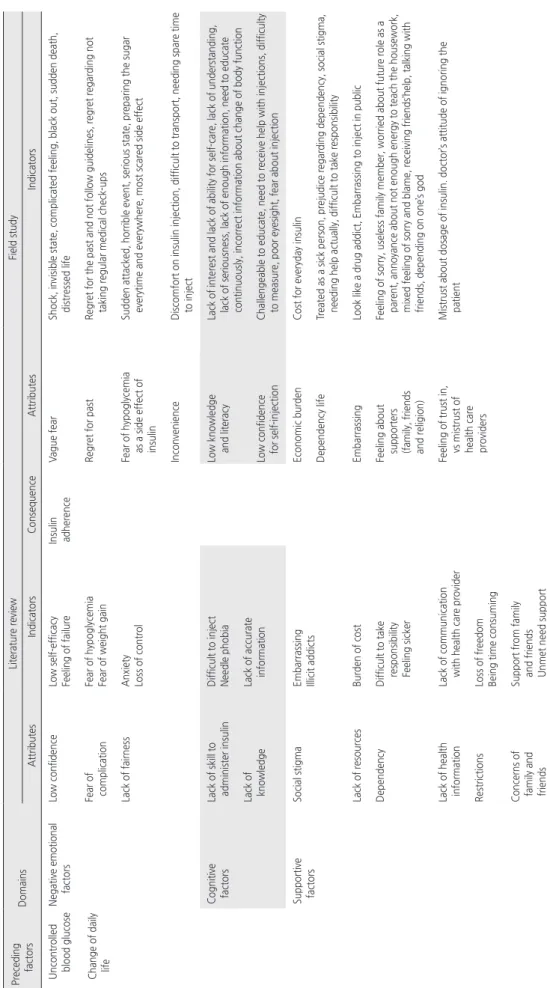
현장작업에서는 당뇨병 대상자의 면담을 통해 심리적 인슐린저항 성의 차원과 속성을 확인하였다. 그 결과 부정적 감정 요인과 인지 적 요인 및 지지적 요인 총 세가지 차원의 심리적 인슐린저항성이 확 인되었다(Table 3).
감정적 요인은 4가지의 부정적 감정으로 구분되었다. 즉, 막연한 두려움, 과거에 대한 후회, 합병증인 저혈당에 대한 두려움과 불편 감이며 긍정적 감정 요인은 깨달음과 혈당조절에 대한 자신감과 신 체적 회복이 도출되었다. 이들 6가지 속성의 지표를 각각 살펴보면, 막연한 두려움은 인슐린치료 초기시 나타나며 ‘쇽’, ‘앞이 캄캄함’,
‘복잡한 심경’, ‘아무 생각도 안남’, ‘갑자기 죽을수도 있다는 생각’,
‘절망감’과 같은 지표가 포함되었다. 과거에 대한 후회 속성은 2가지 지표를 포함하고 있었는데 ‘과거 치료이행을 따르지 않은 것에 대한 후회’, ‘사전에 규칙적 건강검진을 하지 않은 것에 대한 후회’로 나타 났다. 저혈당 합병증에 대한 두려움 속성은 ‘갑작스럽게 나에게 부닥 칠 수 있는 증상’, ‘무서운 사건’, ‘심각한 상태’, ‘사탕을 언제/어디서 든 준비해야 하는 것’, ‘가장 무서운 합병증’ 의 지표를 내포하고 있 으며, 불편감 속성은 ‘인슐린주사에 대한 번거로움’, ‘가지고 다니기 불편함’, ‘주사를 위한 시간이 필요함’ 지표를 포함하고 있다.
인지적 요인은 2가지 차원 즉, 낮은 지식과 문해력, 자가주사에 대한 낮은 자신감으로 나타났다. 2가지 차원 중 낮은 지식과 문해력 은 ‘관심부족’, ‘자가관리 능력 부족’, ‘이해 부족’. ‘심각성 부족’, ‘충 분한 정보의 부재’, ‘끊임없이 교육을 받아야 함’, ‘신체변화에 대한 부적절한 정보습득’ 지표를 포함하였다. 자가주사에 대한 낮은 자신 감 속성은 ‘배우기 어려움’, ‘주사 때문에 타인의 도움을 받아야 함’,
‘주사용량을 맞추기 어려움’, ‘시력저하’, ‘주사 자체에 대한 두려움’
지표를 포함하였다.
지지적 요인은 5가지 차원 즉, 경제적 부담, 의존적 삶, 민망함과 지지체계(가족, 친구, 종교)에 대한 감정 및 의료진에 대한 신뢰와 불신으로 나뉘었다. 이중 경제적 부담은 ‘인슐린주사를 매일 맞아야 하는데 드는 비용’ 1개의 지표로 대표된다. 의존적 삶은 ‘환자 취급 당함’, ‘환자니까 도움이 필요한 사람일거라는 주위의 선입견’, ‘정상 resources, lack of time, fear being seen as sick, dependent, illicit
drug user, embarrassment at injecting in public, hypoglycemia and weight gain 으로 제시하였으며, Gherman 등[19]은 인슐린치료 부작용에 대한 불안이나 주사공포와 관련된 우울증상 등의 감정적 요인을 가진 것으로 보고하였다. 이러한 부정적 감정의 속성은 인슐 린치료를 저해하거나 장기간 중단하게 한다고 보았다. Peyrot 등[9]
은 sense of loss of control, belief that disease has worsened, sense of personal failure, injection-related anxiety, fear of weight gain, fear of hypo-glycaemia, lack of confidence in ability to manage insulin therapy, concerns of family, work and friends 이 심리적 인슐린저항성에 포함된 속성으로 소개하고 있으며, Makine 등[23]은 feeling sicker, being more dependent, having a higher risk of hypoglycemia, painful injections, being restricted in daily life, being protected from complications or feeling more energetic 으로, Abu Hassan 등[24]은 painful injection, apprehension about self-injection. needle phobia, social embarrassment을 심리적 인슐 린저항성이 가지는 대상자의 속성으로 보았다.
이와 같은 이론적 단계에서 분석한 심리적 인슐린저항성의 선행요 인은 조절되지 않은 혈당과 일상생활의 변화이며, 이러한 심리적 인 슐린저항성의 결과는 인슐린 치료이행에 영향을 주는 것으로 보았 다. 결국, 심리적 인슐린저항성은 ‘개인이 가지는 자신감결여, 합병 증에 대한 두려움, 자기관리 실패감, 억울함과 같은 부정적 감정과 당뇨합병증 감소에 대한 기대와 혈당조절로 인한 안도감등과 같은 긍정적 감정이 복잡하게 내재된 개인의 감정이며, 인슐린 주사 관련 기술과 지식결여로 인한 어려움 등의 인지적 요인 및 경제적 부담, 사회적 오명, 지지체계의 부족, 의존적 역할, 충분한 정보부족, 일상 생활에서의 자유박탈, 가족/친구/직장동료들의 걱정을 포함한 지지 관계의 어려움’으로 잠정적으로 정의할 수 있다(Table 3).
5) 심리적 인슐린저항성 측정도구
당뇨병의 심리적 인슐린저항성의 속성을 측정하는 것은 인슐린치 료와 관련된 대상자의 정서상태를 이해하고 관련 요인을 확인함으로 써 인슐린 치료이행을 높이기 위해 시행된다. 국내에서 개발된 측정 도구는 아직 없으며 국외에서 개발되고 활용되고 있는 도구는 몇 가 지가 있다.
Problem Areas In Diabetes (PAID)는 당뇨로 인해 나타나는 절망 감을 측정하기 위해 20문항 6점 척도로 구성된 도구로 인슐린 치료에 대한 심리적 부담감뿐 아니라 전반적인 것을 포함하고 있으며[25], PAID의 영향을 받은 Insulin Treatment Appraisal Scale (ITAS)가 개발되어 20문항 5점척도로 인슐린 치료와 관련된 경험을 객관적으 로 측정하였다[26]. ITAS는 중국의 ‘The Chinese Attitudes to
Table 3. Domains, Attribute, and Indicators of Psychological Insulin Resistance in Literature Review and Field Study Preceding factorsDomains Literature reviewField study AttributesIndicatorsConsequenceAttributesIndicators Uncontrolled blood glucose Change of daily life Negative emotional factorsLow confidenceLow self-efficacy Feeling of failureInsulin adherenceVague fearShock, invisible state, complicated feeling, black out, sudden death, distressed life Fear of complicationFear of hypoglycemia Fear of weight gainRegret for pastRegret for the past and not follow guidelines, regret regarding not taking regular medical check-ups Lack of fairnessAnxiety Loss of controlFear of hypoglycemia as a side effect of insulin
Sudden attacked, horrible event, serious state, preparing the sugar everytime and everywhere, most scared side effect InconvenienceDiscomfort on insulin injection, difficult to transport, needing spare time to inject Cognitive factors Lack of skill to administer insulinDifficult to inject Needle phobiaLow knowledge and literacyLack of interest and lack of ability for self-care, lack of understanding, lack of seriousness, lack of enough information, need to educate continuously, incorrect information about change of body function Lack of knowledgeLack of accurate informationLow confidence for self-injectionChallengeable to educate, need to receive help with injections, difficulty to measure, poor eyesight, fear about injection Supportive factorsSocial stigmaEmbarrassing Illicit addicts Economic burdenCost for everyday insulin Dependency lifeTreated as a sick person, prejudice regarding dependency, social stigma, needing help actually, difficult to take responsibility Lack of resourcesBurden of costEmbarrassingLook like a drug addict, Embarrassing to inject in public DependencyDifficult to take responsibility Feeling sicker
Feeling about supporters (family, friends and religion)
Feeling of sorry, useless family member, worried about future role as a parent, annoyance about not enough energy to teach the housework, mixed feeling of sorry and blame, receiving friends’help, talking with friends, depending on one’s god Lack of health informationLack of communication with health care providerFeeling of trust in, vs mistrust of health care providers
Mistrust about dosage of insulin. doctor’s attitude of ignoring the patient RestrictionsLoss of freedom Being time consuming Concerns of family and friends
Support from family and friends Unmet need support
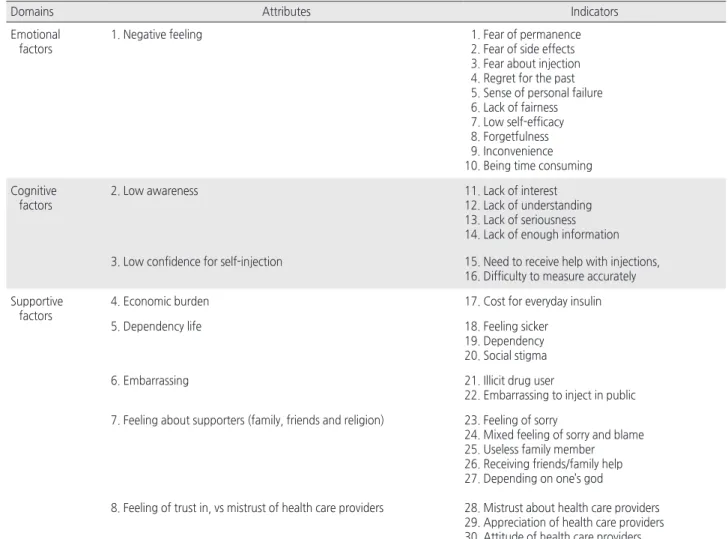
가지 차원과 이들이 포함한 8가지 속성 및 그에 따른 30가지 지표를 도출하였다(Table 4).
감정적 요인은 인슐린 치료에 대한 부정적 감정을 의미하며 10가 지 지표를 포함한다. 즉, 끝나지 않는 막연함, 인슐린에 대한 부작 용 및 주사자체에 대한 두려움이 내포되어 있었고, 과거에 대한 후 회, 실패감, 억울함, 자기효능감 부족, 자꾸 잊어버림, 불편함, 시간 이 필요함과 같은 지표를 포함하였다.
인지적 요인은 인식부족과 자가주사에 대한 낮은 자신감 2가지 속 성을 가지며 속성에 포함되는 6가지 지표를 도출하였다. 인식부족 속성은 관심부족, 이해부족, 심각성 부족과 충분한 정보의 부족과 같은 4가지 지표를 가지며, 주사에 대한 낮은 자신감은 주사를 위한 도움이 필요함과 정확히 용량을 맞출 수 없음과 같은 지표를 가지고 있다.
지지적 요인은 경제적 부담, 의존적 삶, 민망함과 지지체계에 대 한 감정과 의료인에 대한 감정 5가지 속성으로 구분하였고, 이들 속 성은 14가지 지표를 가지는 것으로 나타났다. 경제적 부담은 인슐린 적 사회생활을 못할 것이라는 사회적 오명’, ‘실제 도움이 필요함’,
‘책임을 다 하지 못함’ 총 5가지 지표로 나타났고, 민망함 속성은
‘마약중독자처럼 느껴짐’, ‘공공장소에서 주사하는 것이 민망함’ 2가 지 지표를 보였다. 지지체계(가족, 친구, 종교)에 대한 감정 속성은
‘미안함’, ‘쓸모 없는 가족원’, ‘앞으로 더는 부모역할을 못하게 됨’,
‘집안일을 알려줄 힘이 없음에도 불구하고 알려줘야 하는 짜증스러 움’, ‘미안함과 원망이 섞인 감정’, ‘친구가 도와줌’, ‘친구에게 얘기 함’, ‘종교에 의지함’과 같은 8가지 지표를 보였다. 마지막으로 의료 진에 대한 신뢰와 불신 속성은 ‘인슐린처방에 대한 불신’, ‘환자를 무 시하는 의사의 태도’, ‘환자를 끝까지 포기하지 않는 것에 대한 고마 움’ 3가지 지표를 포함하였다.
3. 최종단계
이론적 단계와 현장단계를 통해 분석된 심리적 인슐린저항성을 종 합하여 최종적으로 감정적 요인과 인지적 요인 및 지지적 요인 총 3
Table 4. Domains, Attribute, and Indicators of Psychological Insulin Resistance in Final Stage
Domains Attributes Indicators
Emotional factors
1. Negative feeling 1. Fear of permanence
2. Fear of side effects 3. Fear about injection 4. Regret for the past 5. Sense of personal failure 6. Lack of fairness 7. Low self-efficacy 8. Forgetfulness 9. Inconvenience 10. Being time consuming Cognitive
factors
2. Low awareness 11. Lack of interest
12. Lack of understanding 13. Lack of seriousness 14. Lack of enough information 3. Low confidence for self-injection 15. Need to receive help with injections,
16. Difficulty to measure accurately Supportive
factors
4. Economic burden 17. Cost for everyday insulin
5. Dependency life 18. Feeling sicker
19. Dependency 20. Social stigma
6. Embarrassing 21. Illicit drug user
22. Embarrassing to inject in public 7. Feeling about supporters (family, friends and religion) 23. Feeling of sorry
24. Mixed feeling of sorry and blame 25. Useless family member 26. Receiving friends/family help 27. Depending on one’s god
8. Feeling of trust in, vs mistrust of health care providers 28. Mistrust about health care providers 29. Appreciation of health care providers 30. Attitude of health care providers
중을 차지하고 있다는 것이다. 지지관계가 심리적 인슐린저항성의 중요한 하나의 차원으로 분류된 것은 중국 당뇨병 환자를 대상으로 한 연구에서도 나타났는데, 인슐린 요법에 대한 당뇨병 환자의 태도 4가지 하위영역 중 가족 지지영역이 하나의 하위영역으로 분류되어 측정도구 개발에 실제 적용된 바 있다[5]. 그러나 본 연구에서 나타 난 지지적 요인이 가족, 의료인, 종교까지 포함하는 폭넓은 범위의 지지적 요인인 것에 반해, 중국 대상자 연구에서의 지지관계는 가족 만으로 한정함으로써 대상자를 둘러싼 다양한 지지요소가 충분히 반영되지 못하고 있는 점이 본 연구와 다르다. 이처럼 한국의 당뇨 병 환자가 경험하는 심리적 인슐린저항성은 개인의 감정과 인지적 차원뿐 아니라 사회적 관계에서 타인에게 비춰질환자라는 오명과 가 족에 대한 미안함, 종교에의 의지, 의료진에 대한 신뢰와 불신 등 다 양한 관계에서의 지지체계가 중요한 요인으로 작용하였다.
한편, 심리적 인슐린저항성 차원과 속성에 대한 일부 선행 연구에 서 인슐린이 자연적인 물질이며 혈당조절 자신감을 준다는 긍정적인 속성을 설명한 연구도 있으나[24], 대부분의 기존 연구에서 심리적 인슐린저항성이 부정적인 차원과 속성을 가지고 있음을 보고하고 있 고 본 연구의 현장연구에서도 대부분 부정적 감정과 인지 및 지지적 요인이 있음을 확인하였다. 비록 인슐린치료가 주는 성공적 혈당조 절의 경험과 당뇨관리에 중요성 깨달음 등 긍정적인 부분이 현장에 서 도출되었으나 최종단계에서 긍정적 감정영역이 저항성이라는 부 정적 개념과 상반되고, 심리적 인슐린저항성을 낮출 수 있는 일부 관련 요인으로 구분될 수 있어 최종 단계에서 제외되었다. 기존연구 에서도 이러한 긍정적인 속성은 인슐린 수용(Insulin Acceptance)이 라는 심리적 인슐린저항성과 상반되는 개념에 포함하기도 했다[24].
결국 심리적 인슐린저항성은 당뇨병 환자의 인슐린 치료에 대한 부 정적 감정이며, 인슐린 치료에 대한 낮은 인식과 낮은 자신감과 같 은 인지적 차원이 개입되어 있으며, 이러한 개인의 상태는 다양한 지지체계 안에서 변화되는 것으로 본 연구에서 나타났다. 실제 현장 단계에서 도출된 지지체계에 대한 대상자의 반응은 미안함과 서운 함을 동시에 느낀다고 하였고, 특히, 의료진에 대해 권위적인 태도 와 치료이행과정에서 겪은 부정적인 신체경험(저혈당, 배고픔)으로 인한 처방과 교육에 대한 불신 등이 도출되기도 했다. 이러한 다양 한 지지체계 관련 속성은 기존 연구와 차이점이며 독특한 우리나라 의료현실과 문화가 반영된 결과로 사료된다.
본 연구에서 도출한 심리적 인슐린저항성의 차원과 속성 및 지표 는 간호연구와 실무 및 환자 이해를 위한 간호교육영역에 다음과 같 이 활용할 수 있을 것으로 본다.
첫째, 도구개발: 본 연구에서 도출된 차원과 속성 및 지표를 이용 한 한국형 심리적 인슐린저항성 도구를 개발할 수 있을 것으로 사료 된다. 현재 한국에서 사용되고 있는 도구는 외국에서 개발된 도구 치료에 대한 경제적 비용 부담을 의미하며, 의존성 삶 속성의 경우
환자처럼 느껴짐, 의존하게 됨과 사회적 오명 총 3가지 지표를 포함 하며, 민망함 속성은 마약중독자 같은 느낌, 공공장소에서 주사하 는 것에 대한 민망함 지표가 도출되었다. 지지체계에 대한 감정 속 성에서는 미안함, 미안함과 원망이 섞인 감정, 쓸모 없는 가족원, 가족/친구의 도움을 받아야 함과 종교에 의지하게 됨 총 5가지를 지 표로 도출하였고, 마지막으로 의료진에 대한 신뢰와 불신은 2가지 지표 즉, 의료진에 대한 불신과 의료진에 대한 고마움 및 의료진의 태도를 포함하였다.
논 의
당뇨병 환자의 내당능장애 악화로 인한 인슐린 치료선택은 단순 히 투약방법의 변화가 아닌 개인의 심리사회적 변화가 함께 내재되 어 있는 복잡한 과정이며 이러한 과정에서 도출되는 행동은 의미 있 는 결과를 나타낸다[24,27]. 즉, 인슐린 선택 지연이나 거부 같은 행동이 초래되고 이로 인한 혈당조절 실패는 심각한 합병증으로 이 어지기 때문이다. 이처럼 심리적 인슐린저항성은 개인의 신념과 가 치에 따라 다르며 이러한 개인의 태도는 문화적 가치나 건강관리체 계에 따라 달라, 우리나라 당뇨병 환자를 위한 심리적 인슐린저항성 에 대한 기존의 문헌을 분석하고 실제 환자 인터뷰를 통해 속성을 정의하는 것은 당뇨병 환자를 이해하고 적절한 중재를 개발하기 위 해 선행되어야 할 중요한 과제이다.
본 연구에서 나타난 한국 당뇨병 환자의 심리적 인슐린저항성은 감정적요인, 인지적 요인과 지지적 요인으로 구별되며 이들은 8개의 속성과 30개의 지표로 나뉘었다. 이전의 서양의 관점에서 바라본 심 리적 인슐린저항성 속성이 환자 개인의 관리부족이나 실패감등에 초 점을 둔 속성이 대부분이며, 부분적으로 사회적 오명과 가족의 걱정 등 지지관계에서 나타나는 속성이 미미하게 포함되어 있었다는 점을 감안할 때, 본 결과는 선행 연구와 다소 차이가 있다. 개인에 초점 을 둔 이러한 기존 연구경향은 국내 연구에도 영향을 미쳤다. 최근 Hong 등과 Kang은 심리적 인슐린저항성을 5가지 속성으로 구분하 여 당뇨병 환자의 심리적 인슐린저항성을 측정하였는데[6,18], 이들 연구에서 포함된 인슐린 치료에 대한 심리적 거부감, 인슐린 주사법 의 두려움과 불편함, 인슐린 치료 부작용에 대한 우려, 다른 대안에 대한 모색과 인슐린 치료에 대한 잘못된 상식과 같은 속성은 비교적 개인의 경험에 초점을 둔 기존 선행 연구와 유사하며 본 연구에서 도출된 감정적/인지적/지지적 요인과는 속성의 범위가 다르다.
특히, 차별화되는 점은, 지지적 요인이 본 연구 결과 하나의 차원 으로 분류되었고 전체 30개 지표 중 14개의 지표가 지지적 요인에 포함되어 있어, 심리적 인슐린저항성의 속성을 설명하는데 높은 비
CONFLICTS OF INTEREST
The author declared no conflict of interest.
REFERENCES
1.Hong JS, Kang HC. Oral antihyperglycemic medication adherence and its associated factors among ambulatory care with adult type 2 diabetes patients in Korea. Korean Journal of Health Policy & Ad- ministration. 2010;20(2):128-143.
http://dx.doi.org/10.4332/KJHPA.2010.20.2.128
2.Korean Diabetes Association. Korean diabetes fact sheet 2013.
Seoul: Author; 2013.
3.Brod M, Kongsø JH, Lessard S, Christensen TL. Psychological in- sulin resistance: Patient beliefs and implications for diabetes man- agement. Quality of Life Research. 2009;18(1):23-32.
http://dx.doi.org/10.1007/s11136-008-9419-1
4.Peyrot M, Rubin RR, Lauritzen T, Skovlund SE, Snoek FJ, Mat- thews DR, et al. Resistance to insulin therapy among patients and providers: Results of the cross-national Diabetes Attitudes, Wishes, and Needs (DAWN) study. Diabetes Care. 2005;28(11):2673- 2679. http://dx.doi.org/10.2337/diacare.28.11.2673
5.Fu SN, Chin WY, Wong CK, Yeung VT, Yiu MP, Tsui HY, et al.
Development and validation of the Chinese Attitudes to Starting Insulin Questionnaire (Ch-ASIQ) for primary care patients with type 2 diabetes. PloS One. 2013;8(11):e78933.
http://dx.doi.org/10.1371/journal.pone.0078933
6.Hong SH, Kim MJ, Noh SG, Suh DW, Youn SJ, Lee KW, et al. A study on resistance in type 2 diabetic patient against commencement of insulin treatment. The Journal of Korean Diabetes. 2008;32(3):269- 279. http://dx.doi.org/10.4093/kdj.2008.32.3.269
7.Petrak F, Stridde E, Leverkus F, Crispin AA, Forst T, Pfützner A.
Development and validation of a new measure to evaluate psychologi- cal resistance to insulin treatment. Diabetes Care. 2007;30(9):2199- 2204. http://dx.doi.org/10.2337/dc06-2042
8.Polonsky WH, Fisher L, Guzman S, Villa-Caballero L, Edelman SV. Psychological insulin resistance in patients with type 2 diabetes:
The scope of the problem. Diabetes Care. 2005;28(10):2543- 2555. http://dx.doi.org/10.2337/diacare.28.10.2543
9.Peyrot M, Rubin RR, Khunti K. Addressing barriers to initiation of insulin in patients with type 2 diabetes. Primary Care Diabetes.
2010;4 Suppl 1:S11-S18.
http://dx.doi.org/10.1016/s1751-9918(10)60004-6
10.Lee EW. Self-injection related anxiety, fear and self-care compli- ance in insulin-treated diabetes patients [master’s thesis]. Seoul:
Ewha Womans University; 2002. p. 1-69.
11.Larkin ME, Capasso VA, Chen CL, Mahoney EK, Hazard B, Ca- gliero E, et al. Measuring psychological insulin resistance: Barriers to insulin use. The Diabetes Educator. 2008;34(3):511-517.
를 번역하여 도구의 타당성 검증 없이 사용하고 있는 실정이므로 [6,18], 연구를 통해 한국 당뇨병 환자에게 맞는 타당도와 신뢰도 높은 도구를 개발하는데 활용할 수 있다. 추후 개발된 심리적 인슐 린저항성 도구를 이용하여 성별과 사회경제적 배경, 개인의 자가간 호에 대한 자기효능감, 우울 등 주요 요인과의 관계를 연구함으로써 심리적 인슐린저항성 개념의 유용성을 평가하는 것도 가능할 것으 로 본다.
둘째, 인슐린 치료이행을 높이는 전략개발: 그 동안 당뇨병 환자 의 자가간호와 치료이행을 위한 다양한 프로그램과 교육이 수행되 어왔다. 그럼에도 불구하고 인슐린 치료에 대한 거부감은 가지고 있 는 환자가 67%로 보고되고 있어[6], 현재 시행되고 있는 다양한 환 자교육과 프로그램이 인슐린 치료가 필요한 당뇨병 환자에게 적합한 지에 대한 재평가가 필요하다. 본 개념분석을 통해 도출된 감정적·
인지적·지지적 속성은 간호중재가 가능한 속성으로 사료되며, 인슐 린치료이행을 높일 수 있는 당뇨교육 및 상담 프로그램 개발에 활용 가능 할 것으로 보인다.
셋째, 환자이해: 혼종 모형의 현장단계에서 도출된 당뇨병 환자의 심리적 인슐린저항성 차원과 속성은 당뇨병 환자를 직접 간호하는 간호사뿐 아니라 간호대학생 교육에 활용함으로써 당뇨병 환자의 생 리적/신체적 변화에 따른 심리적 변화를 이해하게 하여 폭넓은 전인 적 간호를 수행하는데 활용 될 수 있을 것으로 사료된다.
결 론
심리적 인슐린저항성 개념을 혼종 모형을 이용하여 이론적 단계- 현장단계-최종분석단계를 통해 3가지 감정적·인지적·지지적 차원 과 8개 속성 및 30개 지표가 도출되었다.
결론적으로 한국인의 심리적 인슐린저항성이란 당뇨병 환자가 경 험하는 인슐린 치료에 대한 부정적 감정으로, 인슐린에 대한 잘못된 인식과 자가주사에 대한 낮은 자신감등 인지적 차원과 대상자를 둘 러싼 다양한 지지적 차원의 어려움을 경험하는 심리적 상태라고 정 의할 수 있다.
본 개념분석을 통해 도출된 속성과 지표는 추후 심리적 인슐린저 항성 측정을 위한 도구개발로 이어질 수 있으며, 아울러 당뇨병 환자 가 경험하는 심리적 인슐린저항성을 보다 깊이 이해하는 데 도움이 될 것으로 사료된다. 향후 인슐린 치료 저항감을 낮추고 치료이행을 높이기 위한 감정적·인지적·지지적 간호 전략을 개발하고 적용함으 로써 당뇨병 환자의 성공적인 혈당조절을 통한 삶의 질 향상에 기여 할 수 있을 것으로 사료된다.
http://dx.doi.org/10.1016/j.pcd.2014.03.001
21.Machinani S, Bazargan-Hejazi S, Hsia SH. Psychological insulin resistance among low-income, U.S. racial minority patients with type 2 diabetes. Primary Care Diabetes. 2013;7(1):51-55.
http://dx.doi.org/10.1016/j.pcd.2012.11.003
22.Brunton S. Insulin delivery systems: reducing barriers to insulin therapy and advancing diabetes mellitus treatment. The American Journal of Medicine. 2008;121(6 Suppl):S35-S41.
http://dx.doi.org/10.1016/j.amjmed.2008.03.025
23.Makine C, Karşidağ C, Kadioğlu P, Ilkova H, Karşidağ K, Skovlund SE, et al. Symptoms of depression and diabetes-specific emotional distress are associated with a negative appraisal of insulin therapy in insulin-naive patients with Type 2 diabetes mellitus. A study from the European Depression in Diabetes [EDID] Research Con- sortium. Diabetic Medicine. 2009;26(1):28-33.
http://dx.doi.org/10.1111/j.1464-5491.2008.02606.x
24.Abu Hassan H, Tohid H, Mohd Amin R, Long Bidin MB, Muthu- palaniappen L, Omar K. Factors influencing insulin acceptance among type 2 diabetes mellitus patients in a primary care clinic: A qualitative exploration. BMC Family Practice. 2013;14:164.
http://dx.doi.org/10.1186/1471-2296-14-164
25.Polonsky WH, Anderson BJ, Lohrer PA, Welch G, Jacobson AM, Aponte JE, et al. Assessment of diabetes-related distress. Diabe- tes Care. 1995;18(6):754-760.
http://dx.doi.org/10.2337/diacare.18.6.754
26.Snoek FJ, Skovlund SE, Pouwer F. Development and validation of the insulin treatment appraisal scale (ITAS) in patients with type 2 diabetes. Health and Quality of Life Outcomes. 2007;5:69.
http://dx.doi.org/10.1186/1477-7525-5-69
27.Karter AJ, Subramanian U, Saha C, Crosson JC, Parker MM, Swain BE, et al. Barriers to insulin initiation: The translating re- search into action for diabetes insulin starts project. Diabetes Care.
2010;33(4):733-735. http://dx.doi.org/10.2337/dc09-1184 http://dx.doi.org/10.1177/0145721708317869
12.Nam S, Song HJ, Park SY, Song Y. Challenges of diabetes man- agement in immigrant Korean Americans. The Diabetes Educator.
2013;39(2):213-221.
http://dx.doi.org/10.1177/0145721713475846
13.Reach G, Le Pautremat V, Gupta S. Determinants and conse- quences of insulin initiation for type 2 diabetes in France: Analysis of the National Health and Wellness Survey. Patient Preference and Adherence. 2013;7:1007-1023.
http://dx.doi.org/10.2147/ppa.s51299
14.Schwartz-Barcott D, Kim HS. An expansion and elaboration of the hybrid model of concept development. In: Rodgers BL, Knafl KA, editors. Concept development in Nursing: Foundations, tech- niques, and applications. 2nd ed. Philadelphia, PA: W.B. Sanders;
2000. p. 161-192.
15.Hsieh HF, Shannon SE. Three approaches to qualitative content analysis. Qualitative Health Research. 2005;15(9):1277-1288.
http://dx.doi.org/10.1177/1049732305276687
16.Strauss AL, Corbin JM. Basics of qualitative research: Techniques and procedures for developing grounded theory. Thousand Oaks, CA: Sage Publications; 1998. p. 55-101.
17.National Institute of Korean Language. Basic Korean dictionary [Internet]. Seoul: Author; 2015 [cited 2015 March 1]. Available from: http://stdweb2.korean.go.kr/search/List_dic.jsp.
18.Kang MR. Relationships among psychological insulin resistance di- abetes knowledge and self-efficacy in patients with type 2 diabetes [master’s thesis]. Seoul: Yonsei University; 2014. p. 1-71.
19.Gherman A, Veresiu IA, Sassu RA, Schnur JB, Scheckner BL, Montgomery GH. Psychological insulin resistance: A critical review of the literature. Practical Diabetes International. 2011;28(3):125d–
128d. http://dx.doi.org/10.1002/pdi.1574
20.Farsaei S, Radfar M, Heydari Z, Abbasi F, Qorbani M. Insulin ad- herence in patients with diabetes: Risk factors for injection omis- sion. Primary Care Diabetes. 2014;8(4):338-345.