J. Korean Soc. of Marine Engineering (JKOSME) ISSN 2234-8352 (Online)
http://dx.doi.org/10.5916/jkosme.2015.39.8.828 Original Paper
This is an Open Access article distributed under the terms of the Creative Commons Attribution Non-Commercial License (http://creativecommons.org/licenses/by-nc/3.0), which permits
†Corresponding Author (ORCID: http://orcid.org/0000-0002-7499-8999): Department of Ship Operation, Korea Maritime and Ocean University, 727, Taejong-ro, Yeongdo-gu, Busan 606-791, Korea, E-mail: [email protected], Tel: 041-410-4204
1 Department of Ship Operation, Korea Maritime & Ocean University, E-mail: [email protected], Tel: 041-410-4870
2 Ocean Engineering Program, Department of Civil Engineering, Texas A&M University, E-mail: [email protected], Tel: +1-979-204-3454
A study on the corrosion evaluation and lifetime prediction of fire extinguishing pipeline in residential buildings
Jin-A Jeong1 ․ Chung-Kuk Jin2 ․ Jin Uk Lee†
(Received May 4, 2015; Revised June 23, 2015;Accepted July 2, 2015)
Abstract: This study is conducted for the evaluation of corrosion and lifetime prediction of fire extinguishing pipelines in residential buildings. The fire extinguishing pipeline is made of carbon steel. Twenty-four samples were selected among all the fire extinguishing pipelines in a building; the selection was based on specimenspositions, pipeline diameters, and pipeline thickness. Analysis was conducted by using the results of visual inspection, electrochemical potentiodynamic anodic polarization test, pitting depth measurements, and extreme value statistics with the Gumbel distribution. The maximum pitting depth and remaining life were statistically predicted using extreme value statistics. During visual inspection, pitting corrosion was observed in several samples. In addition, extreme value statistics demonstrated that there were several pipelines that were very sensitive to pitting corrosion. However, the pitting corrosion was not critical in all the pipelines; thus, it was necessary to change only those pipelines that were severely corroded.
Keywords: Pitting corrosion, Gumbel distribution, Extreme value statistics, Polarization, Lifetime prediction
1. Introduction
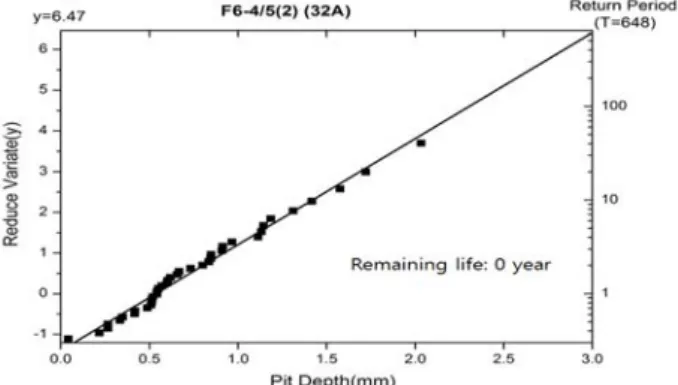
Corrosion, which refers to the degradation of materials, is an electrochemical reaction between a metal and its environ- ment [1]. Normally, it is relatively easy to quantify uniform corrosion through the measurement of weight loss and corro- sion rate, as compared with localized corrosion, such as pitting and crevice corrosion. In contrast, it is difficult to quantify pit- ting and crevice corrosion, because the corrosion rate at a spe- cific location mainly depends on the microscopic material and environmental conditions [2][3]. Prediction of pitting corrosion is important to prevent severe corrosion of pipelines, ships, and offshore structures [4][5]. According to a study conducted by Ahammed [6], the damage inflicted on an unprotected pipe- line without paint, coating, or cathodic protection is mainly due to pitting corrosion. Normally, the analysis of pitting cor- rosion is difficult in the case of deep pits. Thus, it is im- portant to predict pitting corrosion using a reliable method [7][8]. For several decades, extreme value statistics has been used to confirm the pitting sensitivity. Extreme value statistics with Gumbel distribution is quite useful and reliable, not only to estimate the maximum pit depth and pitting corrosion, but also to predict the remaining life [9]. The Gumbel distribution
can be expressed as
exp exp
(1)
where F(x) represents the cumulative probability of pit depth, λ is the location parameter, and α is the scale parameter. The reduced variate, y, can be represented as
(2)
F(y) can be calculated from the following Equation (3):
(3)
where i is the i
thposition of the ordered value of x (descending order), and N is total number of pit samples. In addition, the return period, T, which is a size factor, can be defined as follows.
(4)
The return period of a pipeline can also be calculated by
the total area of pipeline over the area of selected specimens.
After the maximum pit depth is calculated by the equations, the remaining thickness of the specimen can be obtained by deducting the maximum pit depth from the total thickness. The corresponding remaining life of the samples can also be calcu- lated [10].
The main purpose of this study is to investigate not only the type of corrosion and its severity, but also to predict the remaining life of the pipeline. The results from visual in- spection, electrochemical potentiodynamic anodic polarization test, pitting depth measurement, and extreme value statistics with Gumbel distribution are used for the analysis.
Figure 1: An example of Selected pipeline in this study
2. Experimental Method 2.1 Specimen
The structures investigated in our study were each equipped with a fire extinguishing system . The fire extinguishing system was installed on six ground floors and three basement floors. The samples for testing were randomly selected based on visual inspection from outside.
Figure 1 shows one of these pipelines that was selected for this experiment. Six different types of samples were selected, considering mainly the pipeline diameter. In this study, the diameters were chosen as 150 mm, 100 mm, 50 mm, 40 mm, 32 mm, and 25 mm; the details are presented in Table 1.
The material of the pipeline was carbon steel, and the chemical composition of the material is presented in Table 2.
In particular, seam pipes made by joining two semi-circular pipes by welding were used in this pipeline; thus, it was ex- pected that corrosion would be observed mainly in the welding zone. The selected specimens were cut to equal lengths of 25 cm. After cutting, the removal of corrosion products from the test specimens was done by chemical cleaning [11].
Table 1: Selected specimens and dimension Location Specimen
Name
Diameter (mm)
Thickness (mm)
Ground
F6-1A 150 4.5
F6-1B F6-2A
50 3.5
F6-2B F6-3A F6-3B F6-4A
32 3.0
F6-4B F6-5A F6-5B
F5-1A 25
F5-1B F4-1A
2.5 3.0
F4-1B F3-1A F3-1B
Basement
B2-1A 40
B2-1B
B3-1A 150 4.5
B3-1B
B3-2A 100 4.0
B3-2B
B3-3A 40 3.0
B3-3B
Table 2: Chemical composition of pipeline steel
Component C Si Mn P S Cr
Content 0.19 0.23 0.48 0.015 0.004 0.04
Component Ni Cu Mo V Al Fe
Content 0.01 0.01 0.006 0.005 0.008 Bal.
Firstly, 1000 mL of hydrochloric acid, 20 g of antimony tri- oxide, and 50 g of stannic chloride were mixed for preparing the cleaning solution. Then, the solution was heated up to 20–
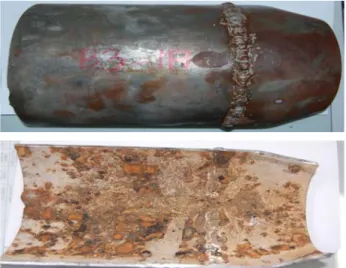
25 °C, and the specimens were kept immersed in the solution for 25 min. Figure 2 shows the surface of a specimen before and after the chemical cleaning. As shown in Figure 2, most of the corrosion products were removed by cleaning.
Figure 2: Internal surface of pipeline specimen before chem-
ical cleaning (upper) and after chemical cleaning (lower)
2.2 Experimental Procedure
Visual inspection, pitting depth measurement, and electro- chemical potentiodynamic anodic polarization test were carried out to evaluate the state of corrosion. Extreme value statistics analysis with Gumbel distribution was applied to the analysis of the maximum pitting corrosion depth and prediction of life- time of the pipeline. Firstly, visual inspection was conducted to confirm the type of corrosion and corroded areas. It was al- so checked whether the corrosion was highly localized around the heat affected zone (HAZ). The pitting depth was measured using an optical microscope and micro dial gage after the specimens was cleaned by means of chemical cleaning.
Twenty pitting points were selected in each specimen. The pit- ting depth could be measured by adjusting the focal point of microscope.
Electrochemical potentiodynamic anodic polarization tests were carried out using a potentiostat, Reference 600, devel- oped by Gamry Instruments Co. ltd [12]. The reference elec- trode for the measurement of potential was a silver/silver chloride electrode (SSCE, Ag/AgCl), and the counter electrode was a platinum electrode. The potentiodynamic anodic polar- ization measurements were conducted in fresh water and 3%
salt water to obtain the polarization curve and corrosion cur- rent density. Finally, the maximum pit depth and lifetime of the pipeline were statistically estimated using the extreme val- ue statistics.
3. Experimental Results 3.1 Visual Inspection
When the samples were selected, they were divided into two categories: those with highly corroded areas and those with moderate corrosion that is not visible from outside. Thus, that remaining life of these pipelines will be less, as only cor- roded pipelines are selected.
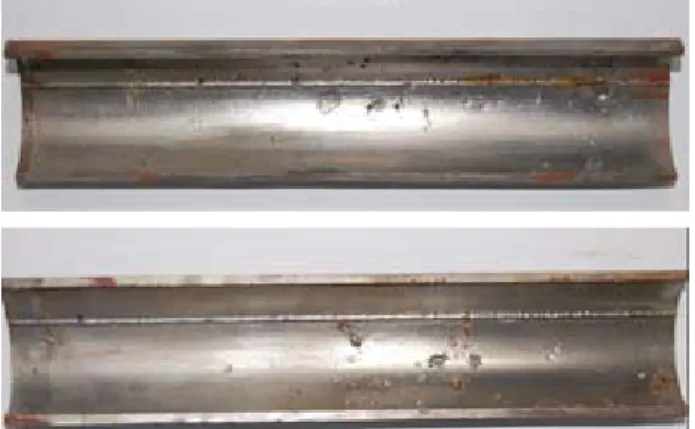
Figures 3 and 4 show state of the samples on the inner side after chemical cleaning. From Figure 3, it can be confirmed that pitting is the main cause of pipeline corrosion, and that most of the pits are concentrated around the seam, where welding was done. It can also be seen that corrosion has de- veloped from the inner side of the pipeline, and not from outside. This is owing to the fact that the outside of pipelines are coated with paint to prevent corrosion.
It can be seen from the visual inspection that not all sam- ples are severely corroded. Evidence of corrosion cannot be confirmed in several samples, as shown in Figure 4. In addi- tion, the closer the distance of the pipeline from the water supply facilities, the higher the corrosion traces are. It is ex-
pected that corrosion may be higher in the areas closer to wa- ter supply facilities, since that pipelines in such areas are more likely to be influenced by water and air simultaneously.
Figure 3: Inner surface of corroded specimens
Figure 4: Inner surface of specimens
3.2 Electrochemical potentiodynamic anodic polarization test
The electrochemical potentiodynamic polarization test is
done for characterization of a metal specimen by its cur-
rent-potential relationship. This test is one of the proven ways
to investigate pitting corrosion and passivation tendencies with-
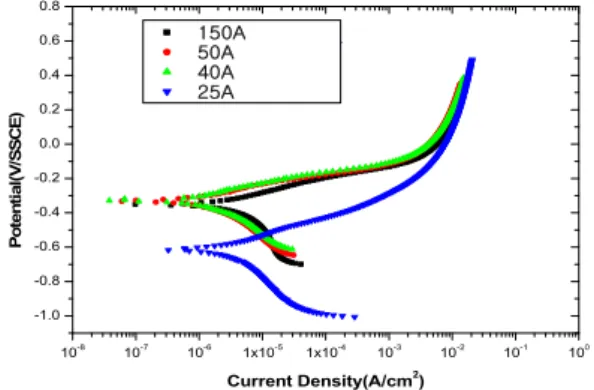
in a few hours. Figures 5 and 6 show the polarization curves
of the specimens in fresh water and in 3% salt water,
respectively. In Figure 5, all the specimens show similar polar-
ization behavior in terms of correlation between the corrosion
potential and current density. The results also show that the
specimens do not have a passive behavior, but are in an active
state of corrosion. It can also be seen that specimen 25A has
a much higher corrosion rate than the other specimens. It must
be noted that the anodic behavior of specimen 25A has been
affected because of the presence of chloride ions in the salt
water, as shown in Figure 6. The reason why all the speci-
mens show a similar trend is that the material of the speci-
mens is the same regardless of the pipeline diameter[13].
10-8 10-7 10-6 1x10⁻⁵ 1x10⁻⁴ -1.0
-0.8 -0.6 -0.4 -0.2 0.0 0.2 0.4 0.6 0.8
Potential(V/SSCE)
Current Density(A/cm2) 150A
50A 40A 25A
Figure 5: Polarization curve of specimens in fresh water
10-8 10-7 10-6 1x10⁻⁵ 1x10⁻⁴ 10-3 10-2 10-1 100 -1.0
-0.8 -0.6 -0.4 -0.2 0.0 0.2 0.4 0.6 0.8
Potential(V/SSCE)
Current Density(A/cm2) 150A
50A 40A 25A