*Received: August 12, 2013 / Revised: September 9, 2013 Accepted: September 9, 2013
†Corresponding author: Michung Yoon. Department of Life Sciences, Mokwon University, Daejeon 302‐729, Korea.
Tel: +82-42-829-7581, Fax: +82-42-829-7580 e-mail: [email protected]
ⒸThe Korean Society for Biomedical Laboratory Sciences. All rights reserved.
J. Exp. Biomed. Sci. 2013, 19(3): 206~212 pISSN : 1738-3226
The Herbal Composition GGEx18 from Laminaria japonica, Rheum palmatum, and Ephedra sinica Inhibits High Fat
Diet‐Induced Obesity by Regulating Appetite Genes
Soon Shik Shin1 and Michung Yoon2,†
1Department of Formula Sciences, College of Oriental Medicine, Dongeui University, Busan 614‐052, Korea
2Department of Life Sciences, Mokwon University, Daejeon 302‐729, Korea
The herbal composition Gyeongshingangjeehwan 18 (GGEx18), which is composed of three herbs, Laminaria japonica Aresch (Laminariaceae), Rheum palmatum L. (Polygonaceae), and Ephedra sinica Stapf (Ephedraceae), has been used as an anti‐obesity drug in Korean local clinics. Thus, we investigated whether GGEx18 regulates obesity by suppressing appetite in high fat diet‐induced obese C57BL/6J mice. Administration of GGEx18 to obese mice for 9 weeks significantly decreased body weight gain, epididymal adipose tissue weight, and food efficiency ratio. GGEx18 also caused a significant decrease in the circulating levels of leptin, which were increased by about 450% in obese control mice compared with normal lean mice. Concomitantly, GGEx18 decreased mRNA levels of a potent appetite‐stimulating hormone neuropeptide Y, but increased an appetite‐suppressing hormone pro‐opiomelanocortin mRNA levels. These results suggest that GGEx18 may prevent obesity through regulating appetite in nutritionally obese mice.
Key words: Appetite, GGEx18, Leptin, Neuropeptide Y, Proopiomelanocortin
INTRODUCTION
Obesity is the result of an energy imbalance caused by an increased ratio of caloric intake to energy expenditure.
In conjunction with obesity, its related metabolic disorders such as insulin resistance, type 2 diabetes, dyslipidemia, hypertension, and atherosclerosis have become global health problems (Bessesen, 2008; James, 2008). Only one anti‐obesity drug orlistat is currently approved by the US FDA for long time use and synthetic anti‐obesity drugs are under development for the treatment of obesity. However, there remains a pressing need for safer and more effective therapies for long‐term
use of these drugs. Thus, investigators have been interested in herbal medicines widely used in oriental societies for the development of new anti‐obesity drugs because their efficacies and safety have already been confirmed.
There has been a great increase in the use of alternative and complementary medicines such as herbal remedies in the treatment of these diseases (Das and Maulix, 2006; Sharpe et al., 2007; Valcheva‐Kuzmanova et al., 2007). Gyeongshingangjeehwan 18 (GGEx18), an herbal drug composed of the three medicinal plants Rheum palmatum L. (Polygonaceae), Laminaria japonica Aresch (Laminariaceae), and Ephedra sinica Stapf (Ephedraceae), has already been used as an anti‐obesity drug in local clinics of Korea. These three herbs are reported to have anti‐obesity, anti‐diabetes, and lipid‐
lowering effects (Boozer et al., 2001, 2002; You et al., 2009; Huang et al., 2010; Xue et al., 2010; Zheng et al., 2010), supporting the belief that GGEx18 may regulate obesity and its related metabolic disorders. Our previous
Original Article
study showed that GGEx18 was more effective compared with individual herbs with respect to their anti‐obesity effects and safety (Yoon et al., 2010). We also found that GGEx18 inhibited obesity and hepatic steatosis by regulating the expression of genes involved in fatty acid oxidation in high fat diet‐fed obese mice (Shin and Yoon, 2012; Shin et al., 2012). Anti‐obesity drugs act through one or more of the following mechanisms, such as suppression of appetite, increase of the body’s metabolism, and prevention of fat absorption (Hainer and Hainerová, 2012). Actually, our present study showed that GGEx18 decreased food intake. Accordingly, we thought it plausible that GGEx18 can effectively inhibit by regulating appetite.
We treated high fat diet‐induced obese mice with GGEx18. We show that GGEx18 reduced body weight gain, subcutaneous fat, and feeding efficiency ratio by both normalizing circulating leptin levels and regulating hypothalamic genes involved in appetite.
MATERIALS AND METHODS Preparation of GGEx18
GGEx18 was prepared from food‐grade aqueous extracts of the three herbs Laminaria japonica from the southern sea of Korea, Ephedra sinica, and Rheum palmatum (Hwalim, Busan, Korea), and the composition of GGEx18 is as previously described (Shin et al., 2012). The proportions used in this study are the same as those used to treat human patients. Boucher specimens for Ephedra sinica (FOS‐05‐04), Laminaria japonica (FOS‐
05‐05), and Rheum palmatum (FOS‐05‐06) were deposited at the Department of Formula Sciences, Dongeui University. Briefly, three dried herbs with their contents weighted were boiled together in distilled water for 22 h at 95℃. The aqueous extracts were then filtered and freeze‐dried under vacuum for the production of GGEx18.
Animal treatments
Eight‐week‐old male wild‐type C57BL/6J mice (n=8/group) were purchased from Central Lab Animal (Seoul, Korea) and randomly divided into five groups.
Mice were fed a low fat diet (normal group; 13% kcal fat, CJ, Incheon, Korea), a high fat diet (control group;
45% kcal fat, Research Diets, New Brunswick, NJ, USA), or the high fat diet supplemented with three doses of GGEx18 (125, 250, and 500 mg/kg/day) for 9 weeks.
In all experiments, body weights were measured daily using top‐loading balance and the person measuring the body weight blinded to each treatment group. Food intake was determined by estimating the amount of food consumed by mice throughout the treatment period.
Cages were inspected for food spillage, but only a little spillage was noticed and collected to measure the food intake. Food efficiency ratio (FER) was calculated as follows: FER (%)=body weight gain (g/d)/food intake (g/d)x100. At the end of the 9‐week period, the animals were sacrificed and their tissues were harvested, weighed, snap frozen in liquid nitrogen and stored at –80℃ until use. Blood was collected after 4‐hr fast from the saphenous vein into tubes, and serum was separated and stored at –80℃ until analysis. Levels of plasma leptin were measured using a leptin radioimmunoassay kit (Linco, St. Charles, MO, USA). All animal experiments were approved by the Institutional Animal Care and Use Committee of Dongeui University and followed National Research Council Guidelines.
Reverse transcription‐polymerase chain reaction (RT
‐PCR)
Total cellular RNA from hypothalamus was prepared using the Trizol reagent (Invitrogen). After 2 μg total RNA was reverse‐transcribed using Moloney murine leukemia virus reverse transcriptase (MMLV‐RT;
Promega, Madison, WI, USA) and an antisense primer, cDNA was generated. The RNA was denatured for 5 min at 72℃ and immediately placed on ice for 5 min.
Denatured RNA was mixed with MMLV‐RT, MMLV‐RT buffer, and a dNTP mixture, and incubated for 1 h at 4 2℃. Synthesized cDNA fragments were amplified by PCR in an MJ Research Thermocycler (Waltham, MA, USA). The PCR sequences for neuropeptide Y (NPY) are as follows: NPY forward primer 5′‐taggtaacaagcgaatgggg‐
3′ and reverse primer 5′‐gggatgagatgagatgaggg‐3′. The
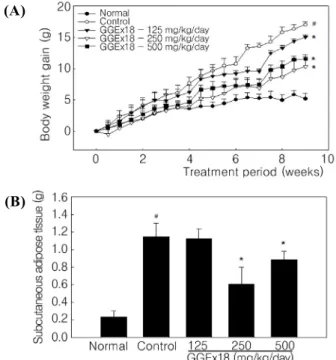
Fig. 1. Body weight gain and subcutaneous adipose tissue weight. Adult male C57BL/6J mice were fed a low fat diet (Normal), a high fat diet (Control), or the high fat diet supplemented with 125, 250, and 500 mg/kg/day GGEx18 for 9 weeks. (A) Body weights at the end of the treatment period are significantly different when comparing the control group to the normal (#P<0.05) or GGEx18 (*P<0.05) groups. (B) Subcutaneous adipose tissues were measured at the end of the study. All values are expressed as the mean ± SD. #P<0.05 compared with normal group, *P<0.05 compared with control group.
PCR sequences for pro‐opiomelanocortin (POMC) are as follows: POMC forward primer 5′‐tgccgagattctgctaca‐3′
and reverse primer 5′‐atggcgttcttgaagagc‐3′. The PCR sequences for β‐actin are as follows: β‐actin forward primer 5′‐tggaatcctgtggca tccatgaaa‐3′ and reverse primer 5′‐taaaacgcagctcagtaac agtcc‐3′. The cDNA was mixed with PCR primers, Taq DNA polymerase (Nanohelix, Daejeon, Korea), and a dNTP mixture. The reaction consisted of 30 cycles of denaturation for 1 min at 94℃, annealing for 1 min at 56‐58℃, and elongation for 1 min at 72℃. The PCR products were analyzed by electrophoresis on a 1% agarose gel. Relative expression levels are presented as a ratio of target gene cDNA vs.
β‐actin cDNA. PCR products were quantified from agarose gels using the GeneGenius (Syngene, Cambridge, UK).
Statistical analysis
All values are expressed as the mean ± standard deviation (SD). Statistical analysis was performed by ANOVA followed by either Tukey’s multiple comparison or Dunnett’s post hoc tests. A P value <0.05 was considered statistically significant.
RESULTS
Body weight gain and subcutaneous adipose tissue weight in high fat diet‐induced obese mice
To determine whether GGEx18 regulates obesity in high fat diet‐fed obese mice, we measured body weight gain and inguinal adipose tissue weight. Obese control mice had a higher body weight gain (225%) than low fat diet‐fed normal lean mice (Fig. 1A). In contrast, GGEx18 significantly decreased body weight gain of control mice by 11%, 39% and 31% at doses of 125, 250 and 500 mg/kg/day, respectively, compared with control mice.
Similarly, subcutaneous adipose tissue weight was significantly lower in GGEx18‐treated than in untreated control mice (Fig. 1B). GGEx18 significantly decreased subcutaneous adipose tissue weight by 46% and 22% at doses of 250 and 500 mg/kg/day, respectively, compared with control mice. In addition, GGEx18 did not have any
toxic effects on other organs.
Food efficiency ratio in high fat diet‐induced obese mice
GGEx18 treatment also significantly decreased food efficiency ratio compared with obese control mice. Food efficiency ratio was increased by 256% in control mice compared with normal mice (Fig. 2). However, food efficiency ratio was reduced by 37.8% and 27% at doses of 250 and 500 mg/kg/day, respectively, compared with control mice. Thus, these results indicate that GGEx18 effectively inhibits body weight gain and food efficiency ratio in obese animals.
Circulating leptin levels in high fat diet‐induced obese mice
Leptin is a long‐term satiety signal that often reflects
(A)
(B)
Fig. 2. Food efficiency ratio. Adult male C57BL/6J mice were fed a low fat diet (Normal), a high fat diet (Control), or the high fat diet supplemented with 125, 250, and 500 mg/kg/day for 9 weeks. Food efficiency ratio was measured daily and all values are expressed as mean ± SD. #P<0.05 compared with normal group, *P<0.05 compared with control group.
Fig. 3. Plasma leptin levels and correlation between plasma leptin levels and subcutaneous adipose tissue. Adult male C57BL/6J mice were fed a low fat diet (Normal), a high fat diet (Control), or the high fat diet supplemented with 125, 250, and 500 mg/kg/day for 9 weeks. (A) Plasma leptin levels. All values are expressed as the mean ± SD. #P<0.05 compared with normal group, *P<0.05 compared with control group. (B) Plasma leptin levels positively correlated with subcutaneous fat mass.
changes in body weight and adipose tissue mass. Marked elevations in leptin are thought to reflect leptin resistance and a diminution of satiety responses. Compared to normal mice, serum leptin levels were 449% higher in control mice (Fig. 3A). In contrast, GGEx18 treatment significantly decreased serum levels of leptin by 37%, 54%, and 38% at doses of 125, 250, 500 mg/kg/day in control mice, respectively. Interestingly, subcutaneous fat weights positively correlated with leptin levels following GGEx18 treatment (Fig. 3B), suggesting that reductions in body weight gain and subcutaneous adipose tissue weight as well as food intake by GGEx18 were not due to decreases in leptin levels. Thus, GGEx18 may improve obesity through alleviation of leptin resistance.
Expression of genes involved in food intake in high fat diet‐induced obese mice
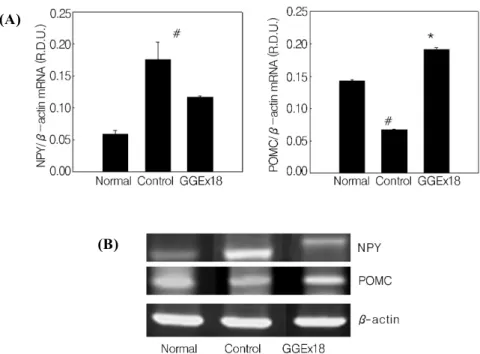
We tested the effects of GGEx18 on the hypothalamic expression of genes associated with food intake, such as NPY and POMC. Compared with normal mice, obese controls had 197% higher mRNA levels of an appetite‐
stimulating hormone NPY, whereas control mice had 52% lower mRNA levels of an appetite‐suppressing hormone POMC (Fig. 4). Consistent with the effects of GGEx18 on feeding efficiency ratio, GGEx18 (250
mg/kg/day) decreased NPY mRNA levels by 33%, but increased POMC mRNA levels by 183% compared with controls. These results suggest that GGEx18 may inhibit obesity, in part, through the regulation of genes responsible for appetite.
DISCUSSION
Our previous study demonstrated that GGEx18 regulates obesity and hepatic steatosis by activating liver and skeletal muscle peroxisome proliferator‐activated receptor α (PPARα) (Shin et al., 2012; Shin and Yoon, 2012). We thus investigated whether GGEx18 inhibits obesity by suppressing appetite.
Our results show that GGEx18 decreased high fat diet‐
induced increases in body weight gain and inguinal adipose tissue mass in obese control mice. High fat diet‐
(A)
(B)
Fig. 4. The mRNA expression levels of hypothalamic genes involved in appetite. (A) Adult male C57BL / 6J mice were fed a low fat diet (Normal), a high fat diet (Control), or the high fat diet supplemented with 250 mg/kg/day mg / kg
/ day GGEx18 for 9 weeks. All values are expressed as the mean ± SD. #P<0.05 compared with normal group, *P<0.05 compared with control group. (B) Representative RT‐PCR bands from one of three independent experiments are shown.
NPY, neuropeptide Y; POMC, pro‐opiomelanocortin.
fed control mice had much higher body weight gain compared with low fat diet‐fed normal mice. However, administration of GGEx18 to obese mice for 9 weeks significantly reduced body weight gain compared with untreated control mice. Similar to data from the animal study, our human study also showed that administration of GGEx18 (800‐900 mg/day) to obese patients for 6 months decreased body weights and abdominal fat area compared with untreated obese patients (data not shown).
GGEx18 inhibited hyperphagia (overeating). As expected, obese control mice had 256% higher food efficiency ratio compared with lean normal mice. However, administration of GGEx18 decreased food efficiency ratio by 37% and 27% at doses of 250 and 500 mg/kg/day, respectively, in obese controls. Our results suggest that GGEx 18 effectively decreases body weight gain and subcutaneous fat mass and that these effects of GGEx18 may be due to the feeding‐inhibitory effects of GGEx18.
As these effects were not dose dependent, further studies in cellular and molecular effects of individual herbs could help clarify the reason why there are nondose‐dependent
effects of GGEx18 on body weight, adipose tissue mass, and food efficiency ratio.
Leptin is a long‐term satiety signal, which is secreted mainly by adipocytes (Considine et al., 1996). Its level is proportional to body fat amount, so this is the primary way to know how much body fat is stored (Maffei et al., 1995). Animals with a leptin deficiency or a defect in leptin receptors exhibit hyperphasia and extreme obesity (Friedman and Halaas, 1998). However, marked increases in leptin levels may induce leptin resistance and a decreased satiety response (Ahima and Flier, 1983).
Leptin exerts negative feedback effects on energy intake, but it loses the ability to inhibit energy intake and to stimulate energy expenditure in common obesity. This apparent leptin resistance is explained by the results that the endogenous hyperleptinemia or exogenous leptin treatment is not able to prevent weight gain in obese humans and rodents (Considine et al., 1996; Flier, 2004).
Therefore, high fat diet‐fed obese mice are likely becoming leptin resistant, a disorder observed in human obesity. Similarly, our results showed that obese controls (A)
(B)
had 4.5 times higher levels of serum leptin compared with lean normals. In contrast, serum leptin levels were significantly decreased by GGEx18. In fact, increased leptin levels did not induce decreased food efficiency ratios in obese mice and its decreased levels by GGEx18 did not result in increased food efficiency ratios.
Increased lipid accumulation in adipose tissue would be expected to increase leptin production. Subcutaneous adipose tissue is more responsive to produce leptin than visceral adipose tissue. We observed that subcutaneous inguinal fat is significantly decreased by GGEx18 at doses of 250 and 500 mg/kg/day in control mice. It is likely that the decreased subcutaneous fat by GGEx18 contributes to the decreased leptin levels. Regression analysis also revealed that serum leptin levels positively correlated with subcutaneous adipose tissue weight. Thus, it is plausible that GGEx18 prevents hyperphagia, body weight gain and fat mass increment caused by high fat diet in C57BL/6J mice in part through decreasing the leptin levels.
We also examined whether the changes in the expression of appetite genes are involved in the regulation of obesity by GGEx18. An important brain center for appetite regulation is the arcuate nucleus of hypothalamus (Morris, 1989; Cowley et al., 2001; Suzuki et al., 2012). The arcuate nucleus has two groups of neurons involved in hunger. One group secretes NPY, a potent appetite stimulant. The other secretes POMC, which inhibits eating. Our results showed that GGEx18 significantly decreased mRNA levels of NPY with increasing POMC mRNA levels in hypothalamus. Thus, prevention of increases in body weight gain, fat mass by GGEx18 may be attributed in part to changes in hypothalamic mRNA expression of genes involved in the control of food intake by GGEx18.
In addition to the effects of GGEx18 on appetite‐
related genes, GGEx18 seems to prevent obesity by increasing the expression of adiponectin. Adiponectin, which is exclusively secreted from adipose tissue and its levels are inversely correlated with body fat, is a protein hormone that modulates a number of metabolic processes, including fatty acid oxidation and glucose metabolism
(Ukkola and Santaniemi, 2002; Nedvídková et al., 2005).
Most of the effects of adiponectin are thought to be mediated by AMP‐activated protein kinase and PPARα involved in fatty acid oxidation (Shin and Yoon, 2011;
Yoon, 2011; Padmalayam and Suto, 2013). Since our previous results suggested that GGEx18 inhibited hepatic steatosis and obesity through up‐regulating liver and skeletal muscle PPARα (Shin et al., 2012; Shin and Yoon, 2012), GGEx18 may regulate obesity by increasing the adiponectin expression. Thus, further studies will be needed to determine the effects of GGEx18 on the adiponectin expression.
In conclusion, these results demonstrate that GGEx18 effectively decreases food efficiency ratio, body weight, subcutaneous fat mass in high fat diet‐induced obese mice. GGEx18 is likely to act as an anti‐obesity drug by both normalizing the serum leptin levels and regulating the expression of genes related to appetite.
Acknowledgements
This work supported by the National Research Foundation of Korea (NRF) Grant funded by the Korea Government (MEST) (NRF‐2010‐0027498 and NRF‐2010‐
0017313).
REFERENCES
Ahima RS, Flier JS. Leptin. Ann Rev Physiol. 2000. 62: 413‐ 437.
Bessesen DH. Update on obesity. J Clin Endocrinol Metab.
2008. 93: 2027‐2034.
Boozer CN, Daly PA, Homel P, Solomon JL, Blanchard D, Nasser JA, Strauss R, Meredith T. Herbal ephedra/caffeine for weight loss: A 6‐month randomized safety and efficacy trial. Int J Obes Relat Metab Disord. 2002. 26: 593‐604.
Boozer CN, Nasser JA, Heymsfield SB, Wang V, Chen G, Solomon JL. An herbal supplement containing Ma Huang‐ Guarana for weight loss: A randomized, double‐blind trial.
Int J Obes Relat Metab Disord. 2001. 25: 316‐324.
Considine RV, Sinha MK, Heiman ML, Kriauciunas A, Stephens TW, Nyce MR, Ohannesian JP, Marco CC, McKee LJ, Bauer TL, Caro JF. Serum immunoreactive‐ leptin concentrations in normal‐weight and obese humans.
N Engl J Med. 1996. 334: 292‐295.
Cowley MA, Smart JL, Rubinstein M, Cerdán MG, Diano S, Horvath TL, Cone RD, Low MJ. Leptin activates anorexigenic POMC neurons through a neural network in the arcuate nucleus. Nature. 2001. 411: 480‐484.
Das DK, Maulik N. Resveratrol in cardioprotection: a therapeutic promise of alternative medicine. Mol Interv.
2006. 6: 36‐47.
Flier JS. Obesity wars: molecular progress confronts an expanding epidemic. Cell. 2004. 116: 337‐350.
Friedman JM, Halaas JL. Leptin and the regulation of body weight in mammals. Nature. 1998. 395: 763‐770.
Hainer V, Hainerova IA. Do we need anti‐obesity drugs?
Diabetes Metab Res Rev. 2012. 28: 8‐20.
Huang L, Wen K, Gao X, Liu Y. Hypolipidemic effect of fucoidan from Laminaria japonica in hyperlipidemic rats.
Pharm Biol. 2010. 48: 422‐426.
James WP. The epidemiology of obesity: the size of the problem. J Intern Med. 2008. 263: 336‐352.
Maffei M, Halaas J, Ravussin E, Pratley RE, Lee GH, Zhang Y, Fei H, Kim S, Lallone R, Ranganathan S, Kern PA, Friedman JM. Leptin levels in human and rodent:
measurement of plasma leptin and ob RNA in obese and weight‐reduced subjects. Nat Med. 1995. 1: 1155‐1161.
Morris BJ. Neuronal localisation of neuropeptide Y gene expression in rat brain. J Comp Neurol. 1989. 290: 358‐368.
Nedvídková J, Smitka K, Kopský V, Hainer V. Adiponectin, an adipocyte‐derived protein. Physiol Res. 2005. 54: 133‐ 140.
Padmalayam I, Suto M. Role of Adiponectin in the metabolic syndrome: current perspectives on its modulation as a treatment strategy. Curr Pharm Des. 2013. 19: 5755‐5763.
Shin SS, Park D, Lee HY, Hong Y, Choi J, Oh J, Lee H, Lee HR, Kim MR, Shen ZB, Cui HH, Yoon M. The herbal composition GGEx18 from Laminaria japonica, Rheum palmatum, and Ephedra sinica reduces obesity via skeletal
muscle AMPK and PPARα. Pharm Biol. 2012. 50: 506‐515.
Shin SS, Yoon M. The herbal composition GGEx18 from Laminaria japonica, Rheum palmatum, and Ephedra sinica inhibits high‐fat diet‐induced hepatic steatosis via hepatic PPARα activation. Pharm Biol. 2012. 50: 1261‐1268.
Shin SS, Yoon M. The Korean traditional anti‐obesity drug Gyeongshingangjeehwan stimulates AMPKα activation in skeletal muscle of OLETF rats. J Exp Biomed Sci. 2011.
17: 273‐281.
Suzuki K, Jayasena CN, Bloom SR. Obesity and appetite control. Exp Diabetes Res. 2012. 2012: 824305.
Ukkola O, Santaniemi M. Adiponectin: a link between excess adiposity and associated comorbidities? J Mol Med. 2002.
80: 696‐702.
Valcheva‐Kuzmanova S, Kuzmanov K, Tancheva S, Belcheva A. Hypoglycemic and hypolipidemic effects of Aronia melanocarpa fruit juice in streptozotocin‐induced diabetic rats. Methods Find Exp Clin Pharmacol. 2007. 29: 101‐105.
Xue J, Ding W, Liu Y. Anti‐diabetic effects of emodin involved in the activation of PPARgamma on high‐fat diet‐ fed and low dose of streptozotocin‐induced diabetic mice.
Fitoterapia. 2010. 81: 173‐177.
Yoon M. The Korean traditional medicine Gyeongshin gangjeehwan stimulates reduces lipid accumulation in skeletal muscle and C2C12 cells. J Exp Biomed Sci.
2011. 17: 283‐289.
Yoon KH, Lee HY, Jung YS, Seo BI, Park KY, Yoon M, Shin S.S. Modulation of obesity by Gyeongshin gangjeehwan 18 in ob/ob mice. Kor J Herb. 2010. 25: 1‐9.
You JS, Sung MJ, Chang KJ. Evaluation of 8‐week body weight control program including sea tangle (Laminaria japonica) supplementation in Korean female college students. Nutr Res Pract. 2009. 3: 307‐314.
Zheng CD, Duan YQ, Gao JM, Ruan ZG. Screening for anti‐ lipase properties of 37 traditional Chinese medicinal herbs.
J Chin Med Assoc. 2010. 73: 319‐324.