• 검색 결과가 없습니다.

Influence of Angle Ply Orientation on the Flexural Strength of Basalt and Carbon Fiber Reinforced Hybrid Composites

N/A
N/A
Protected

Academic year: 2021

Share "Influence of Angle Ply Orientation on the Flexural Strength of Basalt and Carbon Fiber Reinforced Hybrid Composites"

Copied!
5
0
0

로드 중.... (전체 텍스트 보기)

전체 글

(1)

ISSN 2288-2103(Print), ISSN 2288-2111(Online)

Paper

Influence of Angle Ply Orientation on the Flexural Strength of Basalt and Carbon Fiber Reinforced Hybrid Composites

Ali Nawaz Mengal* , Saravanan Karuppanan*

ABSTRACT: In this paper the influence of fiber orientation of basalt and carbon inter-ply fabrics on the flexural properties of hybrid composite laminates was experimentally investigated. Four types of basalt/carbon/epoxy inter-ply hybrid composite laminates with varying angle ply orientation of reinforced basalt fiber and fixed orientation of carbon fiber were fabricated using hand lay-up technique. Three point bending test was performed according to ASTM 7264. The fracture surface analysis was carried out by scanning electron microscope (SEM). The results obtained from the four laminates were compared. Lay-up pattern of [0B/+30B/-30B/0C]

S

exhibits the best properties in terms of flexural strength and flexural modulus. Scanning electron microscopy results on the fracture surface showed that the interfacial de-bonding between the fibers and epoxy resin is a dominant fracture mode for all fiber lay-up schemes.

Key Words: Carbon fiber, Basalt fiber, Hybrid, Hand lay-up, Laminates, Scanning electron microscope

1. INTRODUCTION

Hybrid composite materials are produced by combining two or more different reinforced materials in a single matrix [1].

By this combination it would be possible to fabricate a new material structure with more attractive and additional prop- erties, whilst diminishing their disadvantages [2].

In recent years there has been a great interest in hybrid materials, particularly with the combination of basalt fiber and carbon fiber. Basalt fiber has received increasing attention as a new comer to fiber reinforced polymers on the basis of its superior mechanical properties [3]. Some researchers claim that basalt fiber has good potential to provide benefits that are superior to glass fiber, and significantly cost effective to carbon fiber. Mingchao et al. [4] investigated the mechanical prop- erties of basalt fiber reinforced plastic. They concluded that the interface formed between basalt fiber reinforced plastic and epoxy resin is better than glass fiber reinforced plastic. Czigany et al. [5] examined the basalt fiber as a reinforcement of poly- mer composites. They claimed that basalt fiber due to its out- standing mechanical properties can be an alternative to glass

fiber. Khalili et al. [6] presented an experimental investigation on mechanical behavior of basalt fiber reinforced composite under tensile and bending loads. The results revealed that basalt fibers can be successfully used instead of glass fibers in fiber composite manufacturing. Basalt fiber has high tensile strength, modulus, rupture strength, good range of thermal performance, good chemical resistance, superior electromag- netic properties, good resistance to vibration, high compres- sive strength, and better strain to failure, inexpensive, environmentally and ecologically harmless.

Carbon fiber provides very high strength, stiffness and modulus of elasticity among all the fibers [7]. Due to its supe- rior properties, carbon fiber composites have been widely used in various sectors of engineering technology such as for air- craft, wind turbine blades, construction, ships, automobile and sporting goods. However, they are more brittle, have low dam- age tolerance and expensive to manufacture. Due to their high cost carbon fibers has limited prospects of mass application [8]. To overcome these drawbacks of carbon fiber, hybrid composites with two types of fibers are most useful and cost effective. With hybridization it is possible to design a new

Received 24 September 2014, received in revised form 23 December 2014, accepted 10 February 2015

*

*

Department of Mechanical Engineering, Universiti Teknologi PETRONAS, Bandar Seri Iskandar, 31750 Tronoh, Perak, Malaysia

Department of Mechanical Engineering, Universiti Teknologi PETRONAS, Bandar Seri Iskandar, 31750 Tronoh, Perak, Malaysia,

Corresponding author (E-mail: aliract@ gmail.com)

(2)

composite material system to best suit the requirements. Com- bining basalt fiber with carbon fiber are the most advanced and exciting area of hybrid technologies. Many studies have been carried out to investigate the mechanical behavior of basalt fiber and to understand its cooperation with other rein- forced materials [9]. Subagia et al. [10] investigated the stack- ing sequence effect on flexural properties of basalt carbon hybrid composite. They presented that the strength of basalt carbon hybrid composite improved by appropriate variation in the staking sequence of hybrid composites. However, very few research has been done on basalt/carbon hybrid composites [11]. In particular, the effect of angle-ply fiber orientation of basalt carbon hybrid composites has not been investigated.

The objective of this work was to evaluate the influence of angle ply orientation on the flexural strength of basalt and car- bon fiber reinforced hybrid composite. For this purpose, hybrid composite reinforced with basalt fiber and carbon fiber were prepared by hand lay-up technique. The angle ply ori- entation of carbon fiber was fixed at 0°, and the angle ply ori- entation of basalt fiber was varied with +25°/-25°, +30°/-30°, +45°/-45° and +60°/-60°. Three point bending test was carried out to investigate the effect of angle ply orientation on the flex- ural strength of basalt carbon hybrid composite. After the flex- ural test, fractured surfaces of hybrid composites were examined by using scanning electron microscope (SEM).

2. EXPERIMENT

2.1 Materials

Basalt fiber (300 g/m

2

) and carbon fiber (300 g/m

2

) was sup- plied by Suretex Composite International China. The epoxy used was epocast and the curing agent was amine based epo- harden. Both epocast and epoharden was supplied by Portal Trading Malaysia. The properties of unidirectional fabrics and epoxy resin are given in Table 1.

2.2 Specimen preparation

The samples of hybrid composite laminates with varying orientation of reinforced fibers were fabricated by the hand

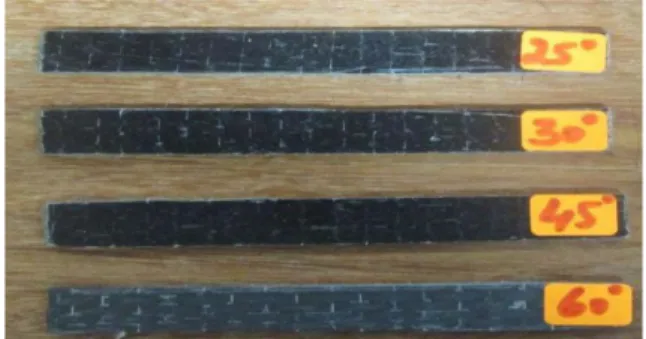
lay-up method. All hybrid composites were prepared by impregnating each fabric with a matrix made of epoxy resin mixed with a curing agent (2:1 by weight) by hand roller. After that a curing stage under room temperature was performed for 24 hours before release. A total of 20 specimens, 5 of each orientation was cut in to the required shape and size as per the ASTM 7264 test standards. Each specimen is composed of 8 layers of basalt and carbon fabric. The quasi-isotropic stacking sequence, fiber orientation and specimen dimensions are sum- marized in Table 2a and 2b. The composite specimen is shown in Fig. 1. The fiber volume fraction of the composite was 33%.

2.3 Test procedure

The test was performed in the Department of Mechanical Engineering, Universiti Teknologi PETRONAS, Malaysia.

Flexural test was carried out in a servo controlled UTM machine according to ASTM D7264 in a three point bending mode (Fig. 2). The crosshead speed was maintained at 1 mm/

min at a span to depth ratio of 32:1. Five rectangular spec- imens (Fig. 1) for each stacking sequence were tested. The tested specimens were examined and analyzed through scan- Table 1. Physical and mechanical properties of fibers and matrix

Properties Basalt fiber

Carbon

fiber Epoxy

Fabric weight (g/m²) 300 300

Fabric thickness (mm) 0.2±0.02 0.2±0.02 Mono filament diameter (μm) 13 7

Epocast viscosity (cps, 30

o

C) 750 ± 15 Hardner viscosity (cps, 30

o

C) 1500 ±2

Hardness Shore D80±1

Flexural strength (MPa) 89.63

Flexural modulus (MPa) 3554

Fig. 1. Basalt carbon hybrid composite specimen with different orientations

Table 2a. Specimen characteristics for flexural test Laminate code Stacking

sequence Fiber orientation

H1 B3C2B3 (0B/+25B/-25B/0C)

S

H2 B3C2B3 (0B/+30B/-30B/0C)

S

H3 B3C2B3 (0B/+45B/-45B/0C)

S

H4 B3C2B3 (0B/+60B/-60B/0C)

S

Table 2b. Specimen dimensions for flexural test Laminate

code

Thickness (mm)

Total length (mm)

Span length (mm)

Width (mm)

H1 2.4 100 76.8 13

H2 2.4 100 76.8 13

H3 2.4 100 76.8 13

H4 2.4 100 76.8 13

(3)

ning electron microscope for failure of fibers and matrix.

3. RESULTS AND DISCUSSION

3.1 Flexural properties

Basalt and carbon fiber reinforced plastic specimens were subjected to flexural loading and tested till failure. The reported data consists of the mean values of five tests for each orientation. The flexural strength and flexural modulus were determined using the following equations.

Flexural strength (σ

f

) = 3P

max

L / 2bh

2

(1) Flexural modulus (E

f

) = L

3

m / 4bh

3

(2)

In the above equation L, b, h, m and P

max

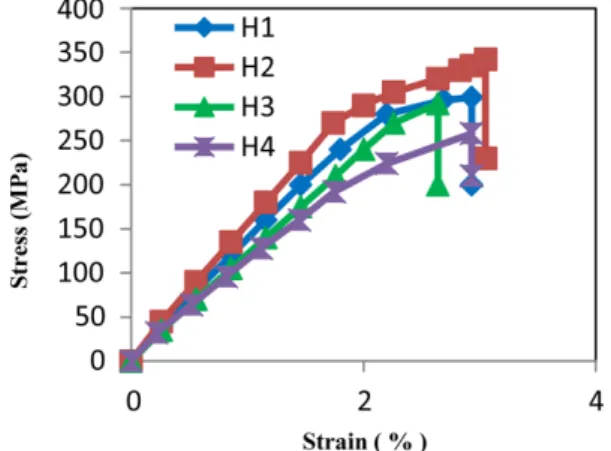
represent the sup- port span, width of the specimen, depth of the specimen, ini- tial slope of the stress strain curve and maximum flexural load respectively. The scatter results and the stress-strain curves of basalt carbon hybrid composite specimen are shown in Fig. 3 and 4, respectively. On the basis of data presented in Fig. 3 it can be seen that hybrid composite laminates (H1, H2, H3, H4) with different orientations exhibit almost linear characteristics before reaching the maximum applied load. All the hybrid composites with different the angle ply orientation of basalt fiber showed differences in the resulting properties of the

Fig. 3. Experimental scatter curves for basalt carbon inter-ply hybrid composites with different angle ply orientation

Fig. 4. Stress-strain curves for basalt carbon inter-ply hybrid composites with different angle ply orientation

Fig. 2. Test specimen in three point bending mode

(4)

basalt/carbon hybrid composite laminates. When the fiber angle was increased from 25° to 30°, there was an increase in flexural strength. As the fiber angle was further increased towards 60°, there was a decrease in flexural strength. It is obvious according to Fig. 3 that H2 with (0B/+30B/-30B/0C)

S

orientation showed significant superior flexural strength and stiffer behavior than other orientations. A better interfacial adhesion between the basalt and carbon fibers was found in H2 as compared to H1. The strong mechanical interlocking through the fibers restricted the shrinkage behavior of the overall composite material in H2. Furthermore, the flexural strength of basalt carbon hybrid composites decreased when the angle increased towards 45° and 60°, which results from

the decline of stress transfer from the matrix to basalt and car- bon fibers. In the case of H1 and H4, both hybrid composite laminates showed the same strain at failure, however, flexural strength of H1 was higher. The strength of H3 was better than H4. It was found that all the composite specimens showed

Fig. 5. Average flexural strength for basalt carbon inter-ply hybrid composites with different angle ply orientation

Fig. 6. Average flexural modulus for basalt carbon inter-ply hybrid composites with different angle ply orientation

Table 3. Flexural properties of basalt carbon hybrid composite laminates

Laminate code Average flexural strength (MPa)

Average flexural modulus (GPa)

H1 299 18

H2 342 22

H3 292 13

H4 258 17

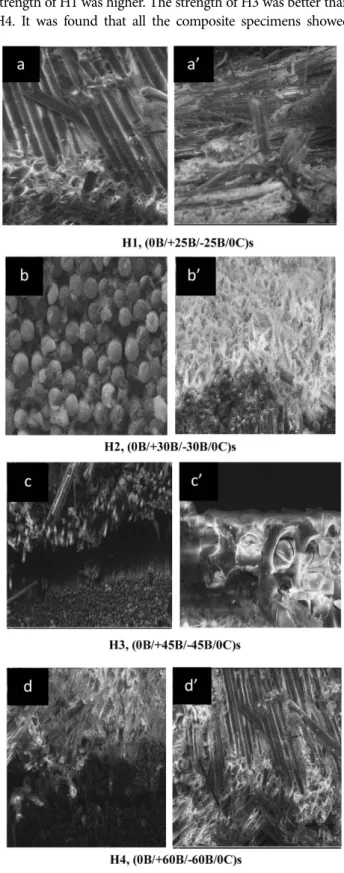
Fig. 7. SEM images of the cross-section of the fractured surfaces

of basalt carbon hybrid composites with different angle

ply orientation

(5)

good ductility with basalt fiber on both compression and ten- sion sides. Fig. 5 and 6 compare the flexural strength and flex- ural modulus of H1, H2, H3 and H4. The figures also show the influence of fiber orientation on basalt carbon hybrid com- posites. Calculated data for flexural properties are given in Table 3.

3.2 Scanning electron microscopic analysis

Scanning electron microscopic observations were made on the fractured surface of flexural test specimens. The SEM was used to analyze the fracture mechanism and evaluate the adhe- sion between layers due to fiber orientation. Fig. 7 shows the SEM images of fractured test specimen. The SEM observations revealed fiber pull outs, breakage and formation of voids in both basalt and carbon fibers, which were not totally filled with epoxy matrix. Fig. 7a and a’ show some evidence of fiber pull-outs and voids that were not totally filled with epoxy matrix, which could explain the lower strength of H1 com- pared to H2. The hybrid composite H2 with fiber orientation 30° showed excellent flexural strength and modulus. It can be clearly seen (Fig. 7b and b’) that the fiber filaments were fully covered with epoxy resin in H2. There is no separation of the fibers from the matrix and a very good interaction between the components can be inferred from the image. The outer- most basalt fiber layers in H3 showed de-bonding and delam- ination (Fig. 7c) while matrix and carbon fiber cracks are nucleated in the central 45° basalt plies and 0° carbon (7c’). In H4 (Fig. 7d and d’), de-bonding and matrix cracking were the common occurrences. All angle ply hybrid specimens showed good ductility as basalt fiber layers were located on the outer side. In all specimens major bending failure happened in ten- sile way. Inclusion of carbon fiber with basalt fiber showed a positive hybridization effect.

4. CONCLUSION

In this study it was found that fiber orientation has a sig- nificant effect on the flexural properties of basalt carbon hybrid composite. This experimental study showed that the flexural properties of laminates using the same materials, with same stacking sequence, but with different fiber orientations change significantly. The laminates with fiber orientation [0B/

+30B/-30B/0C]

S

have exhibited higher flexural strength than the other laminates with [0B/+25B/-25B/0C]

S

, [0B/+45B/

-45B/0C]

S

and [0B/+60B/-60B/0C]

S

orientations. The flexural strength of the basalt carbon hybrid composite with H2 arrangement was 12%, 14% and 24% greater than those of the H1, H3 and H4, respectively. The scanning electron micros- copy (SEM) analysis showed that the dominant failure was de-

bonding between the fibers and epoxy. The results have clearly shown the influence of fiber orientation on the flexural strength of basalt carbon hybrid composite.

REFERENCES

1. Dehkordi, M.T., Nosraty, H., Shokrieh, M.M., Minak, G., and Ghelli, D., “Low Velocity Impact Properties of Intra-ply Hybrid Composites Based on Basalt and Nylon Woven Fabrics,” Mate- rials & Design, Vol. 31, No. 8, 2010, pp. 3835–3844.

2. Singha, K., “A Short Review on Basalt Fiber,” International Jour- nal of Textile Science, Vol. 1, No. 4, 2012, pp. 19-28.

3. Mengal, A.N., Karuppanan, S., and Wahab, A.A., “Basalt Car- bon Hybrid Composite for Wind Turbine Rotor Blades: A Short Review,” Advanced Materials Research, Vol. 970, 2014, pp.

67-73.

4. Mingchao, W., Zuoguang, Z., Yubin, L., Min, L., and Zhijie, S.,

“Chemical Durability and Mechanical Properties of Alkali- proof Basalt Fiber and Its Reinforced Epoxy Composites,” Jour- nal of Reinforced Plastics and Composites, Vol. 27, No. 4, 2008, pp. 393-407.

5. Czigany, T., “Special Manufacturing and Characteristics of Basalt Fiber Reinforced Hybrid Polypropylene Composites:

Mechanical Properties and Acoustic Emission Study,” Compos- ites Science and Technology, Vol. 66, No. 16, 2006, pp. 3210- 3220.

6. Khalili, S.M.R., Daghigh, V., and Eslami, R., “Mechanical Behavior of Basalt Fiber-reinforced and Basalt Fiber Metal Laminate Composites under Tensile and Bending Loads,” Jour- nal of Reinforced Plastics and Composites, Vol. 30, No. 8, 2011, pp.647-659.

7. Han, S.H., Oh, H.J., Lee, H.C., and Su, S.S., “The Effect of Post- Processing of Carbon Fibers on the Mechanical Properties of Epoxy-based Composites,” Composites Part B: Engineering, Vol. 45, No. 1, 2012, pp. 172-177.

8. Faulstich de Paiva, J.M., Nadai dos Santos, A., Rezendec, M.C.,

“Mechanical and Morphological Characterizations of Carbon Fiber Fabric Reinforced Epoxy Composites used in Aeronauti- cal Field”, Journal of Materials Research, Vol. 12, No. 3, 2009, pp. 367-374.

9. Wang, X., Wu, Z., Wu, G., Zhu, H., and Zen, F., “Enhancement of Basalt FRP by Hybridization for Long-span Cable-stayed Bridge,” Composites Part B: Engineering, Vol. 44, No. 1, 2013, pp. 184-192.

10. Subagia, I.D.G., Kim, Y., Tijing, L.D., Kim, C.S., and Shon, H.K.,

“Effect of Stacking Sequence on the Flexural Properties of Hybrid Composites Reinforced with Carbon and Basalt Fibers,”

Composites Part B: Engineering, Vol. 58, 2014, pp. 251-258.

11. Fiore, V., Bella Di, G., and Valenza, A., “Glass–basalt/epoxy Hybrid Composites for Marine Applications”, Materials &

Design, Vol. 32, No. 4, 2011, pp. 2091-2099.

수치

Table 2b. Specimen dimensions for flexural test Laminate  code Thickness(mm) Total length(mm) Span length(mm) Width(mm) H1 2.4 100 76.8 13 H2 2.4 100 76.8 13 H3 2.4 100 76.8 13 H4 2.4 100 76.8 13
Fig. 4. Stress-strain curves for basalt carbon inter-ply hybrid composites with different angle ply orientation
Fig. 5. Average flexural strength for basalt carbon inter-ply hybrid composites with different angle ply orientation

참조

관련 문서

Evaluation of Machining Characteristics of the Carbon Fiber Reinforced Plastic (CFRP) Composite by the Orthogonal Cutting.. 김영빈 1 , 김민지 1 ,

초 록: 탄소섬유 강화 열가소성 수지 복합재료(Carbon fiber reinforced thermoplastic composites; CFRTPs)의 물성 은 다양한 요인들에 영향을 받는다1. 그

Laminates were fabricated from the spread tow prepreg and control laminate composites were produced from unspread tow prepreg consisting of 12 K carbon fiber and PP.. The

The purpose of this paper is to develop a Hybrid Fiber-reinforced High Strength Lightweight Cementitious Composite (HFSLCC) incorporated with lightweight filler and hybrid

Development of regenerative scramjet combustor with carbon fiber reinforced ceramic matrix composites Seyoung Kim* † ․ Soohyun Kim* ․ Insub Han* ․ Sangkuk Woo* ․ Younghoon

Fu, “Positive synergistic effect of graphene oxide/carbon nanotube hybrid coating on glass fiber/epoxy interfacial normal bond strength”, Compos- ites Science and

This study analyzed mechanical properties and flexural behavior of carbon fiber reinforced cement composites(CFRC) with different fiber contents and fiber lengths, and also

Woven CFRP composite materials are fabricated from carbon fibers with two orientation angles (0°/90°), which influences the mechanical properties. Therefore, woven