INTRODUCTION
Osteoporosis is a common musculoskeletal disease in elderly populations that increases the risk and frequency of low-trauma fractures1). Among osteoporotic fractures (e.g., spine, hip, wrist, and humerus), hip fractures are the most serious cause of morbidity, disability, mortality, and increased economic burden in elderly patients2,3). Although the age-adjusted incidence rate of hip fractures is reportedly steady or declining in many countries, the total number of hip fractures is increasing due to the increase in elderly pop- ulations4-6).
According to the national age-specific mortality and life expectancy in 35 industrialized countries with high-qual-
Recent Epidemiology of Hip Fractures in South Korea
Boo-Seop Kim, MD, Jae-Young Lim, MD*, Yong-Chan Ha, MD��
Department of Orthopaedic Surgery, Hyundae General Hospital, Chung-Ang University, Namyangju, Korea Department of Orthopaedic Surgery, Inje University Haeundae Paik Hospital,
Inje University College of Medicine, Busan, Korea*
Department of Orthopaedic Surgery, Chung-Ang University Hospital, Seoul, Korea��
The aging of the Korean population is expected to result in an increase in the prevalence of hip fractures. The aim of this review is to evaluate potential hip-fracture trends in Korea during the last few decades. Data from a hip fracture-related epidemiology study informed by: (1) a cohort study; (2) hospital-based cohort study; and (3) claims database, were reviewed and summarized. The incidence of hip fractures rose from 159.1/100,000 in 2008 to 181.5/100,000 in 2012, and the total number of hip fractures is estimated to increase by 1.4 times over the next 10 years (35,729 in 2016 to 51,259 in 2025). The use of intramedullary nails has greatly surpassed the use of plates for the treatment of intertrochanteric fractures. The 1-year cumulative mortality rates in patients aged ≥50 years after hip fractures based on National Health Insurance Service data were 17.2% (3,575/20,849) in 2008 and 16.0% (4,547/28,426) in 2012; the decrease was mainly observed among women. In addition, the mean 1-year mortality rates were 21% for men and 15% for women, indicating that mortality was 1.4 times higher in men than in women. The number of hip fractures is rapidly increasing, and the incidence of hip frac- tures demonstrated a slightly increasing trend until 2012. Trends in the use of varying surgical options for treat- ments for femoral neck and intertrochanteric fractures follow global trends. Although the high mortality rate after hip fractures in Korea remains concerning, a decrease in these rates over the study period was observed.
Key Words: Hip fractures, Incidence, Mortality, Republic of Korea, Therapeutics
Hip Pelvis 32(3): 119-124, 2020 http://dx.doi.org/10.5371/hp.2020.32.3.119
Submitted:February 19, 2020 1st revision:March 29, 2020 Final acceptance:June 4, 2020
Address reprint request to Yong-Chan Ha, MD
(https://orcid.org/0000-0002-6249-0581)
Department of Orthopaedic Surgery, Chung-Ang University College of Medicine, 102 Heukseok-ro, Dongjak-gu, Seoul 06973, Korea TEL:+82-2-6299-1577 FAX:+82-2-822-1710
E-mail:[email protected]
This is an Open Access article distributed under the terms of the Creative Commons Attribution Non-Commercial License (http://creativecommons.
org/licenses/by-nc/4.0) which permits unrestricted non-commercial use, dis- tribution, and reproduction in any medium, provided the original work is properly cited.
ity vital statistics data, there is a high probability that life expectancy will continue to increase by more than 50%, meaning that by 2030, the national life expectancy of females in South Korea will break the 90-year barrier7). In addition, in 2018, South Korea became an aged society (defined as having an elderly population ≥14% of the total population);
in 2026, it is expected to become a super-aged society (elder- ly population ≥20% of the total population)8). Through these reports, the proportion of the population with age-related frailty and the number of hip fractures in South Korea are anticipated to show increasing trends.
To estimate and establish preventive and therapeutic strate- gies for minimizing complications after hip fracture in elder- ly populations, an epidemiology study of hip fractures is mandatory. Currently, a hip fracture-related epidemiology study is continuously being updated using: (1) a cohort study; (2) hospital-based cohort study; and (3) claims data-
base3,8,9). The aim of this review is to report changes in the
trends of the incidence, treatment, morbidity, and mortality of hip fractures in South Korea.
INCIDENCE OF HIP FRACTURES
Examples of the well-documented incidence rates of hip fractures were those in Gwangju city and Jeollanam-do, which have been reported every decade since 199110,11). The hip fracture incidence in patients aged ≥50 years is increas- ing and reported to be 33/100,000 (1991), 133/100,000 (2001), and 140/100,000 (2011)12). A prospective longitu- dinal hospital-based study based on a cohort study in Jeju Island aimed to investigating the hip fracture incidence in patients aged ≥50 years between 2002 and 20118). During the study period, the number of hip fractures increased two- fold (from 151 in 2002 to 304 in 2011). The crude incidence of hip fractures in the population of Jeju aged ≥50 years increased from 126.6/100,000 to 183.7/100,000. The annu- al increase in the incidence rate of hip fracture was 4.3%
(5.3% in women and 2.2% in men) according to the Trend in Hip Fracture Incidence and Mortality in Korea8). However, data from these studies are not representative of the actual incidence because of the small area and differences in the distribution of the elderly populations.
The recently reported nationwide incidence of hip frac- tures in patients aged ≥50 years was based on the data from the National Health Insurance Service (NHIS) nation- wide database. From 2008 to 2012, the number of hip frac- tures in patients aged ≥50 years increased by 36.9% in 5 years (20,849 in 2008 and 28,426 in 2012)9). The incidence
of hip fractures increased from 159.1/100,000 (209.9/100,000 in women and 99.6/100,000 in men) in 2008 to 181.5/100,000 (243.1/100,000 in women and 110.5/100,000 in men) in 2012. Notably, between 2008 and 2012, the increase in the incidence of hip fractures in women (15.8%) was greater when compared to men (10.9%). Nevertheless, according to a systematic review in 2017, the change of age-adjusted incidence of hip fractures in Korea was not statistically sig- nificant in either gender between 2001 and 2010. This differ- ence could be due to the change in demographic features of population which is reflected in the general incidence but not in the age-adjusted incidence.
Projections of the incidence of hip fractures using the Poisson distribution from 2016 to 2025 in Korea indicated that over the 10-year period, the population in Korea is expect- ed to increase by 2.3%, but the population aged ≥50 years will increase more substantially (27.0%), and the popula- tions aged ≥70 and ≥90 years will exponentially increase by 42.2% and 101.7%, respectively9). The authors of this study concluded that the incidence of hip fractures continues to increase, and the socioeconomic burden of hip fractures is expected to increase in Korea along with the increased esti- mated number of fractures.
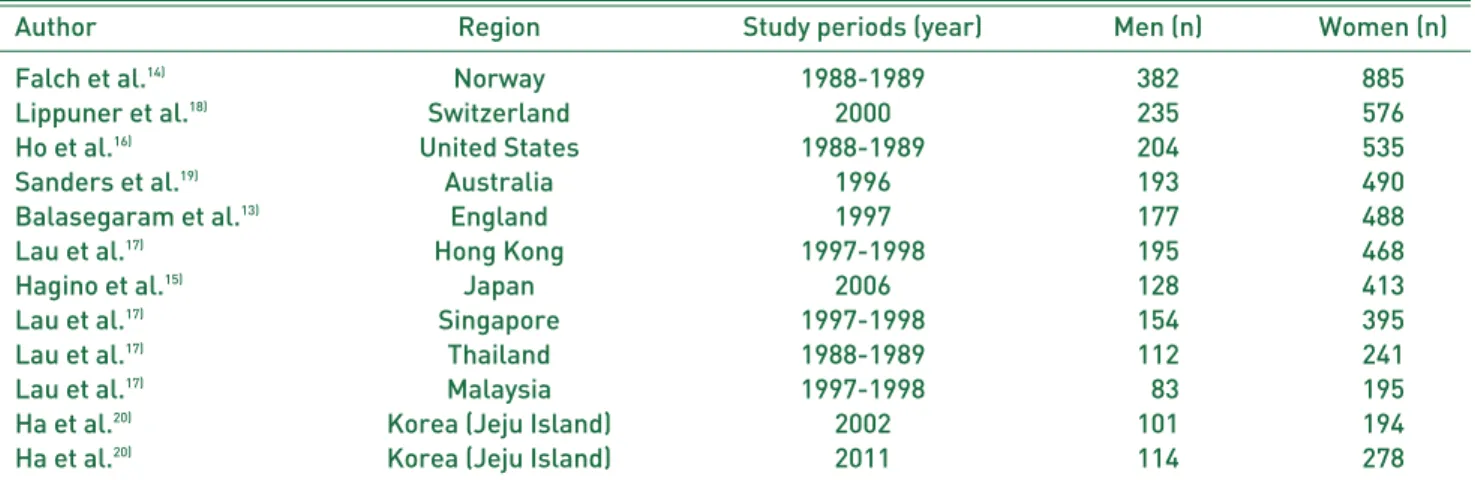
The incidence of fractures in the population, standardized to the 2008 population in the United States, increased from 100.6/100,000 (men) and 194.4/100,000 (women) in 2002 to 114.2/100,000 (men) and 278.4/100,000 (women) in 2011.
The incidence rate of hip fractures in Korea is similar to the reports from population-based studies in South East Asia (Thailand and Malaysia) and Mexico, higher than that in Thailand and Malaysia, and still lower than those from other advanced Asian countries (Japan, Hong Kong, and Singapore), Norway, Australia, Switzerland, England, and the United States (Table 1)8,13-20).
TRENDS IN TREATMENT CHOICES
According to nationwide data from the Health Insurance Review Assessment Service (HIRA) in 2010, among prox- imal femoral fractures, 14,330 were femoral neck fractures, 13,089 were intertrochanteric fractures, and 974 were sub- trochanteric fractures. The female-to-male ratio was 2.534 for femoral neck fractures, 2.165 for intertrochanteric fractures, and 1.435 for subtrochanteric fractures21). Subtrochanteric fractures accounted for 3.4% of all proximal femoral frac- tures. By age, the absolute numbers of femoral neck and intertrochanteric fractures increased exponentially after 60 years of age and peaked for both sexes21). The incidence of
subtrochanteric fractures increased after 70 years of age, while the incidence rates of femoral neck and intertrochanteric fractures exponentially increased with age in both sexes (Fig. 1)21).
Trends in the surgical treatment approaches used for femoral neck fractures, including internal fixation and hip arthro- plasty, were assessed in patients aged ≥50 years using HIRA data from 2006 to 201122). Overall, the proportion of patients who underwent internal fixation diminished from 34.2% in 2006 to 29.9% in 2011, whereas the proportions
of patients who underwent hemiarthroplasty and total hip arthroplasty increased, respectively, from 62.2% and 3.6%
in 2006 to 65.1% and 5.0% in 2011 (P<0.001 for both, Fig.
2)22). The trends in the utilization of cemented and cement- less hemiarthroplasty for femoral neck fractures revealed that the proportion of cementless hemiarthroplasty increased from 42.7% of all surgical procedures in 2007 to 61.4%
of all surgical procedures in 2011 (P<0.001), while the use of cemented hemiarthroplasty demonstrated a correspond- ing decrease in South Korea23).
Table 1. Age-adjusted Incidence (per 100,000) of Hip Fractures in Subjects Aged >50 Years in Different Populations
Author Region Study periods (year) Men (n) Women (n)
Falch et al.14) Norway 1988-1989 382 885
Lippuner et al.18) Switzerland 2000 235 576
Ho et al.16) United States 1988-1989 204 535
Sanders et al.19) Australia 1996 193 490
Balasegaram et al.13) England 1997 177 488
Lau et al.17) Hong Kong 1997-1998 195 468
Hagino et al.15) Japan 2006 128 413
Lau et al.17) Singapore 1997-1998 154 395
Lau et al.17) Thailand 1988-1989 112 241
Lau et al.17) Malaysia 1997-1998 083 195
Ha et al.20) Korea (Jeju Island) 2002 101 194
Ha et al.20) Korea (Jeju Island) 2011 114 278
Standardized to the Unites States population in 2008. Reproduced from Ha et al. (J Korean Med Sci. 2015;30:483-8)20).
F
Fiigg.. 11.. The incidences (per 100,000) of each type of hip fracture type by age in Korea in 2010.
Trends in the surgical treatment of intertrochanteric frac- tures were assessed in patients aged ≥50 years using HIRA data from 2006 to 2011, and the ratio of intramedullary nail- ing increased from 27.9% in 2006 to 64.3% in 2011 (P<
0.001), while the ratio of plate fixation decreased24). During the most recent 5 years, the utilization of intramedullary nailing for intertrochanteric fractures doubled in clinical practice in Korea (Fig. 3)24).
The present data on intertrochanteric fractures revealed a shift from plate fixation to intramedullary nailing, a trend that mirrors the situation in the United States25).
MORTALITY AND MORBIDITY AFTER HIP FRACTURE
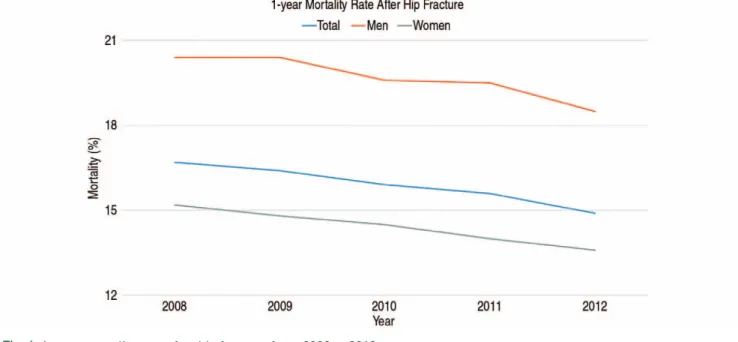
A recent study on mortality after hip fracture consistently
confirmed the excessively high mortality after hip fractures in short-term follow-up. From 2008 to 2012, the 1-year cumu- lative mortality rate in patients aged ≥50 years after hip fractures using NHIS data was 17.2% (3,575/20,849) in 2008 and 16.0% (4,547/28,426) in 2012; the decrease was mainly observed among women9). In addition, the mean 1- year mortality rate was 21% for men and 15% for women, indicating that the incidence in men was 1.4 times higher than that in women (Fig. 4)9). The mean standardized mor- bidity ratio (SMR) for hip fractures in patients aged ≥50 years was higher for men (11.93; 95% confidence interval [CI], 11.66-12.21) compared with women (11.22; 95% CI, 11.03-11.42) and gradually declined with age9). In the younger age group (50-69 years), however, the mean SMR was high- er in women. The SMRs were observed to be higher in all age groups compared with the general population9).
F
Fiigg.. 22.. The proportion of each surgical treatment for femoral neck fractures from 2006 to 2011.
F
Fiigg.. 33.. Proportion of each surgical treatment for intertrochanteric fractures from 2006 to 2011. Reproduced from Lee et al. (J Korean Med Sci. 2013;28:1407-8)24).
A prospective cohort study assessing mid- to long-term mortality and morbidity rates after hip fracture was con- ducted to estimate the morbidity and mortality in 790 patients aged ≥50 years who sustained hip fractures and were fol- lowed up for a mean of 6 years3). Accumulated mortality was 16.7% (132 patients) in 1 year, 45.8% (337 patients) in 5 years, and 60% (372 patients) in 8 years. The SMR at 5 years after injury was 1.3 times greater when compared with the general population3). Among the 389 patients who remained alive at the final follow-up and agreed to activ- ity evaluation, 199 of the 293 patients (68%) with preinjury outdoor activity levels of grades I and II achieved the same outdoor activity levels at final follow-up (P<0.001)3). In addi- tion, only 59 out of the 150 previous outdoor ambulators (39.3%) retained same activity level at a mean of 6 years after fracture (range, 4-9 years) (Table 2)3).
CONCLUSION
Considering the rapid aging of the South Korean popu- lation, the number of hip fractures is rapidly increasing; the incidence of hip fractures trended slightly up until 2012. Trends for in the use of different surgical options for femoral neck and intertrochanteric fractures in Korea are in line with the global trends. Although the high post-hip fracture mortality remains concerning, the mortality rate following hip frac- tures in Koreans decreased during the study period.
CONFLICT OF INTEREST
The authors declare that there is no potential conflict of interest relevant to this article.
F
Fiigg.. 44.. 1-year mortality rate after hip fracture from 2008 to 2012.
Table 2. Changes in Activity Levels at a Mean 6 Years after Hip Fracture
Activity level Preinjury activity (n) Postinjury activity (n) P-value
Grade I 150 059 <0.001
Grade II 143 140 <0.001
Grade III 086 136 <0.001
Grade IV 010 054 <0.001
Activity levels were defined as follows: Grade I, normal; Grade II, essentially independent outdoors but requiring help with some activities; Grade III, independent indoors but always requiring help outdoors; Grade IV, not independent indoors but able to walk independently; and Grade V, confined to a bed or chair and not ambulatory. Chi-square test was used to ana- lyze categorical variables. Reproduced from Lee et al. (J Korean Med Sci. 2013;28:1089-94)3).
REFERENCES
01. NIH Consensus Development Panel on Osteoporosis Prevention, Diagnosis, and Therapy, March 7-29, 2000: highlights of the conference. South Med J. 2001;94:569-73.
02. Kim HY, Ha YC, Kim TY, et al. Healthcare costs of osteoporot- ic fracture in Korea: information from the National Health Insurance claims database, 2008-2011. J Bone Metab. 2017;
24:125-33.
03. Lee SR, Ha YC, Kang H, Park YG, Nam KW, Kim SR.
Morbidity and mortality in Jeju residents over 50-years of age with hip fracture with mean 6-year follow-up: a prospec- tive cohort study. J Korean Med Sci. 2013;28:1089-94.
04. Cassell E, Clapperton A. A decreasing trend in fall-related hip fracture incidence in Victoria, Australia. Osteoporos Int.
2013;24:99-109.
05. Giversen IM. Time trends of age-adjusted incidence rates of first hip fractures: a register-based study among older people in Viborg County, Denmark, 1987-1997. Osteoporos Int. 2006;17:552-64.
06. Maravic M, Taupin P, Landais P, Roux C. Change in hip frac- ture incidence over the last 6 years in France. Osteoporos Int.
2011;22:797-801.
07. Kontis V, Bennett JE, Mathers CD, Li G, Foreman K, Ezzati M. Future life expectancy in 35 industrialised coun- tries: projections with a Bayesian model ensemble. Lancet.
2017;389:1323-35.
08. Zhang XY, Shuai J, Li LP. Vision and relevant risk factor interventions for preventing falls among older people: a net- work meta-analysis. Sci Rep. 2015;5:10559.
09. Ha YC, Kim TY, Lee A, et al. Current trends and future projections of hip fracture in South Korea using nationwide claims data. Osteoporos Int. 2016;27:2603-9.
10. Rowe SM, Yoon TR, Ryang DH. An epidemiological study of hip fracture in Honam, Korea. Int Orthop. 1993;17:139- 43.
11. Rowe SM, Song EK, Kim JS, et al. Rising incidence of hip fracture in Gwangju City and Chonnam Province, Korea. J Korean Med Sci. 2005;20:655-8.
12. Park KS, Woo SH, Park WJ, Rowe SM, Yoon TR. Change in incidence of hip fracture in Gwangju City and Jeonnam Province, Korea, over 20 years. Arch Osteoporos. 2015;10:38.
13. Balasegaram S, Majeed A, Fitz-Clarence H. Trends in hos- pital admissions for fractures of the hip and femur in England, 1989-1990 to 1997-1998. J Public Health Med. 2001;23:
11-7.
14. Falch JA, Kaastad TS, Bøhler G, Espeland J, Sundsvold OJ.
Secular increase and geographical differences in hip fracture incidence in Norway. Bone. 1993;14:643-5.
15. Hagino H, Furukawa K, Fujiwara S, et al. Recent trends in the incidence and lifetime risk of hip fracture in Tottori, Japan.
Osteoporos Int. 2009;20:543-8.
16. Ho SC, Bacon WE, Harris T, Looker A, Maggi S. Hip frac- ture rates in Hong Kong and the United States, 1988 through 1989. Am J Public Health. 1993;83:694-7.
17. Lau EM, Lee JK, Suriwongpaisal P, et al. The incidence of hip fracture in four Asian countries: the Asian Osteoporosis Study (AOS). Osteoporos Int. 2001;12:239-43.
18. Lippuner K, Johansson H, Kanis JA, Rizzoli R. Remaining lifetime and absolute 10-year probabilities of osteoporotic frac- ture in Swiss men and women. Osteoporos Int. 2009;20:1131-40.
19. Sanders KM, Seeman E, Ugoni AM, et al. Age- and gender- specific rate of fractures in Australia: a population-based study. Osteoporos Int. 1999;10:240-7.
20. Ha YC, Park YG, Nam KW, Kim SR. Trend in hip fracture incidence and mortality in Korea: a prospective cohort study from 2002 to 2011. J Korean Med Sci. 2015;30:483-8.
21. Yoon BH, Lee YK, Kim SC, Kim SH, Ha YC, Koo KH.
Epidemiology of proximal femoral fractures in South Korea.
Arch Osteoporos. 2013;8:157.
22. Lee YK, Ha YC, Park C, Koo KH. Trends of surgical treat- ment in femoral neck fracture: a nationwide study based on claim registry. J Arthroplasty. 2013;28:1839-41.
23. Lee YK, Kim KC, Yoon BH, Ha YC, Koo KH. Current trends of stem use in hemiarthroplasty for femoral neck fracture in South Korea. Clin Orthop Surg. 2014;6:285-9.
24. Lee YK, Yoon BH, Nho JH, Kim KC, Ha YC, Koo KH.
National trends of surgical treatment for intertrochanteric fractures in Korea. J Korean Med Sci. 2013;28:1407-8.
25. Anglen JO, Weinstein JN; American Board of Orthopaedic Surgery Research Committee. Nail or plate fixation of intertrochanteric hip fractures: changing pattern of prac- tice. A review of the American Board of Orthopaedic Surgery Database. J Bone Joint Surg Am. 2008;90:700-7.