https://doi.org/10.9721/KJFST.2020.52.2.144
144
©The Korean Society of Food Science and Technology
Corn silk extracts did not alter the adiposity and underlying substrate
utilization in high-fat diet-induced obese C57BL/6 mice
Eun Young Kang1,†, Hyun Kyung Kim1,†, Knowledge Mudhibadhi Moyo1, Gyoungok Gang2, Wooki Kim3, and Gwang-woong Go1,*
1Department of Food and Nutrition, Hanyang University 2Department of Animal Science, Texas A&M University 3Department of Food Science and Biotechnology, Kyung Hee University
Abstract Corn silk (Okmi-su) was anciently adopted as a material for tea or beverage. Corn silk extracts (CSE) contain bioactive phytochemicals such as phenolic acid, flavonoids, ascorbic acid, tannins, and glycosides. Under the impact of these functional components, CSE has benefits for antioxidation, diuresis, anti-diabetes, and dyslipidemia recovery. Nonetheless, its role in whole-body adiposity was not investigated; therefore, the effects of CSE on obesity were evaluated in high-fat diet-induced obese mice. Mice were assigned to either group (n=12); 1) normal diet (18% kcal from fat), 2) high-fat diet (45% kcal from fat, the control), 3) high-fat diet with CSE (800 mg/kg diet), and 4) high-fat diet with orlistat (500 mg/kg diet, a comparable control for weight loss). Our results showed that body weight, adiposity, and energy expenditure in obese mice were not altered by CSE. Lean body mass tended to decrease by CSE, which can be explained by stimulation of diuresis (p=0.06). In conclusion, our results suggest that dietary consumption of CSE does not influence the adiposity and underlying substrate utilization in high-fat diet-induced obese mice.
Keywords: corn silk extracts, adiposity, energy expenditure, respiratory quotient, lean body mass, dual-energy X-ray absorptiometry
Introduction
Obesity is defined by undesirable fat accumulation in the body. Due to unhealthy diets and physical inactivity, obesity is now a main health issue worldwide. In Korea, nearly half of the adult population is overweight and 32% is obese (Korean Society for the Study of Obesity, 2016). The prevalence of many medical comorbidities and complications including cardiovascular diseases, type 2 diabetes, hypertension, chronic kidney disease, and osteoarthritis, are approximately 1.4-4.2 folds higher in individuals with abdominal obesity compared to lean people (Korean Society for the Study of Obesity, 2014). The prevention and treatment of obesity using natural functional foods have shown considerable effects. Reflecting on this situation, the market for health-functioning foods is growing around the world, and materials and products that help reduce body fat are particularly becoming popular (Trigueros et al., 2013). According to The Ministry of Food and Drug Safety in Korea, the greatest number of functional foods categories were body fat reduction with 91 cases as of 2018 (MFDS, 2020).
Corn silk (also known as Okmi-su) has been anciently adopted by Koreans, Native Americans, and Chinese as a material of tea or beverage. Koreans practiced corn silk to acquire diuretic, circulatory, and hypoglycemic effects, which treated kidney infection, high blood pressure, and diabetes (BRIS, 2020). As if to prove the efficacy of traditional positive effects, previous studies demonstrated that corn silk extracts (CSE) include a variety of bioactive phytochemicals, including phenolic acid, flavonoids, ascorbic acid, tannins, and glycosides (Hasanudin et al., 2012). Researches have emerged the potential use of CSE as extraordinary functional foods for antioxidation, diuresis, anti-diabetes, and dyslipidemia rescue. There was a linear correlation between antioxidant capacity and tannin and proanthocyanidin, meaning the antioxidant power of corn silk was performed by its polyphenol contents (Maksimoviæ et al., 2005). CSE improved diuresis and kaliuresis, the discharge of urine in a large amount and the secretion of potassium in a large amount in urine, respectively (Velazquez et al., 2005). An aqueous extract of corn silk reduced the fasting glucose level, identifying corn silk as a hypoglycemic agent (Guo et al., 2009). Furthermore, CSE containing flavonoids rescued hypercholesterolemia induced by a high-cholesterol/cholic acid diet (Cha et al., 2016; Saheed et al., 2015).
In fact, the market for tea and beverage products using corn silk has been steadily rising and maintained (Food Information Statistics System, 2017). Nevertheless, there were limited studies to identify CSE as an anti-obesity agent. We, therefore, investigated the adiposity-regulatory effect of CSE using high-fat diet-induced obese mice.
†These authors contributed equally to this manuscripts.
*Corresponding author: Gwang-woong Go, Department of Food and Nutrition, Hanyang University, Seoul 04763, Korea
Tel: +82-2-2220-1206
E-mail: [email protected]
Received February 21, 2020; revised April 3, 2020; accepted April 3, 2020
Materials and Methods
Animals and diets
All animal experiments were approved by the Institutional Animal Care and Use Committee of Kookmin University (KMU-2016-1). Six to eight-week-old C57BL/6 mice (all males) were purchased from Dae-Han Biolink (Eumsung-si, Korea). The mice have housed in individually ventilated cages under a 12 h light/ dark cycle, the humidity of 50±10%, and a temperature of 22±1oC. After 1 week of climatization, mice were allocated into one of the following treatment groups: normal chow (18 kcal% from fat); high-fat diet (HFD, 45 kcal% fat, the control; D12451, Research Diets, New Brunswick, USA); HFD+CSE (800 mg/kg diet), and HFD+Orlistat (Roche Korea, Seoul, Korea; 500 mg/kg diet). All groups had 12 mice (n=12). A gastrointestinal lipase inhibitor, Orlistat, was applied as a positive control for weight loss. Feed and water were provided ad libitum during the experiment (8 weeks).
Corn silk extracts were provided by Kwangdong Co. LTD. (Seoul, Korea). The corn silk (harvested from Jilin Province in China) was extracted with water approximately 98-100oC for one hour. The crude extract was filtered through microfilter paper followed by concentrating under reduced pressure at 50oC or lower (concentrated Brix: 44-48 Brix). Final sterilization was followed at 95-98oC for 20 min.
Growth performance and body composition
Body weight and feed intake were measured every week. Total energy intake (kcal) was calculated using the feed intake. We examined body composition, including fat in tissue, lean mass, and bone mineral density, using a dual-energy X-ray absorptiometry (DEXA, Medikors, Seongnam-si, Korea). To this end, mice were first anesthetized with Ketamine (100 mg/kg bw; Yuhan Co., Seoul, Korea) and Xylazine (10 mg/kg bw; Bayer Korea, Seoul, Korea).
Energy expenditure and respiratory quotient
Energy expenditure and respiratory quotient were analyzed to assess metabolic phenotypes using an indirect calorimetry system (Oxylet, Panlab, Barcelona, Spain). The indirect calorimetry was calibrated using mixed gases, each containing 50% O2/1.5% CO2/ 48.5% N2 (high point) and 20% O2/0% CO2/80%N2 (low point). A single animal was housed in a separate cage, where the amount of oxygen consumption (VO2) and carbon dioxide production (VCO2) was observed for 24 h. Mice were provided feed and water ad libitum during the experiment. The respiratory exchange ratio was calculated, and the data were presented as the amount of O2 or CO2/h/animal. Energy expenditure and respiratory quotient were determined from the respiratory gas analysis with the Metabolism® software (Panlab).
Statistical analysis
All data are expressed as the mean±standard deviation. The difference between normal diet vs. a high-fat diet (negative control) was analyzed by unpaired t-test. The difference between samples
vs. negative control were analyzed by one-way ANOVA, followed by Tukey’s multiple comparisons. All analyses were carried out with Prism 6.0 (GraphPad Software, San Diego, USA).
Results and Discussion
Growth performance
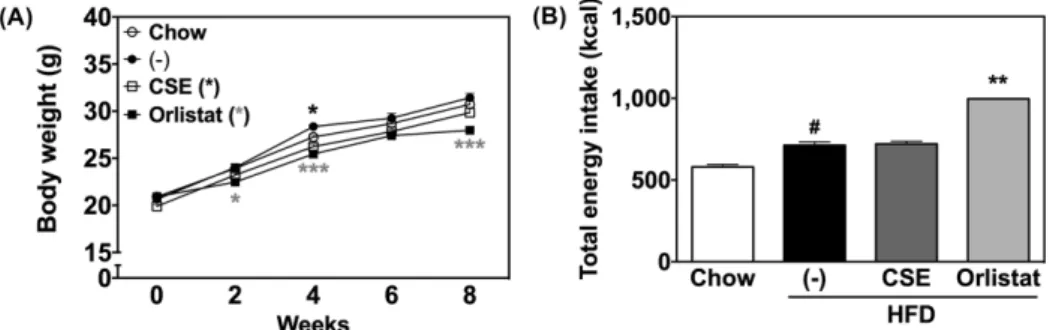
Male C57BL/6J mice were fed a high-fat diet (45 kcal% fat) with or without CSE (800 mg/kg bw). A standard chow diet (18 kcal% fat) was supplied to secure non-obese mice. Orlistat, a lipase inhibitor, was adopted as a control for weight loss. Body weight and feed intake were measured every week to observe weight loss. There was no difference in body weight between the control and the CSE-treated group at week 8. Only mice provided orlistat, as expected, showed a decrease in body weight compared to the control at week 8 (Fig. 1A) (p<0.05). A previous study reported that the ethanol extraction of corn sigma (100 mg/kg bw) decreased body weight by approximately 9% in a high-fat diet (47% kcal) fed obese mice after the 4th week (Lee et al., 2016). We speculate that this discrepancy might be due to the difference in the solvent because ethanol extracts contained higher bioactive compounds such as maysin and other flavonoids compared to hot water extracts.
We evaluated the effect of CSE on total energy consumption throughout the experiment (Fig. 1B). A high-fat diet increased (p<0.05) total energy intake (712.90±40.02 kcal) compared to the normal chow diet (579.50±21.83 kcal). Mice provided orlistat further increased total energy intake (p<0.01) compared to the control diet group, which can be explained by the occurrence of fat absorption impairment in the small intestine by orlistat (Lucas et al., 2020). High-fat diet-induced adiposity and its rescue by the drug orlistat were successfully established. However, CSE did not modulate body weight and total calorie intake during the experiment. Similarly, an oral administration of corn silk ethanol extract did not alter feed intake in obese mice (Cha et al., 2016). Thus, it is concluded that the CSE does not affect the amount of food intake or the total calories consumed.
Body composition
We analyzed body composition, including fat mass, lean mass, and bone mineral density, even if there was no difference in growth performance (Fig. 2). As expected, a high-fat diet substantially increased fat accumulation compared to the standard diet (p<0.01) (Fig. 2A). Body fat tended to decrease among the mice given orlistat compared to the control (p=0.10). CSE had no effect on adiposity compared to the control. DEXA scan images also showed no differences in the fat of CSE-treated mice. In contrast to our findings, some of the previous studies reported a reduction of adiposity when treated with CSE. For instance, Chaiittianan et al. (2016) reported that ethanol extracts of corn silk suppressed lipid accumulation in 3T3-L1 adipocytes. Lee et al. (2016) also reported that the administration of corn silk ethanol extracts in obese mice reduced body weight as it inhibited adipocyte differentiation, fatty acid synthesis, and beta-oxidation. Both studies used inorganic solvents to produce the corn silk extracts, which might have
yielded anti-obese phenolic compounds, including quercetin, an inhibitor of fat absorption in the small intestine (Rodriìguez-Peìrez et al., 2019). On the other hand, in this study, CSE were extracted with hot distilled water, which has lower phenolic contents compared to alcohol extracts (Ali and El-Anany, 2017). Thus, we believe this might explain why the CSE used in this study had no effect on adiposity. However, our results have been important to understand that CSE effects on adiposity are apparently associated with the type of solvent used for the extraction.
Given that CSE had no effect on body weight and adiposity, we examined if there were any changes in leanness. Lean mass, also known as fat-free mass, is calculated by subtracting fat mass from body weight. Thus, lean mass is mainly water, muscle mass, and mineral contents, meaning that a decrease in lean mass indicates either muscle loss or water loss. Interestingly, lean body mass marginally decreased in CSE-treated group (p=0.06) compared to the control (Fig. 2B). If the loss of lean body mass was caused by a decrease in muscle mass, this is a very fatal risk. However, previous studies on CSE have provided important evidence to
explain this change. For instance, corn silk supplements have been reported to promote urine excretion, which causes a decrease in lean mass (Sepehri et al., 2011; Velazquez et al., 2005). There is so far no evidence of muscle wasting and a negative impact on muscle physiology by CSE. Thus, a reduction in lean body mass by CSE can be observed due to diuretic stimulation, not by muscle wasting. Further research needs to examine the role of CSE in skeletal muscle physiology and kidney functions.
Additionally, our results demonstrated that dietary supplementation with corn silk did not modify the bone mineral density in obese mice (Fig. 2C). Similar observations have recently been explored in a prior study using ovariectomized rats, which exhibited ethanol extracts of corn silk had no impact on bone density (Triutomo et al., 2016). There is limited evidence of a regulatory role of CSE in bone health and further study needs to assess.
Energy expenditure and respiratory quotient
One of the most state-of-the-art techniques to investigate metabolic assimilation is an indirect calorific analysis, providing Fig. 1. Growth performance in mice given different diets for eight weeks. (A) Body weight and (B) total energy intake. Data is expressed as mean±standard error (n=12). The difference between normal diet vs. a high-fat diet (negative control) was analyzed by unpaired t-test (#p<0.05). The difference between samples vs. negative control were analyzed by one-way ANOVA, followed by Tukey’s multiple comparisons (*p<0.05, **p<0.01, and ***p< 0.001).
Fig. 2. Body composition in mice given different diets for eight weeks. (A) fat in tissue, (B) lean mass, and (C) bone mineral density. Data is expressed as mean±standard error (n=12). The difference between normal diet vs. a high-fat diet (negative control) was analyzed by unpaired t-test (##p<0.01).
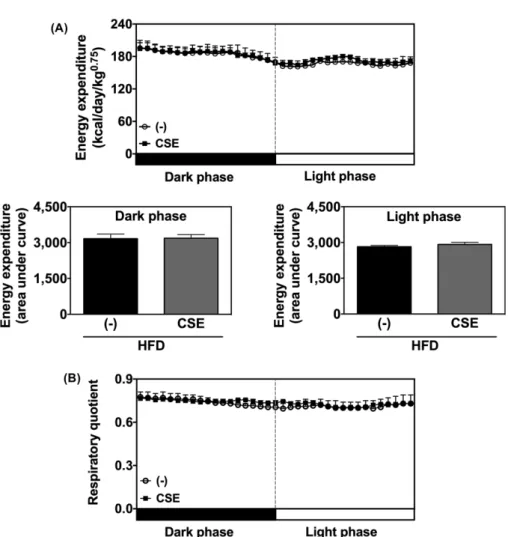
energy consumption and respiratory quotas. Respiratory quotient presents verified data about the type of fuel being metabolized (e.g., carbohydrates versus fat). To determine the energy catabolism of obese mice fed CSE, we evaluated their metabolic phenotypes (including total energy expenditure and respiratory quotient) using an indirect calorimetry (Fig. 3). Total energy expenditure did not differ among groups, indicating that CSE did not alter adiposity given it did not affect energy expenditure (Fig. 3A). The respiratory quotient did not differ between the control and the CSE-treated groups, with all groups exhibiting values ranging between 0.7-0.8 (Fig. 3B). Although the respiratory quotient increased slightly during the late stage of the dark phase and the early stage of the light phase, we did not observe any evidence to claim that CSE altered the type of fuel, mainly from carbohydrates to fatty acids. To our knowledge, the direct effect of CSE on respiratory quotient using indirect calorimetry has not been investigated. Instead, previous studies have reported that certain flavonoids (e.g., quercetin) were associated with non-shivering thermogenesis (Stewart et al., 2008; Zhang et al., 2019).
Conclusion
In conclusion, we investigated the effects of CSE on adiposity
in mice fed a high-fat diet. CSE did not modify the markers of growth performance, such as body weight and total energy intake. According to DEXA analysis, fat mass and bone mineral density were not modulated by CSE supplementation. Interestingly, a reduction in lean body mass by CSE was observed. Previous studies explained this observation was due to diuretic stimulation, not by muscle wasting. Corn silk tea has been confirmed to be still valid in terms of traditional diuretic improvement. The current study first demonstrated the effect of CSE on energy expenditure and fuel type. As a result, total energy expenditure and utilized fuel types were not affected by CSE. Verification of the hypothesis of body fat reduction and energy consumption enhancement by hot water extract of corn silk has not been successful. Our findings were seldom inconsistent with previous studies using CSE; however, our results have been essential to understanding that bioactivity of CSE is associated with the type of solvent used for the extraction. Follow-up research is needed to clarify the physiological activity of the extraction method. Therefore, hot water extract of corn silk had no impact on the prevention of fat accumulation or acceleration of the use of stored energy in high-fat diet-induced obese mice.
Fig. 3. The effects of corn silk extracts on energy metabolism and substrate utilization. (A) Energy expenditure and (B) respiratory quotient. Dark and light phases (9 hours each). Data is expressed as mean±standard error (n=12; p<0.05).
Acknowledgments
This research was supported by Kwangdong Co. Ltd.
References
Ali RFM, El-Anany AM. Stabilization of neem oil biodiesel with corn silk extract during long-term storage. J. Oleo Sci. 66: 133-145 (2017)
Bio Resource Information Service. Zea mays L. Available from: h t t p s : / / b r i s . g o . k r / p o r t a l / r e s o u r c e / b o o k / s e l e c t R e s o u r c e -BookDtlInfo.do?lfrcMnno=MANUIP3300100007&gubun= 1&siteGb=P&menuNo=200221. Accessed Feb. 19, 2020.
Cha JH, Kim SR, Kang HJ, Kim MH, Ha AW, Kim WK. Corn silk extract improves cholesterol metabolism in C57BL/6J mouse fed high-fat diets. Nutr. Res. Pract. 10: 501-506 (2016)
Chaiittianan R, Chayopas P, Rattanathongkom A, Tippayawat P, Sut-thanut K. Anti-obesity potential of corn silks: relationships of phytochemicals and antioxidation, anti-pre-adipocyte proliferation, anti-adipogenesis, and lipolysis induction. J. Funct. Foods. 23: 497-510 (2016)
Food Information Statistics System. POS Retail Sales by item. 2017. Available from: https://www.atfis.or.kr/sales/M002020000/view.do? searchItem=CD00000579&searchDivision=CD00000600&search- Company=2&searchYear=2017&searchQuarter=3&selectAc-cessHistoryIdx. Accessed Feb. 19, 2020.
Guo J, Liu T, Han L, Liu Y. The effects of corn silk on glycaemic metabolism. Nutr. Metab. 6: 47 (2009)
Hasanudin K, Hashim P, Mustafa S. Corn silk (Stigma maydis) in healthcare: a phytochemical and pharmacological review. Mole-cules. 17: 9697-9715 (2012)
Korean Society for the Study of Obesity. Guidelines for treating obe-sity. 2014. Available from: http://general.kosso.or.kr/html/?pmode =BBBS0001300003&page=1&smode=view&seq=1214&search-Value=&searchTitle=strTitle. Accessed Feb. 19, 2020.
Korean Society for the Study of Obesity. Guidelines for treating obe-sity. 2016. Available from: http://www.kosso.or.kr/file/2017_ Obesity_Fact_Sheet.pdf. Accessed Feb. 20, 2020.
Lee EY, Kim SL, Kang HJ, Kim MH, Ha AW, Kim WK. High may-sin corn silk extract reduces body weight and fat deposition in C57BL/6J mice fed high-fat diets. Nutr. Res. Pract. 10: 575-582 (2016)
Lucas N, Legrand R, Deroissart C, Dominique M, Azhar S, Le
Sol-liec MA, Léon F, Do Rego JC, Déchelotte P, Fetissov SO, Lam-bert G. Hafnia alvei HA4597 strain reduces food intake and body weight gain and improves body composition, glucose, and lipid metabolism in a mouse model of hyperphagic obesity. Microor-ganisms. 8: 35 (2020)
Maksimoviæ Z, Malenèiæ Ð, Kovaèeviæ N. Polyphenol contents and antioxidant activity of Maydis stigma extracts. Bioresour. Tech-nol. 96: 873-877 (2005)
Ministry of Food and Drug Safety. information of base material. Available from: https://www.foodsafetykorea.go.kr/portal/board/ board.do?menu_grp=MENU_NEW01&menu_no=2660. Accessed Feb. 19, 2020.
Rodriìguez-Peìrez C, Segura-Carretero A, Del Mar Contreras M. Phe-nolic compounds as natural and multifunctional anti-obesity agents: a review. Crit. Rev. Food Sci. Nutr. 59: 1212-1229 (2019) Saheed S, Oladipipo AE, Abdulazeez AA, Olarewaju SA, Ismaila
NO, Emmanuel IA, Fatimah QD, Aisha AY. Toxicological evalu-ations of Stigma maydis (corn silk) aqueous extract on hemato-logical and lipid parameters in Wistar rats. Toxicol. Rep. 2: 638-644 (2015)
Sepehri G, Derakhshanfar A, Zadeh FY. Protective effects of corn silk extract administration on gentamicin-induced nephrotoxicity in rat. Comp. Clin. Path. 20: 89-94 (2011)
Stewart LK, Soileau JL, Ribnicky D, Wang ZQ, Raskin I, Poulev A, Majewski M, Cefalu WT, Gettys TW. Quercetin transiently increases energy expenditure but persistently decreases circulating markers of inflammation in C57BL/6J mice fed a high-fat diet. Metabolism. 57: S39-S46 (2008)
Trigueros L, Peña S, Ugidos AV, Sayas-Barberál E, Pérez-Álvarez JA, Sendra E. Food ingredients as anti-obesity agents: a review. Crit. Rev. food sci. and nutr. 53: 929-942 (2013)
Triutomo DH, Miranda A, Tamba LJ, Lukitaningsih E. Estrogenic effect ethanol extract corn silk (Stigma maydis) on bone density and histology femur profiles in ovariectomized rats female spra-gue dawley strain. Indones. J. Cancer. Chemoprevent. 7: 104-109 (2016)
Velazquez DVO, Xavier HS, Batista JEM, De Castro-Chaves C. Zea mays L. extracts modify glomerular function and potassium uri-nary excretion in conscious rats. Phytomedicine. 12: 363-369 (2005)
Zhang X, Li X, Fang H, Guo F, Li F, Chen A, Huang S. Flavonoids as inducers of white adipose tissue browning and thermogenesis: signaling pathways and molecular triggers. Nutr. Metab. 16: 47 (2019)