Received:April 4, 2017, Revised:May 4, 2017, Accepted:May 15, 2017
Corresponding to:Jisoo Lee, Division of Rheumatology, Department of Internal Medicine, Ewha Womans University School of Medicine, 1071 Anyangcheon-ro, Yangcheon-gu, Seoul 07985, Korea. E-mail:[email protected]
Copyright ⓒ 2017 by The Korean College of Rheumatology. All rights reserved.
This is a Open Access article, which permits unrestricted non-commerical use, distribution, and reproduction in any medium, provided the original work is properly cited.
Prevalence and Risk Factors Associated with Neutropenia in Hospitalized Patients with Systemic Lupus Erythematosus
Min Kyung Chung, In Je Kim, Jisoo Lee
Division of Rheumatology, Department of Internal Medicine, Ewha Womans University School of Medicine, Seoul, Korea
Objective. This study estimated the prevalence and explored possible risk factors associated with neutropenia in hospitalized patients with systemic lupus erythematosus (SLE). Methods. This review included 160 admissions of 85 SLE patients between 2006 and 2013. Neutropenia was defined as absolute neutrophil count (ANC) below 1,500/mm3. The baseline characteristics of the patients were compared between patients who experienced neutropenia and those who did not. Clinical and serological factors related to neutropenia episodes during admission were analyzed. Results. Thirty-five (21.9%) neutropenic episodes were found among the 160 admissions. Most of the neutropenic episodes were mild to moderate. Severe neutropenia of ANC
<500/mm3 occurred in 3.1% of the cases. Patients with neutropenia had higher frequencies of ANA (100.0% vs. 86.8%, p=0.042) and anti-double stranded DNA (87.5% vs. 60.4%, p=0.008), and satisfied more SLE classification criteria at the time of diagnosis than those without (5.1 vs. 4.6, p=0.009). Anemia, leukopenia, thrombocytopenia and low complement levels were frequently accompanied with neutropenia. Chronic kidney disease (odds ratio, 11.17; 95% confidence interval, 1.46∼
85.27; p=0.020) was associated with neutropenia. Conclusion. This study demonstrates that neutropenia is frequent in hospi- talized patients with SLE, and patients with neutropenia have more hematologic and immunologic abnormalities. Renal dam- age was more frequent among those presenting with neutropenia. (J Rheum Dis 2017;24:203-210)
Key Words. Systemic lupus erythematosus, Neutropenia, Risk factors
INTRODUCTION
Systemic lupus erythematosus (SLE) is a chronic auto- immune disease of unclear etiology that affects multiple organs and shows heterogeneous clinical features [1].
Hematologic manifestations such as hemolytic anemia, leukopenia, lymphopenia, and thrombocytopenia are common and characteristic features associated with SLE patients, which are included as one of criteria for the clas- sification of SLE proposed by the American College of Rheumatology (ACR) [2]. When SLE patients manifest with hematologic abnormalities, it is important to dis- tinguish these abnormalities from SLE disease activity, bone marrow suppression secondary to use of im- munosuppressive drugs, and primary hematologic dis- ease such as myelodysplastic syndrome [3,4].
Leukopenia in SLE is defined as leukocyte count below 4,000/mm3 on two or more occasions according to the ACR criteria [2]. Lymphopenia is a most commonly found leukocyte abnormality, but neutropenia is also fre- quently observed occurring in about 50% to 60% of pa- tients with active SLE [5]. Most of the neutropenia epi- sodes occurring in patients with SLE are mild, but approx- imately 5% of patients may experience moderate (500/mm3
≤absolute neutrophil count [ANC] <1,000/mm3) to se- vere neutropenia (ANC<500/mm3) [6]. The patho- genesis of neutropenia in SLE is not entirely understood, but both humoral and cellular immune responses are known to be involved. Increased peripheral destruction of granulocyte by circulating antineutrophil antibodies [7], increased margination or changes in marginal and splenic pool [8], and decreased granulocytopoiesis in the bone
marrow [9,10] were suggested as potential mechanisms.
Clinically, neutropenia in SLE patients can increase sus- ceptibility to recurrent infection [3,11]. Infection can be detrimental in the immunocompromised patients, thus neutropenia occurring in the SLE patients require high level of vigilance. Infection is currently one of the leading causes of mortality in patients with SLE in spite of the im- provement of overall survival rate [12,13]. It is crucial to understand the risk factors associated with neutropenia in SLE patients, but there is a paucity of clinical data re- garding neutropenia in patients with SLE. Although many studies deal with hematologic abnormalities in SLE [14], only one previous study showed clinical data focus- ing on neutropenia reporting risk factors associated with neutropenia in 33 SLE patients with moderate and severe neutropenia [6]. They reported that concomitant medi- cations including immunosuppressants, history of thrombocytopenia and central nervous systemic manifes- tation as risk factors of developing neutropenia in SLE.
Therefore, we investigated the clinical, serologic charac- teristics of SLE patients with neutropenic episodes dur- ing admissions to determine the risk factors associated with neutropenia in hospitalized patients with SLE.
MATERIALS AND METHODS
Patients and data collection
We identified 85 SLE patients who fulfilled the 1997 ACR classification criteria for SLE [2] and were hospi- talized at the Rheumatology Division of Ewha Womans University Mokdong Hospital between January 2006 and December 2013. Admissions due to cancer chemotherapy or hematologic malignancy which can cause neutropenia independently from SLE were excluded from the study. Of these 85 patients, 160 admissions occurred. The medical records of each admission were retrospectively reviewed to identify admissions with neutropenia. Neutropenia was defined as ANC less than 1,500/mm3. Demographics, clinical, and laboratory data were collected from medical chart using a standardized format. Demographic data in- cluded sex and age of SLE diagnosis and admission.
Clinical data included clinical manifestations and the au- toantibody profiles at the time of SLE diagnosis and co- morbidities, concomitant medication, and disease activ- ity measurement at the time of admission. Laboratory tests including complete blood count, erythrocyte sed- imentation rate (ESR), C-reactive protein (CRP), com- plement (C)3, C4, anti-double stranded (anti-ds)DNA
were collected at the time of admission. Disease activity was assessed using SLE disease activity index (SLEDAI) [15]. Duration of neutropenia, use of granulocyte-colony stimulating factor (G-CSF), accompanied neutropenic fe- ver, and bone marrow biopsy findings were reviewed when available. Neutropenic fever was defined as having fever over 38oC with ANC below 500/mm3 or 1,000/mm3 with predicted to ≤500/mm3 [16]. Chronic kidney dis- ease was defined as estimated glomerular filtration rate
<60 mL/min/1.73 m2 for 3 months or more [17]. The present study was approved by the Institutional Review Board of Ewha Womans University Mokdong Hospital (no. 2015-05-029-001).
Statistical analysis
All statistical analyses were conducted using PASW Statistics 18.0 (IBM Co., Armonk, NY, USA). Continuous variables were expressed as median±standard deviation while categorical data were shown as number of sample and percentage values (%). Comparing 2 groups of pa- tients who had or had not experienced neutropenia, Mann-Whitney test was applied for continuous variables, and χ2 test for categorical variables. Risk factors asso- ciated with development of neutropenia in SLE patients were analyzed by comparing admissions with and with- out neutropenia episode using generalized estimating equation (GEE) which can evaluate effects of independent variables in dichotomous outcomes, and were expressed as odds ratio (OR) and 95% confidence interval (CI). The fact that a SLE patient could contribute to more than one admission related to each other made GEE necessary.
Factors associated with neutropenia with a p-value of less than 0.2 in the univariate analysis were entered in multi- variate model, and a p-value of less than 0.05 was consid- ered to indicate statistical significance in the final analysis.
RESULTS
Initial disease characteristics of SLE patients at the time of SLE diagnosis according to the presence of neutropenia during admission
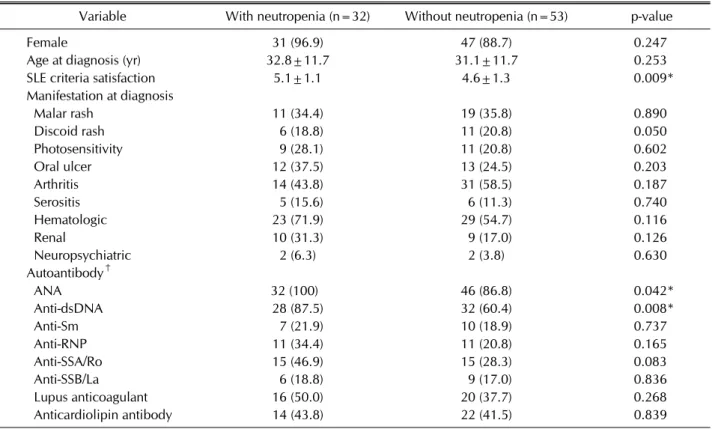
To assess the disease characteristics which might predis- pose for development of neutropenia during admission, clinical and serologic characteristics at the time of SLE di- agnosis was compared between 32 SLE patients who de- veloped neutropenia during hospitalization and 53 pa- tients who did not (Table 1). Age at diagnosis and sex of
Table 1. Initial characteristics of SLE patients at the time of SLE diagnosis according to the presence of neutropenia during hospitalization (n=85)
Variable With neutropenia (n=32) Without neutropenia (n=53) p-value
Female 31 (96.9) 47 (88.7) 0.247
Age at diagnosis (yr) 32.8±11.7 31.1±11.7 0.253
SLE criteria satisfaction 5.1±1.1 4.6±1.3 0.009*
Manifestation at diagnosis
Malar rash 11 (34.4) 19 (35.8) 0.890
Discoid rash 6 (18.8) 11 (20.8) 0.050
Photosensitivity 9 (28.1) 11 (20.8) 0.602
Oral ulcer 12 (37.5) 13 (24.5) 0.203
Arthritis 14 (43.8) 31 (58.5) 0.187
Serositis 5 (15.6) 6 (11.3) 0.740
Hematologic 23 (71.9) 29 (54.7) 0.116
Renal 10 (31.3) 9 (17.0) 0.126
Neuropsychiatric 2 (6.3) 2 (3.8) 0.630
Autoantibody†
ANA 32 (100) 46 (86.8) 0.042*
Anti-dsDNA 28 (87.5) 32 (60.4) 0.008*
Anti-Sm 7 (21.9) 10 (18.9) 0.737
Anti-RNP 11 (34.4) 11 (20.8) 0.165
Anti-SSA/Ro 15 (46.9) 15 (28.3) 0.083
Anti-SSB/La 6 (18.8) 9 (17.0) 0.836
Lupus anticoagulant 16 (50.0) 20 (37.7) 0.268
Anticardiolipin antibody 14 (43.8) 22 (41.5) 0.839
Values are presented as number (%) or mean±standard deviation. SLE: systemic lupus erythematosus, ANA: antinuclear antibodies, Anti-dsDNA: anti-double stranded deoxyribonucleic acid, Anti-Sm: anti-Smith, Anti-RNP: anti-ribonucleoprotein.
*Represents statistical significance of p<0.05. †Autoantibody positivity at diagnosis.
the patients were similar between the 2 groups. However, patients who developed neutropenia satisfied more num- ber of 1997 ACR classification criteria for SLE than those who did not develop neutropenia (5.1±1.1 vs. 4.6±1.3, p=0.009). Patients who developed neutropenia showed higher frequency of ANA and anti-dsDNA positivity at the time of the SLE diagnosis. ANA was detected in all pa- tients who developed neutropenia while it was detected in 86.8% in those who did not develop neutropenia (p=0.042). Anti-dsDNA was also more commonly ob- served in SLE patients who developed neutropenia than in those who did not (87.5% vs. 60.4%, p=0.008).
Patients who developed neutropenia had tendency to have anti-SSA/Ro positivity (46.9% vs. 28.3%, p=0.083).
Prevalence and characteristics of neutropenia in hospitalized patients with SLE
Thirty-five (21.9%) neutropenic episodes were found among 160 admissions. Characteristics of neutropenia associated in SLE were shown in Table 2. Most of the neutropenic episodes were mild (1,000/mm3≤ANC
<1,500/mm3) to moderate (500/mm3≤ANC<1,000/mm3) occurring in 17 (48.6%) and 13 (37.1%) of neutropenic admissions respectively. Severe neutropenia of ANC
<500/mm3 occurred only in 5 (14.3%) admissions. Overall average of neutrophil count was 934/mm3. When cause of admission was compared between mild, moderate, and severe neutropenia groups, although SLE flare was the most common cause of admission, infection as a cause of admission appeared to increase with severity of neu- tropenia (5.9% in mild neutropenia vs. 15.4% in moder- ate neutropenia vs. 40% in severe neutropenia). On aver- age, neutropenia lasted for a duration of 8 days, and re- mained for the longest period of 12 days in admissions with severe neutropenia. Most of neutropenia improved without using G-CSF except for 2 admissions with severe neutropenia. No death occurred as a consequence of neutropenia. Neutropenic fever occurred in 10 (28.6%) admissions with neutropenia, and was accompanied more frequently in admissions with severe neutropenia.
A bone marrow biopsy was performed in 2 cases with findings of slightly decreased cellularity in one case, and
Table 2. Characteristics of admissions with neutropenia in patients with SLE
Variable Total (n=35) Neutropenia
Mild* (n=17) Moderate† (n=13) Severe‡ (n=5) Cause of admission
Infection 5 (14.3) 1 (5.9) 2 (15.4) 2 (40.0)
SLE flare 27 (77.1) 13 (76.5) 11 (84.6) 3 (60.0)
Others§ 3 (8.6) 3 (17.6) 0 (0.0) 0 (0.0)
Neutropenia duration (d) 7.9±4.4 7.5±4.6 7.0±2.4 12.4±5.8
Use of G-CSF 2 (5.7) 0 (0) 0 (0) 2 (40.0)
Neutropenic fever 10 (28.6) 0 (0) 6 (46.2) 4 (80.0)
Values are presented as number (%) or mean±standard deviation. SLE: systemic lupus erythematosus, G-CSF: granulocyte-colony stimulating factor, ANC: absolute neutrophil count. *ANC≥1,000/mm3∼<1,500/mm3, †ANC≥500/mm3∼<1,000/mm3, ‡ ANC<500/mm3. §Peripheral neuropathy, allergic rhinitis, deep vein thrombosis.
Table 3. Comparison of clinical characteristics of admissions with and without neutropenia in patients with SLE
Variable With neutropenia (n=35) Without neutropenia (n=125) p-value
Age at admission (yr) 36.7±11.8 36.9±11.2 0.971
Disease duration (yr) 5.3±8.1 4.9±5.0 0.690
Cause of admission
Infection 5 (14.3) 21 (16.8) 0.714
SLE 27 (77.1) 95 (76.0) 0.741
Others† 3 (8.6) 9 (7.2) 0.978
Comorbidities
DM 1 (2.9) 3 (2.4) 0.839
Hypertension 4 (11.4) 13 (10.4) 0.904
Chronic kidney disease 7 (20.0) 2 (1.6) 0.004*
Sjögren’s syndrome 3 (8.6) 4 (3.2) 0.234
Medication in use
Glucocorticoid 20 (57.1) 95 (76.0) 0.050
Dose of glucocorticoid (mg) 6.79±8.03 8.32±9.01 0.319
Hydroxychloroquine 13 (37.1) 60 (48.0) 0.153
Cyclophosphamide 2 (5.7) 1 (0.8) 0.104
Azathioprine 6 (17.1) 20 (16.0) 0.827
MMF 1 (2.9) 5 (4.0) 0.763
Mizoribine 3 (8.6) 7 (5.6) 0.383
SLEDAI 11.3±6.4 10.2±7.5 0.576
Hemoglobin (mg/dL) 10.3±1.9 11.2±2.1 0.029*
Leukocyte (/mm3) 2,029.4±6,668.2 6,534.2±3,337.1 0.001*
Platelet (×103/mm3) 149.0±71.9 190.9±93.1 0.029*
ESR (mm/h) 21.23±16.81 24.47±19.92 0.250
CRP (mg/dL) 2.13±5.62 2.95±4.77 0.535
Decreased C3 29 (82.9) 68 (54.4) 0.005*
Decreased C4 19 (54.3) 35 (28.0) 0.012*
Rise in anti-dsDNA titer 27 (77.1) 79 (63.2) 0.207
Presence of proteinuria‡ 9 (25.7) 28 (22.4) 0.766
Values are presented as number (%) or mean±standard deviation. SLE: systemic lupus erythematosus, DM: diabetes mellitus, MMF: mycophenolate mofetil, SLEDAI: systemic lupus erythematosus disease activity index, ESR: erythrocyte sediment rate, CRP:
C-reactive protein, C: complement, Anti-dsDNA: anti-double stranded deoxyribonucleic acid. *Represents statistical significance of p<0.05, using generalized estimating equation analysis. †Myocardial infarction, peripheral neuropathy, allergic rhinitis, drug fever, hemarthrosis, compression fracture, deep vein thrombosis, gastrointestinal bleeding, gastric spasm. ‡Proteinuria>0.5 g/d.
Table 4. Risk factors associated with neutropenia during hospitalization in patients with SLE in univariate and multivariate analysis
Variable Univariate Multivariate
Odds ratio 95% CI p-value Odds ratio 95% CI p-value
Age at admission 0.99 0.96∼1.04 0.971 - - -
Disease duration 1.02 0.94∼1.09 0.690 - - -
Cause of admission
Infection 0.84 0.32∼2.18 0.714 - - -
SLE 1.16 0.49∼2.71 0.741 - - -
Others† 0.98 0.27∼3.63 0.978 - - -
Comorbidities
DM 1.27 0.12∼13.04 0.839 - - -
Hypertension 0.91 0.21∼4.02 0.904 - - -
Chronic kidney disease 16.38 2.44∼109.85 0.004* 11.17 1.46∼85.27 0.020*
Sjögren’s syndrome 3.14 0.48∼20.67 0.234 - - -
Medication in use
Glucocorticoid 0.44 0.19∼1.00 0.050 0.51 0.18∼1.48 0.217
Dose of glucocorticoid 0.98 0.93∼1.03 0.319 - - -
Hydroxychloroquine 0.56 0.25∼1.24 0.153 0.70 0.22∼2.24 0.543
Cyclophosphamide 5.76 0.70∼47.72 0.104 5.57 0.89∼34.96 0.067
Azathioprine 1.12 0.41∼3.09 0.827 - - -
MMF 0.78 0.16∼3.90 0.763 - - -
Mizoribine 1.61 0.55∼4.73 0.383 - - -
SLEDAI 1.01 0.97∼1.06 0.576 - - -
Hemoglobin 0.82 0.68∼0.98 0.029* 1.00 0.82∼1.22 0.995
Leukocyte 0.99 0.995∼0.998 0.001* - - -
Platelet 0.82 0.68∼0.98 0.029* 1.00 0.99∼1.00 0.183
ESR 0.99 0.97∼1.01 0.250 - - -
CRP 0.97 0.86∼1.08 0.535 - - -
Decreased C3 3.70 1.49∼9.18 0.005* 2.130 0.69∼6.60 0.190
Decreased C4 2.90 1.26∼6.65 0.012* 1.635 0.52∼5.17 0.402
Increased anti-dsDNA 1.75 0.73∼4.15 0.207 - - -
Presence of proteinuria‡ 1.14 0.48∼2.69 0.766 - - -
SLE: systemic lupus erythematosus, CI: confidence interval, DM: diabetes mellitus, MMF: mycophenolate mofetil, SLEDAI:
systemic lupus erythematosus disease activity index, ESR: erythrocyte sediment rate, CRP: C-reactive protein, C: complement, Anti-dsDNA: anti-double stranded deoxyribonucleic acid, -: not applicable. *Represents statistical significance of p<0.05, using generalized estimating equation analysis. †Myocardial infarction, peripheral neuropathy, allergic rhinitis, drug fever, hemarthrosis, compression fracture, deep vein thrombosis, gastrointestinal bleeding, gastric spasm. ‡Proteinuria>0.5 g/d.
myelofibrosis in another suggesting primary bone mar- row abnormality rather than peripheral destruction.
Clinical characteristics of admissions with and without neutropenia in patients with SLE
Clinical and laboratory characteristics of 35 admissions with neutropenia and 125 admissions without neu- tropenia were analyzed (Table 3). Mean age and disease duration at the time of admission were similar between the 2 groups. Infectious causes included pneumonia, up- per respiratory infection, cellulitis, enterocolitis, menin- gitis, and parotitis. Other causes of admission included myocardial infarction, peripheral neuropathy, allergic rhi-
nitis, drug fever, hemarthrosis, compression fracture, deep vein thrombosis, gastrointestinal bleeding, and gas- tric spasm. Among comorbidities, chronic kidney disease was more frequently accompanied in admissions with neutropenia than those without (p=0.004). Medications in use at the time of admission were not significantly dif- ferent, except that glucocorticoid was employed more fre- quently in admissions without neutropenia. Disease ac- tivity measured by SLEDAI was not significantly different between the 2 groups. Hemoglobin, leukocyte counts, platelet counts were significantly lower in neutropenic group than in non-neutropenic group. Lower level of C3 and C4 were more frequently accompanied in admissions
with neutropenia than in those without. There was no significant difference in ESR, CRP, and rise in anti-dsDNA titer between neutropenic and non-neutropenic admi- ssions.
Risk factors associated with neutropenia during hospitalization in patients with SLE
Following variables were associated with the develop- ment of neutropenia in the univariate analysis; con- comitant chronic kidney disease (OR, 16.38; 95% CI, 2.44∼109.85, p=0.004), low platelet count (OR, 0.99;
95% CI, 0.99∼1.00, p=0.006), decrease of C3 (OR, 3.70;
95% CI, 1.49∼9.18, p=0.005), and decrease of C4 (OR, 2.90; 95% CI, 1.26∼6.65, p=0.012). Glucocorticoid use decreased the likelihood of developing neutropenia (OR, 0.44; 95% CI, 0.19∼1.00, p=0.050). Multivariate analy- sis using generalized estimating equation revealed ac- companied chronic renal failure (OR, 11.17; 95% CI, 1.46∼85.27, p=0.020) as an independent risk factor for developing neutropenia in SLE patients (Table 4).
DISCUSSION
In this study, we found that neutropenia is a frequent event during hospitalization occurring in 22% of admis- sions experienced by SLE patients. Hematologic and im- munologic abnormalities were more frequently accom- panied during admissions associated with neutropenia.
Co-existence of chronic kidney disease appeared to in- crease the risk of developing neutropenia during admission.
Our results suggest that neutropenia is a frequent event occurring in the disease course of patients with SLE, and the prevalence was similar with that of the previous re- ports [4,14,18,19]. While there is no universal cut-off level in defining neutropenia in SLE patients, neutropenia is reported in 20% to 40% of the SLE patients during their disease course [4,18], especially in 25.4% at the onset of their disease [14]. In this study, we observed that neu- tropenia occurred in 21.9% of admissions of SLE patients which is compatible with other studies. Most of neu- tropenia are reported to be mild while moderate to severe neutropenia with ANC<1,000/mm3 is described in only 0.8% to 4% of patients [14,19]. Severe neutropenia de- fined as ANC below 500/mm3 occurred in 3.1% of admis- sions in our study.
Limited studies have been explored the risk factors for developing neutropenia in patients with SLE. Both in-
ternal and external factors were reported to contribute to the development of neutropenia. Intrinsic factors such as thrombocytopenia, lupus activity in central nervous sys- tem, and circulating autoantibodies and extrinsic factors such as use of immunosuppressive drugs and con- comitant infections were reported as risk factors for neu- tropenia in SLE patients [6,10,20-22]. Antineutrophil an- tibodies were shown to be directly involved in the periph- eral destruction of neutrophils in SLE patients [7,23,24].
In patients with Sjögren’s syndrome, frequency of an- ti-SSA/Ro and anti-SSB/La positivity were shown to be higher in patients with neutropenia than those without [25]. Our findings that SLE patients with neutropenia were more likely to be seropositive with ANA or an- ti-dsDNA at the time of the diagnosis, increased tendency for developing neutropenia in patients with anti-SSA/Ro positivity, and hypocomplementemia accompanying ad- missions with neutropenia support the role of circulating autoantibodies in development of neutropenia. In our study, use of immunosuppressive drugs did not increase the risk of neutropenia development. However, low he- moglobin, platelet, and leukocyte count detected at the admissions were shown to be associated with neu- tropenia in our study suggesting that primary bone mar- row abnormalities might contribute to development of neutropenia [9,26]. Chronic kidney disease that might reflect lupus nephritis was revealed as an independent risk factor for neutropenia in SLE patients in this study.
Reasons for association of neutropenia with kidney dam- age is not fully understood. It was hypothesized in a pre- vious review article that a proportion of neutrophils which infiltrate the kidney may undergo active apoptosis causing neutropenia and organ damage to occur simulta- neously [1].
Generally, the rate of infection is inversely associated with neutrophil counts [27]. In spite of the improve- ments in short and medium term survival rate of SLE pa- tients [12], infection is still considered to be the most common cause of mortality and a poor prognostic factor [28]. Although a clear association between increased in- fection risk and the cut off value of neutropenia is un- certain, serious infection was reported to be associated with moderate to severe neutropenia of ANC<1,000/mm3 [6]. Admission caused by infection was not significantly high in neutropenic group compared with non-neu- tropenic group in this study. However, when we subgroup the admissions according to the severity of neutropenia, the rate of infection-induced admission was 5.9% in mild
neutropenia, 15.4% in moderated neutropenia, and 40%
in severe neutropenia, which showed tendency of positive relationship between infection-induced admission rate and severity of neutropenia (p=0.071). G-CSF was used in 2 cases with severe neutropenia in this study. Although there are reports of flare in disease activity associated with G-CSF use in SLE [29,30], there was no disease flare or fatal side effects in those 2 patients treated with G-CSF in this study.
This study has some limitations. Since this is a study performed by retrospective review of medical records, some of the clinical data were missing. In addition, this study included relatively small number of cases with neu- tropenia since the study was performed in a single center during limited period of 8 years. In particular, this small number of cases might have made a large 95% CI in the correlation between neutropenia and chronic kidney dis- ease, thus making insufficient power to detect differences between groups. Lastly, we included only hospitalized pa- tients, so exclusion of patients treated without hospital- ization may have brought bias toward patients with more complicated medical state. Despite the limitations, the results of our study delineating the prevalence and risk factors of neutropenia in patients with SLE may contrib- ute significantly to the clinical management of SLE since there is limited information available for this common and potentially critical problem of neutropenia encoun- tered in the patients with SLE.
CONCLUSION
This study implicates that neutropenia in SLE patients may be promoted by activation of autoimmunity, and may occur in the process of hematologic abnormalities. SLE patients with renal damage should be closely monitored for development of neutropenia. Prospective study in- cluding large cohort of patients is required to further de- fine the prevalence and risk factors associated with neu- tropenia in patients with SLE.
CONFLICT OF INTEREST
No potential conflict of interest relevant to this article was reported.
REFERENCES
1. Kaplan MJ. Neutrophils in the pathogenesis and manifes-
tations of SLE. Nat Rev Rheumatol 2011;7:691-9.
2. Hochberg MC. Updating the American College of Rheuma- tology revised criteria for the classification of systemic lu- pus erythematosus. Arthritis Rheum 1997;40:1725.
3. Keeling DM, Isenberg DA. Haematological manifestations of systemic lupus erythematosus. Blood Rev 1993;7:
199-207.
4. Nossent JC, Swaak AJ. Prevalence and significance of hae- matological abnormalities in patients with systemic lupus erythematosus. Q J Med 1991;80:605-12.
5. Budman DR, Steinberg AD. Hematologic aspects of sys- temic lupus erythematosus. Current concepts. Ann Intern Med 1977;86:220-9.
6. Martínez-Baños D, Crispín JC, Lazo-Langner A, Sánchez- Guerrero J. Moderate and severe neutropenia in patients with systemic lupus erythematosus. Rheumatology (Oxford) 2006;45:994-8.
7. Rustagi PK, Currie MS, Logue GL. Complement-activating antineutrophil antibody in systemic lupus erythematosus.
Am J Med 1985;78:971-7.
8. Boxer LA, Greenberg MS, Boxer GJ, Stossel TP. Autoim- mune neutropenia. N Engl J Med 1975;293:748-53.
9. Yamasaki K, Niho Y, Yanase T. Granulopoiesis in systemic lupus erythematosus. Arthritis Rheum 1983;26:516-21.
10. Starkebaum G, Price TH, Lee MY, Arend WP. Autoimmune neutropenia in systemic lupus erythematosus. Arthritis Rheum 1978;21:504-12.
11. Lee SW, Park MC, Lee SK, Park YB. Adjusted neutropenia is associated with early serious infection in systemic lupus erythematosus. Mod Rheumatol 2013;23:509-15.
12. Doria A, Iaccarino L, Ghirardello A, Zampieri S, Arienti S, Sarzi-Puttini P, et al. Long-term prognosis and causes of death in systemic lupus erythematosus. Am J Med 2006;119:700-6.
13. Bernatsky S, Boivin JF, Joseph L, Manzi S, Ginzler E, Gladman DD, et al. Mortality in systemic lupus erythe- matosus. Arthritis Rheum 2006;54:2550-7.
14. Carli L, Tani C, Vagnani S, Signorini V, Mosca M. Leukope- nia, lymphopenia, and neutropenia in systemic lupus eryth- ematosus: Prevalence and clinical impact--A systematic lit- erature review. Semin Arthritis Rheum 2015;45:190-4.
15. Petri M, Kim MY, Kalunian KC, Grossman J, Hahn BH, Sammaritano LR, et al. Combined oral contraceptives in women with systemic lupus erythematosus. N Engl J Med 2005;353:2550-8.
16. Hughes WT, Armstrong D, Bodey GP, Brown AE, Edwards JE, Feld R, et al. 1997 guidelines for the use of antimicrobial agents in neutropenic patients with unexplained fever.
Infectious Diseases Society of America. Clin Infect Dis 1997;25:551-73.
17. Inker LA, Astor BC, Fox CH, Isakova T, Lash JP, Peralta CA, et al. KDOQI US commentary on the 2012 KDIGO clinical practice guideline for the evaluation and management of CKD. Am J Kidney Dis 2014;63:713-35.
18. Beyan E, Beyan C, Turan M. Hematological presentation in systemic lupus erythematosus and its relationship with dis- ease activity. Hematology 2007;12:257-61.
19. Dias AM, do Couto MC, Duarte CC, Inês LP, Malcata AB.
White blood cell count abnormalities and infections in one-year follow-up of 124 patients with SLE. Ann N Y Acad Sci 2009;1173:103-7.
20. Kramers C, Hylkema MN, van Bruggen MC, van de Lagemaat R, Dijkman HB, Assmann KJ, et al. Anti-nucleo- some antibodies complexed to nucleosomal antigens show anti-DNA reactivity and bind to rat glomerular basement membrane in vivo. J Clin Invest 1994;94:568-77.
21. Ren Y, Tang J, Mok MY, Chan AW, Wu A, Lau CS. Increased apoptotic neutrophils and macrophages and impaired mac- rophage phagocytic clearance of apoptotic neutrophils in systemic lupus erythematosus. Arthritis Rheum 2003;48:
2888-97.
22. Donnelly S, Roake W, Brown S, Young P, Naik H, Words- worth P, et al. Impaired recognition of apoptotic neutrophils by the C1q/calreticulin and CD91 pathway in systemic lu- pus erythematosus. Arthritis Rheum 2006;54:1543-56.
23. Kurien BT, Newland J, Paczkowski C, Moore KL, Scofield RH. Association of neutropenia in systemic lupus eryth- ematosus (SLE) with anti-Ro and binding of an immunolog- ically cross-reactive neutrophil membrane antigen. Clin Exp Immunol 2000;120:209-17.
24. Hsieh SC, Yu HS, Lin WW, Sun KH, Tsai CY, Huang DF, et al. Anti-SSB/La is one of the antineutrophil autoantibodies responsible for neutropenia and functional impairment of polymorphonuclear neutrophils in patients with systemic lupus erythematosus. Clin Exp Immunol 2003;131:506-16.
25. Brito-Zerón P, Soria N, Muñoz S, Bové A, Akasbi M, Belenguer R, et al. Prevalence and clinical relevance of auto-
immune neutropenia in patients with primary Sjögren's syndrome. Semin Arthritis Rheum 2009;38:389-95.
26. Duckham DJ, Rhyne RL Jr, Smith FE, Williams RC Jr.
Retardation of colony growth of in vitro bone marrow cul- ture using sera from patients with Felty's syndrome, dis- seminated lupus erythematosus (SLE), rheumatoid arthri- tis, and other disease states. Arthritis Rheum 1975;18:
323-33.
27. Lortholary O, Lefort A, Tod M, Chomat AM, Darras-Joly C, Cordonnier C; Club de Reflexion sur les Infections en Onco-Hématologie. Pharmacodynamics and pharmacoki- netics of antibacterial drugs in the management of febrile neutropenia. Lancet Infect Dis 2008;8:612-20.
28. Wang Z, Wang Y, Zhu R, Tian X, Xu D, Wang Q, et al.
Long-term survival and death causes of systemic lupus er- ythematosus in China: a systemic review of observational studies. Medicine (Baltimore) 2015;94:e794.
29. Vasiliu IM, Petri MA, Baer AN. Therapy with granulocyte colony-stimulating factor in systemic lupus erythematosus may be associated with severe flares. J Rheumatol 2006;33:1878-80.
30. Kim YG, Kim SR, Hwang SH, Jung JY, Kim HA, Suh CH.
Mesenteric vasculitis after G-CSF administration in a severe neutropenic patient with systemic lupus erythematosus.
Lupus 2016;25:1381-4.