서론
심미성에 대한 기대가 높아짐에 따라 금속을 포함하지 않는 전부도재 수복물에 대한 관심이 증가하고 있으며 이런 요구는 전치부를 넘어 구치부까지 확대되고 있다.1,2최근 개발된 지르 코니아 세라믹은 높은 강도로 인해 고정성 보철, 포스트 및 임 플란트 지대주 등 치과 보철 분야에서 폭넓게 사용되고 있다.3 또한 CAD/CAM 기술의 발전은 지르코니아 세라믹을 이용한 전부도재 수복물의 사용을 더욱 증가시키고 있다.4
지르코니아와 같은 강화세라믹 수복물의 임상적 성공은 시 멘트와 세라믹 표면 사이의 믿을 수 있는 결합력에 직접적으 로 연관되어 있으며, 이를 위해 수복물의 표면처리와 시멘트 선택은 중요한 요소이다.5비록 인산아연 시멘트나 글라스아 이오노머 시멘트와 같은 전통적인 시멘트를 사용하여 지르코 니아 수복물을 합착 시 임상적으로 적절한 고정을 얻을 수 있 지만, 레진시멘트의 사용은 더 나은 유지력과 변연 적합을 제 공한다.6
레진시멘트는 강도 및 치질과의 화학적 결합력이 우수하고, http://dx.doi.org/10.4047/jkap.2015.53.4.318 ORIGINAL ARTICLE
인산염계 기능성 단량체가 첨가된 수종의 자가 접착 레진시멘트와 지르코니아 세라믹 사이 열순환 전후 전단결합강도 비교
이지훈∙김민경∙이정진∙안승근∙박주미∙서재민*
전북대학교 치의학전문대학원 치과보철학교실 및 구강생체과학연구소
Evaluation of shear-bond strength between different self-adhesive resin cements with phosphate monomer and zirconia ceramic before and after thermocycling
Ji-Hun Lee, Min-Kyung Kim, Jung-Jin Lee, Seung-Geun Ahn, Ju-Mi Park, Jae-Min Seo*
Department of Prosthodontics, School of Dentistry and Institute of Oral Bio-Science, Chonbuk National University, Jeonju, Republic of Korea
Purpose: This study compared shear bond strengths of five self-adhesive cements with phosphate monomer to zirconium oxide ceramic with and without airborn particle abrasion. Materials and methods: One hundred zirconia samples were air-abraded (50 ㎛ Al2O3). One hundred composite resin cylinders were fabricated. Composite cylinders were bonded to the zirconia samples with either Permacem 2.0 (P), ClearfilTMSA Luting (C), Multilink�Speed (M), RelyXTMU200 Automix (R), G-Cem LinkAceTM(G). All bonded specimens were stored in distilled water (37℃) for 24 h and half of them were additionally aged by thermocycling (5℃, 55℃, 5,000 times). The bonded specimens were loaded in shear force until fracture (1 mm/min) by using Universal Testing Machine (Model 4201, Instron Co, Canton, MA, USA). The failure sites were inspected under field-emission scanning electron microscopy. The data was analyzed with ANOVA, Tukey HSD post-hoc test and paired samples t-test (α=.05). Results:
Before and after thermocycling, Multilink�Speed (M) revealed higher shear-bond strength than the other cements. G-Cem LinkAceTM(G) showed significantly lower bond strengths after thermocycling than before treatment (P<.05), but the other groups were not significantly different (P>.05). Conclusion: Most self-adhesive cements with phos- phate monomer showed high shear bond strength with zirconia ceramic and weren't influenced by thermocycling, so they seem to valuable to zirconia ceramic bonding. (J Korean Acad Prosthodont 2015;53:318-24)
Key words: Self-adhesive resin cements; Phosphate monomer; Zirconia ceramic; Shear bond strength; Thermocycling
c cc
2015 The Korean Academy of Prosthodontics
This is an Open Access article distributed under the terms of the Creative Commons Attribution Non-Commercial License (http://creativecommons.org/licens- es/by-nc/3.0) which permits unrestricted non-commercial use, distribution, and reproduction in any medium, provided the original work is properly cited.
*Corresponding Author: Jae-Min Seo
Department of Prosthodontics, School of Dentistry and Institute of Oral Bio-Science, Chonbuk National University, 20, Geonji-ro, Deokjin-gu, Jeonju, Jeonbuk 54907, Repulic of Korea +82 63 250 2696: e-mail, [email protected]
Article history: Received July 17, 2015 / Last Revision August 19, 2015 / Accepted August 19, 2015
물에 대한 용해도가 낮으며 중합시간이 짧고 기계적 성질과 피막두께, 변연 적합성 등 에서 우수한 결과를 나타낸다.7,8그러 나 초기 레진시멘트는 산부식, priming 및 adhesive 도포 등과 같이 여러 단계의 과정을 거쳐야 하기 때문에 시간 소요가 많고, 술 자의 능력에 따라 술식이 민감하다는 문제점이 있다.9
이후 화학 결합력을 증가시켜 접착 술식을 단순화한 접착성 레진시멘트가 개발되었다. 이는 10-MDP, 4-META 등과 같은 기 능성 단량체가 들어있어 치질 및 금속 계열 또는 alumina-based, zirconia-based 세라믹과 접착한다.10-12약 10년 전 소개된 자가접착 레진시멘트의 유기 바탕질은 주로 methacrylate phosphoric acid로 이루어져 있으며 전처리 과정 없이 치질과 화학적 결합을 이 루는데 이는 인산기의 친수성 때문이다. 또한 산성의 인산기 는 필러의 알칼리 성분과 중화반응을 이루어 높은 강도의 결 합력을 나타낸다.13이러한 자가접착 레진시멘트의 인산염계 기능성 단량체는 시술시간의 단축 및 오염 가능성을 줄이고 금속 및 세라믹 수복물과 안정된 결합을 이루며 특히 10-MDP 와 같은 일부 단량체는 지르코니아와 화학결합을 통해 직접 결합한다.14,15
따라서 본 연구에서는 다양한 인산염계 기능성 단량체가 포 함된 수종의 자가접착 레진시멘트와 지르코니아 표면 사이의 열순환 처리 전후 전단결합강도 차이를 비교하고 이를 임상에 활용하고자 한다.
재료 및 방법
1. 지르코니아 시편 제작 및 표면처리
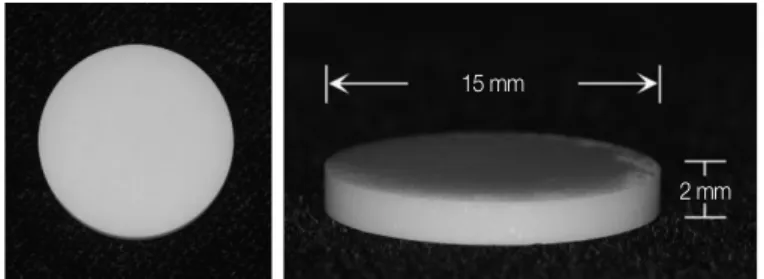
정방정 지르코니아 다결정체(3Y-TZP: 3 mol% yttria-tetragonal zir- conia polycrystal)를 원료로 하는 CAD/CAM 지르코니아 블록 (Fulluster, >99.9%, 30 nm, HASS, Gangneung, Korea)을 다이아몬드 휠을 이용하여 연삭한 뒤 1 ㎛ 다이아몬드 페이스트로 연마하 여 직경 15 mm, 두께 2 mm의 디스크 모양의 시편을 100개 제조 하였다(Fig. 1). 시편은 연마 후 발생하는 상변화에 의한 변질층 을 제거하기 위해 1200℃에서 1시간 동안 공기 중에서 annealing
하였다. 모든 지르코니아 시편은 110 ㎛의 Al2O3를 3 bar의 압력 으로 표면에 수직으로 10 mm 거리에서 10초간 분사하였다.
2. 레진 실린더 제작
내경 6 mm, 높이 6 mm인 teflon tube와 composite resin (FiltekTMZ250, 3M ESPE, St. Paul, MN, USA)을 이용하여, 직경 6 mm와 높이 6 mm 인 composite resin cylinder를 제작하였다. Composite resin은 tube를 채우기 위해 각각 1 mm 높이로 6번에 걸쳐 중합하였고, 각 층을 20초간 총 120초 광중합 하였다(Fig. 2).
3. 자가 접착 레진시멘트를 이용한 접착
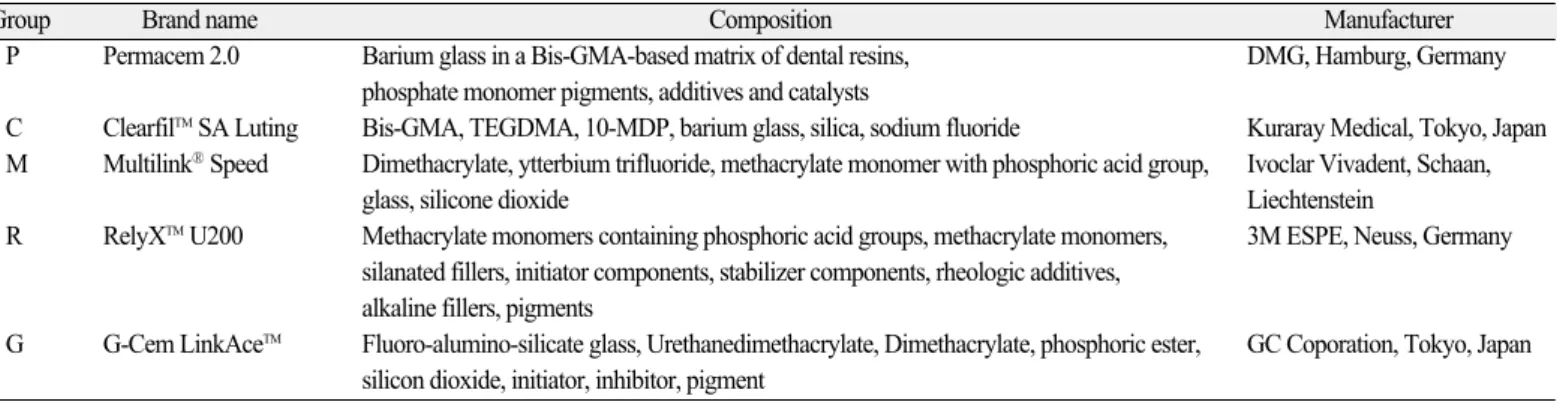
총 100개의 지르코니아 시편을 다양한 인산염계 기능성 단량 체가 포함된 이중 중합형 자가 접착 레진시멘트(Table 1)의 종류 에 따라 각 군당 20개의 시편을 가지도록 5개의 군으로 나누었 다. 자가 접착 레진시멘트를 composite resin cylinder에 도포 후 산 화알루미늄 분사로 표면 처리된 지르코니아 시편에 접착하고 10 N의 정적 하중을 가했다. 과잉의 시멘트는 제거하고, 지르코 니아와 composite resin cylinder 계면을 따라 20초씩 4방향에서 총 80초 동안 광중합 했다. 그 후 접착된 시편을 상온에 10분간 놓아두었다.
이렇게 완성된 각군 20개의 시편은 다시 10개씩 2개의 sub- group으로 나누었다. 첫 번째 subgroup은 37℃ 증류수에 24시간 동 안 보관하고, 두 번째 subgroup은 37℃ 증류수에 24시간 동안 보 관한 후에 5℃와 55℃에서 5,000회의 열순환을 시행하였다.
4. 전단결합강도 측정
전단결합강도(MPa)는 만능시험기(Model 4201, Instron Corporation, Canton, MA, USA)를 이용하여 하중속도 1 mm/min로 측정하였으며, composite resin cylinder가 지르코니아에서 분리 될 때의 최대하중(N)을 접착면적(mm2)으로 나누어 계산하였다.
Fig. 1. Zirconia specimen.
15 mm
2 mm
Fig. 2. Composite resin cylinder.
6 mm
6 mm
5. 파절양상 관찰
각 시편의 파절양상을 주사전자현미경(×2,000 magnification, SUPRA 40VP, ZEISS, Thornwood, NY, USA)을 이용하여 관찰하였 다.
6. 통계분석
SPSS ver. 18.0 프로그램(SPSS Inc., Chicago, IL, USA)을 이용하였 다. 두 변수 즉, 자가 접착 레진시멘트의 종류와 열순환 처리 여 부의 교작용 유무를 알아보기 위해 이원변량분석(Two-way ANOVA) 시행하였고, 각 실험군 간 전단결합강도의 유의성을 알아보기 위해 일원변량분석(One-way ANOVA) 시행하였으며, Tukey HSD post hoc test를 이용하여 사후검정 하였다(α=.05). 각 시 멘트의 열순환 전 후 전단결합강도 변화를 살펴보기 위하여 paired t-test 시행하였다(α=.05).
결과
1. 전단결합강도 비교
각 실험군과 그에 따른 전단결합강도의 평균을 Table 2와 Fig.
3에 나타내었다. 열순환 전의 전단결합강도는 M군이 13.61 (±
1.45) MPa로 가장 높았고 R군이 9.69 (±1.55) MPa로 가장 낮았다.
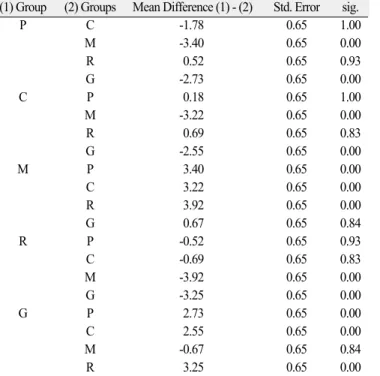
열순환 후 측정한 전단결합강도는 M군이 12.36 (±2.40) MPa로 가장 높았고 G군이 6.26 (±2.41) MPa로 가장 낮았다. 시멘트 종 류와 열순환 유무에 따라 각각 유의한 차이를 보였으며, 시멘 트 종류와 열순환 유무 사이에 교작용이 나타났다(P<.05). 열순 환 전, P-G, C-M, M-R, M-G군을 제외한 나머지 군 사이 유의한 차 이를 보였고 열순환 후, P-G, C-M, M-R, M-G군 사이 유의한 차이 를 보였다(P<.05) (Table 3, Table 4). 열순환 처리 전 후 각 군의 전단 결합강도 변화를 살펴본 결과 5종의 자가 접착 레진시멘트는 모두 값이 작아졌는데, 그 중 G군이 가장 큰 변화를 보였으며 다른 시멘트와는 달리 유의한 차이를 나타냈다(P<.05) (Fig. 3).
Table 1. Self-adhesive resin cements used in this study
Group Brand name Composition Manufacturer
P Permacem 2.0 Barium glass in a Bis-GMA-based matrix of dental resins, DMG, Hamburg, Germany phosphate monomer pigments, additives and catalysts
C ClearfilTMSA Luting Bis-GMA, TEGDMA, 10-MDP, barium glass, silica, sodium fluoride Kuraray Medical, Tokyo, Japan M Multilink�Speed Dimethacrylate, ytterbium trifluoride, methacrylate monomer with phosphoric acid group, Ivoclar Vivadent, Schaan,
glass, silicone dioxide Liechtenstein
R RelyXTMU200 Methacrylate monomers containing phosphoric acid groups, methacrylate monomers, 3M ESPE, Neuss, Germany silanated fillers, initiator components, stabilizer components, rheologic additives,
alkaline fillers, pigments
G G-Cem LinkAceTM Fluoro-alumino-silicate glass, Urethanedimethacrylate, Dimethacrylate, phosphoric ester, GC Coporation, Tokyo, Japan silicon dioxide, initiator, inhibitor, pigment
Table 2. Mean shear bond strength (MPa) with SD
Group N Mean SD
P-11) 10 10.21 1.36
P-22) 10 9.70 1.57
C-1 10 10.38 1.29
C-2 10 8.65 2.39
M-1 10 13.61 1.45
M-2 10 12.36 2.40
R-1 10 9.69 1.55
R-2 10 8.21 2.45
G-1 10 12.94 1.64
G-2 10 6.26 2.41
1) -1 : Before thermocycling
2) -2 : After thermocycling Fig. 3. Mean shear bond strength (*: Statistically significant with P<.05).
2. 주사전자현미경 관찰
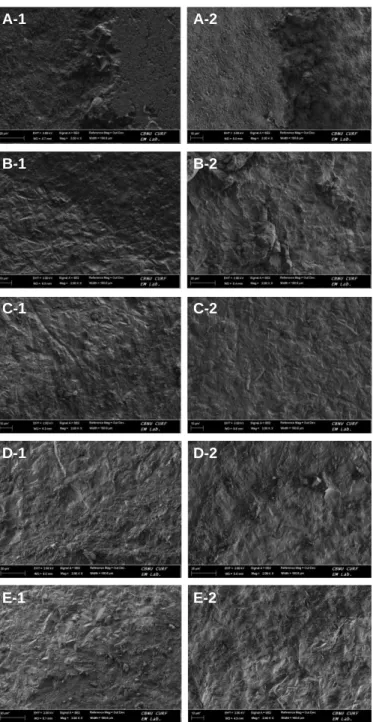
시편의 파절양상을 관찰한 결과 P군은 응집성 파절이 우세 하게 나타났으며 나머지 군들은 혼합성 파절이 주로 나타났다 (Fig. 4). 지르코니아의 연마면, 산화알루미나 분사 후 표면 및 자 가접착 레진시멘트에 따른 각 군의 열순환 전 후 파절면을 Fig.
5, Fig. 6에 나타내었다.
고찰
강화세라믹 특히 지르코니아 세라믹은 뛰어난 심미성과 우 수한 물리적 성질 및 생체 적합성으로 인해 최근 치과보철 영 역에서 폭넓게 사용되고 있다. 따라서 지르코니아 수복물의 임상적 성공을 위한 많은 연구들이 진행되고 있으며 Passos 등5 은 수복물의 표면처리와 시멘트 선택이 중요한 요소라고 하였 다. 그러나 Ferracane 등16은 최근 간편한 술식으로 각광받고 있는 자가 접착 레진시멘트와 지르코니아 사이의 결합강도를 비교 한 연구의 수가 적다고 하였다. 하지만 최근 들어 인산염계 기 능성 단량체가 첨가된 자가 접착 레진시멘트가 다른 단량체를 포함한 레진시멘트 보다 지르코니아와 더 우수한 결합강도를 보인다는 연구가 보고되고 있다.14,17따라서 이번 연구에서는 최근 들어 개발된 인산염계 기능성 단량체가 포함된 수종의 자가 접착 레진시멘트 들과 지르코니아 사이의 전단결합강도 를 측정하여 자가 접착 레진시멘트에 포함되어 있는 다양한 인산염계 기능성 단량체의 지르코니아에 대한 결합능을 비교 해 보았다.
Table 3. The results of Tukey HSD post hoc test (before thermocycling) (1) Group (2) Groups Mean Difference (1) - (2) Std. Error sig.
P C -1.78 0.65 1.00
M -3.40 0.65 0.00
R 0.52 0.65 0.93
G -2.73 0.65 0.00
C P 0.18 0.65 1.00
M -3.22 0.65 0.00
R 0.69 0.65 0.83
G -2.55 0.65 0.00
M P 3.40 0.65 0.00
C 3.22 0.65 0.00
R 3.92 0.65 0.00
G 0.67 0.65 0.84
R P -0.52 0.65 0.93
C -0.69 0.65 0.83
M -3.92 0.65 0.00
G -3.25 0.65 0.00
G P 2.73 0.65 0.00
C 2.55 0.65 0.00
M -0.67 0.65 0.84
R 3.25 0.65 0.00
No significant difference: P>.05
Table 4. The results of Tukey HSD post hoc test (after thermocycling) (1) Group (2) Groups Mean Difference (1) - (2) Std. Error sig.
P C 1.05 1.01 0.84
M -2.66 1.01 0.08
R 1.49 1.01 0.59
G 0.36 1.01 0.01
C P -1.05 1.01 0.84
M -3.71 1.01 0.01
R 0.44 1.01 0.99
G 2.39 1.01 0.15
M P 2.66 1.01 0.08
C 3.71 1.01 0.01
R 4.15 1.01 0.00
G 6.10 1.01 0.00
R P -1.49 1.01 0.59
C -0.44 1.01 0.99
M -4.15 1.01 0.00
G 1.95 1.01 0.32
G P -3.44 1.01 0.01
C -2.39 1.01 0.15
M -6.10 1.01 0.00
R -1.95 1.01 0.32
No significant difference: P>.05
Fig. 4. Failure mode before and after thermocycling (-1 : before thermocycling, -2 : after thermocycling).
Fig. 5. Scanning electron microscope image of zirconia surface (×5,000 magnification).
(A) polished with 1 ㎛ diamond paste, (B) sandblasting with 50 ㎛ Al2O3.
A B
Wolfart 등15은 인산염계 단량체인 10-MDP는 지르코니아와 화학적 결합을 나타내어 높은 결합강도를 나타낸다고 하였다.
D'Amario 등18은 또 다른 인산염계 단량체인 phosphoric acid acry- late가 첨가된 레진시멘트가 10-MDP가 첨가된 레진시멘트보 다 열순환 후 유의하게 높은 결합강도를 나타냈음을 보고하였 다. 본 연구에서는 methacrylate phosphoric acid 단량체가 포함된
Multilink�Speed가 10-MDP 및 또 다른 인산염계 단량체를 포함한 자가 접착 레진시멘트 보다 열순환 전 후에 높은 결합강도를 나타냈다. 따라서 Multilink�Speed에 첨가된 인산염계 단량체의 지르코니아에 대한 결합능이 다른 시멘트에 포함된 단량체보 다 뛰어난 것으로 사료된다.
시편의 파절양상 분석 시, Toledano 등19은 접착성 파절이 낮은 결합강도와 관련되어 있다고 하였고, Passos5와 Oyagüe 등17은 높 은 결합강도를 나타내는 응집성 및 혼합성 파절이 임상적으로 바람직하다고 하였다. 하지만 이와는 대조적으로 Luthy 등14은 열순환 후 레진시멘트의 결합강도는 감소한 반면, 응집성 파 절이 증가한 연구결과를 보고하였다. 본 연구의 결과 Permacem 2.0은 열순환 전 후 모두 응집성 파절이 우세했지만, 다른 군과 의 결합강도 비교 시 상대적으로 높지 않은 순위를 나타냈다.
Fischer 등20은 결합강도는 피착체와 결합재 사이의 강도 및 결합 재 내부강도에 영향을 받는다고 하였고, Chung과 Greener21, Asmussen과 Peutzfeldt22는 레진시멘트의 물리적 성질은 단량체의 조성, 충전제의 함량과 구조 및 단량체 전환율 등에 의해 영향 을 받는다고 하였다. 따라서 Permacem 2.0이 열순환 전 후 주로 응집성 파절을 나타냈지만 다른 군과 비교하여 높지 않은 결 합강도를 나타낸 것은 시멘트의 내부 기계적 물성이 상대적으 로 약하여 접착면이 분리되기 전 레진 시멘트 내부에서 파절 이 발생했기 때문인 것으로 사료된다.
Blatz 등23은 열순환 처리 후 지르코니아와 레진시멘트 사이 전단결합강도가 유의하게 감소했음을 보고하였다. 이와는 대 조적으로, Lüthy 등14은 열순환 처리 후 일부 레진시멘트의 결합 강도가 유의하게 증가하고, 또 다른 레진시멘트는 결합강도의 변화가 안정적이었음을 보고하였다. 이를 통해 열순환의 영향 은 시멘트의 종류에 따라 다양한 것을 알 수 있다. 본 연구에서 는 G-Cem LinkAceTM가 열순환 처리 후 결합강도가 유의하게 감 소한 반면 나머지 시멘트의 결합강도는 열순환 전 후 비교적 안정적이었다. 따라서 G-Cem LinkAceTM를 제외한 나머지 시멘 트에 포함된 인산염계 단량체는 열순환 처리에 비교적 영향을 적게 받는 것으로 보인다.
하지만 본 실험은 인산염계 기능성 단량체의 명확한 성분을 분석하여 지르코니아와의 접착력을 비교하지 못한 한계점을 가지고 있다. 따라서 추후 인산염계 기능성 단량체의 성분에 따른 구체적인 접착력 비교와 더 다양한 자가 접착 레진 시멘 트를 포함한 연구가 필요할 것으로 사료된다.
결론
본 연구에서는 다양한 인산염계 기능성 단량체를 포함한 5 종의 자가 접착 레진시멘트를 선택하여 지르코니아 세라믹과 접착한 후 열순환 처리 전 후 전단결합강도를 비교하여 임상 적으로 유용한 기능성 단량체를 함유한 시멘트를 선택하는데 도움을 얻고자 하였으며 이 실험의 한계 내에서 다음과 같은 결론을 얻었다.
Fig. 6. Scanning electron microscope image of zirconia surface after shear-bond strength test (×2,000 magnification, -1: before thermocycling, -2: after thermo- cycling). (A) P: Permacem 2.0, (B) C: ClearfilTMSA Luting, (C) M: Multilink�Speed, (D) R: RelyXTMU200, (E) G: G-Cem LinkAceTM.
A-1 A-2
B-1 B-2
C-1 C-2
D-1 D-2
E-1 E-2
1. 평균 전단결합강도 비교 시, 열순환 처리 전과 후 모두 Multilink�Speed가 가장 높은 값을 나타내었다.
2. 열순환 처리 후 G-Cem LinkAceTM를 제외한 나머지 시멘트의 결합강도 변화는 안정적이었다.
ORCID
Ji-Hun Lee http://orcid.org/0000-0002-5954-0453 Seung-Geun Ahn http://orcid.org/0000-0002-9105-931X Ju-Mi Park http://orcid.org/0000-0003-1910-1525 Jae-Min Seo http://orcid.org/0000-0001-5095-4046
References
1. Anusavice KJ. Recent developments in restorative dental ceramics.
J Am Dent Assoc 1993;124:72-4, 76-8, 80-4.
2. Kelly JR, Nishimura I, Campbell SD. Ceramics in dentistry: his- torical roots and current perspectives. J Prosthet Dent 1996;75:18- 32.
3. Lin J, Shinya A, Gomi H, Shinya A. Effect of self-adhesive resin cement and tribochemical treatment on bond strength to zirco- nia. Int J Oral Sci 2010;2:28-34.
4. Luthardt RG, Sandkuhl O, Reitz B. Zirconia-TZP and alumina-- advanced technologies for the manufacturing of single crowns.
Eur J Prosthodont Restor Dent 1999;7:113-9.
5. Passos SP, May LG, Barca DC, Ozcan M, Bottino MA, Valandro LF. Adhesive quality of self-adhesive and conventional adhesive resin cement to Y-TZP ceramic before and after aging conditions.
Oper Dent 2010;35:689-96.
6. Derand T, Molin M, Kvam K. Bond strength of composite lut- ing cement to zirconia ceramic surfaces. Dent Mater 2005;21:1158- 62.
7. Anusavice KJ. Phillips science of dental materials. 11th ed.
Saunders, Missouri, USA, 2003. p. 443-94.
8. Dixon DL, Breeding LC, Hughie ML, Brown JS. Comparison of shear bond strengths of two resin luting systems for a base and a high noble metal alloy bonded to enamel. J Prosthet Dent 1994;72:457-61.
9. In HS, Park JI, Choi JI, Cho HW, Dong JK. The study of shear bond strength of a self-adhesive resin luting cement to dentin. J Korean Acad Prosthodont 2008;46:535-43.
10. Miragaya L, Maia LC, Sabrosa CE, de Goes MF, da Silva EM. Evaluation of self-adhesive resin cement bond strength to yttria-stabilized zirconia ceramic (Y-TZP) using four surface treat-
ments. J Adhes Dent 2011;13:473-80.
11. Komine F, Kobayashi K, Saito A, Fushiki R, Koizumi H, Matsumura H. Shear bond strength between an indirect composite veneering material and zirconia ceramics after thermocycling. J Oral Sci 2009;51:629-34.
12. Ikemura K, Jogetsu Y, Shinno K, Nakatsuka T, Endo T, Kadoma Y. Effects of a newly designed HEMA-free, multi-purpose, single-bottle, self-etching adhesive on bonding to dental hard tis- sues, zirconia-based ceramics, and gold alloy. Dent Mater J 2011;30:616-25.
13. Kim AJ, Yu SH, Oh SH, Bae JM. Effect of self-adhesive resin cements on the shear bond strengths between bovine teeth and composite resin block. J Korean Soc Dent Mater 2013;40:367- 72.
14. Lüthy H, Loeffel O, Hammerle CH. Effect of thermocycling on bond strength of luting cements to zirconia ceramic. Dent Mater 2006;22:195-200.
15. Wolfart M, Lehmann F, Wolfart S, Kern M. Durability of the resin bond strength to zirconia ceramic after using different surface con- ditioning methods. Dent Mater 2007;23:45-50.
16. Ferracane JL, Stansbury JW, Burke FJ. Self-adhesive resin ce- ments - chemistry, properties and clinical considerations. J Oral Rehabil 2011;38:295-314.
17. Oyagüe RC, Monticelli F, Toledano M, Osorio E, Ferrari M, Osorio R. Effect of water aging on microtensile bond strength of dual- cured resin cements to pre-treated sintered zirconium-oxide ceramics. Dent Mater 2009;25:392-9.
18. D'Amario M, Campidoglio M, Morresi AL, Luciani L, Marchetti E, Baldi M. Effect of thermocycling on the bond strength between dual-cured resin cements and zirconium-oxide ceramics. J Oral Sci 2010;52:425-30.
19. Toledano M, Osorio R, Osorio E, Aguilera FS, Yamauti M, Pashley DH, Tay F. Durability of resin-dentin bonds: effects of direct/in- direct exposure and storage media. Dent Mater 2007;23:885-92.
20. Fischer J, Grohmann P, Stawarczyk B. Effect of zirconia surface treatments on the shear strength of zirconia/veneering ceramic composites. Dent Mater J 2008;27:448-54.
21. Chung KH, Greener EH. Correlation between degree of conversion, filler concentration and mechanical properties of posterior com- posite resins. J Oral Rehabil 1990;17:487-94.
22. Asmussen E, Peutzfeldt A. Influence of UEDMA BisGMA and TEGDMA on selected mechanical properties of experimental resin composites. Dent Mater 1998;14:51-6.
23. Blatz MB, Sadan A, Martin J, Lang B. In vitro evaluation of shear bond strengths of resin to densely-sintered high-purity zirconi- um-oxide ceramic after long-term storage and thermal cycling.
J Prosthet Dent 2004;91:356-62.
ORIGINAL ARTICLE
인산염계 기능성 단량체가 첨가된 수종의 자가 접착 레진시멘트와 지르코니아 세라믹 사이 열순환 전후 전단결합강도 비교
이지훈∙김민경∙이정진∙안승근∙박주미∙서재민*
전북대학교 치의학전문대학원 치과보철학교실 및 구강생체과학연구소
목적: 본 연구에서는 서로 다른 인산염계 기능성 단량체가 첨가된 5종의 자가 접착 레진시멘트와 지르코니아 사이의 열순환 전후 전단결합강도를 비교 평가하고자 하였다.
재료 및 방법: Airborne particle abrasion (50 μm Al2O3)을 시행한 디스크 모양의 Y-TZP 지르코니아 블록을 총 100개 준비하였다. 그리고 composite resin cylin- der (FiltekTMZ250, 3M ESPE, St. Paul, MN, USA) 100개를 준비하였다. 서로 다른 인산염계 기능성 단량체가 첨가된 5종의 이중 중합형 자가 접착 레진 시멘트 즉, Permacem 2.0 (DMG, Hamburg, Germany), ClearfilTMSA Luting (Kuraray Medical, Tokyo, Japan), Multilink�Speed (Ivoclar Vivadent, Schaan, Liechtenstein), RelyXTMU200 Automix (3M ESPE, Neuss, Germany), G-Cem LinkAceTM(GC Corporation, Tokyo, Japan)를 이용하여 지르코니아 블록과 composite resin cylin- der를 접착하고 1군당 20개의 시편을 갖는 5개의 군을 만들었다. 시편을 37℃ 의 증류수에 24시간 동안 보관한 후 각 군의 시편 절반(n=10)은 곧 바로 그리고 나머지 절반(n=10)은 5000회 열순환(5 - 55℃) 후에 전단결합강도를 측정하였다. 파절면은 FE-SEM을 이용하여 관찰하였다. 통계분석은 레진 시멘트 종류 및 열순환 유무에 따른 전단결합강도의 비교를 위해 Two/One-way ANOVA를 시행하고 Tukey HSD post-hoc test를 이용하여 사후 검정하 였으며, 열순환 전후의 비교를 위해 paired t-test를 이용하였다(α=.05).
결과: 열순환 전과 후 모두 Multilink�Speed 군은 나머지 4종류의 시멘트 군 보다 큰 전단결합강도를 나타내었다. G-Cem LinkAceTM군은 열순환 전과 비교하여 열순환 후에 유의하게 낮은 전단결합강도를 나타내었지만, 다른 4종류 군은 열순환 전후 유의한 차이가 없었다.
결론: 인산염계 단량체를 포함한 대부분의 이중 중합형 자가 접착 레진시멘트는 지르코니아와 높은 전단결합강도를 보이고 열순환에 의해 유의 한 영향을 받지 않아 지르코니아 보철물의 접착에 유용할 것이라고 사료된다. (대한치과보철학회지 2015;53:318-24)
주요단어: 자가접착 레진시멘트; 인산염계 단량체; 지르코니아 세라믹; 전단결합강도; 열순환
*교신저자: 서재민
54907 전북 전주시 덕진구 건지로 20 전북대학교 치의학전문대학원 치과보철학교실 063-250-2696: e-mail, [email protected]
원고접수일: 2015년 7월 17일 / 원고최종수정일: 2015년 8월 19일 / 원고채택일: 2015년 8월 19일
2015 대한치과보철학회
이 글은 크리에이티브 커먼즈 코리아 저작자표시-비영리 3.0 대한민국 라이선스에 따라 이용하실 수 있습니다.
c cc