www.kaom.org
ISSN 2288-9272 J Oral Med Pain 2014;39(3):96-99 http://dx.doi.org/10.14476/jomp.2014.39.3.96
The Effects of Gabapentin in Treatment of Burning Mouth Syndrome:
Retrospective Pilot Study
Jun-Young Heo1, Soo-Min Ok1, Sung-Hee Jeong1, Kyung-Hee Kim2, Yong-Woo Ahn1
1Department of Oral Medicine and Dental Research Institute, Pusan National University Dental Hospital, Yangsan, Korea
2Department of Oral Medicine, Inje University Busan Paik Hospital, Busan, Korea
Received June 26, 2014 Revised July 15, 2014 Accepted July 31, 2014
Purpose: The objective of this retrospective pilot study was to evaluate the effectiveness of Ga- bapentin in patients with primary burning mouth syndrome (BMS).
Methods: Ten subjects were diagnosed with primary BMS (8 women and 2 men). The mean age was 60.1 years. They had clinical examination to exclude local factors such as the presence of Candida species, xerostomia, lichen planus, etc. They also underwent hematological examina- tion to exclude secondary BMS due to systemic disorders. Pain was assessed by patients on an 11-point numerical rating score system (0 to 10). Gabapentin was administered at a starting dose of 300 mg/day, slowly titrated up to maximum of 1,800 mg/day. All patients were treated for 4 weeks.
Results: One half of the patients (n=5) obtained reduction in pain over the treatment period.
Four patients reported no reduction in pain symptoms. One patient reported that symptoms were worsening. The average pain score before the treatment was 6.3 and after the treatment was 5.25. No significant relationship was detected between pretreatment and posttreatment pain score. Only one patient noted mild side effect (dizziness).
Conclusions: This retrospective pilot study provides no preliminary evidence that Gabapentin has effect in the management of BMS. However, further research (well-designed, randomized, and controlled trial with large sample) would be needed to investigate the efficacy of Gabapen- tin in treatment of BMS.
Key Words: Burning mouth syndrome; Gabapentin
Correspondence to:
Yong-Woo Ahn
Department of Oral Medicine, School of Dentistry, Pusan National University, 49, Busandaehak-ro, Mulgeum-eup, Yangsan 626-870, Korea
Tel: +82-55-360-5241 Fax: +82-55-360-5238 E-mail: [email protected] This study was supported by Clinical Research Grant, Pusan National University Dental Hospital (2013).
identified and a neuropathological cause is likely.8) No pre- cise information pertaining to the natural history of BMS is available. However, according to based on a single study, spontaneous and complete remission is rare and reported to occur in 3% of patients within 5 years after the onset of BMS.9)
To date, the treatment of BMS has largely been empiri- cal and depends on the patient’s condition and physician’s preference. There is no effective treatment applicable to most patients with BMS.10) However, currently employed therapies for the treatment of BMS include hormone re- placement therapy, anticonvulsants, antidepressants, capsa- icin, benzodiazepines, analgesics, alpha-lipoic acid (ALA),
INTRODUCTION
Burning mouth syndrome (BMS) is a condition that is diagnosed based on the presence of an oral burning or similar dysesthesia in the absence of other dental or medi- cal causes.1) Its true prevalence is uncertain, which an esti- mated incidence of the condition of 0.7%-4.6% in the gen- eral population and a predominance among women.2-5) The tongue is the primary location of the burning complaint in the majority of cases, but BMS can also involve the lips, palate, and gingival.6) BMS be classified into 2 clinical forms: “primary BMS” and “secondary BMS.”7) The primary BMS for which organic local or systemic causes cannot be
Original Article
JOMP
Journal of Oral Medicine and PainCopyright Ⓒ 2014 Korean Academy of Orofacial Pain and Oral Medicine. All rights reserved.
97 Jun-Young Heo, et al. Effects of Gabapentin in Burning Mouth Syndrome Patients
www.kaom.org
follows:
·Use of certain medications associated with BMS (for example, angiotensin converting enzyme inhibitors)
·Patients treated and being treating with psychological therapies
·History of an allergy to dental materials
2. Dose Escalations and Pain Assessment
Gabapentin was administered at a starting dose of 300 mg/day, slowly titrated up to maximum of 1,800 mg/day.
The mean dose was 900±374.16 mg/day. All patients were treated for 4 weeks. Pain was assessed by patients on an 11-point numerical rating score system (0 to 10) before and after treatment.
3. Statistical Analysis
The categorical variables were summarized as counts and percentages; numerical variables as the mean±standard de- viation. The treatment outcomes were statistically analyzed by Wilcoxon signed rank test using SPSS 12.0 for Windows (SPSS Inc., Chicago, IL, USA). p-values less than 0.05 were considered to be statistically significant.
RESULTS
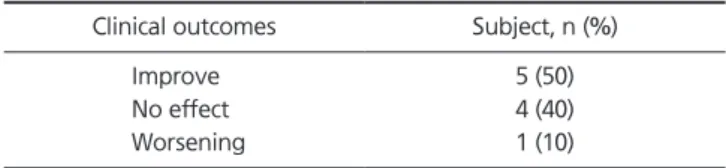
Of the 10 subjects included in this study, 8 were female and 2 were male. The mean age was 60.1±11.56 years, ranging from 49 to 79 years. The mean symptom duration was 27.2±31.13 months. Average treatment course was 2.7 visits (range, 2-4 visits). One half of the patients (n=5) ob- tained reduction in pain over the treatment period. Four and congnitive therapies.11) In spite of the many behavioral
and medication-based treatment, the management of BMS is still not satisfactory.
Gabapentin was approved by the U.S. Food and Drug Administration in 2002 for the treatment of postherpetic neuralgia. Even before this, Gabapentin has been used off- label for many types of neuropathic pain disorders includ- ing BMS.12)
The objective of this pilot study was to evaluate the effec- tiveness of Gabapentin in patients with primary BMS.
MATERIALS AND METHODS
The study was approved by the Institutional Review Board of Pusan National University Dental Hospital.
1. Subjects and Treatment Methods
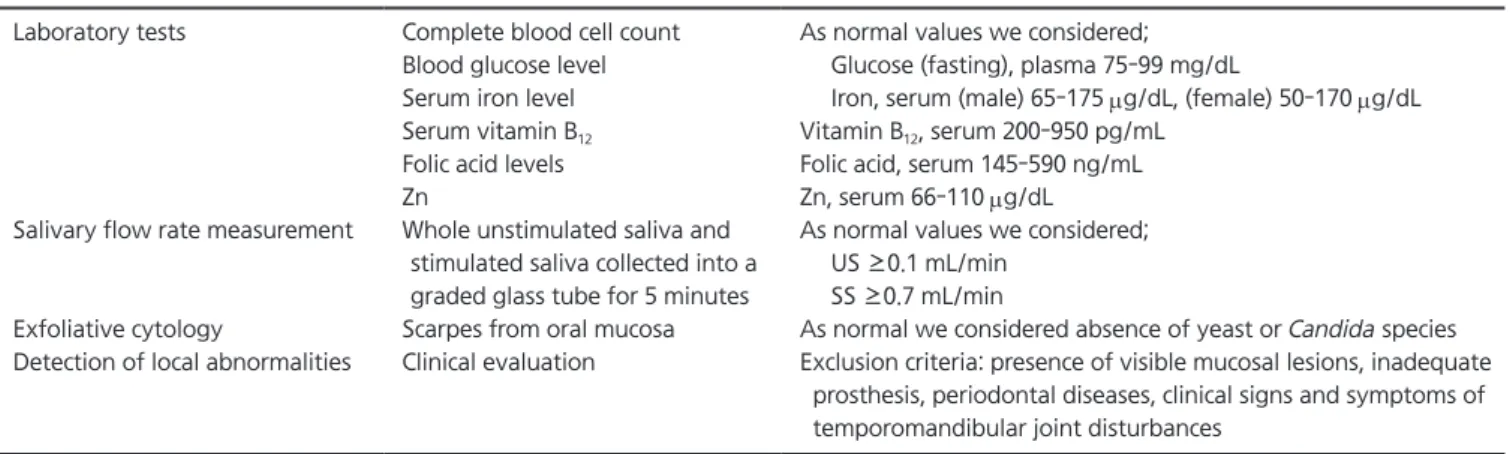
This study was conduted at the Department of Oral Medicine, Pusan National University Dental Hospital during the period from April to September 2012. Con secutive out- patients complaining of burning mouth pain were screened for inclusion in the study by clinical examination to ex- clude local factors, such as the presence of Candida spe- cies, parafunctional habits, allergic contact stomatitis, xe- rostomia, and lichen planus. In addition, they underwent hematological examinations to exclude systemic disorders including determination of serum levels of iron, zinc, folic acid, vitamin B12, and blood glucose (Table 1). Ultimately, 10 patients (8 women and 2 men) met the inclusion criteria with definitive diagnosis of primary BMS according to the criteria of Scala et al.7) also the exclusions criteria were as
Table 1. Clinical and laboratorial evaluations Laboratory tests
Salivary flow rate measurement
Exfoliative cytology
Detection of local abnormalities
Complete blood cell count Blood glucose level Serum iron level Serum vitamin B12
Folic acid levels Zn
Whole unstimulated saliva and stimulated saliva collected into a graded glass tube for 5 minutes Scarpes from oral mucosa Clinical evaluation
As normal values we considered;
Glucose (fasting), plasma 75-99 mg/dL
Iron, serum (male) 65-175 mg/dL, (female) 50-170 mg/dL Vitamin B12, serum 200-950 pg/mL
Folic acid, serum 145-590 ng/mL Zn, serum 66-110 mg/dL
As normal values we considered;
US ≥0.1 mL/min SS ≥0.7 mL/min
As normal we considered absence of yeast or Candida species Exclusion criteria: presence of visible mucosal lesions, inadequate
prosthesis, periodontal diseases, clinical signs and symptoms of temporomandibular joint disturbances
US, unstimulated saliva; SS, stimulated saliva.
98 J Oral Med Pain Vol. 39 No. 3, September 2014
www.kaom.org
tricyclic antidepressants, anticonvulsant and benzodiaz- epine are used for managemant of BMS.14) Although there is no one accepted treatment of for BMS, BMS should be treated as a neuropathic pain. However, management of BMS is difficult and challenging.
Gabapentin is used to manage many neuropathic pains for example postherpetic neuralgia, trigeminal neuralgia and diabetic neuropathies.15) The mechanisms of action of Gabapentin is still uncertain but most likely it acts to affect voltage-dependent L-type CA2+ channels. For neuropath- ic pain therapy, starting dose is 300 mg/day. The dose is gradually increased to 3,600 mg/day (the maximum dose).
Advantage of Gabapentin are that it has good tolerability and lower drug-drug interactions. General side effects of Gabapentin include edema, drousiness, nausea, dizziness, fa- tique, etc.16) However, these side effects are not serious and self-limiting. A recent case report showed that Gabapentin was beneficial at reducing oral burning symptoms.17) Also, Heckmann et al.18) reported pilot study. According to the au- thors, Gabapentin has little or no effect for BMS. However, this study is an open-label study with small sample.
Therefore, before randomized controlled study with suffi- cient sample, we conducted retrospective pilot study.
The results of this pilot study also suggest that Gabapentin are not beneficial for BMS treatment. Only 2 patients (20%) obtained more 50% reduction in BMS symptoms. Such re- sults may be explained as follows: first, possible explana- tion that the dosage was too small or that the duration of treatment was too short. And the number of patients was too small to detect a significant treatment effect. Second, such results also may be explained by the ambiguity of the cause of BMS: primary BMS cannot be caregorized into a single pain type (neuropathic pain).
This pilot study provides no preliminary evidence that Gabapentin has effect in the management of BMS. However, further research (well-designed, randomized and controlled trial with large sample) would be needed to investigate the efficacy of Gabapentin in treatment of BMS.
CONFLICT OF INTEREST
No potential conflict of interest relevant to this article was reported.
patients reported no reduction in pain symptoms. One pa- tient reported that symptoms were worsening. After treat- met, only 2 patients obtained more 50% reduction of pain score (Table 2).
Average pain score before treatment was 6.3±2.26 (range, 4-10). The average pain score after treatment was 5.25±2.68 (range, 4-8.5). Since data did not turn out to have normal distribution because of small sample size, the Wilcoxson signed rank test was applied to analyze the difference after treatment. No significant relationship was detected between pretreatment and posttreatment pain score (p=0.168) (Table 3).
Side effects were recorded by patient history. All subjects completed testing without major side effects. Only one pa- tients noted mild side effect (dizziness).
DISCUSSION
Although there are several etiologic factors (including lo- cal, systemic, or psychological factors) in BMS patients, the exact mechanisms of BMS are not elucidated.13) Recent neurophysiologic, psychophysical, neuropathological, and functional imaging studies have provided evidence that pri- mary (idiopathic) BMS may be a chronic neuropathic pain disorder.8) Therefore, for primary BMS treatment, various drugs for chronic neuropathic pain therapy have been used in clinics.11) According to Cochrane database of systematic review in 2005, only three interventions demonstrated a reduction in BMS symptoms: ALA, clonazepam, and con- gnitive behavioral therapy.1) Also, based on expert opinion and common clinical practice, topical capsaicin, systemic
Table 2. Effect of Gabapentin in the 10 subjects
Clinical outcomes Subject, n (%) Improve
No effect Worsening
5 (50) 4 (40) 1 (10)
Table 3. Summary of pain scores recorded during treatment Pain score Mean±SD Range Significant change Pretreatment
Posttreatment
6.3±2.26 5.25±2.68
4-10
4-8.5 No (p=0.168) SD, standard deviation.
Statistical analysis by Wilcoxn signed rank test.
99 Jun-Young Heo, et al. Effects of Gabapentin in Burning Mouth Syndrome Patients
www.kaom.org 10. Mínguez Serra MP, Salort Llorca C, Silvestre Donat FJ. Pharma- cological treatment of burning mouth syndrome: a review and update. Med Oral Patol Oral Cir Bucal 2007;12:E299-E304.
11. Patton LL, Siegel MA, Benoliel R, De Laat A. Management of burning mouth syndrome: systematic review and management recommendations. Oral Surg Oral Med Oral Pathol Oral Radiol Endod 2007;103(Suppl):S39.e1-e13.
12. Suarez P, Clark GT. Burning mouth syndrome: an update on di- agnosis and treatment methods. J Calif Dent Assoc 2006;34:611- 622.
13. Woda A, Dao T, Gremeau-Richard C. Steroid dysregulation and stomatodynia (burning mouth syndrome). J Orofac Pain 2009;23:
202-210.
14. Sun A, Wu KM, Wang YP, Lin HP, Chen HM, Chiang CP. Burning mouth syndrome: a review and update. J Oral Pathol Med 2013;
42:649-655.
15. Wiffen PJ, McQuay HJ, Edwards JE, Moore RA. Gabapentin for acute and chronic pain. Cochrane Database Syst Rev 2005;(3):
CD005452.
16. Nicholson B. Gabapentin use in neuropathic pain syndromes.
Acta Neurol Scand 2000;101:359-371.
17. White TL, Kent PF, Kurtz DB, Emko P. Effectiveness of gabapen- tin for treatment of burning mouth syndrome. Arch Otolaryngol Head Neck Surg 2004;130:786-788.
18. Heckmann SM, Heckmann JG, Ungethüm A, Hujoel P, Hummel T. Gabapentin has little or no effect in the treatment of burning mouth syndrome: results of an open-label pilot study. Eur J Neurol 2006;13:e6-e7.
REFERENCES
1. Zakrzewska JM, Forssell H, Glenny AM. Interventions for the treatment of burning mouth syndrome. Cochrane Database Syst Rev 2005;(1):CD002779.
2. Lipton JA, Ship JA, Larach-Robinson D. Estimated prevalence and distribution of reported orofacial pain in the United States. J Am Dent Assoc 1993;124:115-121.
3. Tammiala-Salonen T, Hiidenkari T, Parvinen T. Burning mouth in a Finnish adult population. Community Dent Oral Epidemiol 1993;21:67-71.
4. Femiano F. Statistical survey of afferent pathologies during a 5-year study in the oral pathology Department at the Second University of Naples. Minerva Stomatol 2002;51:73-78.
5. Bergdahl M, Bergdahl J. Burning mouth syndrome: prevalence and associated factors. J Oral Pathol Med 1999;28:350-354.
6. Lamey PJ, Hobson RS, Orchardson R. Perception of stimulus size in patients with burning mouth syndrome. J Oral Pathol Med 1996;25:420-423.
7. Scala A, Checchi L, Montevecchi M, Marini I, Giamberardino MA.
Update on burning mouth syndrome: overview and patient man- agement. Crit Rev Oral Biol Med 2003;14:275-291.
8. Jääskeläinen SK. Pathophysiology of primary burning mouth syndrome. Clin Neurophysiol 2012;123:71-77.
9. Sardella A, Lodi G, Demarosi F, Bez C, Cassano S, Carrassi A. Burn- ing mouth syndrome: a retrospective study investigating spontane- ous remission and response to treatments. Oral Dis 2006;12:152- 155.