항암화학요법을 받은 유방암 환자의 인지기능
김경혜1·정복례2·김경덕3·변혜선4·최은희5·조은정6
1김천과학대학 간호과 부교수, 2경북대학교 간호대학 교수, 3동양대학교 간호학과 조교수, 4대구산업정보대학 간호과 전임강사,
5영남이공대학 간호과 조교수, 6서라벌대학 간호과 조교수
Cognitive Function in Breast Cancer Patients Receiving Adjuvant Chemotherapy
Kim, Kyung Hae
1· Chung, Bok Yae
2· Kim, Gyung Duck
3· Byun, Hye Sun
4· Choi, Eun Hee
5· Cho, Eun Jung
61Associate Professor, Department of Nursing, Kimcheon Science College, Gimcheon; 2Professor, School of Nursing, Kyungpook National University, Daegu;
3Assistant Professor, Department of Nursing, Dongyang University, Yeongju; 4Full-time Lecturer, Department of Nursing, Daegu Polytechnic College, Daegu;
5Assistant Professor, Department of Nursing, Yeungnam College of Science and Technology, Daegu; 6Assistant Professor, Department of Nursing, Sorabol College, Gyeongju, Korea
Purpose: This study reviewed articles related to breast cancer, cognitive function and chemotherapy available in 4 databases. Meth- ods: The researcher reviewed 32 pieces of literature that were published between January 2001 and November 2011. Results: Within the last decade, several studies have investigated whether adjuvant treatment of breast cancer affects cognitive function. A number of prospective studies have reported inconsistent results regarding whether chemotherapy affects cognitive function. Approximately half of the studies reported subtle cognitive decline in a wide range of domains among some breast cancer patients following chemothera- py, and others did not. Conclusion: Breast cancer patients receiving adjuvant chemotherapy showed the most deterioration and the most persistent decline in cognitive function. Since cognitive impairment is subtle, if evident at all, discrepant findings are due to hor- monal, physiological, psychological or temporal confounding variables and differences in study design. Especially, that chemotherapy may impair memory, executive function, attention and visuospatial function in women with breast cancer.
Key Words: Breast neoplasms, Cognition, Drug Therapy
주요어: 유방암, 인지기능, 약물요법
*본 논문은 2010년도 정부(교육과학기술부)의 재원으로 한국연구재단의 지원을 받아 수행된 기초연구사업임(No. 2010-0011091).
Address reprint requests to: Chung, Bok Yae
School of Nursing, Kyungpook National University, Dongin-dong, Jung-gu, Daegu 700-842, Korea
Tel: +82-53-420-4933 Fax: +82-53-421-2758 E-mail: [email protected] 투 고 일: 2012년 1월 5일 심사의뢰일: 2012년 1월 5일
심사완료일: 2012년 2월 5일
서 론
1. 연구의 필요성
유방암은 우리나라에서 전체 암 발생의 7.1%로 6위이며, 2002년 이후 여성의 암 중에서 갑상샘암 다음으로 2위를 차지하고 있다.1) 세계적으로 유방암의 증가가 두드러져 여성의 중요한 건강문제가 되고 있다. 우리나라 유방암의 5년 생존율은 75.6%로 전체 암 중에 2 위로 다른 암에 비해 비교적 높은 편이며, 조기 유방암의 5년 생존 율은 97%로 매우 높아져 유방암 발생률과 더불어 유방암 생존자도 급증하고 있다.1) 이와 같이 유방암의 생존율이 높아지면서 유방암
생존자를 만성질환처럼 암 치료의 장기적 영향을 이해하고 관리해 야 할 필요성이 커지고 있다.
유방암의 일반적 치료는 수술요법, 방사선요법, 항암요법 및 호르 몬요법 등이 있으며 환자의 임상적 상태와 암의 특성에 따라 병행 치료를 받게 된다. 유방암은 다른 고형암에 비해 비교적 항암요법에 반응이 좋은 편으로 생존기간이 긴 편이지만 종양의 특성상 호르 몬 수용체의 양성반응이나 HER2 과발현 여부에 따라 항암요법 후 보조적 호르몬요법을 병행하여 장기간 치료받게 된다. 지난 10년 동 안 암 생존자에 대한 연구 분야에서 주요 논제 중의 하나는 인지기 능에 대한 항암화학요법의 영향에 대한 것으로 주목을 받고 있다.2) 유방암 생존자의 약 83%가 다양한 인지기능의 변화를 호소하며3) 항암화학요법과 보조적 항암치료를 받은 환자가 받지 않은 사람보 다 인지기능의 변화를 더 많이 호소한다.4) 이러한 유방암 생존자의 급성 혹은 장기적 인지기능 변화에 대한 호소는 유방암의 치료가 인지기능과 관련이 있는가의 의문이 제기되면서 서구에서는 1990 년대 후반부터 연구가 진행되어 최근 그 관심이 높아지고 있으며 인
지기능과 항암화학요법 및 보조적 호르몬요법과의 관련성에 맞추 어지고 있다.5)
항암화학요법을 받은 유방암 생존자는 자주 인지기능의 손상으 로 일상생활에 부정적 영향을 미침을 호소하며 이러한 현상을 ‘che- mobrain’이라고 한다. 항암화학요법으로 인한 인지기능 손상의 발 생률 범위는 16%에서 75%로 보고된다.6) 심지어 항암 치료 후 5년 이 상 유방암 생존자 중 약 50%가 기억력과 집중력 등의 인지기능 손 상을 호소하기도 한다.7) 이와 같이 유방암 생존자의 인지기능의 변 화에 대한 보고와 그 증거에도 불구하고 국내에서 유방암 생존자 의 인지기능 측면은 신체적 증상이나 두드러진 정서적 문제 등에 가려 많은 관심을 받지 못하였으며 그에 대한 연구도 찾아보기 힘 든 실정이다. 유방암 생존자가 경험하는 인지기능의 변화는 대체로 미묘한 경향이 있으며 주관적 자가보고 형태이고 이러한 것들은 뇌 졸중이나 치매 등과 같은 중증 인지기능의 장애에 비하면 심각한 부작용이 아니라 하더라도, 이러한 인지기능의 변화는 개별적 삶의 질에 중요한 영향을 미침은 간과할 수 없는 사실이다.5)
연구에 의하면 장기간에 걸친 암 치료가 유방암 생존자에게 지 속적 인지기능에 손상을 일으키며8,9) 일부 약제는 뇌수질 통합에 영향을 미치며 이러한 신경변화는 경한 인지기능의 손상과 연관이 있다고 하였다.10) 또한 약물 용량도 인지기능의 손상에 영향을 미친 다는 보고도 있다.11) 암 치료로 인한 인지기능의 변화는 여성의 작 업능력에 영향을 주기도 한다.6) 유방암 생존자는 일상적인 작업수 행에 어려움을 인식하며 수행해야 할 업무의 인식 및 의사결정 능 력의 한계를 호소한다. 암 치료 후 기억력, 집중력 및 정보체계화능 력 등의 감소는 장기적으로 업무 및 작업능력의 변화로 인해 고용 결정에 중대한 영향을 미칠 수 있다.12) 우리나라의 유방암 발생률이 폐경 후 호발하는 서구에 비해 호발 연령이 낮고 40대에 가장 높다 는 사실과 여성의 사회진출이 증가하는 우리의 현실을 비추어 볼 때 문제가 아닐 수 없다.13)
일반적으로 인지기능의 장애 요인으로 나이, 성별, 유전, 지능, 교 육수준, 암의 종류, 암 치료, 약제, 동반질환, 기분, 우울, 스트레스 등 이 될 수 있다.14) 그러나 항암화학요법으로 인한 인지기능 손상의 원인 및 발생기전은 잘 알려져 있지 않으며 추측되는 기전으로는 항암치료로 인한 신경이나 세포 손상, 산화스트레스, DNA 손상 등 의 직접적 신경독성 효과, 호르몬 변화, 면역계의 퇴화나 cytokines 의 방출, 중추신경계 혈관의 혈전 형성 등이 있다. 유방암의 치료는 수술 후에도 대부분 항암화학요법 및 보조적 호르몬요법을 장기간 받으며 이러한 치료 후 많은 유방암 생존자가 인지기능의 변화를 경험한다.15) 국외의 많은 연구에서 유방암 치료과정 중 인지기능의 변화를 유발하는 것으로 알려져 있고, 실제로 많은 유방암 생존자 가 인지기능의 변화를 호소하고 있지만, 아직까지 국내에서는 유방
암 환자의 인지기능에 대한 관심 및 연구가 저조하며 체계적인 조사 가 거의 없는 실정이다.
이상으로 국외의 경우 최근 유방암 생존자의 인지기능에 대한 관심이 고조되면서 이에 대한 연구가 증가하고 있으나 결과가 일치 하지 않는 경우가 있으며, 국내의 경우 유방암 생존자의 인지기능의 변화에 대한 자가보고는 있으나 항암화학요법을 받는 유방암 환자 의 인지기능에 대한 연구는 매우 드문 실정이다. 급증하는 유방암 생존자의 삶의 질 향상을 위하여 먼저 암 치료로 인하여 발생할 수 있는 인지기능의 변화에 대한 관심 및 이해가 필요하다. 또한 유방 암 환자의 인지기능에 대한 연구의 활성화를 위하여 우선적으로 체계적인 문헌연구가 이루어져야 할 것으로 본다. 따라서 본 연구는 보조적 항암화학요법을 받는 유방암 환자의 인지기능과 관련된 문 헌을 고찰하여 제시함으로써 항암화학요법이 유방암 환자의 인지 기능에 어떠한 연관이 있는지 확인하여 유방암 생존자의 장기적 관리에 기초자료를 제시하고자 한다.
2. 연구 목적
본 연구는 발표된 일차문헌을 근거로 하여 보조적 항암화학요법 을 받는 유방암 환자의 인지기능에 대하여 탐색하기 위한 이차연구 이다.
연구 방법
1. 연구 설계
본 연구는 보조적 항암화학요법을 받는 유방암 환자의 인지기능 을 탐색하기 위해 관련 논문을 분석하는 서술적 조사연구이다.
2. 연구 대상 논문 선정
본 연구에서 선정된 논문은 2001년 1월부터 2011년 11월까지 간호 학, 의학, 보건학 등의 분야에서 발표된 국외논문 32편이며 선정방 법은 다음과 같다.
국내논문은 한국교육학술정보원(http://www.riss4u.net), 국가전 자도서관(http://www.dlibrary.go.kr), 국회도서관(http://www.nanet.
go.kr), 한국학술정보(http://kiss.kstudy.com)에서 ‘항암화학요법’, ‘유 방암’, ‘인지기능’ 혹은 ‘인지’를 키워드로 하여 검색한 결과 최근 발 표된 2편의 연구가 검색되었고, 한편 키워드를 ‘유방암’, ‘인지기능’으 로 하여 검색한 결과 3편이 검색되었으나 서술적 문헌고찰 논문으 로 본 연구의 조건에 해당되는 것이 없었다. 국외논문은 ‘Chemo- therapy’, ‘Breast cancer’, ‘Cognitive function’ 혹은 ‘Cognitive’ 를 키워 드로 하여 2001년 1월부터 2011년 11월까지 최근 약 10년간 발표된 논문 중 영문과 성인 여성으로 제한하여 4개의 검색엔진으로 검색
하였다. 검색결과, Pubmed (http://www.ncbi.nlm.nih.gov)에서 201편, Ovid (http://ovidsp.tx.ovid.com/sp-3.2/ovidweb.cgi)에서 57편, Proquest (http://proquest.umi.com)에서 27편 및 Medline (http://www.ebsco- host.com)에서 19편으로 총 304편이 검색되었다. 검색된 논문 중에 서 유방암 치료 중 항암화학요법을 받거나 항암요법 후 보조적 호 르몬요법의 병행요법을 받으며 이에 대한 인지기능의 변화 정도를 측정한 양적연구를 선택하였다. 또한 서술적 문헌고찰 논문과 양적 연구이지만 중복되거나 항암요법을 제외한 유방암 치료 및 본 연구 와 관련이 없는 것은 제외하였다. 그 결과 항암화학요법을 받는 유 방암의 인지기능과 관련된 문헌 32편을 선택하여 고찰하였다.
3. 논문 분석 방법
본 연구에서는 항암요법과 인지기능, 호르몬요법과 인지기능, 연 구디자인, 인지기능 측정 등 4가지 영역으로 탐색하였다. 항암요법 과 인지기능에서는 인지기능 변화 정도, 인지기능 변화 시기, 항암 제의 독성 및 용량에 따른 인지기능 변화 등을 탐색하였다. 호르몬 요법과 인지기능에서는 항암요법과 병행 혹은 항암요법 후 보조요 법으로 호르몬요법을 받는 유방암 환자에게서 호르몬요법에 따른 인지기능의 변화 정도를 탐색하였다. 연구디자인에서는 횡단적 혹 은 종단적 연구설계, 인지기능의 baseline 측정 및 대조군 설정 유무 에 대하여 탐색하였다. 인지기능 측정에서는 다양한 인지기능 영역 에서 유방암 환자에게 측정된 인지기능 영역 및 관련이 높은 영역, 주관적 혹은 객관적 인지기능 측정도구 등에 대하여 탐색하였다.
4. 연구의 신뢰도와 타당도
본 연구의 신뢰도를 높이기 위해서는 동일 키워드를 사용해 두 명의 연구자가 각각 일관되게 문헌을 탐색하여 보조적 항암화학요 법을 받는 유방암 환자의 인지기능 혹은 인지와 관련된 논문을 검 색하여 서로 비교하여 선정하였다. 연구의 타당도를 높이기 위하여 간호학 박사로서 유방암 관련 연구자 4인에게 자문하여 본 연구의 목적과 부합되는지 평가한 후 유방암 환자의 인지기능과 관련된 연 구를 선택하여 문헌을 고찰하였다.
연구 결과
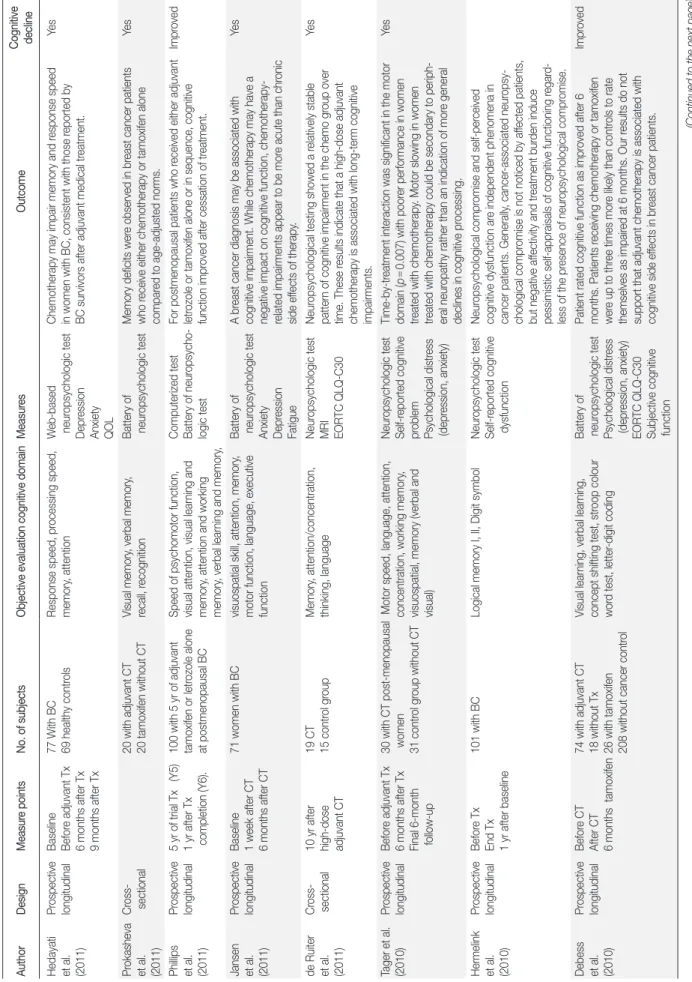
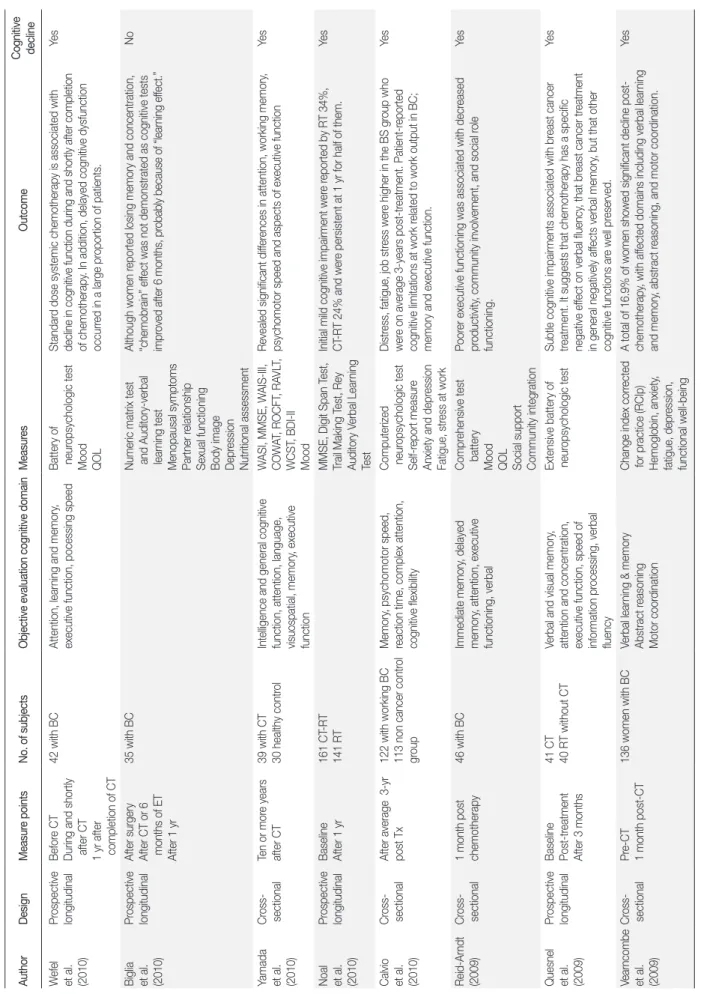
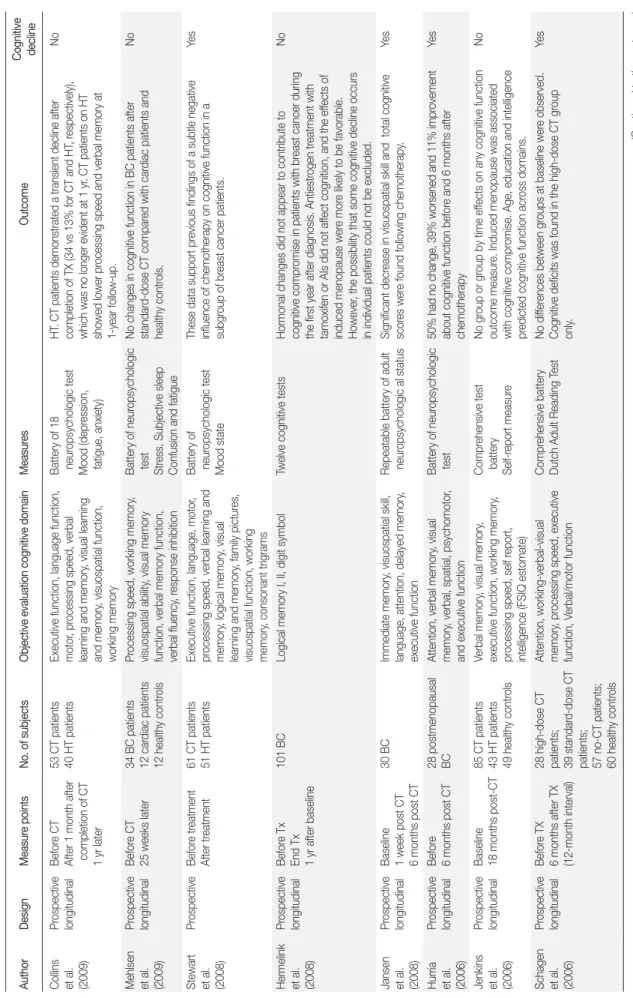
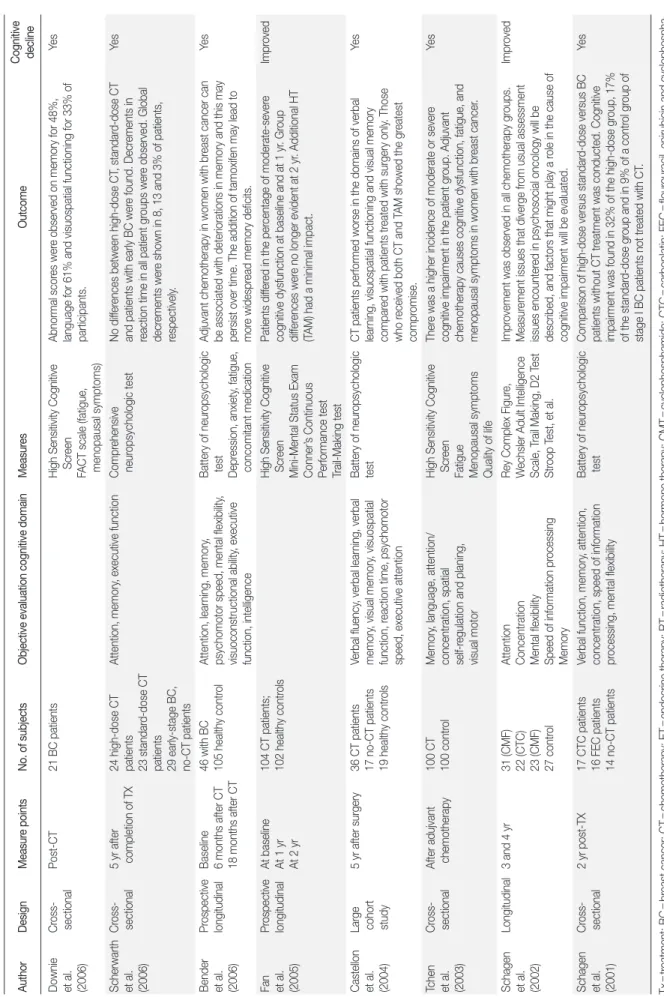
1. 항암요법과 인지기능
항암화학요법을 받는 유방암 생존자의 인지기능에 대한 32편의 문헌 결과를 살펴보면 다음과 같다(Table 1). 항암요법을 받은 후 혹 은 급성기에 인지기능에 변화가 있었다는 보고 13편과 항암요법을 받은 후 1년 이상 10년 후의 장기적 인지기능에 변화가 있었다는 보 고가 9편으로 합하여 총 22편에서 항암요법을 받은 유방암 생존자
가 인지기능의 변화가 있음을 보고하였다. 연구에서 항암요법을 받 은 유방암 생존자는 건강한 여성이나9) 항암요법을 받지 않은 유방 암 환자보다 인지기능이 감소한다고 하였다.16) 항암요법으로 인한 인지기능의 변화 시기는 치료 동안이나 치료 후 급성기에 인지기능 의 감소를 보고한 연구가 많았다. 즉, 유방암 환자는 항암요법을 받 은 1주 이내부터 인지기능의 감소를 보이거나17) 항암요법을 받은 1 개월 후 혹은 항암요법을 완료한 후에 인지기능 감소가 있다고 보 고하였다.18) 또한 항암요법을 받은 유방암 환자는 방사선요법만 받 거나16) 호르몬요법만 받은 유방암 환자보다 인지기능에 부정적 결 과를 보였다.17)
반면, 항암요법 후 인지기능의 변화에 대하여 유방암 환자의 자가 보고는 있으나 인지기능의 객관적 검사에서는 정상이거나 변화가 없다는 보고가 3편 있었으며, 항암요법을 받은 후 인지기능의 감소 가 있었으나 항암요법을 완료하거나 6개월 이상 지난 후 개선되었 다는 연구가 5편 있었다. 일부 연구에서는 유방암 환자가 항암요법 을 받은 후 경미한 인지기능의 손상이 있거나 기억력 영역에 부정적 영향을 미치지만 통계적 차이는 없었다는 보고도 있었다.16)
약제의 독성(toxicity)이 인지기능의 손상을 초래할 수 있다. 연구 에 의하면 5-fluorouracil, doxorubicin, cyclophosphamide 등과 같은 항 암제를 투여받은 유방암 환자는 치료 동안과 치료 후 인지기능의 감 소를 보였고, 1년 이상 지연된 인지장애가 나타나는 대상자도 있다 고 보고하였다.21) 또한 약제의 용량(dose)이 유방암의 인지기능과 관 련된다. 유방암 치료를 위한 항암제의 고용량 사용이 표준용량 사 용보다 신경학적 손상의 증가로 인지기능의 변화를 초래할 수 있어 항암제의 용량과 인지기능과의 관련성을 제시한 보고가 있었다.24)
2. 호르몬요법과 인지기능
항암요법과 병행하여 혹은 항암요법 후 보조적 호르몬요법을 투 여받은 유방암 생존자는 인지기능의 지속적 감소를 호소하여 호르 몬요법이 인지기능의 저하와 연관이 있음을 시사하였다.5) 유방암 치료를 위해 보조요법으로 투여받는 tamoxifen과 exemestane 간의 유의한 차이는 없었으나 tamoxifen을 투여받는 유방암 환자는 언어 적 기능의 저하를 보였고, exemestane을 투여받는 유방암 환자는 운동속도기능의 저하를 보였으며, 두 군 모두 언어적 유창성과 정 보처리속도 등의 인지기능이 건강한 여성보다 저하되었다. 또한 항 암요법과 호르몬요법을 병행한 유방암 환자는 항암요법 단독치료 나 체계적 치료를 받지 않은 여성보다 인지기능의 감소가 더 많았다.5) 반면, 호르몬요법이 유방암 생존자에게 경미한 인지기능의 감소 를 일으킬 수 있으나 시간의 경과 후 개선된다는 보고도 있다.
Debess 등26)은 tamoxifen의 호르몬요법을 받은 유방암 환자는 인지 기능의 손상이 건강한 여성보다 3배 정도 높았으나 6개월 후에 인
Table 1. Studies of Chemotherapy-induced Cognitive Function in Women with Breast Cancer AuthorDesignMeasure pointsNo. of subjectsObjective evaluation cognitive domainMeasuresOutcomeCognitive decline Hedayati et al. (2011) Prospective longitudinalBaseline Before adjuvant Tx 6 months after Tx 9 months after Tx 77 With BC 69 healthy controlsResponse speed, processing speed, memory, attentionWeb-based neuropsychologic test Depression Anxiety QOL Chemotherapy may impair memory and response speed in women with BC, consistent with those reported by BC survivors after adjuvant medical treatment.
Yes Prokasheva et al. (2011)
Cross- sectional20 with adjuvant CT 20 tamoxifen without CTVisual memory, verbal memory, recall, recognitionBattery of neuropsychologic testMemory deficits were observed in breast cancer patients who receive either chemotherapy or tamoxifen alone compared to age-adjusted norms.
Yes Phillips et al. (2011)
Prospective longitudinal5 yr of trial Tx (Y5) 1 yr after Tx completion (Y6).
100 with 5 yr of adjuvant tamoxifen or letrozole alone at postmenopausal BC Speed of psychomotor function, visual attention, visual learning and memory, attention and working memory, verbal learning and memory, Computerized test Battery of neuropsycho- logic test For postmenopausal patients who received either adjuvant letrozole or tamoxifen alone or in sequence, cognitive function improved after cessation of treatment.
Improved Jansen et al. (2011)
Prospective longitudinalBaseline 1 week after CT 6 months after CT 71 women with BCvisuospatial skill, attention, memory, motor function, language, executive function Battery of neuropsychologic test Anxiety Depression Fatigue A breast cancer diagnosis may be associated with cognitive impairment. While chemotherapy may have a negative impact on cognitive function, chemotherapy- related impairments appear to be more acute than chronic side effects of therapy.
Yes de Ruiter et al. (2011)
Cross- sectional10 yr after high-dose adjuvant CT 19 CT 15 control groupMemory, attention/concentration, thinking, languageNeuropsychologic test MRI EORTC QLQ-C30 Neuropsychological testing showed a relatively stable pattern of cognitive impairment in the chemo group over time. These results indicate that a high-dose adjuvant chemotherapy is associated with long-term cognitive impairments.
Yes Tager et al. (2010)Prospective longitudinalBefore adjuvant Tx 6 months after Tx Final 6-month follow-up
30 with CT post-menopausal women 31 control group without CT Motor speed, language, attention, concentration, working memory, visuospatial, memory (verbal and visual) Neuropsychologic test Self-reported cognitive problem Psychological distress (depression, anxiety) Time-by-treatment interaction was significant in the motor domain (p=0.007) with poorer performance in women treated with chemotherapy. Motor slowing in women treated with chemotherapy could be secondary to periph- eral neuropathy rather than an indication of more general declines in cognitive processing.
Yes Hermelink et al. (2010)
Prospective longitudinalBefore Tx End Tx 1 yr after baseline 101 with BCLogical memory I, II, Digit symbolNeuropsychologic test Self-reported cognitive dysfunction
Neuropsychological compromise and self-perceived cognitive dysfunction are independent phenomena in cancer patients. Generally, cancer-associated neuropsy- chological compromise is not noticed by affected patients, but negative affectivity and treatment burden induce pessimistic self-appraisals of cognitive functioning regard- less of the presence of neuropsychological compromise. Debess et al. (2010)
Prospective longitudinalBefore CT After CT 6 months tamoxifen 74 with adjuvant CT 18 without Tx 26 with tamoxifen 208 without cancer control Visual learning, verbal learning, concept shifting test, stroop colour word test, letter-digit coding
Battery of neuropsychologic test Psychological distress (depression, anxiety) EORTC QLQ-C30 Subjective cognitive function Patient rated cognitive function as improved after 6 months. Patients receiving chemotherapy or tamoxifen were up to three times more likely than controls to rate themselves as impaired at 6 months. Our results do not support that adjuvant chemotherapy is associated with cognitive side effects in breast cancer patients.
Improved (Continued to the next page)
Table 1.(Continued from the previous page)Studies of Chemotherapy-induced Cognitive Function in Women with Breast Cancer AuthorDesignMeasure pointsNo. of subjectsObjective evaluation cognitive domainMeasuresOutcomeCognitive decline Wefel et al. (2010) Prospective longitudinalBefore CT During and shortly after CT 1 yr after completion of CT 42 with BCAttention, learning and memory, executive function, pocessing speedBattery of neuropsychologic test Mood QOL Standard dose systemic chemotherapy is associated with decline in cognitive function during and shortly after completion of chemotherapy. In addition, delayed cognitive dysfunction occurred in a large proportion of patients.
Yes Biglia et al. (2010)
Prospective longitudinalAfter surgery After CT or 6 months of ET After 1 yr
35 with BCNumeric matrix test and Auditory-verbal learning test Menopausal symptoms Partner relationship Sexual functioning Body image Depression Nutritional assessment Although women reported losing memory and concentration, “chemobrain” effect was not demonstrated as cognitive tests improved after 6 months, probably because of “learning effect.”
No Yamada et al. (2010)
Cross- sectionalTen or more years after CT39 with CT 30 healthy control Intelligence and general cognitive function, attention, language, visuospatial, memory, executive function WASI, MMSE, WAIS-III, COWAT, ROCFT, RAVLT, WCST, BDI-II Mood Revealed significant differences in attention, working memory, psychomotor speed and aspects of executive functionYes Noal et al. (2010)
Prospective longitudinalBaseline After 1 yr161 CT-RT 141 RTMMSE, Digit Span Test, Trail Making Test, Rey Auditory Verbal Learning Test Initial mild cognitive impairment were reported by RT 34%, CT-RT 24% and were persistent at 1 yr for half of them.Yes Calvio et al. (2010)
Cross- sectionalAfter average 3-yr post Tx122 with working BC 113 non cancer control group Memory, psychomotor speed, reaction time, complex attention, cognitive flexibility Computerized neuropsychologic test Self-report measure Anxiety and depression Fatigue, stress at work Distress, fatigue, job stress were higher in the BS group who were on average 3-years post-treatment. Patient-reported cognitive limitations at work related to work output in BC; memory and executive function.
Yes Reid-Arndt (2009)Cross- sectional1 month post chemotherapy46 with BCImmediate memory, delayed memory, attention, executive functioning, verbal
Comprehensive test battery Mood QOL Social support Community integration Poorer executive functioning was associated with decreased productivity, community involvement, and social role functioning.
Yes Quesnel et al. (2009)
Prospective longitudinalBaseline Post-treatment After 3 months 41 CT 40 RT without CTVerbal and visual memory, attention and concentration, executive function, speed of information processing, verbal fluency Extensive battery of neuropsychologic testSubtle cognitive impairments associated with breast cancer treatment. It suggests that chemotherapy has a specific negative effect on verbal fluency, that breast cancer treatment in general negatively affects verbal memory, but that other cognitive functions are well preserved.
Yes Vearncombe et al. (2009)
Cross- sectionalPre-CT 1 month post-CT136 women with BCVerbal learning & memory Abstract reasoning Motor coordination Change index corrected for practice (RCIp) Hemoglobin, anxiety, fatigue, depression, functional well-being A total of 16.9% of women showed significant decline post- chemotherapy, with affected domains including verbal learning and memory, abstract reasoning, and motor coordination.
Yes (Continued to the next page)
Table 1.(Continued from the previous page)Studies of Chemotherapy-induced Cognitive Function in Women with Breast Cancer AuthorDesignMeasure pointsNo. of subjectsObjective evaluation cognitive domainMeasuresOutcomeCognitive decline Collins et al. (2009) Prospective longitudinalBefore CT After 1 month after completion of CT 1 yr later 53 CT patients 40 HT patientsExecutive function, language function, motor, processing speed, verbal learning and memory, visual learning and memory, visuospatial function, working memory Battery of 18 neuropsychologic test Mood (depression, fatigue, anxiety) HT. CT patients demonstrated a transient decline after completion of TX (34 vs 13% for CT and HT, respectively), which was no longer evident at 1 yr. CT patients on HT showed lower processing speed and verbal memory at 1-year follow-up.
No Mehlsen et al. (2009)
Prospective longitudinalBefore CT 25 weeks later 34 BC patients 12 cardiac patients 12 healthy controls Processing speed, working memory, visuospatial ability, visual memory function, verbal memory function, verbal fluency, response inhibition Battery of neuropsychologic test Stress, Subjective sleep Confusion and fatigue No changes in cognitive function in BC patients after standard-dose CT compared with cardiac patients and healthy controls.
No Stewart et al. (2008)
ProspectiveBefore treatment After treatment61 CT patients 51 HT patientsExecutive function, language, motor, processing speed, verbal learning and memory, logical memory, visual learning and memory, family pictures, visuospatial function, working memory, consonant trigrams Battery of neuropsychologic test Mood state These data support previous findings of a subtle negative influence of chemotherapy on cognitive function in a subgroup of breast cancer patients.
Yes Hermelink et al. (2008)
Prospective longitudinalBefore Tx End Tx 1 yr after baseline
101 BCLogical memory I, II, digit symbolTwelve cognitive testsHormonal changes did not appear to contribute to cognitive compromise in patients with breast cancer during the first year after diagnosis. Antiestrogen treatment with tamoxifen or AIs did not affect cognition, and the effects of induced menopause were more likely to be favorable. However, the possibility that some cognitive decline occurs in individual patients could not be excluded.
No Jansen et al. (2008)
Prospective longitudinalBaseline 1 week post CT 6 months post CT 30 BCImmediate memory, visuospatial skill, language, attention, delayed memory, executive function Repeatable battery of adult neuropsychologic al statusSignificant decrease in visuospatial skill and total cognitive scores were found following chemotherapy.Yes Hurria et al. (2006)
Prospective longitudinalBefore 6 months post CT28 postmenopausal BCAttention, verbal memory, visual memory, verbal, spatial, psychomotor, and executive function Battery of neuropsychologic test50% had no change, 39% worsened and 11% improvement about cognitive function before and 6 months after chemotherapy
Yes Jenkins et al. (2006)
Prospective longitudinalBaseline 18 months post-CT 85 CT patients 43 HT patients 49 healthy controls Verbal memory, visual memory, executive function, working memory, processing speed, self report, intelligence (FSIQ estomate) Comprehensive test battery Self-report measure No group or group by time effects on any cognitive function outcome measure. Induced menopause was associated with cognitive compromise. Age, education and intelligence predicted cognitive function across domains.
No Schagen et al. (2006)
Prospective longitudinalBefore TX 6 months after TX (12-month interval) 28 high-dose CT patients; 39 standard-dose CT patients; 57 no-CT patients; 60 healthy controls Attention, working-verbal-visual memory, processing speed, executive function, Verbal/motor function Comprehensive battery Dutch Adult Reading TestNo differences between groups at baseline were observed. Cognitive deficits was found in the high-dose CT group only.
Yes (Continued to the next page)
Table 1.(Continued from the previous page)Studies of Chemotherapy-induced Cognitive Function in Women with Breast Cancer AuthorDesignMeasure pointsNo. of subjectsObjective evaluation cognitive domainMeasuresOutcomeCognitive decline Downie et al. (2006) Cross- sectionalPost-CT21 BC patients High Sensitivity Cognitive Screen FACT scale (fatigue, menopausal symptoms) Abnormal scores were observed on memory for 48%, language for 61% and visuospatial functioning for 33% of participants.
Yes Scherwarth et al. (2006)
Cross- sectional5 yr after completion of TX 24 high-dose CT patients 23 standard-dose CT patients 29 early-stage BC, no-CT patients Attention, memory, executive function Comprehensive neuropsychologic testNo differences between high-dose CT, standard-dose CT and patients with early BC were found. Decrements in reaction time in all patient groups were observed. Global decrements were shown in 8, 13 and 3% of patients, respectively.
Yes Bender et al. (2006)
Prospective longitudinalBaseline 6 months after CT 18 months after CT 46 with BC 105 healthy controlAttention, learning, memory, psychomotor speed, mental flexibility, visuoconstructional ability, executive function, intelligence Battery of neuropsychologic test Depression, anxiety, fatigue, concomitant medication Adjuvant chemotherapy in women with breast cancer can be associated with deteriorations in memory and this may persist over time. The addition of tamoxifen may lead to more widespread memory deficits.
Yes Fan et al. (2005)
Prospective longitudinalAt baseline At 1 yr At 2 yr 104 CT patients; 102 healthy controls High Sensitivity Cognitive Screen Mini-Mental Status Exam Conner’s Continuous Performance test Trail-Making test Patients differed in the percentage of moderate-severe cognitive dysfunction at baseline and at 1 yr. Group differences were no longer evident at 2 yr. Additional HT (TAM) had a minimal impact.
Improved Castellon et al. (2004)
Large cohort study 5 yr after surgery36 CT patients 17 no-CT patients 19 healthy controls Verbal fluency, verbal learning, verbal memory, visual memory, visuospatial function, reaction time, psychomotor speed, executive attention Battery of neuropsychologic testCT patients performed worse in the domains of verbal learning, visuospatial functioning and visual memory compared with patients treated with surgery only. Those who received both CT and TAM showed the greatest compromise.
Yes Tchen et al. (2003)
Cross- sectionalAfter adujvant chemotherapy100 CT 100 controlMemory, language, attention/ concentration, spatial self-regulation and planing, visual motor High Sensitivity Cognitive Screen Fatigue Menopausal symptoms Quality of life There was a higher incidence of moderate or severe cognitive impairment in the patient group. Adjuvant chemotherapy causes cognitive dysfunction, fatigue, and menopausal symptoms in women with breast cancer.
Yes Schagen et al. (2002)
Longitudinal3 and 4 yr31 (CMF) 22 (CTC) 23 (CMF) 27 control Attention Concentration Mental flexibility Speed of information processing Memory Rey Complex Figure, Wechsler Adult Intelligence Scale, Trail Making, D2 Test Stroop Test, et al.
Improvement was observed in all chemotherapy groups. Measurement issues that diverge from usual assessment issues encountered in psychosocial oncology will be described, and factors that might play a role in the cause of cognitive impairment will be evaluated.
Improved Schagen et al. (2001)
Cross- sectional2 yr post-TX17 CTC patients 16 FEC patients 14 no-CT patients Verbal function, memory, attention, concentration, speed of information processing, mental flexibility Battery of neuropsychologic testComparison of high-dose versus standard-dose versus BC patients without CT treatment was conducted. Cognitive impairment was found in 32% of the high-dose group, 17% of the standard-dose group and in 9% of a control group of stage I BC patients not treated with CT.
Yes Tx=treatment; BC=breast cancer; CT=chemotherapy; ET=endocrine therapy; RT=radiotherapy; HT=hormone therapy; CMT=cyclophosphamide; CTC=carboplatin; FEC=flourouracil, epirubicin and cyclophospha- mide.
지기능이 개선되었으며 건강한 여성과 차이가 나타나지 않았다고 보고하였다. Phillips 등27)은 유방암의 치료 및 항암요법 완료 후 ta- moxifen 혹은 letrozole의 호르몬요법을 5년간 받은 폐경된 유방암 환자를 대상으로 한 연구에서 치료를 중단한 1년 후 인지기능이 개 선되었다고 보고하였다. Hermelink 등28)도 유방암 생존자에게 tamo- xifen이나 aromatase inhibitors (AIs)와 같은 antiestrogen 요법으로 발 생한 호르몬 변화가 인지기능의 감소에 영향을 주지 않았으며, 일 부 개별적 인지기능의 감소는 호르몬 변화보다는 호르몬요법으로 유도된 폐경이 좀 더 유력하다고 보고하였다.
3. 연구 디자인(Design)
항암화학요법을 받는 유방암 환자의 인지기능에 대한 32편 문헌 중 종단적 연구 및 코호트 연구가 22편이었고 횡단적 연구는 10편이 었다. 횡단적 연구 설계는 어느 한 시점에서 변수를 평가하는 것으 로 본 연구의 유방암 환자의 인지기능에 대한 횡단적 연구 10편의 연구결과에서 모두 항암화학요법이 인지기능의 변화와 관련이 있 는 것으로 보고되었다. 종단적 연구는 두 시점 이상 변수를 반복 측 정하거나 6개월 이상 5년 후까지 장기적 시간 간격으로 평가되었다.
본 연구에서 전망적 장기적 연구 설계 중 10편의 연구결과에서 항 암화학요법이 치료 동안이나 치료 후에 나타난 인지기능의 변화가 6개월 이상 지난 후 평가한 결과 인지기능이 개선되는 경향이 나타 났다. 또한 항암화학요법을 받기 전에 이미 인지기능의 장애가 존재 하였을 가능성을 간과해서는 안 된다.25) 따라서 치료 전 인지기능 에 대한 baseline 측정과 외생변수의 통제가 요구된다. 유방암의 인 지기능의 정도를 비교하기 위해서는 치료 전 인지기능의 사정이 수 행되어야 하며, 32편의 문헌 중 19편의 연구에서 항암화학요법을 시 작하기 전 인지기능의 baseline 조사가 시행되었다. 또한 대조군 설 정이 된 연구가 14편으로 무작위 대상자 선정으로 연구결과의 신뢰 도 및 타당도를 높이는 노력이 증가하였다.
4. 인지기능의 영역 및 측정도구
유방암 환자에게 인지기능을 측정하는 영역으로는 주로 기억력 (verbal memory, visual memory), 집중력(attention, concentration), 실 행기능(executive function), 정보처리속도(information processing speed), 언어기능(language function,), 운동기능(motor function), 시공 간기능(visuospatial function), 작업기능(working memory), 학습력 (learning) 등이다. 이 중 항암화학요법으로 인한 인지기능 변화와 관련이 높은 영역은 정보처리속도, 집중력, 기억력, 실행기능, 작업 능력 등의 영역이다.4) 본 연구에서 문헌의 연구결과 항암화학요법 을 받은 유방암 생존자에게 인지기능의 변화가 많이 나타났던 인지 기능의 영역으로는 기억력의 감소가 9편으로 가장 많았으며, 실행
기능 4편, 집중력 3편, 시공간기능 3편, 언어학습력 2편, 운동조정력 2편 그리고 반응속도, 추리력, 정신운동속도, 작업능력, 정보처리속 도 등에 감소를 보였다. 한편, 시간의 경과에 따라 항암화학요법을 받은 유방암 생존자의 감소된 인지기능이 개선 및 회복을 보인 연 구결과가 보고되고 있다. 감소된 인지기능이 개선된 시기를 살펴보 면, 치료를 완료한 6개월 후 개선된 연구가 4편, 1년 후 개선된 연구 가 4편 있었으며, 2년 이상 경과 후 개선이 나타난 연구도 2편 있었 다. 항암화학요법을 받은 후 급성기에는 경미한 인지기능의 감소를 보였으나 치료가 완료된 1년 후 개선되는 경우와 유방암 환자의 기 억력 영역의 손상이 항암요법을 받은 6개월 후에도 지속되다가 1년 후 개선되는 경우도 있어, 유방암의 인지기능에 대한 연구 설계는 장기적 비교 연구가 필요함을 제시하였다.
인지기능을 평가하기 위하여 사용한 측정도구의 종류와 그 결과 가 매우 다양하였다. 인지기능의 측정 방법은 신경학적 검사를 통 한 객관적 평가 방법과 자가보고 형태의 주관적 평가 방법이 있다.
주로 신경심리검사(neuropsychological battery)를 이용한 객관적 측 정도구를 사용하여 연구자의 의도에 따라 측정 영역을 부분적으 로 병합하여 평가한 연구가 24편으로 가장 많았다. 또한 HSCS, CFQ, Dutch instrument modified 등 자가보고 형식의 주관적 측정방 법으로 평가한 연구가 있었으며, 객관적 측정도구와 주관적 측정도 구를 함께 평가한 연구도 3편 있었다. 문헌에서 객관적 측정도구와 주관적 측정도구를 함께 평가한 경우, 유방암 환자의 인지기능에 대하여 신경학적 검사를 통한 객관적 측정 결과와 자가보고를 통 한 주관적 측정 결과가 다르게 나타나기도 한다. 즉, 신경학적 검사 결과에는 인지기능의 변화가 없는 경우에도 자가보고적 주관적 검 사 결과는 인지기능에 부정적 영향을 미치는 것으로 나타났다.28) 또한 항암화학요법을 받은 유방암 환자는 기억력과 집중력의 인지 기능에 변화를 호소하였으나 객관적 인지기능 측정에는 변화가 없 었으며 항암요법을 받은 6개월 후 개선되는 것을 보였다.15)
한편, 문헌에서 인지기능과 함께 평가된 변수로 불안, 우울, 기분 등 정서상태를 측정한 연구가 11편, 피로가 8편, 삶의 질이 6편으로 많이 측정되었다. 인지기능은 고차원적 뇌의 기능으로 과거의 경험 이나 지능뿐만 아니라 기분이나 정서 상태에 따라 영향을 받는다.21) 따라서 유방암 생존자의 인지기능에 영향을 주는 요인 분석을 통 하여 다양한 각도의 접근이 필요하다.
논 의
과거 10년간 유방암 생존자의 항암화학요법으로 인한 인지기능 효과에 대한 관심이 높아져 왔다. 또한 많은 유방암 대상자는 교육 의 효과로 인하여 항암화학요법과 관련된 인지기능 변화인 “che-
mobrain”의 가능성을 염려하고 있다.21) 그러나 일부 출판된 문헌에 서 항암화학요법과 인지기능 간의 인과적 관련성을 명확하게 제시 하지 못하고 있다는 목소리가 크다.20) 최근 항암화학요법과 인지기 능손상 간의 연관성에 대한 인식들이 증가되고 있으나 아직까지 항 암화학요법으로 인한 인지기능장애의 원인 및 발생기전과 그 영향 에 대하여 정확히 알려져 있지 않다.
Vearncombe 등8)은 항암요법을 받은 유방암 환자의 16.9%에서 인 지기능 감소를 보였고, 특히 언어학습력과 기억력, 추리력 및 운동 조정력의 영역에 감소를 보인다고 하였고, Hurria 등19)은 항암요법 을 받기 전과 항암요법을 받은 6개월 후 비교한 결과 50%는 변화가 없었고 39%는 인지기능이 감소하였으며, 11%는 인지기능이 개선되 었다고 보고하여 항암요법이 인지기능에 부정적 영향이 있음을 보 여주었다. 또한 항암요법으로 인한 인지기능의 감소는 치료가 완료 되고 1년 이상 지난 후에도 보고되고 있어 인지기능에 대한 항암요 법의 장기적 영향을 시사하고 있다.20) Wefel 등21)의 연구에서 유방 암 환자는 항암요법 전 21%, 항암요법 후 65% 그리고 항암요법을 완 료한 1년 후 61%에서 인지기능 감소를 보였으며, 1년 후 인지기능 감 소를 보인 대상자 중 71%는 항암요법 후부터 지속적으로 나타났고 29%는 1년 후에 새롭게 인지기능의 감소가 나타났다. 일부 연구는 항암요법을 받은 10년 후에 인지기능의 변화를 보여 항암요법이 장 기적 인지기능의 감소와도 관련이 있음을 보여준다.4,11) 많은 선행 연구에서 항암요법이 인지기능에 부정적 영향을 미친다는 결과를 보고하고 있으나, 일부 연구에서는 인지기능의 변화가 없거나 경미 하며 6개월 이상 시간의 경과 후 개선된다는 결과도 보고되므로, 인 지기능에 대한 체계적인 문헌고찰을 통한 반복 연구가 축적되어야 할 것으로 본다.
유방암 치료를 위해 투여되는 항암제의 종류가 인지기능의 손상 과 관련이 있다. 세포증식을 억제하는 항암제는 인지기능 손상의 잠재적 기여 역할을 한다. 유방암 치료에 흔히 사용되는 doxorubi- cin과 cyclophosphamide 등의 항암제는 인지기능의 선택적 영역에 부정적 영향을 미친다. Jansen 등22)은 doxorubicin과 cyclophospha- mide의 항암요법을 받은 유방암 환자는 항암요법을 완료한 1주와 6 개월 후 인지기능을 측정한 결과 유의하게 감소되었다. 유방암 치료 를 위한 항암제는 methotrexate, paclitaxel, 5-fluorouracil, doxorubicin, cyclophosphamide 등이 투여되며 이러한 약물은 신경독성의 부작 용이 있는 것으로 알려져 있다. 신경독성(neutoxicity)은 주로 말초신 경병리나 뇌신경병리로 규명된다.21) 연구에 의하면 신경생물학적 실험에서 methotrexate와 같은 항암제 투여 후 인지기능손상과 해 마 세포 증식의 지속적 억제가 나타났으며, 이것은 인지손상의 신 경생물학적 기전의 가능성을 시사하였다.23)
약제의 용량도 장기적 인지기능 손상과 관련이 있다.4) 고용량을
투여받은 유방암 환자가 표준용량을 투여받은 유방암 환자보다 인 지기능의 손상이 나타날 가능성이 더 높다.24) 유방암 치료는 대게 6 주기 이상의 항암화학요법을 시행하는 경우가 많으며, 고용량의 항 암요법을 받은 유방암 생존자가 건강한 여성과 비교하여 인지기능 의 변화가 많다는 연구결과가 보고된다.4,24) 1년 이상 장기 연구에 의하면 항암요법의 용량에 따라 인지기능에 영향을 미치며, 고용량 을 투여받은 유방암 환자가 표준용량을 투여받은 유방암 환자보다 인지기능의 손상이 나타날 가능성이 더 높다.24) 개인 간 차이는 있 으나 대게 항암요법의 1-2주기에는 부작용이 많지 않으나 3주기 이 상이 되면 부작용이 나타나기 시작한다. 비록 인지기능에 있어서 항암요법의 누적효과에 대한 연구는 거의 없으나 항암요법을 받은 암 환자는 항암요법의 횟수와 인지기능손상과 연관이 있음이 보고 된다.25) 많은 연구에서 항암요법으로 인한 신경독성과 뇌세포 손상 으로 인지기능의 변화를 유발하는 것으로 보고하지만, 치료와 관 련된 병태생리학적 기전을 설명하는 연구는 일부 동물실험을 제외 하고 부족한 실정이다. 따라서 앞으로 항암요법이 인지기능의 변화 를 초래하는 요인 및 기전을 확인하고 설명하는 연구가 수행되어야 한다.
유방암의 치료는 일차적으로 수술 후 항암요법과 병행하거나 보 조적 호르몬요법을 5년간 지속적으로 치료받게 된다. 호르몬요법을 받는 유방암 환자는 estrogen의 결핍으로 인지기능의 변화를 일으 킬 수도 있다는 것이 추측된다.5) 호르몬요법은 estrogen 결핍을 유발 하며 이것은 다양한 갱년기 증상, 우울증, 성적활동, 신체이미지, 인 지기능 등에 부정적 효과로 여성의 삶의 질에 중요한 영향을 미칠 수 있다.15) 호르몬요법으로 인한 인지기능 손상의 발생기전은 치료 로 유도된 폐경이 뇌 위축을 증가시킴으로써 인지기능의 감소를 유 발할 수 있다. 호르몬요법으로 인한 폐경기 증상은 자연적 폐경기 여성의 증상보다 더 심한 증상을 경험하기도 한다. 그러나 인지기능 에 있어서 estrogen의 영향에 대한 근거가 포괄적이며 암환자의 인 기기능에 대한 호르몬 변화의 결과에 대한 연구는 드물게 연구되어 져 왔다. 따라서 유방암 생존자의 호르몬요법으로 인한 연구결과의 축적이 요구된다. 또한 호르몬요법이 인지기능에 영향을 주지 않거 나 치료 후 약간의 경미한 인지기능의 감소가 있으나 치료를 완료하 거나 중단한 후에는 인지기능이 개선되었다는 연구결과가 있으므 로, 앞으로의 연구는 종단적 연구로 시기별 반복측정을 고려해야 할 것이다.
연구설계 측면에서 인지기능에 대한 초기의 연구는 횡단적 연구 가 많았으며 연구 결과의 대부분이 치료 후 인지기능의 변화가 있 는 것으로 나타났다. 항암화학요법이 인지기능에 부정적 영향을 미 치는 결과가 대체로 많으나 일부 연구에서는 변화가 없거나 경미하 며 시간이 지난 후 개선되는 경향도 나타나므로 유방암의 인지기
능에 대한 연구의 설계에 신중을 기할 필요가 있다. 즉, 대부분 횡단 적 연구에서는 항암화학요법이 인지기능의 감소를 초래한다는 결 과를 제시하고 있지만,4) 흥미롭게도 종단적 혹은 전망적 장기 연구 에서는 유방암 환자의 인지기능 손상이 항암요법을 받기 전과 후에 큰 차이가 없거나 수개월 후 개선된 연구 결과를 제시하기도 한다.9) 이와 같은 결과는 항암화학요법과 인지기능 간의 평가는 종단적 장 기적 연구 설계가 필요함을 시사한다.
또한 인지기능에 대한 평가도구의 선택에 있어서 주관적 혹은 객 관적 측정도구에 따라 결과가 달라질 수 있다.18) 최근 영상학 연구 에서 항암화학요법 후 뇌 영역에서 대뇌위축, 대뇌피질경화, 대사활 동감소 등 항암화학요법이 신경학적 기능에 직접적 영향을 미치는 증거들이 보고하기도 한다.4) 객관적 측정도구는 연구에서 권장되 는 도구 형태이다. 그러나 많은 연구자들이 항암화학요법을 받는 유 방암 생존자의 경미하고 미묘한 인지기능의 변화를 평가하기 위한 도구로서 신경학적 검사의 타당성에 의문을 가지게 되었으며, 경제 적 타당성도 떨어진다.28) 인지기능의 객관적 평가와 주관적 평가의 연관성의 부족은 실제로 인지기능의 감소를 느끼는 대상자와 검사 결과에 의한 인지기능 감소 대상자가 다르게 나타나는 현상이 일어 나며, 연구에서 이 두 평가 방법의 결과가 일치하는 경우가 일치하 지 않는 경우보다 많지 않다.28) 이는 유방암 생존자의 인지기능을 평가하기 위한 측정도구의 선정에 신중해야 함을 시사한다. 인지기 능은 다양한 영역을 포함한 복합적인 기능이며 특히 치료로 인한 유방암 환자의 인지기능은 뇌손상이나 치매 같은 중증 인지기능장 애와는 달리 심리적인 영향이 많이 작용한다.29) 따라서 기존에 개 발된 객관적 인지기능 측정도구를 유방암 대상자에게 그대로 적용 하기에 어려움이 있다. 유방암의 인지기능에 대한 연구의 활성화를 위하여 항암화학요법으로 변화되는 인지기능의 속성을 확인하여 타당도 및 신뢰도가 높은 한국형 유방암 환자를 위한 인지기능 측 정도구의 개발이 선행되어야 할 것이다.
결 론
본 연구는 보조적 항암화학요법을 받는 유방암 환자의 인지기능 을 탐색하기 위해 일차문헌을 근거로 하여 관련 논문을 분석하는 서술적 조사연구이다. 연구의 대상은 ‘Chemotherapy’, ‘Breast cancer’,
‘Cognitive function’ 혹은 ‘Cognitive’를 키워드로 하여 2001년 1월부 터 2011년 11월까지 최근 약 10년간 발표된 국외논문 중 영문과 성인 여성으로 제한하여 4개의 검색엔진으로 검색하여 연구목적에 따 라 선정된 32편의 문헌이다.
연구결과, 많은 선행 연구에서 항암화학요법이 유방암 환자의 인 지기능에 부정적 영향을 미침을 보고하였다. 그러나 일부 연구에서
는 인지기능의 변화가 없거나 경미한 경우가 있으며 시간의 경과 후 개선된다는 결과도 보고되었다. 또한 항암화학요법이 유방암 환자 의 인지기능에 미치는 요인에 대한 이해와 연구결과의 일관성이 부 족한 실정이다. 따라서 항암화학요법과 인지기능에 대한 체계적인 연구를 통하여 유방암 생존자의 인지기능에 영향을 미치는 요인을 탐색하고 그 발생기전을 밝히며 나아가 인지기능의 증진 및 관리를 위한 중재를 개발함이 필요하다. 또한 항암요법과 호르몬요법을 병 행하거나 항암요법 후 보조적 호르몬요법을 받는 유방암 환자는 그 렇지 않은 경우보다 인지기능의 변화를 더 일으킬 수 있음을 보고 하였다. 그러나 일부 호르몬요법이 인지기능에 영향을 주지 않거나 치료 후 경미한 인지기능의 감소가 있으나 치료를 완료한 후에는 인 지기능이 개선되었다는 연구결과가 있으므로 반복 연구가 필요하다.
인지기능에 대한 초기 연구는 횡단적 연구가 많았으나 최근 전망 적 종단적 연구가 증가하고 있다. 횡단적 연구 설계는 유방암 환자 의 인지기능의 변화가 항암화학요법으로 인한 유일한 결과인지를 구별하기가 어려운 제한점이 있다. 따라서 유방암의 인지기능에 대 한 연구는 횡단적 연구보다는 장기적 종단적 연구 설계 및 시기별 반복측정으로 평가하는 것이 필요할 것으로 사료된다.
유방암 생존자에게 흔히 나타나는 인지기능의 변화 영역은 기억 력, 실행기능, 집중력, 시공간기능 등이다. 또한 인지기능을 평가함 에 있어서 측정 도구의 선택이 중요하다. 유방암 생존자의 인지기능 변화는 심리적인 영향이 많이 작용하므로 객관적 평가 방법만으로 측정하기 어려운 제한점이 있다. 따라서 유방암 환자를 대상으로 항암화학요법으로 변화되는 인지기능의 속성을 확인하여 타당도 및 신뢰도가 높은 한국형 유방암 환자를 위한 인지기능 측정도구 의 개발이 선행되어야 할 것이다.
이상으로 항암화학요법으로 인한 인지기능의 변화 정도는 뇌손 상이나 치매 등에 비하여 경미한 편이지만, 앞으로 장기 생존율이 높은 유방암 환자의 삶의 질 향상을 위하여 인지기능의 변화에 대 한 많은 관심과 인지기능 증진을 위한 연구가 이루어져야 할 것으 로 본다.
참고문헌
1. National Cancer Information Center. 2009. http://www.ncc.re.kr [ac- cessed on 1 July 2011].
2. Reid-Arndt SA. Breast cancer and “chemobrain”: the consequences of cognitive difficulties following chemotherapy and the potential for re- covery. Mo Med 2009;106(2):127-31.
3. Jenkins V, Shilling V, Deutsch G, Bloomfield D, Morris R, Allan S, et al.
A 3-year prospective study of the effects of adjuvant treatments on cog- nition in women with early stage breast cancer. Br J Cancer 2006;94:828- 34.
4. de Ruiter MB, Reneman L, Boogerd W, Veltman DJ, van Dam FS, Ne-
derveen AJ, et al. Cerebral hyporesponsiveness and cognitive impair- ment 10 years after chemotherapy for breast cancer. Hum Brain Map 2011;32:1206-19.
5. Vodermaier A. Breast cancer treatment and cognitive function: the cur- rent state of evidence, underlying mechanisms and potential treatments.
Women’s Health 2009;5:503-16.
6. Calvio L, Peugeot M, Bruns GL, Todd BL, Feuerstein M. Measures of cognitive function and work in occupationally active breast cancer sur- vivors. J Occup Environ Med 2010;52:219-27.
7. Vardy J, Wefel JS, Ahles T, Tannock IF, Schagen SB. Cancer and cancer- therapy related cognitive dysfunction: an international perspective from the Venice cognitive workshop. Ann Oncol 2008;19:623-9.
8. Vearncombe KJ, Rolfe M, Wright M, Pachana NA, Andrew B, Beadle G.
Predictors of cognitive decline after chemotherapy in breast cancer pa- tients. J Int Neuropsychol Soc 2009;15:951-62.
9. Hedayati E, Alinaghizadeh H, Schedin A, Nyman H, Albertsson M. Ef- fects of adjuvant treatment on cognitive function in women with early breast cancer. Eur J Oncol Nurs 2011;9:1-8.
10. Deprez S, Amant F, Yigit R, Porke K, Verhoeven J, Van den Stock J, et al.
Chemotherapy-induced structural changes in cerebral white matter and its correlation with impaired cognitive functioning in breast cancer pa- tients. Hum Brain Mapp 2011;32:480-93.
11. Yamada TH, Denburg NL, Beglinger LJ, Schultz SK. Neuropsychologi- cal outcomes of older breast cancer survivors: cognitive features ten or more years after chemotherapy. J Neuropsychiatry Clin Neurosci 2010;
22(1):48-54.
12. Munir F, Burrows J, Yarker J, Kalawsky K, Bains M. Women’s perceptions of chemotherapy-induced cognitive side affects on work ability: a focus group study. J Clin Nurs 2010;19:1362-70.
13. Chung BY, Byun HS, Kim KD, Kim KH. Breast cancer and risk factor. J Korean Oncol Nurs 2008;8(2):120-7.
14. Andrykowski MA, Burris JL, Walsh E, Small BJ, Jacobsen PB. Attitudes toward information about genetic risk for cognitive impairment after cancer chemotherapy: breast cancer survivors compared with healthy controls. J Clin Oncol 2010;28:3442-7.
15. Biglia N, Moggio G, Peano E, Sgandurra P, Ponzone R, Nappi RE, et al.
Effects of surgical and adjuvant therapies for breast cancer on sexuality, cognitive functions, and body weight. J Sex Med 2010;7:1891-900.
16. Quesnel C, Savard J, Ivers H. Cognitive impairments associated with breast cancer treatments: results from a longitudinal study. Breast Can- cer Res Treat 2009;116(1):113-23.
17. Stewart A, Collins B, Mackenzie J, Tomiak E, Verma S, Bielajew C. The
cognitive effects of adjuvant chemotherapy in early stage breast cancer:
a prospective study. Psychooncology 2008;17(2):122-30.
18. Jansen CE, Cooper BA, Dodd MJ, Miaskowski CA. A prospective lon- gitudinal study of chemotherapy-induced cognitive changes in breast cancer patients. Support Care Cancer 2011;19:1647-56.
19. Hurria A, Rosen C, Hudis C, Zuckerman E, Panageas KS, Lachs MS, et al. Cognitive function of older patients receiving adjuvant chemother- apy for breast cancer: a pilot prospective longitudinal study. J Am Geri- atr Soc 2006;54:925-31.
20. Tager FA, McKinley PS, Schnabel FR, El-Tamer M, Cheung YK, Fang Y, et al. The cognitive effects of chemotherapy in post-menopausal breast cancer patients: a controlled longitudinal study. Breast Cancer Res Treat 2010;123(1):25-34.
21. Wefel JS, Saleeba AK, Buzdar AU, Meyers CA. Acute and late onset cog- nitive dysfunction associated with chemotherapy in women with breast cancer. Cancer 2010;116:3348-56.
22. Jansen CE, Dodd MJ, Miaskowski CA, Dowling GA, Kramer J. Prelimi- nary results of a longitudinal study of changes in cognitive function in breast cancer patients undergoing chemotherapy with doxorubicin and cyclophosphamide. Psychooncology 2008;17:1189-95.
23. Seigers R, Fardell JE. Neurobiological basis of chemotherapy-induced cognitive impairment: a review of rodent research. Neurosci Biobehav Rev 2011;35:729-41.
24. Schagen SB, Muller MJ, Boogerd W, Mellenbergh GJ, van Dam FS.
Change in cognitive function after chemotherapy: a prospective longi- tudinal study in breast cancer patients. J Natl Cancer Inst 2006;98:1742- 5.
25. Ahles TA, Saykin AJ. Breast cancer chemotherapy-related cognitive dys- function. Clin Breast Cancer 2002;3 Suppl 3:84-90.
26. Debess J, Riis JØ, Engebjerg MC, Ewertz M. Cognitive function after adjuvant treatment for early breast cancer: a population-based longitu- dinal study. Breast Cancer Res Treat 2010;121(1):91-100.
27. Phillips KA, Aldridge J, Ribi K, Sun Z, Thompson A, Harvey V, et al.
Cognitive function in postmenopausal breast cancer patients one year after completing adjuvant endocrine therapy with letrozole and/or tamoxifen in the BIG 1-98 trial. Breast Cancer Res Treat 2011;126:221-6.
28. Hermelink K, Küchenhoff H, Untch M, Bauerfeind I, Lux MP, Bühner M, et al. Two different sides of ‘chemobrain’: determinants and nonde- terminants of self-perceived cognitive dysfunction in a prospective, randomized, multicenter study. Psychooncology 2010;19:1321-8.
29. Bender CM. Chemotherapy may have small to moderate negative ef- fects on cognitive functioning. Cancer Treat Rev 2006;32:316-9.