Vol. 16, No. 9 pp. 5955-5967, 2015
정책평가 틀을 이용한 도시정비사업 내 공공관리자제도의 평가기준 수립에 관한 연구
이정재1, 이주형1*
1한양대학교 도시대학원 도시개발경영학과
Establish of Evaluation level in Public Management System using Policy Evaluation Framework in Urban Renewal Project
Jeong Jae Lee
1, Joo-Hyung Lee
1*1
Graduate School of Urban Studies, Hanyang University
요 약 본 연구는 도시정비사업 내 공공관리자제도의 평가 필요성을 인지하고, 공공 관리자 제도의 평가기준을 체계적이고 객관적으로 수립하고자 정책평가의 틀을 이용하여 선행연구와 전문가의 의견을 바탕으로 공공성, 전문성, 참여성, 합리성, 지속가능성이라는 다섯 가지의 방향 아래 사업계획 단계에서부터 운영, 참여, 사업의 사후평가단계까지 확장된 개념의 지속 적인 평가요소를 구축하였다. 중요도 분석 결과, 평가 분야에서는 사후관리 및 지속성 분야가 가장 중요하게 도출되었으며, 세부 평가 요소로는 사업 시 안정적 경제구조 조성 유도와 투명한 운영체계 수립, 제반 비용 절감, 자족성 있는 지역발전의 유도 등의 항목이 중요한 요소로 분석되었다. 이상과 같은 분석결과를 통해 얻을 수 있는 시사점은 다음과 같다. 첫째, 공공관 리자제도는 사업의 계획단계부터 사업 완료 이후 사후관리 부분까지 원칙을 세워서 그에 맞게 운영방안을 수립해야한다.
둘째, 공공관리자제도의 지속가능한 운영을 이끌어내기 위해서는 지속적인 재교육 및 주민의 사업 참여 활동이 필수적이다.
셋째, 공공관리자제도를 평가할 때의 종전의 물리적, 경제적 효과에 치중하여 이끌어내던 성과관리시스템에서 탈피하여 사업 의 운영과정에서의 갈등관리 등 비 물리적 평가기준 등의 요소 또한 평가될 필요가 있다.
Abstract This study targets to recognize needs of adopting public management system in Urban Renewal Project.
and to establish evaluation level of public management system using policy evaluation framework for establishing perspective and systemic level. Also, this study constructed basic principles as expanded concept like Public, expertise, participation, rationality, and sustainability based on previous studies and expert opinion. AHP analysis results are following. In case of upper level, post management and continuity are important factors. Also in case of under level, making stable economic system, honest operating system, reducing development costs, local development with self-sufficiency were important factors. through empirical results, the implications are following. First, public management system needs to develop a consistent principle from planning step to post management. Second, it is essential point that continuous retraining between involved people and drawing residents participate in progress activity. Third, when evaluating public management system, it is need that emphasize non-physical factor like conflict issue between stakeholder.
Keywords : Policy evaluation, Public management system, Urban Renewal Project, Analytic hierarchy process, Focus Group Interview
*Corresponding Author : Joo-Hyung Lee(Hanyang Univ.) Tel: +82-2-2220-0276 email: [email protected]
Received May 29, 2015 Revised (1st July 2, 2015, 2nd July 17, 2015) Accepted September 11, 2015 Published September 30, 2015
1. 서론
1.1 연구의 배경
우리나라는 1960년대 이후에 도시화와 산업화가 급
속도로 이루어지면서 수도권에 거주하는 인구를 수용하 기 위한 정책이 시급하였다. 이에 따라 공급된 대량의 주 거지는 시간이 지남에 따라 노후・불량화 되었고, 자연스 럽게 철거 혹은 불량주택의 개선 사업이 “도시정비사업”
이라는 이름으로 행해지게 되었다.
도시정비사업은 공공의 도시정비 목적으로 시작 되었 지만, 이외에도 부동산 가치의 상승, 원주민의 개발 욕구 충족 등 경제적 가치 창출이 수반되기 때문에 여러 이해 집단이 관여하게 되었는데[1], 이 과정에서 사업성에 의 존한 민간주도의 정비사업이 사업추진과 철거, 보상을 둘러싸고 지자체와 조합, 조합원 간 끊임없는 갈등을 발 생시켰다[2].
따라서 이러한 문제점을 인식하고 시공사, 정비업자 등 관계사의 선정과 절차 개선 등에 중점을 두어 서울시 는 2010년 3월 주거환경정비법이 개정됨에 따라 “공공 관리자제도”를 도입하게 되었다. 조합과 정비사업자간 의 유착 및 조합원 내외부 갈등을 효과적으로 해결할 수 있다는 기대효과가 있었지만, 한편으로는 공공관리자제 도의 업무 범위가 사업시행 인가 단계까지만 담당함에 따라 보상문제와 원주민에 대한 대책을 충분히 제시하지 못한다는 비판도 있다.
도입된 지 약 5년이 지난 이 시점에 공공관리자제도 가 앞으로 효과적인 도시정비사업을 이끌어나가기 위해 서는 체계적으로 평가기준을 마련하고 이에 따라 더욱 본래의 취지에 맞는 제도로 개선되어야 하는 실정이다.
1.2 연구의 목적
따라서 본 연구는 도시정비사업 내 기운영되고 있는 공공관리자제도의 평가 필요성을 인지하고, 공공 관리자 제도의 평가기준을 체계적이고 객관적으로 검토함으로 써 향후 공공관리자제도를 통한 도시정비사업이 보다 효 율적으로 시행될 수 있도록 도시정비사업의 전 과정에 적용될 수 있는 평가기준을 수립하는 것을 목적으로 하 고 있다. 특히 공공부문의 정책평가의 틀로 사용되는 BSC 성과관리 시스템의 구조를 본 논문에 적용하여 정 책의 기본방향을 설정하고 요소별 중요도 분석을 통하여 공공관리자제도의 평가체계 구축에 대한 효과적인 정책 적 시사점을 도출하도록 하였다.
2. 관련연구 및 선행연구 고찰
2.1 공공관리자제도의 개념
공공관리자제도란 민간 정비사업전문관리자가 수행 하는 조합설립업무, 사업성 검토, 설계자 및 시공사 선
정, 사업시행인가 신청대행, 관리처분계획 수립대행 등 의 업무를 시장, 군수가 정비사업에 대하여 사업시행 과 정을 지원하거나, 주택공사 등 「자본시장과 금융 투자 업에 관한 법률」 재 8조 7항에 따른 신탁업자・ 「주택 법」 제 76조제1항에 따른 대한주택보증 주식회사 또는 이 법 제 69조제1항 단서에 따라 대통령령이 정하는 기 관(한국토지주택공사, 한국감정원)에 위탁하여 관리하게 하는 것을 말한다(도시및주거환경정비법 제 77조의 4 제 1항).
법에 명시된 공공관리자의 업무범위는 추진위원회 또 는 주민 대표회의의 구성을 위한 업무를 지원하고, 정비 사업전문관리자의 선정, 설계자 및 시공사 선정 방법 등 에 대한 지원으로 규정하고 있으며, 적용대상으로는 주 택재개발 정비사업, 주택재건축 정비사업, 도시환경정비 사업의 경우 조합이 시행하는 사업에 한하여 적용한다 [3]. 현재까지 서울시는 공공관리자제도를 3차에 걸쳐 성수구역, 한남구역 등 18개의 지역에 시범운영하고 있 으며, 이 과정에서 도출된 문제점을 분석하여 이후 제도 에 반영하고자 하고 있다. 시범 운영효과와 관련하여 성 수구역과 한남구역을 자체 분석한 결과 전체 사업비의 약 20%정도 절감될 것으로 산정하였다[4].
2.2 정책평가의 틀
정책 평가로서의 성과관리는 공공부문의 핵심 평가 수단으로서, 기존에 공공정책을 단순 가시적 성과나 경 제적 효과만으로 평가하던 방법과는 다르게 정책결정 단 계에서부터 정책과 관련된 전략과제, 사업의 사후평가단 계까지 확장된 개념의 지속적인 평가체계를 요구하고 있 다[5]. 따라서 이 과정에서 수립되는 정책평가는 정량적 인 기준 뿐 아니라 정성적 기준을 함께 종합하며, 이해관 계자 및 정책 결정자들의 의견을 모두 고려하는 평가방 법을 수립하는 것을 목적으로 삼고 있다.
따라서 정책평가를 고려하여 수립하는 평가기준은 통 합적 정책 목표를 수립한 후 다 방면의 정책 요소들을 수립하고, 전문가들과 각 이해관계자들의 의견을 반영한 평가체계를 구축하도록 한다.
2.3 BSC의 도입 필요성
BSC는 중장기 발전계획을 수립하였으나 실천이 되고 있지 않거나, 하부조직에서 전략목표의 달성을 위한 구 체적 활동을 파악하지 못하고 있거나, 현재의 경영성과
의 평가기준에 대해 각 조직계층이 만족하지 못하는 경 우, 프로세스의 개선활동이 이루어지고 있으나 사업성과 와의 연관을 파악할 수 없는 경우에 주로 적용되는데, 이 런 기업들에게 BSC의 도입이 필요한 이유는 재무적 지 표의 한계성과 균형을 이루는 통합된 성과지표의 필요 성, 그리고 전략과 실행을 연계시키는 도구가 필요하다 는 점에서 필요성이 요구되고 있다.
성과측정시스템을 개선하기 위하여 초기에 BSC의 개 념을 도입한 많은 외국 기업들은 좁은 영역이지만 구체 적인 결과를 얻을 수 있었다. 그리고 BSC의 개념에서 진일보하여 이를 통합하고 반복적인 전략경영시스템의 기반으로 활용하는 기업들이 나타나고 있다.
공공부문, 특히 정부기관은 민간기업과 달리 수익을 목적으로 존재하는 것이 아니라 정부의 고유한 임무를 수행하기 위해 존재한다. 그러므로 정부기관은 국가 또 는 사회를 보다 나은 방향으로 발전시키기 위한 여러 가 지 미션을 달성하고자 하기 때문에 비재무적 요소에 중 점을 둔 성과평가 도구가 필요할 수 있다. 본 연구와 같 이 주민간의 갈등문제, 관리업체의 공정성 등 비 재무적 인 것을 평가하는 데에 있어서 BSC 성과평가 도구가 가 장 적합하다고 할 수 있다.
BSC 구현절차는 크게 4가지 단계로 실행된다. 1단계 는 비전의 정립을 통한 전략 지도 설계단계이며, 2단계 는 지표설계 및 인과관계 분석 및 조직과 관련된 목표배 정 및 평가방법을 설계하는 단계이며, 3단계는 1,2단계 에서 생성된 자료를 BSC 솔루션으로 전산화하는 과정 이며 마지막 4단계는 지표의 성과측정에 의한 성과결과 를 인사평가로 활용하여 연봉제 및 성과급제 등의 보상 시스템과 연동하여 활용하는 단계이다.
민간 기업에 맞추어 설계된 BSC는 용어의 정의가 다 를 뿐만 아니라 재무적인 보상이 공공부문이나 비영리부 문의 궁극적인 성공의 척도로 사용하기에는 한계가 있을 수 있다. 따라서 본 연구의 맞게 BSC의 구조를 활용하는 방법은 1단계로, 기존의 선행연구들과 사례를 통하여 평 가기준의 통합적 정책 목표를 수립한 후 2단계에서는 다 방면의 전문가들의 의견을 들어 정책 요소들을 명확히 수 립하는 과정을 거치게 된다. 이후, 3단계에서는 전문가들 과 정비사업 이해관계자 등 공공관리제도 관련자들의 의 견을 반영한 평가체계를 구축하여 평가체제를 수립한다.
BSC를 본 연구에서 도입하여 활용하게 된다면, 첫째, 각 공공관리제도 추진 관련자 에게 일관성 있고 종합적
인 계획과 통제시스템의 개발을 체계적으로 고려할 수 있는 방법을 제공하게 될 것이며, 둘째, 성공적인 그리고 성공적이지 못한 공공관리제도 시범구역의 차이를 이해 할 수 있는 바탕을 제시할 것이다.
2.4 선행연구 고찰
(1) 공공관리자제도 관련 연구
공공관리자제도와 관련한 연구는 연구초기에는 공공 관리자제도에 대한 인식을 조사하고 제도의 개선점 도출 에 관한 연구가 많이 진행되었다. 이정수[6]는 공공관리 자제도 시범구역 중 하나인 강북구 수유동의 토지등소유 자를 대상으로 인식조사를 하였으며, 두성규[7]는 공공 관리자제도의 합리적 역할 수행을 위한 제도개선방향 연 구에서 사회적 공감대의 형성이나 시범사업의 실시․평 가와 같은 충분한 검증이 완료되지 않은 상태에서 도정 법과 조례 개정 등 입법화가 급속하게 진행되었다는 점 을 강조하고, 공공관리자제도 적용에 대한 주민 또는 조 합원의 선택권 보장 등에 관한 항목을 개선해야 한다는 결론을 도출하였다.
또 다른 측면으로는 공공관리자제도 시범지구로 선정 되어 운영중인 한남동과 성수동의 시범지구를 사례로 들 어 공공관리자제도의 문제점 및 개선점을 도출 해 낸 연 구가 있다. 김종성[8]은 한남 재정비촉진지구를 중심으 로 도시정비사업의 공공관리자제도 개선방안에 대한 연 구를 진행하였다. 이를 통해 공공관리자제도의 시범지구 를 통한 운영 효과와 한계점, 개선방안을 도출하였다. 또 한 어용경[9]는 성수전략정비지구를 중심으로 시범운영 실태를 알아보고 공공관리자제도의 공공성에 대한 효과 및 한계점을 분석하였다.
(2) 정책평가 틀 활용 연구
기존의 정책평가를 활용하여 이루어진 연구는 주로 공공부문의 정책을 평가하기 위한 연구가 많이 진행되었 다. 정광섭[10]과 김상원[11] 등은 서울시 한강 르네상스 정책과 어린이보호구역을 평가하기 위한 연구방법으로 표적집단면접법(Focus Group Interview :이하 FGI) 와 계층적 의사결정법 (Analytic Hierarchy Process : 이하 AHP) 등을 사용하였는데, 이와 같은 연구방법이 대체적 으로 사용되던 시기를 지나 현재는, 신예철 외[5]와 김영 춘 외[12]는 통합적 성과관리 및 정책평가방법인 균형성 과 관리시스템의 BSC (Balanced Score Card)를 활용하
여 공공디자인과 공공부문의 정책을 평가하였다.
2.5 연구의 착안점
본 연구는 기존의 선행연구와 다음과 같은 면에서 차 별성이 있다.
첫째, 공공관리자 제도에 관련한 기존의 선행연구는 시범사업지를 대상으로 하여 사업의 시행과정에서 발생 한 갈등 및 문제점과 그에 따른 해소 방안을 나타낸 연 구가 많았지만, 체계적으로 공공관리자 제도에 대한 평 가차원에서 접근한 연구는 없었다. 또한 공공관리자 제 도는 2010년 도입되어 현재 5년차에 접어들었는데, 현 재의 시범사업 운영 현황은 공공관리자제도의 의무적 사 항인 사업시행인가 단계 근처에서 시범 사업이 마무리되 고 있기 때문에, 사업 시행과정에서 나타나는 문제점들 사업시행인가 이후의 과정은 전무한 실정이다. 사업시행 인가 이후에 거쳐야 하는 관리처분단계나 청산 단계 등 이해관계가 더욱 첨예하게 대립될 가능성이 높지만, 이 과정에 대해서 공공관리자제도가 선택적으로 운영됨으 로써, 공공관리자제도가 연장되어 운영되더라도 특정한 가이드라인이나 지침 등이 존재하지 않는다.
이에 본 연구는 공공관리자 제도의 의무적 적용단계 를 포함한 도시정비사업 전 단계에 거쳐서 공공관리자제 도가 적용되었을 때, 어떤 점을 평가해야 하는지에 대한 구체적인 기준을 세워 이에 대한 중요도를 도출하여 기 운영 중인 시범사업의 현재 운영단계와 사업의 마무리 단계까지 적용 가능하도록 체계적으로 평가지표를 수립 한다는 점에서 타 연구와 차별성이 있다.
둘째, 기존의 공공사업 평가요소는 물리적 혹은 경제 적 측면에 치우친 효율성 분석 혹은 가시적인 성과에 치 중한 평가가 주를 이루었으며, 사업의 추진과정에 대한 평가 혹은 비 물리적 요소에 대한 평가는 미흡하였다.
본 연구에서는 기업에만 적용되어 오던 정책평가로서 의 성과측정방법인 BSC의 방법을 공공사업에 적용하여, BSC에서 제공하는 정책평가 틀에 적용된 구조적 특성 을 이용하여 작성함으로써, 물리적 혹은 경제적 효과에 만 치우친 것이 아닌 통합적이고 균형적인 성과지표를 수립할 수 있다는 점에서 타 연구와 차별성이 있다고 할 수 있다. 또한 더 나아가서는 공공부문에서의 BSC 도입 및 운영구조상의 특성이 성과에 어떻게 영향을 미치는지 를 규명하여 BSC제도를 정착시켜 나갈 수 있는 방향도 제시할 수 있다.
3. 평가기준 정립
3.1 선행연구 및 전문가 의견 검토
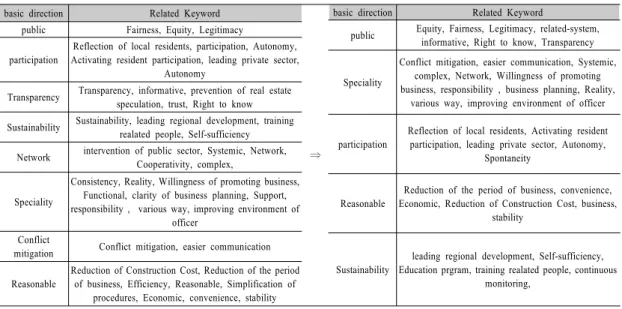
본 단계에서는 Table 1과 같이 선행연구의 검토를 통 하여 공공관리자와 관련한 연구에서 관련 키워드를 도출 하여 이를 종합, 재그룹화 하여 Table 2의 왼쪽 부분과 같이 공공관리자평가기준 정책의 방향을 공공성, 참여 성, 투명성, 지속가능성, 네트워크, 전문성, 갈등해소, 합 리성의 8개의 방향의 1차적 기준방향을 설정하였다.
또한 이를 토대로 FGI를 시행하였다. FGI는 서면인 터뷰와 이메일 응답을 통한 1:1 방식으로 이루어졌으며, 3월 10일부터 3월 17일까지 약 일주일 간 이루어졌다.
응답 전문가는 정비사업 관련 전문가와 교수, 연구직 등 의 종사자였다. FGI결과는 Table 2에서 다루어지고 있 는데, 전체적으로 사업방향이 다소 많다는 의견이 있었 으며, 8가지의 지표를 통합・수정하여 공공성, 전문성, 참 여성, 합리성, 지속성의 5가지 기준방향성이 제시되었다.
3.2 세부 평가분야 및 평가요소 설정
이를 Fig 1의 과정을 걸쳐서 관련 키워드간 부분 그룹 핑을 하여 총 15가지의 평가요소가 도출되었다. 전문성 과 합리성의 일부 키워드는 ‘상위법 및 제도와의 정합 성’, ‘명확한 사업계획 수립’, ‘현실성을 기반으로 한 창 의적 관리수단 도입’, ‘사업시 안정적 경제구조 조성 유 도’ 등의 4가지 평가요소를 도출하였으며, 이는 종합적 으로 “사업계획 수립 및 사업 수단 선정” 분야로 분류되 었다. 한편, 공공성과 전문성 방향 내 일부 키워드는 ‘형 평성 있는 업체 선정 및 운영’, ‘투명한 운영체계 수립’,
‘효과적 갈등관리체계 운영’, ‘관련 네트워크 구축’ 등의 4가지 평가요소를 도출하였으며, 이는 “조직의 운영”이 라는 평가분야로 분류되었다.
또한 참여성과 합리성의 일부 키워드는 ‘주민 참여 촉 진’, ‘민간 섹터의 적극적 참여 유도’, ‘절차의 간소화를 통한 정비사업 기간 단축’, ‘제반 비용 절감’ 등의 4가지 평가요소로 분류되었고, 이는 “이용자의 이용 및 참여”
항목으로 나뉘어 졌다. 마지막으로 지속성의 관련키워드 는 ‘자족성 있는 지역발전의 유도’, ‘조합 및 실무자 교 육을 통한 사업 지속성 확보’, ‘단계별 모니터링을 통한 사업 유도’ 의 3가지 평가 요소로 분류되었고, “사후관 리 및 지속성”의 분야로 도출되었다. 따라서 종합적으로 5가지의 기준방향을 가지고 4가지의 평가분야 아래 15
1 2 3 4 5 6 7 8 9 10 11 12 13 14 15 16
Reduction of Construction Cost 0 0 0 0 0 0 0
Reduction of the period of business 0 0 0 0 0
Transparency 0 0 0 0 0 0 0 0 0 0 0 0 0 intervention of public sector 0 Reflection of local residents 0 0 0 trust 0 Persistence 0 0 0 0 Immediacy 0 0 Autonomy 0 0
Efficiency 0 0 0 0 0 0 0 0 Reasonable 0 0 0 0 0 0 Simplification of procedures 0 0
Conflict mitigation 0 0 0 0 0 0 0 0 0 0 Speciality 0 0 0 0 0 0 0 0 0 0 0 0 Equity 0 0 0 0
ethics 0 Autonomy 0 0 Fairness 0 0 0 0 0 0 participation 0
Support 0 0 0 Spontaneity 0 0
Economic 0
Spontaneity 0 0 0 0 0 public 0 0 0 0 0 0 0 0 0 Systemic 0
Right to know 0
Network 0 0
Willingness of promoting business 0
Activating resident participation 0 0 0 0 0 Consistency 0 0 0 Reality 0 0 0
improving environment of officer 0
business 0 0 0 Functional 0
convenience 0
easier communication 0
various way 0 0 leading private sector 0
Legitimacy 0 0
clarity of business planning 0
stability 0
Cooperativity 0
training realated people 0
leading regional development 0
complex 0
informative 0
Self-sufficiency 0
prevention of real estate speculation 0
complement system 0 1. [16] 2.[7], 3.[17], 4. [3], 5. [18], 6. [19], 7. [20], 8. [9], 9. [21], 10. [22], 11. [23], 12. [8],
13. [24], 14. [27], 15. [25], 16. [26]
Table 1. establishing evaluation factor through literature review
basic direction Related Keyword
⇒
basic direction Related Keyword
public Equity, Fairness, Legitimacy, related-system, informative, Right to know, Transparency public Fairness, Equity, Legitimacy
participation
Reflection of local residents, participation, Autonomy, Activating resident participation, leading private sector,
Autonomy
Speciality
Conflict mitigation, easier communication, Systemic, complex, Network, Willingness of promoting business, responsibility , business planning, Reality,
various way, improving environment of officer Transparency Transparency, informative, prevention of real estate
speculation, trust, Right to know Sustainability Sustainability, leading regional development, training
realated people, Self-sufficiency
participation
Reflection of local residents, Activating resident participation, leading private sector, Autonomy,
Spontaneity Network intervention of public sector, Systemic, Network,
Cooperativity, complex,
Speciality
Consistency, Reality, Willingness of promoting business, Functional, clarity of business planning, Support, responsibility , various way, improving environment of
officer
Reasonable
Reduction of the period of business, convenience, Economic, Reduction of Construction Cost, business,
stability Conflict
mitigation Conflict mitigation, easier communication
Sustainability
leading regional development, Self-sufficiency, Education prgram, training realated people, continuous
monitoring, Reasonable
Reduction of Construction Cost, Reduction of the period of business, Efficiency, Reasonable, Simplification of
procedures, Economic, convenience, stability
Table 2. establishing basic direction through re-grouping with keywords using Focus Group Interview
Fig. 1. Setting evaluation sector and detail factor
Evaluaion
Sector Evaluaion Factor Related keywords description of factor
Setting business planning and selecting business tool
Corresponding higher rank law and
system Legitimacy, related-system it can establish public management planning which accord with higher law and system
Establishing clear business plan
Willingness of promoting business, responsibility, business
planning
setting business plan which can manage until final step in urban renewal project
Introducing creative management system based on reality
Reality, various way, improving officer environment
it can make creative and effective management way adopting real situation, and various renewal
tool.
Inducting stable economic structure
in conducting business business, stability
it can provide basic form which can make stable business system for reducing total business cost
and period
operation of organization
Selecting company which has fairness and Managing Company
Equity, Fairness when select company including construction company, it should be fair
Setting Transparent operating system up
informative, Right to know, Transparency
all process of renewal project should be shared with residents, then it can make transparent
operating system.
Operating effective conflict management system
Conflict mitigation, easier communication
the conflict which is uprising between stakeholder can adjustment effectively and
minimize
Making related network Systemic, complex, Network
effectively public management system should be operated through networking between public and
private institute
Using and participation of
user
Promoting to citizen participation
Reflection of local residents, Activating resident participation
it should need for people who has practical demand and should provide chance for
participation
Leading active participation of private sector
leading private sector, Autonomy, Spontaneity
it can provide environment which public sector as well as public can invest Reducing period of business
process through simplifying procedures
Reduction of the period of business, convenience
when project ongoing, the period should be reduce through simplifying procedures
Cost Saving Economic, Reduction of Construction Cost
while reducing period, the cost should be reduce of construction Cost
post management
and sustainability
Inducting regional development with self-sufficient
leading regional development, Self-sufficiency
it can lead regional development through making job and securing renewal source
Ensure business continuity through educating practitioners
Education program, training related people
it should keep education program for public management practitioners
Operating business through monitoring for each step
monitoring, management public management process, through feedback, should be complemented for next Table 3. Classification of final evaluation factors and Description
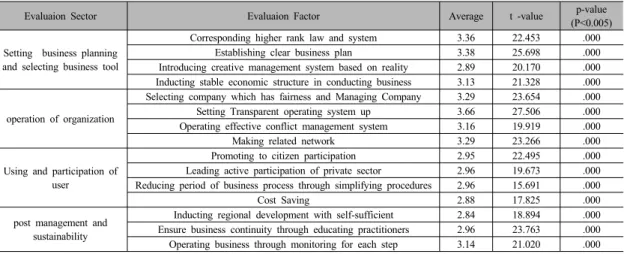
Evaluaion Sector Evaluaion Factor Average t -value p-value (P<0.005)
Setting business planning and selecting business tool
Corresponding higher rank law and system 3.36 22.453 .000
Establishing clear business plan 3.38 25.698 .000
Introducing creative management system based on reality 2.89 20.170 .000 Inducting stable economic structure in conducting business 3.13 21.328 .000
operation of organization
Selecting company which has fairness and Managing Company 3.29 23.654 .000 Setting Transparent operating system up 3.66 27.506 .000 Operating effective conflict management system 3.16 19.919 .000
Making related network 3.29 23.266 .000
Using and participation of user
Promoting to citizen participation 2.95 22.495 .000
Leading active participation of private sector 2.96 19.673 .000 Reducing period of business process through simplifying procedures 2.96 15.691 .000
Cost Saving 2.88 17.825 .000
post management and sustainability
Inducting regional development with self-sufficient 2.84 18.894 .000 Ensure business continuity through educating practitioners 2.96 23.763 .000 Operating business through monitoring for each step 3.14 21.020 .000 Table 4. 2nd Verification of Adequacy ( T - test)
가지의 평가요소가 도출되었다. 도출된 요소에 관련한 정의는 Table 3에 제시하였다.
3.3 평가요소에 대한 2차 적합성 검증
최종 도출된 평가분야를 전문가 설문조사를 통한 2차 적 검증을 Table 4와 같이 하였다. FGI에 참여하였던 전 문가들을 포함하여 각 분야별 전문가 23인을 대상으로 지표에 대한 설문조사를 실시하였다. 설문방법은 각 평 가 요소에 관하여 “매우 적합”에서 “매우 부적합”까지의 5점 척도로 정량화하여 실시하였으며, 응답에 따른 분석 은 SPSS 21.0을 이용하여 t-검정을 실시하였다. 분석결 과 모든 평가요소가 95%의 수준에서 유의한 것으로 분 석되었다. 따라서 15가지의 요소를 가지고 전문가를 대 상으로 중요도 분석을 실시하였다.
4. 평가요인의 중요도 분석
이와 같이 선정된 평가분야 및 평가요소들에 대한 중 요도를 분석하기 위하여 AHP분석을 실시하였다. 중요 도 분석을 위한 AHP 설문은 2015년 3월 25일부터 4월 8일까지 총 14일간 실시되었으며, 설문의 방법은 직접 인터뷰, e-mail 및 모바일 설문조사를 겸하였다. 응답자 는 시공사, 정비사업자, 조합, 설계사무소, 연구원 등으 로 구성되었으며, 정비사업 관련 평균 근무년수는 10.91 년인 것으로 나타났다.
총 설문부수는 65부를 실시하여 56부를 회수하여 총
86.15%를 회수하였다. 이 중 입력값으로 사용되는 데이 터는 일관성 검증을 거쳐야 한다. 이는 응답자의 불합리 한 사고 및 무성의 등의 이유로 일관성이 결여될 수 있 기 때문이다. 각각의 설문은 데이터의 일관성 비율(CR : Consistency Rate)이 0.1보다 작아야 일관성이 있다고 여겨지는데 56부의 설문 중 일관성 지수가 0.1보다 크게 나온 3부는 제외하고 총 53부를 분석에 활용하도록 하 였다.
4.1 평가분야별 중요도 분석
먼저 평가 분야별 중요도 분석 결과는 다음과 같다.
가장 중요하게 도출 된 분야가 사후관리 및 지속성(0.28) 이었으며, 사업계획 수립 및 사업 수단 선정(0.25), 조직 의 운영(0.23), 이용자의 이용 및 참여(0.23) 분야 순으로 나타났다. 이는 공공관리자제도가 시작단계도 중요하겠 지만, 일회성 제도로 끝나는 것이 아니라 시행된 이후의 사후관리 측면을 가장 중요시해야 한다는 의견을 나타낸 다고 할 수 있다.
Evaluaion Sector weight rate rank
Setting business planning
and selecting business tool 0.25 25% 2 operation of organization 0.23 23% 3 Using and participation of user 0.23 23% 3
post management and
sustainability 0.28 28% 1
Table 5. Important Analysis by evaluation sector
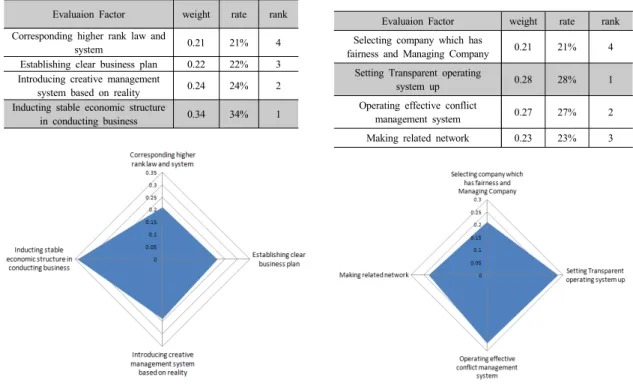
Evaluaion Factor weight rate rank Corresponding higher rank law and
system 0.21 21% 4
Establishing clear business plan 0.22 22% 3 Introducing creative management
system based on reality 0.24 24% 2 Inducting stable economic structure
in conducting business 0.34 34% 1 Table 6. Important Analysis by Setting business planning
and selecting business tool
Evaluaion Factor weight rate rank Selecting company which has
fairness and Managing Company 0.21 21% 4 Setting Transparent operating
system up 0.28 28% 1
Operating effective conflict
management system 0.27 27% 2
Making related network 0.23 23% 3
Table 7. Important Analysis by operation of organization
Fig. 3. Important Analysis diagram by Setting business planning and selecting business tool
Fig. 4. Important Analysis diagram by operation of organization
Fig. 2. Important Analysis diagram by evaluation sector
4.2 각 단계별 세부 중요도 분석
각 평가분야별 평가요소에 대한 중요도 분석을 시행 한 결과는 다음 Table 6에서 Table 9에 걸쳐 나타난다.
먼저 사업계획수립 및 사업수단 선정 분야에서 가장 중 요한 요소는 사업 시 안정적 경제구조 조성 유도에 관한
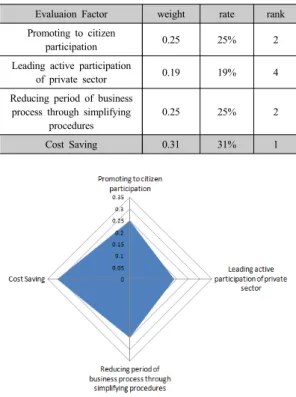
항목이 0.34로 가장 높았다. 이후의 순위는 현실성을 기 반으로 한 창의적 관리수도입(0.24), 명확한 사업계획 수립(0.22), 상위법 및 제도와의 정합성 분야(0.21) 순으 로 결과가 도출되었다. 이는 공공관리자제도로 정비사 업을 시행할 때에 현실가능한 측면에서 경제성 있는 계 획을 세우는 것에 공공 섹터가 더 많은 관심을 쏟아야 한다는 점을 나타내고 있다. 조직의 운영분야에 있어서 는 공공관리자제도의 초기 초입 목적인 투명한 운영체 계를 수립하는 것이 0.28로 가장 중요도가 높게 분석되 었다. 그 다음으로는 효과적 갈등관리체계 운영(0.27), 관련 네트워크 구축(0.23), 형평성 있는 업체 선정 및 운 영(0.21) 순으로 중요도가 도출되었다. 정비사업을 실질 적으로 운영해나가는 조합, 정비사업자 사이에서 벌어 지는 갈등의 양상들을 공공관리자제도를 통해 방지하기 위해서 투명한 운영체계를 갖추는 것이 전문가들이 생 각했을 때에 가장 중요한 요소가 된다. 이용자의 이용 및 참여분야 내에서 세부 평가 요소 간 중요도 분석으로 는 제반비용을 절감하는 것 (0.31)이 가장 중요한 요소 로 도출 되었으며, 절차의 간소화를 통한 정비사업기간 단축과 주민 참여 촉진(0.25), 민간섹터의 참여 유도
Evaluaion Factor weight rate rank Promoting to citizen
participation 0.25 25% 2
Leading active participation
of private sector 0.19 19% 4
Reducing period of business process through simplifying
procedures
0.25 25% 2
Cost Saving 0.31 31% 1
Table 8. Important Analysis by Using and participation of user
Fig. 5. Important Analysis diagram by Using and participation of user
(0.19) 순서로 중요도가 도출되었다. 이는 사업계획 수 립 분야와 마찬가지로 안정적 경제구조의 조성 및 이후 원활한 운영을 위해 기간 단축을 통해 제반 비용을 절감 하도록 하는 것이 공공관리자제도의 평가기준을 수립하 는 데 있어서 가장 중요한 요소가 됨을 나타내고 있다.
하지만 이는 주민참여의 촉진과는 다소 다른 양상을 나 타낼 수 있다. 왜냐하면 주민참여를 촉진하게 되면 이전 보다 다양한 의견이 도출되고 그에 따라 정비사업 기간 은 다소 증가할 수 있다.
이에 따른 공공관리자제도의 조정이 또 하나의 중요 한 평가 요소로 작용하게 됨을 알 수 있다. 마지막으로 사후관리 및 지속성 분야의 평가요소간 중요도 분석 결 과는 자족성 있는 지역발전의 유도(0.37)가 가장 중요한 요소로 도출되었으며, 단계별 모니터링을 통한 사업유도 (0.34), 조합 및 실무자 교육을 통한 사업 지속성 확보 (0.30)가 순으로 중요하게 도출되었다. 이는 공공이 관여 하여 도시정비사업을 마친 후에도 지속적으로 자생할 수 있는 지역으로 만들기 위한 측면이 가장 중요함을 강조
하고 있다. 이를 위해 조합과 실무자에 대한 지속적인 교 육이 확대 될 필요가 있으며, 정비사업을 진행하는 과정 에서 사후 관리에 대한 모니터링 및 지속적 평가 체계를 조성하는 것이 중요하다고 할 수 있다.
Evaluaion Factor weight rate rank
Inducting regional development
with self-sufficient 0.37 37% 1
Ensure business continuity
through educating practitioners 0.30 30% 3 Operating business through
monitoring for each step 0.34 34% 2 Table 9. Important Analysis by post management and
sustainability
Fig. 6. Important Analysis diagram by post management and sustainability
4.3 종합적 중요도 분석
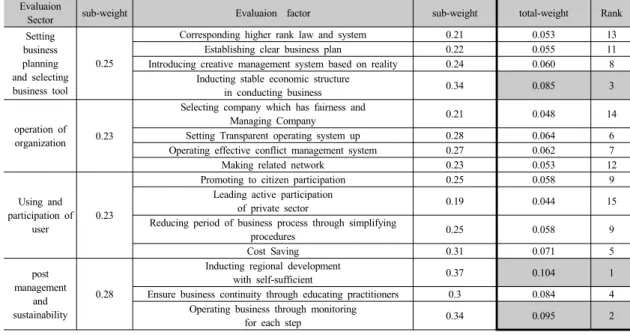
앞서 시행한 분석을 통해 종합적 가중치를 도출한 결 과 Table 10과 같이 도출되었다. 가장 중요한 요소가 자 족성 있는 지역발전을 유도하는 것이 가장 높게 분석되 었고, 그 다음으로는 정비사업 계획 수립 시에 안정적 경 제구조를 조성하는 것이 중요도 순위가 높게 나타났다.
따라서, 공공관리자제도의 수립은 지속적 사후관리를 우 선적으로 고려하고, 지속가능한 도시정비사업으로 거듭 날 수 있도록 안정적인 경제구조를 조성하여 정비사업을 운영할 수 있는 평가기준을 수립할 때, 공공관리자제도 의 운영원칙인 공공성, 전문성, 참여성, 합리성, 지속가 능성의 원칙을 모두 충족할 수 있을 것이다.
Evaluaion
Sector sub-weight Evaluaion factor sub-weight total-weight Rank
Setting business planning and selecting business tool
0.25
Corresponding higher rank law and system 0.21 0.053 13
Establishing clear business plan 0.22 0.055 11
Introducing creative management system based on reality 0.24 0.060 8 Inducting stable economic structure
in conducting business 0.34 0.085 3
operation of organization 0.23
Selecting company which has fairness and
Managing Company 0.21 0.048 14
Setting Transparent operating system up 0.28 0.064 6
Operating effective conflict management system 0.27 0.062 7
Making related network 0.23 0.053 12
Using and participation of
user
0.23
Promoting to citizen participation 0.25 0.058 9
Leading active participation
of private sector 0.19 0.044 15
Reducing period of business process through simplifying
procedures 0.25 0.058 9
Cost Saving 0.31 0.071 5
post management
and sustainability
0.28
Inducting regional development
with self-sufficient 0.37 0.104 1
Ensure business continuity through educating practitioners 0.3 0.084 4 Operating business through monitoring
for each step 0.34 0.095 2
Table 10. Total Important Analysis
5. 결 론
본 연구는 도시정비사업 내 공공관리자제도의 도입 필요성을 인지하고, 공공 관리자 제도의 평가기준을 체 계적이고 객관적으로 수립하고자 정책평가의 틀을 이용 하여 선행연구와 전문가의 의견을 바탕으로 공공성, 전 문성, 참여성, 합리성, 지속가능성이라는 다섯 가지의 방 향 아래 사업계획 단계에서부터 운영, 참여, 사업의 사후 평가단계까지 확장된 개념의 지속적인 평가요소를 구축 하였다.
또한 구축된 평가요소를 바탕으로 전문가들을 대상으 로 설문조사 실시 결과 평가 분야에서는 사후관리 및 지 속성 분야가 가장 중요하게 도출되었으며, 세부 평가 요 소로는 사업 시 안정적 경제구조 조성 유도와 투명한 운 영체계 수립, 제반 비용 절감, 자족성 있는 지역발전의 유도 등의 항목이 중요한 요소로 분석되었다. 이들 중 통 합적으로 가장 중요한 요소가 사후관리 및 지속성 분야 의 평가 요소들로 분석되어 공공관리자제도가 일회성 도 시정비사업에서 그치는 것이 아닌 도시의 자생력을 이끌 어줄 수 있도록 지원해주는 것이 가장 중요하다고 할 수 있었다.
이상과 같은 분석결과를 통해 얻을 수 있는 시사점 및 지표의 적용방법은 실무적 차원과 학술적 차원으로 나누 어 설명할 수 있다.
실무적 차원으로서는 첫째, 공공관리자제도는 사업의 계획단계부터 사업 완료 이후 사후관리 부분까지 원칙을 세워서 그에 맞게 운영방안을 수립해야한다. 그러나 현 재는 사업추진위원회와 조합의 구성단계 이후부터 공공 관리자제도가 본격적으로 운영되기 때문에 이전에 세워 진 원칙들과 다소 상충될 우려가 있고, 이에 따라 조합과 행정기관과의 갈등을 초래하기도 한다. 따라서 일관된 평가체계를 구축할 필요가 있다.
둘째, 공공관리자제도의 지속가능한 운영을 이끌어내 기 위해서는 지속적인 재교육 및 주민의 사업 참여 활동 이 필수적이다. 정비사업기간을 단축하여 제반 비용을 절감하는 것도 중요한 이슈이지만, 주민의 참여가 배제 된 공공주도의 정비사업은 지속가능한 측면에서는 다소 부족한 사업이 될 수 있다. 그러므로 주민의 참여를 지속 적으로 이끌어내면서도 사업기간을 단축시킬 수 있는 공 공관리자제도의 조정활동이 무엇보다 중요하다고 할 수 있다.
한편, 학술적 차원의 시사점은 다음과 같다.
첫째, 공공관리자제도를 평가할 때 종전의 물리적, 경 제적 효과에 치중하여 이끌어내던 성과관리시스템에서 탈피하여 사업의 운영과정에서의 갈등관리 등 비 물리적 평가기준 등의 요소 또한 평가될 필요가 있다. 이를 통하 여 공공관리자제도는 공공성, 전문성, 참여성, 합리성, 지속가능성이라는 기제 안에서 더욱 성공적인 도시환경
정비사업을 이끌어낼 수 있을 것이다.
둘째, 공공관리자제도를 보다 실질적으로 평가하기 위하여 연구분야 뿐만 아니라 공공관리자제도의 사업시 행에 있어서 실제적 갈등과정이 반영된 지표가 구축되어 야 할 것이다. 이는 대법원의 판례 혹은 소송 기록 등을 통하여 구축할 수 있으며, 학술적으로만 구축된 평가지 표 보다 체계적으로 공공관리자제도를 평가해볼 수 있을 것이다.
본 연구는 연구를 통해 도출된 평가지표를 실제적으 로 적용해보고 판단해보지 못했다는 점에서는 한계가 있 다. 그러나, 본 연구를 통해 도출된 평가지표를 통해 향 후 정책수립에 있어 보다 객관적 근거로 활용할 수 있을 것이며 도시정비사업 내 공공의 역할에 대한 가이드 모 델을 구축할 수 있을 것이라는 점에서 의의가 있다.
References
[1] Shin-Eun, Kang, The Study of implementation of the management disposal plan on legal system
–
in the housing redevelopment and rebuilding project, master’s thesis, p.1-249, chungang university, 2012.[2] Hee-soo, Park, “An analysis on the characteristic of the conflicts and public Interventions for the urban renewal projects”, doctor’s thesis. p.1-157, hanyang university, 2010.
[3] KwanSoo, Yang, “A study on the system of project manager In urban renewal”, master’s thesis. p.1-109, hanyang university, 2010.
[4] Housing department in Seoul Metropolitan Government,
“Q&A about public management system in seoul housing,” , Seoul Metropolitan Government,
[5] Yea-Cheol, Shin, Young-Gull, Kim, Ja-Hoon, Koo,
“Development of Evaluation System for Public Design Policy as Urban Design - Focused on Evaluation for the Public Design Policy of Seoul”, Journal of the Urban Institute of Korea 11(4), p.5-22, 2010.
[6] Jung-Soo, Lee, Dae-Jung,Kwon, “A Survey on the Consciousness of Landowners with the Implementation of the Public Management System -Focused on the Housing Redevelopment Project”, Journal of Korea Real Estate Society 28(1), p. 239-262, 2010.
[7] Sung kyu, Doo, “Direction to improve system for activating resonable role of public management system”, journal of Cooperation &economy Research Institute of
Korea, p.1-23, 2010.
[8] Jong Seong, Kim, “A study on Improvement of he Public Management System in Urban Renewal Project : Focuses on Project District”, master’s thesis, p.1-179, hanyang university, 2012.
[9] Yong Kyeong, Eo, “A study on the promotion of public interest in the cite redevelopment policy : focused on public management system”, master’s thesis. p.1-106, hanyang university, 2010.
[10] Kwang-sub, Jung, “The development of evaluation models for assessing green performances of sustainable green cities”, doctor’s thesis. p.1-165, hanyang university, 2010.
[11] Sang won, kim, “developing evaluation factor for improving effective investment in protecting children area”, Journal of the korea association for policy analysis and evaluation 19(2), p. 21-36, 2009.
[12] young-choon, kim, seung ho, shin, jung sook, kim, “An Empirical Study on the Factors of BSC Performances in the Public Sector”, The e-Business Studies 8(4), p.
241-262, 2007.
[13] Ji ho, chun, “Overseas market entry strategies for new town development in public enterprise perspective“, master’s thesis, p.1-113, yonsei university, 2007.
[14] Won chul, lee, “Derivation study of urban-rehabilitation strategies and planning factors for waterfront areas in consideration of revitalization”, doctor’s thesis, p.1-179, hanyang university, 2014.
[15] Keun tae, jo, Sung jun, kim, Dae sick, kim, young woo, jo, jong in, lee, “ Priority Setting for Future Core Technologies using the AHP - With Major Fields in Rural Development and Resources -”,Journal of Korean Society of Rural Planning 9(3), p.41-46, 2003.
[16] Sung yeon, kim, “Study of Public Management System on Housing Redevelopment Program through Principal-Agent Theory”, journal of housing studies 19(4), p.1-21, 2011.
[17] Dong-ryul, Lee, “ The Study on the Fairness and Transparency of Public Control System of Urban and Housing Redevelopment Projects”, master’s thesis, p.1-137, Ajoo university, 2011.
[18] chun gyu, Park, “Development Direction of the Public Management System for Urban and Housing Development Projects”, master’s thesis, p.1-51, hanbat university, 2011.
[19] JuHyun, Cho, “A study on the improvement of the legislative system for the housing reconstruction efficiency”, master’s thesis, p.1-102, konkuk university,
2010.
[20] Seung Kyoo, Kim, “A study on the system improvement of the urban and residential environment projects”, master’s thesis, p.1-91, konkuk university, 2010.
[21] Pil-hwan, Park, “A Study on the Problems and Improvements of Public Management System in the Urban Redevelopment Projects”, master’s thesis, p.1-104, Sejong university, 2010.
[22] Jin-Kun, Lee, “The Study of Vitalization Approaches for Urban Renewal Project Implementation : Focuses on Planning District Case in North of Seoul”, master’s thesis, p.1-85, Seoul National University of Technology, 2010.
[23] Moon do, Han, “A study on the Improvement of Public Management System in the Urban Renewal Project”, p.1-115, dongeui university, 2012.
[24] Young Jong, Kim, “A study on new town development in Seoul metropolitan city : focused on securing public interests through government involvement”, doctor’s thesis, p.1-171, hanyang university, 2010.
[25] Sung Ki, Jun , “A Study on the Obstacle sand Vitalizations of Residential Housing Reconstruction
–
Centering on Kae-Po Area-, ”, master’s thesis, p.1-122, kyungki university, 2011.[26] Hyung-Sic, Yoon, “The Study of Public vs Private Role for Housing Renewel Planning : The Case Study of the Urban Renwell Promotion Area in Seoul city”, master’s thesis, p.1-142, Seoul National University of Technology, 2009.
[27] Gi Hong, Kim, “A study on the work of CMr in the apartment reconstruction project”, master’s thesis, p.1-98, Yonsei University, 2002.
이 정 재(Jeong-Jae Lee) [정회원]
•
1999년
2월
:강남대학교 철학과
(인문학사
)•
2011년
2월
:한양대학교 대학원
(도시 및 부동산 개발학 석사
)•
2015년
2월
:한양대학교 도시대 학원 박사수료
<
관심분야
>부동산
,도시문화
,도시재생
이 주 형(Joo-Hyung Lee) [정회원]
•
1979년
2월
:한양대학교 건축학 과
(건축공학사
)•
1983년
5월
:미 코넬대학교 대학 원
(도시계획학석사
)•
1985년
6월
:미 코넬대학교 대학 원
(도시계획학박사
)•
1986년
3월
~현재
:한양대학교 도시대학원 교수
<