뇌졸중후 경직에 대한 침치료 임상진료지침
김제신1, 신승원1, 이의주1, 신병철2, 이명수3, 임성민4, 남동우5, 문상관6
1경희대학교한방병원 사상체질과, 2부산대한의전 한방병원 한방재활의학과, 3한국한의학연구원
4국립재활원, 5경희대학교한방병원 침구과, 6경희대학교한방병원 한방내과 Original Article
Clinical Practice Guideline on Acupuncture for Post-stroke Spasticity
Je-Shin Kim1, Seung-Won Shin1, Eui-Ju Lee1, Byung-Cheul Shin2, Myeong-Soo Lee3 Sung-Min Lim4, Dong-Woo Nam5, Sang-Kwan Moon6
1Dept. of Sasang Constitutional Medicine, Kyung Hee Uiversity Korean Medicine Hospital
2Dept. of Korean Physical Medicine Rehabilitation, School of Korean Medicine, Pusan National University
3Korean Institute of Oriental Medicine
4Department of Clinical Research on Rehabilitation, Korean National Rehabilitation Research Institute
5Dept. of Acupuncture & Moxibustion Medicine, Kyung Hee Uiversity Korean Medicine Hospital
6Dept. of Korean Internal Medicine, Kyung Hee Uiversity Korean Medicine Hospital
Objectives: This study is aimed to develop a Clinical Practice Guideline (CPG) on acupuncture treatment for the patients with post-stroke spasticity.
Methods: Experts committee, consisting of stroke or methodology specialists, searched Medline, EMBASE, Cochrane Library, China National Knowledge Infrastructure, and 19 Korean medicine journals. The search terms were selected to screen the randomized controlled trials (RCTs) or systematic reviews for the effectiveness of acupuncture on post-stroke spasticity, compared with placebo or conventional group. Levels of evidence and grades of recommendations were appraised based on Recommendations for Development of Clinical Practice Guideline in Korean Medicine.
Results & Conclusions: One systematic review and 7 RCT were included to build the CPG. There was a strong evidence to support the effectiveness of electroacupuncture treatment for post-stroke spasticity. However, it did not show any sufficient evidence to treat the patients with post-stroke spasticity with the sole acupuncture. The moderate evidence was presented that over 3 times of the electroacupuncture treatments with 1-100 Hz frequency should be performed every week on the acupoints, such as LI11, LI10, TE5, LI4, ST36, GB34, ST40, or LR3, for 20-30 minutes. It was also suggested that the procedure should begin at the acute stage just after the vital signs of the patients are stabilized. Finally, there was a moderate evidence to support safety of acupuncture treatment for post-stroke spasticity.
Key Words : Acupuncture, stroke, spasticity, Clinical practice guideline
⋅Received:23 November 2014 ⋅Revised:13 March 2015 ⋅Accepted:17 March 2015
⋅Correspondence to:이의주(Eui-Ju Lee)
서울 동대문구 경희대로 23 경희대학교한방병원 사상체질과
Tel:+82-2-958-9232, Fax:+82-2-958-9234, E-mail:[email protected]
뇌졸중후 경직(Poststroke sapsticity; PSS)은 중풍
후 발생하는 상위운동신경원증후군(upper motoer
neuron syndrome) 중 하나로, 속도에 비례하여 근육
의 긴장성이 증가하는 운동 장애를 의미한다
1). 2009
년 뇌졸중 재활치료를 위한 한국형 표준 임상진료지
침에서는 뇌졸중후 경직 치료법으로 적절한 자세,
서 론
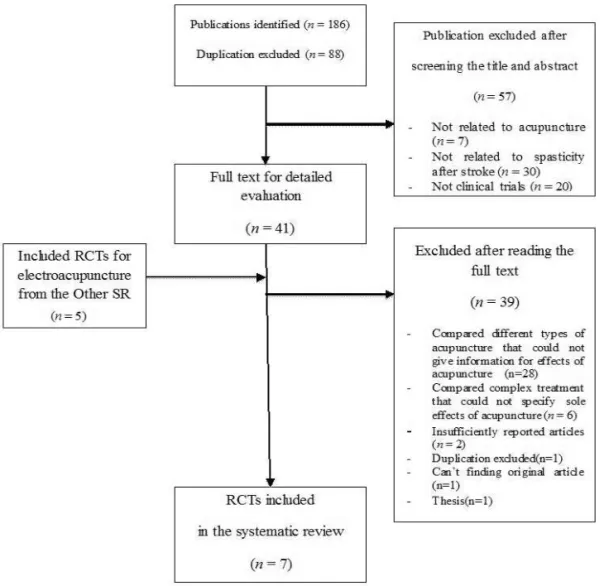
Fig. 1. Flow Chart of the Trial Selection Process.
RCT: Randomized Controlled Trial; SR: Systematic Review.
관절운동, 신전운동, 부목 또는 수술적 교정을 제시 하였고, 타자니딘, 단트롤린, 바클로펜 등의 약물치 료를 시행할 것을 제시하였다
2).
침치료는 한의학에서 사용하는 치료법 중 하나로 경락과 기혈을 조절하여 질환을 치료한다. 최근 침 치료와 관련하여 많은 연구가 진행되어 있으며, the Cochrane Library에서는 각종 통증 질환, 뇌신경계 질환, 신경정신과적 질환과 관련하여 많은 코크란 체계적 문헌고찰이 진행되었다. 뇌졸중 재활에 대한 침치료의 외국의 권고사항을 살펴보면 대부분 뇌졸
중 재활에 대한 총괄적 임상진료지침
3)을 제시하고 있을 뿐, 경직에 대한 부분은 특화하여 제시하지 않 고 있다. 이러한 추세 속에서 같이 뇌졸중후 발생한 경직에 대한 침치료에 대한 효과를 살펴보고 이에 따른 구체적인 지침을 제시하고자 한다.
1. 임상질문 설정
사상체질과, 한방내과, 한방재활의학과, 침구의학
연구 대상 및 방법
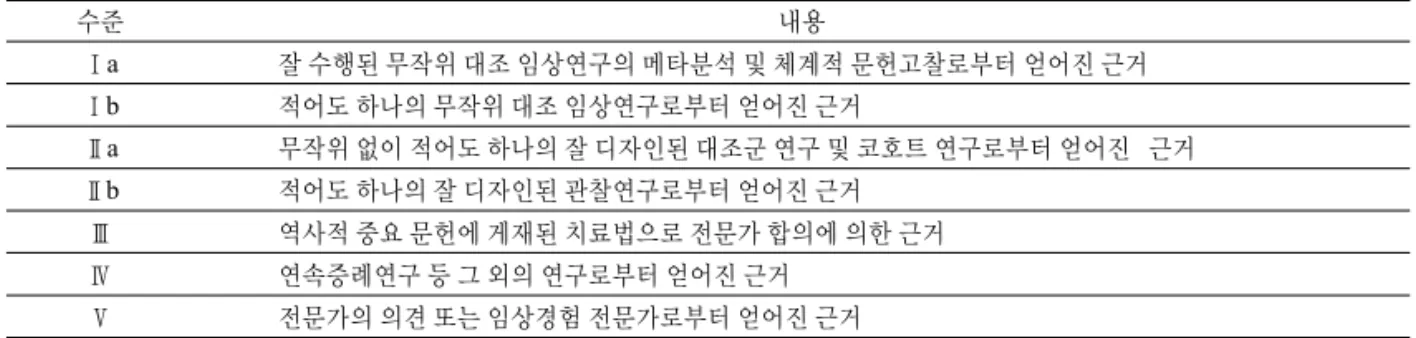
수준 내용
Ⅰa 잘 수행된 무작위 대조 임상연구의 메타분석 및 체계적 문헌고찰로부터 얻어진 근거
Ⅰb 적어도 하나의 무작위 대조 임상연구로부터 얻어진 근거
Ⅱa 무작위 없이 적어도 하나의 잘 디자인된 대조군 연구 및 코호트 연구로부터 얻어진 근거
Ⅱb 적어도 하나의 잘 디자인된 관찰연구로부터 얻어진 근거
Ⅲ 역사적 중요 문헌에 게재된 치료법으로 전문가 합의에 의한 근거
Ⅳ 연속증례연구 등 그 외의 연구로부터 얻어진 근거
Ⅴ 전문가의 의견 또는 임상경험 전문가로부터 얻어진 근거
Table 2. Grade of Recommendation.
등급 내용 근거수준
A 매우권고 적어도 한 개 이상의 무작위 대조 임상연구 또는 메타분석에 의한 근거가 있는
경우 매우 권고함 Ⅰa, Ⅰb
B 권고 무작위 대조 임상연구가 아니라도 잘 수행된 연구디자인에 의한 근거이거나
역사적으로 중요 문헌에 의한 것이면 권고함. Ⅱa, Ⅱb, Ⅲ
C 선택적권고 근거 자료가 부족하더라도 전문가 합의가 있을 경우 선택적으로 권고함 Ⅳ, Ⅴ
GPP 임상진료지침 개발그룹의 임상적 경험에 근거하였을 경우 권고함
Table 1. Level of Evidence.