* Corresponding author: Jae Woong Sull
Department of Biomedical Laboratory Science, College of Health Science, Eulji University, 553 Sansung-daero, Sujeong-gu, Seongnam 13135, Korea E-mail: [email protected]
* ORCID: https://orcid.org/0000-0002-5178-0065
ORIGINAL ARTICLE
Effects of ATP2B1 Variants on the Systolic and Diastolic Blood Pressure according to the Degree of Obesity in the South Korean Population
Gi Tae Kim
1, In Sik Kim
1,2, Sun Ha Jee
3, Jae Woong Sull
1,21Department of Senior Healthcare, General Graduate School, Eulji University, Seongnam, Korea
2Depratment of Biomedical Laboratory Science, College of Health Science, Eulji University, Seongnam, Korea
3Department of Epidemiology and Health Promotion, Institute for Health Promotion, Graduate School of Public Health, Yonsei University, Seoul, Korea
한국인에게서 ATP2B1 유전 변이가 비만 정도에 따른 수축기 혈압과 이완기 혈압에 미치는 영향
김기태
1, 김인식
1,2, 지선하
3, 설재웅
1,21을지대학교 대학원 시니어헬스케어학과, 2을지대학교 보건과학대학 임상병리학과, 3연세대학교 보건대학원 역학건강증진학과
ARTICLE INFO ABSTRACT
Received November 22, 2019 Revised 1st December 9, 2019 Revised 2nd January 15, 2020 Revised 3rd January 28, 2020 Revised 4th February 18, 2020 Accepted February 18, 2020
Hypertension often leads to cardiovascular disease and kidney disease, and hypertention is an important worldwide problem. Body mass index (BMI) has an important role for raising blood pressure. Further, hypertension can be affected by both environmental factors and genetic factors.
Many single nucleotide polymorphisms have been associated with hypertension. Genome wide association study (GWAS) is a method of confirming a new locus of increasing the risk of disease, and GWAS has confirmed several single nucleotide polymorphisms (SNPs) that are associated with high blood pressure. This study analyzed the relationship between systolic blood pressure, diastolic blood pressure and SNP of the ATP2B1 gene in 994 Koreans. SNPs that showed the highest statistical significance with systolic and diastolic blood pressures were selected on the multiple linear regression analysis. One-way analysis of variance for systolic and diastolic blood pressures was performed, and multiple logistic regression analysis was performed on the risk of hypertension. The P values were two-tailed, and P<0.05 was considered significant. Four SNPs were associated with systolic blood pressure and six SNPs were associated with diastolic blood pressure. In addition, a genotype-based analysis showed significant odds ratios for the risk of hypertension in older men (adjusted OR, 5.743; 95% CI, 1.173∼28.121; P=0.031). This study suggests that the ATP2B1 variants affect both the systolic and diastolic blood pressure.
Copyright © 2020 The Korean Society for Clinical Laboratory Science. All rights reserved.
Key words ATP2B1 Blood pressure Body mass index Hypertension
Single nucleotide polymorphism
서 론
고혈압은 종종 심혈관 질환 및 신장 질환으로 이어지며 전 세
계적으로 중요한 문제이다[1]. 혈압이 수축기 혈압이 140 mmHg를 넘거나, 이완기 혈압이 90 mmHg을 넘으면 고혈압 이라고 진단한다[2]. 혈압은 혈관 평활근의 수축과 팽창, 세포 내 칼슘 농도에 따라 달라진다[3]. 생활 습관과 같은 요인들이 혈 압을 높이는 것으로 알려져 있다[4]. 소금 섭취는 혈압에 영향을 미칠 수 있으며, 평균 일일 소금 섭취량은 전세계 성인 인구보다 아시아 성인 인구가 더 높았다[5]. 체질량지수(body mass
Korean Society for Clinical Laboratory Science
index, BMI)가 높으면 혈압상승과 밀접한 관계가 있다. 또한, 고혈압은 환경적 요인과 유전적 요인에 영향을 받을 수 있으며, 비만도 고혈압과 유의한 상관관계에 있다고 보고 되었다[6]. 폐 경기는 복잡한 생리적 과정으로 난소호르몬인 에스트로겐과 프 로게스테론의 분비가 감소하여 발생하며, 생리기간과 BMI, 혈 압은 서로 관련이 있다[7]. 국내에서 이루어진 한 연구에서 폐경 전 여성과 폐경 후 여성을 비교하였을 때, 고혈압은 폐경 후 여성 에게서 높은 유병률을 보였으며, 비만도 폐경 후 여성이 높은 비 율을 보였다[8].
유전적으로 많은 단일 염기 다형성(single nucleotide polymorphism, SNP)이 고혈압과 관련이 있다[9]. 유전자 분 석 기술의 개발로 고혈압 관련 유전자의 전장유전체 관련성 연 구(genome wide association study, GWAS)가 수행되었으 며, GWAS는 질병 위험에 대한 새로운 유전자 자리를 확인하는 방법이다. 기존의 다른 GWAS 연구에서 혈압과 관련된 여러 단 일 염기 다형성을 확인했다[10]. 많은 GWAS 연구에서 혈장 막 칼슘 단백질인 PMCA1 (plasma membrane calcium ATPase 1)의 ATP2B1 (plama membrane calcium-trans- porting ATPase 1)유전자가 혈압과 연관성이 높다는 것을 발 견했다. ATP2B1 유전자는 12번 염색체에 위치해 있으며, 한국 에서 이루어진 KARE (Korean Association Resource)자료 의 연구에서는 ATP2B1 유전자의 SNP인 rs17249754가 수축 기 혈압과 강하게 연관되어있다고 보고되었다[11]. APT2B1 유 전자는 고혈압의 원인 유전자로서 일본인 뿐만 아니라 백인에서 도 발견되었다[12]. 중국에서는 고혈압 관련 SNP를 가지고 BMI와의 연관성 연구가 이루어졌었고, 비만과 유의한 관련성 을 보인 SNP가 보고되었다[13]. 그러나 한국인에서는 ATP2B1 유전자와 고혈압과의 관련성을 BMI를 고려하여 분석한 연구는 거의 없었다. 따라서 본 연구에서는 한국인 994명을 대상으로 수축기 혈압, 이완기 혈압과 ATP2B1 유전자의 SNP와 연관성 을 분석하였으며, BMI수치에 따라 하위그룹으로 계층화하여 차이가 있는지 알아보고, 어느 정도의 영향이 있는지 확인하고 자 하였다.
대상 및 방법
1. 연구 대상
연구 대상자는 2006년 1월부터 2007년 6월까지 서울지역 종합병원 건강검진센터에 방문하여 대사증후군 연구 사업에 참 여한 6,622명 중 신체계측(키, 체중, 허리둘레, 혈압)과 혈액검 사(콜레스테롤, 공복시 혈당)를 하였고, 이 중 1,004명에 대하
여 전장유전체 다형성 분석을 진행한 참여대상자들의 사전 동의 를 구하였으며, 분석률이 낮거나 유전자 분석과 성별이 불일치 한 10명을 제외하고 994명을 대상으로 하였다. 연구계획에 대 하여 을지대학교 IRB (Institutional Review Board of Human Research at Eulji University)의 승인을 얻었다(IRB No: EUIRB2016-15).
2. 자료수집
허리둘레는 줄자를 이용하여 장골과 마지막 늑골사이의 중간 부위를 수평으로 측정하는 것을 원칙으로 하였으며, 정확한 위 치를 가늠하기 어려운 경우는 배꼽 위 3 cm를 측정하였다. 키와 몸무게는 간단한 옷만 입은 채 측정하였다. BMI는 체중(kg)/키 (m2)으로 계산하였다. 수축기 혈압(systolic blood pressure, SBP)과 이완기 혈압(diastolic blood pressure, DBP) 모두 15 분 안정을 취한 후 측정하였다. 연구 대상자 994명을 성별에 따 라(남,녀), 연령에 따라(20∼29, 30∼39, 40∼49, 50∼59, 60∼
69, 70∼79), BMI 수치는 대한비만학회[22, 23] 권고를 참고 하여(<23.0 kg/m2, 23∼24.9 kg/m2, ≥25.0 kg/m2) 하위그 룹으로 계층화 했다. 또한, 혈압은 미국 JNC 7 (Seventh Report of the Joint National Committee on the Prevention) 기준에 따라서 정상 혈압은 수축기 혈압이 120 mmHg 미만이 고, 이완기 혈압이 80 mmHg 미만으로 정의하였으며, 고혈압 환자는 수축기 혈압이 140 mmHg 이상이거나 이완기 혈압이 90 mmHg 이상일 때로 정의하였다.
3. 생화학적 검사
모든 대상자는 12시간 이상 금식 후에 혈액을 채취하여 원심 분리 후 영하 70도로 냉동시켰다. 대사증후군 지표인 공복 시 혈 당(fasting blood sugar, FBS)과 총콜레스테롤, 중성지방, 고 밀도콜레스테롤을 Hitachi-7600 자동생화학분석기(Hitachi Co, Tokyo, Japan)를 이용하여 측정하였으며, 연구 대상자들 의 검사 결과를 연구 자료로 활용하였다.
4. 자료처리 및 분석 1) 유전자 분석
Affymetrix Genome-Wide Human SNP array 5.0 (Affymetrix, Santa Clara, CA, USA)을 이용하여 유전자 분 석을 시행하였으며 quality control call rate (dynamic model algorithm)는 86% 이상을 나타내었고, X 염색체 상의 heterozygosity로 대상자 개개인의 성별을 정확하게 구별하였 다. Genotype calling은 birdseed v2 algorithm을 통해 시행
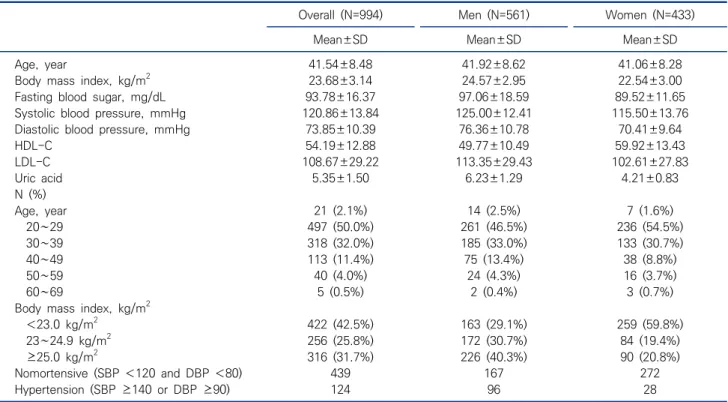
Table 1. Characteristics of the study subjects
Overall (N=994) Men (N=561) Women (N=433)
Mean±SD Mean±SD Mean±SD
Age, year 41.54±8.48 41.92±8.62 41.06±8.28
Body mass index, kg/m2 23.68±3.14 24.57±2.95 22.54±3.00
Fasting blood sugar, mg/dL 93.78±16.37 97.06±18.59 89.52±11.65
Systolic blood pressure, mmHg 120.86±13.84 125.00±12.41 115.50±13.76
Diastolic blood pressure, mmHg 73.85±10.39 76.36±10.78 70.41±9.64
HDL-C 54.19±12.88 49.77±10.49 59.92±13.43
LDL-C 108.67±29.22 113.35±29.43 102.61±27.83
Uric acid 5.35±1.50 6.23±1.29 4.21±0.83
N (%)
Age, year 21 (2.1%) 14 (2.5%) 7 (1.6%)
20∼29 497 (50.0%) 261 (46.5%) 236 (54.5%)
30∼39 318 (32.0%) 185 (33.0%) 133 (30.7%)
40∼49 113 (11.4%) 75 (13.4%) 38 (8.8%)
50∼59 40 (4.0%) 24 (4.3%) 16 (3.7%)
60∼69 5 (0.5%) 2 (0.4%) 3 (0.7%)
Body mass index, kg/m2
<23.0 kg/m2 422 (42.5%) 163 (29.1%) 259 (59.8%)
23∼24.9 kg/m2 256 (25.8%) 172 (30.7%) 84 (19.4%)
≥25.0 kg/m2 316 (31.7%) 226 (40.3%) 90 (20.8%)
Nomortensive (SBP <120 and DBP <80) 439 167 272
Hypertension (SBP ≥140 or DBP ≥90) 124 96 28
Abbreviations: HDL-C, high density lipoprotein cholesterol; LDL-C, low density lipoprotein cholesterol; SD, standard deviation; SBP, systolic blood pressure; DBP, diastolic blood pressure.
하였다. 표본의 분석률이 낮거나(<90%, MIND (missing rate per individual) >0.1 기준 적용), PLINK를 이용하여 identity-by-sate (IBS) 산출식으로 전체 SNP를 분석하여 유 전적으로 연관성을 가진 표본을 제외하였다. 유전자 SNP의 position은 NCBI build 36을 이용하였다.
2) 통계 분석
통계 프로그램은 PLINK ver. 1.05 (Free Software Foundation, Inc. Boston, USA)와 Haploview ver. 4.1 (Broad Institute, USA) 및 IBM SPSS statistics 24.0 (Armonk, NY, USA)을 사용하였고 통계 분석과정에서 minor allele frequency (MAF) 5% 이하인 SNP들을 제외시켰다. 연 구 대상자의 일반적 특성에 대한 분포 등 연속형 자료는 평균 (mean±SD)으로 표시하였다. 연령과 성별을 통제변수로 하여 다중선형회귀분석을 시행하였다. 다중선형회귀분석에서 수축 기 혈압 및 이완기 혈압과 가장 높은 통계적 유의성을 보인 SNP 를 선정하였다. 수축기 혈압 및 이완기 혈압에서 공통적으로 높 은 통계적 유의성을 보인 SNP들로 성별을 구분하여 유전자형 (genotype)에 따른 추가 분석을 시행하였다. One-way ANOVA (analysis of variance)를 시행하였고, 고혈압 발생
위험에 대한 다중로지스틱회귀분석을 시행하였다. 다중로지스 틱회귀분석은 BMI 수치를 비만 기준[14, 15] (<25 kg/m2,
≥25.0 kg/m2)으로 시행하였으며, 연령은 여성의 폐경기 기준 [7, 8] (<50, ≥50)으로 각각 구분하여 시행하였으며, 연령, BMI, 공복 시 혈당을 통제한 방법에서 비교하였다. 또한, 통계 적 불확실성을 배제하기 위해(SBP 120∼140 and/or DBP 80∼90)에 해당되는 인원을 제외하고 normotensive인 439 명과 hypertension인 123명으로 분석을 시행하였다. 또한, 모 든 경우에서 2 tailed significance를 구하였고, P<0.05를 통 계적으로 유의한 것으로 간주하였다.
결 과
연구 대상자는 총 994명이었으며, 남성 561명, 여성 433명 으로 구성되어 있다. BMI, FBS, SBP, DBP 수치는 남성이 더 높 았으며, 평균 연령은 남녀 간 큰 차이가 없었다. 남녀 모두 30대 가 인원이 제일 많았다. 남성은 BMI 수치가 ≥25.0 kg/m2인 인 원이 제일 많았으며, 여성의 경우 BMI 수치가 <23.0 kg/m2인 인원이 제일 많았다. 그리고 BMI 수치가 ≥25.0 kg/m2인 비만 에 해당되는 인원은 여성보다 남성이 더 많았다. 또한,
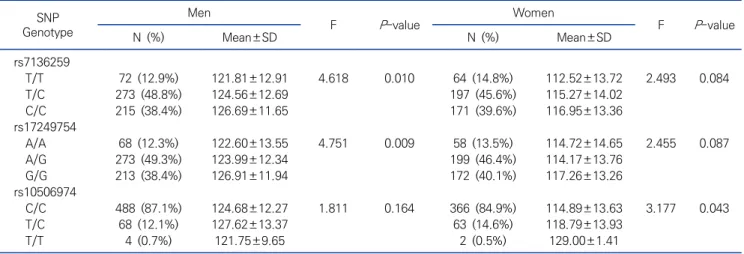
Table 3. Mean of systolic blood pressure levels by genotype of ATP2B1 gene SNPs (N=994) SNP
Genotype
Men F P-value Women
F P-value
N (%) Mean±SD N (%) Mean±SD
rs7136259
T/T 72 (12.9%) 121.81±12.91 4.618 0.010 64 (14.8%) 112.52±13.72 2.493 0.084
T/C 273 (48.8%) 124.56±12.69 197 (45.6%) 115.27±14.02
C/C 215 (38.4%) 126.69±11.65 171 (39.6%) 116.95±13.36
rs17249754
A/A 68 (12.3%) 122.60±13.55 4.751 0.009 58 (13.5%) 114.72±14.65 2.455 0.087
A/G 273 (49.3%) 123.99±12.34 199 (46.4%) 114.17±13.76
G/G 213 (38.4%) 126.91±11.94 172 (40.1%) 117.26±13.26
rs10506974
C/C 488 (87.1%) 124.68±12.27 1.811 0.164 366 (84.9%) 114.89±13.63 3.177 0.043
T/C 68 (12.1%) 127.62±13.37 63 (14.6%) 118.79±13.93
T/T 4 (0.7%) 121.75±9.65 2 (0.5%) 129.00±1.41
Calculated by the ANOVA (analysis of variance) test.
Abbreviations: SD, standard deviation; SNP, single nucleotide polymorphism.
Table 2. ATP2B1 variants significantly associated with blood pressure based on a linear regression model
SNP Position Minor/Major allele MAF (S.E.) P-value
Systolic blood pressure
rs7136259 88605319 T/C 0.3756 −2.098 (0.5913) 4.07×10⁻⁴
rs17249754 88584717 A/G 0.3685 −1.993 (0.6023) 9.68×10⁻⁴
rs10506974 88510467 T/C 0.07122 2.837 (1.095) 9.71×10⁻³
rs17836882 88708990 A/C 0.1154 −2.084 (0.9309) 2.54×10⁻²
Diastolic blood pressure
rs7136259 88605319 T/C 0.3756 −1.443 (0.4617) 1.82×10⁻³
rs17249754 88584717 A/G 0.3685 −1.295 (0.4696) 5.92×10⁻³
rs1371075 89087651 C/T 0.09629 −1.972 (0.7428) 8.05×10⁻³
rs10506974 88510467 T/C 0.07122 2.276 (0.8536) 7.80×10⁻³
rs10506983 89177415 A/C 0.2207 −1.12 (0.5273) 3.39×10⁻²
rs10777237 89167655 T/C 0.3685 0.9844 (0.4655) 3.47×10⁻²
Estimated effect size () for the significant SNPs identified from N=994 and associated P-value in multiple linear regression model considering age and sex under ad additive model.
Abbreviations: MAF, minor allele frequency; SNP, single nucleotide polymorphism; SE, standard error.
hypertension (SBP ≥140 or DBP ≥90)에 해당되는 인원도 남성이 더 많았다(Table 1).
수축기 혈압에 유의하게 영향을 미치는 ATP2B1 유전자의 SNP는 4가지가 있었고, 1개의 SNP (rs10506974; , 2.816;
P=0.010)가 수축기 혈압 상승과 통계적으로 유의성을 가졌으 며, 나머지 3개의 SNP (rs7136259; , −2.086; P=0.0004), (rs17249754, , −1.98; P=0.001), (rs17836882; , −2.191;
P=0.0189)는 수축기 혈압을 유의하게 감소시켰다. 그리고 이 완기 혈압에 유의하게 영향을 미치는 SNP는 6가지가 있었고, 2 개의 SNP (rs10506974; , 2.258; P=0.008), (rs10777237;
, 0.9561; P=0.0402)가 이완기 혈압을 유의하게 증가시켰으 며, 4개의 SNP (rs7136259; , −1.429; P=0.002), (rs17249754; , −1.28; P=0.006), (rs1371075; , −2;
P=0.007), (rs10506983; , −1.196; P=0.0238)가 이완기 혈압을 유의하게 감소시켰다. 각각의 SNP들의 minor allele과 minor allele frequency는 Table 2에 나와있다. 수축기 혈압 과 이완기 혈압 모두 유의하게 영향을 미치는 SNP는 rs7136259, rs17249754, rs10506974 3개의 SNP였다(Table 2).
수축기 혈압과 이완기 혈압에 모두 유의하게 영향을 미치는 ATP2B1 유전자의 SNP들로 유전자형에 따른 one-way ANOVA를 시행하였다. rs7136259는 minor allele인 T를 가 질수록, 수축기 혈압이 낮았으며, 남성에게서만 유의하였다 (P=0.010). rs17249754는 minor allele인 A를 가질수록, 수 축기 혈압에 낮았으며, 남성에게서만 유의하였다. rs10506974 는 minor allele인 수축기 혈압이 높았으며, 여성에게서만 유의 하였다(Table 3).
Table 5. Multiple logistic regression analysis of ATP2B1 SNP on the risk of hypertension by age, sex
SNP Genotype age<50 OR (95% CI) P-value age≥50 OR (95% CI) P-value
rs7136259 Men
T/T 1 2.455 (0.140∼42.926) 0.538
T/C 2.664 (0.976∼7.268) 0.056 1.179 (0.232∼5.986) 0.843
C/C 4.094 (1.439∼11.649) 0.008 5.743 (1.173∼28.121) 0.031
Women
T/T 1 0.429 (0.024∼7.591) 0.356
T/C 1.189 (0.230∼6.153) 0.836 0.541 (0.043∼6.757) 0.633
C/C 0.872 (0.159∼4.774) 0.874 1.140 (0.099∼13.063) 0.916
rs17249754 Men
A/A 1 3.071 (0.166∼56.885) 0.451
A/G 2.563 (0.852∼7.551) 0.095 1.447 (0.262∼7.983) 0.671
G/G 4.392 (1.421∼13.571) 0.010 7.060 (1.320∼37.762) 0.022
Women
A/A 1 0.469 (0.027∼8.104) 0.603
A/G 1.101 (0.212∼5.705) 0.909 0.471 (0.038∼5.849) 0.558
G/G 0.852 (0.155∼4.675) 0.854 1.083 (0.095∼12.289) 0.949
Adjusted for age, body mass index, fasting blood sugar.
Abbreviations: CI, confidence interval; OR, odd ratio.
Table 4. Mean of diastolic blood pressure levels by genotype of ATP2B1 gene SNPs (N=994) SNP
Genotype
Men
F P-value Women
F P-value
N (%) Mean±SD N (%) Mean±SD
rs7136259
T/T 72 (12.9%) 73.58±9.70 5.236 0.006 64 (14.8%) 69.50±10.23 0.747 0.474
T/C 273 (48.8%) 76.21±10.31 197 (45.6%) 70.13±9.61
C/C 215 (38.4%) 77.92±9.95 171 (39.6%) 71.05±9.49
rs17249754
A/A 68 (12.3%) 74.19±10.49 4.113 0.017 58 (13.5%) 70.69±10.25 1.426 0.241
A/G 273 (49.3%) 75.91±10.04 199 (46.4%) 69.64±9.71
G/G 213 (38.4%) 77.84±10.03 172 (40.1%) 71.33±9.33
rs10506974
C/C 488 (87.1%) 76.23±10.04 1.676 0.188 366 (84.9%) 70.03±9.75 2.683 0.070
T/C 68 (12.1%) 78.63±10.98 63 (14.6%) 72.51±8.73
T/T 4 (0.7%) 77.00±10.17 2 (0.5%) 79.50±2.12
Calculated by the ANOVA (analysis of variance) test.
Abbreviations: SD, standard deviation; SNP, single nucleotide polymorphism.
수축기 혈압과 이완기 혈압에 모두 유의하게 영향을 미치는 ATP2B1 유전자의 SNP들로 유전자형에 따른 one-way ANOVA를 시행하였다. rs7136259는 minor allele인 T를 가 질수록, 이완기 혈압이 낮은 경향을 보였으며, 남성에게서만 유 의하였다(P=0.006). rs17249754는 minor allele인 A를 가질 수록, 이완기 혈압이 낮은 경향을 보였으며, 남성에게서만 유의 하였다(P=0.017). rs10506974의 경우 남성과 여성 모두 유의 하지 않았다(Table 4).
rs10506974는 유전자형이 T/T인 인원이 적어 분석에서 제 외하였으며, 2개의 SNP로 유전자형별 성별과 나이(age<50, age≥50)에 따라 고혈압 발생 위험에 따른 다중로지스틱회귀
분석을 시행하였으며, 연령과 BMI, FBS를 통제 변수로 하였다 (Table 5). rs7316259는 남성에게서만 minor allele인 T를 가 지지 않을수록, 나이가 많을수록, 고혈압 발생 위험이 높은 경향 을 보였으며, 유전자형이 C/C이고, age<50일 때(adjusted OR, 4.094; 95% CI, 1.439∼11.649; P=0.008)와 age≥50 일 때(adjusted OR, 5.743; 95% CI, 1.173∼28.121;
P=0.031)만 유의하였다. rs17249754는 남성에게서만 minor allele인 A를 가지지 않을수록, 나이가 많을수록, 고혈압 발생 위험이 높은 경향을 보였으며, 유전자형이 G/G이고, age<50 일 때(adjusted OR, 4.392; 95% CI, 1.412∼13.571;
P=0.010)와 age≥50일 때(adjusted OR, 7.060; 95% CI,
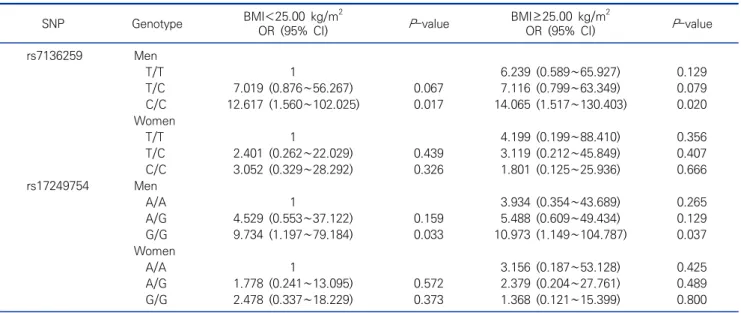
Table 6. Multiple logistic regression analysis of ATP2B1 SNP on the risk of hypertension by BMI, sex
SNP Genotype BMI<25.00 kg/m2
OR (95% CI) P-value BMI≥25.00 kg/m2
OR (95% CI) P-value
rs7136259 Men
T/T 1 6.239 (0.589∼65.927) 0.129
T/C 7.019 (0.876∼56.267) 0.067 7.116 (0.799∼63.349) 0.079
C/C 12.617 (1.560∼102.025) 0.017 14.065 (1.517∼130.403) 0.020
Women
T/T 1 4.199 (0.199∼88.410) 0.356
T/C 2.401 (0.262∼22.029) 0.439 3.119 (0.212∼45.849) 0.407
C/C 3.052 (0.329∼28.292) 0.326 1.801 (0.125∼25.936) 0.666
rs17249754 Men
A/A 1 3.934 (0.354∼43.689) 0.265
A/G 4.529 (0.553∼37.122) 0.159 5.488 (0.609∼49.434) 0.129
G/G 9.734 (1.197∼79.184) 0.033 10.973 (1.149∼104.787) 0.037
Women
A/A 1 3.156 (0.187∼53.128) 0.425
A/G 1.778 (0.241∼13.095) 0.572 2.379 (0.204∼27.761) 0.489
G/G 2.478 (0.337∼18.229) 0.373 1.368 (0.121∼15.399) 0.800
Adjusted for age, body mass index, fasting blood sugar.
Abbreviations: BMI, body mass index; CI, confidence interval; OR, odd ratios.
1.320∼37.762; P=0.022)만 유의하였다.
rs10506974는 유전자형이 T/T인 인원이 적어 분석에서 제 외하였으며, 2개의 SNP로 유전자형별 성별과 비만 기준인 BMI 수치(<25.00 kg/m2, ≥25.00 kg/m2)에 따라 고혈압 발생 위 험에 따른 다중로지스틱회귀분석을 시행하였으며, 연령과 BMI, FBS를 통제 변수로 하였다(Table 6). rs7316259는 남성 에게서만 minor allele인 T를 가지지 않을수록, BMI 수치가 높 을수록, 고혈압 발생 위험이 높은 경향을 보였으며, 유전자형이 C/C이고, BMI 수치가 <25.00 kg/m2일 때(adjusted OR, 12.617; 95% CI, 1.560∼102.025; P=0.017)와 BMI 수치가
≥25.00 kg/m2일 때(adjusted OR, 14.065; 95% CI, 1.517∼130.403; P=0.020)만 유의하였다. rs17249754는 남성에게서만 minor allele인 A를 가지지 않을수록, 나이가 많 을수록, 고혈압 발생 위험이 높은 경향을 보였으며, 유전자형이 G/G이고, BMI 수치가 <25.00 kg/m2일 때(adjusted OR, 9.734; 95% CI, 1.197∼79.184; P=0.033)와 BMI 수치가 ≥ 25.00 kg/m2일 때(adjusted OR, 10.973; 95% CI, 1.149∼
104.787; P=0.037)만 유의하였다.
고 찰
본 연구에서는 한국인 남성 561명, 여성 433명, 총 994명을 대상으로 수축기 혈압, 이완기 혈압과 ATP2B1 유전자의 SNP 와 연관성을 분석하였다. 수축기 혈압과 이완기 혈압에 공통적
으로 영향을 주는 3개의 SNP (rs7136259, rs17249754, rs10506974)를 선별하여 분석을 시행하였으며, 성별과 나이, BMI 수치에 따라 추가 분석을 시행하였다. 또한, SNP (rs10506974)는 유전자형별 인원 집단 중에 너무 적은 인원인 집단이 있어 일부 분석에서는 제외하였다.
혈장 막 칼슘 펌프(Plasma membrane calcium pump, PMCP)는 진핵세포에서 Ca2+를 특이적으로 배출하는 것으로 알려져 있다. 또한, 세포내와 세포외 사이에서 Ca2+의 수송을 조 절한다[16]. PMCA는 여러 개의 isoform을 가지고 있으며, 포 유류의 PMCA는 4가지의 유전자(ATP2B1, ATP2B2, ATP2B3, ATP2B2)에 의해 코딩 된다[16]. PMCA1과 PMCA4는 모든 조 직에서 발현 될 수 있고, PMCA2와 PMCA3은 뇌나 근육과 같은 일부에서만 발현된다. 각각의 PMCA의 isoform은 유전 변이 에 의해 영향을 받을 수 있다[17]. PMCA1과 PMCA4는 동맥 평 활근에서 발현되며, 동맥 수축성과 Ca2+을 조절할 수 있다고 알 려졌지만, PMCA1보다는 PMCA4가 더 많은 연구가 이루어져 혈압에 대한 영향을 뒷받침하고 있다[18, 19].
중국에서 이루어진 한 대규모 연구에서 기존에 보고된 SNP 들과 함께 혈압과 관련된 새로운 SNP들을 보고 했으며, BMI와 의 연관성 연구도 이루어 졌다[20]. 동아시아인을 대상으로 평 균 동맥압(mean atterial pressure, MAP)와 맥압(pulse pressure, PP)과 관련된 GWAS 메타분석이 이루어졌으며, 많 은 유전자의 SNP들이 확인 되었다. 그리고 다른 인종인 유럽인 들을 대상으로 한 GWAS 메타분석에서 혈압과 관련된 13가지
SNP가 발견되었는데, 동아시아인에게서도 이 SNP중에서 7가 지를 발견하였다. 또한, 혈압과 관련된 SNP가 관상 동맥 질환과 도 관련이 있을 수 있다고 보고하였다[21, 22]. 관상동맥질환에 대한 중국인의 GWAS에서 4가지의 SNP (rs2123536, rs1842896, rs9268402, rs7136259)가 보고되었고, rs7136259 는 ATP2B1의 SNP였다[23]. 또한 rs7136259의 경우는 RegulmomeDB database에서 eQTL로 추정 될 수 있는 영역 이라고 언급하고 있습니다. 한 연구에서는 RHTN (resistant hypertension)과 ATP2B1의 SNP인 rs12817819의 연관성 을 연구하였고 rs12817819의 A 대립유전자가 RHTN과 관련 이 있음을 보고했다[24]. 중국인을 대상으로 한 연구에서는 고 혈압에서 BMI와 ATP2B1 유전자의 SNP의 상호작용을 알아보 았으며, 여성에게서 BMI가 <25 kg/m2일 때, rs2070759의 A 대립유전자와 rs17249754의 G 대립유전자가 고혈압과 유의 한 연관성을 보였다. 또한, 일본에서 이루어진 GWAS에서는 ATP2B1 유전자의 SNP인 rs2681472와 rs11105364가 고혈 압과 유의한 관련이 있었으며, 동일한 LD block에 위치했다 [25-27]. 국내의 KARE 자료를 이용한 연구에서도 ATP2B1 유 전자의 SNP rs17249754가 고혈압과 유의한 연관성을 보였으 며, 같이 보고된 다른 SNP들보다 수축기 혈압과 이완기 혈압에 강한 영향을 미치고 있었다[28]. 또한 최근 연구로서 ATP2B1 유전자 rs17249754와 고혈압의 관련성에 대하여 소변 중 나트 륨 수치의 상호작용 효과를 보고한 연구도 있다. 이에 대해서는 추후 대규모 연구대상자로 확인 연구가 필요하겠다[29].
본 연구는 ATP2B1의 유전변이가 수축기 혈압과 이완기 혈압 에 미치는 영향을 비만 정도에 따른 차이, 남성과 여성의 차이, 폐경기를 기준으로 한 연령에 따른 차이를 보고자 하였다. 하지 만, 항고혈압제 복용 인원을 제외하지 않았고, 연구 대상자 수 제 한으로 선행 연구들과 결과 차이가 있을 수 있으며, 특정 SNP는 추가 분석을 할 수 없었다.
본 연구에서 밝혀진 ATP2B1 유전자와 연령과의 관련성은 기 존에 밝혀진 유전자들의 추가 연구에 도움을 줄 수 있을 것으로 기대된다. 또한 한국인에서 ATP2B1 유전자와 고혈압의 관련성 을 보면서 BMI수치에 따라 분석한 것에서 연구에 의의가 있다.
추후 충분한 수의 연구 대상을 가지고 추가적인 확인 연구가 진 행되어야 할 것이다.
요 약
고혈압은 종종 심혈관 질환 및 신장 질환으로 이어지며 전 세 계적으로 중요한 문제이다. 유전적으로 많은 단일 염기 다형성
이 고혈압과 관련이 있다. 많은 GWAS 연구에서 ATP2B1 유전 자가 혈압과 연관성이 높다는 것을 발견했다. 본 연구에서는 한 국인 994명을 대상으로 수축기 혈압, 이완기 혈압과 ATP2B1 유전자의 SNP와 연관성을 분석하였다. 또한, BMI수치에 따라 하위그룹으로 계층화하여 차이가 있는지 확인하고자 하였다.
다중선형회귀분석에서 수축기 혈압 및 이완기 혈압과 가장 높은 통계적 유의성을 보인 SNP를 선정하였다. 수축기 혈압과 이완 기 혈압에서의 one-way analysis of variance를 시행하였고, 고혈압 발생 위험에 대한 다중로지스틱회귀분석을 시행하였다.
다중로지스틱회귀분석은 연령 기준으로 구분하여 시행하였으 며, 연령, BMI, 공복 시 혈당을 통제한 방법에서 비교하였다. 수 축기 혈압에서는 4개의 SNP (rs10506974, rs7136259, rs17249754, rs17836882)가, 이완기 혈압에서는 6개의 SNP (rs10506974, rs10777237, rs7136259, rs17249754, rs1371075, rs10506983)가 유의하게 관련성을 보였다. 추가 적으로, 유전자형(genotype)에 따른 분석에서는 남성에게서 고혈압 위험에 대한 유의한 odd ratio 값을 보였다. 본 연구는 ATP2B1 다형성이 수축기 혈압과 이완기 혈압에 영향을 미치는 것을 제안한다.
Acknowledgements: This paper was supported by the Ministry of Education (2018R1D1A1B07050834).
Conflict of interest: None
Author’s information (Position): Kim GT1, Researcher;
Kim IS1,2, Professor; Jee SH3, Professor; Sull JW1,2, Professor.
REFERENCES
1. Kearney PM, Whelton M, Reynolds K, Muntner P, Whelton PK, et al.
Global burden of hypertension: analysis of worldwide data. Lancet.
2005;365:217-223. https://doi.org/10.1016/S0140-6736(05)17741-1 2. Carretero OA, Oparil S. Essential hypertension. Part I: definition and etiology. Circulation. 2000;101:329-335. https://doi.org/
10.1161/01.cir.101.3.329
3. Gros R, Afroze T, You XM, Kabir G, Van Wert R, et al. Plasma membrane calcium ATPase overexpression in arterial smooth muscle increases vasomotor responsiveness and blood pressure.
Circ Res. 2003;93:614-621. https://doi.org/10.1161/01.RES.
0000092142.19896.D9
4. Whelton PK, He J, Appel LJ, Cutler JA, Havas S, et al. Primary pre- vention of hypertension: clinical and public health advisory from The National High Blood Pressure Education Program. JAMA.
2002;288: 1882-1888. https://doi.org/10.1001/jama.288.15.1882 5. Strazzullo P, D'Elia L, Kandala NB, Cappuccio FP. Salt intake,
stroke, and cardiovascular disease: meta-analysis of prospective studies. BMJ. 2009;339:b4567. https://doi.org/10.1136/bmj.b4567 6. Taylor J, Sun YV, Chu J, Mosley TH, Kardia SL. Interactions be- tween metallopeptidase 3 polymorphism rs679620 and BMI in predicting blood pressure in African-American women with hypertension. J Hypertens. 2008;26:2312-2318. https://doi.org/
10.1097/HJH.0b013e3283110402
7. Nelson HD. Menopause. Lancet. 2008;371:760-770. https://doi.
org/10.1016/S0140-6736(08)60346-3
8. Korean CDC. Survey for the postmenopausal women symptom and behavior. Final report; 2013.
9. Natekar A, Olds RL, Lau MW, Min K, Imoto K, et al. Elevated blood pressure: our family’s fault? The genetics of essential hypertension. World J Cardiol. 2014;6:327-337. https://doi.
org/10.4330/wjc.v6.i5.327
10. Heo SG, Hwang JY, Uhmn S, Go MJ, Oh B, et al. Male-specific ge- netic effect on hypertension and metabolic disorders. Hum Genet. 2014;133:311-319. https://doi.org/10.1007/s00439-013- 1382-4
11. Cho YS, Go MJ, Kim YJ, Heo JY, Oh JH, et al. A large-scale ge- nome-wide association study of Asian populations uncovers ge- netic factors influencing eight quantitative traits. Nat Genet.
2009;41:527-534. https://doi.org/10.1038/ng.357
12. Nakagami H. Evaluation of the genetic risk of hyper- tension-related diseases. Circ J. 2015;79:756-757. https://doi.
org/10.1253/circj.CJ-15-0178
13. Fu L, Zhang M, Hu YQ, Zhao X, Cheng H, et al. Gene-gene inter- actions and associations of six hypertension related single nu- cleotide polymorphisms with obesity risk in a Chinese children population. Gene. 2018;679:320-327. https://doi.org/10.1016/
j.gene.2018.09.019
14. Nam GE, Park HS. Perspective on diagnostic criteria for obesity and abdominal obesity in Korean adults. J Obes Metab Syndr.
2018;27:134-142. https://doi.org/10.7570/jomes.2018.27.3.134 15. Seo MH, Lee WY, Kim SS, Kang JH, Kang JH, Kim KK, et al. 2018
Korean Society for the Study of Obesity Guideline for the Management of Obesity in Korea. J ObesMetabSyndr. 2016;28:
40-45. https://doi.org/10.7570/jomes.2019.281.1.40
16. Strehler EE, Zacharias DA. Role of alternative splicing in generat- ing isoform diversity among plasma membrane calcium pumps.
Physiol Rev. 2001;81:21-50. https://doi.org/10.1152/physrev.
2001.81.1.21
17. Brini M, Carafoli E, Cali T. The plasma membrane calcium pumps: focus on the role in (neuro)pathology. Biochem Biophys Res Commun. 2017;483:1116-1124. https://doi.org/10.1016/
j.bbrc.2016.07.117
18. Pande J, Mallhi KK, Sawh A, Szewczyk MM, Simpson F, et al.
Aortic smooth muscle and endothelial plasma membrane Ca2+
pump isoforms are inhibited differently by the extracellular in-
hibitor caloxin 1b1. Am J Physiol Cell Physiol. 2006;290:
C1341-1349. https://doi.org/10.1152/ajpcell.00573.2005 19. Cartwright EJ, Oceandy D, Austin C, Neyses L. Ca2+ signalling in
cardiovascular disease: the role of the plasma membrane calcium pumps. Sci China Life Sci. 2011;54:691-698. https://doi.
org/10.1007/s11427-011-4199-1
20. Lu X, Wang L, Lin X, Huang J, Charles Gu C, et al. Genome-wide association study in Chinese identifies novel loci for blood pres- sure and hypertension. Hum Mol Genet. 2015;24:865-874.
https://doi.org/10.1093/hmg/ddu478
21. Kelly TN, Takeuchi F, Tabara Y, Edwards TL, Kim YJ, et al.
Genome-wide association study meta-analysis reveals transethnic replication of mean arterial and pulse pressure loci. Hypertension.
2013;62:853-859. https://doi.org/10.1161/HYPERTENSIONAHA.
113.01148
22. Kato N, Takeuchi F, Tabara Y, Kelly TN, Go MJ, et al. Meta-analy- sis of genome-wide association studies identifies common var- iants associated with blood pressure variation in east Asians. Nat Genet. 2011;43:531-538. https://doi.org/10.1038/ng.834 23. Lu X, Wang L, Chen S, He L, Yang X, et al. Genome-wide associa-
tion study in Han Chinese identifies four new susceptibility loci for coronary artery disease. Nat Genet. 2012;44:890-894.
https://doi.org/10.1038/ng.2337
24. Fontana V, McDonough CW, Gong Y, El Rouby NM, Si AC, et al.
Large-scale gene-centric analysis identifies polymorphisms for resistant hypertension. J Am Heart Assoc. 2014;3:E001398.
https://doi.org/10.1161/JAHA.114.001398
25. Xu J, Qian HX, Hu SP, Liu LY, Zhou M, et al. Gender-Specific as- sociation of ATP2B1 variants with susceptibility to essential hy- pertension in the Han Chinese population. Biomed Res Int.
2016;2016:1910565. https://doi.org/10.1155/2016/1910565.
26. Tabara Y, Kohara K, Kita Y, Hirawa N, Katsuya T, et al. Common variants in the ATP2B1 gene are associated with susceptibility to hy- pertension: the Japanese Millennium Genome Project. Hypertension.
2010;56:973-980. https://doi.org/10.1161/HYPERTENSIONAHA.
110.153429
27. Park JB, Uhmm S, Shin C, Cho NH, Cho YS, et al. Genome-wide association analyses on blood pressure using three different phe- notype definitions. Genomics & Informatics. 2010;8:108-115.
https://doi.org/10.5808/gi.2010.8.3.108
28. Hong KW, Go MJ, Jin HS, Lim JE, Lee JY, et al. Genetic variations in ATP2B1, CSK, ARSG and CSMD1 loci are related to blood pres- sure and/or hypertension in two Korean cohorts. J Hum Hypertens. 2010;24:367-372. https://doi.org/10.1038/jhh.2009.86 29. Lee S, Kim SH, Shin C. Interaction according to urinary sodium
excretion level on the association between ATP2B1 rs17249754 and incident hypertension: the Korean genome epidemiology study. Clin Exp Hypertens. 2016;38:352-358. https://doi.org/
10.3109/10641963.2015.1116544