
© 2016 Korean Breast Cancer Society. All rights reserved. http://ejbc.kr | pISSN 1738-6756
INTRODUCTION
Recently, the American Society of Clinical Oncology (ASCO) clinical practice guidelines were updated in terms of the use of endocrine therapy for premenopausal hormone re- ceptor (HR)-positive breast cancer to recommend ovarian function suppression (OFS) for high-risk patients who require adjuvant chemotherapy [1]. To date, tamoxifen, a selective es- trogen receptor (ER) modulator, has been recommended as the standard therapy for premenopausal HR-positive breast cancer, such that OFS was indicated only when tamoxifen could not be used as the primary adjuvant endocrine therapy.
Endocrine therapy for breast cancer began with bilateral
oophorectomy in premenopausal women with inoperable breast cancer at the end of the 19th century. Thereafter, ovarian ablation (OA), including pelvic irradiation, has served as the main endocrine therapy for premenopausal patients with HR-positive breast cancer, and it is still used as an effective treatment modality in special medical situations [2]. Luteiniz- ing hormone-releasing hormone (LHRH) agonists were de- veloped in the 1970s and used to suppress ovarian function for the treatment of premenopausal breast cancer in the 1980s, and over time, OFS was gradually substituted for OA. The therapeutic roles of OA and OFS have been reliably evaluated with meta-analyses by the Early Breast Cancer Trialists’ Col- laborative Group (EBCTCG) since 1985 [3]. Recently, the de- finitive therapeutic role of OFS in combination with tamoxi- fen or aromatase inhibitor (AI) following chemotherapy was demonstrated by large randomized trials, including Suppres- sion of Ovarian Function Trial (SOFT) [4] and Tamoxifen and Exemestane Trial (TEXT) [5]. Subsequently, the ASCO clinical practice guidelines were updated to recommend OFS
Role of Ovarian Function Suppression in Premenopausal Women with Early Breast Cancer
Woo-Chan Park
Department of Surgery, Yeouido St. Mary’s Hospital, The Catholic University of Korea, Seoul, Korea REVIEW ARTICLE
Historically, endocrine therapy for breast cancer began with ovarian ablation (OA) for the treatment of premenopausal pa- tients. After the identification of estrogen receptors and the de- velopment of many antiestrogens, tamoxifen has been approved and used as the standard endocrine therapy for hormonal recep- tor (HR)-positive premenopausal patients to date. With the de- velopment of luteinizing hormone-releasing hormone agonists, the paradigm of endocrine therapy for premenopausal women with HR-positive breast cancer began to change from OA to ovarian function suppression (OFS). To date, the indication for OFS was limited to those premenopausal patients with HR-posi- tive breast cancer who were unable to use tamoxifen as the pri- mary adjuvant endocrine therapy. However, following the defini- tive demonstration of the therapeutic role of OFS added to tamoxifen or aromatase inhibitor after chemotherapy in large randomized trials, such as Tamoxifen and Exemestane Trial or Suppression of Ovarian Function Trial, the American Society of
Clinical Oncology guidelines for the use of endocrine therapy in premenopausal HR-positive breast cancer were recently updated to recommend OFS in high-risk patients who required adjuvant chemotherapy. In contrast, the role of OFS to protect ovarian function during chemotherapy in premenopausal women has remained controversial, and some evidence showing the protec- tive effect of OFS on the ovaries during chemotherapy as well as its therapeutic effect for breast cancer in premenopausal women with HR-negative breast cancer was recently published. Further evaluation is necessary to determine its exact role. In conclusion, the role of OA or OFS has been evolving, not only to improve the efficacy of breast cancer treatment, but also to preserve ovary function. OFS remains a main strategy for premenopausal women with HR-positive early breast cancer, though its exact role should be determined in further studies.
Key Words: Breast neoplasms, Function, Ovary, Premenopause
Correspondence to: Woo-Chan Park
Department of Surgery, Yeouido St. Mary’s Hospital, The Catholic University of Korea, 10 63-ro, Yeongdeungpo-gu, Seoul 07345, Korea
Tel: +82-2-3779-1035, Fax: +82-2-786-0802 E-mail: [email protected]
Received: August 15, 2016 Accepted: December 7, 2016
Cancer
in high-risk patients who required adjuvant chemotherapy for premenopausal HR-positive breast cancer [1].
In contrast, the additional role of OFS in the protection of the ovaries from chemotherapy or irradiation therapy in pre- menopausal women was proposed, though its effectiveness remains controversial. Recently, a randomized controlled trial (RCT) of OFS during chemotherapy demonstrated its protec- tive effect as well as its therapeutic effect in premenopausal women with breast cancer [6].
The roles of OA and/or OFS in the treatment of premeno- pausal breast cancer are still evolving, and in this article, the author performs a historical overview and explores the clinical evidence for the use of OA or OFS in adjuvant setting for premeno- pausal patients with HR-positive early breast cancer.
HISTORICAL OVERVIEW
Ovarian ablation
Endocrine therapy for breast cancer began at the end of the 19th century with bilateral oophorectomy, performed by a Scottish surgeon George Thomas Beatson in 1895. This was a new method for the treatment of premenopausal patients with breast cancer, and his successful results were published in 1896 [7,8]. He thought that bilateral oophorectomy would bring about a fatty degeneration of cancer cells in breast can- cer patients, as he had observed that the removal of the ova- ries could induce prolonged lactation and the fatty degenera- tion of breast tissue in animal studies. Earlier, in 1892, an English surgeon Thomas William Nunn suggested a relation- ship between ovarian function and breast cancer in a report of the regression of breast cancer after ceased menstruation in premenopausal woman. Moreover, in 1889 a German sur- geon, Albert S. Schinzinger proposed the performance of bi- lateral oophorectomy prior to breast surgery with a rationale that oophorectomy would induce menopause, and therefore might shrink breast tumors, as had been observed in post- menopausal atrophied breasts [9]. Stanley Boyd, of Charing Cross Hospital in London, explained the surgery as an endo- crine ablation for breast cancer in 1897 [10], and reported the summary of the national oophorectomy case reports in 1900 with the very significant findings that only one-third of pa- tients responded to OA and that responses lasted only for 1 or 2 years [11]. The mechanisms of these findings were eventual- ly clarified with the discovery of ERs approximately 60 years later. The effect of OA with surgery was immediate and per- manent, but it was accompanied by significant surgical com- plications, including mortality and permanent loss of fertility, and therefore, OA with surgery was not favored at that time.
However, in the 1950s Huggins and Dao [12] brought back
oophorectomy, combined with adrenalectomy, to the main- stream of breast cancer therapies. Nowadays, surgical oopho- rectomy can be performed laparoscopically, with decreased morbidity and shorter hospital stay, and it occasionally en- ables a discovery of ovarian micrometastasis or a chance to reduce the risk of ovarian cancer in women predisposed to the disease [13]. Surgical oophorectomy is still the most cost- effective OA method, which is a particularly critical factor in some developing countries [2].
Another OA method involves irradiation of the ovaries, which was first attempted in 1904 by a French radiologist, Foveau de Courmelles, as a substitute for surgical castration.
His first case report was published in 1909 [14]. In contrast to surgery, pelvic irradiation was easier and non-invasive, but brought about irreversible changes in ovarian function with a longer time to achieve castration and unreliable long-term suppression. Compared with surgical oophorectomy, the therapeutic effects of pelvic irradiation have not been well de- fined, and it is generally less likely to be performed; therefore, it is considered equivalent to surgery with limited data [15]
and extrapolation [16]. In this day and age, though it is still used in some countries in Western Europe and Canada, it is not widely employed [17,18].
Ovarian function suppression
In 1923, estrogenic hormones in the ovary were discovered by Allen and Doisy [19]. Synthetic estrogen, diethylstilbestrol, was discovered in the late 1930s and has been used for the re- search and treatment of breast cancer. In 1966, an ER was fi- nally identified in rats by Toft and Gorski [20], with advances in radioisotope chemistry and detection techniques for triti- um. In contrast, estrogen antagonists, i.e., antiestrogens, were developed in 1958 and initially used as antifertility agents.
Among them, tamoxifen was approved as the first safe and ef- fective antiestrogen for the treatment of breast cancer in the 1970s and has been used ever since as the standard therapy for premenopausal patients with HR-positive breast cancer.
In 1971, LHRH was isolated and synthesized from porcine hypothalamus by Schally et al. [21] and thereafter, many LHRH agonists, i.e., modified synthetic peptides, were devel- oped and shown to have prolonged agonistic action on LHRH receptor because of higher affinity and stability [22]. With prolonged administration of LHRH agonists, pituitary func- tion was suppressed with initial hypersecretion of LHRH through receptor downregulation and desensitization of pitu- itary cells [22,23]. Subsequently, the production of luteinizing hormone and follicle stimulating hormone decreased and se- rum estradiol level also decreased to a postmenopausal level.
LHRH agonists have been used in many diseases including
breast cancer to suppress ovarian function. Therefore, the long-term use of an LHRH agonist for the treatment of HR- positive breast cancer was considered a new medical method of OA in the reversible form, which could be seen as advanta- geous for the preservation of fertility in breast cancer survi- vors or as disadvantageous for patients with remnant or recur- rent tumor cells [16]. This was the start of a new era of OFS.
In the 1980s, OA therapy was gradually substituted for LHRH agonists, because of its invasiveness and irreversible effects in the treatment of premenopausal HR-positive breast cancer. In addition, the protective action of LHRH agonists against the deleterious effects of chemotherapy or radiation therapy on the ovaries was reported in some experiments [23] and ap- plied in recent clinical trials. The therapeutic effects and toxic- ities of OFS were evaluated in only two RCTs of premeno- pausal patients with metastatic breast cancer that were closed early due to poor accrual, but they were found to be equiva- lent to those of OA with a limitation in data analyses due to the small number of enrolled patients [24,25]. Thereafter, with the extrapolation of limited data, medical oophorectomy with LHRH agonists prevailed for the treatment of premenopausal breast cancer in place of OA in most clinical situations, in- cluding the adjuvant setting [26].
OA/OFS with evidence
The effectiveness of a treatment is ultimately determined by robust evidence, such as meta-analysis or systematic reviews of RCTs according to the hierarchy of evidence. The EBCTCG was established in 1985 and it has organized systematic over- views (meta-analyses) of data from individual patients from all randomized trials of the treatment of operable breast can- cers since 1985. In 2007, the group published the meta-analy- ses pertaining to OA in 1996 [3], based on data collected prior
to 1980 that involved surgical or radiotherapeutic ablation with at least 15 years of follow-up, including OFS [27]. There- fore, in the present article, the role of OA/OFS was reviewed across the extensive historical data, with particular focus on the meta-analyses or systematic reviews in view of the hierar- chy of evidence in order to determine the exact role of each treatment and to make accurate therapeutic recommenda- tions for clinical practice.
THERAPEUTIC ROLE OF OA/OFS IN PREMENOPAUSAL WOMAN WITH EARLY
BREAST CANCER
OA/OFS alone versus control
The EBCTCG’s overview that focused on the use of OA in early breast cancer was published in 1996 [3]. In that meta- analysis of 12 randomized trials of OA that began before 1990 with 2,102 women aged under 50 at entry, the therapeutic role of OA alone was confirmed with significantly improved 15- year overall survival (OA, 52.4% vs. control, 46.1%; log rank 2p=0.001) and recurrence-free survival (OA, 45.0% vs. con- trol 39.0%; log rank 2p=0.0007). In subgroup analyses, these benefits were significant for both node-positive patients and node-negative patients, but the reduction rates of OA alone on recurrence or mortality appeared smaller in patients with chemotherapy than in those without chemotherapy (Table 1).
In 2005, another meta-analysis for the therapeutic effects of OA or OFS with almost 8,000 women younger than 50 years of age with ER-positive or ER-unknown breast cancer re- vealed the definite survival benefits of OA or OFS in terms of recurrence (hazard ratio, 0.830; standard error [SE], 0.07;
2p<0.00001) and breast cancer mortality (hazard ratio, 0.870;
SE, 0.045; 2p=0.004) [28]. However, the risk reduction rates Table 1. Effects of OA alone with or without chemotherapy among ER-positive or unknown premenopausal women from meta-analysis of EBCTCG in 1996 [3]
OA alone
(no chemotherapy) OA alone
(+chemotherapy) OA alone
(±chemotherapy)
OA Cont OA+chemo Cont+chemo OA±chemo Cont±chemo
No. of patients 673 622 472 461 1,145 1,083
No. of recurrence 400 426 269 274 669 700
Rate (%) 59.4 68.5 57 59.4 58.4 64.6
Risk reduction (%) 25±7 10±9 18.5±5.5
p-value 2p=0.0005 NS 2p=0.0007
No. of death 378 408 209 217 587 625
Rate (%) 56.2 65.6 44.3 47.1 51.3 57.7
Risk reduction (%) 24±9 8±10 18.4±5.7
p-value 2p=0.0006 NS 2p=0.001
OA=ovarian ablation; ER=estrogen receptor; EBCTCG=Early Breast Cancer Trialists’ Collaborative Group; Cont=control; chemo=chemotherapy; NS=not sig- nificant.
were 17% for recurrence and 13% for breast cancer mortality, which were not as good as those in earlier meta-analyses of these trials, i.e., 25% for recurrence and 24% for breast cancer mortality.
In contrast, in a 2007 meta-analysis of 16 randomized trials of OFS alone with 11,906 premenopausal women with HR- positive early breast cancer, the therapeutic effect of LHRH agonists as the sole systemic therapy was not found, and there was also a non-significant reduction in recurrence (hazard ra- tio, 0.72; 95% confidence interval [CI], 0.49–1.04; p=0.08) and death after recurrence (hazard ratio, 0.82; 95% CI, 0.47–
1.43; p=0.49) [27]. However, the number of patients included in this comparison was too small to determine the clinical sig- nificance: the total number of patients was 338, with 167 in the LHRH agonists group and 171 in the control group.
OA/OFS alone versus tamoxifen
The LHRH agonist was directly compared with tamoxifen in a small randomized trial of 320 patients with node-positive and HR-positive or unknown tumors, and no differences were found in the time to first recurrence or overall survival. How- ever, the patient population was once again so small that the clinical significance could not be determined [29]. Therefore, the effect could only be indirectly estimated with a compari- son of the separate results of individual treatments. In the EBCTCG’s 2005 overview, tamoxifen showed much higher survival benefits than LHRH agonists, in terms of recurrence (tamoxifen: hazard ratio, 0.605; SE, 0.028; 2p<0.00001 vs.
OA/OFS: hazard ratio, 0.830; SE, 0.07; 2p<0.00001) and breast cancer mortality (tamoxifen: hazard ratio, 0.683; SE, 0.036; 2p<0.0001 vs. OA/OFS: hazard ratio, 0.870; SE, 0.045;
2p=0.004) [28]. To date, tamoxifen has been recommended as a standard treatment for premenopausal HR-positive breast cancer, based on this indirect comparison and extrapolation.
OFS alone versus chemotherapy
It was previously mentioned that the effects of OA/OFS were impacted and reduced by systemic chemotherapy (Table 1) [3,28]. Indeed, data on the direct comparison of OFS alone and chemotherapy alone was found only in the EBCTCG’s 2007 meta-analysis, and in a total of 3,184 patients, the ther- apeutic effects of chemotherapy alone were similar to that of LHRH agonists alone, in terms of recurrence (hazard ratio, 1.04; 95% CI, 0.092–1.17; p=0.52) and deaths after recur- rence (hazard ratio, 0.93; 95% CI, 0.79–1.10; p=0.40) [27].
However, it should be kept in mind that in most trials, che- motherapy was a CMF-based regimen, though anthracycline- based regimens were also used in some trials.
OFS+tamoxifen versus tamoxifen and SOFT
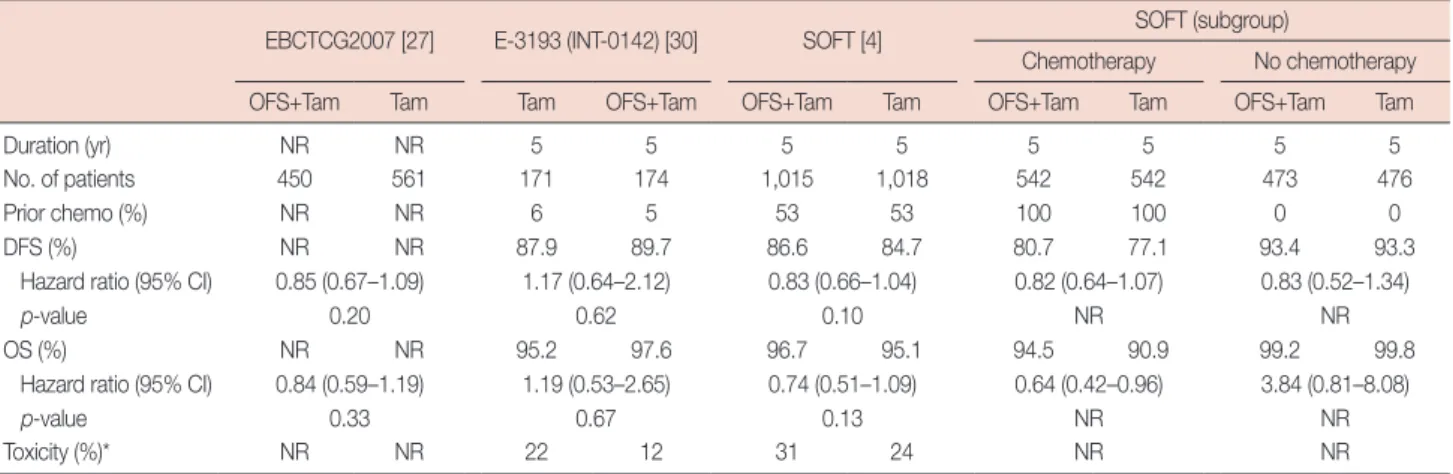
The results of studies on OFS with tamoxifen compared with tamoxifen alone are summarized in Table 2, and conclu- sive data regarding the combination therapy of OFS with tamoxifen was found in the 2007 EBCTCG meta-analysis [27]. When the use of an LHRH agonist plus tamoxifen with- out other systemic therapies (n=407) was compared with a control group without any systemic therapy, the therapeutic effects were definite, with significant reductions in recurrence (58.4%; 95% CI, 36.0–72.9; p<0.0001), death after recurrence (46.6%; 95% CI, 3.4–70.5; p=0.04), and death from any cause (49.4%; 95% CI, 12.2–70.8; p=0.02). However, when the therapeutic effect of the addition of OFS to tamoxifen was
Table 2. Comparisons of additional effect of OFS to tamoxifen with that of tamoxifen alone among ER-positive or unknown premenopausal women with breast cancer
EBCTCG2007 [27] E-3193 (INT-0142) [30] SOFT [4] SOFT (subgroup)
Chemotherapy No chemotherapy
OFS+Tam Tam Tam OFS+Tam OFS+Tam Tam OFS+Tam Tam OFS+Tam Tam
Duration (yr) NR NR 5 5 5 5 5 5 5 5
No. of patients 450 561 171 174 1,015 1,018 542 542 473 476
Prior chemo (%) NR NR 6 5 53 53 100 100 0 0
DFS (%) NR NR 87.9 89.7 86.6 84.7 80.7 77.1 93.4 93.3
Hazard ratio (95% CI) 0.85 (0.67–1.09) 1.17 (0.64–2.12) 0.83 (0.66–1.04) 0.82 (0.64–1.07) 0.83 (0.52–1.34)
p-value 0.20 0.62 0.10 NR NR
OS (%) NR NR 95.2 97.6 96.7 95.1 94.5 90.9 99.2 99.8
Hazard ratio (95% CI) 0.84 (0.59–1.19) 1.19 (0.53–2.65) 0.74 (0.51–1.09) 0.64 (0.42–0.96) 3.84 (0.81–8.08)
p-value 0.33 0.67 0.13 NR NR
Toxicity (%)* NR NR 22 12 31 24 NR NR
OFS=ovarian function suppression; ER=estrogen receptor; EBCTCG=Early Breast Cancer Trialists’ Collaborative Group; SOFT=Suppression of Ovarian Func- tion Trial; Tam=tamoxifen; NR=not reported; chemo=chemotherapy; DFS=disease-free survival; CI=confidence interval; OS=overall survival.
*≥grade 3.
compared with that of tamoxifen alone, there was no signifi- cant reduction in the hazard rates for recurrence (hazard ratio, 0.85; 95% CI, 0.67–1.09; p=0.20) or death after recurrence (hazard ratio, 0.84; 95% CI, 0.59–1.19; p=0.33). Although we found an RCT by the Eastern Cooperative Oncology group evaluating the therapeutic effects of tamoxifen versus tamoxi- fen plus OFS in premenopausal women with node-negative HR-positive breast cancer [30], this E-3193 trial was unfortu- nately closed early because of poor accrual and data that were too underpowered to draw conclusions about the impact on survival. However, the health-related quality of life (QOL) data of the E-3193 trial with 345 patients revealed that adding OFS to tamoxifen resulted in a more significant increase in menopausal symptoms and sexual dysfunction as compared to using tamoxifen alone. In addition, these adverse effects were confirmed in a later trial with a QOL analysis of 1,722 premenopausal patients of HR-positive breast cancer ran- domly assigned to receive adjuvant treatment with 5 years of tamoxifen plus OFS or tamoxifen alone. During the first 2 years of treatments, worse symptoms and poorer sexual func- tioning were found in the OFS plus tamoxifen group than in the tamoxifen alone group [31]. With all of these findings, it could be understood that the therapeutic effect of tamoxifen was so strong as not to require the addition of LHRH agonists to the tamoxifen regimen, which can be accompanied by seri- ous adverse effects in premenopausal patients in clinical use.
In light of these results, the addition of OFS to tamoxifen has not been accepted as a standard endocrine therapy for pre- menopausal patients with HR-positive breast cancer to date.
In spite of these results, the SOFT was performed to evalu- ate the uncertain role of OFS in premenopausal women re- ceiving tamoxifen [4]. The therapeutic effect of adding OFS to
tamoxifen did not provide a significant benefit to the overall study population (hazard ratio for recurrence, second invasive cancer, or death, 0.83; 95% CI, 0.66–1.04; p=0.10) compared with using tamoxifen alone. However, for women who were at high risk of recurrent need for adjuvant chemotherapy and who remained premenopausal, the addition of OFS improved overall survival (hazard ratio, 0.63; 95% CI, 0.42–0.96;
p=0.03). Furthermore, in a subpopulation analysis on 5-year breast cancer-free interval (BCFI) according to composite risk of SOFT, the apparent benefit of adding OFS to tamoxifen versus tamoxifen alone was approximately 5%, which was no- table in subpopulations with higher composite risk; this bene- fit diminished in subpopulations with lower composite risk [32]. This result rediscovered the hidden role of OFS and shifted the position of OFS in the domain of endocrine ther- apy for the treatment of HR-positive breast cancer.
OFS+chemotherapy versus chemotherapy
The additional effect of OFS on chemotherapy showed sig- nificant survival benefits in patients with premenopausal HR- positive breast cancer when compared to chemotherapy alone.
In the 2007 meta-analyses of OFS combined with LHRH ago- nists, the addition of LHRH agonists to chemotherapy with or without tamoxifen significantly reduced the recurrence rate (hazard ratio, 0.88; 95% CI, 0.77–0.99; p=0.04) and death rate after recurrence (hazard ratio, 0.85; 95% CI, 0.73–0.99; p=
0.04) compared with chemotherapy alone (with or without tamoxifen) [27]. This result may have been affected by the therapeutic effect of OFS in those patients that recovered ovarian function after chemotherapy, and be an important clue for understanding the positive results of the SOFT and TEXT trials.
Table 3. Comparison of AI with tamoxifen after OFS in HR-positive premenopausal women with early breast cancer: TEXT [5] & ABCSG-12 trials [33]
TEXT
(TEXT & SOFT combined analysis) ABCSG-12
OFS+AI OFS+Tam OFS+AI OFS+Tam
Duration (yr) 5 5 3 3
No. of patients 2,346 2,344 903 900
Prior chemo (%) 57.4 57.4 6 3
DFS (%) 91.1 87.3 85 87
Hazard ratio (95% CI) 0.72 (0.60–0.85) 1.13 (0.88–1.45)
p-value <0.001 0.335
OS (%) 95.9 96.9 94 96
Hazard ratio (95% CI) 1.14 (0.86–1.51) 1.63 (1.06–2.52)
p-value 0.37 0.03
Toxicity ≥grade 3 (%) 29 31 32 25
AI=aromatase inhibitor; OFS=ovarian function suppression; HR=hormonal receptor; TEXT=Tamoxifen and Exemestane Trial; ABCSG=Austrian Breast &
Colorectal Cancer Study Group; SOFT =Suppression of Ovarian Function Trial; Tam =tamoxifen; chemo =chemotherapy; DFS =disease-free survival;
CI=confidence interval; OS=overall survival.
OFS+AI versus OFS+tamoxifen after chemotherapy: TEXT and ABCSG-12 trial
There were two RCTs that examined the combination of OFS with either AI or tamoxifen with opposite results (Table 3). The TEXT sought to determine whether adjuvant therapy with exemestane and OFS improved disease-free survival, compared with that of tamoxifen and OFS, among premeno- pausal women with HR-positive breast cancer [5]. Comparing the additional effect of an LHRH agonist on exemestane with its effect on tamoxifen, there were improvements in disease- free survival including disease recurrence, second invasive cancer, or death (hazard ratio, 0.72; 95% CI, 0.60–0.85; p<
0.001), but not in overall survival (hazard ratio, 1.14; 95% CI, 0.86–1.51; p=0.37) with similar adverse events to those of postmenopausal women. Moreover, in a subpopulation analy- sis of the 5-year BCFI of TEXT [32] pertaining to those pa- tients who did not receive chemotherapy, the average im- provement of exemestane plus OFS compared to tamoxifen plus OFS was 3.6%, and the absolute improvement was ap- proximately 1% in patients with the lowest composite risk, in- creasing to about 10% in patients with the highest composite risk. Among TEXT patients who received adjuvant chemo- therapy and OFS concurrently, the average improvement of the 5-year BCFI with exemestane plus OFS versus tamoxifen plus OFS was 5.8%, and the absolute improvement was ap- proximately 3% among patients with the lowest composite risk. The percentage improvement ranged from 5% to 15% as composite risk increased in this cohort of patients who re- ceived chemotherapy.
In contrast, the ABCSG-12 trial was performed to evaluate the therapeutic effect of zoledronic acid, a bisphosphonate, added to adjuvant endocrine therapies (goserelin+anstarozole or goserelin+tamoxifen) for 3 years in premenopausal women with early breast cancer [33]. In a subgroup comparison of the ABCSG-12 trial, OFS with anastrozole was directly compared with OFS with tamoxifen during a median follow-up of 7.9 years. In the results of this trial, there was no significant differ- ence in DFS (hazard ratio, 1.13; 95% CI, 0.88–1.45; Cox p=0.335) between the two groups. However, in contrast to the results of the TEXT trial, a higher death rate was found in the OFS with anastrozole group (hazard ratio, 1.63; 95% CI, 1.05–2.52; Cox p=0.030). Among the 251 patients with dis- ease recurrence, the relative risk of death was significantly higher in patients who received OFS and anastrozole, com- pared with patients treated with OFS and tamoxifen (53/134 vs. 33/117; hazard ratio, 2.0; 95% CI, 1.28–3.13; Cox p=
0.002). The discordance in the results of these two trials may be explained by variances in the number of patients and the duration of therapy. However, the exact role of the addition
of OFS to AI should be determined with further, larger RCTs.
CLINICAL EVIDENCE FOR PROTECTIVE ROLE OF OFS FOR PRESERVATION OF OVARIAN
FUNCTION
Although the protective effect of LHRH agonists against chemotherapy has been demonstrated in experimental stud- ies, inconsistent results have been reported in humans [34,35].
In 2013, the ASCO concluded that the use of LHRH agonists was not an effective method of fertility preservation based on the current state of understanding regarding these agents, though there may be other potential benefits, including the inhibition of menses during intensive chemotherapy, thereby preventing certain complications such as menorrhagia [36].
ASCO guidelines recommended embryo cryopreservation and oocyte cryopreservation as standard practice for fertility preservation in female cancer patients.
However, a randomized trial of OFS for fertility preserva- tion was recently published and the results demonstrated the benefits of the preservation of ovarian function, as well as OFS’ therapeutic effects [6]. In this Prevention of Early Meno- pause Study (POEMS/S0230) trial, a total of 257 premeno- pausal women with operable HR-negative breast cancer were enrolled and received either standard chemotherapy with an LHRH agonist or standard chemotherapy alone in order to first reveal the rates of ovarian failure and pregnancy out- comes after 2 years, and then to evaluate the disease-free and overall survival rates. Among 135 patients with complete pri- mary end-point data, the ovarian failure rate was 8% in the LHRH agonist group and 22% in the chemotherapy-alone group (hazard ratio, 0.30; 95% CI, 0.09–0.97; 2p=0.04), and pregnancy occurred in more women in the LHRH agonist group than in the chemotherapy-alone group (21% vs. 11%, p=0.03). In addition, with a median follow-up time of 4.1 years, women in the LHRH group also had improved disease- free survival (hazard ratio, 0.49; 95% CI, 0.24–0.97; p=0.04) and overall survival (hazard ratio, 0.43; 95% CI, 0.18–1.00;
p=0.05). Even though the data are too small and incomplete to determine the generalizable clinical significance, these re- sults of this trial suggested that the exact role of OFS in fertil- ity preservation should be clarified in larger, well-designed RCTs in the future.
CONCLUSION
Endocrine therapy for breast cancer began with OA more than a century ago and following the discovery of LHRH ago- nists, OA was gradually substituted by OFS. The role of OA
and/or OFS in the treatment of premenopausal patients with HR-positive breast cancer has evolved according to develop- ments in breast cancer research and clinical trials for im- proved treatments. Today, even though OFS is not a standard treatment for adjuvant endocrine therapy in premenopausal HR-positive breast cancer, the definitive role of OFS as an ad- juvant endocrine therapy combined with tamoxifen or AI has been established and is recommended for high-risk patients that need chemotherapy among premenopausal women with early breast cancer. In addition, the important role of OFS to preserve ovarian function in premenopausal cancer patients has remained controversial, and recently this role of OFS was supported by small evidence showing the protective effect of OFS on the ovaries during chemotherapy, as well as the ther- apeutic effect for breast cancer in premenopausal women with HR-negative breast cancer. The exact roles of OFS in pre- menopausal patients with HR-positive breast cancer should be determined by larger RCTs in the near future.
CONFLICT OF INTEREST
The author declares that he has no conflict of interests.
REFERENCES
1. Burstein HJ, Lacchetti C, Anderson H, Buchholz TA, Davidson NE, Gelmon KE, et al. Adjuvant endocrine therapy for women with hor- mone receptor-positive breast cancer: American Society of Clinical Oncology Clinical Practice guideline update on ovarian suppression. J Clin Oncol 2016;34:1689-701.
2. Singh G. Oophorectomy in breast cancer-controversies and current status. Indian J Surg 2012;74:210-2.
3. Early Breast Cancer Trialists’ Collaborative Group. Ovarian ablation in early breast cancer: overview of the randomised trials. Lancet 1996;
348:1189-96.
4. Francis PA, Regan MM, Fleming GF, Láng I, Ciruelos E, Bellet M, et al.
Adjuvant ovarian suppression in premenopausal breast cancer. N Engl J Med 2015;372:436-46.
5. Pagani O, Regan MM, Walley BA, Fleming GF, Colleoni M, Láng I, et al. Adjuvant exemestane with ovarian suppression in premenopausal breast cancer. N Engl J Med 2014;371:107-18.
6. Moore HC, Unger JM, Phillips KA, Boyle F, Hitre E, Porter D, et al.
Goserelin for ovarian protection during breast-cancer adjuvant chemo- therapy. N Engl J Med 2015;372:923-32.
7. Beatson GT. On the treatment of inoperable cases of carcinoma of the mamma: suggestions for a new method of treatment, with illustrative cases. Lancet 1896;148:104-7.
8. Beatson GT. On the treatment of inoperable cases of carcinoma of the mamma: suggestions for a new method of treatment, with illustrative cases. Lancet 1896;148:162-5.
9. Love RR, Philips J. Oophorectomy for breast cancer: history revisited. J Natl Cancer Inst 2002;94:1433-4.
10. Boyd S. On oöphorectomy in the treatment of cancer. Br Med J 1897;
2:890-6.
11. Boyd S. On oophorectomy in cancer of the breast. BMJ 1900;2:1161-7.
12. Huggins C, Dao TL. Adrenalectomy and oophorectomy in treatment of advanced carcinoma of the breast. J Am Med Assoc 1953;151:1388- 94.
13. Mueller MD, Dreher E, Eggimann T, Linder H, Altermatt H, Hänggi W.
Is laparoscopic oophorectomy rational in patients with breast cancer?
Surg Endosc 1998;12:1390-2.
14. Ahlbom H. Castration by roentgen rays as an auxiliary treatment in the radiotherapy of cancer Mammae at Radiumhemmet, Stockholm. Acta Radiol 1930;11:614-35.
15. Lees AW, Giuffre C, Burns PE, Hurlburt ME, Jenkins HJ. Oophorecto- my versus radiation ablation of ovarian function in patients with meta- static carcinoma of the breast. Surg Gynecol Obstet 1980;151:721-4.
16. Dees EC, Davidson NE. Ovarian ablation as adjuvant therapy for breast cancer. Semin Oncol 2001;28:322-31.
17. Bese NS, Iribas A, Dirican A, Oksuz D, Atkovar G, Ober A. Ovarian ablation by radiation therapy: is it still an option for the ablation of ovar- ian function in endocrine responsive premenopausal breast cancer pa- tients? Breast 2009;18:304-8.
18. Davidson NE. Ovarian ablation as treatment for young women with breast cancer. J Natl Cancer Inst Monogr 1994;(16):95-9.
19. Allen E, Doisy EA. An ovarian hormone: preliminary report on its lo- calization, extraction and partial purification, and action in test animals.
JAMA 1923;81:819-21.
20. Toft D, Gorski J. A receptor molecule for estrogens: isolation from the rat uterus and preliminary characterization. Proc Natl Acad Sci U S A 1966;55:1574-81.
21. Schally AV, Arimura A, Kastin AJ, Matsuo H, Baba Y, Redding TW, et al. Gonadotropin-releasing hormone: one polypeptide regulates secre- tion of luteinizing and follicle-stimulating hormones. Science 1971;173:
1036-8.
22. Engel JB, Schally AV. Drug insight: clinical use of agonists and antago- nists of luteinizing-hormone-releasing hormone. Nat Clin Pract Endo- crinol Metab 2007;3:157-67.
23. Schally AV, Comaru-Schally AM, Nagy A, Kovacs M, Szepeshazi K, Plonowski A, et al. Hypothalamic hormones and cancer. Front Neuro- endocrinol 2001;22:248-91.
24. Taylor CW, Green S, Dalton WS, Martino S, Rector D, Ingle JN, et al.
Multicenter randomized clinical trial of goserelin versus surgical ovari- ectomy in premenopausal patients with receptor-positive metastatic breast cancer: an intergroup study. J Clin Oncol 1998;16:994-9.
25. Boccardo F, Rubagotti A, Perrotta A, Amoroso D, Balestrero M, De Matteis A, et al. Ovarian ablation versus goserelin with or without tamoxifen in pre-perimenopausal patients with advanced breast cancer:
results of a multicentric Italian study. Ann Oncol 1994;5:337-42.
26. Prowell TM, Davidson NE. What is the role of ovarian ablation in the management of primary and metastatic breast cancer today? Oncolo- gist 2004;9:507-17.
27. LHRH-agonists in Early Breast Cancer Overview Group, Cuzick J, Ambroisine L, Davidson N, Jakesz R, Kaufmann M, et al. Use of lutein- ising-hormone-releasing hormone agonists as adjuvant treatment in premenopausal patients with hormone-receptor-positive breast cancer:
a meta-analysis of individual patient data from randomised adjuvant
trials. Lancet 2007;369:1711-23.
28. Early Breast Cancer Trialists’ Collaborative Group (EBCTCG). Effects of chemotherapy and hormonal therapy for early breast cancer on re- currence and 15-year survival: an overview of the randomised trials.
Lancet 2005;365:1687-717.
29. Söreide JA, Varhaug JE, Fjösne HE, Erikstein B, Jacobsen AB, Skovlund E, et al. Adjuvant endocrine treatment (goserelin vs tamoxifen) in pre- menopausal patients with operable node positive stage II breast cancer:
a prospective randomized national multicenter study. Eur J Surg Oncol 2002;28:505-10.
30. Tevaarwerk AJ, Wang M, Zhao F, Fetting JH, Cella D, Wagner LI, et al.
Phase III comparison of tamoxifen versus tamoxifen plus ovarian func- tion suppression in premenopausal women with node-negative, hor- mone receptor-positive breast cancer (E-3193, INT-0142): a trial of the Eastern Cooperative Oncology Group. J Clin Oncol 2014;32:3948-58.
31. Ribi K, Luo W, Bernhard J, Francis PA, Burstein HJ, Ciruelos E, et al.
Adjuvant tamoxifen plus ovarian function suppression versus tamoxi- fen alone in premenopausal women with early breast cancer: patient- reported outcomes in the Suppression of Ovarian Function Trial. J Clin Oncol 2016;34:1601-10.
32. Regan MM, Francis PA, Pagani O, Fleming GF, Walley BA, Viale G, et al. Absolute benefit of adjuvant endocrine therapies for premenopausal
women with hormone receptor-positive, human epidermal growth fac- tor receptor 2-negative early breast cancer: TEXT and SOFT trials. J Clin Oncol 2016;34:2221-31.
33. Gnant M, Mlineritsch B, Stoeger H, Luschin-Ebengreuth G, Knauer M, Moik M, et al. Zoledronic acid combined with adjuvant endocrine therapy of tamoxifen versus anastrozol plus ovarian function suppres- sion in premenopausal early breast cancer: final analysis of the Austrian Breast and Colorectal Cancer Study Group Trial 12. Ann Oncol 2015;
26:313-20.
34. Lambertini M, Ceppi M, Poggio F, Peccatori FA, Azim HA Jr, Ugolini D, et al. Ovarian suppression using luteinizing hormone-releasing hor- mone agonists during chemotherapy to preserve ovarian function and fertility of breast cancer patients: a meta-analysis of randomized studies.
Ann Oncol 2015;26:2408-19.
35. Elgindy E, Sibai H, Abdelghani A, Mostafa M. Protecting ovaries dur- ing chemotherapy through gonad suppression: a systematic review and meta-analysis. Obstet Gynecol 2015;126:187-95.
36. Loren AW, Mangu PB, Beck LN, Brennan L, Magdalinski AJ, Partridge AH, et al. Fertility preservation for patients with cancer: American So- ciety of Clinical Oncology clinical practice guideline update. J Clin On- col 2013;31:2500-10.
![Table 3. Comparison of AI with tamoxifen after OFS in HR-positive premenopausal women with early breast cancer: TEXT [5] & ABCSG-12 trials [33]](https://thumb-ap.123doks.com/thumbv2/123dokinfo/5251213.134277/5.871.76.799.789.1022/table-comparison-tamoxifen-positive-premenopausal-breast-abcsg-trials.webp)
