Copyright © 2018 The Korean Society for Bone and Mineral Research
This is an Open Access article distributed under the terms of the Creative Commons Attribution Non-Commercial Li- cense (http://creativecommons.org/licenses/by-nc/4.0/) which permits unrestricted non-commercial use, distribu- tion, and reproduction in any medium, provided the original work is properly cited.
Proton-pump Inhibitor Use and Fracture Risk:
An Updated Systematic Review and Meta-analysis
Yousef Nassar, Seth Richter
Department of Medicine, Albany Medical Center, Albany, New York, USA
Background: This study’s objective was to evaluate the association between proton- pump inhibitor (PPI) use and bone fracture incidence and bone mineral density (BMD) by meta-analyzing the estimates reported by epidemiological and cohort studies. Meth- ods: Data were acquired from studies identified after a literature search in electronic da- tabases. Odds ratios (ORs), hazard ratios (HRs), and risk ratios (RRs) between PPI use and bone fracture incidence were pooled under the random effects model, and meta-analy- sis of standardized mean differences between PPI users and controls in cross-sectional values and BMD changes was conducted. Results: Thirty-three studies fulfilled the eligi- bility criteria. These studies provided data from 2,714,502 individuals with a mean age of 66.91 years (95% confidence interval [CI], 63.37-70.46); 33.21% (95% CI, 30.44-35.99) were males and 64.61% (95% CI, 60.73-68.49) were females. Overall, fracture incidence was 22.04% (95% CI, 16.10-27.97) in PPI users and 15.57% (95% CI, 12.28-18.86) in con- trols. The overall effect size of the point estimate was 1.28 (95% CI, 1.22-1.35) between PPI use and bone fracture incidence. There was a trend towards increased fracture inci- dence from short duration use: OR 1.29 (95% CI, 1.19-1.40), medium duration use: OR 1.33 (95% CI, 1.12-1.55) and long duration use: OR 1.62 (95% CI, 1.33-1.90). There was no significant difference in the standardized mean differences between PPI users and con- trols, either in cross-sectional BMD values or in the BMD change observed in longitudi- nal studies. Conclusions: Pooling of ORs, HRs, and RRs suggested that PPI use might in- crease fracture risk. However, there was no effect of PPI use on BMD.
Key Words: Fracture · Meta-analysis · Proton-pump inhibitors
INTRODUCTION
Proton-pump inhibitors (PPIs) are widely prescribed medications used to treat acid-related gastrointestinal diseases and are considered the superior option for anti-secretory therapy against several conditions including: non-erosive gastroin- testinal reflux disease, erosive esophagitis, dyspepsia and peptic ulcer in terms of improved symptomatic outcomes [1] and as co-therapy with non-steroidal anti- inflammatory drugs for the prevention of peptic ulcers.[2] PPIs irreversibly block the proton pump (H+-K+-ATPase ion exchanger) in the stomach’s acid-secreting parietal cells, leading to a profound inhibition of gastric acid secretion.[3]
In general, PPIs are well tolerated with minimal short-term side effects; there- fore, these drugs are considered safe therapeutic regimens.[4] However, many ep- idemiological and cohort studies have observed an association between PPI use Corresponding author
Yousef Nassar
Department of Medicine, Albany Medical Center, 43 New Scotland Ave, Albany, New York 12208, USA
Tel: +1-518-526-6240 Fax: +1-518-526-6240 E-mail: [email protected] Received: May 10, 2018 Revised: June 30, 2018 Accepted: July 6, 2018
No potential conflict of interest relevant to this article was reported.
Original Article
J Bone Metab 2018;25(3):141-151 https://doi.org/10.11005/jbm.2018.25.3.141 pISSN 2287-6375 eISSN 2287-7029
142
http://e-jbm.org/ https://doi.org/10.11005/jbm.2018.25.3.141and an increased fracture risk among long-term PPI us- ers,[5] which has raised concerns about their long-term use, especially in individuals with fracture risk. This risk is concerning for patients who prescribe PPIs and wish to balance their efficacy and the possibilities of future meta- bolic bone disease and fracture.[6]
Whereas many studies have found significant associa- tions between PPI use and fracture risk, others could not endorse these findings. This discrepancy has necessitated a comprehensive review of the literature to synthesize the evidence. Recently, a meta-analysis of relative risk obtained from 18 studies found a modest risk of bone fractures with PPI use.[7] We conducted a systematic review and performed a meta-analysis by including all possible sources of pro- spective and retrospective data to evaluate the relation- ship between PPI use and fracture incidence.
METHODS
The present study was performed following the Cochrane Collaboration guidelines for conducting systematic reviews and meta-analysis, and the Preferred Reporting Items for Systematic Reviews and Meta-analysis (PRISMA) statement was used as guideline for preparing the present report.
1. Eligibility criteria
Inclusion criteria: (1) the study was general/patient pop- ulation-based prospective or retrospective examining the association between PPI use and fracture incidence; (2) the study reported fracture incidence (hip, femur, forearm, hindarm, humerus, spine, etc.) in PPI users vs PPI non-users or the odds or hazards of using PPI for fracture incidence;
(3) the study reported PPI use in individual with and with- out fracture incidence; or (4) the study reported either the epidemiological value of bone mineral density (BMD) or the BMD change in PPI users and their non-user controls.
Exclusion criteria: (1) the study examined the association between fracture incidence and PPI use in combination with other drugs such as histamine2-receptor antagonists;
or (2) the study involved other related measures such as falls or fracture-related mortality but not fractures per se.
2. Literature search
The literature search was conducted in electronic data- bases including: PubMed, Embase, and Google Scholar us-
ing the following relevant keywords and subject headings:
PPIs, lansoprazole, dexlansoprazole, rabeprazole, panto- prazole, omeprazole, bone density, fractures, incidence, humans, medical records, BMD, incidence, hazard, odds, cohort, case-control, prospective, retrospective, database, general population, patient population, registry, medical records, trial, and registries. The search encompassed arti- cles published in peer-reviewed journals in the English language before February 2018. Each database was searched for the aforementioned search terms. The search encom- passed articles published in peer-reviewed journals in the English language before February 2018. Additional search- es included the considerations of software-suggested cor- roborations and cross references of important research pa- pers and review articles relevant to the present study.
3. Meta-analysis endpoints
For the present study, the meta-analysis endpoint was the attainment of a point estimate by pooling the odds ra- tio (OR), hazard ratio (HR), and risk ratio (RR) between PPI use and fracture incidence reported in individual studies.
Subgroup meta-analysis were performed regarding low/
medium/high PPI use, short/medium/long duration PPI use, outcomes of prospective vs. retrospective studies, and the fracture site. An additional endpoint was differences in cross-sectional values of BMD and BMD changes between PPI users and non-users observed in longitudinal studies.
4. Data and analyses
Demographic and clinical characteristics of subjects, study characteristics, and outcomes were extracted from respective research articles using a standardized proce- dure and were organized in specialized datasheets. Meta- analysis were performed using a random-effects model with STATA software (version 12; Stata Corp., College Sta- tion, TX, USA) by pooling the OR, HR, and RR reported by individual studies to achieve the overall effect size (OR ap- proximated RR). The classifications used either for low, me- dium, and high intensity or for short, medium, and long duration were those of individual studies’ authors which are reported in Table 1.
For the assessment of the relationship between PPI use and BMD, meta-analyses of standardized mean differences (SMD) were performed by using RevMan software (version 5.3.1; The Cochrane Collaboration, Oxford, UK) to evaluate
Proton-pump Inhibitors and Fractures
Table 1. Characteristics of the included studies which recruited cases with fractures and non-fracture controls ReferencesFollow- up (month)DesignnAge (year)Males (%) Fracture site PPI use intensity Low/medium/ high PPI use duration* Short/medium/long
Ratio CasesControlsCasesControlsCasesControls Adams et al.[10]120RET-GPC6,7746,774Hip0-1/100-416/417- 1,931 daysOR Chiu et al.[13]48RET-DC1,2411,24174.8±10.074.5±10.042.042.0Hip0-28/29-70/>70 defined daily doseOR Corley et al.[14]120RET-DC33,752130,47135.034.0Hip0-0.74/0.75-1.49/>1.5 pills/ day1-3/4-6/>6 yearsOR Freedberg et al.[17]60RET-GPCC605,643124,79934.035.0Any fracture1-179/180-720/>721 dosesOR Kaye and Jick [19]78RET-DC1,09810,923HipRR Kumar et al.[21]150RET-PPC11336665.0±13.060±13.066.082.0HipRR Lee et al.[22]RET-DCC24,71098,64277.7±7.077.7±7.027.027.0Hip0-29/30-89/>89 defined daily doseOR Lenihan et al.[23]36RET-PPC23115,57551.8±12.951.2±10.047.060.0Hip0-292/>292 daysOR Moberg et al.[27]172RET-PPC9035,51356.3±4.056.4±4.00.00.0HipOR Ozdil et al.[28]7PROS-PP11411037.7±8.837.7±6.848.038.0Spine/FemurMD Pouwels et al.[29]36RET-DCC6,76326,34175.7±13.075.3±13.027.027.0Hip/Femur0-1/1-1.75/>1.75 defined daily dose0-3/4-12/13-36 monthsOR Reyes et al.[30]60RET-PPCC35869882.0±13.081.9±13.023.023.0HipOR Roux et al.[31]36RCT2792,89974.6±6.874.0±7.1VertebralPC Targownik et al.[33]72RET-DCC15,79247,28930.030.0Hip/Spine/Wrist0-1/0-4/0-7 yearsOR Targownik et al.[34]60RET-DC3,95610,25767.8±11.067.1±11.07.07.0Spine1-750/751-1500/>1500 stan- dard doses dispensedOR Vestergaard et al.[38]12RET-DCC124,655373,96243.4±27.043.4±27.048.048.0Any fracture0-12/25-99/>99 defined daily doseOR Yang et al.[39]48RET-DCC13,556135,38677.0±9.077.0±9.0Hip<175/>175 defined daily dose0-1/0-2/0-4 yearsOR Abrahamsen et al.[8]40PROS-GPC10,17727,91171.6±11.070.0±11.019.416.0Hip0-359/360-719 defined daily dose2-99 daysHR Abrahamsen and Vestergaard [9]RET-DC35,445398,362Any fractureOR Arj et al.[11]CS404040.4±5.141±3.840.037.5Femur/Hip/Spine Bahtiri et al.[12]12PROS-OLC1674250.5±10.549.6±11.025.026.0Femur/Hip/Spine Ding et al.[15]84RET-DC1,60423,67278.6±12.017.118.7Any fracture0-0.39/0.4-0.8/>0.8 average daily doseHR Fraser et al.[16]120PROS-GPC2619,16267.6±11.161.9±13.021.830.9Any fractureHR Gray et al.[18]48PROS-GPC3,396148,39464.8±7.063.1±7.0Any fracture0-1/1-3/>3 yearsHR (Continued to the next page)
144
http://e-jbm.org/ https://doi.org/10.11005/jbm.2018.25.3.141the significance of differences in BMD between PPI users and non-users or change in BMD after PPI use reported by longitudinal studies.
The overall effect size/s in the meta-analysis were a weight- ed average of the inverse variance adjusted individual ef- fect sizes. Between-study inconsistency was tested using the I2 index. For the assessment of publication bias, Begg’s funnel plot asymmetry tests was performed, and trim-and- fill method was used to estimate the number of missing studies. All data are presented as weighted effect sizes with 95% confidence interval (CI) and P<0.05 were considered statistically significant.
RESULTS
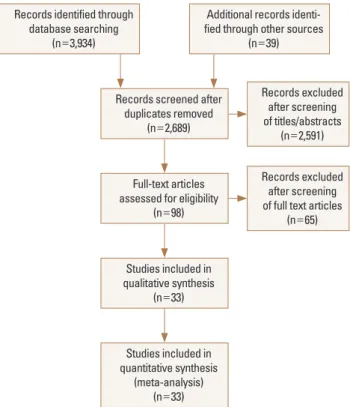
Thirty-three studies [8-40] fulfilled the eligibility criteria (Fig. 1). No significant publication bias was detected with the Begg’s test of funnel plot asymmetry (adjusted Kend- all’s score=58±40.32; P=0.15), but the trim-and-fill meth- od indicated the possibility of up to 4 missing studies (Sup- plementary Fig. 1). Important characteristics of these stud- ies are presented in Table 1. Study subjects had a mean
ReferencesFollow- up (month)DesignnAge (year)Males (%) Fracture site
PPI use intensity Low/medium/ high PPI use duration* Short/medium/long
Ratio CasesControlsCasesControlsCasesControls Khalili et al.[20]96PROS-GPC15,10164,798HipHR Lewis et al.[24]40PROS-GPC12090580.1±2.579.9±2.0Any fractureOR Maggio et al.[26]PROS-GPC361,00275.6±6.175.5±7.561.056.0Trabecular Lin et al.[25]60RET-GPC5,2985,29866.7±13.066.9±13.062.863.7Any fractureHR Solomon et al.[32]PROS-GPC2071,67650.7±4.250.2±3.9Femur/Hip/Spine van der Hoorn et al.[37]78PROS-GPC2,3282,10478.2±1.478.3±2.0Any fracture<400/>400 defined daily doseHR Zirk-Sadowski et al.[40]48RET-DC86,46986,46943.643.6Any fractureHR Targownik et al.[35]28PROS-GPC2288,11266.3Femur/Hip/Spine Targownik et al.[36]120PROS-PPC525265.1±9.164.9±7.9Femur/Hip/Trochanter RET, retrospective; GPC, general population cohort; DC, database cohort; GPCC, general population case-controlled; PPC, patient population cohort; DCC, database case-control; PROS, prospective; PPCC, patient-population case-controlled; RCT, randomized controlled trial; CS, cross-sectional; OLC, open-label comparative; PPI, proton-pump inhibitor; OR, odds ratio; RR, risk ratio; MD, mean difference; PC, precision; HR, hazard ratio.
Table 1. Continued
Fig. 1. A flowchart of study screening and selection process after the literature search.
Records identified through database searching
(n=3,934)
Additional records identi- fied through other sources
(n=39)
Records screened after duplicates removed
(n=2,689)
Full-text articles assessed for eligibility
(n=98)
Studies included in qualitative synthesis
(n=33)
Studies included in quantitative synthesis
(meta-analysis) (n=33)
Records excluded after screening of titles/abstracts
(n=2,591)
Records excluded after screening of full text articles
(n=65)
Proton-pump Inhibitors and Fractures
age of 66.91 years (95% CI, 63.37-70.46). Thirty-three point twenty one percent (95% CI, 30.44-35.99) were males while 64.61% (95% CI, 60.73-68.49) were females. Overall, frac- ture incidence was 22.04% (95% CI, 16.10-27.97) in 302,522 PPI users and 15.57% (95% CI, 12.28-18.86) in 833,254 con- trols (data from 14 studies).
1. Relationship between PPI use and fractures For the point estimation of the relationship between PPI use and fracture risk, pooling of the OR, HR, and RR revealed an effect size of 1.28 (95% CI, 1.22-1.35) (85 ratios from 2,714,502 individuals; I2=89.7%; P<0.00001; Supplemen- tary Fig. 2). The follow-up duration was 73.12 (95% CI, 60.70- 85.54) months (range, 12-150 months; data from 23 stud-
ies). There was a trend toward increased fracture incidence from short duration use, pooled OR 1.29 (95% CI, 1.19-1.40);
I2=69.1%; P=0.001) to medium OR 1.33 (95% CI, 1.12-1.55);
I2=86.6%; P<0.00001) and long duration use OR 1.62 (95%
CI, 1.33-1.90); I2=71.7% ; P<0.00001) (Fig. 2). There was no difference in fracture incidence with low OR 1.22 (95% CI, 1.078-1.36); I2=91.9%; P<0.00001), medium OR 1.32 (95%
CI, 1.08-1.56); I2=91.3%; P<0.00001) and high PPI use OR 1.26 (95% CI, 1.045-1.47); I2=91.1%; P<0.00001; Fig. 3).
In other subgroup analyses, the effect sizes of the OR, HR and RR between PPI use and fracture incidence were OR 1.33 (95% CI, 1.25-1.41); (I2=92.4%; P<0.00001; 57 OR from 14 studies), HR 1.26 (95% CI, 1.19-1.33); (I2=49%; P=0.005;
23 HR from 8 studies), and RR 0.74 (95% CI, 0.48-0.99); (I2= Fig. 2. A forest graph showing the outcomes of a subgroup meta-analysis conducted to evaluate the effect of proton-pump inhibitor (PPI) use on fracture incidence with respect to the duration of PPI use. ES, effect sizes; CI, confidence interval.
22
Fig. 2. A forest graph showing the outcomes of a subgroup meta-analysis conducted to evaluate the effect of proton-pump inhibitor (PPI) use on fracture incidence with respect to the duration of PPI use. ES, effect sizes; CI, confidence interval.
Fracture risk according to the duration of PPI use
146
http://e-jbm.org/ https://doi.org/10.11005/jbm.2018.25.3.141 Fig. 3. A forest graph showing the outcomes of a subgroup meta-analysis conducted to evaluate the effect of proton-pump inhibitor (PPI) use on fracture incidence with respect to the intensity of PPI use. ADD, average daily dose; DDD, defined daily dose; SDD, standard daily dose; PDC, pro- portion of days covered; ES, effect sizes; CI, confidence interval.23
Fig. 3. A forest graph showing the outcomes of a subgroup meta-analysis conducted to evaluate the effect of proton-pump inhibitor (PPI) use on fracture incidence with respect to the intensity of PPI use. ADD, average daily dose; DDD, defined daily dose; SDD, standard doses dispensed; PDC, proportion of days covered; ES, effect sizes; CI, confidence interval.
43.1%; P=0.134; 5 RR from 2 studies), respectively (Supple- mentary Fig. 2). Outcomes regarding the study design were similar for retrospective studies OR 1.29 (95% CI, 1.21-1.36);
(I2=91.5%; P<0.00001; 18 studies) and for prospective studies OR 1.27 (95% CI, 1.16-1.38); (I2=49.7%; P=0.009; 7 studies). Effect sizes regarding the fracture site were hip
with OR 1.34 (95% CI, 1.24-1.46); (I2=89.6%; P<0.00001;
15 studies), spine OR 1.18 (95% CI, 0.93-1.42); (I2=91.5%;
P<0.00001; 10 studies), and any fracture OR 1.24 (95% CI, 1.18-1.31); (I2=78.6%; P<0.00001; 22 studies).
Proton-pump Inhibitors and Fractures
2. Relationship between PPI use and BMD In the literature search, 11 studies were identified that reported the association between PPI use and either the cross-sectional BMD values or the BMD changes evaluated in longitudinal designs. Overall, data for 1,863 PPI users and 34,392 controls were used in this meta-analysis.
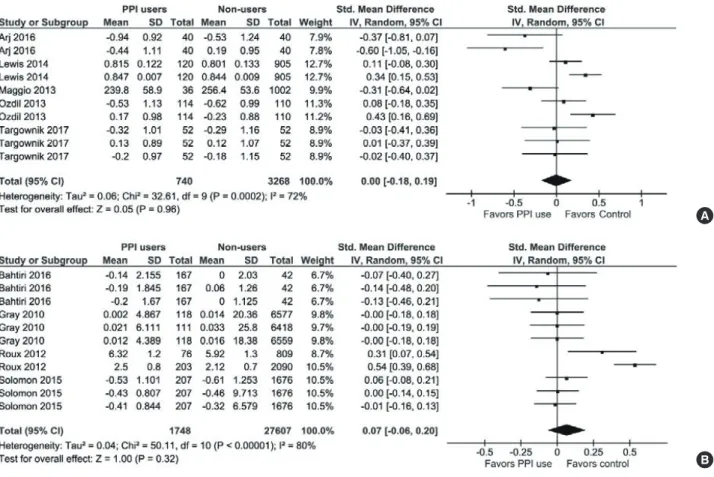
With respect to the cross-sectional BMD values, there was no significant difference between the PPI users and their non-user counterparts (SMD, 0.00; 95% CI, -0.18 to 0.19; P=0.96; I2=72%; P=0.0002; Fig. 4A). Also, there was no significant difference between PPI users and PPI non users in the BMD changes observed in the longitudinal studies (SMD, 0.07; 95% CI, -0.06 to 0.20; P=0.32; I2=80%;
P<0.00001; Fig. 4B). In these studies, treatment durations were between 1 and 8 years.
DISCUSSION
In this meta-analysis, we found that PPI use might in- crease fracture risk. A subgroup analysis also showed that the risk of fracture incidence with PPI use increased from short duration use to medium through high duration use.
However, there was no significant difference between the PPI users and their non-user counterparts, either in cross- sectional values of BMD or in the change in BMD observed in longitudinal studies. At least 12 of the included studies failed to observe a significant association between PPI use and fracture incidence or BMD.
So far, a mechanistic relationship between PPI use and fracture incidence is lacking. However, many factors are identified that can affect this relationship. PPI therapy may be associated with side effects such as vitamin B12 defi- ciency, hypomagnesaemia, Clostridium difficile infection, Fig. 4. (A) A forest graph showing the meta-analysis of standardized mean differences between proton-pump inhibitor (PPI) users and non-users in cross-sectional bone mineral density (BMD) values observed in individual studies. (B) A forest graph showing the meta-analysis of standardized mean differences between PPI users and non-users in the BMD changes observed in longitudinal studies. SD, standard deviation; CI, confidence interval; df, degrees of freedom.
24
A
B
Fig. 4. (A) A forest graph showing the meta-analysis of standardized mean differences between proton-pump inhibitor (PPI) users and non-users in cross-sectional bone mineral density (BMD) values observed in individual studies. (B) A forest graph showing the meta-analysis of standardized mean differences between PPI users and non-users in the BMD changes observed in longitudinal studies. SD, standard deviation; CI, confidence interval; df, degrees of freedom.
24
A
B
Fig. 4. (A) A forest graph showing the meta-analysis of standardized mean differences between proton-pump inhibitor (PPI) users and non-users in cross-sectional bone mineral density (BMD) values observed in individual studies. (B) A forest graph showing the meta-analysis of standardized mean differences between PPI users and non-users in the BMD changes observed in longitudinal studies. SD, standard deviation; CI, confidence interval; df, degrees of freedom.
A
B
148
http://e-jbm.org/ https://doi.org/10.11005/jbm.2018.25.3.141pneumonia, gastrointestinal and cardiovascular risks [41,42]
and may also interfere with bioavailability and/or metabo- lism of minerals such as calcium, iron and magnesium.[43]
A review has also found that PPI use is associated with in- creased risk of chronic kidney disease.[44] Whereas in vitro studies have shown deleterious effects of PPIs on bone cells possibly by affecting bone turnover,[45] in vivo stud- ies have shown that PPIs inhibit osteoclast mediated re- sorption when delivered to a bony defect in self setting calcium phosphate cements.[46] Bone fragility depends not only on areal BMD but also on other factors including bone quality, which may be affected by other factors such as vitamin B12 levels and modulated skeletal fragility due to collagen cross-linking independent of areal BMD.[47]
Although these results suggest that PPI therapy increas- es fracture risk, confounding factors may play a role in the overall outcomes. Participant age in individual studies ranged from 38±9 to 82±13 years, for example. Effects of aging, general health conditions and comorbid conditions may affect the actual prevalence of fractures. This presumption is further supported by the fact that PPI use had no effect on BMD. Many drugs, such as antipsychotics, anti-Parkin- son’s and anti-seizure medications can affect bone strength and are associated with increased fracture risk.[39] Thyrox- ine replacement therapy and warfarin may also affect the incidence rate of fractures.[48,49] Thus, possible spurious effects of confounders can’t be ruled out when interpret- ing the results of this meta-analysis. Delineation of such effectors may be possible in the future as confounder vari- able–specific analyzable data from future trials become available or further retrospective analyses are performed.
In the present meta-analysis, the majority of fracture cas- es were related to the hip. Hip fractures can have several determinants. Falls, muscle weakness, low physical activity levels, suboptimal nutrition, drugs increasing fall risk and comorbid conditions of the neuromuscular system may contribute to hip fracture disability.[50] Neurological and neurodegenerative diseases such as Alzheimer's disease also pose significant fracture risk.[51] These factors may contribute to the presence of high statistical heterogeneity in the meta-analysis.
A significant increase in cardiovascular disease (CVD) in- cidence has been found with PPI use.[52] Some studies have also reported an increased incidence of major adverse cardiac events in patients who received PPIs along with an
antiplatelet drug, clopidogrel.[53,54] A recent meta-analy- sis has also found that co-prescription of PPI and thieno- pyridines increases the risk of ischemic and composite stroke.
[55] In the present study, four of the included studies re- ported incidence of CVD events, which was almost double OR 1.90 (1.52-2.37); P<0.00001) in PPI users (n=20,268) compared with non-users (n=21,298). However, the possi- ble influence of confounding factors in the association be- tween PPI use and increased cardiovascular risk cannot be ruled out [56] because fracture incidence has been found to be usually higher in patients with comorbidities,[57-59]
which could be partially related to physical inactivity fol- lowing fracture.[60]
There were several limitations to this study. There were a large number of studies included in this meta-analysis and were primarily observational rather than randomized con- trolled trials. This is the evidence currently available on this topic. Also, in subgroup analysis of the present study, out- comes were mostly associated with moderate to high I2. Sources of statistical heterogeneity could be several but usually originate from clinical and methodological hetero- geneity. Clinical heterogeneity may arise from patients’ dif- ferences, interventions or co-interventions and outcome measures, whereas the methodological heterogeneity may arise from the use of different study designs, cut-offs, and control over bias.
Regardless of the possible impacts of unidentified fac- tors, the outcomes of the present meta-analysis demand a judicious and cautious use of PPIs. Studies have found that inappropriate use of PPIs in the inpatient setting is preva- lent and should be discouraged.[61] With some caveats, authors of previous meta-analysis have also suggested that there could be a potential association between PPI use and fracture incidence especially hip and vertebral frac- tures.[7,62] Moreover, a strong association has been re- ported between PPI use and the subsequent prescribing of anti-osteoporotic drugs. Such an association has been also found to increase in a dose and time dependent man- ner.[63] Patients requiring continuous PPI therapy should ensure the recommended daily intake of calcium and vita- min D. However, the pharmacologic osteoprotection or BMD monitoring may not be advisable for chronic PPI us- ers unless other indications necessitate it.[64]
Proton-pump Inhibitors and Fractures
CONCLUSIONS
Data generated from prospective and retrospective stud- ies may be used for better statistical modeling to study po- tential confounding factors [5] and by arranging more ho- mogeneous sub-datasets. Risk stratification of elderly, frail, malnourished, dialyzed and chronically hospitalized pa- tients will also help in narrowing the conclusive evidence.
[43] Prospective studies should establish cohorts of long- term PPI users and their non-user controls to follow BMD changes.[64] Even more useful, although potentially more demanding, would be to conduct randomized controlled trials.[5]
REFERENCES
1. Farrell B, Pottie K, Thompson W, et al. Deprescribing pro- ton pump inhibitors: evidence-based clinical practice gui- deline. Can Fam Physician 2017;63:354-64.
2. Lanza FL, Chan FK, Quigley EM. Guidelines for prevention of NSAID-related ulcer complications. Am J Gastroenterol 2009;104:728-38.
3. Wolfe MM, Soll AH. The physiology of gastric acid secre- tion. N Engl J Med 1988;319:1707-15.
4. Eusebi LH, Rabitti S, Artesiani ML, et al. Proton pump in- hibitors: risks of long-term use. J Gastroenterol Hepatol 2017;32:1295-302.
5. Richards JB, Goltzman D. Proton pump inhibitors: balanc- ing the benefits and potential fracture risks. CMAJ 2008;
179:306-7.
6. Laine L. Proton pump inhibitors and bone fractures? Am J Gastroenterol 2009;104 Suppl 2:S21-6.
7. Zhou B, Huang Y, Li H, et al. Proton-pump inhibitors and risk of fractures: an update meta-analysis. Osteoporos Int 2016;27:339-47.
8. Abrahamsen B, Eiken P, Eastell R. Proton pump inhibitor use and the antifracture efficacy of alendronate. Arch In- tern Med 2011;171:998-1004.
9. Abrahamsen B, Vestergaard P. Proton pump inhibitor use and fracture risk - effect modification by histamine H1 re- ceptor blockade. Observational case-control study using National Prescription Data. Bone 2013;57:269-71.
10. Adams AL, Black MH, Zhang JL, et al. Proton-pump inhibi- tor use and hip fractures in men: a population-based case- control study. Ann Epidemiol 2014;24:286-90.
11. Arj A, Razavi Zade M, Yavari M, et al. Proton pump inhibi- tors use and change in bone mineral density. Int J Rheum Dis 2016;19:864-8.
12. Bahtiri E, Islami H, Hoxha R, et al. Esomeprazole use is in- dependently associated with significant reduction of BMD:
1-year prospective comparative safety study of four pro- ton pump inhibitors. J Bone Miner Metab 2016;34:571-9.
13. Chiu HF, Huang YW, Chang CC, et al. Use of proton pump inhibitors increased the risk of hip fracture: a population- based case-control study. Pharmacoepidemiol Drug Saf 2010;19:1131-6.
14. Corley DA, Kubo A, Zhao W, et al. Proton pump inhibitors and histamine-2 receptor antagonists are associated with hip fractures among at-risk patients. Gastroenterology 2010;139:93-101.
15. Ding J, Heller DA, Ahern FM, et al. The relationship between proton pump inhibitor adherence and fracture risk in the elderly. Calcif Tissue Int 2014;94:597-607.
16. Fraser LA, Leslie WD, Targownik LE, et al. The effect of pro- ton pump inhibitors on fracture risk: report from the Ca- nadian Multicenter Osteoporosis Study. Osteoporos Int 2013;24:1161-8.
17. Freedberg DE, Haynes K, Denburg MR, et al. Use of proton pump inhibitors is associated with fractures in young adults:
a population-based study. Osteoporos Int 2015;26:2501-7.
18. Gray SL, LaCroix AZ, Larson J, et al. Proton pump inhibitor use, hip fracture, and change in bone mineral density in postmenopausal women: results from the Women’s Health Initiative. Arch Intern Med 2010;170:765-71.
19. Kaye JA, Jick H. Proton pump inhibitor use and risk of hip fractures in patients without major risk factors. Pharmaco- therapy 2008;28:951-9.
20. Khalili H, Huang ES, Jacobson BC, et al. Use of proton pump inhibitors and risk of hip fracture in relation to dietary and lifestyle factors: a prospective cohort study. BMJ 2012;344:
e372.
21. Kumar S, Drake MT, Schleck CD, et al. Incidence and pre- dictors of osteoporotic fractures in patients with Barrett’s oesophagus: a population-based nested case-control study.
Aliment Pharmacol Ther 2017;46:1094-102.
22. Lee J, Youn K, Choi NK, et al. A population-based case-con- trol study: proton pump inhibition and risk of hip fracture by use of bisphosphonate. J Gastroenterol 2013;48:1016- 22.
23. Lenihan CR, Sukumaran Nair S, Vangala C, et al. Proton
150
http://e-jbm.org/ https://doi.org/10.11005/jbm.2018.25.3.141pump inhibitor use and risk of hip fracture in kidney trans- plant recipients. Am J Kidney Dis 2017;69:595-601.
24. Lewis JR, Barre D, Zhu K, et al. Long-term proton pump in- hibitor therapy and falls and fractures in elderly women: a prospective cohort study. J Bone Miner Res 2014;29:2489- 97.
25. Lin SM, Yang SH, Liang CC, et al. Proton pump inhibitor use and the risk of osteoporosis and fracture in stroke pa- tients: a population-based cohort study. Osteoporos Int 2018;29:153-62.
26. Maggio M, Lauretani F, Ceda GP, et al. Use of proton pump inhibitors is associated with lower trabecular bone density in older individuals. Bone 2013;57:437-42.
27. Moberg LM, Nilsson PM, Samsioe G, et al. Use of proton pump inhibitors (PPI) and history of earlier fracture are in- dependent risk factors for fracture in postmenopausal women. The WHILA study. Maturitas 2014;78:310-5.
28. Ozdil K, Kahraman R, Sahin A, et al. Bone density in proton pump inhibitors users: a prospective study. Rheumatol Int 2013;33:2255-60.
29. Pouwels S, Lalmohamed A, Souverein P, et al. Use of pro- ton pump inhibitors and risk of hip/femur fracture: a pop- ulation-based case-control study. Osteoporos Int 2011;22:
903-10.
30. Reyes C, Formiga F, Coderch M, et al. Use of proton pump inhibitors and risk of fragility hip fracture in a Mediterra- nean region. Bone 2013;52:557-61.
31. Roux C, Goldstein JL, Zhou X, et al. Vertebral fracture effi- cacy during risedronate therapy in patients using proton pump inhibitors. Osteoporos Int 2012;23:277-84.
32. Solomon DH, Diem SJ, Ruppert K, et al. Bone mineral den- sity changes among women initiating proton pump in- hibitors or H2 receptor antagonists: a SWAN cohort study.
J Bone Miner Res 2015;30:232-9.
33. Targownik LE, Lix LM, Metge CJ, et al. Use of proton pump inhibitors and risk of osteoporosis-related fractures. CMAJ 2008;179:319-26.
34. Targownik LE, Lix LM, Leung S, et al. Proton-pump inhibi- tor use is not associated with osteoporosis or accelerated bone mineral density loss. Gastroenterology 2010;138:896- 904.
35. Targownik LE, Leslie WD, Davison KS, et al. The relation- ship between proton pump inhibitor use and longitudinal change in bone mineral density: a population-based study [corrected] from the Canadian Multicentre Osteoporosis
Study (CaMos). Am J Gastroenterol 2012;107:1361-9.
36. Targownik LE, Goertzen AL, Luo Y, et al. Long-term proton pump inhibitor use is not associated with changes in bone strength and structure. Am J Gastroenterol 2017;112:95- 101.
37. van der Hoorn MMC, Tett SE, de Vries OJ, et al. The effect of dose and type of proton pump inhibitor use on risk of fractures and osteoporosis treatment in older Australian women: a prospective cohort study. Bone 2015;81:675- 82.
38. Vestergaard P, Rejnmark L, Mosekilde L. Proton pump in- hibitors, histamine H2 receptor antagonists, and other antacid medications and the risk of fracture. Calcif Tissue Int 2006;79:76-83.
39. Yang YX, Lewis JD, Epstein S, et al. Long-term proton pump inhibitor therapy and risk of hip fracture. JAMA 2006;296:
2947-53.
40. Zirk-Sadowski J, Masoli JA, Strain WD, et al. Proton-pump inhibitors and fragility fractures in vulnerable older pa- tients. Am J Gastroenterol 2017;112:520-3.
41. Abraham NS. Proton pump inhibitors: potential adverse effects. Curr Opin Gastroenterol 2012;28:615-20.
42. de la Coba Ortiz C, Argüelles Arias F, Martin de Argila de Prados C, et al. Proton-pump inhibitors adverse effects: a review of the evidence and position statement by the So- ciedad Espanola de Patologia Digestiva. Rev Esp Enferm Dig 2016;108:207-24.
43. Heidelbaugh JJ. Proton pump inhibitors and risk of vita- min and mineral deficiency: evidence and clinical implica- tions. Ther Adv Drug Saf 2013;4:125-33.
44. Li T, Xie Y, Al-Aly Z. The association of proton pump inhibi- tors and chronic kidney disease: cause or confounding?
Curr Opin Nephrol Hypertens 2018;27:182-7.
45. Costa-Rodrigues J, Reis S, Teixeira S, et al. Dose-depen- dent inhibitory effects of proton pump inhibitors on hu- man osteoclastic and osteoblastic cell activity. Febs j 2013;
280:5052-64.
46. Sheraly AR, Lickorish D, Sarraf F, et al. Use of gastrointesti- nal proton pump inhibitors to regulate osteoclast-mediat- ed resorption of calcium phosphate cements in vivo. Curr Drug Deliv 2009;6:192-8.
47. Sugiyama T, Watarai K, Oda T, et al. Proton pump inhibi- tors and fracture: they impair bone quality and increase fall risk? Osteoporos Int 2016;27:1675-6.
48. Gage BF, Birman-Deych E, Radford MJ, et al. Risk of osteo-
Proton-pump Inhibitors and Fractures
porotic fracture in elderly patients taking warfarin: results from the National Registry of Atrial Fibrillation 2. Arch In- tern Med 2006;166:241-6.
49. Turner MR, Camacho X, Fischer HD, et al. Levothyroxine dose and risk of fractures in older adults: nested case-con- trol study. BMJ 2011;342:d2238.
50. Marks R, Allegrante JP, Ronald MacKenzie C, et al. Hip frac- tures among the elderly: causes, consequences and con- trol. Ageing Res Rev 2003;2:57-93.
51. Tolppanen AM, Taipale H, Tanskanen A, et al. Comparison of predictors of hip fracture and mortality after hip frac- ture in community-dwellers with and without Alzheimer’s disease - exposure-matched cohort study. BMC Geriatr 2016;16:204.
52. Shiraev TP, Bullen A. Proton pump inhibitors and cardio- vascular events: a systematic review. Heart Lung Circ 2018;
27:443-50.
53. Ho PM, Maddox TM, Wang L, et al. Risk of adverse out- comes associated with concomitant use of clopidogrel and proton pump inhibitors following acute coronary syndrome. JAMA 2009;301:937-44.
54. Bhatt DL, Cryer BL, Contant CF, et al. Clopidogrel with or without omeprazole in coronary artery disease. N Engl J Med 2010;363:1909-17.
55. Malhotra K, Katsanos AH, Bilal M, et al. Cerebrovascular outcomes with proton pump inhibitors and thienopyri- dines: a systematic review and meta-analysis. Stroke 2018;
49:312-8.
56. Sukhovershin RA, Cooke JP. How may proton pump inhibi- tors impair cardiovascular health? Am J Cardiovasc Drugs
2016;16:153-61.
57. Menzies IB, Mendelson DA, Kates SL, et al. The impact of comorbidity on perioperative outcomes of hip fractures in a geriatric fracture model. Geriatr Orthop Surg Rehabil 2012;3:129-34.
58. Roche JJ, Wenn RT, Sahota O, et al. Effect of comorbidities and postoperative complications on mortality after hip fracture in elderly people: prospective observational co- hort study. BMJ 2005;331:1374.
59. Chiang CH, Liu CJ, Chen PJ, et al. Hip fracture and risk of acute myocardial infarction: a nationwide study. J Bone Miner Res 2013;28:404-11.
60. Dharmarajan TS, Banik P. Hip fracture. Risk factors, preop- erative assessment, and postoperative management. Post- grad Med 2006;119:31-8.
61. Durand C, Willett KC, Desilets AR. Proton pump inhibitor use in hospitalized patients: is overutilization becoming a problem? Clin Med Insights Gastroenterol 2012;5:65-76.
62. Ngamruengphong S, Leontiadis GI, Radhi S, et al. Proton pump inhibitors and risk of fracture: a systematic review and meta-analysis of observational studies. Am J Gastro- enterol 2011;106:1209-18; quiz 19.
63. McGowan B, Bennett K, Barry M. Prescribing of anti-osteo- porotic therapies following the use of proton pump inhib- itors in general practice. Pharmacoepidemiol Drug Saf 2010;19:763-9.
64. Fournier MR, Targownik LE, Leslie WD. Proton pump inhib- itors, osteoporosis, and osteoporosis-related fractures. Ma- turitas 2009;64:9-13.
http://e-jbm.org/ https://doi.org/10.11005/jbm.2018.25.3.141 Supplementary Fig. 1. Forest graph showing the outcomes of an overall pooling of all odds ratios, hazard ratios, and relative risks for point esti- mation depicting relationship between the proton-pump inhibitor (PPI) use and the incidence of fracture. DDD, defined daily dose; SDD, standard daily dose; PDC, proportion of days covered; ES, effect sizes; CI, confidence interval.
25
Supplementary Fig. 1. Forest graph showing the outcomes of an overall pooling of all odds ratios, hazard ratios, and relative risks for point estimation depicting relationship between the
NOTE: Weights are from random effects analysis .
. .
Overall (I-squared = 89.7%, p = 0.000) Study
Targownik 2010 Lenihan 2016 Lee 2013 Freedberg 2015
Moberg 2014
Lin 2018 HR Pouwels 2011
Subtotal (I-squared = 43.1%, p = 0.134) Freedberg 2015
Vestergaard 2006 Vestergaard 2006 Corley 2010
Pouwels 2011
Kumar 2017 van der Hoorn 2015 Pouwels 2011
Abrahamsen 2011 Gray 2010 Freedberg 2015
Targownik 2008
Ding 2014
Gray 2010 Gray 2010 Vestergaard 2006 Vestergaard 2006
Gray 2010 Lin 2018
Kaye 2008 Fraser 2013 Ding 2014 Targownik 2010
Yang 2006 Abrahamsen 2013 Vestergaard 2006
Lewis 2014
Gray 2010 Vestergaard 2006 Corley 2010
Abrahamsen 2013 Targownik 2008
Yang 2006 Pouwels 2011 Freedberg 2015
Abrahamsen 2011 Lin 2018 Pouwels 2011
Targownik 2008
Gray 2010 Yang 2006 Targownik 2010
Vestergaard 2006 Targownik 2010
Yang 2006
Gray 2010
RR Gray 2010 Vestergaard 2006 Corley 2010
Vestergaard 2006 Reyes 2013
Subtotal (I-squared = 92.4%, p = 0.000) Pouwels 2011
Corley 2010
Subtotal (I-squared = 49.0%, p = 0.005) Ding 2014
van der Hoorn 2015 Corley 2010
Lee 2013 Lee 2013
Yang 2006 Corley 2010
Gray 2010 Targownik 2010 Lenihan 2016 Chiu 2010
Kaye 2008 Freedberg 2015 Freedberg 2015
Kaye 2008 Khalili 2012
Abrahamsen 2011
Kumar 2017 Chiu 2010
Zirk-Sadowski 2017 Chiu 2010 Adams 2014 Adams 2014 Adams 2014 OR
Targownik 2010 Site
Hip Hip Hip Any fracture
Hip
Spine Hip/femur Any fracture
Hip Hip Hip
Hip/femur
Hip Any fracture Hip/femur
Hip Any fracture Any fracture
Hip/spine/wrist
Any fracture
Spine Any fracture Spine Spine
Spine Any fracture
Hip Any fracture Any fracture Spine
Hip Any fracture Any fracture
Any fracture
Hip Any fracture Hip
Any fracture Hip/spine/wrist
Hip Hip/femur Any fracture
Hip Hip Hip/femur
Hip/spine/wrist
Spine Hip Hip
Forearm Spine
Hip
HipHip Hip Hip
Spine Hip Hip/femur Hip
Any fracture
Any fracture Hip
HipHip
Hip Hip
Any fracture Hip Hip Hip
Hip Any fracture Any fracture
Hip Hip
Hip
Hip Hip
Any fracture HipHip HipHip
Spine
Cutoff
751-1500 SDD 0-292 days 0-29 DDD 1-179 doses
0-3 months 180-720 doses
Over 99 DDD 0-24 DDD Over 1.5 pills/day
13-36 months
0-400 PPI 4-12 months
360-719 DDD 0-1 year Over720 doses
0-1 year
0-0.39 PDC
0-1 year Over 1 year Over 99 DDD 0-24 DDD
1-3 years 0.4-0.79 PDC 751-1500 SDD
0-1.75 ADD Over 99 DDD
0-1 year 25-99 DDD 0.75-1.49 pills/day
0-7 year
0-2 year Over 1.75 DDD 180-720 doses
Over 720 DDD 0-1 DDD
0-4 year
Over 1 year Over 1.75 ADD Over 1500 SDD
0-24 DDD Over 1500 SDD
0-4 year
Over 1 year 1-3 years 25-99 DDD 0-1 year use
25-99 DDD 1-1.75 DDD over 10 years use
Over 0.8 ADD
Over 400 PPI 0.01-0.74 pills/day
Over 90 DDD 30-89 DDD
0-1 year 4-6 years use
1-3 years 1-750 SDD Over 292 days 29-70 DDD
Over 720 doses 1-179 doses
0-359 DDD Over 70 DDD 0-28 DDD 417-1931 days 100-416 days 2-99 days
1-750 SDD
1.28 (1.22, 1.35) ES (95% CI)
0.89 (0.68, 1.16) 1.45 (1.04, 2.02) 1.48 (1.35, 1.63) 1.30 (1.24, 1.37)
2.53 (1.28, 4.99)
1.34 (1.16, 1.56) 1.63 (1.24, 2.15)
0.74 (0.48, 0.99) 1.07 (0.78, 1.42)
1.27 (1.15, 1.40) 1.51 (1.21, 1.89) 1.39 (0.61, 3.16)
1.55 (1.22, 1.97)
0.87 (0.12, 6.39) 1.28 (1.04, 1.59) 1.79 (1.36, 2.38)
1.39 (1.09, 1.84) 1.27 (1.13, 1.44) 1.30 (0.94, 1.77)
1.12 (1.01, 1.25)
0.95 (0.68, 1.43)
1.67 (1.22, 2.27) 1.30 (1.03, 1.64) 1.44 (1.18, 1.75) 1.44 (0.95, 2.18)
1.40 (1.02, 1.92) 1.31 (1.19, 1.43)
0.90 (0.60, 1.40) 1.40 (1.11, 1.76) 1.30 (1.05, 1.61) 0.63 (0.51, 0.79)
1.77 (1.61, 1.95) 1.08 (1.05, 1.11) 1.04 (0.93, 1.16)
2.17 (1.25, 3.77)
1.00 (0.60, 1.67) 1.09 (0.93, 1.28) 1.64 (1.07, 2.52)
1.13 (1.05, 1.21) 2.53 (1.60, 4.02)
1.84 (1.67, 2.01) 1.35 (1.02, 1.77) 1.46 (1.29, 1.66)
1.63 (1.10, 2.57) 1.20 (1.02, 1.41) 1.21 (0.93, 1.57)
1.20 (1.00, 1.45)
1.11 (0.59, 2.07) 3.18 (2.20, 4.60) 0.57 (0.42, 0.79)
0.89 (0.69, 1.15) 0.54 (0.42, 0.70)
2.17 (1.93, 2.45)
1.01 (0.42, 2.43) 0.98 (0.59, 1.61) 1.85 (1.61, 2.13) 1.25 (1.19, 1.31)
2.10 (1.60, 2.75) 1.44 (1.09, 1.89)
1.33 (1.25, 1.41) 1.12 (0.88, 1.42) 1.85 (1.41, 2.43)
1.26 (1.19, 1.33) 1.46 (1.22, 1.76)
1.42 (1.12, 1.81) 2.07 (1.30, 3.28)
1.67 (1.41, 1.98) 1.69 (1.52, 1.88)
1.43 (1.35, 1.52) 1.21 (1.10, 1.33)
1.19 (1.05, 1.35) 0.96 (0.84, 1.09) 1.65 (1.20, 2.27) 1.89 (1.25, 2.77)
1.00 (0.70, 1.30) 1.40 (1.20, 1.64) 1.30 (1.15, 1.45)
0.50 (0.30, 0.90) 1.35 (1.13, 1.62)
1.02 (0.94, 1.11)
0.49 (0.21, 1.16) 2.74 (1.95, 3.85)
1.27 (1.16, 1.34) 1.14 (0.80, 1.62) 1.47 (1.20, 1.79) 1.11 (0.92, 1.34) 1.21 (0.98, 1.50)
0.82 (0.75, 0.91)
100.00 Weight
1.41 0.85 1.64 1.75
0.11
1.51 0.92
4.48 1.22
1.66 1.17 0.21
1.09
0.04 1.33 0.82
1.09 1.61 1.00
1.67
1.09
0.79 1.25 1.30 0.66
0.93 1.67
1.03 1.20 1.31 1.64
1.58 1.78 1.68
0.22
0.77 1.56 0.53
1.73 0.23
1.58 1.09 1.54
0.52 1.52 1.22
1.45
0.51 0.24 1.54
1.44 1.64
1.36
%
0.320.82 1.36 1.75
0.71 1.03
68.33 1.34 0.82
27.19 1.34
1.16 0.33
1.301.55
1.73 1.68
1.62 1.66 0.77 0.49
1.26 1.46 1.62
1.26 1.40
1.73
0.88 0.35
1.72 1.011.28 1.481.36
1.73
1.28 (1.22, 1.35) ES (95% CI)
0.89 (0.68, 1.16) 1.45 (1.04, 2.02) 1.48 (1.35, 1.63) 1.30 (1.24, 1.37)
2.53 (1.28, 4.99)
1.34 (1.16, 1.56) 1.63 (1.24, 2.15)
0.74 (0.48, 0.99) 1.07 (0.78, 1.42)
1.27 (1.15, 1.40) 1.51 (1.21, 1.89) 1.39 (0.61, 3.16)
1.55 (1.22, 1.97)
0.87 (0.12, 6.39) 1.28 (1.04, 1.59) 1.79 (1.36, 2.38)
1.39 (1.09, 1.84) 1.27 (1.13, 1.44) 1.30 (0.94, 1.77)
1.12 (1.01, 1.25)
0.95 (0.68, 1.43)
1.67 (1.22, 2.27) 1.30 (1.03, 1.64) 1.44 (1.18, 1.75) 1.44 (0.95, 2.18)
1.40 (1.02, 1.92) 1.31 (1.19, 1.43)
0.90 (0.60, 1.40) 1.40 (1.11, 1.76) 1.30 (1.05, 1.61) 0.63 (0.51, 0.79)
1.77 (1.61, 1.95) 1.08 (1.05, 1.11) 1.04 (0.93, 1.16)
2.17 (1.25, 3.77)
1.00 (0.60, 1.67) 1.09 (0.93, 1.28) 1.64 (1.07, 2.52)
1.13 (1.05, 1.21) 2.53 (1.60, 4.02)
1.84 (1.67, 2.01) 1.35 (1.02, 1.77) 1.46 (1.29, 1.66)
1.63 (1.10, 2.57) 1.20 (1.02, 1.41) 1.21 (0.93, 1.57)
1.20 (1.00, 1.45)
1.11 (0.59, 2.07) 3.18 (2.20, 4.60) 0.57 (0.42, 0.79)
0.89 (0.69, 1.15) 0.54 (0.42, 0.70)
2.17 (1.93, 2.45)
1.01 (0.42, 2.43) 0.98 (0.59, 1.61) 1.85 (1.61, 2.13) 1.25 (1.19, 1.31)
2.10 (1.60, 2.75) 1.44 (1.09, 1.89)
1.33 (1.25, 1.41) 1.12 (0.88, 1.42) 1.85 (1.41, 2.43)
1.26 (1.19, 1.33) 1.46 (1.22, 1.76)
1.42 (1.12, 1.81) 2.07 (1.30, 3.28)
1.67 (1.41, 1.98) 1.69 (1.52, 1.88)
1.43 (1.35, 1.52) 1.21 (1.10, 1.33)
1.19 (1.05, 1.35) 0.96 (0.84, 1.09) 1.65 (1.20, 2.27) 1.89 (1.25, 2.77)
1.00 (0.70, 1.30) 1.40 (1.20, 1.64) 1.30 (1.15, 1.45)
0.50 (0.30, 0.90) 1.35 (1.13, 1.62)
1.02 (0.94, 1.11)
0.49 (0.21, 1.16) 2.74 (1.95, 3.85)
1.27 (1.16, 1.34) 1.14 (0.80, 1.62) 1.47 (1.20, 1.79) 1.11 (0.92, 1.34) 1.21 (0.98, 1.50)
0.82 (0.75, 0.91)
100.00 Weight
1.41 0.85 1.64 1.75
0.11
1.51 0.92
4.48 1.22
1.66 1.17 0.21
1.09
0.04 1.33 0.82
1.09 1.61 1.00
1.67
1.09
0.79 1.25 1.30 0.66
0.93 1.67
1.03 1.20 1.31 1.64
1.58 1.78 1.68
0.22
0.77 1.56 0.53
1.73 0.23
1.58 1.09 1.54
0.52 1.52 1.22
1.45
0.51 0.24 1.54
1.44 1.64
1.36
%
0.320.82 1.36 1.75
0.71 1.03
68.33 1.34 0.82
27.19 1.34
1.16 0.33
1.301.55
1.73 1.68
1.62 1.66 0.77 0.49
1.26 1.46 1.62
1.26 1.40
1.73
0.88 0.35
1.72 1.011.28 1.481.36
1.73
0
-6.39 0 6.39
Proton-pump Inhibitors and Fractures
Supplementary Fig. 2. A funnel plot showing the outcomes of trim and fill method of publication bias assessment. Theta represents the effect sizes of point estimate ratios.
2
1
0
-1
-2
theta, filled
0 0.5 1 s.e. of: theta, filled
Filled funnel plot with pseudo 95% confidence limits