Journal of Bacteriology and Virology 2011. Vol. 41, No. 4 p.255 – 265 http://dx.doi.org/10.4167/jbv.2011.41.4.255
Purification and Characterization of Helicobacter pylori γ-Glutamyltranspeptidase
Jae-Young Song1,4, Yeo-Jeong Choi1, Jeong-Min Kim1,4, Yoo-Ree Kim1, Jin-Seong Jo1, Jin-Sik Park1, Hee-Jin Park1, Yun-Gyu Song1, Kon-Ho Lee1,3, Hyung-Lyun Kang1,3,4, Seung-Chul Baik1,3,4,
Hee-Shang Youn2,3, Myung-Je Cho1,3,4, Kwang-Ho Rhee1,3,4 and Woo-Kon Lee1,3,4* Department of 1Microbiology and 2Pediatrics, Gyeongsang National University School of Medicine;
3Institute of Health Sciences, Gyeongsang National University; 4Research Institute of Life Science, Gyeongsang National University, Jinju, Korea
Gamma-glutamyltranspeptidase (GGT) was purified to electrophoretic homogeneity from the cell extract of H. pylori.
The purified enzyme consisted of heavy and light subunits with molecular weights of 38 kDa and 21 kDa, respectively.
N-terminal amino acid sequence of heavy and light subunits revealed that H. pylori GGT was processed into 3 parts for a signal peptide of 27 amino acid residues, a heavy subunit of 352 residues, and a light subunit of 188 residues during translation. The reaction rate for hydrolysis of γ-GpNA was 84.4 μmol/min per milligram of protein, and that for the γ-glutamyl transfer from γ-GpNA to gly-gly was 23.8 μmol/min per milligram of protein. The apparent Km values of H.
pylori GGT for γ-glutamyl compounds were on the order of 10-3 to 10-4 M and those for acceptor peptides and amino acids were on the order of 10-1 to 10-2 M. The GGT protein kept approximately 80% of the initial enzymatic activity on incubation at 60℃ for 15 min. The optimum temperature and pH for reactions of both hydrolysis and transpeptidation were 40℃ and 9.0, respectively. The transpeptidation and hydrolysis reactions catalyzed by H. pylori GGT were strongly inhibited by L-Gln and moderately inhibited by L-Ala, L-Ser, β-chloro-L-Ala, and L-Glu. These results demonstrated that the biochemical properties of H. pylori GGT are different from those of other bacterial GGTs. Further, H. pylori GGT might degrade glutathione in the gastric mucous layer of humans if the enzyme could be secreted in the bacterial niches.
Key Words: H. pylori, γ-glutamyltranspeptidase, Glutathione
INTRODUCTION
Helicobacter pylori (H. pylori) was first identified and isolated from the human gastric mucosa in 1982 by Warren and Marshall (1). H. pylori infects and colonizes the human
gastric mucosa and areas of gastric metaplasia in the duo- denum, exhibiting a specific tropism for gastric epithelium of humans (2, 3).
H. pylori infection causes accumulation of the inflam- matory cells in the lamina propria of gastric mucosa, leading to the development of the active and chronic inflammation (2, 4). The inflammatory cells produce oxygen free radicals that can damage the DNA of adjacent cells resulting in mutagenic and carcinogenic events in the gastric mucosa, which is thought to be the main pathogenic mechanism connecting from H. pylori infection to gastric disorders including gastritis and gastric cancers (5~7).
The gastric mucosa is destined to be continuously ex- Original Article
255
Received: September 20, 2011/ Revised: November 29, 2011 Accepted: December 2, 2011
*Corresponding author: Woo-Kon Lee, VMD, PhD. Department of Microbiology, Gyeongsang National University School of Medicine, Jinju, Gyeong-Nam 660-751, Korea.
Phone: +82-55-772-8083, Fax: +82-55-772-8089 e-mail: [email protected]
**This research was supported by Basic Science Research Program through the National Research Foundation of Korea (NRF) funded by the Ministry of Education, Science and Technology (521-2007-1-E00035).
posed to luminal oxidants generated endogenously and exogenously so that defense systems against such oxidants should present in the epithelium of stomach. Reduced glutathione (GSH) was reported to be an important cellular protectant against reactive oxygen metabolites in gastric mucous and chief cells (8~10). In addition, extracellular GSH protects against peroxidant toxicity in gastric epithelial cell by accelerating intracellular GSH synthesis and by eliminating extracellular oxidants (11~16).
Gamma-glutamyltranspeptidase (GGT) catalyzes the hydrolysis of γ-glutamyl compounds and the transfer of their γ-glutamyl moiety to amino acids and peptides in mammalian and plant tissues (10, 17~23). Also, GGT activity is widely found in the bacterial species (24~28) and its enzymatic properties were investigated with a cell-free preparation of Proteus mirabilis and Escherichia coli (27, 29). Bacterial GGTs have been confirmed to be important in glutathione metabolism, consistent with the mammalian enzymes (10, 25, 29, 30).
H. pylori has been reported to produce a total of 31 enzymes in normal culture conditions (31). The enzymes include urease, oxidase, and catalase that are critical features for identification of H. pylori. Additionally, another salient feature was the presence of GGT. The presence of H. pylori GGT may be detrimental to the intact gastric mucosa since the organism colonizes the gastric mucous layer in which glutathione is one of the major factors for neutralizing the luminal oxidants (13~15). H. pylori GGT can also compete with gastric epithelial GGT in enzymatic reactions using glutathione of gastric mucous layer. H. pylori GGT could degrade the mucosal glutathione leading to the depletion of oxidant scavengers in the gastric mucosa. Therefore, the presence of H. pylori results in damaging defense systems against reactive oxygen in the gastric mucosa. Taken together, H. pylori GGT might be one of the candidate factors for disrupting the gastric mucosal defense mechanism against oxidants.
The H. pylori GGT gene was cloned and its nucleotide sequence was determined (32). It was controversial that H. pylori GGT is essential for colonization of the gastric mucosa of mice (32, 33). H. pylori GGT was reported to
up-regulate COX-2 and EFG-related peptide expression in human gastric cells (34). In addition, H. pylori GGT induces an apoptosis through mitochondria pathway and cell cycle arrest at G1-S phase transition (35, 36). H. pylori GGT was partly characterize its enzymatic properties using recom- binant proteins (37~39). However, detailed biochemical and enzymatic properties of H. pylori GGT have to be investigated for the understanding of GGT's roles in the pathogenesis of H. pylori infections. In this report, we pre- sent the purification and characterization of H. pylori GGT.
H. pylori GGT was characterized by catalytic properties, substrate specificity, effect of inhibitors, and N-terminal amino acid sequence determination of subunits.
MATERIALS AND METHODS Reagents
L-γ-glutamyl-p-nitroanilide (γ-GpNA), glycylglycine (gly-gly), reduced glutathione (GSH), oxidized glutathione (GSSG), S-methyl GSH, 6-diazo-5-oxo-norleucine, azaserine, borate, iodoacetic acid, HgCl2, L-serine, L-alanine, L-α- amino-n-butyrate, γ-amino-n-butyrate, D-arginine, L-arginine, L-asparagine, L-aspartic acid, benzoyl-L-tyrosine ethyl ester, S-carboxymethyl-L-cysteine, β-chloro-L-alanine, D-cysteine, L-cysteine, L-cysteic acid, L-dihydroxy-phenylamine (L- DOPA), L-glutamine, L-glutamic acid, glycylglycylglycine, glycyl-L-leucine, D-histidine, L-histidine, L-homoserine, L-isoleucine, L-leucine, L-leucyl-glycine, D-lysine, L-lysine, L-methionine, 3-methoxy-L-tyrosine, S-methyl-L-cysteine, O-methyl-L-tyrosine, L-phenylalanine, L-proline, L-threonine, L-tryptophane, L-tryptophyl-L-glycine, D-tyrosine, L-tyrosine, L-valine, Sephacryl S-200, acrylamide, Coomassie brilliant blue R-250 and Polybuffer 96 were purchased from Sigma Chemical Co. (St. Louis, MO, USA). Bisacrylamide and sodium dodecyl sulfate (SDS) were from Amresco (Solon, CA, USA). Other chemicals were purchased from com- mercial sources.
Bacterial strain and culture
Frozen H. pylori strain 51 (40) was retrieved from a liquid nitrogen tank and rapidly thawed in a 37℃ water bath.
The bacteria was grown on a brucella agar supplemented with 10% bovine serum overnight at 37℃, 10% CO2, and 100% relative humidity. The grown cells were harvested in a 50 ml tube. Approximately 38 g (wet weight) of cells were obtained from 250 petri dishes (87 mm in diameter).
The packed cells were stored at -20℃ until purification of the enzyme.
Enzyme assay for GGT activity
GGT activity was determined by a spectrophotometric method and amino acid analysis depending on the purpose of the assay as described previously (27). The assay solution contained 2.5 mM of L-γ-GpNA, 60 mM of gly-gly, 50 mM of Tris-HCl [pH 8.0], 750 mM of NaCl, and the enzymatic sample in a final volume of 0.5 ml. After incubation at 37℃, reaction was stopped by the addition of 1 ml of 3.5 N acetic acid. The mixture was centrifuged at 12,000 rpm for 5 min at 4℃. The difference in A410 between reaction mixtures with and without gly-gly was used to calculate the trans- ferase activity. Hydrolyase activity of γ-glutamyl compound was measured without a γ-glutamyl acceptor under the same conditions. One unit of enzyme activity was defined as the amount of the enzyme which transferred 1 μmol of γ-glutamyl moiety per min. Specific activity was noted in units per milligram of protein.
When γ-glutamyl compounds other than γ-GpNA were used, each reaction was terminated by adding 1 ml of 0.1 N HCl, and then the mixtures were injected into the amino acid analyzer (LKB, Sweden) equipped with PEEK Sodium High Resolution Column for Biochrom 20 (Biochrom Ltd, St. Albans, UK). γ-Glutamyl-glycylglycine was measured to calculate the transferase activity and glutamic acid was measured to calculate the hydrolyase activity.
Protein determination
The protein concentration was spectrometrically deter- mined by the method of Lowry et al. (41) using bovine serum albumin as a standard.
SDS-polyacrylamide gel electrophoresis
SDS-polyacrylamide gel electrophoresis was performed
with 12.5% polyacrylamide running gel (0.75 mm thick) and 3% polyacrylamide stacking gel by the Laemmli method (42). After electrophoresis, a portion of the gel was stained with Coomassie brilliant blue R250. The subunit molecular weight was estimated by SDS-PAGE. High range protein molecular weight standard marker (200, 97.4, 68, 43, 29, 18.4, and 14.3 kDa) from GibcoBRL, Life Technologies, Inc (Rockville, NY, USA) was used as a standard.
Purification of GGT from H. pylori
Purification of H. pylori GGT was performed by a modi- fication of previously described methods (29). Frozen cell paste (wet weight, 38 g) was suspended in 80 ml of 50 mM Tris-HCl buffer [pH 8.0]. The cells were disrupted with a ultrasonicator (Sonics & Materials Inc. Danbury, CA, USA) and the supernatant solution was obtained by centrifugation.
Solid ammonium sulfate was added to the cell extract to 40% saturation, and the mixture was stirred on ice for 2 hr.
The precipitate was removed by centrifugation at 16,900 g for 1 hr at 4℃, and the supernatant was adjusted to 60%
saturation and stirred on ice for 2 hr. The precipitate was collected by centrifugation as described above and dissolved in 20 ml of 50 mM Tris-HCl [pH 8.0]. This solution was twice dialyzed against 5 ℓ of the same buffer for 24 hr at 4℃.
The dialyzed enzyme solution was applied to a Sephacryl S-200 column (1.6 by 100 cm) equilibrated with 50 mM Tris-HCl [pH 8.0], and eluted with the same buffer at a flow rate of 2 ml/10 min in 2 ml fractions. The active fractions were combined and concentrated by the addition of ammonium sulfate to 60% saturation. The precipitate was collected by centrifugation and then dissolved in 50 mM citrate-phosphate [pH 5.0]. This solution was dialyzed against the same buffer. The dialyzed enzyme solution was applied to a FPLC Resource S column (Pharmacia, Upsala, Sweden) equilibrated with 50 mM citric acid-sodium phos- phate dibasic buffer [pH 5.0] for ion exchange chromatog- raphy and eluted with 25 ml of the same buffer containing a linear gradient of 0~1 M NaCl at a flow rate of 1 ml/min in 1 ml fractions. The active fractions that eluted at 0.2 M NaCl were combined and dialyzed against 1 mM sodium phosphate [pH 7.5]. The dialyzed enzyme solution was
applied to a hydroxyapatite column (Econo-pac CHT-II, BIO-RAD, Hercules, CA, USA) equilibrated with 1 mM sodium phosphate [pH 7.5] and eluted by a linear gradient of 1 mM to 0.5 M sodium phosphate at a flow rate of 0.5 m1/min. The active fractions eluted at 0.33 M sodium phosphate were combined and dialyzed against 25 mM ethanolamine-acetic acid [pH 9.4]. The dialyzed mixture was applied on a Mono P column (1 by 5 cm, Pharmacia, Upsala, Sweden) equilibrated with 25 mM ethanolamine- acetic acid [pH 9.4], and eluted with 12 bed volumes of polybuffer 96-acetic acid (tenfold dilution [pH 6.0]) to form a descending linear gradient of pH 9 to 6.
N-terminal amino acid sequencing
Purified GGT was subjected to SDS-PAGE and was transferred electrically to a polyvinylidene difluoride mem- brane (BIO-RAD) by a modification of the previously described method (43). After transfer, the membranes were washed with distilled water and followed by staining with Ponceau S solution (0.5% W/V Ponceau S in 7.5% W/V trichloroacetic acid in water). Stained subunits were excised and subjected to determination of N-terminal amino acid sequences with a Procise® Protein Sequencing System (Applied Biosystems, Foster, CA, USA).
RESULTS Enzyme purification
The purification scheme (Table 1) using ammonium
sulfate fraction, three sequential column chromatographic fractionations, and chromatofocusing, gave a 416-fold purification with a recovery of 0.06%. The final step of chromatofocusing gave one protein peak showing GGT activity (Fig. 1). SDS-PAGE of purified H. pylori GGT gave heavy and light subunits with apparent molecular weights of 38 and 21 kDa, respectively (Fig. 2).
Table 1. Summary of purification of GGT from H. pylori 51 Steps Total
protein (mg)
Total activity
(unit)
Specific activity (unit/mg)
Yield (%) Whole cell lysate 2,050 123.0 0.06 100 Ammonium sulfate
(40~60%) 475.95 76.15 0.16 23.22 Sephacryl S-200 273.24 68.31 0.25 13.33 Resource S 8.81 46.87 5.32 0.43 Hydroxyapatite 2.29 43.56 19.02 0.11 Chromatofocusing 1.13 26.91 23.82 0.06
Figure 2. SDS-polyacrylamide gel electrophoresis of H. pylori GGT in the purification steps. Approximately 8 μg of each fraction was applied. SDS-PAGE was performed with 12.5% polyacry- lamide running gel (0.75 mm thick) and 3% polyacrylamide stacking gel at 15 mA for 2 hrs. After electrophoresis, a portion of the gel was stained with Coomassie brilliant blue R250. The subunit molecular weight was estimated by SDS-PAGE. Protein molecular weight standard, high range marker (200, 97.4, 68, 43, 29, 18.4, and 14.3 kDa) was used as a standard. M, marker; W, cell extract; SO, salt precipitation; GF, gel-filtration fraction; RS, Resource S fraction; HA, hydroxyapatite fraction; CF, chromato- focusing fraction.
Figure 1. Chromatofocusing pattern of H. pylori GGT. Enzyme fractions collected from a hydroxyapatite column were applied on a Mono P column (1 by 5 cm, Pharmacia) equilibrated with 25 mM ethanolamine-acetic acid buffer (pH 9.4) and eluted with 12 bed volumes of polybuffer 96-acetic acid (tenfold dilution [pH 6.0]) to form a descending linear gradient of pH 9 to 6 in the column. Dashed rectangle bars represented the enzyme activity (unit/m1) of fractions. The active fractions (arrow) eluted at pH 8.2 were pooled.
N-terminal amino acid sequence of subunits
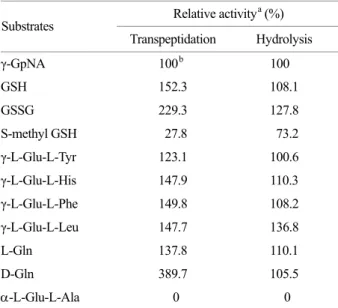
Of subunits of H. pylori GGT, N-terminal amino acid sequence of the heavy subunit was determined to be SYPPIKNTKVGL and that of light subunit was TTHYSVADRW, completely corresponding to the deduced amino acid sequence of the reported H. pylori GGT gene Table 2. Substrate specificity of H. pylori GGT for γ-glutamyl
donors
Relative activitya (%) Substrates
Transpeptidation Hydrolysis
γ-GpNA 100b 100
GSH 152.3 108.1
GSSG 229.3 127.8
S-methyl GSH 27.8 73.2
γ-L-Glu-L-Tyr 123.1 100.6 γ-L-Glu-L-His 147.9 110.3 γ-L-Glu-L-Phe 149.8 108.2 γ-L-Glu-L-Leu 147.7 136.8
L-Gln 137.8 110.1
D-Gln 389.7 105.5
-L-Glu-L-Ala 0 0
a Both activities were measured with an amino acid analyzer as described in Materials and Methods. Concentrations of donors and gly-gly were 2.5 and 60 mM, respectively. Activity is denoted relative to that found with γ-GpNA.
b The indicated values are the mean of two independent experi- ments.
Table 3. Continued
Relative rate (%) Substrates Conc.
(mM) H. pylori P. mirabilisa E. colib
L-DOPA 20 0 - 63.9
L-Gln 60 0 2.5 -
L-Glu 60 0 0 10.2
Gly 60 0 16.6 20.8
Gly-gly-gly 60 29.7 - 14.2
Gly-Leu 60 0 - 12.5
D-His 60 0 - -
L-His 60 0 36.9 49.5
L-Hse 60 0 6.7 0
L-Ile 60 19.8 25.2 13.8 L-Leu 20 17.1 20.7 2.5
Leu-Gly 60 0 - 12.5
D-Lys 60 55.0 - 16.5
L-Lys 60 46.6 16.0 121
L-Met 60 46.8 46.7 91.8 3-Methoxy-L-Tyr 20 0 - - S-Methyl-L-Cys 20 0 - 13.5
O-Methyl-L-Tyr 20 0 - 5.6
L-Phe 60 52.6 51.7 42.9
L-Pro 60 50.0 13.2 2.4
L-Ser 60 0 6.2 9.6
L-Thr 60 0 15.6 22.9
L-Trp 20 30.7 36.9 29.8
Trp-Gly 20 0 - 23.6
D-Tyr 20 0 - 1.1
L-Tyr 20 20.4 6.6 2.8
L-Val 60 0 12.6 10.8
a Nakayama et al. (29)
b Suzuki et al. (27)
c Data were not available.
Table 3. Substrate specificity of H. pylori GGT for γ-glutamyl acceptors
Relative rate (%) Substrates Conc.
(mM) H. pylori P. mirabilisa E. colib
Gly-gly 60 100 100 100
Gly-gly 20 62.4 -c 29.4
L-Ala 60 0 4.0 0
L-α-Amino-n-butyrate 60 0 5.5 12.7 γ-Amino-n-butyrate 60 54.0 16.3 22.3
D-Arg 60 37.2 - 18.1
L-Arg 60 79.9 20.7 141
L-Asn 60 38.7 - 31.8
L-Asp 60 0 - 4.2
Benzoyl-L-Tyr
ethyl ester 20 0 - 0
S-Carboxymethyl
L-Cys 20 0 - 1.9
β-chloro-L-Alanine 60 0 0 -
D-Cys 20 0 - 0
L-Cys 20 0 15.7 13.5
L-Cysteic acid 20 17.7 - 0
(32). This result revealed that H. pylori GGT is processed into 3 parts for a signal peptide of 27 amino acid, a heavy subunit of 352 residues, and a light subunit of 188 residues during translation.
Catalytic properties of H. pylori GGT
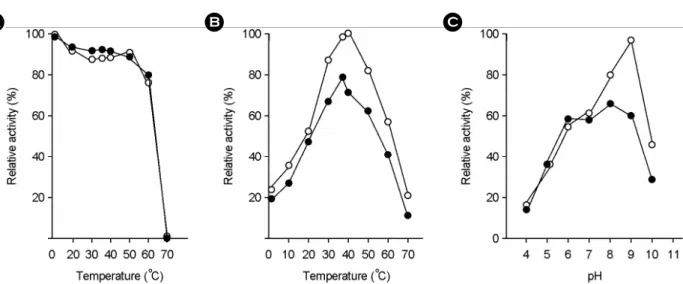
The purified enzyme catalyzed the reactions of both hydrolysis and γ-glutamyl transpeptidation of γ-glutamyl compounds (Table 2 & 3). The reaction rate for hydrolysis of γ-GpNA was 84.4 μmol/min per milligram of protein, and that for the γ-glutamyl transfer from γ-GpNA to gly-gly was 23.8 μmol/min per milligram of protein under the standard reaction conditions. The GGT protein kept approximately 80% of the initial enzymatic activity on incubation at 60℃ for 15 min and lost most of the activity on incubation at 70℃ (Fig. 3). The optimum temperature and pH for reactions of both hydrolysis and transpeptidation were 40℃ and 9.0 under the standard conditions, respec- tively (Fig. 3).
Substrate specificity
The enzyme activities of the purified GGT for hydrolysis and γ-glutamyl transfer of γ-glutamyl compounds to gly-gly were measured at pH 9.0 (Table 2). Various γ-glutamyl
compounds acted as a donor of γ-glutamyl moiety except for α-L-Glutamyl-L-alanine. D-Gln was the best γ-glutamyl donor for transpeptidation. The enzyme used various amino acids as γ-glutamyl acceptors (Table 3). L-Arg, D-Lys, L-Lys, L-Met, L-Phe, L-Pro, and γ-amino-n-butyrate were good acceptors and other amino acids and peptides were poor or inactive as γ-glutamyl acceptors. The apparent Km values for γ-GpNA and GSH as γ-glutamyl donors in the transpeptidation and hydrolysis reactions were on the order
Table 4. Km valuesa
Parameters Substrate mM
Transferase activity
Donorb -GpNA 0.66±0.03
GSH 1.95±1.04
Acceptorc Gly-gly 32±6
L-Arg 107±6
Hydrolase activity
-GpNA 1.64±0.06
GSH 1.06±0.27
a Calculated by Lineweaver-Burk plotting. The indicated values are the mean of two independent experiments ± the standard deviation of the mean.
b 60 mM gly-gly was used as an acceptor.
c 2.5 mM -GpNA was used as a donor.
A B C
Figure 3. Temperature stability and reactivity of H. pylori GGT at the various conditions of temperature and pH. (A) reaction mixtures were incubated at various temperatures for 15 min in 20 mM Tris-HCl (pH 8.0), and then GGT activities were measured; (B) GGT activities were measured at various temperature on the standard conditions described in Materials and Methods; (C) the pH of the reaction mixture containing the enzyme was adjusted with phosphate buffer for pH 4.0~6.0 or Tris-HCl buffer for pH 7.0~11.0 (open circles, transpeptidation activity; closed circles, hydrolysis activities). The indicated value is the mean of two independent experiments.
of 10-3~10-4 M (Table 4 & Fig. 4). The Km values for gly-gly and L-Arg as γ-glutamyl donors in the transpepti- dation were on the order of 10-1~10-2 M (Table 4 & Fig. 4).
Inhibition by amino acids and other inhibitors The transpeptidation and hydrolysis reactions catalyzed by H. pylori GGT were strongly inhibited by L-Gln and
moderately inhibited by L-Ala, L-Ser, D-Cys, L-Cysteic acid, β-chloro-L-Ala, L-Cys and L-Glu (Table 5). Inhibition by affinity labeling reagents such as DON and azaserine and other inhibitors was also investigated (Table 6).
DISCUSSION
A number of mammalian cellular GGTs have now been purified and their properties and functions have been well characterized (22, 23, 42, 44, 45). In addition, several bacterial GGTs have been identified and investigated up to date (24, 25, 27~29, 46).
Cell-free extracts of P. mirabilis and E. coli were purified Table 5. Inhibition of H. pylori GGT by amino acids
Inhibition (%) of Amino acids
Conc. (mM) Transpeptidation Hydrolysis
None 0a 0
L-Ala 10 56.1 54.8
L-Ser 10 48.3 48.4
L-Hse 10 36.3 18.9
L-α-Ab 10 16.1 20.9
Gly 10 22.9 25.8
D-Cys 10 72.1 12.4
L-Cysteic acid 10 72.8 3.9
L-Asp 10 22.3 12.0
β-chloro-L-Ala 10 57.0 42.3
L-Cys 10 61.3 11.2
L-Gln 10 91.7 89.8
L-Glu 10 72.7 46.5
a The indicated values are the mean of two independent experi- ments.
Table 6. Inhibition of H. pylori GGT by various inhibitors Inhibition (%) of Inhibitors Final Conc.
(mM) Transpeptidation Hydrolysis
None 0.0b 0.0
DONa 1 100.0 97.4
Azaserine 1 100.0 95.4 L-Ser + borate 1 100.0 11.9
10 100.0 83.9
Iodoacetic acid 1 41.6 5.6 HgCl2 1 25.8 0.0
a 6-diazo-5-oxo-norleucine
b The indicated values are the mean of two independent experi- ments.
A B C
Figure 4. Lineweaver-Burk plot of transpeptidation and/or hydrolysis of γ-GpNA, gly-gly, L-Arg, and GSH as catalyzed by purified H.
pylori GGT. The enzyme activities were measured on the conditions described in Materials and Methods except for the change of the pH 9.0. (A) donor activities of γ-glutamyl moiety of γ-GpNA in transpeptidation reaction (○) and in hydrolysis reaction (●); (B) acceptor activities of gly-gly (◇) and L-Arg (△) in transpeptidation reaction; C, donor activities of glutamyl moiety of GSH in transpeptidation reaction (□) and in hydrolysis reaction (■). The reciprocals of the rates of 2-nitroaniline production (A, B) or γ-glutamyl-glycylglycine and glutamic acid production (C) were plotted against those of different concentrations of γ-glutamyl moiety donors or acceptors. The indicated values are the mean of two independent experiments.
to give 2 homogenous proteins showing GGT activity, a major peak, fraction A and a minor peak, fraction B (27, 29). Fraction B was thought to be a protein modified by proteolysis (27, 29). In the case of H. pylori, a final step of purification gave only one protein peak (Fig. 1).
Mammalian GGT generally consisted of light subunit (ca. 22 kDa) and heavy subunit (ca. 45~64 kDa) (22). P.
mirabilis and E. coli GGTs have subunits of 47 and 28 kDa, and of 39 and 22 kDa, respectively (27, 29). The light subunit of H. pylori GGT has a molecular weight of 21 kDa, which is the same as those of mammalian and E. coli GGTs in molecular size, while the heavy subunit has a molecular weight of 38 kDa, which is smaller than those of mammalian and other bacterial GGTs in molecular size.
Nucleotide sequence of the H. pylori GGT gene was reported to span 1,704 bp encoding a polypeptide of 567 amino acid residues (32). The data for the nucleotide sequence and N-terminal amino acid sequences of subunits of H. pylori GGT revealed that it was processed into 3 parts for a signal peptide composed of 27 amino acid, a heavy subunit of 352 residues, and a light subunit of 188 residues post or co-translationally, which is similar to the features of other bacterial GGTs (27, 29). The N-terminal amino acid residue of light subunit has previously been reported to be the 27th residue (Ala) (32, 39), however, which has been confirmed as the 28th residue (Ser) in this study.
The H. pylori GGT catalyzed hydrolysis and transpepti- dation of γ-glutamyl compounds, including the oxidized and reduced forms of glutathione and γ-glutamyl compounds of p-nitroaniline as reported for mammalian and other bacterial GGTs (Table 2). H. pylori GGT prefers L-Arg, D-Lys, L-Lys, L-Met, L-Phe, L-Pro, and γ-amino-n-butyrate as acceptors of the γ-glutamyl moiety in the transpeptidation reaction, while other amino acids and peptides were poor or inactive (Table 3). Basic amino acids and aromatic amino acids were relatively good acceptors for H. pylori GGT (Table 3), which is consistent with other bacterial GGTs (27, 29). Neutral amino acids such as L-Cys, L-Glu, and L-Ser, which were good acceptors for mammalian GGTs, were inactive as acceptors for H. pylori GGT. D-Arg, D-Lys and L-Pro, which are poor acceptors for mammalian GGTs,
were relatively good acceptors for H. pylori GGT.
In the case of other bacterial GGTs, the transferase activity was reported to be higher than or similar to the hydrolase activity (27, 29). On the contrary, the reaction rate (84.4 μmol/min per mg of protein) of H. pylori GGT protein for hydrolysis was more than 3.5 times higher than that (23.8 μmol/min per milligram of protein) for γ-glutamyl transfer when used γ-GpNA as a donor of γ-glutamyl moiety and gly-gly as an acceptor. The relative activities between γ- GpNA and D-Gln for hydrolase and transpeptidase showed that both enzymatic activities may be similar when used D-Gln as a donor (Table 2).
The thermal stability of H. pylori GGT was better than that of other species' GGT because it kept approximately 80% of the initial enzymatic activity on incubation at 60℃
for 15 min. The optimum temperatures of hydrolysis and transpeptidation of H. pylori GGT were near body tem- perature (Fig. 3). The optimum pH was more alkaline than other bacterial GGTs (Fig. 3). Therefore, the activity of H.
pylori GGT in the gastric mucosa may be maximized in concert with its urease activity.
In the contrary to recombinant GGT (32-7), the apparent Km values of H. pylori GGT for γ-glutamyl donors and acceptors in the transpeptidation reaction and that of donor in hydrolysis reaction were ordinary when compared with those of mammalian and other bacterial GGTs (Table 4 &
Fig. 4). Like other bacterial GGTs, transpeptidation is not thought to be the major function because its Km values for γ-glutamyl donors are low while those for γ-glutamyl acceptors are high (27, 29).
Several amino acids inhibited H. pylori GGT activity as other bacterial GGTs (Table 5) (27, 29). H. pylori GGT activity was strongly inhibited by L-Gln and was weakly inhibited by other amino acids when compared with P.
mirabilis GGT. DON, azaserine, and L-Ser with borate that were known as inhibitors of E. coli GGT strongly inhibited H. pylori GGT (Table 6).
There is little evidence that GSH is important to the maintenance of the redox balance in H. pylori. On the basis of genome analyses, H. pylori does not appear to contain homologs of the genes encoding for the synthesis of glu-
tathione (γ-glutamylcysteine synthetase) and the reduction of oxidized glutathione (glutathione reductase). It was reported that reduced glutathione level of gastric mucosa ranges from 0.3 to 1.7 mM in chronic gastritis (47), supporting that H. pylori GGT is sufficient to degrade the glutathione in gastric mucous layer. Since the localization of H. pylori GGT remains to be determined, we couldn't conclude that the presence of H. pylori leads to bacterial breakdown of glutathione in the gastric mucous layer. This problem has to be resolved in the future investigation.
REFERENCES
1) Marshall BJ, Warren JR. Unidentified curved bacilli in the stomach of patients with gastritis and peptic ulcera- tion. Lancet 1984;1:1311-5.
2) Blaser MJ. Helicobacter pylori and the pathogenesis of gastroduodenal inflammation. J Infect Dis 1990;161:
626-33.
3) Lee A, Fox J, Hazell S. Pathogenicity of Helicobacter pylori: a perspective. Infect Immun 1993;61:1601-10.
4)Correa P. Human gastric carcinogenesis: A multistep and multifactorial process-First American Cancer Society Award Lecture on Cancer Epidemiology and Prevention.
Cancer Res 1992;52:6735-40.
5)Bagchi D, Bhattacharya G, Stohs SJ. Production of reactive oxygen species by gastric cells in association with Helicobacter pylori. Free Radic Res 1996;24:439 -50.
6) Baik SC, Youn HS, Chung MH, Lee WK, Cho MJ, Ko GH, et al. Increased oxidative DNA damage in Helicobacter pylori-infected human gastric mucosa.
Cancer Res 1996;56:1279-82.
7) Weitzman SA, Gordon LI. Inflammation and cancer:
role of phagocyte-generated oxidants in carcinogenesis.
Blood 1990;76:655-63.
8)Ghanayem BI, Boor PJ, Ahmed AE. Acrylonitrile- induced gastric mucosal necrosis: role of gastric glu- tathione. J Pharmacol Exp Ther 1985;232:570-7.
9)Giorgi G, Micheli L, Segre G, Pecchi A. Glutathione (GSH) in human stomach mucosa. Riv Eur Sci Med Farmacol 1989;11:163-7.
10) Orlowski M, Meister A. The gamma-glutamyl cycle: a
possible transport system for amino acids. Proc Natl Acad Sci U S A 1970;67:1248-55.
11) Hiraishi H, Terano A, Ota S, Mutoh H, Sugimoto T, Harada T, et al. Protection of cultured rat gastric cells against oxidant-induced damage by exogenous glu- tathione. Gastroenterology 1994;106:1199-207.
12) Hirokawa K, Kawasaki H. Changes in glutathione in gastric mucosa of gastric ulcer patients. Res Commun Mol Pathol Pharmacol 1995;88:163-76.
13) Robert A, Eberle D, Kaplowitz N. Role of glutathione in gastric mucosal cytoprotection. Am J Physiol 1984;
247:G296-304.
14) Shaw S, Herbert V, Colman N, Jayatilleke E. Effect of ethanol-generated free radicals on gastric intrinsic factor and glutathione. Alcohol 1990;7:153-7.
15) Shimizu M, Nakama A, Yamano T, Noda T, Fujita T, Kuroda K, et al. Role of gastric glutathione in smoke flavouring-induced gastric injury in rats. Food Chem Toxicol 1992;30:1005-9.
16)Szabo S, Nagy L, Plebani M. Glutathione, protein sulfhydryls and cysteine proteases in gastric mucosal injury and protection. Clin Chim Acta 1992;206:95-105.
17)Griffith OW, Meister A. Translocation of intracellular glutathione to membrane-bound gamma-glutamyl trans- peptidase as a discrete step in the gamma-glutamyl cycle: glutathionuria after inhibition of transpeptidase.
Proc Natl Acad Sci U S A 1979;76:268-72.
18) Griffith OW, Novogrodsky A, Meister A. Translocation of glutathione from lymphoid cells that have markedly different gamma-glutamyl transpeptidase activities. Proc Natl Acad Sci U S A 1979;76:2249-52.
19) Hanigan MH, Pitot HC. Gamma-glutamyl transpeptidase- its role in hepatocarcinogenesis. Carcinogenesis 1985;6:
165-72.
20)Inoue M, Horiuchi S, Morino Y. gamma-Glutamyl transpeptidase in rat ascites tumor cells LY-5. Lack of functional correlation of its catalytic activity with the amino acid transport. Eur J Biochem 1977;78:609-15.
21) Rosalki SB, Rowe JA. Gamma-glutamyl-transpeptidase activity of human seminal fluid. Lancet 1973;1:323-4.
22)Tate SS, Meister A. gamma-Glutamyl transpeptidase:
catalytic, structural and functional aspects. Mol Cell Biochem 1981;39:357-68.
23) Tate SS, Meister A. gamma-Glutamyl transpeptidase
from kidney. Methods Enzymol 1985;113:400-19.
24) Ishiye M, Yamashita M, Niwa M. Molecular cloning of the gamma-glutamyltranspeptidase gene from a Pseudomonas strain. Biotechnol Prog 1993;9:323-31.
25) Mineyama R, Mikami K, Saito K. Partial purification and some properties of gamma-glutamyl peptide- hydrolysing enzyme from Actinobacillus actinomy- cetemcomitans. Microbios 1995;82:7-19.
26) Orlowski M, Meister A. Isolation of gamma-glutamyl transpeptidase from hog kidney. J Biol Chem 1965;240:
338-47.
27)Suzuki H, Kumagai H, Tochikura T. gamma- Glutamyltranspeptidase from Escherichia coli K-12:
purification and properties. J Bacteriol 1986;168:1325 -31.
28)Xu K, Strauch MA. Identification, sequence, and expres- sion of the gene encoding gamma-glutamyltranspeptidase in Bacillus subtilis. J Bacteriol 1996;178:4319-22.
29)Nakayama R, Kumagai H, Tochikura T. Purification and properties of gamma-glutamyltranspeptidase from Proteus mirabilis. J Bacteriol 1984;160:341-6.
30) Suzuki H, Hashimoto W, Kumagai H. Escherichia coli K-12 can utilize an exogenous gamma-glutamyl pep- tide as an amino acid source, for which gamma- glutamyltranspeptidase is essential. J Bacteriol 1993;
175:6038-40.
31)Megraud F, Bonnet F, Garnier M, Lamouliatte H.
Characterization of "Campylorbacter pyloridis" by culture, enzymatic profile, and protein content. J Clin Microbiol 1985;22:1007-10.
32)Chevalier C, Thiberge JM, Ferrero RL, Labigne A.
Essential role of Helicobacter pylori gamma-glutamyl- transpeptidase for the colonization of the gasric mucosa of mice. Mol Microbiol 1999;31:1359-72.
33) McGovern KJ, Blanchard TG, Gutierrez JA, Czinn SJ, Krakowka S, Youngman P. gamma-Glutamyltransferase is a Helicobacter pylori virulence factor but is not essential for colonization. Infect Immun 2001;69:4168 -73.
34) Busiello I, Acquaviva R, Di Popolo A, Blanchard TG, Ricci V, Romano M, et al. Helicobacter pylori gamma- glutamyltranspeptidase upregulates COX-2 and EGF- related peptide expression in human gastric cells. Cell Microbiol 2004;6:255-67.
35) Kim KM, Lee SG, Park MG, Song JY, Kang HL, Lee WK, et al. Gamma-glutamyltranspeptidase of Helico- bacter pylori induces mitochondria-mediated apoptosis in AGS cells. Biochem Biophys Res Commun 2007;
355:562-7.
36) Kim KM, Lee SG, Kim JM, Kim DS, Song JY, Kang HL, et al. Helicobacter pylori gamma-glutamyl- transpeptidase induces cell cycle arrest at the G1-S phase transition. J Microbiol 2010;48:372-7.
37) Boanca G, Sand A, Barycki JJ. Uncoupling the enzy- matic and autoprocessing activities of Helicobacter pylori gamma-glutamyltranspeptidase. J Biol Chem 2006;281:19029-37.
38) Boanca G, Sand A, Okada T, Suzuki H, Kumagai H, Fukuyama K, et al. Autoprocessing of Helicobacter pylori gamma-glutamyltranspeptidase leads to the for- mation of a threonine-threonine catalytic dyad. J Biol Chem 2007;282:534-41.
39)Shibayama K, Wachino J, Arakawa Y, Saidijam M, Rutherford NG, Henderson PJ. Metabolism of glutamine and glutathione via gamma-glutamyltranspeptidase and glutamate transport in Helicobacter pylori: possible significance in the pathophysiology of the organism.
Mol Microbiol 2007;64:396-406.
40) Rhee KH, Lee WK, Baik SC, Cho MJ, Choi HJ. Pro- duction of the monoclonal antibody and the genomic library of Helicobacter pylori. J Korean Soc Microbiol 1991;26:305-16.
41)Lowry OH, Rosebrough NJ, Farr AL, Randall RJ.
Protein measurement with the Folin phenol reagent. J Biol Chem 1951;193:265-75.
42)Laemmli UK. Cleavage of structural proteins during the assembly of the head of bacteriophage T4. Nature 1970;227:680-5.
43)Moos M Jr, Nguyen NY, Liu TY. Reproducible high yield sequencing of proteins electrophoretically sepa- rated and transferred to an inert support. J Biol Chem 1988;263:6005-8.
44) Meister A, Anderson ME. Glutathione. Annu Rev Biochem 1983;52:711-60.
45) Miller SP, Awasthi YC, Srivastava SK. Studies of human kidney gamma-glutamyl transpeptidase. Purification and structural, kinetic and immunological properties. J Biol Chem 1976;251:2271-8.
46) Suzuki H, Kumagai H, Echigo T, Tochikura T. DNA sequence of the Escherichia coli K-12 gamma- glutamyltranspeptidase gene, ggt. J Bacteriol 1989;171:
5169-72.
47) Farinati F, Della Libera G, Cardin R, Molari A, Plebani
M, Rugge M, et al. Gastric antioxidant, nitrites, and mucosal lipoperoxidation in chronic gastritis and Helico- bacter pylori infection. J Clin Gastroenterol 1996;22:
275-81.