ORIGINAL ARTICLE
Copyright ⓒ 2009 Korean Neurological Association 81
Print ISSN 1738-6586 / On-line ISSN 2005-5013 10.3988/jcn.2009.5.2.81 J Clin Neurol 2009;5:81-84
Cognitive Impairment in Essential Tremor without Dementia
Joong-Seok Kim, MD; In-Uk Song, MD; Yong-Soo Shim, MD; Jeong-Wook Park, MD;
Ji-Yeon Yoo; Yeong-In Kim, MD; Kwang-Soo Lee, MD
Department of Neurology, College of Medicine, The Catholic University of Korea, Seoul, Korea
Received December 18, 2008 Revised March 16, 2009 Accepted March 16, 2009 Correspondence Joong-Seok Kim, MD Department of Neurology, College of Medicine,
The Catholic University of Korea, Seoul St. Mary’s Hospital, 505 Banpo-dong, Seocho-gu, Seoul 137-701, Korea Tel +82-2-2258-6078 Fax +82-2-599-9686 E-mail [email protected]
Background and PurposeaaSeveral clinical studies have demonstrated that patients with es- sential tremor (ET) may have cognitive deficits; however, there are no published data regarding detailed neuropsychological assessments of ET without dementia. We therefore conducted a case-control study of cognitive function in patients with ET.
MethodsaaThe cohort for this study comprised 34 consecutive patients with ET without demen- tia and 33 age-matched controls, all of who completed a dementia-screening questionnaire and underwent a detailed neuropsychological investigation.
ResultsaaSevere impairments were observed in most domains for the ET group compared to the controls, including attention, part of language function, verbal memory, and frontal executive functions.
ConclusionsaaOur results support the finding that the subclinical cognitive deficits characte- rized by attention, verbal memory impairments, and executive dysfunction are a clinical feature of ET. In addition, our results also support the finding that age at examination and educational status are the most important risk factors associated with cognitive deficits in patients with ET.
J Clin Neurol 2009;5:81-84 Key Wordsaaessential tremor, cognition, age, education.
Introduction
Essential tremor (ET) is a late-life neurologic disease that is characterized by action tremor.1,2 There is growing evidence that this disease is a multiple-system disorder because of ad- ditional motor features (e.g., intention tremor and ataxia) and nonmotor features (mild cognitive deficits and personality changes).3,4 Several studies have demonstrated that patients with ET may also have mild cognitive impairments (MCIs), mainly in frontal executive function and memory, and cross- sectional studies have shown that these are associated with prevalent dementia.5-11 However, there are no published data regarding detailed neuropsychological assessments of pa- tients with ET without dementia in Korea. We therefore con- ducted a case-control study of cognitive function in patients with ET without dementia.
Methods
Subjects
The initial study cohort comprised 38 consecutive patients
with ET who were examined at the Movement Disorder Cli- nic of Kangnam St. Mary’s Hospital between January and December 2007. Four of these patients were excluded from the study after comprehensive neuropsychological testing re- vealed that they had mild dementia. Thus, a final total of 34 patients who had no history or symptoms of memory impair- ment or other cognitive disorders with functional impairment (as revealed by a dementia-screening questionnaire) were enrolled in this study. The evaluation procedure comprised a detailed medical history, a physical and neurological exami- nation, a neuropsychological assessment, and brain magnetic resonance imaging. The patient’s history of medical and neu- rological problems was obtained from the patients and fa- mily members, or from other caregivers. All patients were diag- nosed as having either definite or probable ET based on Na- tional Institutes of Health diagnostic criteria,12 and all were tested for mutations of the FMR gene of fragile X tremor and ataxia syndrome. Patients were excluded from the study if 1) they had neurological abnormalities related to systemic or other neurological diseases, 2) they were taking medications reported to influence cognition, such as anticholinergics or
Cognitive Impairment in ET without Dementia
82 J Clin Neurol 2009;5:81-84
beta-blocking agents, or 3) they were found to have an FMR gene mutation.
The age-matched controls (n=33) did not have a history or symptoms of tremor, memory impairment, or other cognitive dysfunctions, as revealed by a dementia screening question- naire, and they had no history of other neurological diseases, such as head trauma, epilepsy, and stroke, or brain surgery.
This study was approved by the local ethics committee, and each patient provided written informed consent to participate.
Neuropsychological assessment
The patient’s general cognitive status and severity of demen- tia were evaluated by the Korean version of Mini-Mental State Examination (K-MMSE), Clinical Dementia Rating (CDR), and the sum of box (SOB) of CDR.13-15 Several cognitive do- mains were assessed by conducting a detailed battery of neu- ropsychological tests. The tests included an attention and working memory test (forward digit span, backward digit span, and letter cancellation), a language and related-functions test (comprehension, repetition, Boston Naming Test, writing, cal- culation, finger naming, right-left orientation, body part iden- tification, and praxis), a visuospatial function test (drawing an interlocking pentagons and Rey-Osterrieth Complex Figure Copy Test), a verbal memory test [registration, recall, recog- nition of three words, Hopkins Verbal Learning Test (HVLT), immediate recall, delayed recall, and recognition], a nonver- bal (visual) memory test (immediate recall, delayed recall, and recognition of a Rey’s complex figure), a frontal execu- tive function test (motor impersistence, contrasting program, go-no-go test, fist-edge-palm, alternating hand movement, al- ternating square and triangle, and Luria Loop Test), the word fluency test [Controlled Oral Word Association Test (COWAT) animal, supermarket, and Korean letters], and the Stroop Co- lor and Word Test (word reading and color reading).15-17
Data analysis
The statistical analyses were performed using SPSS, version 13.0. Statistical comparisons of some of the demographic data between the groups, and neuropsychological test results were performed using an independent-samples t-test. Other group differences (data for nominal variables) were assessed with the chi-square test. The relationships between the general mental functions and the age at examination, symptom dura- tion, educational status, and Barthel index were analyzed us- ing Spearman rank correlation coefficients. The level of sta- tistical significance was set at p<0.05.
Results
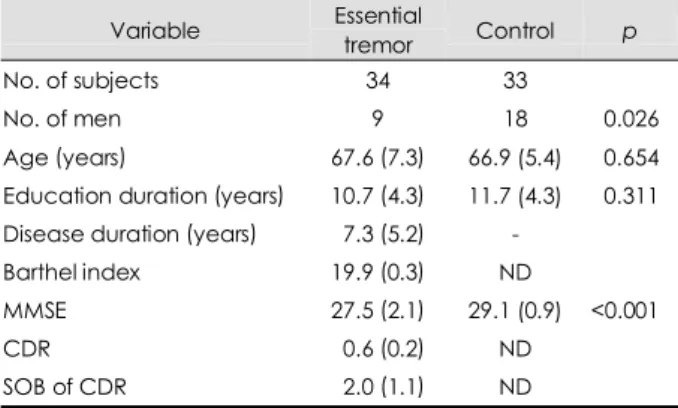
The demographic characteristics of the ET patients and con-
trols are summarized in Table 1. The mean education level and age of the two groups were similar, however the gender distribution was not similar (26.5% and 54.5% of the ET and control groups, respectively, were men; p=0.026). The mean MMSE score was lower in the ET group than in the control group.
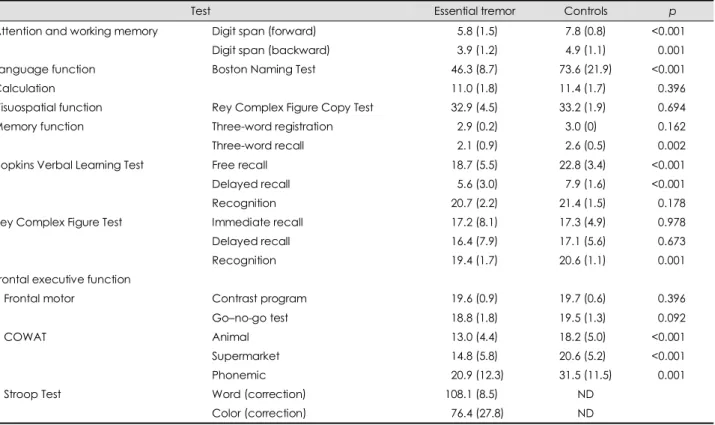
Table 2 and 3 present the characteristics of the ET and control groups as well as differences in the results of the de- tailed, comprehensive neuropsychological tests between the two groups. The impairments in most domains were more severe in the ET group than in the control group, including in attention and working memory, part of the language func- tions (Boston Naming Test), verbal memory (three-word re- call and HVLT, free and delayed recall), and the frontal ex- ecutive functions (the COWAT; p<0.01). The correlation an- alysis revealed that cognitive decline was significantly cor- related with age and educational status, but not with either disease duration or Barthel index (Table 4).
Discussion
Cognitive impairment is often associated with ET, although the deficits may be relatively subtle and not clinically apparent, or else they do not overtly affect the person’s daily function- ing. Executive dysfunction is thought to be at the heart of the cognitive dysfunction in ET patients and it is usually one of the earliest cognitive impairments found in these patients.5-11 Besides frontal executive dysfunction, previous studies have reported that most ET patients develop mild neuropsycholo- gical deficits across a range of cognitive functions (i.e., these deficits affect memory, visuospatial processing, and atten- tion).10,11 However, these MCIs do not progress to full demen- tia in all ET patients, and the precise frequency and etiology of the dementia associated with ET are a matter of contro- versy. Nevertheless, early detection of the initial stages of de-
Table 1. Demographic data and general cognitive functioning in patients with essential tremor and normal controls
Variable Essential
tremor Control p
No. of subjects 34 33
No. of men 9 18 0.026
Age (years) 67.6 (7.3) 66.9 (5.4) 0.654 Education duration (years) 10.7 (4.3) 11.7 (4.3) 0.311 Disease duration (years) 07.3 (5.2) -
Barthel index 19.9 (0.3) ND
MMSE 27.5 (2.1) 29.1 (0.9) <0.001
CDR 00.6 (0.2) ND
SOB of CDR 02.0 (1.1) ND
Data are mean (standard deviation) values.
ND: not determined, MMSE: Mini-Mental State Examination, CDR: Clinical Dementia Rating, SOB of CDR: sum of box of CDR.
Kim JS et al.
www.thejcn.com 83
mentia would have considerable clinical, therapeutic, and pub- lic health value.
In the present study we investigated the cognitive dys- functions of ET without dementia and compared them with age-matched normal controls. As expected, the ET group had significantly more severe impairments of attention, verbal memory, and frontal executive functions compared to the nor- mal control group. Many ET patients had cognitive decline ranging from normal to an MCI. In addition, the cognitive decline was significantly correlated with age and educational status, but not with disease duration or Barthel index.
The pathophysiologic basis for these findings is unclear, but there are several lines of evidence that ET is a neurode-
Table 2. Neuropsychological test results for the essential tremor and control groups
Test Essential tremor Controls p
Attention and working memory Digit span (forward) 005.8 (1.5)0 07.8 (0.8)0 <0.001
Digit span (backward) 003.9 (1.2)0 04.9 (1.1)0 0.001
Language function Boston Naming Test 046.3 (8.7)0 73.6 (21.9) <0.001
Calculation 011.0 (1.8)0 11.4 (1.7)0 0.396
Visuospatial function Rey Complex Figure Copy Test 032.9 (4.5)0 33.2 (1.9)0 0.694 Memory function Three-word registration 002.9 (0.2)0 03.0 (0)0.0 0.162
Three-word recall 002.1 (0.9)0 02.6 (0.5)0 0.002 Hopkins Verbal Learning Test Free recall 018.7 (5.5)0 22.8 (3.4)0 <0.001
Delayed recall 005.6 (3.0)0 07.9 (1.6)0 <0.001
Recognition 020.7 (2.2)0 21.4 (1.5)0 0.178
Rey Complex Figure Test Immediate recall 017.2 (8.1)0 17.3 (4.9)0 0.978
Delayed recall 016.4 (7.9)0 17.1 (5.6)0 0.673
Recognition 019.4 (1.7)0 20.6 (1.1)0 0.001
Frontal executive function
Frontal motor Contrast program 019.6 (0.9)0 19.7 (0.6)0 0.396
Go–no-go test 018.8 (1.8)0 19.5 (1.3)0 0.092
COWAT Animal 013.0 (4.4)0 18.2 (5.0)0 <0.001
Supermarket 014.8 (5.8)0 20.6 (5.2)0 <0.001
Phonemic 020.9 (12.3) 31.5 (11.5) 0.001
Stroop Test Word (correction) 108.1 (8.5)0 ND
Color (correction) 076.4 (27.8) ND
Data are mean (standard deviation) values.
The level of statistical significance (i.e., p) was calculated by independent-samples t-test.
ND: not determined, COWAT: Controlled Oral Word-Association Test.
Table 3. The result of neuropsychological test in the essential tre- mor and control groups
Test Essential
tremor Controls p
Attention
Letter cancellation 0 0
Language and related functions
Comprehension 0 0
Repetition 0 0
Reading 0 0
Writing 0 0
Finger naming 0 0
Right–left disorientation 1 0 0.321 Body-part identification 0 0
Ideomotor praxis 0 0
Buccofacial praxis 0 0
Visuospatial function
Interlocking pentagons 3 0 0.081 Frontal executive functions
Fist-edge-palm test 5 4 0.756 Alternating hand movement 4 2 0.414 Alternating square and triangle 0 0
Luria Loop Test 0 0
All data are the number of patients with an abnormal score.
The level of statistical significance (i.e., p) was calculated by chi-square test.
Table 4. Correlations between general cognition domains and the age at examination, symptom duration, and education duration
MMSE CDR SOB of CDR Age -0.344 (0.047) 0.320 (0.065) 0.543 (0.001) Disease duration 0.216 (0.243) 0.087 (0.643) -0.254 (0.168) Education duration 0.464 (0.006) -0.334 (0.054) -0.509 (0.002) Barthel index 0.167 (0.357) -0.342 (0.048) -0.253 (0.148) Analyses were performed using Spearman rank correlation co- efficients.
Data are r (p) values for the correlation.
MMSE: Mini-Mental State Examination, CDR: Clinical Dementia Rating, SOB of CDR: sum of box of CDR.
Cognitive Impairment in ET without Dementia
84 J Clin Neurol 2009;5:81-84
generative disease. ET is clinically progressive, with com- plex clinical characteristics accompanied by both cerebellar and extracerebellar signs, which may include olfactory de- ficits and cognitive dysfunction.5-11,18,19 Recent work has shown widespread white-matter pathology in ET, primarily involving the frontal area, but also with some temporopa- rietal area involvement.20 Other studies have shown that the cerebellum is functionally connected to the cerebral cortex through feedforward and feedback pathways.21,22 In addition, there are multiple lines of evidence that the circuitry involved includes the frontosubcortical pathways, which play a role in cognitive and affective processes in patients with ET.5-11 Con- versely, these neuropsychological findings are similar to those observed in some cerebellar disorders.23,24 Taken together, the findings of previous studies and our own demonstrate that ET is associated with a poorer performance on tests of mem- ory and frontal executive function. Our clinical findings there- fore support the hypothesis that cognitive and motor fronto- cerebellar circuits are functionally associated in ET.
Our study does have several limitations that mean we are unable to resolve the pathophysiological association between cognitive and motor dysfunctions in ET. We did not test the impact of tremor severity on cognitive dysfunctions. Further studies using several motor parameters are needed to identify the pathologic basis for cognitive deficits in cases of ET. In addition, it is more helpful to perform functional metabolism studies and structural volumetric analyses to assess the asso- ciated functional pathogenesis of ET.
In summary, our results support the finding that the subcli- nical cognitive deficits characterized by attention and verbal memory impairments, and executive dysfunction are a clini- cal feature of ET. In addition, our results support the finding that age at examination and educational status are the most important risk factors associated with cognitive deficits in patients with ET, as with other types of dementia.25
Acknowledgments
This study was supported by a grant of the Korea Health 21 R&D Pro- ject, Ministry of Health and Welfare, Republic of Korea (project no.
A060093).
REFERENCES
1. Dogu O, Sevim S, Camdeviren H, Sasmaz T, Bugdayci R, Aral M, et al. Prevalence of essential tremor: door-to-door neurological exams in Mersin Province, Turkey. Neurology 2003;61:1804-1806.
2. Tanner CM, Goldman SM, Lyons KE, Aston DA, Tetrud JW, Welsh MD, et al. Essential tremor in twins: an assessment of genetic vs en- vironmental determinants of etiology. Neurology 2001;57:1389-1391.
3. Louis ED. Essential tremor. Lancet Neurol 2005;4:100-110.
4. Lim ES, Seo MW, Woo SR, Jeong SY, Jeong SK. Relationship be- tween essential tremor and cerebellar dysfunction according to age. J Clin Neurol 2005;1:76-80.
5. Tröster AI, Woods SP, Fields JA, Lyons KE, Pahwa R, Higginson CI, et al. Neuropsychological deficits in essential tremor: an expression of cerebello-thalamo-cortical pathophysiology? Eur J Neurol 2002;9:
143-151.
6. Benito-León J, Louis ED, Bermejo-Pareja F; Neurological Disorders in Central Spain (NEDICES) Study Group. Population-based case-con- trol study of cognitive function in essential tremor. Neurology 2006;
66:69-74.
7. Gasparini M, Bonifati V, Fabrizio E, Fabbrini G, Brusa L, Lenzi GL, et al. Frontal lobe dysfunction in essential tremor: a preliminary study.
J Neurol 2001;248:399-402.
8. Lacritz LH, Dewey R Jr, Giller C, Cullum CM. Cognitive functioning in individuals with “benign” essential tremor. J Int Neuropsychol Soc 2002;8:125-129.
9. Benito-León J, Louis ED, Bermejo-Pareja F; Neurological Disorders in Central Spain Strudy Group. Elderly-onset essential tremor is as- sociated with dementia. Neurology 2006;66:1500-1505.
10. Lombardi WJ, Woolston DJ, Roberts JW, Gross RE. Cognitive defi- cits in patients with essential tremor. Neurology 2001;57:785-790.
11. Sahin HA, Terzi M, Ucak S, Yapici O, Basoglu T, Onar M. Frontal functions in young patients with essential tremor: a case comparison study. J Neuropsychiatry Clin Neurosci 2006;18:64-72.
12. Jankovic J. Essential tremor: clinical characteristics. Neurology 2000;
54(11 Suppl 4):S21-S25.
13. Kang YW, Na DL, Hahn SH. A validity study on the Korean mini- mental state examination (K-MMSE) in dementia patients. J Korean Neurol Assoc 1997;15:300-308.
14. Choi SH, Na DL, Lee BH, Hahm DS, Jeong JH, Yoon SJ, et al. Esti- mating the validity of the Korean version of expanded clinical de- mentia rating (CDR) scale. J Korean Neurol Assoc 2001;19:585-591.
15. Kang YW. Samsung neuropsychological screening battery, Current research in dementia. Seoul: The Korean Dementia Association, 1998;
99-107.
16. Kim H, Na DL. Korean-Boston Naming Test. Seoul: Hakji Co, 1997.
17. Kim E, Kim H, Na DL. Naming deficits in patients with dementia of the Alzheimer type: error analysis of Korean version-Boston Naming Test. J Korean Neurol Assoc 1997;15:1012-1021.
18. Louis ED, Bromley SM, Jurewicz EC, Watner D. Olfactory dysfunc- tion in essential tremor: a deficit unrelated to disease duration or se- verity. Neurology 2002;59:1631-1633.
19. Applegate LM, Louis ED. Essential tremor: mild olfactory dysfunc- tion in a cerebellar disorder. Parkinsonism Relat Disord 2005;11:
399-402.
20. Shin DH, Han BS, Kim HS, Lee PH. Diffusion tensor imaging in pa- tients with essential tremor. AJNR Am J Neuroradiol 2008;29:151-153.
21. Schmahmann JD, Pandya DN. The cerebrocerebellar system. Int Rev Neurobiol 1997;41:31-60.
22. Middleton FA, Strick PL. Basal ganglia and cerebellar loops: motor and cognitive circuits. Brain Res Brain Res Rev 2000;31:236-250.
23. Schmahmann JD, Sherman JC. The cerebellar cognitive affective syn- drome. Brain 1998;121:561-579.
24. Yang YS, Kim JE, Lee JS, Kim S. Akinetic mutism and cognitive- affective syndrome caused by Unilateral PICA Infarction. J Clin Neu- rol 2007;3:192-196.
25. Bermejo-Pareja F, Louis ED, Benito-Leon J; Neurological Disorders in Central Spain (NEDICES) Study Group. Risk of incident dementia in essential tremor: a population-based study. Mov Disord 2007;22:
1573-1580.