Korean J Clin Microbiol Vol. 13, No. 4, December, 2010 DOI: 10.5145/KJCM.2010.13.4.169
Prevalence of Metallo-β-lactamases in Imipenem-non- susceptible Pseudomonas aeruginosa and
Acinetobacter baumannii
Nam Hee Ryoo, Jung Sook Ha, Dong Seok Jeon, Jae Ryong Kim
Department of Laboratory Medicine, School of Medicine, Keimyung University, Daegu, Korea Background: Metallo-β-lactamases (MBLs) have been
reported in gram negative bacilli and are becoming increasingly important clinically because the enzymes hydrolyse almost all β-lactams, including carbapenems.
Thus, the present study was conducted to determine the prevalence of MBL types in imipenem-nonsus- ceptible Pseudomonas aeruginosa and Acinetobacter baumannii isolated from a tertiary teaching hospital.
Methods: Imipenem-nonsusceptible strains, 128 P. aeru- ginosa and 93 A. baumannii, were collected from clinical specimens. Identification and susceptibility tests were determined by Vitek GNI and GNS cards. MBL pro- duction was determined by modified Hodge test and imipenem-EDTA synergy test. Multiplex PCR amplifi- cation of MBL genes including blaIMP-1, blaVIM-1 and blaVIM-2
were performed.
Results: Thirty-one P. aeruginosa (24.2%) isolates and
3 A. baumannii (3.2%) were found to be MBL pro- ducers. In P. aeruginosa, 20 (15.6%) and 11 (8.6%) isolates were positive for blaIMP-1 and blaVIM-2, respec- tively whereas 1 (1.0%) and 2 (2.2%) isolates in A.
baumannii, respectively.
Conclusion: IMP-1 is more prevalent MBL type than VIM-2 among imipenem-nonsusceptible P. aerugino- sa unlike in other studies. Larger numbers of isolates and sequential studies are strongly recommended for the useful evaluation and monitoring of MBL pro- duction in the hospital setting to infection-control.
(Korean J Clin Microbiol 2010;13:169-172)
Key Words: Multidrug resistance, Pseudomonas aer- uginosa, Acinetobacter baumannii, Metallo- beta-lactamase (MBL), IMP-1, VIM-2
Received 29 May, 2010, Revised 22 July, 2010 Accepted 22 August, 2010
Correspondence: Nam Hee Ryoo, Department of Laboratory Medicine, School of Medicine, Keimyung University, 194 Dongsan-dong, Jung-gu, Daegu 700-712, Korea. (Tel) 82-53-250-7950, (Fax) 82-53-250-7275, (E-mail) [email protected]
169 INTRODUCTION
Carbapenem is the most active antimicrobial agent against both gram negative and positive organisms and is used for the treat- ment of nosocomial infections especially due to multidrug- re- sistant Pseudomonas aeruginosa and Acinetobacter baumannii[1].
However, its efficacy is increasingly being limited because carba- penem-resistant isolates are emerging in many regions of the world[2,3]. The mechanisms for resistance to carbapenems were known to be the combined action of the acquisition of β-lacta- mases that hydrolyze carbapenems, Ambler class B (metalloen- zymes, MBLs) and class D (oxacillinases) enzymes, mutations in genes coding for penicillin-binding proteins and decreased outer membrane permeability or overexpressed efflux pumps[2]. Among class B enzymes IMP and VIM types are frequent MBLs whereas OXA-23, OXA-24 and OXA-58 enzymes are three major sub- groups of class D lactamases[4,5].
In Korea, recent studies reported imipenem resistance rates
among nonfermenters were ranged from 18% up to 40%[6,7].
Imiepnem resistance rapidly increased from less than 5% in 2002 to 35% in 2009 in our hospital and became a great concern to treat multidrug-resistant P. aeruginosa and A. baumannii. Accor- ding to the studies of carbapenem resistance, carbapenemase pro- duction accounts the most[2,3]. IMP-1, VIM-2 and OXA-23 are the most frequently encountered enzymes among multidrug-re- sistant P. aeruginosa and A. baumannii with proportions varied within Korea[8]. Therefore, we conducted this study to evaluate the prevalence and types of MBLs among class B group resulting in carbapenem resistance in our hospital.
MATERIALS AND METHODS
A total of 128 P. aeruginosa and 93 A. baumannii consecutive, non-duplicated and imipenem-nonsusceptible were collected from May 2004 to April 2006. Identification was determined by Vitek GNI card (bioMerieux, Marcy l'Etoile, France). Antimicrobial sus- ceptibility test was done both with disk-diffusion and micro- dilution methods depends on the specimen types. Microdilution method was performed by Vitek GNS card. Carbapenemase and MBL productions were screened by modified Hodge test and imi- penem-EDTA synergy test, respectively. A suspension of Escheri-
170
Korean J Clin Microbiol 2010;13(4):169-172Table 1. Sequences of primers used in this study Enzyme Primer Sequence (5’→3’) Size
(bp)Reference Class B IMP-1F CTACCGCAGCAGAGTCTTTGC
578
10, 11 IMP-1R GAACAACCAGTTTTGCCTTACC
VIM-1F TCTACATGACCGCGTCTGTC VIM-1R TGTGCTTTGACAACGTTCGC 748 VIM-2F ATGTTCAAACTTTTGAGTAAG VIM-2R CTACTCAACGACTGAGCG 801
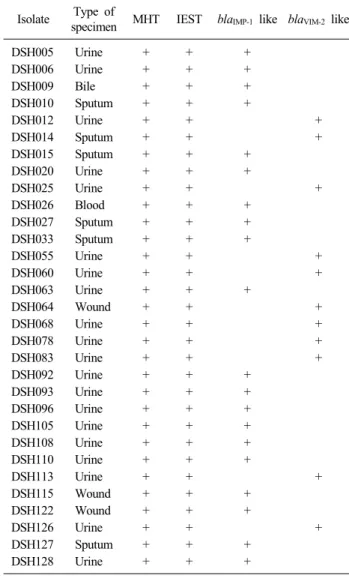
Table 2. Characteristics of metallo-β-lactamase producing P. aeruginosa Isolate Type of
specimen MHT IEST blaIMP-1 like blaVIM-2 like
DSH005 Urine + + +
DSH006 Urine + + +
DSH009 Bile + + +
DSH010 Sputum + + +
DSH012 Urine + + +
DSH014 Sputum + + +
DSH015 Sputum + + +
DSH020 Urine + + +
DSH025 Urine + + +
DSH026 Blood + + +
DSH027 Sputum + + +
DSH033 Sputum + + +
DSH055 Urine + + +
DSH060 Urine + + +
DSH063 Urine + + +
DSH064 Wound + + +
DSH068 Urine + + +
DSH078 Urine + + +
DSH083 Urine + + +
DSH092 Urine + + +
DSH093 Urine + + +
DSH096 Urine + + +
DSH105 Urine + + +
DSH108 Urine + + +
DSH110 Urine + + +
DSH113 Urine + + +
DSH115 Wound + + +
DSH122 Wound + + +
DSH126 Urine + + +
DSH127 Sputum + + +
DSH128 Urine + + +
Abbreviations: MHT, modified Hodge test; IEST, imipenem-EDTA synergy test.
Table 3. Metallo-β-lactamase genes detected in imipenem-nonsusceptible P. aeruginosa and A. baumannii by PCR Organism (No.) No. of isolates
with MHT positive
No. of isolates with IEST
No. of isolates with positive genes for
Total blaIMP-1-like blaIMP-6* blavim-2-like
P. aeruginosa (128) 51 31 15 5 11 31 (24.2%)
A. baumannii (93) 79 3 1 0 2 3 (3.2%)
Total (221) 130 34 16 5 13 34 (15.4%)
*Identified and confirmed as blaIMP-6[16].
Abbreviations: MHT, modified Hodge test; IEST, imipenem-EDTA synergy test.
chia coli ATCC 25922, which was adjusted to the turbidity of the McFarland No. 0.5 tube was inoculated evenly on a Mueller- Hinton agar (MHA) plate. Then, an imipenem disk (30 μg, BBL) was placed at the center of the plate and test strains were streaked from the edge of the disk to the end of the plate. The presence of a distorted inhibition zone after an incubation at 35oC for 18 hours was interpreted as a positive modified Hodge test. The test strains suspended to the McFarland No. 0.5 were used to in- oculate on a MHA plate. A 30 μg imipenem disk and a blank filter paper disk were placed 10 mm apart from edge to edge on MHA plate. Ten microliters of 0.5 M EDTA solution was applied to the blank disk and then plates were incubated at 35oC for 18 hours. The presence of an enlarged zone of inhibition was in- terpreted as EDTA-synergy test positive.
Multiplex PCR ampilification of MBL genes including blaIMP-1, blaVIM-1, and blaVIM-2 were performed[9,10](Table 1). The amplifi- cation conditions were: initial denaturation at 94oC for 5 minutes, 30 cycles of 94oC for 25 seconds, 52oC for 40 seconds, 72oC for 50 seconds, and a final elongation at 72oC for 7 minutes. Se- quencing analysis was then perform to determine specific en- zymes of MBLs as described previously[11] sending to the refer- ence laboratory.
RESULTS
One hundred twenty-eight P. aeruginosa isolates were from sputum (58), urine (45), body fluid (9), wound (7), blood (3), catheter tip (3), and others (3). Ninety-three A. baumannii isolates were from sputum (79), urine (5), wound (4), body fluid (2), cath- eter tip (2) and throat (1).
Thirty-one isolates (24.2%) of 128 imipenem-nonsusceptible P.
aeruginosa were found to be MBL producers. Eleven isolates (8.6%) were blaVIM-2 positive and 20 (15.6%) were blaIMP-1 posi- tive (Table 2). Among 93 imipenem-nonsusceptible A. baumannii, 3 isolates (3.2%) were positive for modified Hodge and imipe- nem-EDTA synergy test. Gene of blaVIM-2 was positive in 2 A.
baumannii isolates and only one was blaIMP-1 positive (Table 3).
Nam Hee Ryoo, et al. : Prevalence of MBLs in P. aeruginosa and A. baumannii
171
By DNA sequencing analysis of MBL producing strains in P. aer- uginosa, 5 out of 20 blaIMP-1 like positive isolates were IMP-6 and the rest were IMP-1. Eleven of blaVIM-2-like positive were VIM-2.
All the blaIMP-1-like and blaVIM-2-like in A. baumannii were IMP-1 and VIM-2, respectively.
DISCUSSION
Carbapenems such as imipenem and meropenem generally rep- resent last resources for the treatment of nosocomial infections produced by multidrug-resistant Gram-negative bacteria due to their broad antimicrobial activity spectrum and stability against most common β-lactamases[12]. However, emergence of resist- ance to these drugs becomes a threatening for the treatment of Gram-negative bacterial infection worldwide[4,10]. As the mecha- nisms of the carbapenem resistance have been studied, they are due to specific reductions in outer membrane permeability, efflux pump, alteration of penicillin-binding proteins and also presence of carbapenem-hydrolysing enzymes[5]. Production of carbapene- mases, especially MBLs, is becoming a leading cause of the re- sistance and considered to be more important than other mecha- nisms due to the horizontal spread of plasmids[2,3].
Ambler class B carbapenemases, MBLs, such as IMP, VIM and SIM are frequently detected enzyme types in imiepnem-resistant P. aeruginosa and A. baumannii in Korea[12-14]. For class B car- bapenem-hydrolysing enzymes, IMP-1 is found out to be more prevalent MBL type than VIM-2 type among imipenem-non- susceptible P. aeruginosa in our study. The results were consistent with other reports of Daegu and Busan, near city in Korea[14,15].
We were able to find an outbreak of IMP-6 positive P. aeruginosa retrospectively during this study and reported for the first time in Korea[16]. However, VIM-2 type was the most frequently de- tected in other regions of Korea[8,17,18]. Only three isolates of A. baumannii had MBLs, 2 for VIM-2 and 1 for IMP-1 in this study. Considering that the isolates of imipenem-resistant A. bau- mannii have increased abruptly in our hospital since 2003, carba- penemases other than MBLs and or other resistant mechanisms could be present and further affect the prevalence of carbapenem nonsusceptibility. It was very regretful that we could not perform any epidemiological studies to determine the clonality of the imi- penem-nonsusceptible isolates. Therefore, our infection control committee recently started to surveillance the prevalence and out- breaks since then and to collect the isolates to perform the molec- uloepidemiological studies, if possible.
Early recognition of carbapenemase producers among patho- genic isolates and a preliminary characterization of the type of en- zyme produced are considered to an essential step for infection control in the hospital. Guiding the use of antibiotics that may fa- vor the spread of carbapenemase producing bacteria also plays an important role in infection-control measures[4]. We give attention to increased prevalence of any multidrug-resistant organisms and also to outbreaks, especially in intensive care units. Larger num- bers of isolates including closer districts within Daegu and se- quential studies for annual prevalence are strongly recommended
for the useful evaluation and monitoring of carbapenemase pro- ducing Gram-negative bacteria.
ACKNOWLEDGEMENTS
The present research has been conducted by the Bisa Research Grant of Keimyung University in 2006.
REFERENCES
1. Jacoby GA and Medeiros AA. More extended-spectrum beta- lactamases. Antimicrob Agents Chemother 1991;35:1697-704.
2. Nordmann P and Poirel L. Emerging carbapenemases in Gram- negative aerobes. Clin Microbiol Infect 2002;8:321-31.
3. Queenan AM and Bush K. Carbapenemases: the versatile beta- lactamases. Clin Microbiol Rev 2007;20:440-58.
4. Cornaglia G, Akova M, Amicosante G, Cantón R, Cauda R, Docquier JD, et al. Metallo-beta-lactamases as emerging resistance determinants in Gram-negative pathogens: open issues. Int J Antimicrob Agents 2007;29:380-8.
5. Walther-Rasmussen J and Høiby N. OXA-type carbapenemases. J Antimicrob Chemother 2006;57:373-83.
6. Lee H, Kim CK, Lee J, Lee SH, Ahn JY, Hong SG, et al.
Antimicrobial resistance of clinically important bacteria isolated from 12 hospitals in Korea in 2005 and 2006. Korean J Clin Microbiol 2007;10:59-69.
7. Hong SG, Lee J, Yong D, Kim EC, Jeong SH, Park YJ, et al.
Antimicrobial resistance of clinically important bacteria isolated from 12 hospitals in Korea. Korean J Clin Microbiol 2004;7:171-7.
8. Lee K, Yong D, Yum JH, Lim YS, Bolmström A, Qwärnström A, et al. Evaluation of E test MBL for detection of blaIMP-1 and blaVIM-2 allele-positive clinical isolates of Pseudomonas spp. and Acinetobacter spp. J Clin Microbiol 2005;43:942-4.
9. Poirel L, Naas T, Nicolas D, Collet L, Bellais S, Cavallo JD, et al. Characterization of VIM-2, a carbapenem-hydrolyzing metallo- beta-lactamase and its plasmid- and integron-borne gene from a Pseudomonas aeruginosa clinical isolate in France. Antimicrob Agents Chemother 2000;44:891-7.
10. Lee K, Ha GY, Shin BM, Kim JJ, Kang JO, Jang SJ, et al.
Metallo-beta-lactamase-producing gram-negative bacilli in Korean nationwide surveillance of antimicrobial resistance group hospitals in 2003: continued prevalence of VIM-producing Pseudomonas spp. and increase of IMP-producing Acinetobacter spp. Diagn Microbiol Infect Dis 2004;50:51-8.
11. Lee K, Lim JB, Yum JH, Yong D, Chong Y, Kim JM, et al.
blaVIM-2 cassette-containing novel integrons in metallo-beta-lacta- mase-producing Pseudomonas aeruginosa and Pseudomonas putida isolates disseminated in a Korean hospital. Antimicrob Agents Chemother 2002;46:1053-8.
12. Thomson JM and Bonomo RA. The threat of antibiotic resistance in Gram-negative pathogenic bacteria: beta-lactams in peril! Curr Opin Microbiol 2005;8:518-24.
13. Lee S, Park YJ, Kim M, Lee HK, Han K, Kang CS, et al. Pre- valence of Ambler class A and D beta-lactamases among clinical isolates of Pseudomonas aeruginosa in Korea. J Antimicrob Che- mother 2005;56:122-7.
14. Yoon WS, Lee BY, Bae IK, Kwon SB, Jeong SH, Jeong TJ, et al.
Prevalence of imipenem-resistant Pseudomonas aeruginosa isolates and mechanisms of resistance. Korean J Clin Microbiol 2005;
8:26-33.
172
Korean J Clin Microbiol 2010;13(4):169-172 15. Nho SO, Jin JS, Kim JW, Oh JY, Kim J, Lee YC, et al. Disse-mination of the blaIMP-1 and blaVIM-2 metallo-beta-lactamase genes among genetically unrelated Pseudomonas aeruginosa isolates in a South Korean hospital. Int J Antimicrob Agents 2008;31:586-8.
16. Ryoo NH, Lee K, Lim JB, Lee YH, Bae IK, Jeong SH. Outbreak by meropenem-resistant Pseudomonas aeruginosa producing IMP-6 metallo-beta-lactamase in a Korean hospital. Diagn Microbiol Infect Dis 2009;63:115-7.
17. Oh EJ, Lee S, Park YJ, Park JJ, Park K, Kim SI, et al. Prevalence
of metallo-beta-lactamase among Pseudomonas aeruginosa and Acine- tobacter baumannii in a Korean university hospital and comparison of screening methods for detecting metallo-beta-lactamase. J Micro- biol Methods 2003;54:411-8.
18. Kim IS, Lee NY, Ki CS, Oh WS, Peck KR, Song JH. Increasing prevalence of imipenem-resistant Pseudomonas aeruginosa and molecular typing of metallo-beta-lactamase producers in a Korean hospital. Microb Drug Resist 2005;11:355-9.
=국문초록=
Pseudomonas aeruginosa
와Acinetobacter baumannii
에서의 Metallo-β-lactamase의 유병률계명대학교 의과대학 진단검사의학교실 류남희, 하정숙, 전동석, 김재룡
배경: 그람음성막대균에서의 metallo-β-lactamase에 대한 연구가 지속되고 있으며 카바페넴을 포함한 대부분의 β-lactam 제제를 가수분해하므로 임상적 중요성이 점차 증가되고 있다. 본 연구는 일개 대학병원에서 분리된 이미페넴에 비감수 성 Pseudomonas aeruginosa와 Acinetobacter baumannii를 대상으로 metallo-β-lactamase의 유병률을 조사하였다.
방법: 임상검체에서 분리된 이미페넴 비감수성인 128주의 P. aeruginosa와 93주의 A. baumannii를 대상으로 Vitek GNI와 GNS 카드를 이용하여 균의 동정과 감수성검사를 실시하였다. Hodge 변법과 imipenem-EDTA synergy 검사를 이용하여 metallo-β-lactamase의 생성유무를 확인하였다. blaIMP-1, blaVIM-1 그리고 blaVIM-2 유전형검사는 다중분획중합효소연쇄반응 법을 이용하였다
결과: 총 31주의 P. aeruginosa (24.2%)와 3 A. baumannii (3.2%)에서 metallo-β-lactamase를 생성하였다. P. aeruginosa 31주 중 20 (15.6%)주에서 blaIMP-1를 11 (8.6%)주에서는 blaVIM-2를 생성하였으며 A. baumannii에서는 1 (1.0%)주에서 blaIMP-1를, 2 (2.2%)주에서 blaVIM-2를 생성하였다.
결론: 본 연구결과, 다른 연구와는 달리 이미페넴 비감수성 P. aeruginosa에서 IMP-1이 VIM-2유전자보다 더 흔한 것으로 나타났다. 병원 내 감염관리와 metallo-β-lactamase의 유전형의 지역적 역학분석을 위하여 보다 많은 균주를 대상으로 지속적인 연구가 필요할 것으로 생각한다. [대한임상미생물학회지 2010;13:169-172]
교신저자 : 류남희, 700-712, 대구시 중구 동산동 194 계명대학교 의과대학 진단검사의학교실 Tel: 053-250-7950, Fax: 053-250-7275 E-mail: [email protected]