Original Article: Food Science/Microbiology
Enhanced Anti-oxidant Activity Effects of Smilax china L. Rhizome Water Extracts Added with Its Fermented Leaf Water Extracts
Sang-Il Lee · Ye-Kyung Lee · Soon-Dong Kim · Soon-Mi Shim · Seung Hwan Yang · Jinhua Cheng · Joo-Won Suh*
발효 청미래덩굴잎 추출물의 혼합에 의한 토복령의 항산화활성 증진효과
이상일 · 이예경 · 김순동 · 심순미 · 양승환 · 성금화 · 서주원*
Received: 14 October 2013 / Accepted: 21 November 2013 / Published Online: 30 June 2014
© The Korean Society for Applied Biological Chemistry 2014
Abstract To evaluate the improving effects of antioxidant activity, we observed antioxidant capacities such as electron donating ability (EDA), Ferric reducing antioxidant power (FRAP), inhibitory activity of xanthine oxidase (XO) and aldehyde oxidase (AO), and sensory characteristics on mixture of Smilax china L. root water extract added with water extract of fermented S. china L. leaf by Aspergillus oryzae (FSCL). Those contents of mixture with higher ratio of FSCL were proportionally high. And OD475 of mixture with higher ratio of FSCL was almost proportionally high (R
2= 0.9850). Antioxidant capacities of EDA and FRAP of the mixture was higher than that of non-mixture. In addition, XO inhibitory activity (IC
50) of A (1.19) was 59.80% higher than that of F
(2.96), and the activity of mixture by the higher ratio of FSCL was proportionally low (R
2=0.9490). Taste acceptability of A was slightly higher than that of F, whereas that of C was highest. And color acceptability of 40−80% mixture was higher than those of A, F, and B. Overall acceptability of C and D was highest than those of others. Moreover, hot water extract of S. china L. leaf fermented with A. oryzae was maroon color, which looks like Puerh tea style, and mixture of S. china L. root extract added with hot water extract of S. china L. leaf was high acceptability of beverage. These results suggest that mixture of extract of S. china L. root and hot water extract of S. china L. leaf fermented with A.
oryzae could improve antioxidant activities.
Keywords aldehyde oxidase · anti-oxidant activity · Aspergillus oryzae · mixing effect · Smilax china L. · xanthine oxidase
서 론
청미래덩굴(Smilax china L.)은 우리나라 산야에 널리 분포하는 활엽덩굴성 관목으로 그 근경(rhizome)인 토복령은 고뇨산혈증 의 치유 및 신장보호 작용(Chen 등, 2011)이 있어 주로 통풍의 치료제(Shu 등, 2006)로 쓰이나 해독(Cheng과 Hua, 2006), 항 염, 항암 및 항산화 효과(Shu 등, 2006; Li 등, 2007)가 알려져 있다. 통풍은 요산의 과잉생성 또는 배설부진으로 오는 고뇨산 혈증으로 요산의 결정체가 관절부위에 축적되어 통증을 유발하 는 질환(Chena 등, 2011)이며, 요산은 식이로 섭취된 핵산 또는 de novo합성된 purine 염기의 대사과정에서 hypoxanthine 및 xanthine이 xanthine oxidoreductase (XOR)의 촉매작용에 의하 여 생성되며(Parks과 Granger, 1986), 여기에 aldehyde oxidase S.-I. Lee
Department. of Food, Nutrition and Cookery, Keimyung College, Daegu 704-703, Republic of Korea
Y.-K. Lee · S.-D. Kim · S. H. Yang · J. Cheng · J.-W. Suh
Center for Nutraceutical and Pharmaceutical Materials, Myongji University, Gyeonggi-do 449-728, Republic of Korea
S.-M. Shim
Department of Food Science and Technology and Carbohydrate Bioproduct Research Center, Sejong University, Seoul 143-747, Republic of Korea.
J.-W. Suh
Division of Bioscience and Bioinformatics, College of Natural Science, Myongji University, Gyeonggi-do 449-728, Republic of Korea
*Corresponding author (J.-W. Suh: [email protected])
This is an Open Access article distributed under the terms of the Creative Commons Attribution Non-Commercial License (http://creativecommons.
org/licenses/by-nc/3.0/) which permits unrestricted non-commercial use, distribution, and reproduction in any medium, provided the original work is properly cited.
(AO)도 관여한다는 보고도 있다(Beedham, 1987). AO는 간, 폐 및 신장 등의 세포질에 다량으로 존재하는 효소(Al-Salmy, 2001)로 xanthine oxidase (XO)와 분자량이 유사할 뿐만 아니라 XO와 같이 flavin adenine dinucleotide, molybdenum 및 철-유 황과 같은 보결분자단을 가지고 있으며 기질특이성에서 다소 차 이는 있으나 작용에 있어서 XO와 밀접한 관련이 있다 (Beedham, 1987). 또한 AO는 항암제(methotrexate) 및 항바이 러스제(famciclovir)와 같은 약물을 포함한 aldehyde 및 질소를 함유하는 heterocyclic compounds의 산화에 관여하며(Beedham, 1987; Clarke 등, 1995; Jordan 등, 1999; Kawashima 등, 1999; Kitamura 등, 1999), 체내 내외인성 기질들의 산화 과정 중에 superoxide와 같은 Reactive oxygen species (ROS)를 생 성(Mira 등, 1995; Kundu 등, 2007)할 뿐만 아니라 알코올성 간 손상의 유도(Shaw와 Jayatilleke, 1990), 고지방 식이에 의한 지방간 생성유도(Conklin 등, 2007; Weigert 등, 2008), 지방세 포의 분화(Huang과 Ichikawa 1994; Mercader 등, 2006)에 관 여함으로써 비만조절과 간 손상의 예방 및 항암제 개발에 대한 표적효소로 알려져 있다(Pryde 등, 2010; Garattini과 Terao 2011). 토복령이 가지고 있는 상기의 효과들은 근원적으로 항산 화활성을 나타내는 polyphenol 성분인 kaempfrol-7-O-β-D- glucoside (Shu 등, 2006), astilbin 및 3-O-methylastilbin (Guo, 2007), chlorogenic acid, caffeic acid, polydatin, resveratrol, astillbin, rutin 및 oxyresveratrol (Chen 등, 2011)에 근거하는 것으로 밝혀져 있다. 한편, 청미래덩굴의 잎에서도 항균 및 항 산화 효과(Song 등, 2006; Ko와 Yang, 2011)가 있으며 α- tocopherol 수준의 높은 항산화활성을 가지는 kaempferol-7-O-α-
L-rhamnopyranoside와 kaempferol-3,7-O-α-L-dirhamno-pyranoside 가 함유되어 있으며(Cha와 Lee, 2007), 발효에 의하여 관능적 품질 향상과 XO 및 AO에 대한 저해활성이 더 강한 aglycone 으로 분해되는 것으로 알려져 있다(Lee, 2012; Hamzeh- Mivehroud, 2013).
본 연구에서는 토복령의 기능성을 향상시키기 위한 한 방안 으로 그 열수추출물에 Aspergillus oryzae로 발효시킨 청미래덩 굴잎 열수 추출물을 혼합하였을 때 열수추출액의 최대흡수파장 에서의 흡광도, 총 polyphenol 및 총 flavonoid 함량을 비교하 는 동시에 항산화활성의 지표로 알려진 전자공여능과 철 환원 력을 측정하였으며, 체내 활성산소 생성계효소로 알려진 XO와 AO에 대한 저해활성이 미치는 영향을 조사하였다.
재료 및 방법
재료, 균주 및 종균배양. 실험에 사용한 청미래덩굴(Smilax china L.) 잎은 2013년 5월에 경북 경산시 남산면의 야산에서 채취하여 이상일 교수(계명문화대학 식품영양조리학부)에 의해 검수된 것을 사용하였고, 40oC에서 충분히 건조시킨 후 Food Mixer (HNF-1710, Hanil Electric Co Ltd, Korea)를 사용하여 40 mesh로 분쇄하였다. 근경(토복령)은 2−3 mm 두께로 엷게 썰 어 말린 것을 약재상(Kapdang Herbs, Korea)에서 구입하였다.
발효용 균주는 한국종균협회에서 분양 받은 Aspergillus oryzae KFRI 995를 사용하였으며, malt extract (BactoTM, Becton, Dickinson and Co., USA)에 이식하여 25oC에서 10−15일간 진 탕배양한 후 제균한 Food Mixer (NF-1710, Hanil Electric Co. Ltd., Korea)로 30초 동안 분쇄하여 균수를 108 cells/mL로
조정하여 종균으로 사용하였다.
청미래덩굴잎의 발효. 청미래덩굴잎의 발효는 분말 시료 1 kg에 대하여 종균 배양액 100 mL을 가하여 혼합한 살균수 2 L을 섞 어 첨가한 수분함량을 67%로 조정하였다. 다음에 70% ethanol 로 제균한 플라스틱 발효상자(가로 40×세로 60×높이 12 cm)에 두께 3−5 cm 정도로 펴 담은 후 polyethylene film으로 밀봉하 여 25oC에서 10일간 발효시켰다. 발효가 끝난 청미래덩굴잎은 polypropylene bag에 담아 121oC에서 60분간 증자한 후 45−50
oC에서 건조시켜 발효 청미래덩굴잎을 제조하였다.
열수 추출물의 조제. 발효청미래덩굴잎의 열수추출은 시료 20 g에 90−95oC의 증류수를 가하여 1 L가 되게 하여 5분간 추출 하였으며 Whatman No. 2 여과지(Whatman International Ltd, England)로 여과하여 2% 발효청미래덩굴잎 추출물(fermented S.
china L. leaf: FSCL)을 얻었다. 토복령의 열수추출(S. china L.
rhizome: SCLR)은 통상의 방법(Kapdang Herbs, Korea)에 준하 여 시료 20 g에 증류수 2 L을 가하여 30분간 가열, 추출한 후 여과하고 그 여액을 1 L가 되게 가열, 농축하여 최종농도가 2%
로 조정하였다.
혼합조건. 토복령과 발효청미래덩굴잎 추출물의 혼합은 각 2%
열수추출물을 Chung (1971)의 binary interaction을 조사하기 위 한 system에 준하여 Table 1에서와 같이 FSCL : SCLR의 혼합 비율을 0:100 (발효청미래덩굴잎 무첨가), 20:80 (20% 첨가), 40:60 (40% 첨가), 60:40 (60% 첨가), 80:20 (80% 첨가) 및 100:0 (토복령 추출물 무첨가)으로 설계하여 상호 혼합에 의한 영향을 조사하였다(Table 1).
Total polyphenol 및 total flavonoid 함량. Total polyphenol (TP) 함량은 Minussi 등(2003)의 방법에 따라 물 추출액 100 µL에 2% sodium carbonate 2 mL와 50% Folin-Ciacalteu reagent 100µL를 가한 후 720 nm에서 흡광도를 측정하였으며, gallic acid (Sigma-Aldrich Co., USA)의 표준검량선에 의하여 함량을 산출하였다. Total flavonoid (TF) 함량은 Meda 등 (2005)의 방법에 따라 물 추출액 1 mL에 2% aluminum chloride 1 mL와 50% 에탄올 1 mL를 혼합하여 실온에서 10분간 반응시 킨 다음 415 nm에서 흡광도를 측정하였으며, 표준품 quracetin (Sigma-Aldrich Co., USA)의 표준검량선에 의하여 함량을 산출 하였다.
물 추출액의 색상과 OD475의 측정. 발효청미래덩굴잎 물 추출 액의 색상은 Chromameter (CR-200, Minolta Co., Japan)를 이 용하여 밝기를 나타내는 L*(lightness), 적색도를 나타내는 a*
(redness) 및 황색도를 나타내는 b* (yellowness) 값을 측정하였 다. 이때 사용한 표준백판의 L*, a* 및 b*값은 각각 94.50, 0.3132, 0.3203이었다. 열수추출액의 갈색도는 Recording Spectrophometer (Cary Winuv, Varian, Korea)를 사용하여 Table 1 Mixing ratio of fermented leaf, and hot water root extracts of Smilax china L.
Extracts1) Mixing ratio (volume)
A B C D E F
FSCL 02) 20 40 60 80 100
SCLR 100 80 60 40 20 0
1)Abbreviations: FSCL; fermented Smilax china L. leaf, SCLR; Smilax china L. root.
2)Parenthesis denotes the mixing ratio between the FSCL and SCLR.
400−700 nm에서의 흡광도를 recording하여 얻어진 최대파장인 475 nm에서의 흡광도를 측정하였다.
전자공여능. 전자공여능(electron donating ability: EDA)은 Blois (1958)의 방법에 따라 물 추출액 0.2 mL에 0.4 mM DPPH (1,1diphenyl-2-picryl-hydrazyl) 용액 0.8 mL를 가하여 10분간 방치한 다음 520 nm에서 흡광도를 측정하였으며 계산 식, 전자공여능(%)=[1−(시료흡광도/대조구 흡광도)]×100에 의하 여 활성도를 산출하였다.
Ferric reducing antioxidant power (FRAP). FRAP는 Hayes 등(2011)의 방법에 따라 시료추출액 0.05 mL에 증류수 0.05 mL을 가하여 혼합한 후 0.3 M sodium acetate buffer (pH 3.60), 10 mM 2,4,6-tris(2-pyridyl)-s-triazine을 함유하는 40 mM HCl 용액 및 20 mM FeCl3 용액(10:1:1, v/v) 혼합용액 1.90 mL를 가하여 37oC에서 30분간 반응시킨 후 593 nm에서 흡광 도를 측정하였다. 대조구는 추출액 대신에 추출용매를 사용하였 으며 활성도는 molar extinction coefficient (21.25 mM−1 cm−1) 를 이용하여 건조시료 g당 Fe3+이 Fe2+로 환원된 량을 µmole로 나타내었다.
AO 및 XO 저해활성. 발효 청미래덩굴잎 열수추출액이 토끼 간 조직으로부터 부분 정제한 AO 및 XO에 저해활성은 다음과 같
이 측정하였다. 실험동물의 사육과 사용 등 실험과정이, 실험이 행하여진 기관(세종대학교)의 윤리위원회 승인을 받았고 해당 연구기관의 윤리위원회 규정에 저촉되지 않게 실시하였다. 효소 원으로 사용한 AO와 XO는 Rajagopalan 등(1962)의 방법에 따 라 토끼의 간 조직에 4배량의 0.1 mM potasium phosphate buffer (pH 7.4)를 가하여 마쇄, 균질화 시킨 후 60oC에서 2분간 열처 리하여 생성되는 침전물을 10,000 g에서 원심분리하여 제거하였 다. 얻어진 상등액은 30% 이상 50% 이하의 ammonium sulfate 포화용액에서의 침전물을 원심분리하여 얻은 후 동일 buffer에 현탁시키고 50% acetone 용액에서의 침전물을 얻었으 며, 투석막(분자량 2,000 이하를 제거)을 이용하여 12시간 동안 투석한 후 원심분리하여 얻어진 상등액을 −70oC에서 보관하면 서 효소원으로 사용하였다. XO 활성도는 Stirpe와 Della Corte (1969)의 방법에 따라 기질 xanthine을 요산으로의 전환율 정도 를 %로 나타내었으며, AO 활성도는 Rajagopalan 등(1962)의 방법에 따라 기질 NMN (N1-methyl nicotinamide)으로부터 산 화된 pyridone의 흡광도를 300 nm에서 측정한 다음 시료대신에 증류수를 첨가한 대조구에 대한 %로 나타내었다.
관능검사. 혼합액에 대한 관능검사는 향, 맛, 색상, 후미 및 종 합적인 기호도에 대하여 25명의 관능요원에 의하여 아주 나쁘 다(1점), 나쁘다(2점), 보통이다(3점), 좋다(4점), 아주 좋다(5점) 로 평가하였으며 평균값과 표준편차로 나타내었다. 관능요원은 차를 연구 교육하는 (사)우리차문화연합회의 40−60세의 여성회 원 25명으로 주 1회 4시간씩 4주간 차의 향, 맛, 색상, 밝기, 후미 및 종합적인 기호도에 대한 교육을 행하였다.
통계처리. 분석은 3회 반복으로 실험하여 평균치와 표준편차로 나타내었고, 관능검사는 관능요원 25명의 평균값과 표준편차로 나타내었다. 유의성 검증은 version 12의 SPSS (Statistical Package for Social Sciences, SPSS Inc, Chicago, IL, USA) software package program을 이용하여 Duncan’s multiple range test를 행하였다.
결과 및 고찰
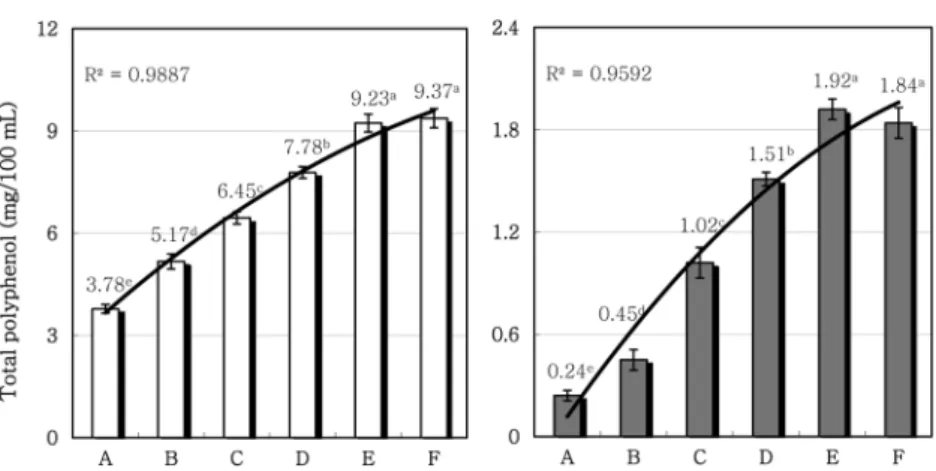
TP 및 TF 함량. 발효청미래덩굴잎의 2% 열수추출물과 토복령 2% 열수추출물을 0:100 (A), 20:80 (B), 40:60 (C), 60:40 (D), 80:20 (E) 및 100:0 (F)의 비율(v/v %)로 혼합하였을 때 TP 및 TF 함량의 변화를 조사한 결과는 Fig. 2와 같다. 2% 토복 령 열수추출물(A)과 2% 발효청미래덩굴잎 열수추출물(F)의 TP 함량은 각각 3.78 및 9.37 mg/100 mL, TF 함량은 0.24 및 1.84 mg/100 mL으로 발효청미래덩굴잎의 경우가 TP는 2.48배, TF는 7.67배가 높았다. 그리고 발효청미래덩굴잎의 열수추출물 의 첨가비율이 높아질수록 TP와 TF의 함량이 비례적으로 증가 되었으며(R2=0.9887, R2=0.9592), 그 증가율은 TF의 경우가 TP 에 비하여 높은 경향을 나타내었다. Polyphenol성분은 항산화 작용을 비롯한 다양한 생리활성(Holasova 등, 2002)을 나타내나 한편으로는 polyphenol 성분의 함량이 높을수록 hydrogen peroxide의 함량이 높으며(Arakawa 등, 2004), 강한 삽미를 나 타낼 뿐만 아니라 단백질 및 소화효소와 결합함으로써 소화성 을 떨어트리는 작용이 있다(Lesschaeve와 Noble, 2005). 그러나 세계적으로 녹차에 비하여 발효차의 이용율이 현저하게 높은 것 은 발효에 의하여 polyphenol 성분이 가지는 떫은맛을 제거시 킴으로써 기호성을 높이고 소화성을 높임과 동시에 색상성분을 Fig. 1 Fermentation procedure of Smilax china L. leaf by Aspergillus
oryzae.
포함한 새로운 기능성성분들을 생성케 함으로서 품질을 향상되 는데 그 원인이 있는 것으로 사료 된다(Zuo 등, 2002; Ngure 등, 2009) (Fig. 2).
흡광도의 변화. 발효청미래덩굴잎의 열수추출물의 차류로 활용 하기 위하여 관능검사용 추출액을 시료로 하여 흡광도 값을 측 정하였다. 발효청미래덩굴잎의 열수추출액은 475 nm에서 maximum peak을 보인다. Fig. 3에서는 발효청미래덩굴잎 2%
열수추출물을 0, 20, 40, 60, 80 및 100% 함유하는 토복령 2% 열수추출물의 475 nm에서의 흡광도(OD475)를 측정한 결과 로 발효청미래덩굴잎 2% 열수추출물의 첨가비율이 높아질수록 거의 비례적으로 높은 흡광도를 나타내었다(R2=0.9850). 혼합액 의 색상에서 보는 바와 같이 발효청미래덩굴잎 열수추출물을 첨 가하지 않은 2% 토복령의 열수추출물은 연한 자색을 띠었으나 발효청미래덩굴잎 열수추출물의 첨가율이 높아질수록 토복령 추 출물에서 보였던 자색은 점차적으로 나타나지 않는 반면 발효 청미래덩굴잎 추출물의 색상이 강하게 나타났으며 60−80% 첨 가한 경우는 2% 발효청미래덩굴잎 열수추출물의 색상과 유사 하였다.
청미래덩굴잎의 발효에 사용한 Aspergillus oryzae는 우리나라 의 메주발효 미생물로 amylase, protease와 같은 효소를 강력하 게 분비할 뿐만 아니라 pectinase와 같은 식물체 세포벽성분의
분해에 관여하는 효소를 분비함으로써 세포벽에 강하게 결합되 어 용출되기 어려운 성분들을 탈리시켜 가용화 할 수 있도록 하는 효과가 있다(Angayarkanni 등, 2002). 또한 식물체에 널리 분포하는 떫은 맛의 원인이 되는 gallotannins을 비롯한 gallic acid esters의 depside결합과 ester결합의 가수분해에 관여하는 tannase를 분비함으로써 polyphenol의 함량과 떫은맛을 감소시 키는 효과가 있으며(Garcia-Conesa 등, 2001), polyphenol성분의 산화에도 관여함으로써 무색의 polyphenol성분을 아름다운 색상 으로 변화시키는데도 관여하는 것으로 사료된다(Fig. 3).
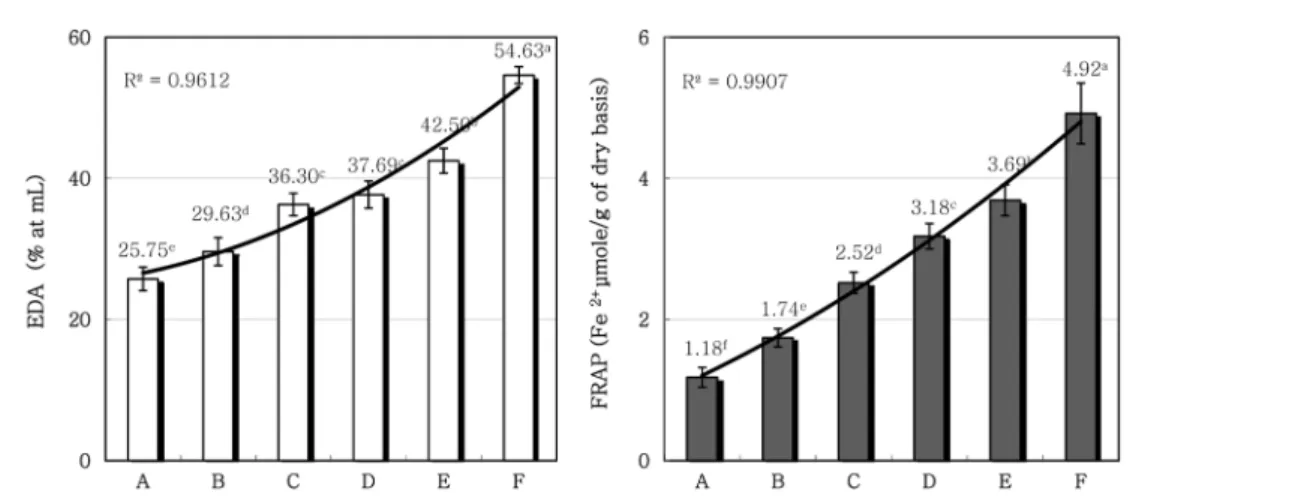
EDA 및 FRAP. 발효청미래덩굴잎 2% 열수추출물의 첨가에 따 른 2% 토복령 열수추출물의 EDA 및 FRAP의 변화를 조사한 결과는 Fig. 4와 같다. 발효청미래덩굴잎 2% 열수추출물을 첨 가하지 않은 2% 토복령 열수추출물의 EDA (% at mL)는 25.75%이었으나 토복령이 첨가되지 않은 발효청미래덩굴잎 2%
열수추출물의 EDA는 54.63%로 발효청미래덩굴잎의 경우가 2.12배가 높았으며 발효청미래덩굴잎 열수추출물의 첨가비율이 높아질수록 EDA도 높아지는 경향을 보였다(R2=0.9668). FRAP (Fe2+ µmole/g of dry basis)의 경우도 EDA와 마찬가지로 2%
토복령 열수추출물에서는 1.18이었으나 2% 발효청미래덩굴잎 열수추출물에서는 4.92로 발효청미래덩굴잎의 경우가 4.17배가 높았으며, 발효청미래덩굴잎 열수추출물의 첨가비율이 높아질수 Fig. 2 Mixing effects of FSCL and SCLR extracts on the contents of total polyphenol and total flavonoid. Abbreviations and mixing conditions: See Table 1. Values are mean ± standard deviation of triplicate determination, different letters on the bars (A−E) indicate significant differences (p <0.05).
Fig. 3 Mixing effects of FSCL and SCLR extracts on the OD at 475nm and color. Abbreviations and mixing conditions: See Table 1. Values are mean ± standard deviation of triplicate determination, different letters on the bars (A−E) indicate significant differences (p <0.05).
록 비례적으로 높아지는 경향을 나타내었다(R2=0.9907).
전자공여능은 항산화능을 나타내는 지표(Choi 등, 2003)의 하 나로 phenolic acid 및 flavonoid 등과 같은 polyphenol 성분의 함량이 높을수록 전자공여능도 높아지며(Torel 등, 1986), 환원 력은 산화물을 원래의 상태로 환원시키는 힘으로 항산화를 나 타내는 중요한 지표로 활용되고 있으며(Song 등, 2006), 전자공 여능이 높을수록 환원력도 높아지는 것으로 알려져 있다(Kang 등, 1995).
따라서 이상의 결과는 토복령 열수추출물에 함유하는 발효청 미래덩굴잎 열수추출물의 함량이 높아질수록 항산화능이 높아 짐을 나타내며 그 효과는 EDA에 비하여 FRAP에서 더욱 큼을 나타낸다(Fig. 4).
XO 및 AO에 대한 저해활성. 발효청미래덩굴잎 열수추출물의 첨가비율에 따른 토복령 열수추출물의 XO 및 AO에 대한 저 해활성의 변화를 조사한 결과는 Fig. 5와 같다. 발효청미래덩굴 잎 열수추출물을 첨가하지 않은 2% 토복령 열수추출물(A)의 XO에 대한 저해활성(mg/mL of IC50)은 1.19로 2% 발효청미래 덩굴잎 열수추출물(F)의 2.96에 비하여 59.80%가 높았으며, 발 효청미래덩굴잎 열수추출물의 첨가비율이 높아질수록 비례적으 로 감소하였다(R2=0.9490). 그러나 AO에 대한 저해활성(mg/mL
of IC50)은 XO의 경우와 반대로 A에서는 3.37, F에서는 1.41로 F의 경우가 A에 비하여 58.16%의 높은 저해활성을 나타내었으 며, 발효청미래덩굴잎 열수추출물의 첨가비율이 높아질수록 저 해활성도 높아지는 경향을 보였다. 즉, 발효청미래덩굴잎 열수 추출물의 첨가비율이 높아질수록 XO에 대한 저해활성은 감소 되나 AO에 대한 저해활성은 높아지는 형상을 보였다.
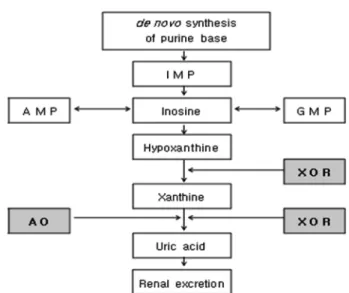
XO는 XOR (xanthine oxidoreductase)의 O type (xanthine oxidase) 효소로 D type 효소(xanthine dehydrogenase)와 함께 식이로부터 섭취된 nucleic acid나 체내에서 de novo 합성된 purine체인 hypoxanthine을 xanthine으로 산화시켜 요산을 생성 (Fig. 6)할 뿐만 아니라 pyrimidine, aldehyde류 및 heterocyclic 화합물의 대사에도 관여하는 비 특이적인 효소(Park 등, 1997) 로 정상적 생리상태에서는 NAD+를 전자수용체로 이용하는 D type으로 작용하나 병태적 상태에서는 분자상의 O2를 전자수용 체로 이용하는 O type으로 작용 한다(Parks과 Granger, 1986;
Roy 와 McCord, 1982). 한편 AO는 XOR과 생화학적으로 매 우 유사한 효소(Beedham, 1987)로 기질특이성에서 다소의 차이 는 있으나 XOR에서와 같이 pyrimidine, purine, pteridine 유도 체 등의 산화에 관여(Maia와 Mira, 2002)할 뿐만 아니라 항암 제(Fabre 등, 1986; Yee와 Pritsos 1997; Rashidi 등, 2007;
Fig. 4 Mixing effects of FSCL extract in SCLR extracts on electron donating ability (EDA) and ferrous reducing antioxidant power (FRAP).
Abbreviations and mixing conditions: See Table 1. Values are mean ± standard deviation of triplicate determination, different letters on the bars (A−F) indicate significant differences (p <0.05).
Fig. 5 Mixing effects of FSCL and SCLR extracts on XO and AO inhibitory activities (IC50). Abbreviations and mixing conditions: See Table 1 Values are mean ± standard deviation of triplicate determination, different letters (A−F) indicates significant differences (p <0.05).
Itoh, 2009), 항고혈압제(Dambrova 등, 1998)의 환원에도 관여 하며, XOR이 결핍된 경우에는 XOR의 활성저해제인 allopurinol의 대사에도 관여 한다(Reiter 등, 1990; Moriwaki 등, 1993). 또한 이들 효소들은 분자상 산소를 전자수용체로 이 용하여 superoxide와 hydrogen peroxide 등과 같은 ROS를 생 성함으로써 ROS 관련 질병(Sahinoglu 등, 1996; Wright와 Repine, 1997; Wright 등, 1999; Kundu 등, 2007)과 에탄올 (Kato 등, 1990; Shaw와 Jayatilleke, 1990; Mira 등, 1995) 및 thioacetamide와 chloroform 등과 같은 간 독소에 의한 간 손상유도(Ali 등, 2008)에 관여하며, adipocyte의 분화, 지질의 저장 및 adiponectin의 분비(Weigert 등, 2008)에 관여하며, 고 지방식이 또는 에탄올성 지방간의 생성에도 관여 한다(Shaw 와 Jayatilleke, 1990).
따라서 이상의 결과와 문헌적인 지경들을 종합해볼 때 토복 령 열수추출물에 발효청미래덩굴잎 열수추출물을 혼합함으로써 비록 XO에 대한 저해활성은 다소 감소되나 XO에 대한 저해 활성의 감소율 이상으로 AO에 대한 저해활성을 증가시킴과 동 시에 전자공여능과 환원력과 같은 항산화활성을 증가시키는 효 과가 있어 이에 대한 활용이 기대된다(Fig. 5와 6).
관능적 품질. 발효청미래덩굴잎 열수추출물의 혼합비율에 따른 토복령 열수추출물의 음료로서의 품질을 조사하기 위하여 향 (aroma), 맛(taste), 색상(color), 입맛(mouth feel) 및 종합적 품 질에 대한 기호도를 5점 측도법으로 조사한 결과는 Table 2와 같다. 향에 대한 기호도는 A와 F에서는 각각 2.77 및 2.72점으 로 비슷한 값을 보였으며 발효청미래덩굴잎 열수추출물을 20−
80비율로 혼합하였을 때는 다소 향상되는 경향을 나타내었으나 상호간의 유의적인 차이는 없었다. 그러나 40% 혼합(C) 하였을 때는 무첨가 경우(A 또는 F)에 비하여 유의적으로 향상되었다.
맛에 대한 기호도는 2% 발효청미래덩굴잎 열수추출물(F)에 비 하여 2% 토복령 열수추출물이 다소 높은 값을 나타내었으며 40%를 첨가한 C에서 가장 높은 값을 나타내었다. 색상에 대한 기호도는 40−80% 첨가한 경우가 무첨가(A, F) 또는 20% 첨가 (B) 경우보다 높았다. 입맛과 종합적인 품질에 대한 기호도는 40−60% 첨가한 C, D에서 가장 높았다.
향과 맛, 밝기 및 입맛 등은 발효차 또는 발효음료에서 주요 품질평가 항목으로 제시되고 있으며, 발효상태가 좋지 않을 경 우는 식물체 존재하는 엽록소나 이의 미분해 산물인 pheophytin 또는 pheophorbide의 혼합물이 잔존하여 어두운 색상을 띠게 된 다(Chen 등, 2000; Owuor 등, 2006). 반면에 발효가 원만하게 이루어지게 되면 녹색을 띠는 chlorophyll 이 완전히 분해됨과 동시에 polyphenol성 물질의 산화와 중합체가 생성됨으로서 밝 고 아름다운 적색계의 색상을 띠는 새로운 기능성의 물질들이 생성되며 아울어 glycoside 형태의 flavonoid가 분해되어 aglycone화 함으로서 XO 또는 AO에 대한 저해활성이 높아지 는 것으로 보고되고 있다(Hamzeh-Mivehroud 등, 2013). 본 연 구에서도 Aspergillus oryzae로 발효시킨 청미래덩굴잎의 열수추 출물은 보이차 스타일의 적갈색을 나타내었으며(Fig. 3), 토복령 열수추출물과 혼합함으로서 음료로서의 기호성이 높아짐과 동 시에 EDA 및 FRAP와 같은 항산화활성이 높아지며, XO에 대 한 저해활성은 다소 감소되나 AO에 대한 저해활성은 높아짐으 로서 종합적으로 항산화활성이 향상되었다(Table 2).
초 록
Aspergillus oryzae로 발효시킨 청미래덩굴(Smilax china L) 잎 열수추출물(FSCL)의 첨가가 토복령 열수추출물(SCLR)의 항산 화능에 미치는 영향을 조사하기 위하여 각 2% 열수추출물을 0:100 (A), 20:80 (B), 40:60 (C), 60:40 (D), 80:20 (E), 100:0 (F) (v/v)의 조건으로 혼합하였을 때 total polypheno l(TP) 및 total flavonoid (TF) 함량, OD475, 전자공여능(EDA), 철환원력 Fig. 6 Catalytic action of XOR and AO on the metabolism of uric acid
from de novo synthetic and dietary nucleic acid. Abbreviations: IMP;
inosine monophosphate, AMP; adenosine monophosphate, GMP;
guanosine monophosphate, XOR; xanthine oxidoreductase, AO;
aldehyde oxidase.
Table 2 Mixing effects of FSCL1) and SCLR2) extracts on the sensory quality
Attributes Mixed samples3)
A B C D E F
Aroma 02.77±0.14b,5) 03.25±0.21ab 3.72±0.21a 03.51±0.22ab 3.11±0.21b 2.72±0.19b
Taste 3.41±0.16b0 3.51±0.22b 4.07±0.22a 03.92±0.21ab 3.32±0.24b 2.64±0.18c
Color 3.07±0.12c0 3.16±0.23c 4.01±0.26a 4.15±0.26a 4.06±0.19a 3.56±0.15b
Mouth feel 3.45±0.18ab 03.54±0.25ab 3.86±0.27a 3.82±0.25a 03.09±0.25bc 2.65±0.17c
OA4) 3.04±0.19bc 3.33±0.18b 3.95±0.24a 3.62±0.24a 03.05±0.23bc 2.69±0.16c
1-3)Abbreviations and mixing conditions: See Table 1, OA4): overall acceptability.
5)Values are mean ± standard deviation of 25 panels evaluated from very poor (1 point) to very good (5 points). Different superscripts at the same row (a-c) indicate significant differences (p <0.05).
(FRAP), xanthine oxidase (XO) 및 aldehyde oxidase (AO)에 대한 저해활성과 관능적 품질을 조사하였다. A와 F의 TP 함량 은 각각 3.78 및 9.37 mg/100 mL, TF 함량은 각각 0.24 및 1.84 mg/100 mL로 FSCL이 SCLR에 비하여 TP는 2.48배, TF 는 7.67배가 높았으며 FSCL의 첨가비율이 높아질수록 비례적 으로 높았다(R2=0.9887, R2=0.9592). OD475는 FSCL의 첨가비 율이 높아질수록 거의 비례적으로 높은 흡광도를 나타내었다 (R2=0.9850). EDA (% at mL)는 A (25.75%)에 비하여 F (54.63%) 에서 2.12배가 높았으며 FSCL의 첨가비율이 높을수록 높아지 는 경향을 보였다(R2=0.9668). FRAP (Fe2+ µmole/g of dry basis)의 경우도 EDA와 마찬가지로 A (1.18)에 비하여 F (4.92) 에서 4.17배가 높았으며, FSCL의 첨가비율이 높아질수록 비례 적으로 높았다(R2=0.9907). A의 XO에 대한 저해활성(mg/mL of IC50)은 1.19로 F의 2.96에 비하여 59.80%가 높았으며, FSCL의 첨가비율이 높아질수록 비례적으로 감소하였다 (R2=0.9490). 그러나 AO에 대한 저해활성(mg/mL of IC50)은 XO의 경우와 반대로 A (3.37)에 비하여 F (1.41)에서 58.16%
의 높은 저해활성을 나타내었으며, FSCL의 첨가비율이 높아질 수록 높아지는 경향을 보였다. 향에 대한 기호도는 A와 F에서 는 각각 2.77 및 2.72점으로 비슷한 값을 보였으며 발효청미래 덩굴잎 열수추출물을 20−80 비율로 혼합하였을 때는 다소 향 상되는 경향을 나타내었으나 상호간의 유의적인 차이는 없었다 . 그러나 40% 혼합(C) 하였을 때는 무첨가 경우(A 또는 F)에 비하여 유의적으로 향상되었다. 맛에 대한 기호도는 F에 비하 여 A에서 다소 높은 값을 나타내었으며 C에서 가장 높은 값을 나타내었다. 색상에 대한 기호도는 40−80% 첨가한 경우가 A, F 및 B보다 높았다. 입맛과 종합적인 품질에 대한 기호도는 C, D 에서 가장 높았다.
이상의 결과 A. oryzae로 발효시킨 청미래덩굴잎의 열수추출 물은 보이차 스타일의 적갈색을 나타내며, 토복령 열수추출물과 혼합함으로써 음료로서의 기호성이 높아짐과 동시에 EDA 및 FRAP와 같은 항산화활성이 높아지나, ROS 생성계 효소로 알 려져 있는 XO와 AO의 활성 억제현상은 상반된 결과를 나타 내고 있어 이와 관련된 기능성 식품 개발에 대한 기초자료로 활용할 수 있을 것으로 생각한다. 그러나 현재 실험의 결과만 으로는 어떠한 성분이 이러한 항산화활성의 변화에 관여하는지 는 확인할 수 없으며 추후 계속적인 연구 검토가 필요하다.
Keywords 알데히드 산화효소 · 잔틴 산화효소 · 청미래덩쿨 · 항산화활성 · 혼합효과 · 황국균
감사의 글 본 연구는 농촌진흥청 “차세대 바이오그린21사업(과제번호:
PJ009521)의 지원에 의해 이루어진 연구이며, 연구비 지원에 감사 드립니다.
References
Ali S, Pawa S, Naime M, Prasad R, Ahmad T, Farooqui H et al. (2008) Role of mammalian cytosolic molybdenum Fe-S flavin hydroxylases in hepatic injury. Life Sci 82, 780–8.
Al-Salmy HS (2001) Individual variation in hepatic aldehyde oxidase activity.
IUBMB Life 51, 249–53.
Angayarkanni J, Palaniswamy M, Murugesan S, and Swaminathan K (2002) Improvement of tea leaves fermentation with Aspergillus spp. pectinase.
J Biosci Bioeng 94, 299–303.
Arakawa H, Maeda M, Okubo S, and Shimamura T (2004) Role of hydrogen
peroxide in bactericidal action of catechin. Biol Pharm Bull 27, 277–81.
Beedham C (1987) Molybdenum hydroxylases: biological distribution and substrate- inhibitor specificity. Prog Med Chem 24, 85−121.
Blois MS (1958) Antioxidant determination by the use of a stable free radical.
Nature 181, 1199−200.
Cha BC and Lee EH (2007) Antioxidant activities of flavonoids from the leaves of Smilax china Linne. Kor J Pharmacogn 38, 31−6.
Chena L, Yina H, Lanb Z, Maa S, Zhanga C, Yanga Z et al. (2011) Anti- hyperuricemic and nephroprotective effects of Smilax china L. J Ethnopharm 135, 399−405.
Chen CH, Chan HC, Chang YN, Liu BL, and Chen YS (2000) Effects of bacterial strains on sensory quality of Pu-erh tea in an improved pile- fermentation process. J Sens Stud 24, 534−53.
Cheng DS and Hua XL (2006) Today’s research of Smilax china. J Chin Med Mater 29, 90−3.
Chen L, Yin H, Lan Z, Ma S, Zhang C, Yang Z et al. (2011) Anti- hyperuricemic and nephroprotective effects of Smilax china L. J Ethnopharm 135, 399−405.
Choi CH, Song ES, Kim SJ, and Kang MH (2003) Antioxidative activities of Castanea crenata Flos. methanol extracts. Korean J Food Sci Technol 35, 1216−20.
Chung SR (1971) The influence of various mineral nutrient solutions on growth and alkaloid synthesis in Solanaceae. Ph D Thesis, Univ of Brussels, Belgium.
Clarke SE, Harrell AW, and Chenery RJ (1995) Role of aldehyde oxidase in the in vitro conversion of famciclovir to penciclovir in human liver. Drug Metab Dispos 23, 251−4.
Conklin D, Prough R, and Bhatanagar A (2007) Aldehyde metabolism in the cardiovascular system. Mol Biosyst 3, 136−50.
Dambrova M, Uhlén S, Welch CJ, and Wikberg JES (1998) Identification of an N-hydroxyguanidine reducing activity of xanthine oxidase. Eur J Biochem 257, 178−84.
Fabre G, Seither R, and Goldman D (1986) Hydroxylation of 4-amino- antifolates by partially purified aldehyde oxidase from rabbit liver.
Biochem Pharmacol 35, 1325−30.
Garattini E and Terao M (2011) Increasing recognition of the importance of aldehyde oxidase in drug development and discovery. Drug Metab Rev 43, 374−86.
Garcia-Conesa MT, Østergaard P, Kauppinen S, and Williamson G (2001) Hydrolysis of diethyl diferulates by a tannase from Aspergillus oryzae.
Carbohydrate Polymers 44, 319−24.
Hamzeh-Mivehroud M, Rahmani S, Rashidi MR, Hosseinpour Feizi MA, and Dastmalchi S (2013) Structure-based investigation of rat aldehyde oxidase inhibition by flavonoids. Xenobiotica 43, 661−70.
Hayes WA, Mills DS, Neville RF, Kiddie J, and Collins LM (2011) Determination of the molar extinction coefficient for the ferric reducing/
antioxidant power assay. Anal Biochem 416, 202−5.
Holasova M, Fiedlerova V, Smrcinova H, Orsak M, Lachman J, and Vavreinova S (2002) Buckwheat the source of antioxidant activity in functional foods. Food Res Int 35, 207−11.
Huang DY and Ichikawa Y (1994) Two different enzymes are primarily responsible for retinoic acid synthesis in rabbit liver cytosol. Biochem Biophys Res Commun 205, 1278−83.
Itoh K (2009) Individual and strain differences of aldehyde oxidase in the rat.
Yakugaku Zasshi 129, 1487-93.
Jordan CGM, Rashidi MR, Laljee H, Clarke SE, Brown JE, and Beedham C (1999) Aldehyde oxidase-catalyzed oxidation of methotrexate in the liver of guinea- pig, rabbit and man. J Pharm Pharmacol 51, 411−8.
Kang YH, Park YK, Oh SR, and Moon KD (1995) Studies on the physiological functionality of pine needle and mugwort extracts. Korean J Food Sci Technol 27, 978−84.
Kato S, Kawase T, Alderman J, Inatomi N, and Lieber C (1990) Role of xanthine oxidase in ethanol-induced lipid peroxidation in rats.
Gastroenterology 98, 203−10.
Kawashima K, Hosoi K, Naruke T, Shiba T, Kitamura M, and Watabe T (1999) Aldehyde oxidasedependent marked species difference in hepatic metabolism of the sedative-hypnotic, zeleplon, between monkeys and rats. Drug Metab Dispos 27, 422−8.
Kitamura S, Nakatani K, Sugihara K, and Ohta S (1999) Strain differences of the ability to hydroxylate methotrexate in rats. Comp Biochem Physiol 122C, 331−6.
Ko MS and Yang JB (2011) Antioxidant and antimicrobial activities of Smilax china leaf extracts. Korean J Food Preserv 18, 764−72.
Kundu TK, Hille R, Velayutham M, and Zweier JL (2007) Characterization of superoxide production from aldehyde oxidase: an important source of oxidants in biological tissues. Arch Biochem Biophys 460, 113−21.
Lesschaeve I and Noble AC (2005) Polyphenols: factors influencing their sensory properties and their effects on food and beverage preferences.
Am J Clin Nutr 81(Suppl), 330S−5S.
Li YL, Gan GP, Zhang HZ, Wu HZ, Li CL, Huang YP et al. (2007) A flavonoid glycoside isolated from Smilax china L. rhizome in vitro anticancer effects on human cancer cell lines. J Ethnopharmacol 113, 115−24.
Maia L and Mira L (2002) Xanthine oxidase and aldehyde oxidase: A simple procedure for the simultaneous purification from rat liver. Arch Biochem Biophys 400, 48−53.
Meda A, Lamien CE, Romito M, Millogo J, and Nacoulma OG (2005) Determination of the total phenolic, flavonoid and proline contents in burkina fasan honey, as well as their radical scavenging activity. Food Chem 91, 571−7.
Mercader J, Ribot J, Murano I, Felipe F, Cinti S, Bonet ML et al. (2006) Remodeling of white adipose tissue after retinoic acid administration in mice. Endocrinology 147, 5325−32.
Minussi RC, Rossi M, Bologna L, Cordi L, Rotilio D, Pastore GM et al.
(2003) Phenolic compounds and total antioxidant potential of commercial wines. Food Chem 82, 409−16.
Mira L, Maia L, Barreira L, and Manso CF (1995) Evidence for free radical generation due to NADH oxidation by aldehyde oxidase during ethanol metabolism. Arch Biochem Biophys 318, 53−8.
Moriwaki Y, Yamamoto T, Nasako Y, Takahashi S, Suda M, Hiroishi K et al.
(1993) In vitro oxidation of pyrazinamide and allopurinol by rat liver aldehyde oxidase. Biochem Pharmacol 46, 975−81.
Ngure MF, Wanyokob JK, Mahungua SM, and Shitandia AA (2009) Catechins depletion patterns in relation to theaflavin and thearubigins formation. Food Chem 115, 8−14.
Owuor PO, Obanda M, Nyirenda HE, Mphangwe NIK, Wright LP, and Apostolides Z (2006) The relationship between some chemical parameters and sensory evaluations for plain black tea (Camellia sinensis) produced in Kenya and comparison with similar teas from Malawi and South Africa. Food Chem 97, 644−53.
Park GY, Lee SJ, and Lim JG (1997) Effects of green tea catechin on cytochrome p450, xanthine oxidase activities in liver and liver damage in streptozotocin induced diabetic rats. J Korean Soc Food Sci Nutr 26, 901−7.
Parks DA and Granger DN (1986) Xanthine oxidase: Biochemistry,
distribution and physiology. Acta Physiol Scand Suppl 548, 87−99.
Pryde DC, Dalvie D, Hu Q, Jones P, Obach RS, and Tran TD (2010) Aldehyde oxidase: an enzyme of emerging importance in drug discovery.
J Med Chem 53, 8441−60.
Rajagopalan KV, Fridovich I, and Handler P (1962) Hepatic aldehyde oxidase. I. Purification and properties. J Biol Chem 237, 922−8.
Rashidi MR, Beedham C, Smith JS, and Davaran S (2007) In vitro study of 6- mercaptopurine oxidation catalysed by aldehyde oxidase and xanthine oxidase. Drug Metab Pharmacok 22, 299−306.
Reiter S, Simmonds HA, Zöollner N, Braun SL, and Knedel M (1990) Demonstration of a combined deficiency of xanthine oxidase and aldehyde oxidase in xanthinuric patients not forming oxipurinol. Clin Chim Acta 187, 221−34.
Roy R and McCord JM (1982) Ischemia-induced conversion of xanthine dehydrogenase to xanthine oxidase. Fed Proc 41, 767−73.
Sahinoglu T, Stevens CR, Bhatt B, and Blake DR (1996) The Role of Reactive Oxygen Species in Inflammatory Disease: Evaluation of Methodology. Methods 9, 628−34.
Shaw S and Jayatilleke E (1990) The role of aldehyde oxidase in ethanol- induced hepatic lipid peroxidation in the rat. Biochem J 268, 579−83.
Shu XS, Gao ZH, and Yang XL (2006) Anti-inflammatory and anti- nociceptive activities of Smilax china L. aqueous extract. J Ethnopharm 103, 327−32.
Song HS, Park YH, Jung SH, Kim DP, Jung YH, Lee MK et al. (2006) Antioxidant activity of extracts from Smilax china root. J Korean Soc Food Sci Nutr 35, 1133−8.
Stirpe F and Della Corte E (1969) The regulation of rat liver xanthine oxidase.
Conversion in vitro of the enzyme activity from dehydrogenase (type D) to oxidase (type O). J Biol Chem 244, 3855−63.
Torel J, Gillard J, and Gillard P (1986) Antioxidant activity of flavonoids and reactivity with peroxy radical. Phytochem 25, 383−5.
Weigert J, Neumeier M, Bauer S, Mages W, Schnitzbauer AA, Obed A et al.
(2008) Small-interference RNA-mediated knock-down of aldehyde oxidase 1 in 3T3-L1 cells impairs adipogenesis and adiponectin release.
FEBS Lett 582, 2965−72.
Wright RM and Repine JE (1997) The human molybdenum hydroxylase gene family: co-conspirators in metabolic free-radical generation and disease.
Biochem Soc Trans 25, 799−804.
Wright RM, McManaman JL, and Repine JE (1999) Alcohol-induced breast cancer: a proposed mechanism. Free Rad Biol Med 26, 348−54.
Yee SB and Pritsos CA (1997) Comparison of oxygen radical generation from the reductive activation of doxorubicin, streptonigrin, and menadione by xanthine oxidase and xanthine dehydrogenase. Arch Biochem Biophys 347, 235−41.
Zuo YG, Chen H, and Deng YW (2002) Simultaneous determination of catechins, caffeine and gallic acids in green, oolong, black and pu-erh teas using HPLC with a photodiode array detector. Talanta 57, 307−13.