Electrochemical Characteristics of Synthesized Nb
2O
5-Li
3VO
4Composites as Li Storage Materials
Youngmo Yang, Hyungeun Seo, and Jae-Hun Kim
†School of Materials Science and Engineering, Kookmin University, Seoul 02707, Republic of Korea (Received July 28, 2021; Revised July 28, 2021; Accepted July 29, 2021)
The increasing demand for energy storage in mobile electronic devices and electric vehicles has empha- sized the importance of electrochemical energy storage devices such as Li-ion batteries (LIBs) and super- capacitors. For reversible Li storage, alternative anode materials are actively being developed. In this study, we designed and fabricated an Nb2O5-Li3VO4 composite for use as an anode material in LIBs and hybrid supercapacitors. Nb2O5 powders were dissolved into a solution and the precursors were precipitated onto Li3VO4 through a simple, low-temperature hydrothermal reaction. The annealing process yielded an Nb2O5-Li3VO4 composite that was characterized by X-ray diffraction, electron microscopy, and X-ray pho- toelectron spectroscopy. Electrochemical tests revealed that the Nb2O5-Li3VO4 composite electrode demon- strated increased capacities of approximately 350 and 140 mAh g–1 at 0.1 and 5 C, respectively, were maintained up to 1000 cycles. The reversible capacity and rate capability of the composite electrode were enhanced compared to those of pure Nb2O5-based electrodes. These results can be attributed to the micro- structure design of the synthesized composite material.
Keywords: Niobium pentoxide, Li3VO4, Lithium storage, Electrode, Electrochemical properties
1. Introduction
Recently, the importance of electrochemical energy storage devices is increasing with the rapid development of mobile electronic devices and electric vehicles. Among these devices, Li-ion batteries (LIBs) are predominantly used in the current market because of their high energy density, long cycle life, and reasonable cost [1-3]. Carbon- based materials such as graphite are commercially used as anode (negative electrode) materials in LIBs. Features such as moderate capacity (372 mAh g–1 for Li6C phases), low reaction potential, and great cycle performance make graphite suitable for commercial LIBs [1,4]. However, current commercial applications of LIBs require them to have several other properties. Therefore, researchers have been actively pursuing alternative anode materials to replace graphite. In order to increase specific capacity, Li alloy-based materials such as Si and Sn have been widely investigated [5]. Furthermore, alternative intercalation- based materials such as Li4Ti5O12, TiO2, and Nb2O5 have
been examined to enhance the rate capability (fast charging and high power) and safety features [6-8].
These materials exhibit relatively good rate performance;
therefore, they can also be used in hybrid supercapacitors and Li-ion capacitors (LICs), wherein the aforementioned battery-type materials are employed for anodes and activated carbon materials are used for cathodes. Both LIB and LIC applications require intercalation-type materials to further improve the capacity and rate capability. Of these materials, niobium pentoxide (Nb2O5) materials have recently attracted significant attention as high-rate anodes because they are naturally abundant and can provide moderate capacity (~ 200 mAh g–1) as well as excellent rate performance through a pseudocapacitive intercalation mechanism [9]. However, the current market demands increased reversible capacity while maintaining the rate performance.
In this study, we designed and synthesized an Nb2O5- Li3VO4 composite material to enhance the reversible capacity for electrochemical Li storage. Li3VO4 has garnered great interest as an intercalation-based anode material [10]. Its capacity of 397 mAh g–1 (Li3+xVO4, x = 2) is relatively higher than those of graphite and Nb2O5. Another benefit of this material is the high mobility of Li
†Corresponding author: [email protected]
Youngmo Yang and Hyungeun Seo: Graduate student, Jae-Hun Kim: Professor
2. Experimental Methods
2.1 Material synthesis
Nb2O5 powder was purchased from Sigma-Aldrich (99.9%, -325 mesh) and used as received. First, 1.0 g the Nb2O5 powder was dissolved into a mixed solution of ethyl alcohol (60 mL) and distilled water (60 mL). Subsequently, 8 mM NH4VO3 (Sigma-Aldrich, 99%) and 24 mM LiOH·H2O (Samchun, 98%) were dissolved in the solution. The solutions were placed in a Teflon-lined steel autoclave, heated to 120oC and maintained at that temperature for 12 h to induce hydrothermal reaction. After several washes with distilled water and ethyl alcohol, the precipitates were dried and annealed at 400oC for 2 h in an electrical furnace under pure nitrogen atmosphere. Subsequently, the furnace was automatically cooled down to room temperature.
2.2 Materials characterization
Crystalline structures of the prepared materials were identified through X-ray diffraction (XRD) using the Rigaku D/MAX-2500 with Cu Kα radiation. Field-emission scanning electron microscopy (FE-SEM, JEOL 7500) and high- resolution transmission electron microscopy (HR-TEM, JEOL ARM-200F) with an energy dispersive spectroscopy (EDS) detector were employed to characterize the mor- phologies, crystallinity, and elemental distribution of the synthesized samples. X-ray photoelectron spectroscopy (XPS, Thermo Scientific Kα) was adopted to determine the surface chemical states of the samples.
2.3 Electrochemical measurements
The working electrodes were prepared by coating a slurry
2032 half-cells were assembled in an Ar-filled glove box to characterize the electrochemical properties. Cycling experiments were galvanostatically performed using a battery tester (Basytec CTS-Lab) in the potential range of 0.01-3.0 V (vs. Li+/Li) at 25oC . Rate capability was measured at various specific currents under the same conditions.
3. Results and Discussion
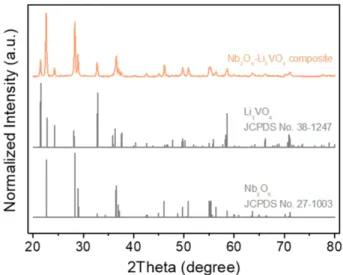
Fig. 1 displays the XRD patterns of the synthesized material with references. All observed diffraction peaks could be indexed to two phases of orthorhombic Li3VO4 (JCPDS No. 38-1247) and orthorhombic Nb2O5 (JCPDS No. 27-1402). This indicates that the Li3VO4 phase was synthesized without impurities through hydrothermal reaction and annealing. The composite is expected to
Fig. 1. XRD patterns of the synthesized material along with references
comprise starting Nb2O5 and synthesized Li3VO4. The morphology of the sample was examined using FE-SEM.
Fig. 2a and b display the FE-SEM images of the Nb2O5- Li3VO4 composite. The spherically shaped particles mea- suring a few microns were observed to be agglomerated.
The corresponding EDS elemental mapping results are shown in Fig. 2c. The signals for Nb and V were inversely detected, indicating that primary Nb2O5 and Li3VO4 particles are mixed in the composite.
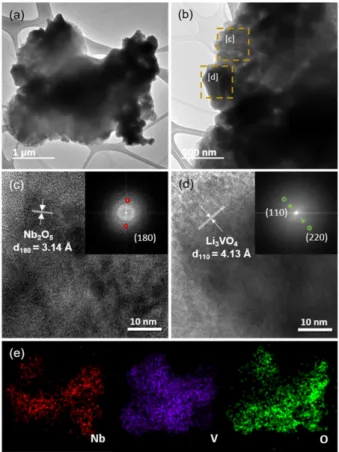
Fig. 3 presents the TEM analysis results for the composite. Fig. 3a and b display the low- and high- magnification TEM images of the composite particles, which were enlarged to obtain several HR-TEM images.
Two typical HR-TEM images along with fast Fourier transform (FFT) patterns (inset) are shown in Fig. 3c and d. Well-crystallized Nb2O5 domains were observed and the corresponding d-spacing of 3.14 Å could be attributed to the (180) reflection plane of orthorhombic Nb2O5 (Fig.
3c), which was confirmed in the FFT pattern [11]. Fig.
3d displays another HR-TEM image wherein a crystalline domain was observed with a different d-spacing of 4.13 Å, which could be matched with the (110) reflection of orthorhombic Li3VO4 [12]. The inset FFT pattern also confirmed the existence of the Li3VO4 phase. The TEM image shown in Fig. 3a was analyzed using EDS elemental mapping, the results of which are shown in Fig.
3e. The O element was observed in the entire particle composite, whereas Nb and V elements were inversely located. This observation corresponds well to the EDS
elemental mapping results in the FE-SEM image (Fig. 2c).
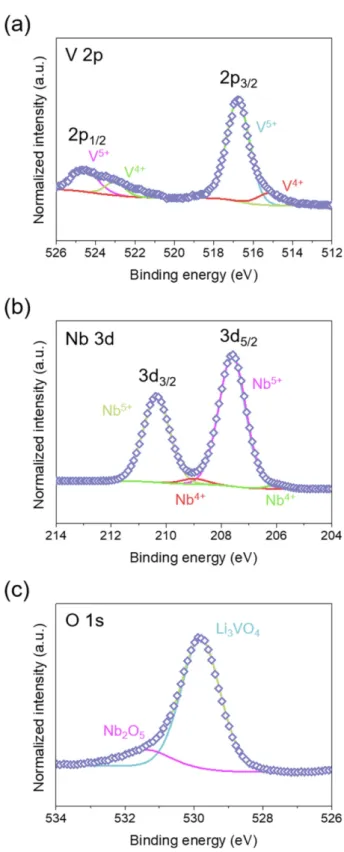
The chemical states of the composites were examined using XPS. The surface of the sample was cleaned using Ar-ion etching for 300 s. Fig. 4a displays the XPS V 2p core-level spectrum for the Nb2O5-Li3VO4 composite with peaks corresponding to the 2p1/2 and 2p3/2 orbitals of V.
The peaks were deconvoluted into two major sub-profiles centered at 524.7 and 516.8 eV that represented V in its pentavalent state (V5+) with its oxidation number corresponding to the Li3VO4 phase [13,14]. Small sub- profiles at 523.0 and 516.8 eV represented the tetravalent state of V (V4+). These results indicated that some oxygen vacancies may still exist in the material [14]. The Nb 3d core-level spectrum of the composite sample with decon- voluted sub-profiles is shown in Fig. 4b. The binding energy distribution was similar to that of V with sub- profiles centered at 210.4 and 207.6 eV representing the Nb5+ oxidation state, as previously reported [11,15]. Very small sub-profiles observed at 209.0 and 206.1 eV are ascribed to Nb4+ state [15]. All these features originate Fig. 2. (a,b) FE-SEM images and (c) the corresponding EDS
elemental mapping results of the Nb2O5-Li3VO4 composite
Fig. 3. (a, b) TEM images, (c, d) HR-TEM images (inset:
FFT pattern), and (e) EDS elemental mapping results of the Nb2O5-Li3VO4 composite
from the orthorhombic Nb2O5 phase in the composite.
The O 1s core-level spectrum is shown in Fig. 4c. The spectrum was deconvoluted into two sub-profiles centered
2 5
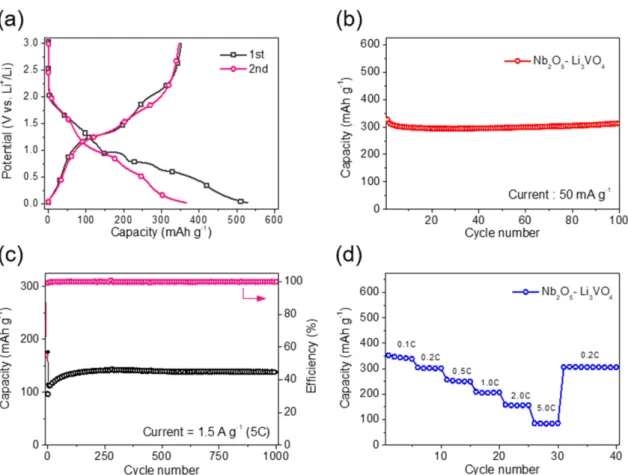
as previously reported [16,17]. Furthermore, solid electrolyte interphase (SEI) layer formation could occur in the region. Below 1.0 V, the Li can be inserted into the Li3VO4, as previously reported [18,19]. During charging, Li would be sequentially extracted from Li3VO4 and Nb2O5.
Fig. 5b shows the cycle performance of the Nb2O5- Li3VO4 composite electrode measured at 50 mA g–1. A reversible capacity of more than 300 mAh g–1 could be maintained for up to 100 cycles. This robust cycling stability can be attributed to the microstructure of the composite. The Nb2O5 and Li3VO4 particles are mixed and well attached to each other in the composite, which can buffer the volume change of both materials during Li insertion and extraction cycling. Long-term cycle performance at a high rate of 5 C (1.5 A g–1, 1 C = 300 mAh g–1) is shown in Fig. 5c. In the first stage, the reversible capacity increased gradually with an increase in cycle number. This phenomenon can be related to the activation of the electrode materials because the cycling current was very high. After 100 cycles, the capacity reached approximately 140 mAh g–1 and was maintained well for up to 1000 cycles. In our previous study [20], a carbon-coated Nb2O5 nanoparticle electrode exhibited a reversible capacity of approximately 100 mAh g–1 after 1000 cycles at a rate of 5 C (1.0 A g–1, 1 C = 200 mAh g–
1 for Nb2O5). In comparison, the Nb2O5-Li3VO4 composite electrode fabricated here demonstrated a much higher capacity at a high specific current (1.5 A g–1). This result could be attributed to fast Li ion transport caused by the high Li ion conduction in the Li3VO4 phase. Moreover, the Li3VO4 phase can store more Li ions through insertion reactions.
Fig. 4. XPS core-level spectra of the Nb2O5-Li3VO4 composite: (a) V 2p, (b) Nb 3d, and (c) O 1s
Fig. 5d presents the rate performance of the Nb2O5- Li3VO4 composite electrode at varying rates of 0.1–5 C.
The electrode exhibited a reversible capacity of about 350 and 210 mAh g–1 at 0.1 and 1 C, respectively. The capacity of the composite at 1 C was higher than those of pure or C-coated Nb2O5 materials [20], which reveals that the synthesized composite electrode has some potential for mid- and/or high-rate Li-storage applications.
4. Conclusions
An Nb2O5-Li3VO4 composite was prepared as an anode material for LIBs and hybrid supercapacitors. Nb2O5 powders were first dissolved into a solution and then the precursors were precipitated onto the Li3VO4 through simple low-temperature hydrothermal reaction. After annealing, the Nb2O5-Li3VO4 composite was successfully synthesized. The formation of Li3VO4 was confirmed by XRD and XPS. The morphology was observed using FE-
SEM and TEM; EDS elemental mapping results revealed the distribution of each element. The electrochemical test revealed that the Nb2O5-Li3VO4 composite electrode had an increased capacity of approximately 350 mAh g–1, compared to that of Nb2O5, as well as good cycle and rate performance that can be ascribed to the microstructure design of the synthesized composite material.
Acknowledgments
This work was supported by the National Research Foundation of Korea (NRF) Grant funded by the Korean Government (2015R1A5A7037615 and 2019R1F1A10 62835).
References
1. M. Winter, J. O. Besenhard, M. E. Spahr, and P. Novák, Insertion Electrode Materials for Rechargeable Lithium Fig. 5. Electrochemical properties of the Nb2O5-Li3VO4 composite electrode: (a) voltage profiles at 50 mAh g–1, (b) cycle performance at 50 mAh g–1, (c) long-term cycle performance at 1.5 A g–1 (5 C), and (d) rate performance
ical and Thermal Property Enhancement of Natural Graphite Electrodes via a Phosphorus and Nitrogen Incorporating Surface Treatment, Corrosion Science and Technology, 19, 31 (2020). Doi: https://doi.org/10.14773/
CST.2020.19.1.31
5. M. N. Obrovac and V. L. Chevrier, Alloy Negative Elec- trodes for Li-Ion Batteries, Chemical Reviews, 114, 11444 (2014). Doi: https://doi.org/10.1021/cr500207g 6. B. Zhao, R. Ran, M. Liu, and Z. Shao, A comprehensive
review of Li4Ti5O12-based electrodes for lithium-ion bat- teries: The latest advancements and future perspectives, Materials Science and Engineering R, 98, 1 (2015). Doi:
https://doi.org/10.1016/j.mser.2015.10.001
7. Y. Zhang, Y. Tang, W. Li, and X. Chen, Nanostructured TiO2-Based Anode Materials for High-Performance Rechargeable Lithium-Ion Batteries, ChemNanoMat, 2, 764 (2016). Doi: https://doi.org/10.1002/cnma.201600093 8. F. Shen, Z. Sun, Q. He, J. Sun, R. B. Kaner, and Y. Shao, Niobium pentoxide based materials for high rate rechargeable electrochemical energy storage, Materials Horizons, 8, 1130 (2021). Doi: https://doi.org/10.1039/
D0MH01481H
9. L. Yan, X. Rui, G. Chen, W. Xu, G. Zou, and H. Luo, Recent advances in nanostructured Nb-based oxides for electrochemical energy storage, Nanoscale, 8, 8443 (2016). Doi: https://doi.org/10.1039/C6NR01340F 10. H. Li, X. Liu, T. Zhai, D. Li, and H. Zhou, Li3VO4: A
Promising Insertion Anode Material for Lithium-Ion Bat- teries, Advanced Energy Materials, 3, 428 (2013). Doi:
https://doi.org/10.1002/aenm.201200833
11. K. Kim and J.-H. Kim, Bottom-up self-assembly of nano- netting cluster microspheres as high-performance lith- ium storage materials, Journal of Materials Chemistry A, 6,
Zhu, and Y. Sun, Optimization of Rate Capability and Cyclability Performance in Li3VO4 Anode Material through Ca Doping, Chemistry A European Journal, 23, 16338 (2017). Doi: https://doi.org/10.1002/chem.201703405 15. K. Kim, M.-S. Kim, P.-R. Cha, S. H. Kang, J.-H. Kim,
Structural Modification of Self-Organized Nanoporous Niobium Oxide via Hydrogen Treatment, Chemistry of Materials, 28, 1453 (2016). Doi: http://doi.org/10.1021/
acs.chemmater.5b04845
16. J. W. Kim, V. Augustyn, B. Dunn, The Effect of Crystal- linity on the Rapid Pseudocapacitive Response of Nb2O5, Advanced Energy Materials, 2, 141 (2012). Doi: https://
doi.org/10.1002/aenm.201100494
17. J. Come, V. Augustyn, J. W. Kim, P. Rozier, P.-L. Tab- erna, P. Gogotsi, J. W. Long, B. Dunn, and P. Simon, Electrochemical Kinetics of Nanostructured Nb2O5 Elec- trodes, Journal of The Electrochemical Society, 161, A718 (2014). Doi: https://doi.org/10.1149/2.040405jes 18. C. Liao, Y. Wen, B. Shan, T. Zhai, andH. Li, Probing the
capacity loss of Li3VO4 anode upon Li insertion and extraction, Journal of Power Sources, 348, 48 (2017).
Doi: https://doi.org/10.1016/j.jpowsour.2017.02.075 19. Z. Liang, Z. Lin, Y. Zhao, Y. Dong, Q. Kuang, X. Lin, X.
Liu, and D. Yan, New understanding of Li3VO4/C as potential anode for Li-ion batteries: Preparation, struc- ture characterization and lithium insertion mechanism, Journal of Power Sources, 274, 345 (2015). Doi: https://
doi.org/10.1016/j.jpowsour.2014.10.024
20. K. Kim, S.-G. Woo, Y. N. Jo, J. Lee, and J.-H. Kim, Nio- bium oxide nanoparticle core–amorphous carbon shell structure for fast reversible lithium storage, Electrochim- ica Acta, 240, 316 (2017). Doi: https://doi.org/10.1016/
j.electacta.2017.04.051