CORROSION SCIENCE AND TECHNOLOGY, Vol.18, No.6(2019), pp.253~257 pISSN: 1598-6462 / eISSN: 2288-65245
[Research Paper] DOI: https://doi.org/10.14773/cst.2019.18.6.253
1. Introduction
The painting is a very important process for the pre- vention of corrosion on the material surface. Although the paint spraying or rolling is the final stage of the painting process, the final quality of coating highly depends on multiple variables such as blasting on the bare metal, work environment, geometry of facilities, skill of each worker, etc.
Therefore, inspection on the final coating surface is es- sential to find out the defects and to repair the defected surfaces. The painting process is recently automated and constant quality can be obtained. However, the inspection process has been manually performed by human eyes and has had technical limitations. In the manual inspection process, the individual performance deviations and human errors are liable to occur, and the judgement for the defect is determined by individual knowledge. Thus, the devia- tion from the inspection judgement can lead to im- perfection and probable defects could be ignored.
In order to improve the manual inspection con- sequences, a visual inspection with cameras has been pro-
posed [1,2]. The camera inspection on painted surface has, however, two main drawbacks; namely, one is the quality of the images for inspection varied by light intensity, and the other is the difficulty to judge painting defects with only image information [3].
Consequently, a mobile vehicle is applied to the camera inspection works. In the painting inspection using the mo- bile vehicle, the light intensity can be always the same, and the camera can be mounted on the fixed place. The high quality images can be obtained therefrom thus im- proving the inspection quality.
In this paper, the drone as an unmanned mobility system and deep learning algorithms are applied to the extension of visual inspection coverage. The proposed painting in- spection drone system consists of a camera, a drone and embedded boards. The image information for inspection is obtained while the drone is flying autonomously to the inspection area with a camera and image data are trans- mitted to the embedded board. On the embedded board, the deep learning-based image processing algorithm oper- ates and the defects are determined by the way of pattern matching. In order to verify the effectiveness of the pro- posed inspection drone system, the defect detection tests have been performed using paint defect image samples.
Deep Learning Based Real-Time Painting Surface Inspection Algorithm for Autonomous Inspection Drone
Hyung-young Chang1, Seung-ryong Han1, and Heon-young Lim2,†
1KEPCO E&C, 269 Hyeoksin-ro Gimcheon Gyeongbuk 39660, Korea
2Department of Unmanned and Autonomous Vehicle Engineering, Kyungwoon University, Gumi Gyeongbuk 39160, Korea (Received December 02, 2019; Revised December 16, 2019; Accepted December 16, 2019)
A deep learning based real-time painting surface inspection algorithm is proposed herein, designed for developing an autonomous inspection drone. The painting surface inspection is usually conducted manually. However, the manual inspection has a limitation in obtaining accurate data for correct judgement on the surface because of human error and deviation of individual inspection experiences. The best method to replace manual surface inspection is the vision-based inspection method with a camera, using various image processing algorithms.
Nevertheless, the visual inspection is difficult to apply to surface inspection due to diverse appearances of material, hue, and lightning effects. To overcome technical limitations, a deep learning-based pattern recognition algorithm is proposed, which is specialized for painting surface inspections. The proposed algorithm functions in real time on the embedded board mounted on an autonomous inspection drone. The inspection results data are stored in the database and used for training the deep learning algorithm to improve performance.
The various experiments for pre-inspection of painting processes are performed to verify real-time performance of the proposed deep learning algorithm.
Keywords: Surface inspection, Deep learning, Inspection drone, Real-time inspection
†Corresponding author: [email protected]
2. Autonomous Inspection Drone System
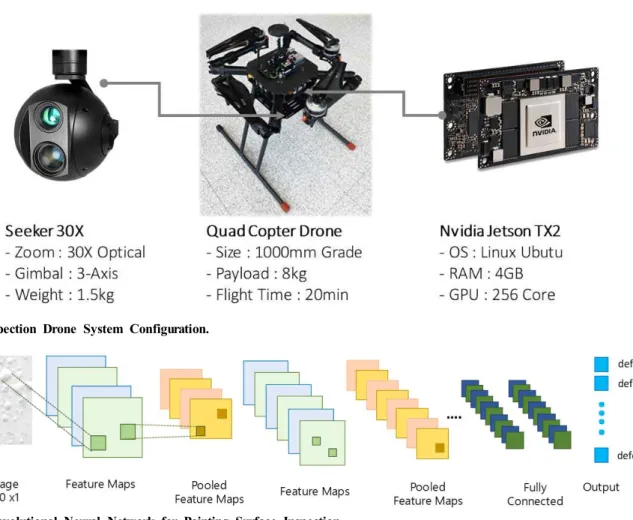
Fig. 1 shows the overall inspection drone system config- uration based on deep learning algorithms for autonomous painting surface inspection. The inspection drone system consists of three main parts: drone platform, vision camera system and image processing system.
The drone platform has four rotors and various sensors for autonomous flight. The GPS (Global Positioning System) and IMU (Inertia Measurement Unit) are used for defining drone’s location or posture. The flight con- troller computes the drone’s position and controls input so as to track a given target location. The extended Kalman filter and real time kinematic methods are used for precise positioning, and the model predictive control method can provide more precise controlling [4].
The 4K HD(High Definition) grade vision camera sys- tem is equipped on the drone for obtaining high resolution images of painting surface. The camera system consists of a camera and a gimbal system. The gimbal is essential to the filming drone system because movement of camera
should be compensated against inertia in the 3-dimen- sional space. The gimbal can rotate the camera on 3 axes to compensate distance deviation with the postures of drone & camera so as to obtain high quality images. The captured images are transferred to the image processing board.
In this study, the Nvidia Jetson TX2 is used for image pre-processing, and Linux Ubuntu is installed as an operat- ing system. The deep learning algorithm operates on the image processing board in real time. The inspection results based on the deep learning algorithm and the original im- age data are transmitted to the server system through LTE (Long-Term Evolution) communication.
3. Deep Learning-Based Real-time Visual Inspection Algorithm
The illustration of the proposed deep learning algorithm for visual inspection is shown in Fig. 2. We used the con- volution neural network as a deep learning algorithm [5,6].
Fig. 1 Inspection Drone System Configuration.
Fig. 2 Convolutional Neural Network for Painting Surface Inspection.
DEEP LEARNING BASED REAL-TIME PAINTING SURFACE INSPECTION ALGORITHM FOR AUTONOMOUS INSPECTION DRONE
The painted surface images are obtained by the camera system mounted on the drone.
In the convolution neural network, there are four main processes such as input layer, convolution layer (Filters
& Relu functions), pooling layer and fully connected layer. The features of obtained painting surface image are extracted using the convolution neural network for image classification.
In this study, two convolution process architectures are used that have two subsampling processes multiplied by the neural network. The neural network should be pre-trained to obtain the proper weight for each neuron using training data and testing data.
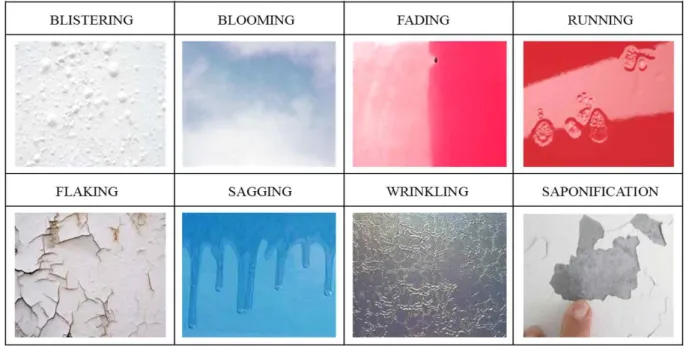
The dataset is composed of 480 training data and 120 testing data, in which the proportion of data between train- ing and testing is recommended to be 80:20. The image process is implemented with OpenCV library and Tensorflow that are installed in the image processing board [7,8]. The painting defects are classified into eight categories as shown in Fig. 3.
4. Performance Experiments for Proposed Inspection Algorithm
The experiment has been performed to verify the pro- posed deep learning algorithm based on data from painting surface inspection with a drone system. The captured im- ages from camera are used for input data in this system.
The captured images analyzed through the convolution
neural network were turned out to be the proper defect cases.
The edge detection method can visually extract sig- nificant edges and defect boundaries that are important processes in the computer recognition mechanism [9].
Edge means boundary or outline. Edge in images indicates the local area where brightness changes from lower values to higher values, and vice versa. Edge defines boundaries of objects in an image, and it contains various information to detect such as shape, direction, color, brightness, etc.
Edge detection is defined as the process to search pixels that consist of edges. Edge is the area where brightness changes so high that it can be detected with the gradient of brightness. It is the 1st differentiation that can detect the edges in images. However, mathematical differential operations are not applied in the image because pixel data are arranged at regular intervals. Instead, a calculation is needed that takes difference between neighboring pixels.
G(x) = f(x-1, y) - f(x+1,y) (horizontal component) G(y) = f(x, y-1) - f(x, y+1) (vertical component) Edge = |G(x)| + |G(y)| (edge direction with
differential operation)
where f = the function of image profile, G(x) = the horizontal component of image data arrays, and G(y)
= the vertical component of image data arrays.
Fig. 3 Common Defects in Paint Works.
However, the edge detection is very difficult for several defect cases such as blooming, fading and wrinkling. In this paper, the enhanced edge detection method has been developed which is based again on the convolution neural network. If f is reconstructed by cross-correlation with filter h:
⊗
Where is approximation of f, h is a filter function and fF is the original function of image profile. Better filters give better resampled images. There are several filters for edge detection such as Gaussian, derivative of Gaussian, Laplacian of Gaussian or LoGs for 2D edge detection.
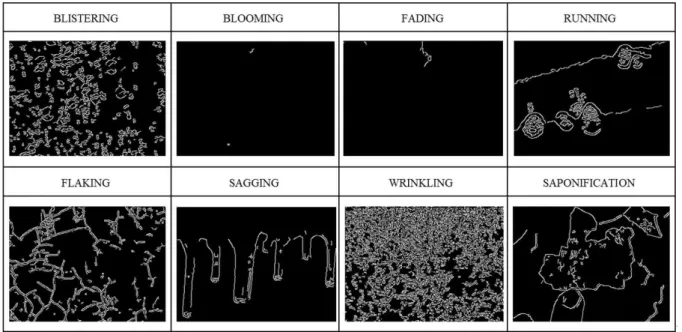
The edge detection results for the paint defects in Fig. 3 are shown in Fig. 4.
The enhanced edge detection process applied to the con- volution neural network performs better for defect de- tection and classification than that of the open library.
It was the open library VGGNet that was modified for the proposed enhanced edge detection process which had
been one of the most popular convolution neural networks in the world [7]. The result shows a valid improvement in detecting defects. The effectiveness of the proposed au- tonomous visual inspection based on the convolution neu- ral network using camera-captured images is shown in Table 1. Detection error ratios in Table 1 are the success ratio of edge detection process which is performed by the k fold (5 fold in this study) cross validation with 480 training data and 120 testing data.
5. Conclusions
This paper presents an autonomous painting surface in- spection method based on deep learning algorithms with an inspection drone system. The inspection drone system is being developed which can inspect painting surface au- tonomously in real time. The experiments were performed to verify the proposed method and the results of the pre- vious method (VGGNet) and the proposed method (Edge Detection + VGGNet) were compared each other, showing the effectiveness of the proposed method. We conclude that the proposed method shows a valid improvement in Fig. 4. Edge Detection Results for Each Paint Defect Case
Table 1 Performance Comparison for Each Convolution Neural Network Previous method
(VGGNet)
Proposed method
(Edge Detection + VGGNet) Result Detection
error ratio (%) 4.83 4.50 6.83% enhanced
DEEP LEARNING BASED REAL-TIME PAINTING SURFACE INSPECTION ALGORITHM FOR AUTONOMOUS INSPECTION DRONE
detecting painting defects and applicability to painting sur- face inspection for an autonomous inspection drone.
In the future, we will focus much on multiple experi- ments for real data on sites to save the learning time and to improve precision for the convolution neural network.
Acknowledgments
This work was supported by the developing con- vergence drone platform program of the Gyeongbuk Techno Park of Republic of Korea, [Development of an autonomous surface inspection UAV and an autonomous wired/wireless painting UAV].
References
1. K. Iyshwerya, B. Janani, S. Krithika, and T. Manikandan, Proc. International Conference on Smart Structures and
Systems, p. 103, IEEE, Chennai, India (2013).
2. A. Maheshwar and G. N. N. Kumar, IJRASET, 5, 2583 (2017).
3. A. Leopoldo, T. Josep, H. Alvaro, and A. Jose, Proc.
International Conference on Robotics and Automation, No.
5980570, IEEE, Shanghai, China (2011).
4. G. Mao, S. Drake, and Brian D. O. Anderson, Proc. Decision and Control Conf., p. 224, IEEE Information (2007).
5. A. Krizhevsky, I. Sutskever, and G. Hinton, ImageNet clas- sificaition with deep convolutional networks, In NIPS (2012).
6. Y. Liu, M. M. Cheng, X. Hu, J. Bian, L. Zhang, X. Bai, and J. Tang, IEEE T. Pattern Anal., 41, 1939 (2019).
7. OpenCV (Open Source Computer Vision Library), https://opencv.org/about/ (2019).
8. Why TensorFlow, https://www.tensorflow.org/about 9. R. Muthukrishnan and M. Radha, IJCSIT, 3, 259 (2011).
10. K. Simonyan and A. Zisserman, Proc. IC LR Conf., arXiv:1409.1556, The Hilton San Diego Resort & Spa, CA (2015).