Journal of the Korean Chemical Society 2012, Vol. 56, No. 3
Printed in the Republic of Korea
http://dx.doi.org/10.5012/jkcs.2012.56.3.313
-313-
속보
(
Communications)
Synthesis, Photophysical and Electrochemical Properties of Novel Ru(II) Complexes
Juangang Wang* and Yunli Shang
College of Chemistry and Material Science, Huaibei Normal University, Huaibei 235000, PR China.
*E-mail: [email protected]
(Received December 27, 2011; Accepted May 7, 2012) Key words: Ru(II) complexes, Extended π-conjugation, Fluorescence
INTRODUCTION
Tremendous interest has been attracted to ruthenium (II) polypyridyl complexes because of their potential applications in molecular electronic devices, DNA struc- tural probes, new therapeutic agents1-3 and photosensitiz- ers in the conversion of solar energy to chemical or electrical energy.4 Over the past decade, a large amount of data has accumulated on changes in the electrochemical and photophysical properties of complexes effected by substitution in the 2,2'-bipyridine (bpy) and by replace- ment of one or two pyridine rings with other nitrogen-con- taining heterocycles.5-11 Based on the earlier studies and recent findings on ruthenium(II) heteroleptic complexes, it has been shown that the electrochemical and photo- physical properties of ruthenium(II) complexes are not only dependent on the spatial geometry and molecular aggregation in the molecules, but also other factors such as the extended π-conjugation of the ligands also play major roles.12,13 This paper is dedicated to the synthesis of three new Ru(II) complexes with different extended con- jugated moieties attached through auxiliary unit. The three ruthenium(II) complexes in DMF solution exhibit strong emission bands centered at 621, 607, and 603 nm, respec- tively, indicating that they are excellent red and orange light-emitting materials.
RESULTS AND DISCUSSION
Absorption Spectroscopy
The ligands (Scheme 1) and the Ru(II) complexes (Scheme 2) were prepared according to the literatures.14,15 The UV-Vis absorbance spectra of the complexes, which were recorded at room temperature in DMF, were shown in Fig. 1. There were broad and intense metal-to-ligand
charge (MLCT) absorption bands throughout the visible region of the spectrum (400-600 nm), characteristics of many other ruthenium(II) polypyridyl complexes, which can be assigned to electronic transitions from the RuII based t2g orbital to the ligand based π* orbitals. The absorption wavelength maximum in the visible region of the complex [(bpy)2Ru(PEYI)]·(PF6)2 was found at 467 nm, which was red-shifted and of lower intensity at 478 nm for [(bpy)2Ru(AYIQ)]·(PF6)2, whereas a blue-shift with enhanced intensity at 459 nm was observed for complex [(bpy)2Ru (PYIQ)]·(PF6)2. The molar extinction coefficient of [(bpy)2Ru(PYIQ)]·(PF6)2 at its maximum (459 nm) in the
Scheme 1. The structure of the ligands.
Scheme 2. The structure of the Ru(II) complexes.
Journal of the Korean Chemical Society
314 Juangang Wang and Yunli Shang
visible region is 3.94×10⁵ M-1 cm-1, is larger than that of [(bpy)2Ru(PEYI)]·(PF6)2 (3.42×10⁵ M-1 cm-1) at 467 nm and [(bpy)2Ru(AYIQ)]·(PF6)2 (3.05×10⁵ M-1 cm-1) at 478 nm, respectively. The mixed-ligands nature of complexes was different to Ru(bpy)3]·(PF6)2,16 producing multiple MLCT transitions in the visible, i.e., Ru→bpy, Ru→PYIQ, Ru→PEYI and Ru→AYIQ with broad absorption at 371, 385 and 383 nm. These features have been found as a means of improving light absorption cross-sections at higher energy in similar complexes.17 The intense absorp- tion band in the UV region around 280-330 nm were assigned to the intraligand π-π* transitions of the ligands.
The lower-energy absorption in the complexes were enhanced due to extending the π-conjugation of the ligands, which lowers the energy of the π* orbital of the ligands.
The Emission Spectra
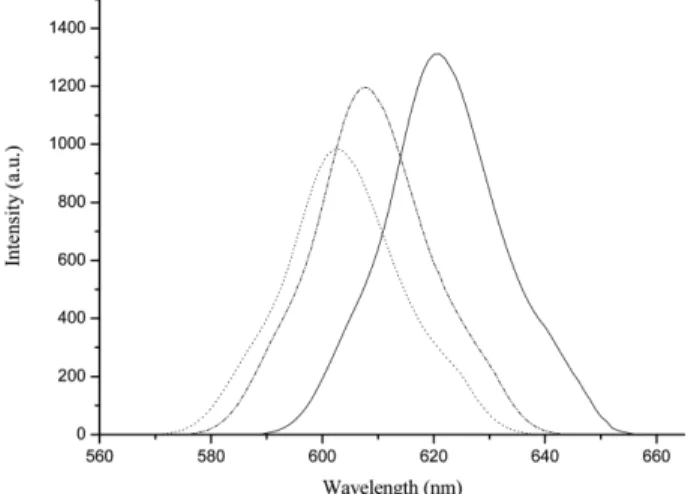
The emission spectra of the complexes were shown in Fig. 2. Upon excitation into the 1LC and 1MLCT bands, (λexc=460, 465 and 480 nm), the complexes displayed appreciable luminescence at room temperature. The emis- sion wavelength maximum of [(bpy)2Ru(PEYI)]·(PF6)2
was found at 607 nm, which was blue-shifted and low-
ered intensity at 603 nm for the complex of [(bpy)2Ru (AYIQ)]·(PF6)2, whereas a red-shift with enhanced inten- sity at 621 nm was observed for [(bpy)2Ru(PYIQ)]·(PF6)2. It is well known that extending π-conjugation of the ligands is useful for the study of electron transport at the molecular scale and that the use of fused-ring systems is a powerful and practical approach.18,19 The intense emis- sion in the complexes is a significant contribution to the excited state from an interaction between the metal d- orbital and the ligand π-systems.20 The photoluminescence quantum yields of [(bpy)2Ru(PYIQ)]·(PF6)2, [(bpy)2Ru (PEYI)]·(PF6)2 and [(bpy)2Ru(AYIQ)]·(PF6)2 were calcu- lated as 0.27, 0.24 and 0.18, respectively, corresponding to their luminescence lifetimes of 1.309, 1.204 and 0.873 µs, respectively.
Electrochemical Study
The CV data of the complexes was summarized in Table 1. The reversible one-electron oxidation process I of [(bpy)2Ru(PEYI)]·(PF6)2 was found at E1/2=+1.27 V, which was decreased to +1.22 V for [(bpy)2Ru(PYIQ)]·(PF6)2, whereas increase to +1.29 V was observed for [(bpy)2Ru (AYIQ)]·(PF6)2, which was assigned to the metal centre Fig. 1. Comparison of the UV-Vis absorption spectrum of
[(bpy)2Ru(PYIQ)]·(PF6)2 (dash dot line) with [(bpy)2Ru(PEYI)]·
(PF6)2 (dot line) and [(bpy)2Ru(AYIQ)]·(PF6)2 (solid line) at a concentration of 1×10⁻⁵M-1 in DMF solution showing effect of extended π-conjugation.
Fig. 2. Comparison of emission spectral of [(bpy)2Ru(PYIQ)]·
(PF6)2 (solid line) with [(bpy)2Ru(PEYI)]·(PF6)2 (dash dot line) and [(bpy)2Ru(AYIQ)]·(PF6)2 (dot line) in DMF solution at a concentration of 1×10⁻⁵ M-1 showing effect of extended π-con- jugation.
Table 1. The electrochemical data for the complexes at 1×10⁻⁶ M in DMF containing 0.1 M TBAP supporting electrolyte. Step potential
=5 mV, 1amplitude=50 mV vs. Ag|AgCl, frequency=10 Hz. Scan rate=100 m Vs-1vs. Ag|AgCl
Complex Oxidation (I) Reduction (II) Reduction (III)
[(bpy)2Ru(PYIQ)]·(PF6)2 1.22 -1.15 -1.41
[(bpy)2Ru(PEYI)]·(PF6)2 1.27 -1.12 -1.38
[(bpy)2Ru(AYIQ)]·(PF6)2 1.29 -0.92 -1.40
Synthesis, Photophysical and Electrochemical Properties of Novel Ru(II) Complexes 315
2012, Vol. 56, No. 3
Ru(III)/Ru(II) wave couple.21 A irreversible wave of the complex [(bpy)2Ru(PEYI)]·(PF6)2 was observed for pro- cesses II at -1.12 V, which is decreased to -1.15 V for [(bpy)2Ru(PYIQ)]·(PF6)2, whereas increase to -0.92 V was observed for complex [(bpy)2Ru(AYIQ)]·(PF6)2. The more negative reduction potential may be assigned to the contribution from ligands due to extending the π-conjugation of the ligands being responsible for lowering the LUMO levels. The irreversible wave for processes III was assigned to electron injection into the LUMO+1 levels of bpy.
CONCLUSIONS
In conclusion, we synthesized three mixed-ligand het- eroleptic ruthenium(II) complexes [(bpy)2 Ru(PYIQ)]·(PF6)2, [(bpy)2Ru(PEYI)]·(PF6)2 and [(bpy)2Ru(AYIQ)]·(PF6)2, with broad spectral bandwidth and visible light absorp- tion at 478, 467 and 459. By modification of the chemical structures of quinoline derivative ligands, the emissive wavelengths of complexes can be tuned from 603 to 621 nm. Interestingly, the photoluminescence quantum effi- ciency and luminescence lifetimes can be improved by the replacement of anthracene with pyrene and perylene. The three new Ru(II) complexes are the excellent fluorescent dyes, due to their relatively long luminescence lifetime, high photoluminescence efficiency, and excellent color tuning.
Acknowledgements. We are grateful for the financial support of the research funding of Huaibei Normal Uni- versity (Grant No. 600437).
REFERENCES
1. Sven, R.; Torsten, B.; Christian, T.; Mario, R.; Helmar, G.; Dirk, W. Inorg. Chem. 2000, 39, 1621.
2. Teng-Yuan, D.; Mei-Ching, L.; Shu-Wei, C.; Chih-Chien, H.; Shu-Fan, L.; Liangshiu, L. Journal of Organometallic Chemistry 2007, 692, 2324.
3. Sooambar, C.; Troiani, V. Org. Biomol. Chem. 2009, 7, 2402.
4. Chen, C. Y.; Wu, S. J.; Wu, C. G.; Chen, J. G.; Ho, K. C.
Angew. Chem. Int. Ed. 2006, 45, 5822.
5. Adeloye, A. O. Molecules 2011, 16, 8353.
6. Juris, A.; Balzani, V.; Barigelletti, F.; Campagna, S.;
Belser, P.; Zelewsky, A.V. V. Coord. Chem. Rev. 1988, 84, 85.
7. Balzani, V.; Juris, A.; Venturi, M.; Campagna, S.; Serroni, S. Chem. Rev. 1996, 96, 756.
8. Cola, L. D.; Belser, P. Coord. Chem. Rev. 1998, 177, 301.
9. Kaes, C.; Katz, A.; Hosseini, M. W. Chem. Rev. 2000, 100, 3553.
10. Chao, H.; Ji, L. N. Bioinorg. Chem. Appl. 2005, 3, 15.
11. Vos, J. G.; Kelly, J. M. Dalton Trans. 2006, 4869.
12. Tyson, D. S.; Luman, C. R.; Castellano, F. N. Inorg.
Chem. 2002, 41, 3578.
13. Adeloye, A. O.; Ajibade, P. A. Molecules 2011, 16, 4615.
14. Xiao-Hang, Z.; Kim, S. H.; In, S.L.; Chun-Ji, G.; Sung, I.
Y.; Kwang-Hyun, A. Bull. Korean Chem. Soc. 2007, 28, 1389.
15. Vivian Wing-Wah, Y.; Vicky Wing-Man, L. Inorg. Chem.
1997, 36, 2124.
16. Gafney, H. D.; Admonson, A. W. J. Am. Chem. Soc. 1972, 94, 8238.
17. Qu, J. Q.; Zhang, J. Y.; Grimsdale, A. C.; Mullen, K.
Macromolecules 2004, 37, 8297.
18. Xu, B.; Holdcroft, S. Macromolecules 1993, 26, 4457.
19. Crosby, G. A.; Watts, R. J.; Carstens, D. H. W. Science 1970, 170, 1195.
20. Henderson, L. J.; Fronczek, F. R.; Cherry, W. R. J. Am.
Chem. Soc. 1984, 106, 5876.
21. Staniszewski, A.; Heuer, W. B.; Meyer, G. J. Inorg. Chem.
2008, 47, 7062.