ISSN 2234-3806 • eISSN 2234-3814
Ann Lab Med 2018;38:545-554
https://doi.org/10.3343/alm.2018.38.6.545
Differences in Colistin-resistant Acinetobacter
baumannii Clinical Isolates Between Patients With and Without Prior Colistin Treatment
Yu Jin Park, M.D.1, Duck Jin Hong, M.D.2, Eun-Jeong Yoon, Ph.D.3, Dokyun Kim, M.D.3, Min Hyuk Choi, M.D.1,
Jun Sung Hong, Ph.D.3,4, Hyukmin Lee, M.D., Ph.D.3, Dongeun Yong, M.D., Ph.D.3, and Seok Hoon Jeong , M.D., Ph.D.3
1Department of Laboratory Medicine, Yonsei University College of Medicine, Seoul, Korea; 2Department of Laboratory Medicine, Sheikh Khalifa Specialty Hospital, Ras Al Khaimah, UAE; 3Department of Laboratory Medicine and Research Institute of Bacterial Resistance, Yonsei University, Seoul, Korea; 4Brain Korea 21 PLUS Project for Medical Science, Yonsei University, Seoul, Korea
Background: The increasing morbidity and mortality rates associated with Acinetobacter baumannii are due to the emergence of drug resistance and the limited treatment options.
We compared characteristics of colistin-resistant Acinetobacter baumannii (CR-AB) clini- cal isolates recovered from patients with and without prior colistin treatment. We assessed whether prior colistin treatment affects the resistance mechanism of CR-AB isolates, mor- tality rates, and clinical characteristics. Additionally, a proper method for identifying CR- AB was determined.
Methods: We collected 36 non-duplicate CR-AB clinical isolates resistant to colistin. Anti- microbial susceptibility testing, Sanger sequencing analysis, molecular typing, lipid A structure analysis, and in vitro synergy testing were performed. Eleven colistin-susceptible AB isolates were used as controls.
Results: Despite no differences in clinical characteristics between patients with and with- out prior colistin treatment, resistance-causing genetic mutations were more frequent in isolates from colistin-treated patients. Distinct mutations were overlooked via the Sanger sequencing method, perhaps because of a masking effect by the colistin-susceptible AB subpopulation of CR-AB isolates lacking genetic mutations. However, modified lipid A analysis revealed colistin resistance peaks, despite the population heterogeneity, and peak levels were significantly different between the groups.
Conclusions: Although prior colistin use did not induce clinical or susceptibility differ- ences, we demonstrated that identification of CR-AB by sequencing is insufficient. We propose that population heterogeneity has a masking effect, especially in colistin non- treated patients; therefore, accurate testing methods reflecting physiological alterations of the bacteria, such as phosphoethanolamine-modified lipid A identification by matrix-as- sisted laser desorption ionization-time of flight, should be employed.
Key Words: Colistin, Population heterogeneity, Acinetobacter baumannii, Resistance, Lipid A analysis, Pathogenesis
Received: November 9, 2017 Revision received: January 26, 2018 Accepted: June 8, 2018
Corresponding author: Seok Hoon Jeong https://orcid.org/0000-0001-9290-897X Department of Laboratory Medicine, Research Institute of Bacterial Resistance, Gangnam Severance Hospital, Yonsei University College of Medicine, 211 Eonju- ro, Gangnam-gu, Seoul 06273, Korea Tel: +82-2-2019-3532
Fax: +82-2-2057-8926 E-mail: [email protected]
© Korean Society for Laboratory Medicine This is an Open Access article distributed under the terms of the Creative Commons Attribution Non-Commercial License (http://creativecom- mons.org/licenses/by-nc/4.0) which permits unrestricted non-commercial use, distribution, and reproduction in any medium, provided the original work is properly cited.
INTRODUCTION
Acinetobacter baumannii (AB) has become associated with in-
creasing morbidity and mortality rates in hospitals in the last two decades, owing to the emergence of drug resistance and limited treatment options [1-4]. Recently, an increase in carbapenem
2017-03-16 https://crossmark-cdn.crossref.org/widget/v2.0/logos/CROSSMARK_Color_square.svg
resistance among AB strains has been reported [5, 6]. These carbapenem-resistant AB strains also frequently display resis- tance to other antibiotics, consequently posing an eminent clini- cal threat. Thus, interest in “old” antibiotics has been rekindled [7, 8].
Colistin, introduced in the 1950s to treat infections caused by gram-negative bacteria (GNB), exerts bactericidal activity by displacing the membrane-stabilizing calcium and magnesium ions and targets the polyanionic lipopolysaccharide (LPS) com- ponents [9, 10]. However, because it induced nephrotoxicity and neurotoxicity, it was replaced by safer antimicrobial agents (e.g., aminoglycosides) [11, 12]. Despite these potential side ef- fects, worldwide dissemination of extensively drug-resistant GNB (XDR-GNB) has rekindled the usage of this drug in clinical settings as a last-resort treatment.
The clinical use of colistin for XDR-GNB infections has led to the development of colistin resistance (CR) in GNB species [13- 15], and reports on the occurrence of colistin-resistant AB (CR- AB) are increasing globally [2]. Previous in vivo studies have demonstrated that CR in AB is mediated by a complete loss of LPS production through mutations in LPS-producing genes (lpxA, lpxC, lpxD, and lpsB) [16, 17] or by modification of lipid A components of LPS through mutations in pmrA and pmrB genes. These genes regulate the expression of the downstream target pmrC, which encodes an inner membrane phosphoetha- nolamine (PE) transferase modifying the outer membrane lipid A [18, 19]. Recently, the emergence of a plasmid-mediated mobile CR gene, mcr-1, in Enterobacteriaceae has been re- ported [20].
Most CR-AB clinical strains are reported to acquire resistance by in vivo selection during colistin treatment [21]; however, clonal spreading of CR-AB strains causing infections or coloni- zation in patients without colistin treatment history has also been reported recently [1]. Both in vitro and in vivo models have shown that mutations in the PmrAB system lead to de- creased fitness and virulence compared with that of colistin- susceptible (CS) parental strains [22-24]. However, these stud- ies evaluated serially obtained CR isolates and their parental CS strains only and thus did not consider the characteristics of dif- ferent clinical CR-AB isolates obtained from different patients with and without history of colistin administration [23-26].
We compared CR-AB isolates recovered from patients with and without prior colistin treatment to assess whether prior co- listin treatment affects CR in CR-AB isolates, patient demo- graphics, mortality rates, or genetic mutations. Additionally, mortality rate was assessed to determine clinical characteristics.
METHODS 1. Bacterial isolates
In total, 36 non-duplicate AB clinical isolates resistant to both carbapenems and colistin were collected from a tertiary care hospital in Seoul, Korea, from April 2012 to December 2014. At the time of sample collection, 18 patients had received previous colistin treatment (Group CT), and the rest had not (Group non- CT). For comparison, AB isolates (N=11) that were resistant to carbapenems but susceptible to colistin were also studied. Bac- terial species were identified by partial rpoB gene sequences and PCR detection of blaOXA-51-like. Patient data, including acute physiology and chronic health evaluation (APACHE II) score, use of colistin treatment, and 30-day mortality from the day of AB recovery, were examined retrospectively using electronic medical records. Multivariate logistic regression analysis was performed to identify risk factors associated with 30-day mortal- ity from the day of CR-AB recovery. This project was approved by the Institutional Review Board of Yonsei University Severance Hospital, Seoul, Korea (4-2017-0758).
2. Antimicrobial susceptibility testing
The susceptibility of the isolates to colistin, meropenem, imipe- nem, piperacillin-tazobactam, ceftazidime, cefepime, gentami- cin, tobramycin, amikacin, tetracycline, ciprofloxacin, and trim- ethoprim/sulfamethoxazole was determined by the disk diffusion method following the CLSI guidelines [27]. Minimum inhibitory concentrations (MICs) of meropenem and imipenem were de- termined by using Etest (bioMérieux, Inc., Durham, NC, USA).
Colistin MIC was determined by the broth microdilution method, following recommendations of the Joint CLSI-EUCAST Poly- myxin Breakpoints Working Group [28]. Synergistic effects of drug combinations of colistin (32–4,096 μg/mL) either with me- ropenem (4–256 μg/mL) or with rifampicin (0.25–32 μg/mL) were evaluated by the checkerboard method [29] in microtiter plates. The fractional inhibitory concentration (FIC) index of each drug combination was determined by dividing the MIC of each drug when used in combination by the MIC of each drug when used alone. The effect of a drug combination was deter- mined by the FIC index: ≤0.5, a synergistic effect; 0.5–4.0, neutrality; and >4.0 an antagonistic effect.
3. PCR analysis of drug-resistant genes
A series of PCR experiments (primer information available upon request) were conducted to detect the OXA carbapenemase genes blaOXA-23-like, blaOXA-24-like, blaOXA-48-like, and blaOXA-58-like [30];
the metallo-β-lactamase genes blaIMP, blaVIM, and blaNDM; and the serine carbapenemase genes blaGES and blaKPC [31]. The pres- ence of ISAba1 upstream from the blaOXA-51-like gene was detected by PCR [32].
4. Genomic analysis of genes associated with colistin resistance
Genes associated with CR in AB (pmrA, pmrB, pmrC, lpxA, lpxC, lpxD, and lpsB) were analyzed by Sanger sequencing [17, 33]. The AB ATCC 17978 strain and 10 randomly selected co- listin-susceptible AB (CS-AB) isolates were used as controls to distinguish CR-inducing mutations from polymorphisms. The mcr-1 gene was also identified by PCR [20].
5. Analysis of lipid A structure
Lipopolysaccharides and lipid A components were extracted from whole bacterial cells using Tri-reagent and mild acid hy- drolysis, and were subjected to negative-ion matrix-assisted la- ser desorption ionization-time of flight (MALDI-TOF) mass spec- trometry (Bruker Daltonik GmbH, Leipzig, Germany) in negative reflection mode. For comparison, three randomly selected CS- AB isolates were used as controls.
6. Pulsed-field gel electrophoresis
Pulsed-field gel electrophoresis (PFGE) was conducted with SmaI-
digested genomic DNA extracted from the AB clinical isolates using a CHEF-DRII device (Bio-Rad, Hercules, CA, USA). PFGE band patterns were analyzed with Molecular Analyst Fingerprint- ing Software Ver. 3.2 (Bio-Rad). Genetic relatedness of PFGE profiles was interpreted using the criteria of Tenover et al [34].
7. Multilocus sequence typing (MLST)
MLST experiments were performed following the Bartual scheme [13]. Sequences of seven housekeeping genes (cpn60, gdhB, gltA, gpi, gyrB, recA, and rpoD) were used to determine the sequence types (STs) of the AB clinical isolates. Each ST number was assigned by comparing the allele sequences with those in MLST databases (http://pubmlst.org/abaumannii).
Clonal complex (CC) was defined as a group of STs that shared five or more of seven alleles and was determined by eBURSTv.3 (http://eburst.mlst.net).
8. Statistical analysis
All variables were evaluated for Gaussian distribution using the Shapiro-Wilk test. Differences were tested with the Fisher exact test for categorical data and with the Mann-Whitney U test for continuous data. Univariate and multivariate analyses were car- ried out using logistic regression to investigate the association between CR, mortality rate, and potential covariates. The pres- ence of variance inflation factors was examined for all parame-
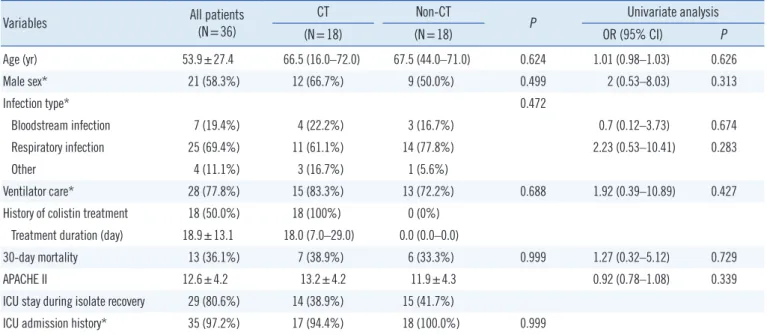
Table 1. Baseline characteristics of study patients
Variables All patients
(N=36)
CT Non-CT
P Univariate analysis
(N=18) (N=18) OR (95% CI) P
Age (yr) 53.9±27.4 66.5 (16.0–72.0) 67.5 (44.0–71.0) 0.624 1.01 (0.98–1.03) 0.626
Male sex* 21 (58.3%) 12 (66.7%) 9 (50.0%) 0.499 2 (0.53–8.03) 0.313
Infection type* 0.472
Bloodstream infection 7 (19.4%) 4 (22.2%) 3 (16.7%) 0.7 (0.12–3.73) 0.674
Respiratory infection 25 (69.4%) 11 (61.1%) 14 (77.8%) 2.23 (0.53–10.41) 0.283
Other 4 (11.1%) 3 (16.7%) 1 (5.6%)
Ventilator care* 28 (77.8%) 15 (83.3%) 13 (72.2%) 0.688 1.92 (0.39–10.89) 0.427
History of colistin treatment 18 (50.0%) 18 (100%) 0 (0%) Treatment duration (day) 18.9±13.1 18.0 (7.0–29.0) 0.0 (0.0–0.0)
30-day mortality 13 (36.1%) 7 (38.9%) 6 (33.3%) 0.999 1.27 (0.32–5.12) 0.729
APACHE II 12.6±4.2 13.2±4.2 11.9±4.3 0.92 (0.78–1.08) 0.339
ICU stay during isolate recovery 29 (80.6%) 14 (38.9%) 15 (41.7%)
ICU admission history* 35 (97.2%) 17 (94.4%) 18 (100.0%) 0.999
Data are presented as number (%), mean±SD for parametric variables or median [1st quartile–3rd quartile] for non-parametric variables.
*Categorical variables included in logistic regression.
Abbreviations: CT, colistin treatment; APACHE II, Acute Physiology and Chronic Health Evaluation II; ICU, intensive care unit; OR, odds ratio; CI, confidence interval.
ters of the multiple regression model. P <0.05 was considered statistically significant. All analyses were performed using R (Version 0.99.893, R Studio, Inc., Boston, MA, USA).
RESULTS
1. Clinical characteristics of patients
The characteristics of patients infected or colonized by CR-AB are presented in Table 1. To determine whether prior colistin treatment had any relevant effect on patient outcome, Groups CT and non-CT were compared.
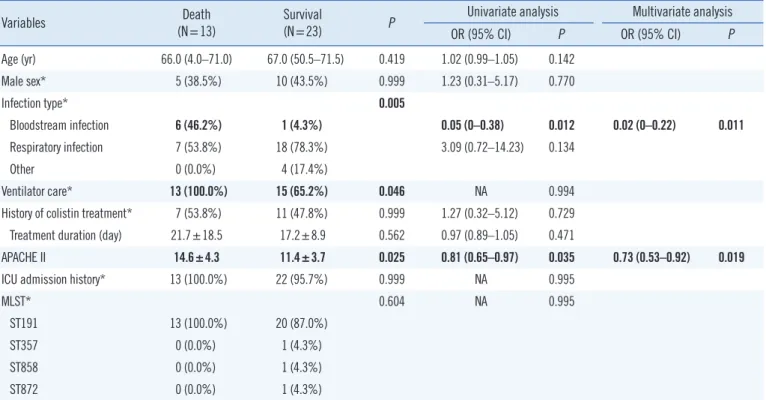
To determine the characteristics associated with higher sur- vival rates, the “within 30-days deceased group” (13/36) was compared with the “alive group” (23/36) (Table 2). Only blood- stream infection and APACHE II scores significantly differed be- tween groups.
2. Strain typing
MLST showed that all CR-AB isolates belonged to CC92. Among these, 91.7% (33/36) were identified as ST191 (Fig. 1). All iso- lates from Group non-CT belonged to ST191, whereas the three
non-ST191 isolates were retrieved from Group CT. The 36 CR- AB isolates were assigned to 13 PFGE types (pulsotypes A to N) on the basis of banding patterns. With the exception of pulso- type A1, isolates of pulsotypes A, F, and H did not show any CR- related genetic mutations, and the majority (16/18) of the host patients belonged to Group non-CT. However, isolates of pulso- types B, C, E, and G showed genetic mutations, and most (8/10) of the host patients belonged to Group CT.
3. PCR analysis and antimicrobial susceptibility
Only the blaOXA-23-like carbapenemase gene was found in all CR- AB isolates. No other carbapenemase genes were detected by PCR. ISAba1, located upstream from the blaOXA-51-like gene, was not detected. All CR-AB isolates were resistant to more than three antimicrobial classes by a disk diffusion susceptibility test (data not shown). All colistin MICs determined by the broth mi- crodilution method were >128 μg/mL.
4. Mutations in genes associated with colistin resistance
All isolates with genetic mutations had mutated pmrB gene, and pmrB gene was the most frequently mutated (16/36, 44.4%).Table 2. Univariate and multivariate analyses of risk factors for 30-day mortality
Variables Death
(N=13) Survival
(N=23) P Univariate analysis Multivariate analysis
OR (95% CI) P OR (95% CI) P
Age (yr) 66.0 (4.0–71.0) 67.0 (50.5–71.5) 0.419 1.02 (0.99–1.05) 0.142
Male sex* 5 (38.5%) 10 (43.5%) 0.999 1.23 (0.31–5.17) 0.770
Infection type* 0.005
Bloodstream infection 6 (46.2%) 1 (4.3%) 0.05 (0–0.38) 0.012 0.02 (0–0.22) 0.011
Respiratory infection 7 (53.8%) 18 (78.3%) 3.09 (0.72–14.23) 0.134
Other 0 (0.0%) 4 (17.4%)
Ventilator care* 13 (100.0%) 15 (65.2%) 0.046 NA 0.994
History of colistin treatment* 7 (53.8%) 11 (47.8%) 0.999 1.27 (0.32–5.12) 0.729 Treatment duration (day) 21.7±18.5 17.2±8.9 0.562 0.97 (0.89–1.05) 0.471
APACHE II 14.6±4.3 11.4±3.7 0.025 0.81 (0.65–0.97) 0.035 0.73 (0.53–0.92) 0.019
ICU admission history* 13 (100.0%) 22 (95.7%) 0.999 NA 0.995
MLST* 0.604 NA 0.995
ST191 13 (100.0%) 20 (87.0%)
ST357 0 (0.0%) 1 (4.3%)
ST858 0 (0.0%) 1 (4.3%)
ST872 0 (0.0%) 1 (4.3%)
Data are presented as N (%), mean±SD for parametric variables, or median [1st quartile–3rd quartile] for non-parametric variables. Bold values are statisti cally significant (P <0.05).
*Categorical variables included in logistic regression.
All colistin-resistant Acinetobacter baumannii isolates were within clonal cluster 92.
Abbreviations: OR, odds ratio; CI, confidence interval; APACHE II, Acute Physiology and Chronic Health Evaluation II; ICU, intensive care unit; MLST, Multilo- cus sequence typing.
Genetic mutations were more frequently observed in isolates from Group CT than in those from Group non-CT patients (72.2% [13/18] and 11.1% [2/18], respectively, P ≤0.001). CR- AB 32, 34, 35, and 36 had the same mutation in pmrB (g.938_939insTTT) and belonged to the same strain type ac- cording to both PFGE (pulsotype G) and MLST (ST191). These patients stayed in the same isolated location (ICU-H) for more than 47 days. Based on the available microbiological and clini- cal information, we concluded that these isolates were of the same strain, and clonal spread was revealed. Interestingly, with the exception of two isolates (CR-AB35 and 37), no genetic mu- tations were detected in isolates from Group non-CT.
5. Lipid A structure
Lipid A MALDI-TOF mass spectra of CR-AB isolates showed distinct profiles (Fig. 2). Common intensity peaks at m/z 1729, 1912, and 2139 were found in both CS-AB and CR-AB, indicat- ing normal hexa-, hepta-, and octa-acylated lipid A, whereas in
some isolates, the hexa- and octa-acylated lipid A peaks were completely changed to phosphoethanolaminated lipid A (hexa- acylated: 1/36, octa-acylated: 9/36). In each isolate, intensities of other lipid A components were compared with that of the hepta-acylated lipid A peak (Table 3), which was set as 100%
because some hexa- and octa-acylated peaks were completely lost, and therefore were not suitable as reference peaks.
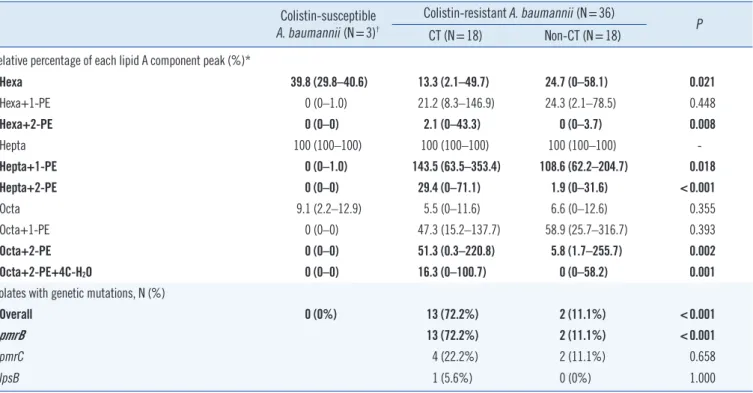
Peak intensity was significantly higher at two phosphoethanol- amine (PE)-modified hexa-, hepta- and octa-acylated lipid A (P =0.008, <0.001, and 0.002, respectively) in isolates from Group CT than in those from Group non-CT. Furthermore, origi- nal hexa-acylated lipid A intensity peaks were significantly lower (P =0.021), and two PE-modified octa-acylated lipid A with 4C- H2O was significantly higher in isolates from Group CT (P =0.01).
The lipid A composition determined by MALDI-TOF M/S divided the CR-AB strains into strains harboring pmrB mutation and those having normal pmrB (Table 4). When lipid A peaks were grouped and analyzed according to the number of substitutions occurring Fig. 1. Dendrogram showing cluster analysis of SmaI-digested pulsed-field gel electrophoresis patterns from colistin-resistant Acinetobacter baumannii isolates. Mutations from genomic analysis of genes associated with colistin resistance are listed on the right in bold font. Note that CR-AB32, 34, 35, and 36 had the same mutation in the pmrB gene (insertion TTT at g.938_939) and were isolated from a single loca- tion (ICU-H) within 47 days (highlighted by a black rectangle).
Abbreviations: ABA, Acinetobacter baumannii; CC, clonal complex; CCU, coronary care unit; GW, general ward; ICU, intensive care unit; PFGE, pulsed-field gel electrophoresis; ST, sequence type; CS-AB, colistin-susceptible Acinetobacter baumannii; CR-AB, colistin-resistant Acinetobacter baumannii.
Fig. 2. Mass spectrometry of lipid A extracted from colistin-susceptible isolates and CR-AB. (A) ATCC 17978, wild type CS-AB. (B) CR- AB18, Group non-CT. (C) CR-AB14, Group CT. The mass (m/z) of peaks only detected in CR-AB strains is indicated in bold.
Abbreviations: Hexa, hexa-acylated lipid A; Hepta, hepta-acylated lipid A; Octa, octa-acylated lipid A; PE, phosphoethanolamine; C, carbon; CS-AB, colistin- susceptible Acinetobacter baumannii; CR-AB, colistin-resistant Acinetobacter baumannii.
Mass/Charge, Da
*1,852.11
*1,852.10
*1,975.15
*1,975.14
1,729.07 1,729.03
1,729.54 100
80
60
40
20
0
100
80
60
40
20
0
140 120 100 80 60 40 20 0
Relative intensity (%)Relative intensity (%)Relative intensity (%)
1,700 1,800 1,900 2,000 2,100 2,200 2,300 2,400 2,500
1,700 1,800 1,900 2,000 2,100 2,200 2,300 2,400 2,500
1,700 1,800 1,900 2,000 2,100 2,200 2,300 2,400 2,500 A
B
C
*2,157.40
*2,157.41
*2,285.83
*2,285.90
*2,423.50
*2,423.50
*2,034.43
*2,034.39
*2,262.83
*2,262.78
1,912.36 1,912.31 1,912.84
2,139.74 2,139.70 2,139.84
in pmrB, pmrC, and lpsB genes, only the octa-acylated lipid A peak and its PE-modified forms were statistically different.
6. In vitro synergy testing
In vitro synergistic resistance effects (ΣFIC ≤0.5) for CR-AB iso- Table 3. Genetic characteristics and lipid A composition of colistin-resistant Acinetobacter baumannii isolates from patients with and with- out colistin treatment
Colistin-susceptible A. baumannii (N=3)†
Colistin-resistant A. baumannii (N=36) CT (N=18) Non-CT (N=18) P
Relative percentage of each lipid A component peak (%)*
Hexa 39.8 (29.8–40.6) 13.3 (2.1–49.7) 24.7 (0–58.1) 0.021
Hexa+1-PE 0 (0–1.0) 21.2 (8.3–146.9) 24.3 (2.1–78.5) 0.448
Hexa+2-PE 0 (0–0) 2.1 (0–43.3) 0 (0–3.7) 0.008
Hepta 100 (100–100) 100 (100–100) 100 (100–100) -
Hepta+1-PE 0 (0–1.0) 143.5 (63.5–353.4) 108.6 (62.2–204.7) 0.018
Hepta+2-PE 0 (0–0) 29.4 (0–71.1) 1.9 (0–31.6) <0.001
Octa 9.1 (2.2–12.9) 5.5 (0–11.6) 6.6 (0–12.6) 0.355
Octa+1-PE 0 (0–0) 47.3 (15.2–137.7) 58.9 (25.7–316.7) 0.393
Octa+2-PE 0 (0–0) 51.3 (0.3–220.8) 5.8 (1.7–255.7) 0.002
Octa+2-PE+4C-H2O 0 (0–0) 16.3 (0–100.7) 0 (0–58.2) 0.001
Isolates with genetic mutations, N (%)
Overall 0 (0%) 13 (72.2%) 2 (11.1%) <0.001
pmrB 13 (72.2%) 2 (11.1%) <0.001
pmrC 4 (22.2%) 2 (11.1%) 0.658
lpsB 1 (5.6%) 0 (0%) 1.000
Bold values are statistically significant (P <0.05).
*Data represent the relative intensity (%) and their range compared with hepta-acylated lipid A, set as 100%.
†For comparison, three randomly selected colistin-susceptible Acinetobacter baumannii clinical isolates were used as controls.
Abbreviations: CT, colistin treatment; Hexa, hexa-acylated lipid A; Hepta, hepta-acylated lipid A; Octa, octa-acylated lipid A; PE, phosphoethanolamine; C, carbon.
Table 4. Lipid A composition with genetic pmrB and other gene mutations of colistin-resistant Acinetobacter baumannii Relative percentage of
each lipid A component peak (%)*
Genetic mutation not detected (N=21)
Genetic mutation detected
(N=15) P pmrB gene single mutation
(N=7)
pmrB gene two mutations
(N=2)
pmrB gene and other mutation
(N=6) P
Hexa 24.8 (18.9–37.4) 11.3 (8.7–14.7) <0.001 15.8 (10.8–19.2) 11.9 (10.3–13.5) 8.7 (2.0–11.3) 0.099 Hexa+1-PE 25.2 (20.0–32.8) 19.2 (17.0–22.4) 0.026 19.2 (17.4–22.0) 14.7 (10.6–18.9) 20.8 (16.7–23.5) 0.588
Hexa+2-PE 0.0 (0.0–1.1) 3.6 (1.1–5.6) 0.002 5.0 (3.0–6.4) 4.1 (0.7–7.4) 0.7 (0.0–3.6) 0.074
Hepta 21 (100.0%) 15 (100.0%) - 7 (100.0%) 2 (100.0%) 6 (100.0%) 0.247
Hepta+1-PE 107.1 (84.6–127.7) 175.9 (138.1–196.4) <0.001 175.9 (140.8–179.9) 131.6 (118.5–144.7) 196.4 (136.8–219.5) 0.381 Hepta+2-PE 1.8 (0.6–4.1) 31.6 (25.2–36.9) <0.001 31.4 (29.4–34.8) 27.1 (22.0–32.2) 33.9 (11.4–42.6) 0.944
Octa 5.6 (0.0–10.0) 6.0 (3.2–7.5) 0.686 6.0 (5.1–6.7) 3.4 (1.6–5.1) 7.5 (0.0–8.2) 0.479
Octa+1-PE 71.3 (44.6–85.4) 42.8 (31.8–70.1) 0.127 51.5±29.4 19.9±4.5 65.0±27.4 0.458
Octa+2-PE 5.8 (3.0–13.9) 85.3 (44.0–129.3) <0.001 55.3 (44.0–105.3) 34.7 (31.0–38.4) 125.8 (90.1–181.2) 0.029 Octa+2-PE+4C-H2O 0.0 (0.0–0.0) 23.9 (15.8–52.6) <0.001 21.1 (4.4–46.4) 15.8 (15.3–16.2) 45.5 (32.1–58.2) 0.201 Data are presented as number (%), mean±SD for parametric variables or median [1st quartile–3rd quartile] for non-parametric variables. Bold values are statistically significant (P <0.05)
*Data represent the relative intensity (%) and their range compared with hepta-acylated lipid A, set as 100%.
Abbreviations: Hexa, hexa-acylated lipid A; Hepta, hepta-acylated lipid A; Octa, octa-acylated lipid A; PE, phosphoethanolamine; C, carbon.
lates were most frequently observed for the colistin-meropenem combination (94.4%, 34/36) followed by the colistin-rifampicin combination (83.3%, 30/36). Although the synergy testing did not show significant differences (colistin-meropenem, P =0.467;
colistin-rifampicin, P =0.655), combinations of colistin with me- ropenem or rifampin lowered the colistin MICs by 16-fold (range, 4–128-fold) and 8-fold (range, 4–128-fold), respectively (data not shown).
DISCUSSION
In our comparison of the characteristics of CR-AB clinical iso- lates recovered from CT and non-CT patients, no specific pa- tient trait was found relevant to the clinical outcome. As for the mortality rate, the APACHE II score and bloodstream infections were two noteworthy markers that should be taken into consid- eration when managing CR-AB-infected patients. These find- ings were expected because the APACHE II scoring system is designed to measure disease severity in patients admitted to ICUs, and because bloodstream infections have a negative im- pact on patient outcome [35]. Although there were no signifi- cant differences in terms of patient characteristics, the causative CR-AB isolates presented obvious differences associated with CR, such as altered lipid A components, as indicated by MALDI- TOF M/S and genetic mutations associated with outer mem- brane modification.
Most of the CR-AB isolates from Group non-CT did not show any genetic mutations, whereas the revised lipid A component was characterized by shifted lipid A component peaks in MALDI-TOF M/S. Two potential hypotheses explain these unex- pected results. First, the isolates may be a hetero-population composed of subpopulations of CR-AB and CS-AB lacking any evident genetic mutation, thus presenting with so-called hetero- resistance [3]. Heteroresistance may be the primary stage, which in the presence of colistin, results in the proliferation of resistant subpopulations, and may prolong the treatment period or even lead to mortality [3, 15, 36, 37]. The major subpopula- tion of CS-AB possibly produces erroneous colistin susceptibility data when using commercially automated systems and disk dif- fusion tests [3], whereas multiplication of the minor CR-AB sub- population results in at least little growth in the presence of high concentrations of colistin by broth dilution, resulting in high MICs [3, 36]. The different density of subpopulations might mask genetic mutations in CR-AB strains analyzed by Sanger sequencing. Similar findings have been demonstrated in Myco- bacterium tuberculosis [38, 39]. PCR-based detection was not
sufficient to identify heteroresistance, because minor allele fre- quencies of less than 15% were below the detection threshold of the method [40]. In addition, the CS-AB population feasibly flourished owing to better fitness in a colistin-free environment compared with the CR-AB population. As a consequence, the proportion switch of the two subpopulations might have pro- duced ambiguous results. Secondly, although less likely, a novel mechanism conferring resistance to colistin might be involved.
Since this study focused on genetic mutations in known CR-as- sociated genes, unknown mechanisms of resistance might have been missed. Future studies should conduct a complex func- tional whole-genome analysis.
Regardless of the population heterogeneity, CR-AB was de- tectable by MALDI-TOF M/S, based on distinct spectra of modi- fied lipid A compositions. Modification of lipid A by the addition of PE to the hexa-, hepta-, and octa-acylated lipid A has been suggested as a major mechanism of CR in AB. Similarly, even though some isolates exhibited unmodified lipid A peaks in this study, CR-AB displayed shifted peaks of one or two PE additives to the three lipid A moieties. Interestingly, the relative peak lev- els of PE-modified compared with unmodified lipid A compo- nents were much more elevated in Group CT. Notably, the rela- tive peak levels of the two PE modified hepta-acylated lipid A moieties clearly separated the two groups.
Most of the CR-AB isolates from both groups showed a syner- gistic effect of colistin upon addition of meropenem or rifampin:
synergism of both combinations was observed for most isolates, without any noticeable difference between combinations or be- tween groups. Thus, combination treatment with either merope- nem or rifampin should be considered for both CT and non-CT patients.
Out study has some limitations. As its main scope was to de- termine characteristics of CR-AB in clinical isolates and did not entail confirmation of heteroresistance, we could not confirm heteroresistant AB. Our data were collected from a single center in Korea, so the findings may not be generalized to other institu- tions. The limited number of CR-AB isolates precludes definitive conclusions on heterogeneous AB populations and CR.
Our study demonstrated that although there were no differ- ences in clinical characteristics between Groups CT and non- CT, there were pathological differences, including those involv- ing characteristics useful in diagnosing CR-AB. Population het- erogeneity masked resistance-causing genetic mutations, tradi- tionally determined by Sanger sequencing, especially in Group non-CT; therefore, to identify CR, accurate testing methods re- flecting physiological alteration of the bacteria, such as PE-mod-
ified lipid A identification by MALDI-TOF M/S, should be carried out. Since colistin heteroresistance is common in patients with- out prior drug treatment and can be caused by better bacterial fitness in the colistin-free environment, lipid A analysis shows clearer results for CR-AB isolates. Broth microdilution was found to accurately determine CR in AB regardless of population het- erogeneity, which prevented exact susceptibility interpretation because of the subpopulations of CR-AB. Furthermore, combi- nation treatment, specifically with meropenem and rifampicin, should be considered for the treatment of CR-AB infections.
Authors’ Disclosures of Potential Conflicts of Interest
No potential conflicts of interest relevant to this article were re- ported.
Acknowledgments
The Research Program funded by the Korean Centers for Dis- ease Control and Prevention (2016ER230100#) supported this work.
REFERENCES
1. Agodi A, Voulgari E, Barchitta M, Quattrocchi A, Bellocchi P, Poulou A, et al. Spread of a carbapenem- and colistin-resistant Acinetobacter baumannii ST2 clonal strain causing outbreaks in two Sicilian hospitals.
J Hosp Infect 2014;86:260-6.
2. Cai Y, Chai D, Wang R, Liang B, Bai N. Colistin resistance of Acineto- bacter baumannii: clinical reports, mechanisms and antimicrobial strat- egies. J Antimicrob Chemother 2012;67:1607-15.
3. Li J, Rayner CR, Nation RL, Owen RJ, Spelman D, Tan KE, et al. Het- eroresistance to colistin in multidrug-resistant Acinetobacter baumannii.
Antimicrob Agents Chemother 2006;50:2946-50.
4. Peleg AY and Hooper DC. Hospital-acquired infections due to Gram- negative bacteria. N Engl J Med 2010;362:1804-13.
5. Amudhan SM, Sekar U, Arunagiri K, Sekar B. OXA beta-lactamase-me- diated carbapenem resistance in Acinetobacter baumannii. Indian J Med Microbiol 2011;29:269-74.
6. Evans BA and Amyes SG. OXA beta-lactamases. Clin Microbiol Rev 2014;27:241-63.
7. Karaiskos I, Galani L, Baziaka F, Giamarellou H. Intraventricular and in- trathecal colistin as the last therapeutic resort for the treatment of multi- drug-resistant and extensively drug-resistant Acinetobacter baumannii ventriculitis and meningitis: a literature review. Int J Antimicrob Agents 2013;41:499-508.
8. Nation RL and Li J. Colistin in the 21st century. Curr Opin Infect Dis 2009;22:535-43.
9. Newton BA. The properties and mode of action of the polymyxins. Bac- teriol Rev 1956;20:14-27.
10. Schindler M and Osborn MJ. Interaction of divalent cations and poly-
myxin B with lipopolysaccharide. Biochemistry 1979;18:4425-30.
11. Falagas ME, Rafailidis PI, Matthaiou DK. Resistance to polymyxins:
Mechanisms, frequency and treatment options. Drug Resist Updat 2010;13:132-8.
12. Koch-Weser J, Sidel VW, Federman EB, Kanarek P, Finer DC, Eaton AE.
Adverse effects of sodium colistimethate. Manifestations and specific reaction rates during 317 courses of therapy. Ann Intern Med 1970;72:
857-68.
13. Meletis G, Tzampaz E, Sianou E, Tzavaras I, Sofianou D. Colistin hetero- resistance in carbapenemase-producing Klebsiella pneumoniae. J Anti- microb Chemother 2011;66:946-7.
14. Pournaras S, Ikonomidis A, Markogiannakis A, Spanakis N, Maniatis AN, Tsakris A. Characterization of clinical isolates of Pseudomonas ae- ruginosa heterogeneously resistant to carbapenems. J Med Microbiol 2007;56:66-70.
15. Yau W, Owen RJ, Poudyal A, Bell JM, Turnidge JD, Yu HH, et al. Colis- tin hetero-resistance in multidrug-resistant Acinetobacter baumannii clinical isolates from the Western Pacific region in the SENTRY antimi- crobial surveillance programme. J Infect 2009;58:138-44.
16. Hood MI, Becker KW, Roux CM, Dunman PM, Skaar EP. Genetic deter- minants of intrinsic colistin tolerance in Acinetobacter baumannii. Infect Immun 2013;81:542-51.
17. Moffatt JH, Harper M, Harrison P, Hale JD, Vinogradov E, Seemann T, et al. Colistin resistance in Acinetobacter baumannii is mediated by complete loss of lipopolysaccharide production. Antimicrob Agents Chemother 2010;54:4971-7.
18. Adams MD, Nickel GC, Bajaksouzian S, Lavender H, Murthy AR, Ja- cobs MR, et al. Resistance to colistin in Acinetobacter baumannii asso- ciated with mutations in the PmrAB two-component system. Antimicrob Agents Chemother 2009;53:3628-34.
19. Lee H, Hsu FF, Turk J, Groisman EA. The PmrA-regulated pmrC gene mediates phosphoethanolamine modification of lipid A and polymyxin resistance in Salmonella enterica. J Bacteriol 2004;186:4124-33.
20. Liu YY, Wang Y, Walsh TR, Yi LX, Zhang R, Spencer J, et al. Emergence of plasmid-mediated colistin resistance mechanism MCR-1 in animals and human beings in China: a microbiological and molecular biological study. Lancet Infect Dis 2016;16:161-8.
21. Kim Y, Bae IK, Lee H, Jeong SH, Yong D, Lee K. In vivo emergence of colistin resistance in Acinetobacter baumannii clinical isolates of se- quence type 357 during colistin treatment. Diagn Microbiol Infect Dis 2014;79:362-6.
22. Beceiro A, Moreno A, Fernandez N, Vallejo JA, Aranda J, Adler B, et al.
Biological cost of different mechanisms of colistin resistance and their impact on virulence in Acinetobacter baumannii. Antimicrob Agents Chemother 2014;58:518-26.
23. Hraiech S, Roch A, Lepidi H, Atieh T, Audoly G, Rolain JM, et al. Im- paired virulence and fitness of a colistin-resistant clinical isolate of Aci- netobacter baumannii in a rat model of pneumonia. Antimicrob Agents Chemother 2013;57:5120-1.
24. López-Rojas R, McConnell MJ, Jiménez-Mejías ME, Domínguez-Herre- ra J, Fernández-Cuenca F, Pachón J. Colistin resistance in a clinical Acinetobacter baumannii strain appearing after colistin treatment: effect on virulence and bacterial fitness. Antimicrob Agents Chemother 2013;
57:4587-9.
25. Jones CL, Singh SS, Alamneh Y, Casella LG, Ernst RK, Lesho EP, et al.
In vivo fitness adaptations of colistin-resistant Acinetobacter baumannii isolates to oxidative stress. Antimicrob Agents Chemother 2017;61.
26. López-Rojas R, Domínguez-Herrera J, McConnell MJ, Docobo-Peréz F, Smani Y, Fernández-Reyes M, et al. Impaired virulence and in vivo fit- ness of colistin-resistant Acinetobacter baumannii. J Infect Dis 2011;
203:545-8.
27. CLSI. Performance standards for antimicrobial susceptibility testing.
26th ed. CLSI supplement M100–S26. Wayne, PA: Clinical and Labora- tory Standards Institute, 2016.
28. EUCAST. Recommendations for MIC determination of colistin (polymyxin E) as recommended by the joint CLSI–EUCAST Polymyxin Breakpoints Working Group. http://www.eucast.org/fileadmin/src/media/PDFs/EU- CAST_files/General_documents/Recommendations_for_MIC_determi- nation_of_colistin_March_2016.pdf (Updated on Mar 2016).
29. Orhan G, Bayram A, Zer Y, Balci I. Synergy Tests by E Test and check- erboard methods of antimicrobial combinations against Brucella meli- tensis. Journal of Clinical Microbiology 2005;43:140-3.
30. Woodford N, Ellington MJ, Coelho JM, Turton JF, Ward ME, Brown S, et al. Multiplex PCR for genes encoding prevalent OXA carbapenemases in Acinetobacter spp. Int J Antimicrob Agents 2006;27:351-3.
31. Cicek AC, Saral A, Iraz M, Ceylan A, Duzgun AO, Peleg AY, et al. OXA- and GES-type beta-lactamases predominate in extensively drug-resis- tant Acinetobacter baumannii isolates from a Turkish University Hospi- tal. Clin Microbiol Infect 2014;20:410-5.
32. Segal H, Garny S, Elisha BG. Is IS(ABA-1) customized for Acineto- bacter? FEMS Microbiol Lett 2005;243:425-9.
33. Beceiro A, Llobet E, Aranda J, Bengoechea JA, Doumith M, Hornsey M, et al. Phosphoethanolamine modification of lipid A in colistin-resistant variants of Acinetobacter baumannii mediated by the pmrAB two-com- ponent regulatory system. Antimicrob Agents Chemother 2011;55:
3370-9.
34. Tenover FC, Arbeit RD, Goering RV, Mickelsen PA, Murray BE, Persing DH, et al. Interpreting chromosomal DNA restriction patterns produced by pulsed-field gel electrophoresis: criteria for bacterial strain typing. J Clin Microbiol 1995;33:2233-9.
35. Pittet D, Tarara D, Wenzel RP. Nosocomial bloodstream infection in criti- cally ill patients. Excess length of stay, extra costs, and attributable mor- tality. Jama 1994;271:1598-601.
36. Hawley JS, Murray CK, Jorgensen JH. Colistin heteroresistance in Aci- netobacter and its association with previous colistin therapy. Antimicrob Agents Chemother 2008;52:351-2.
37. Moosavian M, Shoja S, Nashibi R, Ebrahimi N, Tabatabaiefar MA, Ros- tami S, et al. Post neurosurgical meningitis due to colistin heteroresis- tant Acinetobacter baumannii. Jundishapur J Microbiol 2014;7:e12287.
38. Eilertson B, Maruri F, Blackman A, Herrera M, Samuels DC, Sterling TR. High proportion of heteroresistance in gyrA and gyrB in fluoroqui- nolone-resistant Mycobacterium tuberculosis clinical isolates. Antimi- crob Agents Chemother 2014;58:3270-5.
39. Pholwat S, Stroup S, Foongladda S, Houpt E. Digital PCR to detect and quantify heteroresistance in drug resistant Mycobacterium tuberculosis.
PLoS One 2013;8:e57238.
40. Rohlin A, Wernersson J, Engwall Y, Wiklund L, Bjork J, Nordling M. Par- allel sequencing used in detection of mosaic mutations: comparison with four diagnostic DNA screening techniques. Hum Mutat 2009;30:
1012-20.