• 검색 결과가 없습니다.

Highly Sensitive and Selective Trimethylamine Sensor Using Yolk-shell Structured Mo-doped Co<sub>3</sub>O<sub>4</sub> Spheres

N/A
N/A
Protected

Academic year: 2021

Share "Highly Sensitive and Selective Trimethylamine Sensor Using Yolk-shell Structured Mo-doped Co<sub>3</sub>O<sub>4</sub> Spheres"

Copied!
6
0
0

로드 중.... (전체 텍스트 보기)

전체 글

(1)

http://dx.doi.org/10.5369/JSST.2019.28.5.271 pISSN 1225-5475/eISSN 2093-7563

Highly Sensitive and Selective Trimethylamine Sensor Using Yolk-shell Structured Mo-doped Co 3 O 4 Spheres

Tae-Hyung Kim

, Ki Beom Kim

, and Jong-Heun Lee

1+

Abstract

Pure and 0.5, 1, 2, 5, and 10 at% of Mo-doped Co

3

O

4

yolk-shell spheres were synthesized by ultrasonic spray pyrolysis of droplets containing Co nitrate, ammonium molybdate, and sucrose and their gas sensing characteristics to 5 ppm trimethylamine (TMA), ethanol, p-xylene, toluene, ammonia, carbon monoxide, and benzene were measured at 225-325

o

C. The sensor using pure Co

3

O

4

yolk-shell spheres showed the highest response to p-xylene and very low response to TMA at 250

o

C, while the doping of Mo into Co

3

O

4

tended to increase the overall responses of gas sensors. In particular, the sensor using 5 at% Mo-doped Co

3

O

4

yolk-shell spheres exhibited the high response to TMA with low cross-responses to other interfering gases. The high response and selectivity of Mo-doped Co

3

O

4

yolk- shell spheres to TMA are attributed to the electronic sensitization by higher valent Mo doping and acid-base interaction between TMA and Mo components.

Keywords: Gas sensor, P-type oxide semiconductor, Co

3

O

4

, TMA gas, acid-base interaction, electronic sensitization

1. INTRODUCTION

Trimethylamine (TMA) is a colorless biogenic amine gas secreted from the decay of fish, marine products and meat [1-2].

Exposure to > 10 ppm TMA may induce headache, irritation to eyes, and nausea [3]. Moreover, the concentration of TMA in exhaled breath can give the information on the renal function [4].

Accordingly, the sensitive and selective detection of TMA is highly required for assessing the freshness of fish and meat, protecting human from harmful pollutants, and diagnosing renal disease.

Although various analytic instruments can be used to measure TMA, bulky size, prolonged analysis time, and high cost hamper the applications. In contrast, oxide semiconductor gas sensors with simple structures, high response, rapid responding speed and excellent reliability [5-7] is a cost-effective solution to detect TMA. Moreover, the facile integration of gas sensor into a miniaturized device or mobile phone enables the wireless sensor

networks for evaluating the fish freshness, air quality, and disease and its applications will become stronger with the progress of Internet of Things.

Various n-type oxide semiconductors have been explored to detect TMA, which include SnO

2

-ZnO nanocomposites [8], Cr

2

O

3

-decorated ZnO nanowires [9], and MoO

3

nanostructures [10-12]. However, the design of TMA sensor using p-type oxide semiconductors has been barely investigated and the research needs further improvement on the sensitivity and selectivity toward TMA.

In the present study, highly gas accessible yolk-shell structured Co

3

O

4

spheres were prepared by ultrasonic spray pyrolysis and their response and selectivity toward TMA were enhanced by Mo doping. The gas sensing mechanism underlying the high response and excellent selectivity of Mo-doped Co

3

O

4

yolk-shell spheres to TMA was discussed in relation to the Mo-doping induced changes of charge carrier concentration, oxygen adsorption and the interaction between basic gas and acidic sensing materials.

2. EXPERIMENTAL

2.1 Preparation of pure and Mo-doped Co

3

O

4

yolk-shell spheres

Pure and Mo-doped Co

3

O

4

yolk-shell spheres were prepared by ultrasonic spray pyrolysis. Spray solution was prepared by

1

Department of Materials Science and Engineering, Korea University, Anam-ro 145, Seongbuk Gu, Seoul 02841, Korea

§

Both authors are contributed equally to this work

+
Corresponding author: [email protected]

(Received: Sep. 23, 2019, Revised: Sep. 26, 2019, Accepted: Sep. 27, 2019)

This is an Open Access article distributed under the terms of the Creative Commons Attribution Non-Commercial License(http://creativecommons.org/

licenses/bync/3.0) which permits unrestricted non-commercial use, distribution,

and reproduction in any medium, provided the original work is properly cited.

(2)

dissolving cobalt (II) nitrate hexahydrate (5.82 g, 99.999%, Co(NO

3

)

2

·6H

2

O, Sigma-Aldrich Co., Ltd., USA), sucrose (23.96 g, 99%, C

12

H

22

O

11

, Sigma-Aldrich Co., Ltd., USA), and ammonium molybdate tetrahydrate (99.98%, (NH

4

)

6

Mo

7

O

24

· 4H

2

O, Sigma-Aldrich Co., Ltd., USA) in 100 mL distilled water and subsequent homogenization by stirring. Six different solutions with [Mo]/[Co] = 0, 0.005, 0.01, 0.02, 0.05, and 0.1 were used for spray pyrolysis.

Droplets generated by ultrasonic transducers were transferred by carrier gas (air) with flow rate of 5 L/min to high-temperature furnace (800

o

C) for pyrolysis. The precursor spheres were collected at Teflon bag filter, which were converted into pure and Mo-doped Co

3

O

4

spheres by thermal annealing at 400

o

C for 2 h. For simplicity, hereinafter, Co

3

O

4

yolk-shell spheres doped with 0.5, 1, 2, 5, and 10 at% Mo will be referred as 0.5Mo-, 1Mo-, 2Mo-, 5Mo- , and 10Mo-Co

3

O

4

, respectively. The morphology and phase of yolk-shell spheres are analyzed by Field-emission scanning electron microscope (FE-SEM, S-4300 Hitachi Co, Ltd, Japan) and X-ray diffraction (XRD, Rigaku Model/MAX-2500, Source: CuKa).

2.2 Measurement of gas sensing characteristics Pure and Mo-doped Co

3

O

4

yolk-shell spheres are dispersed in distilled water and the slurry was coated on alumina substrate with Au electrodes (size = 1.5 mm x 1.5 mm, thickness = 0.25 mm).

The sensors were heat-treated at 350 °C for 2 h to remove residual water and to increase the thermal stability of sensing materials.

The sensing temperature (225-325

o

C) was controlled by adjusting the power of heater located in the backside of substrate. The gas responses (R

g

/R

a

: R

g

: resistance in gas; R

a

: resistance in air) to 5 ppm TMA, NH

3

, ethanol, p-xylene, toluene, benzene, and CO (dry synthetic air balance) were measured.

3. RESULTS AND DISCUSSION

3.1 SEM images

The morphology of pure and Mo-doped Co

3

O

4

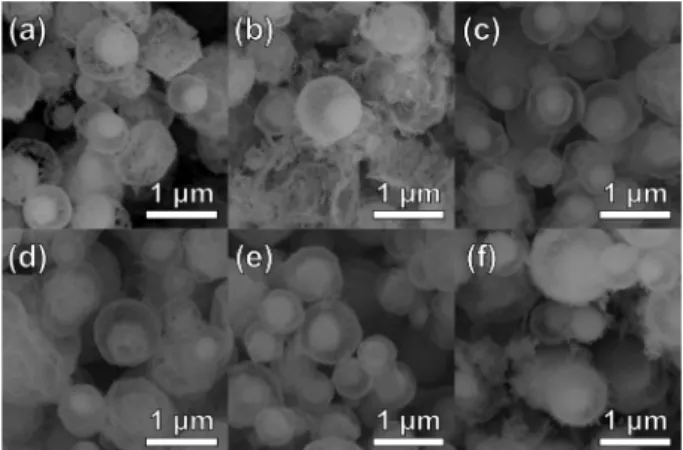
yolk-shell spheres was observed using SEM (Figure 1). Through the semi- transparent and thin shells, yolks are observed in all the samples, confirming the formation of yolk-shell spheres. The formation mechanism of yolk-shell morphology is explained elsewhere [13], which is; 1) drying of droplets; 2) the formation of Co-C(cobalt- carbon) or Mo-Co-C (molybdenium-cobalt-carbon) composite spheres; 3) the formation of Co-C@Co

3

O

4

or Mo-Co-C@Mo- Co

3

O

4

yolk-shell structures by the decomposition of outer part of Co-C or Mo-Co-C composite spheres into Co

3

O

4

or Mo-doped Co

3

O

4

shells; 4) the formation of Co

3

O

4

or Mo-Co

3

O

4

yolk-shell spheres by the converting of Co-C or Mo-Co-C yolks into oxides.

3.2 Phase analysis

The phase of pure and Mo-doped Co

3

O

4

yolk-shell spheres was analysed by X-ray diffraction (Figure 2). No second phase was observed in pure Co

3

O

4

and Co

3

O

4

specimens doped with 0.5-5 at% Mo (Figure 2a-e), while small amount of CoMoO

4

(JCPDS

#21-0868) was observed in 10 at% Mo doped Co

3

O

4

specimens (Figure 2f). This indicates that ≤ 5 at% of Mo can be incorporated into Co

3

O

4

lattice and the solubility limit of Mo in Co

3

O

4

is between 5 and 10 at%. There was no substantial shift of peak position with the doping of Mo into Co

3

O

4

. This can be explained Fig. 1. SEM images of (a) pure Co

3

O

4

, (b) 0.5Mo-, (c) 1Mo-, (d)

2Mo-, (e) 5Mo-, and (f) 10Mo-Co

3

O

4

Fig. 2. XRD patterns of (a) pure Co

3

O

4

, (b) 0.5Mo-, (c) 1Mo-, (d)

2Mo-, (e) 5Mo-, and (f) 10Mo-Co

3

O

4

(3)

by the similar ionic radii of Mo

6+

(0.59 Å) and Co

3+

(0.61 Å) at the same coordination number of 6.

3.3 Gas sensing characteristics and discussion The gas sensing characteristics of sensors using pure and Mo- doped Co

3

O

4

yolk-shell spheres to 5 ppm TMA, ethanol, p-xylene, toluene, NH

3

, CO, and benzene were measured at 225-325

o

C (Figure 3). The sensing characteristics at ≤ 200

o

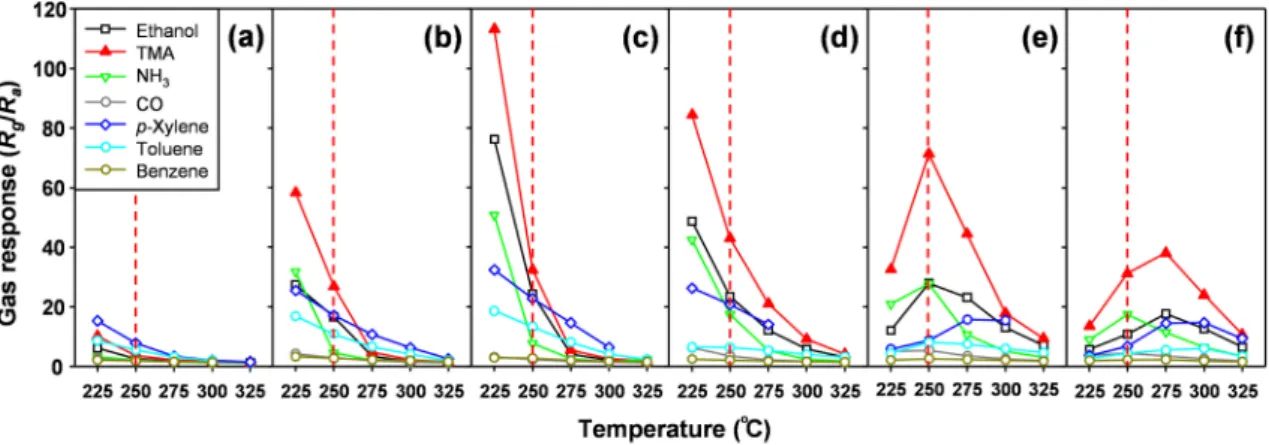
C were not measured because the sensing and recovery speed was too sluggish. All 6 sensors showed the typical gas sensing characteristics of p-type oxide semiconductors. That is, the sensor resistance increased upon exposure to reducing gases and returned to the original level upon exposure to air (Figure 4).

The sensor using pure Co

3

O

4

yolk-shell spheres showed the highest response to p-xylene (Figure 3a). However, the sensor showed relatively low responses to all the analyte gases. The doping of Mo significantly changed the gas sensing characteristics. The overall responses at 225

o

C increased significantly with doping Mo (Figure 3b,c), peaked at 1 at% Mo

doping (Figure 3c), and then decreased with further doping of Mo up to 10 at% (Figure 3d-f). It should be noted that all the 5 at%

Mo-doped sensors showed the highest response to TMA at 225- 250

o

C. This suggests that the doping of Mo enhance not only the response but also the selectivity of Co

3

O

4

-based sensor to TMA.

In the sole viewpoint of TMA response, the operation of 1Mo- Co

3

O

4

sensor at 225

o

C is advantageous (Figure 3c). However, taking into account both response and selectivity to TMA, the operation of 5Mo-Co

3

O

4

sensor at 250

o

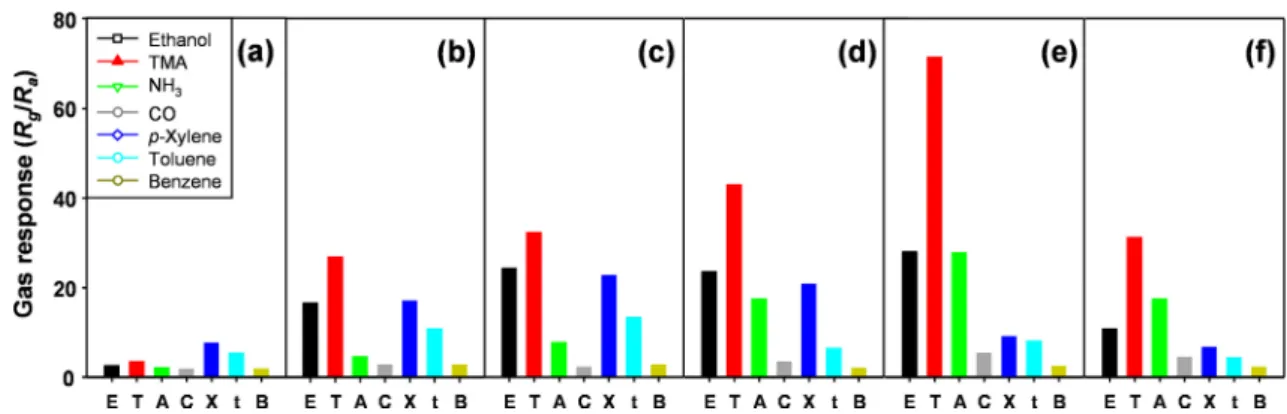
C can be regarded as optimal condition (Figure 3e). For clearer presentation, the gas selectivity of all 6 sensors were shown in Figure 5. Note that the response of 5Mo-Co

3

O

4

sensor to 5 ppm TMA (S = 71.4) is significantly higher than those of 5 ppm ethanol (S = 27.9) and NH

3

(S = 27.8) (Figure 5e).

Significant change of gas response and selectivity by Mo doping into Co

3

O

4

should be understood in relation to the variation of charge carrier concentration, acid-base interaction, and oxygen adsorption. If the fixed amount of charge carriers are provided to sensing materials by the interaction between oxide surface and analyte gases, the material with the lower charge Fig. 3. Gas sensing characteristics of (a) pure Co

3

O

4

, (b) 0.5Mo-, (c) 1Mo-, (d) 2Mo-, (e) 5Mo-, and (f) 10Mo-Co

3

O

4

to 5 ppm TMA, ethanol,

p-xylene, toluene, benzene, CO, NH

3

at 225-325

o

C.

Fig. 4. Dynamic sensing transients of (a) pure Co

3

O

4

, (b) 0.5Mo-, (c) 1Mo-, (d) 2Mo-, (e) 5Mo-, and (f) 10Mo-Co

3

O

4

to 5 ppm TMA at 250

o

C.

(4)

carrier concentration will show the higher chemiresistive variation. Indeed, one of the authors demonstrated that the doping of higher valent Cr and Fe into NiO increased the gas response [14-16] and the gas response of p-type oxide semiconductors are closely dependent upon the charge carrier concentration [15]. To examine the effect of Mo doping on the charge carrier concentration, the R

a

values of the sensors at 225

o

C were measured (Figure 6). Note that the R

a

values increased with increasing the Mo doping concentration. This is feasible considering the substitution of Mo

6+

at the site of Co

3+

because the electrons generated by higher valent doping will decrease the concentration of majority charge carrier (hole) by electron-hole recombination. Accordingly, the general tendency to increase gas response by Mo doping can be explained in part by the electronic sensitization of sensor due to the decrease of charge carrier concentration.

However, the change of gas selectivity cannot be explained by the electronic sensitization mechanism. TMA and NH

3

are basic gases and the reactivity of these gases can be enhanced by employing acidic nature of sensing materials. Indeed, acidic oxides such as MoO

3

and WO

3

are known to show high responses to basic TMA because of strong acid-base interaction [10-12, 17].

Accordingly, the enhancement of TMA selectivity by Mo doping can be explained by the increase of acid-base interaction between gas and sensing materials.

Note that both R

a

and acidity increase with Mo doping but gas response starts to decreases when Mo doping concentration becomes higher than 2 at%. Moreover, the pure, 0.5Mo-, 1Mo-, and 2Mo-Co

3

O

4

sensors showed the monotonous decrease of gas responses with increasing temperature, whereas 5Mo- and 10Mo- Co

3

O

4

sensors showed the bell-shaped response curve with temperature to show the maximum gas response (T

M

). This suggests the presence of other parameter involving the gas sensing

characteristics.

In oxide semiconductors, the gas sensing reaction between reducing gas and negatively charged adsorbed oxygen becomes difficult at low temperature. At very high sensing temperature, on the contrary, the analyte gases are oxidized into non-reactive species at the upper part of sensing film. Moreover, the ionized oxygen adsorption is difficult both at very low and high temperature. Thus, oxide semiconductor gas sensors show bell- shaped gas responses. In 0.5Mo-, 1Mo-, and 2Mo-Co

3

O

4

sensors, the T

M

values are located at < 225 °C (Figure 3b-d). However, the T

M

values increased to 250 and 275 °C at 5Mo- and 10Mo- Co

3

O

4

sensors (Figure 3e-f). If the amount of oxygen adsorption decreased with Mo doping, the reaction between analyte gas and negatively charged oxygen at low temperature will become more difficult, which will shift the T

M

values to the higher temperature.

Thus, slight decrease of gas response and increase of T

M

values by Fig. 5. Gas sensing characteristics of (a) pure Co

3

O

4

, (b) 0.5Mo-, (c) 1Mo-, (d) 2Mo-, (e) 5Mo-, and (f) 10Mo-Co

3

O

4

to 5 ppm TMA, ethanol,

p-xylene, toluene, benzene, CO, NH

3

at 250

o

C.

Fig. 6. Resistance of pure and Mo-doped Co

3

O

4

in air as a con-

centration of Mo doping concentration at 225

o

C.

(5)

heavy Mo doping (2-10 at%) (Figure 3d-f) can be explained by the decrease of oxygen adsorption with Mo doping although further systematic studies are necessary to confirm this.

TMA is a key measure to evaluate the freshness of fishes and meats. For instance, 0-10 ppm, 10-50 ppm, and > 60 ppm TMA are regarded as the criteria of fresh, initial corruption, and rotten states of fishes, respectively. Note that a few ppm level of TMA should be detected in order to evaluate the initial decay of fishes.

It is known that > 10 ppm TMA is harmful for human beings.

Thus, the time weighted average permissible exposure limit of TMA is defined as 10 ppm by Occupational Safety and Health Administration. Moreover, the TMA in exhaled breath is a potential biomarker gas for renal disorders. The TMA concentration of chronic kidney disorder patent range from 1.8- 38 ppb [18]. The 5Mo-Co

3

O

4

sensor shows very high gas response (S = 71.4) to 5 ppm TMA as well as excellent TMA selectivity. This indicates that the sensor in the present study can be used for assessing fish freshness, indoor air monitoring, and examining renal disease.

4. CONCLUSIONS

Highly sensitive and selective trimethylamine sensor was designed using Mo-doped Co

3

O

4

yolk-shell spheres. The doping of Mo to Co

3

O

4

yolk-shell spheres significantly changed the gas sensing characteristics such as gas response, TMA selectivity, and the variation of maximum temperature to show the highest gas response. The overall increase of gas response by Mo doping was explained by the decrease of charge carrier concentration in Co

3

O

4

due to the substitution of higher valent Mo

6+

at the site of Co

3+

. The Mo doping increased the acidity of sensing materials, which enhanced the selectivity to basic TMA. Finally, the oxygen adsorption and gas sensing reaction between analyte gas and ionized oxygen on the surface of sensing materials were also associated with the Mo doping. The sensor using Mo-doped Co

3

O

4

yolk-shell spheres with high selectivity and response to TMA show the promising potentials for evaluating the fish freshness, monitoring indoor air quality and diagnosing disease.

ACKNOWLEDGMENT

This research was supported by the Industrial Strategic Technology Development Program (10073068, Development of Miniaturized 10 mW TVOC/Alcohol Dual Gas Sensor and

Module using Non-Silicon AAO Ceramic Substrate) funded By the Ministry of Trade, Industry & Energy (MOTIE, Korea).

REFERENCES

[1] S. Sadok, R. F. Uglow, and S. J. Haswell, “Determination of trimethylamine in fish by flow injection analysis”, Anal.

Chim. Acta, Vol. 321, pp. 69-74, 1996.

[2] G. M. Bota and P. B. Harrington, “Direct detection of trime- thylamine in meat food products using ion mobility spec- trometry”, Talanta, Vol. 68, No. 3, pp. 629-635, 2006.

[3] H. U. Rehman, “Fish odour syndrome”, Postgrad. Med. J., Vol. 32, pp. 115-130, 2011.

[4] Z. H. Endre, J. W. Pickering, M. K. Storer, W.-P. Hu, K. T.

Moorhead, R. Allardyce, D. O. McGregor, and J. M. Scot- ter, “Breath ammonia and trimethylamine allow real-time monitoring of haemodialysis efficacy”, Physiol. Meas., Vol.

32, No. 1, pp. 115-130, 2011.

[5] J. M. Suh, D. H. Kim, and H. W. Jang, “Synthesis of Nanoporous Metal Oxide Films Using Anodic Oxidation and Their Gas Sensing Properties”, J. Sens. Sci. Technol., Vol. 27, No. 1, pp. 13-20, 2018.

[6] S. M. Majhi, D. V. Dao, H.-J. Lee, and Y. T. Yu, “A Com- parative Study of Gas Sensing Properties of Au-loaded ZnO and Au@ZnO Core-shell Nanoparticles”, J. Sens. Sci. Tech- nol., Vol. 27, No. 2, pp. 76-81, 2018.

[7] S. Y. Yi, Y. G. Song, G. S. Kim, and C.-Y. Kang, “In-dec- orated NiO Nanoigloos Gas Sensor with Morphological Evolution for Ethanol Sensors”, J. Sens. Sci. Technol., Vol.

28, No. 4, pp. 231-235, 2019.

[8] W.-H. Zhang and W.-D. Zhang, “Fabrication of SnO

2

-ZnO nanocomposite sensor for selective sensing of trimethyl- amine and freshness of fishes”, Sens. Actuator B, Vol. 134, No. 2, pp. 403-408, 2008.

[9] H.-S. Woo, C. W. Na, I.-D. Kim, and J.-H. Lee, “Highly sensitive and selective trimethylamine sensor using one- dimensional ZnO-Cr

2

O

3

hetero-nanostructures”, Nanotech- nology, Vol. 23, No. 24, pp. 245501(1)-245501(10), 2012.

[10] H.-Y. Li, L. Huang, X.-X. Wang, C.-S. Lee, J.-W. Yoon, J.

Zhou, X. Guo, and J.-H. Lee, “Molybdenum trioxide nano- paper as a dual gas sensor for detecting trimethylamine and hydrogen sulfide”, RSC Adv., Vol. 7, No.7, pp. 3680-3685, 2017.

[11] X. Chu, S. Liang, W. Sun, W. Zhang, T. Chen, and Q.

Zhang, “Trimethylamine sensing properties of sensors based on MoO

3

microrods”, Sens. Actuator B, Vol. 148, No.

2, pp. 399-403, 2010.

[12] Y. H. Cho, Y. N. Ko, Y. C. Kang, I.-D. Kim, and J.-H. Lee,

“Ultraselective and ultrasensitive detection of trimethyl- amine using MoO

3

nanoplates prepared by ultrasonic spray pyrolysis”, Sens. Actuator B, Vol. 195, pp. 189-196, 2014.

[13] Y. J. Hong, M. Y. Son, and Y. C. Kang, “One-Pot Facile

Synthesis of Double-Shelled SnO

2

Yolk-Shell-Structured

Powders by Continuous Process as Anode Materials for Li-

ion Batteries”, Adv. Mater., Vol. 25, No. 16, pp. 2279-2283,

2013.

(6)

[14] H.-J. Kim, J.-W. Yoon, K.-I. Choi, H. W. Jang, A. Umar, and J.-H. Lee “Ultraselective and sensitive detection of xylene and toluene for monitoring indoor air pollution using Cr-doped NiO hierarchical nanostructures”, Nanoscale, Vol.

5, No. 15, pp. 7066-7079, 2013.

[15] J.-W. Yoon, H.-J. Kim, I.-D. Kim, and J.-H. Lee, “Elec- tronic sensitization of the response to C

2

H

5

OH of p-type NiO nanofibers by Fe doping”, Nanotechnology, Vol. 24, No. 44, pp. 444005(1)-444005(8), 2013.

[16] H.-J. Kim, K.-I. Choi, K.-M. Kim, C. W. Na, and J.-H. Lee,

“Highly sensitive C

2

H

5

OH sensors using Fe-doped NiO hollow spheres”, Sens. Actuator B, Vol. 171-172, pp. 1029-

1037, 2012.

[17] Y. H. Cho, Y. C. Kang, and J.-H. Lee, “Highly selective and sensitive detection of trimethylamine using WO

3

hollow spheres prepared by ultrasonic spray pyrolysis”, Sens. Actu- ator B, Vol. 176, pp. 971-977, 2013.

[18] B. G.-Polanowska, J. Faber, M. Skowron, P. Miarka, A.

Pietrzycka, I. Śliwka, and A. Amann, “Detection of poten-

tial chronic kidney disease markers in breath using gas

chromatography with mass-spectral detection coupled with

thermal desorption method”, J. Chromatogr. A, Vol. 1301,

No. 2, pp. 179-189, 2013.

수치

Fig. 2. XRD patterns of (a) pure Co 3 O 4 , (b) 0.5Mo-, (c) 1Mo-, (d) 2Mo-, (e) 5Mo-, and (f) 10Mo-Co 3 O 4
Fig. 4. Dynamic sensing transients of (a) pure Co 3 O 4 , (b) 0.5Mo-, (c) 1Mo-, (d) 2Mo-, (e) 5Mo-, and (f) 10Mo-Co 3 O 4  to 5 ppm TMA at 250  o C.
Fig. 6. Resistance of pure and Mo-doped Co 3 O 4  in air as a con- con-centration of Mo doping concon-centration at 225  o C.

참조

관련 문서

For job characteristics sub-factors, while the average of functional diversity was high in graduate school graduates, the average of task importance, job

Among the five sub-content categories, only in the communication domain 'listening and speaking', the social relations domain 'living together' and the

This study was conducted to recognize the importance of self - management of dance major students and to understand the relationship between the sub -

For the gender, while training and direction, democratic direction, positive regard, and autocratic direction of leadership type sub-factors were perceived as high in

Fourth, for the sub-factors of personality traits according to weight lifters’ education, while there was a high difference in neuroticism and agreeableness

For the sub-factors of selection attributes and customer value according to screen golf course handicap, convenience, professionality, facilities, price,

The results of this study are as follows: ⑴ 4 basic directions, 16 themes, and 64 sub-themes of the vocational high school development are established, and

Second, there was no statistically significant difference in the sub-factors of participation satisfaction according to age, career, occupation,