• 검색 결과가 없습니다.

대한비과학회

N/A
N/A
Protected

Academic year: 2021

Share "대한비과학회"

Copied!
4
0
0

로드 중.... (전체 텍스트 보기)

전체 글

(1)

- 101 -

KISEP Original Articles J Rhinol 7((((2)))), 2000

Concha Bullosa: : : : Incidence and Relationship with Chronic Sinusitis on OMU CT

Kyung Rae Kim, M.D. and Seung Hwan Lee, M.D.

ABSTRACT

Concha bullosa is one of the most common anatomical variations detected in the paransal sinus and nasal cavity. In this study, the incidence of concha bullosa and the relationship between the size of concha bullosa and the degree of the paranasal sinus lesion is to be inquired. This study was based on 232 patients who visited our outpatient department with rhinological sym- ptoms suspected with chronic sinusitis who went under OMU CT. Based on OMU CT reviews, the grade of concha bullosa was divided into four stages and the paransal sinus lesion was classified into 5 stages. The prevalence rate of concha bullosa was 36.2% with 14.6% bilateral and 21.6% unilateral. The accompanying incidence of concha bullosa in patients with no sinus disease was 20.2% and 26.8% in sinusitis patients, with no significant statistical difference between the two groups. Merely, a higher prevalence rate was seen in patients with paranasal sinus lesions localized in the OMU. However, for a more accurate result as of concha bullosa functioning as an etiological factor of sinusitis, a random population based study will be necessary.

Also, it has been noticed that septal deviation, in all anatomical variations, most commonly occurs in patients with concha bullosa.

KEY WORDS:Concha bullosa·Chronic sinusitis.

INTRODUCTION

Concha bullosa, which designates a pneumatized mi- ddle turbinate, is one of the most common anatomical variations seen in the nasal cavity. It has been recogni- zed that this pneumatization operates as a pathogenetic factor of chronic or recurrent sinusitis. 1-3) It is strongly suggested that the enlargement of the middle turbinate causes obstruction of the ethmoid infundibulum and ostiometal unit as well as disabling sinus ventilation and mucous drainage as a result, leading to sinusitis.

Several studies based on CT scan reviews, suggest that the incidence of sinusitis increases in patients with concha bullosa. 4-6) Calhoun et al., compared the CT scan reviews of 100 sinusitis patients and 82 patients

with orbital pathologies and reported that the incidence of concha bullosa was higher in sinusitis patients. 4)

We began this study to inquire the prevalence of concha bullosa in patients with sinusitis symptoms based on bone setting coronal CT and to also look into the relationship between the size of concha bullosa and the incidence and severity of sinusitis.

MATERIAL AND METHOD Materials

This study was based on the OMU CT review of 464 nasal and paranasal sites of 232 patients suspected with paranasal or nasal cavity diseases who visited Hanyang University ENT OPD from February to October of 1999. The following patients were excluded from this study. Firstly, those who have a history of nasal or paranasal sinus surgery, secondly, those suspected with a malignant disorder, and thirdly, those suspected to have an acuate inflammation. The age distribution ranged from 6 to 66 years old with an average age of 34.2 years old. There were 122 male and 100 female patients in this study.

Department of Otorhinolaryngology, College of Medicine, Ha- nyang University, Seoul, Korea

Address of correspondences and reprint requests to Kyung- Rae Kim, M.D., Department of Otorhinolaryngology, Hanyang University Hospital 17 Haengdang-Dong, Sungdong-Ku, Seoul 133-791, Korea

Tel:82-2-2290-8580, Fax:82-2-2293-3335 E-mail:[email protected]

Accepted for publication on October 18, 2000

(2)

102 / J Rhinol 7(2), 2000

Methods

For the removal of reversible lesions, the OMU CT scan was carried out in a 3 mm thickness and 4 mm interval in all patients, after 4 weeks of medical treat- ment.

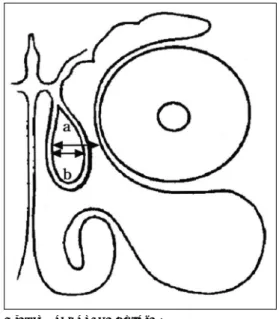
The degree of middle turbinate pneumatization has been classified into 4 stages from Grade 0 to Grade III by the percentage of the largest width of concha bullosa according to the length of the middle turbinate medial plate (the medial bony plate of air cells formed by concha bullosa) and the lamina papyracea (Fig. 1, Ta- ble 1). The interlamellar cells have no pneumatization in the turbinate itself, however, based on the fact that air cells do exist in the vertical bony lamella of the

middle turbinate excluding the free bony plate, it has been designated as Grade I.

The degree of sinusitis viewed by OMU CT has been classified into 5 different stages according to the Mark May criteria 7) from Stage 0 where no lesions are detected to Stage IV, where total opacification is noted in all sinuses (Table 2).

Also, other accompanying anatomical variations that can be detected by OMU CT such as septal deviation, paradoxical middle turbinate, superior turbinate pneu- matization, Haller cell and supraorbital cell has been stu- died. Septal deviation has been decided to be included only in cases where the nasal septal deviation takes over 30% of the nasal cavity width.

For statistical management, analysis of the nasal cavity and paranasal sinus of each side has been carried out independently. Analysis was carried out by the χ 2 (chi- square) test with the standard p-value of 0.05.

RESULT Prevalence of concha bullosa

Of the 232 patients in this study, 84 (36.2%) viewed at least an unilateral concha bullosa of the middle tur- binate on CT. Among them, 34 were bilateral cases of 14.6% and 50 were unilateral cases of 21.6% of all patients. Between all 464 nasal cavity sites, concha bullosa has been detected in 118 when each site has been calculated independently. Therefore, the preval- ence rate of concha bullosa in this study is 25.4%.

The distribution according to each grade, shows 47 sites in Grade Ⅰ, 43 sites in Grade Ⅱ and 28 sites in

Table 3. Comparison between grade of concha bullosa and stage of sinusitis

Stage 0 Ⅰ Ⅱ Ⅲ Ⅳ Total (%)

Grade 0 74 (78.7) 54 (62.1) 95 (76.0) 74 (75.5) 49 (81.7) 346 (74.6)

Ⅰ 11 (11.7) 13 (14.9) 11 ( 8.8) 8 ( 8.2) 4 ( 6.7) 47 (10.1)

Ⅱ 7 ( 7.4) 13 (14.9) 14 (11.2) 3 ( 3.1) 6 (10.0) 43 ( 9.3)

Ⅲ 2 ( 2.1) 7 ( 8.0) 5 ( 4.0) 13 (13.3) 1 ( 1.7) 28 ( 6.0) Total 94 (100) 87 (100) 125 (100) 98 (100) 60 (100) 464 (100) Table 1. Grade of concha bullosa

Grade 0 No air-cell in middle turbinate

Ⅰ Interlamellar cell/less than 30%

Ⅱ 30% to less than 50%

Ⅲ 50% or over than 50%

Table 2. Staging of sinusitis

Stage 0 No evidence of disease

Ⅰ Opacification in OMU

Ⅱ Partial opacification of one or more sinuses

Ⅲ Total opacification of one or more sinuses

Ⅳ Total opacification of all sinuses Fig 1. Grading of concha bullosa:

Greatest horizontal width of concha bullosa×100 (%)(b)

Distance between medial plate of concha bullosa and lamina papyracea (a)

(3)

Kim et al :CT Study of Concha Bullosa / 103

Grade Ⅲ (Table 3).

Relationship between the grade of concha bullosa and stage of sinusitis

If to simply compare the existence or nonexistence of sinusitis and concha bullosa regardless of the seve- rity or degree of it, among 346 nose sites with no concha bullosa 271 patients (78.3%) had sinusitis whereas am- ong 118 sites with concha bullosa 98 nose sites (83.1%) had sinusitis, showing a slightly higher incidence of sinusitis in paranasal sinuses with concha bullosa. How- ever, this showed no statistical significancy (p>0.05).

If we take a look at the relationship between the severity of sinusitis and degree of concha bullosa, a slightly high incidence of concha bullosa of 37.9% in Stage I can be noticed, however, this did not show a statistically significant difference (p>0.05).

Other anatomic variations

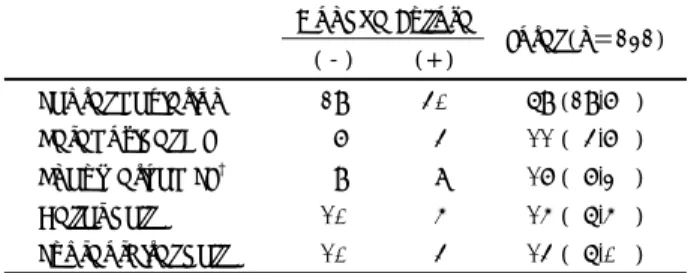
In this study, based on CT scan reviews, other ano- malies implicated in the anatomical variation category include:septal deviation, paradoxical middle turbinate, pneumatized superior turbinate, Haller cell and supra- orbital cell. The incidence of each variation and its accompaniment with concha bullosa has been studied (Table 4). The most common anatomical variation of the nasal cavity and sinus was septal deviation with an incidence rate of 29.7% (69/232) of all patients, im- plying a significantly high incidence in patients with concha bullosa (p<0.05). Other variations did not show much relevance with the incidence of concha bullosa.

DISCUSSION

Concha bullosa is a common anatomical variation of the nasal cavity and it has been presumed that it may have a close relationship with diseases of the nasal and

paranasal sinus. Zinreich et al., 1) reported that concha bullosa has been detected by CT in 34% of patients with sinus symptoms and Choi et al., 5) suggested that in patients who underwent endoscopic paranasal sinus surgery showed a 21.9% incidence rate of concha bu- llosa. Nadas et al., 6) reported a 53% incidence rate in patients with chronic paranasal sinusitis. According to reference reports, concha bullosa shows a variable incidence rate from 24% to 53.6% and this is presumed to have been attributed by the criteria of concha bullosa and the characteristics of the sample group included in this study. 3)4)8)9) In patients with paranasal sinus symp- toms, 36.2%, if each nasal cavity was to be classified, in 25.4% concha bullosa was detected. This incidence is thought to have a difference from concha bullosa detected in a normal group, therefore, further research based on the incidence of concha bullosa in a normal sample group will be necessary.

The relationship between concha bullosa and sinus disease is based on the fact that enlargment of the mi- ddle turbinate caused by pneumatization will compress the uncinate process and occlude the infundibulum wh- ich will obstruct the opening of the middle meatus that will eventually form a mucosal contact area. By com- paring patients with concha bullosa with 100 normal people, Zinreich et al., 8) reported that there was not much of a difference in the incidence of ostiometal diseases, whereas, a big concha bullosa can obstruct the ostiomeatal compex. On the other hand, Nadas 6) reported that regardless of the size of concha bullosa, there is no relationship with the sinus or OMU. and nl et al., 10) suggested that concha bullosa has no effect on the dis- tribution of paranasal sinus opacification. In this report, it has been suggested that the existence of concha bullosa and sinus disease has no relationship with one another and the degree of pneumatization and sinus disease also showed no statistical significancy among one another, however, eventhough it is presumed that even a big concha bullosa has no effect on the sinus lesion, because our study was based on OMU CT re- views of patients with symptoms, it is slightly unreaso- nable for us to rashly come to this conclusion. Therefore, it is considered that a normal random sample research or a comparative study between a normal group and paranasal sinus disease group will be necessary in the near future.

Also, this study showed a high incidence of septal deviation in patients with concha bullosa. This, however,

Table 4. Association with other anatomic variations Concha Bullosa

(-) (+) Total (n=232) Septal deviation 29 40 69 (29.7%) Paradoxical MT* 7 4 11 ( 4.7%) Pneumatized ST

9 8 17 ( 7.3%) Haller cell 10 5 15 ( 6.5%) Supraorbital cell 10 4 14 ( 6.0%)

*:middle turbinate, †:superior turbinate

(4)

104 / J Rhinol 7(2), 2000

is expected to be the result of a physiological compen- sation mechanism of the nasal cavity. Other variations such as supraorbital cell, pneumatized superior turbinate etc. showed no relationship with concha bullosa.

However, concha bullosa acts as an interfering factor in endoscopic sinus surgeries and can cause postoperative complications such as synechiae, stenosis, etc. Therefore, we believe that the management of concha bullosa at nasal surgery is essential.

CONCLUSION

Defining pneumatization of the middle turbinate, concha bullosa is a commonly detected anatomical va- riation of the nasal cavity and the incidence in patients with nasal and paransal sinus symptoms is 36.2% and 25.4% in case of each side notified independently. In this study it has been concluded that concha bullosa does not function as a pathogenetic factor in sinus diseases and the degree of pneumatization also does not show any statistical significancy. However, future studies based on normal group sampling is thought to be necessary.

The incidence of septal deviation in patients with concha bullosa was significantly higher compared to the normal group and this is presumed to be the result

of a compensation mechanism of the nasal septum.

REFERENCES

1) Zinreich SJ, Mattox DE, Kennedy DW, Chisholm HL, Diffley DM, Rosenbaum AE. Concha bullosa: CT evaluation. J Comput Assist Tomogr 1988;12:778-84.

2) Kennedy DW, Zinreich SJ, Rosenbaum AE, Johns ME. Functional endoscopic sinus surgery. Arch Otolaryngol 1985;111:576-82.

3) Bolger WE, Butzin CA, Parsons DS. Paranasal sinus bony anato- mic variations and mucosal abnormalities: CT analysis for endos- copic sinus surgery. Laryngoscope 1991;101:56-64.

4) Calhoun KH, Waggenspach GA, Simpson CB, Hokanson JA, Bailey BJ. CT evaluation of the paranasal sinuses in symptomatic and asymptomatic populations. Otolaryngol Head Neck Surg 1991;

104:480-3.

5) Choi CS, Woo JS, Lee HM, Lee SH, Choi K, Hwang SJ. Eva- luation of concha bullosa on OMU computed tomography. Korean J Otolaryngol 1995;38:1726-30.

6) Nadas S, Duvoisin B, Landry M, Schnyder P. Concha bullosa:

frequency and appearances on CT and correlations with sinus disease in 308 patients with chronic sinusitis. Neuroradiology 1995;37:234-7.

7) May M, Levine HL. Endoscopic sinus surgery. New York: Thieme Medical Publishing: Levine & May;1993. p.105-25.

8) Zinreich SJ, Kennedy DW, Rosenbaum AE. Paranasal sinuses:

CT imaging requirements for endoscopic surgery. Radiology 1987;

163:769-75.

9) Lloyd GAS. CT of the paranasal sinuses: study of a control series in relation to endoscopic sinus surgery. J Laryngol Otol 1990 ; 104:477-81.

10) Ünlü HH, Akyar S, Caylan R, Nalca Y. Concha bullosa. J Oto-

laryngol 1994;23:23-7.

수치

Table 3. Comparison between grade of concha bullosa and stage of sinusitis
Table 4. Association with other anatomic variations   Concha  Bullosa  (-)  (+)  Total (n=232)  Septal deviation  29  40  69 (29.7%)  Paradoxical MT*   7   4  11 ( 4.7%)  Pneumatized ST †  9   8  17 ( 7.3%)  Haller cell  10    5  15 ( 6.5%)  Supraorbital c

참조

관련 문서

100 lux 조건 하에 동영상 촬영을 진행하 고, 모든 동영상 촬영이 끝난 후 Noldus의 Ethovision(ver. 8.0)으 로 mouse가 open arms에 머문 시간과 mouse가 open

The OSFE (osteotome sinus floor elevation) technique has been used for maxillary sinus augmentation.. The implants were clinically and radiographically followed

Undiagnosed malignancy in patients with deep vein thrombosis: incidence, risk indicators, and diagnosis.. Monreal M, Fernandez-Llamazares J, Perandreu

당뇨의 적정관리 평가지표로는 당화혈색소 검사, 미세단백뇨 검사, 안저 검사 등이 있으며(Armesto et al., 2007; Nicolucci et al., 2006), 이에 따른 기준으로

화학시냅스에서 시냅스전뉴런의 활동전압이 시냅스후 뉴런으로 전도되는 과정. Principles of Neuroscience, Kandel

&#34;To me, who actually has been engaged in practice in Japan, it became apparent that many of the aspects of the so-called modern architecture, that is of creative and

Marfaing Marfaing Marfaing Marfaing- -- -Koka A, Devergne O, Gorgone G, et al: Koka A, Devergne O, Gorgone G, et al: Koka A, Devergne O, Gorgone G, et al: Koka A, Devergne O,

&#34;APTEEN: A hybrid Protocol for Efficient Rout ing and Comprehensive Information Retrieval in Wireless Sensor Net works,&#34; IEEE Proc.. Heizelman et