with or without absorbable collagen sponge grafting
Won-Sun Baek1, So-Ra Yoon1, Hyun-Chang Lim2, Jung-Seok Lee1, Seong-Ho Choi1, Ui-Won Jung1,*
1 Department of Periodontology, Research Institute for Periodontal Regeneration, Yonsei University College of Dentistry, Seoul, Korea
2Department of Periodontology, Kyung Hee University School of Dentistry, Seoul, Korea
Research Article
J Periodontal Implant Sci 2015;45:238-246 http://dx.doi.org/10.5051/jpis.2015.45.6.238
Purpose: The purpose of this study was to evaluate bone formation around recombinant human bone morphogenetic protein (rhBMP-2)-coated implants placed with or without absorbable collagen sponge (ACS) in rabbit maxillary sinuses.
Methods: The Schneiderian membrane was elevated and an implant was placed in 24 si- nuses in 12 rabbits. The space created beneath the elevated membrane was filled with ei- ther blood (n=6) or ACS (n=6). In the rabbits in which this space was filled with blood, rh- BMP-2-coated and non-coated implants were alternately placed on different sides. The re- sulting groups were referred to as the BC and BN groups, respectively. The AC and AN groups were produced in ACS-grafted rabbits in the same manner. Radiographic and histo- morphometric analyses were performed after eight weeks of healing.
Results: In micro-computed tomography analysis, the total augmented volume and new bone volume were significantly greater in the ACS-grafted sinuses than in the blood-filled sinuses (P<0.05). The histometric analysis showed that the areas of new bone and bone- to-implant contact were significantly larger in the AC group than in the AN group (P<0.05). In contrast, none of the parameters differed significantly between the BC and BN groups.
Conclusions: The results of this pilot study indicate that the insertion of ACS after elevat- ing the Schneiderian membrane, simultaneously with implant placement, can significantly increase the volume of the augmentation. However, in the present study, the rhBMP-2 coating exhibited limited effectiveness in enhancing the quantity and quality of regenerat- ed bone.
Keywords: Bone morphogenetic protein 2; Collagen; Dental implants; Histology; Maxillary sinus floor augmentation; Microcomputed tomography.
Received: Nov. 13, 2015 Accepted: Dec. 7, 2015
*Correspondence:
Ui-Won Jung
Department of Periodontology, College of Dentistry, Yonsei University, 50-1 Yonsei-ro, Seodaemoon-gu, Seoul 03722, Korea Tel: +82-2-2228-3185
Fax: +82-2-392-0398 E-mail: [email protected]
INTRODUCTION
Sinus augmentation using bone substitute materials is a well-documented procedure for implant placement in posterior maxillae that have undergone severe resorption, and it has shown clinically predictable outcomes with success rates exceeding 90% in meta-analyses [1,2]. However, placing bone substitute under the elevated Schneiderian membrane is bur- densome, time-consuming, and costly. Using a bone substitute may be indispensable for volume maintenance, but it may retard the healing process [3,4] and result in a significant delay before mature new bone is incorporated.
Several modifications have been attempted with the goal of overcoming those difficulties [5-7]. Lundgren et al. [8] suggested performing sinus augmentation with blood coagulum and simultaneous implant placement. Their protocol included stabilizing the elevated
This is an Open Access article distributed under the terms of the Creative Commons Attribution Non-Commercial License (http://creativecommons.org/licenses/by-nc/3.0/).
Schneiderian membrane by suturing, with the holes made on the superior bony surface of the window and on the window sealed by repositioning a bone fragment. The use of non-material sinus aug- mentation with simultaneous implant placement in subsequent studies showed substantial bone formation; the extent of osseoin- tegration was found to be as high as that observed in autogenous bone grafting in both primates [9] and humans (survival rate=98.7%;
new bone height [NBH]=5.3±2.1 mm in a six-year clinical study) [10]. Several studies have also found comparable survival rates for implants with non-material and material-grafted sinus augmenta- tion [11-14]. However, the extent of the increases in NBH varied, and the implant apex was not completely covered in most implants (189 of 239) [10,15]. In addition, it has been found that implants extend- ing into the sinus cavity can cause iatrogenic sinusitis and are associ- ated with the risk of migration into the cavity [16,17]. Such unpre- dictable outcomes could potentially hinder the widespread use of this technique.
Growth factors have been used to enhance the osteogenic pro- cess around the implant surfaces. Recombinant human bone mor- phogenetic protein (rhBMP-2) has been used to coat the implant surfaces in order to facilitate local bone formation [18-20]. Using the implant itself as a delivery system for rhBMP-2 could be ad- vantageous both in terms of minimizing the loss of the growth factor during the surgical procedure and for localizing it at the surgical site [21,22], as well as involving a lower dose of rhBMP-2 and thereby minimizing the complications associated with high doses of rhBMP-2 [23,24].
The presence of an rhBMP-2 coating on implant surfaces has been reported to accelerate new bone formation at the supra-al- veolar level in canine mandibles [21,25]. Definite differences are present between the sinus augmentation model and the ridge augmentation model in terms of the surrounding anatomy and the biomechanics. Ridge and sinus augmentation involve adding bone to the coronal and apical dimensions, respectively, and both involve vertical bone gain along the implant. To the best of our knowledge, no previous study has evaluated the effect of rhBMP- 2-coated implants on sinus augmentation.
The purpose of this study was to evaluate bone formation around rhBMP-2-coated implants placed with or without absorbable colla- gen sponge (ACS) in rabbit maxillary sinuses. The ACS was inserted with the objective of achieving blood clot stabilization.
MATERIALS AND METHODS
Animals
Twelve male New Zealand white rabbits weighing 2.8–3.2 kg were used in this study. Animal selection and management, the surgical protocol, and the operative procedures were approved by the Insti- tutional Animal Care and Use Committee, Yonsei Medical Center, Seoul, South Korea (IACUC Approval No. 2012-0327). The animals were kept in separate cages under standard laboratory conditions, with free access to water and a standard laboratory pellet diet.
Study design
The animals were divided into the blood-filled and ACS-grafted groups (each n =6). In each group, rhBMP-2-coated and non- coated implants were alternately applied to the two sinuses, re- sulting in the following four groups:
1. BN group: non-coated implant placed in the blood-filled sinus.
2. BC group: rhBMP-2-coated implant placed in the blood-filled sinus.
3. AN group: non-coated implant placed in the ACS-grafted sinus.
4. AC group: rhBMP-2-coated implant placed in the ACS-grafted sinus.
Experimental materials Experimental mini-implants
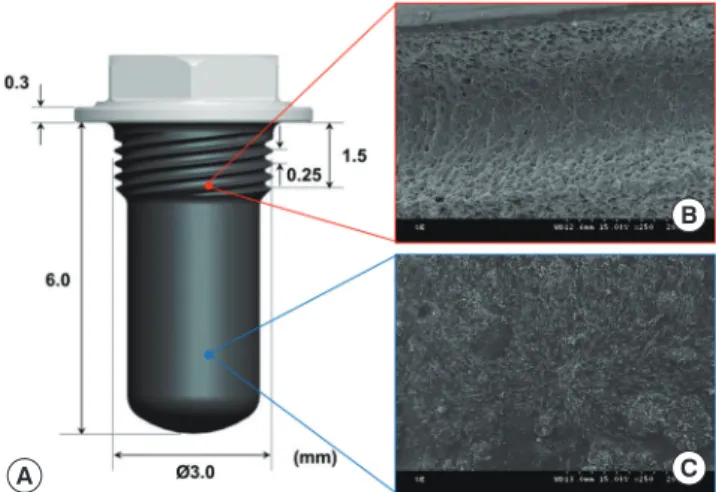
Custom-made mini-implants were used in this study (Genoss, Suwon, Korea). They were cylindrical in shape (6 mm long and 3 mm in diameter) with screw threads for initial fixation that cov- ered a quarter of the coronal portion (1.5 mm from the top of the implant), and the implants had a sand-blasted, large grit, acid- etched surface. The rhBMP-2 was coated on the cylindrical area away from the threads so that it remained in place during installa- tion (Figure 1).
rhBMP-2 coating on mini-implants
The sterilized implants were coated with rhBMP-2 (Genoss, Su- won, Korea). Lyophilized rhBMP-2 in sodium acetate buffer (20 mM sodium acetate, pH 4.0; Sigma, St. Louis, MO, USA) was kept refrigerated at 4°C until use. Under aseptic conditions, the rh- BMP-2 solution was reconstituted to a 2.0 mg/mL liquid concen- tration with 2% hyaluronic acid in sodium acetate buffer. The im-
A
B
C
Figure 1. Custom-made mini-implants and micrographs of their surfaces with and without a recombinant human bone morphogenetic protein (rh- BMP)-2 coating. (A) Schematic of the mini-implant (length, 6.0 mm; diame- ter, 3.0 mm), which had a sandblasted, large grain, acid-etched surface and included a 1.5-mm threaded portion in the coronal area for fixation and a 4.5-mm cylindrical portion that was coated with rhBMP-2. (B) Scanning electron microscopy (SEM) scan of the uncoated surface in the threaded area.
(C) SEM scan of the rhBMP-2-coated surface in the cylindrical area.
plants were placed in sterile 0.5-mL wells (96 Stripwell plate, round well polypropylene, Sigma) that were filled with the 2.0 mg/mL rh- BMP-2 solution (net volume of solution, 0.05 mL per implant) and incubated for 30 minutes. The implants were then air-dried for 16 hours. All of these procedures were performed in a biological safe- ty cabinet (Airstream, Class II, A2 type; Esco, Philadelphia, PA, USA) at room temperature.
Surgical procedure
All surgical procedures were performed by a single experienced surgeon (U.W.J.). Under general anesthesia, additional infiltrative anesthesia was applied to the surgical site in the middle portion of the nasal dorsum. The surgical field was then disinfected with io- dine-soaked cotton wool. An incision was made along the midline, including the skin and periosteum. The resultant full-thickness flaps were lifted and the nasal bone was exposed for the next procedure.
Two identical circular windows were prepared bilaterally using a trephine bur with a diameter of 5.5 mm (C-reamer, Neobiotech, Seoul, Korea), and the Schneiderian membrane was elevated care- fully to a position 10 mm anterior from the window margin. The implant sites were prepared 3 mm in front of the windows using a pilot drill bit followed by a final drill bit (2.7 mm in diameter), with a surgical curette inserted into the window in order to protect the Schneiderian membrane from the drilling process. Before setting the mini-implants, prepared blood obtained from the branchial vein of an ear was applied to both sides (n=6) or ACS soaked with blood was inserted (n=6). One rhBMP-2-coated implant (diameter 3 mm, length 6 mm; Genoss) was placed by manual force in one si- nus, while a non-coated implant for the control group was placed in the contralateral sinus. The groups were allocated alternately in consecutive rabbits. After completing all surgical procedures, the bony windows were replaced and covered by periosteum. The peri- osteum and skin were closed layer by layer with glyconate absorb- able monofilament (6-0 Monosyn, B-Braun, Aesculap, Allentown, PA, USA). Nonsteroidal anti-inflammatory drugs (0.5 mg/kg of ke- torolac, intravenously) were administered once for pain control af- ter surgery. Broad-spectrum antibiotics (5 mg/kg of enrofloxacin, subcutaneously, twice per day for five days) were administered for infection control. All rabbits were raised in individually assigned cages and received food and water ad libitum. The temperature and humidity were maintained at 20°–22°C and 40%–60%, respec- tively. The sutures were removed 10 days postoperatively under se- dation. The rabbits were sacrificed by an overdose of anesthesia af- ter eight weeks of healing.
Radiographic analysis: micro-computed tomography All specimens were fixed in 10% formalin for 10 days and scanned with a high-resolution micro-computed tomography (micro-CT) sys- tem (SkyScan 1173, SkyScan, Aartselaar, Belgium) at a resolution of 9 μm (using settings of 130 kV and 60 μA) with a 0.25-mm bromine filter. One experienced researcher measured the data while blinded to the group assignments using CT Analyzer 1.14 (Bruker-CT, Kon-
tich, Belgium). The total augmented volume (TV; mm3) and the new- ly formed bone volume (NBV; mm3) were measured. New bone was identified in images as pixels with grayscale values of 55–255 [24,26]. The new bone density (NDV) was calculated as the NBV di- vided by the TV.
Histologic and histomorphometric analyses
After micro-CT scanning, the specimens were dehydrated in eth- anol, embedded in methacrylate, and sectioned along the long axis of the mini-implants using a diamond saw (Exakt, Apparatebau, Norderstedt, Germany). The final thickness of the specimens was reduced to about 20 μm. They were stained with hematoxylin and eosin and analyzed histologically using a microscope. Digital imag- es of the histologic slides were obtained using a built-in digital camera in the light microscope (BX50, Olympus, Tokyo, Japan).
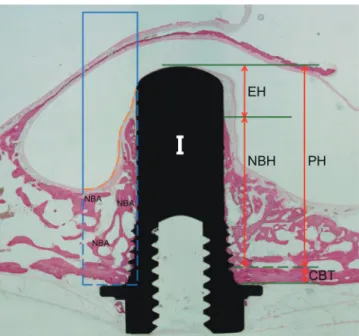
The following linear measurements were made by a single expe- rienced examiner (W.S.B.) twice, at a three-week interval, based on the methodology of a previous study [27]. The following parame- ters were measured:
1. Cortical bone thickness (CBT), reflecting the thickness of native bone close to the bony window;
2. NBH, which was the distance from the inner border of cortical bone to the most apical level of new bone on the implant sur- face;
3. Exposed height (EH), which was the distance between the most apical level of new bone and the horizontal line at the tip of the mini-implant;
4. Protruding height (PH), which was the length of the implant protruding into the sinus cavity;
5. Bone-to-implant contact ratio (BIC), which was the percentage of new bone in contact with the implant surface.
These measurements were performed on both the medial and lat- eral sides of the implants.
A rectangular area of interest (AOI) was selected adjacent to the implant (1.5 mm in width, and as long as the implant plus 1.5 mm apical to the implant apex in height). The following parameters were measured in the AOIs in the medial and lateral areas of the implants: total augmented area (TA; mm2), new bone area (NBA;
mm2), fibrovascular tissue area (FVA; mm2), and new bone density (NDA) (Figure 2).
Statistical analysis
Statistical analysis was performed using SPSS version 15.0 (SPSS, Chicago, IL, USA). The intraexaminer coefficient between the pa- rameters measured at a three-week interval was 0.98 (P <0.05).
Due to the small number of samples, statistical significance was analyzed using the following nonparametric tests: the Wilcoxon signed-rank test for the BC group versus the BN group and for the AC group versus the AN group, and the Mann-Whitney U test for the BC group versus the AC group and for the BN group versus the AN group. The cutoff for statistical significance was set at P<0.05.
RESULTS
Clinical observations
Seven minor perforations (<2 mm) occurred during surgery, at two sites in the BC, BN, and AC groups, and at one site in the AN group. No postoperative complications, such as pus discharge or swelling, were found in any of the rabbits. After euthanizing the animals, implant exposure beyond the Schneiderian membrane and implant displacement were not observed.
Radiographic analysis: micro-CT
New bone appeared in a wide-dome shape in the ACS-grafted group and in a thin-pyramid shape in the blood-filled group. New bone formation was greater on the lateral side of the implant than on the medial side. The presence or absence of the rhBMP-2 coat- ing had no noticeable effect on the patterns of bone formation (Figure 3).
The TV was significantly greater in the ACS-grafted groups than in the blood-filled groups. The TV differed significantly between the
Figure 4. Mean values of the total augmented volume (TV) and newly formed bone volume (NBV) beneath the elevated Schneiderian membrane in micro-com- puted tomography analysis (n=6, respectively). (A) TV, (B) NBV, (C) new bone density (NDV).
*, significant difference, P<0.05.
200
160
120
80
40
0 (mm3)
*
*
BN BC AN AC TV
40 35 30 25 20 15 10 5 0 (mm3)
*
*
BN BC AN AC NBV
25
20
15
10
5
0
(%)
*
BN BC AN AC NDV
A B C
Figure 2. Parameters for the linear and areal measurements. The rectangle with the blue border indicates the area of interest (AOI). The subarea bordered by a dotted line indicates the total augmented area (TA). The orange dotted line dividing the AOI indicates the Schneiderian membrane.
NBA, new bone area; PH, protruding height; NBH, new bone height; CBT, cor- tical bone thickness; EH, exposed height.
Non-coated implant rhBMP-2-coated implant
BloodACS
A B
C D
Figure 3. Three-dimensionally reconstructed images of representative micro- computed tomography (micro-CT) views. Newly formed bone appears red, the mini-implant fixture appears green, and the nasal bone appears brown, with the internal surface of the implant facing upwards. (A, B) The newly formed bone had a pyramidal shape in the BN and BC groups. (C, D) The newly formed bone had a trapezoidal shape in the AN and AC groups. (A) The BN group, (B) the BC group, (C) the AN group, (D) the AC group. BC, blood-filled and coated implant; BN, blood-filled and non-coated implant; AC, absorbable collagen sponge and coated implant; AN, absorbable collagen sponge and non-coated implant.
ACS, absorbable collagen sponge; L, lateral; M, medial; A, anterior; P, posterior.
AC and BC groups (157.01 ±38.29 mm3 vs. 90.47 ±41.61 mm3, P=0.016) and between the AN and BN groups (173.93±41.49 mm3 vs. 65.18±24.95 mm3, P=0.004) (Figure 4A). The NBV was also sig- nificantly greater in the ACS-grafted groups than in the blood-
filled groups: 33.48±11.94 mm3 in the AC group versus 7.60±4.40 mm3 in the BC group (P=0.004), and 29.53±5.03 mm3 in the AN group versus 7.61±2.60 mm3 in the BN group (P=0.004). The NBV was greater in the AC group than in the AN group, but this differ-
A
B
C D
E
F Figure 5. Histologic images of representative sites after eight weeks of healing in the blood-filled group. (A): BN group. Bone formation in a pyramidal shape was observed. The red arrowhead indicates the outer boundary of the cortical bone layer, the yellow arrowhead indicates the inner boundary of the cortical bone lay- er, the blue arrowhead indicates the apical margin of new bone height (NBH), and the white horizontal line indicates the most apical line meeting the fixture. (B) The coronal part adjacent to the top area of the implant. (C) The apical part around the end of the newly formed bone. A well-maintained Schneiderian mem- brane was observed. (D) The BC group. (E) The coronal part adjacent to the top area of the implant. (F) The apical part around the end of the newly formed bone.
NB, new bone.
A
B
C D
E
F Figure 6. Histologic images of representative sites after eight weeks of healing in the ACS-grafted group. (A) The AN group. (B) The coronal part adjacent to the top area of the implant. (C) The apical part around the end of the newly formed bone. A well-maintained Schneiderian membrane was observed. Detached newly formed bone was seen on the apical margin of the new bone height (NBH). Newly formed bone had a relatively low density. (D) The AC group. (E) The coronal part adjacent to the top area of the implant. (F) The apical part around the end of the newly formed bone. A high bone-to-implant contact ratio (BIC) was observed.
NB, new bone.
ence did not reach statistical significance (Figure 4B). The NDV dif- fered significantly between the AC and BC groups (21.77±6.81%
vs. 8.28±2.37%, P=0.004) (Figure 4C).
Histologic observations
Neither inflammatory responses nor adverse foreign body reac- tions were observed in the histological analysis. The new bone generally appeared to initially sprout from the basal bone toward the implant apex along the implant surface. New bone was more loosely scattered in the ACS-grafted group than in the blood-filled group. The Schneiderian membrane made direct contact with the apex of the implant in all except two implants in the AC group, in which it was completely surrounded by bone tissue (Figure 5C and F; 6B, C, E, and F).
The general shape of bone formation differed between the ACS- grafted and blood-filled groups. Dense and lamellar bone in a tri- angular shape with a steep angle was observed around the im- plants in the BC and BN groups, whereas the newly formed bone exhibited a trapezoidal shape in the AC and AN groups. The pat- tern of bone formation did not differ histologically between the BN and BC groups, with the new bone being in continuous contact with the implant surface (Figure 5B and E). The new bone was denser and more even in the AC group than in the AN group (Fig-
ure 6A and D), and it extended more continuously along the im- plant surface in the AC group than in the AN group.
Histomorphometric analysis
Table 1 presents the mean (± standard deviation) values of the linear measurements. CBT did not differ significantly among the four groups. The NBH was highest in the AC group, but the differ- ences did not reach statistical significance. The BIC was signifi- cantly greater in the AC group than in the AN group, but did not Table 1. Linear measurements in the histometric analysis. The data are mean± standard deviation values (in millimeters) for averaged measurements on the medial and lateral sides.
Group BC BN AC AN
CBT (n=6) 0.66±0.20 0.54±0.18 0.52±0.14 0.48±0.08 NBH (n=6) 3.86±1.00 3.99±0.43 4.27±0.91 3.85±1.27 EH (n=6) 1.60±0.70 1.28±0.50 0.96±0.85 1.44±1.28 PH (n=6) 5.46±0.53 5.27±0.36 5.24±0.12 5.29±0.25 CBT, cortical bone thickness; NBH, new bone height; EH, exposed height; PH, protruding height; BC, blood-filled and coated implant; BN, blood-filled and non-coated implant;
AC, absorbable collagen sponge and coated implant; AN, absorbable collagen sponge and non-coated implant.
No significant differences were observed among the groups.
Figure 7. Mean values of bone-to-implant contact (BIC), total augmented area (TA), newly formed bone area (NBA) and fibrovascular tissue area (FVA) in the area of interest in the histometric analysis (n=6, respectively). (A) BIC, (B) TA, (C) NBA, (D) FVA.
*significant difference, P<0.05.
50
40
30
20
10
0
(%)
*
BN BC AN AC
BIC 15
12
9
6
3
0 (mm2)
*
*
BN BC AN AC TA
A B
5
4
3
2
1
0 (mm2)
*
BN BC AN AC
NBA 10
8
6
4
2
0 (mm2)
*
*
BN BC AN AC FVA
C D
differ significantly between the AC and BC groups (Figure 7A).
The measurements made in the AOIs are shown in Figure 7. The TA and FVA were significantly higher in the AC group than in the BC group, and in the AN group than in the BN group (P<0.01). The presence or absence of ACS did not significantly affect the NBA.
The NBA was significantly greater in the AC group than in the AN group (4.10±1.10 mm2 vs. 3.08±0.70 mm2, P<0.05) (Figure 7B–D).
The placing of non-coated implants significantly decreased the NDA in the ACS-grafted groups (48.10±9.76% in the BN group vs.
29.15±11.54% in the AN group, P=0.015), whereas the placing of rhBMP-2-coated implants did not significantly affect the NDA (40.24±8.45% in the BC group vs. 32.76±11.88% in the AC group, P=0.262).
DISCUSSION
The maintenance of space under the elevated Schneiderian mem- brane is critical for ensuring long-term stability following sinus augmentation. Despite the evidence for de novo bone formation in sinus augmentation without bone grafting, the quantity and quality of the regenerated bone have not previously been validated. In the present study, blood coagulum and ACS were used as space-filling matrices for the purpose of aiding the effects of rhBMP-2-coated implants.
Choi et al. [23] reported that inserting collagenous biomaterials under the Schneiderian membrane provided some degree of space maintenance during the early healing phase. However, inserting ACS alone into rabbit sinuses caused the generation of new bone with a thickness of about 2 mm. In the present study, the TV and NBV were significantly greater in the ACS-grafted groups than in the blood-filled groups. However, it should be noted that the ACS did not fully counteract the repneumatization. Although full cov- erage with newly formed bone over the implant apex was ob- served at two of the six sites in the AC group, EHs ranging from 0.96 to 1.44 mm were observed in the ACS-grafted group. This finding closely reflects those of a previous report regarding modi- fied sinus elevation surgery [27].
Longer mini-implants (6 mm) were used in the present study based on the results obtained by Jung et al. [27] using 4-mm mini- implants. A positive correlation between the length of the implant and bone gain has been reported in non-material sinus augmenta- tion [12]: compared to 9-mm implants, 15-mm implants showed a greater average bone gain (3.50 mm vs. 6.94 mm). Such “tenting”
with a long implant against the Schneiderian membrane could in- crease bone regeneration. The average value of the NBH in the BN group in the present study (3.99 mm) was 75% of the PH (5.27 mm), whereas Jung et al. [27] found that the NBH was only 1.5 mm when using a 4-mm implant, which was less than 50% of the PH (3.2 mm).
In the present study, the bony window was repositioned after the sinus augmentation procedure, unlike the previous mini-im- plant study of Jung et al. [27]. The replacement of the bony win-
dow has previously been regarded as indispensable by researchers advocating the use of non-material sinus augmentation [7-9]. The window is intended to act as a barrier to prevent the blood coagu- lum from being dislodged from the augmented sinus compartment and to re-establish pneumatic conditions [8]. The greater stability of the blood coagulum could stimulate mesenchymal progenitor cells and osteogenic cells in the surrounding tissue, thereby pro- moting osteogenic differentiation [7,28]. This could explain why the NBH was more than six times greater (3.99 mm) than the orig- inal bone thickness (0.54 mm) in the BN group.
Coating the implant surface with rhBMP-2 was expected to re- sult in more favorable bone formation overall and along the im- plant surface, regardless of the presence of a space filler. However, combining rhBMP-2 coating with blood filling did not produce a discernible effect. Moreover, in combination with ACS, nonsignifi- cant increases in the NBV and NDV were observed in the AC group in comparison with the AN group, although the NBV and NDV were greater than in the blood-filled group. These findings may have been due to the space-maintaining function of ACS being a more important factor for bone regeneration. However, the ten- dency for bone formation near the Schneiderian membrane was greater in the AC group, in agreement with previous observations of the osteogenic potential of the Schneiderian membrane under the influence of rhBMP-2 [29-31].
Coating the implant with rhBMP-2 improved the BIC in the AC group in comparison to the AN group. The BIC in the AN group decreased by approximately 15%. In other studies using rhBMP- 2-coated implants, a BIC value of 37.4% was found in the sinus of a mini-pig [32], and values of 28%–36.8% were reported for su- pra-alveolar defects in dogs [33]. These differences may have been due to the use of different animals and experimental models, as well as the small sample sizes.
No previous study has evaluated rhBMP-2-coated implants in a rabbit sinus model. Choi et al. [31] found that adding 0.15 mg of rhBMP-2 to a coating of biphasic calcium phosphate did not sup- port sinus augmentation in rabbits, which prompted the use of a lower total dose to 0.1 mg in this pilot study. Kim et al. [34] found that 0.015 mg of rhBMP-2 was not sufficient to induce a statisti- cally significant effect in a similar model. While no adverse events were noted when that dose was used, the bone regeneration asso- ciated with the rhBMP-2-coated implants did not significantly differ from what was observed in other groups. Therefore, increas- ing the amount of newly formed bone and the bone density most likely requires further adjustment of the rhBMP-2 concentration.
Based on the results of this study, it can be concluded that the insertion of ACS following the elevation of the Schneiderian mem- brane and simultaneously with implant placement can significant- ly increase the augmented volume. However, the use of rhBMP-2 coating in the present study had limited effects in terms of en- hancing the quantity and quality of regenerated bone.
CONFLICT OF INTEREST
No potential conflict of interest relevant to this article was re- ported.
ACKNOWLEDGEMENTS
This study was supported by the Basic Science Research Program of the National Research Foundation of Korea (NRF) funded by the Ministry of Education (No. NRF-2014R1A1A1A05002953).
ORCID
Won-Sun Baek http://orcid.org/0000-0002-3427-4101 So-Ra Yoon http://orcid.org/0000-0003-2474-9828 Hyun-Chang Lim http://orcid.org/0000-0001-7695-1708 Jung-Seok Lee http://orcid.org/0000-0003-1276-5978 Seong-Ho Choi http://orcid.org/0000-0001-6704-6124 Ui-Won Jung http://orcid.org/0000-0001-6371-4172
REFERENCES
1. Del Fabbro M, Corbella S, Weinstein T, Ceresoli V, Taschieri S. Im- plant survival rates after osteotome-mediated maxillary sinus augmentation: a systematic review. Clin Implant Dent Relat Res 2012;14 Suppl 1:e159-68.
2. Browaeys H, Bouvry P, De Bruyn H. A literature review on bioma- terials in sinus augmentation procedures. Clin Implant Dent Relat Res 2007;9:166-77.
3. Araújo M, Linder E, Lindhe J. Effect of a xenograft on early bone formation in extraction sockets: an experimental study in dog.
Clin Oral Implants Res 2009;20:1-6.
4. Shanbhag S, Shanbhag V, Stavropoulos A. Volume changes of maxillary sinus augmentations over time: a systematic review. Int J Oral Maxillofac Implants 2014;29:881-92.
5. Lee J, Susin C, Rodriguez NA, de Stefano J, Prasad HS, Buxton AN, et al. Sinus augmentation using rhBMP-2/ACS in a mini-pig model: relative efficacy of autogenous fresh particulate iliac bone grafts. Clin Oral Implants Res 2013;24:497-504.
6. Yamada Y, Nakamura S, Ueda M, Ito K. Osteotome technique with injectable tissue-engineered bone and simultaneous im- plant placement by cell therapy. Clin Oral Implants Res 2013;24:
468-74.
7. Lundgren S, Cricchio G, Palma VC, Salata LA, Sennerby L. Sinus membrane elevation and simultaneous insertion of dental im- plants: a new surgical technique in maxillary sinus floor aug- mentation. Periodontol 2000 2008;47:193-205.
8. Lundgren S, Andersson S, Gualini F, Sennerby L. Bone reformation with sinus membrane elevation: a new surgical technique for maxillary sinus floor augmentation. Clin Implant Dent Relat Res 2004;6:165-73.
9. Palma VC, Magro-Filho O, de Oliveria JA, Lundgren S, Salata LA, Sennerby L. Bone reformation and implant integration following maxillary sinus membrane elevation: an experimental study in primates. Clin Implant Dent Relat Res 2006;8:11-24.
10. Cricchio G, Sennerby L, Lundgren S. Sinus bone formation and implant survival after sinus membrane elevation and implant placement: a 1- to 6-year follow-up study. Clin Oral Implants Res 2011;22:1200-12.
11. Ellegaard B, Baelum V, Kølsen-Petersen J. Non-grafted sinus im- plants in periodontally compromised patients: a time-to-event analysis. Clin Oral Implants Res 2006;17:156-64.
12. Thor A, Sennerby L, Hirsch JM, Rasmusson L. Bone formation at the maxillary sinus floor following simultaneous elevation of the mucosal lining and implant installation without graft material:
an evaluation of 20 patients treated with 44 Astra Tech implants.
J Oral Maxillofac Surg 2007;65 Suppl 1:64-72.
13. Cricchio G, Imburgia M, Sennerby L, Lundgren S. Immediate load- ing of implants placed simultaneously with sinus membrane ele- vation in the posterior atrophic maxilla: a two-year follow-up study on 10 patients. Clin Implant Dent Relat Res 2014;16:609-17.
14. Pinchasov G, Juodzbalys G. Graft-free sinus augmentation pro- cedure: a literature review. J Oral Maxillofac Res 2014;5:e1.
15. Hatano N, Sennerby L, Lundgren S. Maxillary sinus augmentation using sinus membrane elevation and peripheral venous blood for implant-supported rehabilitation of the atrophic posterior max- illa: case series. Clin Implant Dent Relat Res 2007;9:150-5.
16. Iida S, Tanaka N, Kogo M, Matsuya T. Migration of a dental im- plant into the maxillary sinus. A case report. Int J Oral Maxillofac Surg 2000;29:358-9.
17. Raghoebar GM, van Weissenbruch R, Vissink A. Rhino-sinusitis related to endosseous implants extending into the nasal cavity. A case report. Int J Oral Maxillofac Surg 2004;33:312-4.
18. Cole BJ, Bostrom MP, Pritchard TL, Sumner DR, Tomin E, Lane JM, et al. Use of bone morphogenetic protein 2 on ectopic porous coated implants in the rat. Clin Orthop Relat Res 1997;(345):
219-28.
19. Schmidmaier G, Wildemann B, Cromme F, Kandziora F, Haas NP, Raschke M. Bone morphogenetic protein-2 coating of titanium implants increases biomechanical strength and accelerates bone remodeling in fracture treatment: a biomechanical and histolog- ical study in rats. Bone 2002;30:816-22.
20. Hall J, Sorensen RG, Wozney JM, Wikesjö UM. Bone formation at rhBMP-2-coated titanium implants in the rat ectopic model. J Clin Periodontol 2007;34:444-51.
21. Wikesjö UM, Qahash M, Polimeni G, Susin C, Shanaman RH, Rohrer MD, et al. Alveolar ridge augmentation using implants coated with recombinant human bone morphogenetic protein-2:
histologic observations. J Clin Periodontol 2008;35:1001-10.
22. Pelaez M, Susin C, Lee J, Fiorini T, Bisch FC, Dixon DR, et al. Effect of rhBMP-2 dose on bone formation/maturation in a rat critical- size calvarial defect model. J Clin Periodontol 2014;41:827-36.
23. Choi Y, Yun JH, Kim CS, Choi SH, Chai JK, Jung UW. Sinus aug-
mentation using absorbable collagen sponge loaded with Esche- richia coli-expressed recombinant human bone morphogenetic protein 2 in a standardized rabbit sinus model: a radiographic and histologic analysis. Clin Oral Implants Res 2012;23:682-9.
24. Hong JY, Kim MS, Lim HC, Lee JS, Choi SH, Jung UW. A high con- centration of recombinant human bone morphogenetic protein-2 induces low-efficacy bone regeneration in sinus augmentation: a histomorphometric analysis in rabbits. Clin Oral Implants Res.
Forthcoming 2015.
25. Leknes KN, Yang J, Qahash M, Polimeni G, Susin C, Wikesjö UM.
Alveolar ridge augmentation using implants coated with recom- binant human bone morphogenetic protein-2: radiographic ob- servations. Clin Oral Implants Res 2008;19:1027-33.
26. Bouxsein ML, Boyd SK, Christiansen BA, Guldberg RE, Jepsen KJ, Müller R. Guidelines for assessment of bone microstructure in rodents using micro-computed tomography. J Bone Miner Res 2010;25:1468-86.
27. Jung UW, Unursaikhan O, Park JY, Lee JS, Otgonbold J, Choi SH.
Tenting effect of the elevated sinus membrane over an implant with adjunctive use of a hydroxyapatite-powdered collagen membrane in rabbits. Clin Oral Implants Res 2015;26:663-70.
28. Lee SW, Hahn BD, Kang TY, Lee MJ, Choi JY, Kim MK, et al. Hy- droxyapatite and collagen combination-coated dental implants display better bone formation in the peri-implant area than the same combination plus bone morphogenetic protein-2-coated implants, hydroxyapatite only coated implants, and uncoated
implants. J Oral Maxillofac Surg 2014;72:53-60.
29. Srouji S, Kizhner T, Ben David D, Riminucci M, Bianco P, Livne E.
The Schneiderian membrane contains osteoprogenitor cells: in vivo and in vitro study. Calcif Tissue Int 2009;84:138-45.
30. Gruber R, Kandler B, Fuerst G, Fischer MB, Watzek G. Porcine si- nus mucosa holds cells that respond to bone morphogenetic protein (BMP)-6 and BMP-7 with increased osteogenic differen- tiation in vitro. Clin Oral Implants Res 2004;15:575-80.
31. Choi Y, Lee JS, Kim YJ, Kim MS, Choi SH, Cho KS, et al. Recombi- nant human bone morphogenetic protein-2 stimulates the os- teogenic potential of the Schneiderian membrane: a histometric analysis in rabbits. Tissue Eng Part A 2013;19:1994-2004.
32. Lee J, Decker JF, Polimeni G, Cortella CA, Rohrer MD, Wozney JM, et al. Evaluation of implants coated with rhBMP-2 using two different coating strategies: a critical-size supraalveolar peri-im- plant defect study in dogs. J Clin Periodontol 2010;37:582-90.
33. Decker JF, Lee J, Cortella CA, Polimeni G, Rohrer MD, Wozney JM, et al. Evaluation of implants coated with recombinant human bone morphogenetic protein-2 and vacuum-dried using the critical-size supraalveolar peri-implant defect model in dogs. J Periodontol 2010;81:1839-49.
34. Kim MS, Kwon JY, Lee JS, Song JS, Choi SH, Jung UW. Low-dose recombinant human bone morphogenetic protein-2 to enhance the osteogenic potential of the Schneiderian membrane in the early healing phase: in vitro and in vivo studies. J Oral Maxillofac Surg 2014;72:1480-94.