ORIGINAL ARTICLE
급성담낭염으로 경피적 담낭배액술을 시행한 환자에서 담낭절제술 시행의 적절한 시기
정우현, 박동은
원광대학교 의과대학 외과학교실
Timing of Cholecystectomy after Percutaneous Cholecystostomy for Acute Cholecystitis
Woohyun Jung and Dong-Eun Park
Departments of Surgery, Wonkwang University School of Medicine, Iksan, Korea
Background/Aims: Laparoscopic cholecystectomy is the standard treatment for acute cholecystitis. Percutaneous cholecystostomy is an alternative treatment to resolve acute inflammation in patients with severe comorbidities. The purpose of this study is to determine the optimal timing of laparoscopic cholecystectomy after percutaneous cholecystostomy for the patients with acute cholecystitis.
Methods: This retrospective study was conducted in patients who underwent cholecystectomy after percutaneous cholecystostomy from January 2010 through November 2014. Seventy-four patients were included in this study. The patients were divided into two groups by the operation timing. Group I patients underwent cholecystectomy within 10 days after percutaneous chol- ecystostomy (n=30) and group II patients underwent cholecystectomy at more than 10 days after percutaneous cholecystostomy (n=44).
Results: There was no significant difference between groups in conversion rate to open surgery, operation time, perioperative complications rate, and days of hospital stay after operation. However, complications related to cholecystostomy such as catheter dislodgement occurred significantly more often in group II than group I (group I:group II=0%:18.2%; p=0.013).
Conclusions: Timing of laparoscopic cholecystectomy after percutaneous cholecystostomy did not influence postoperative outcomes. However, late surgery caused more complications related to cholecystostomy than early surgery. Therefore, early laparoscopic cholecystectomy should be considered over late surgery after percutaneous cholecystostomy insertion. (Korean J Gastroenterol 2015;66:209-214)
Key Words: Acute cholecystitis; Laparoscopic cholecystectomy; Cholecystostomy
Received July 10, 2015. Revised September 11, 2015. Accepted September 13, 2015.
CC This is an open access article distributed under the terms of the Creative Commons Attribution Non-Commercial License (http://creativecommons.org/licenses/
by-nc/4.0) which permits unrestricted non-commercial use, distribution, and reproduction in any medium, provided the original work is properly cited.
Copyright © 2015. Korean Society of Gastroenterology.
교신저자: 박동은, 54538, 익산시 익산대로 460, 원광대학교 의과대학 외과학교실
Correspondence to: Dong-Eun Park, Department of Surgery, Wonkwang University School of Medicine, 460 Iksan-daero, Iksan 54538, Korea. Tel: +82-63-859-1490, Fax: +82-63-855-2386, E-mail: [email protected]
Financial support: This paper was supported by Wonkwang University 2013. Conflict of interest: None.
INTRODUCTION
Acute cholecystitis (AC) is one of the most commonly en- countered diseases in surgical practice and cholecystectomy is the standard treatment for AC. Laparoscopic chol- ecystectomy (LC) was first performed in 1987 by Mouret.1 In the early days of laparoscopic surgery, LC was contraindi-
cated for AC due to the difficulty of the surgical technique and frequent complications. However, postoperative outcomes have improved through accumulated experience in laparo- scopic surgery and improvements in laparoscopic instru- ments. A meta-analysis of 10 prospective randomized trials concluded that patients who had emergency LC had a shorter hospital stay and similar frequency of complications com-
LC is currently accepted as a gold standard treatment for AC and is regarded as a safe and effective treatment option.3,4
Although LC is performed routinely as an emergent treat- ment option of AC, postoperative complications are still of ma- jor concern. Morbidity rates after LC in elderly patients with high surgical risk are reported to be between 14% and 46%.5
Percutaneous cholecystostomy (PC) using ultrasonography guidance was first described by Radder6 in early 1980s. PC is a minimally invasive technique that can be performed safe- ly under local anesthesia. Therefore, it is an alternative treat- ment for AC in elderly patients with high surgical risk7,8 and considered a bridging procedure for surgical treatment.9,10 However, optimal timing of LC after PC remains unclear.
Updated Tokyo Guidelines for the Management of Acute Cholangitis and Cholecystitis (TG13) recommends delayed cholecystectomy at three months after PC insertion for the patients with severe grade cholecystitis.11 Conversely, sev- eral studies reported early cholecystectomy after PC in- sertion was also safe and had some advantages in compar- ison with later operation.12,13 Therefore, in this study, our in- terest is the optimal timing of LC after PC through the analysis of differences in complication rates and rate of conversion to OC according to timing of LC after PC.
SUBJECTS AND METHODS
1. Patients
This retrospective study was conducted in patients who were diagnosed and treated with AC at Wonkwang University Hospital (Iksan, Korea) between January 2010 and November 2014. Five hundred eighteen patients underwent surgery for AC during study period, and among these patients, 74 pa- tients who underwent cholecystectomy after PC insertion were enrolled in this study. These patients were divided into the following two groups by operation timing. Group I patients underwent cholecystectomy within 10 days after PC insertion (n=30) and group II patients underwent cholecystectomy at more than 10 days after PC insertion (n=44). Age, sex, white blood cell (WBC) counts on admission, presence of gall- bladder stone, American Society of Anesthesiologist (ASA) score, and severity grade of cholecystitis were reviewed. The severity grade of cholecystitis was based on TG13.14 Mild grade was defined as AC in a healthy patient with no organ
bladder, making cholecystectomy a safe and low-risk oper- ative procedure. Moderate grade was defined as AC asso- ciated with any one of the following conditions: elevated WBC count (>18,000/mm3), palpable tender mass in the right upper abdominal quadrant, duration of complaints >72 hours, marked local inflammation. Severe grade was AC as- sociated with dysfunction of any one of the following organs or systems: cardiovascular, neurological, respiratory, renal, hepatic, hematological dysfunction. This study was approved by the institutional review board of Wonkwang University Hospital (WKUH 201510-HRE-095).
2. Treatment protocol
The diagnosis of AC was based on a combination of clinical findings, laboratory data, and radiologic findings, including ultrasonography or CT. Patients who had no contraindica- tions to emergent surgery underwent LC immediately. If the patients were taking anticoagulants (e.g., aspirin, warfarin) that might cause bleeding during surgery or were at high sur- gical risk due to co-morbid conditions, the PC was inserted in- stead of urgent cholecystectomy. Patients over 70 years old underwent PC insertion before surgery to evaluate occult co- morbidities that are frequent in the elderly. After PC insertion, the patients were started on fluid resuscitation, analgesics, and intravenous antibiotics. During conservative manage- ment, we performed multidisciplinary pre-operative tests such as echocardiography and pulmonary function test for perioperative risk evaluation. If the patient’s condition was stabilized and perioperative risk evaluation and manage- ment were completed, LC was performed. In patients who needed a long period of conservative management and peri- operative risk evaluation, the treatment and work-up period before surgery was usually over 10 days after PC insertion.
Therefore we compared postoperative results by dividing the patients into early and late operation group on the basis of the 10th day after PC insertion.
3. Percutaneous cholecystostomy
PC was performed by interventional radiologists under ul- trasound guidance. A trans-hepatic approach was performed for all included patients because of the relatively low risk of bile leakage. Bile samples were obtained and sent for gram staining and culture study.
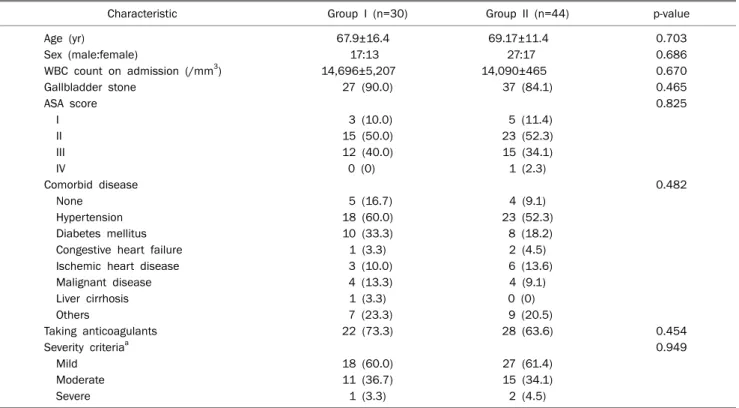
Table 1. Clinical Characteristics
Characteristic Group I (n=30) Group II (n=44) p-value
Age (yr) 67.9±16.4 69.17±11.4 0.703
Sex (male:female) 17:13 27:17 0.686
WBC count on admission (/mm3) 14,696±5,207 14,090±465 0.670
Gallbladder stone 27 (90.0) 37 (84.1) 0.465
ASA score 0.825
I 3 (10.0) 5 (11.4)
II 15 (50.0) 23 (52.3)
III 12 (40.0) 15 (34.1)
IV 0 (0) 1 (2.3)
Comorbid disease 0.482
None 5 (16.7) 4 (9.1)
Hypertension 18 (60.0) 23 (52.3)
Diabetes mellitus 10 (33.3) 8 (18.2)
Congestive heart failure 1 (3.3) 2 (4.5)
Ischemic heart disease 3 (10.0) 6 (13.6)
Malignant disease 4 (13.3) 4 (9.1)
Liver cirrhosis 1 (3.3) 0 (0)
Others 7 (23.3) 9 (20.5)
Taking anticoagulants 22 (73.3) 28 (63.6) 0.454
Severity criteriaa 0.949
Mild 18 (60.0) 27 (61.4)
Moderate 11 (36.7) 15 (34.1)
Severe 1 (3.3) 2 (4.5)
Values are presented as mean±SD or n (%).
Group I, patients underwent cholecystectomy within 10 days after percutaneous cholecystostomy insertion; group II, patients underwent cholecystectomy at more than 10 days after percutaneous cholecystostomy insertion.
WBC, white blood cell; ASA, American Society of Anesthesiologist.
aUpdated Tokyo Guidelines for the Management of Acute Cholangitis and Cholecystitis (TG13) severity grading for acute cholecystitis.
4. Surgical technique
LC was performed by two experienced hepatobiliary sur- geons using a three-trocar technique. The 12-mm laparo- scope port was inserted in the infraumbilical region, and car- bon dioxide gas injected into the intraperitoneal cavity to main- tain an intra-abdominal pressure of 10-12 mmHg. Another two trocars (5 mm) were inserted in the epigastric area and the right subcostal area.
5. Statistical analysis
Statistical analysis was performed using PASW Statistics software ver. 18.0 (IBM Co., Armonk, NY, USA). χ2 and Fisher’s exact tests were employed for categorical parameters, and in- dependent t-test for continuous parameters. Null hypotheses of no difference were rejected if p-values were less than 0.05.
RESULTS
1. Clinical characteristics
There was no significant difference in clinical character- istics between groups including preoperative ASA score (Table 1). Most of the patients had comorbid conditions, with hypertension the most common comorbidity. There was no significant difference in comorbid conditions and anti- coagulant use between groups (Table 1).
2. Complications associated with percutaneous chol- ecystostomy insertion
Median time to cholecystectomy after PC insertion was 6 days (range, 2-10 days) in group I and 23 days (range, 11-38 days) in group II. Significantly more complications associated with PC insertion occurred in group II (18.2%) than in group I (0%) (p=0.013; Table 2). Catheter related complications de- veloped in eight patients in the delayed group at median 17.5 days (range, 13-27 days) after PC insertion. The most com-
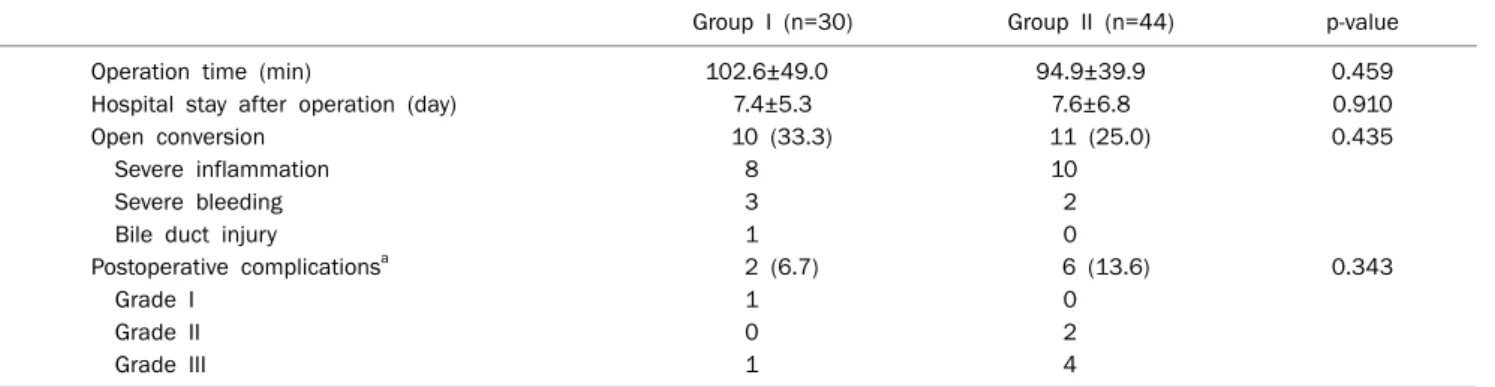
Table 3. Postoperative Outcomes
Group I (n=30) Group II (n=44) p-value
Operation time (min) 102.6±49.0 94.9±39.9 0.459
Hospital stay after operation (day) 7.4±5.3 7.6±6.8 0.910
Open conversion 10 (33.3) 11 (25.0) 0.435
Severe inflammation 8 10
Severe bleeding 3 2
Bile duct injury 1 0
Postoperative complicationsa 2 (6.7) 6 (13.6) 0.343
Grade I 1 0
Grade II 0 2
Grade III 1 4
Values are presented as mean±SD or n (%).
Group I, patients underwent cholecystectomy within 10 days after percutaneous cholecystostomy insertion; group II, patients underwent cholecystectomy at more than 10 days after percutaneous cholecystostomy insertion.
aClavien-Dindo classification of surgical complications.
Table 2. Complications Associated with Percutaneous Cholecystostomy Group I (n=30) Group II (n=44) p-value
0 (0%) 8 (18.2%) 0.013
Tube obstruction, 1 Bleeding, 1 Bile leakage, 1 Tube dislodgement, 5
Group I, patients underwent cholecystectomy within 10 days after percutaneous cholecystostomy insertion; group II, patients under- went cholecystectomy at more than 10 days after percutaneous cholecystostomy insertion.
ment (11.4%) and four of five patients with catheter dislodge- ment developed symptoms such as fever and abdominal pain. All patients with catheter dislodgement underwent tube cholangiography or computed tomography for evalua- tion, and the PC was re-inserted. Bleeding and bile leakage also occurred by accidental retraction of tube at 15 days and 20 days after PC insertion.
3. Postoperative outcomes
We compared surgical time, days of hospital stay after cholecystectomy, conversion rate to open surgery, and post- operative complications between two groups. The mean sur- gical time was 102.6±49.0 min in group I and 94.9±39.9 min in group II, and the mean hospital stay duration after chol- ecystectomy was 7.4±5.3 days in group I and 7.6±6.8 days in group II, not significantly different (Table 3). The conversion rate to OC was not significantly different between groups, 33.3% (10/30) in group I and 25.0% (11/44) in group II. The
3. Difficulty in dissecting the Calot’s triangle because of se- vere inflammation was the most common reason for con- version to open surgery. Postoperative complications oc- curred in two patients (6.7%) of group I and in six patients (13.6%) of group II, but the difference was not statistically sig- nificant (Table 3). Fluid collection around the surgical site was the most frequent complication (3/8). There were two cases of operation site bleeding and one case each of bile duct injury, postoperative embolism, and pseudomembranous colitis.
DISCUSSION
Tokyo Guidelines for the Management of Acute Cholangitis and Cholecystitis (TG07) published in January 2007 are wide- ly used as international guidelines15 and TG07 has been up- dated and published to TG13. According to TG13, early LC within 72 hours since the onset of symptoms is preferable to delayed cholecystectomy.16 Early LC could solve the problem immediately, result in a shorter hospital stay and earlier re- turn to daily activities.17 However, although LC is widely per- formed as a safe emergency procedure for AC, several stud- ies find that elderly patients undergoing emergency LC have high mortality and morbidity rates.5,18 The incidence of gall- stone disease increases with age,19 and comorbid diseases are frequent in elderly patients. Therefore, LC is a challenging procedure for AC in elderly patients, especially those with co- morbid diseases and high surgical risks.
In TG13, optimal treatment for AC was categorized accord- ing to the severity grade of cholecystitis.16 Early LC was pre-
ferred for patients with mild cholecystitis (grade I). Early LC was recommended for patients with moderate cholecystitis (grade II) in experienced centers or if patients had severe lo- cal inflammation, early gallbladder drainage (percutaneous or surgical), because early cholecystectomy might be difficult and incurs a high risk of bile duct injury. Medical treatment with gallbladder drainage and delayed cholecystectomy were recommended. For patients with severe cholecystitis (grade III), urgent management of organ dysfunction and manage- ment of severe local inflammation by gallbladder drainage should be carried out. Delayed elective cholecystectomy should be performed when cholecystectomy was indicated.
PC using ultrasonographic guidance was first described by Radder6 in the early 1980s. PC could be performed under lo- cal anesthesia, resolving acute inflammation through a mini- mally invasive procedure. Scheduled elective LC after PC in- sertion could provide more time to accurately assess the pa- tient’s comorbidity and to improve the patient’s general condition. For these reasons, PC is thought a useful treat- ment method for AC, especially in elderly patients with high surgical risk. However, disagreement still exists regarding the optimal timing for LC after PC.
Cholecystectomy is often performed following PC after in- tervals of several days,12,20 although performing a chol- ecystectomy over two weeks later is also common.21 In gen- eral, early LC following PC is preferred when the patient’s con- dition improves and the patient is confirmed to have no co- morbid disease with high surgical risk. In TG13 management bundles for AC,11 for patients with severe cholecystitis (grade III) with jaundice and poor general conditions, emergent gall- bladder drainage with supportive care including antibiotics are considered initial therapy. For patients found to have gall- bladder stones during biliary drainage, cholecystectomy is performed after three months, after the patients’ general condition improved. However, because of lack of strong evi- dence, the optimal time for LC following PC insertion remains controversial.
Several studies compare postoperative outcome between early and late LC following PC insertion. Chikamori et al.12 suggested that early scheduled LC following PC was a safe and effective treatment option for patients with AC. In their study, open conversion rate and surgery time was lower in pa- tients who underwent early LC after PC (within seven days) than later. Conversely, Kim et al.21 reported that delayed LC
after PC (over 14 days) tended to decrease the rate of con- version to open laparotomy, with similar postoperative com- plication rate. Han et al.13 reported that the complication rate was lower and surgical time was shorter in late LC group (over three days) but hospital stay duration was longer with a sim- ilar open conversion rate. They concluded that decisions on timing of LC following PC should be made based on consid- erations of patient condition, hospital facilities and surgical experience.
In this study, we inserted PC in the patients who were tak- ing anticoagulant drugs or those who had high surgical risk due to comorbid conditions. After PC insertion, we deter- mined the surgery timing after considering the half-life of the drugs and time necessary for evaluating surgical risks.
Hence, we compared the results by dividing the patients into two groups on the basis of the 10th day, the minimal time for improving patient condition and evaluating surgical risk.
There was no difference between groups in comorbid con- ditions that could affect surgical outcome. In this study, we compared the surgery time, hospital stay after cholecystec- tomy, conversion rate to open surgery, and perioperative complications between early and delayed groups to compare post-surgical outcome. There was no significant difference.
However, catheter-related complications were significantly more frequent in the delayed group (18.2%) than in the early group (0%) (p=0.013). In the delayed group, median time to surgery after PC was 23 days. Maintaining a catheter over 20 days caused inconvenience in daily life, and catheter man- agement was difficult for the patients, especially for the elderly. Catheter-related complications mainly occurred more than 10 days after PC insertion, causing patient com- plaints, longer hospital stay and higher cost. We suggest that early LC within 10 days after PC insertion is preferable if the patient condition improved and preoperative evaluation and management were completed.
However, there are several limitations to this study. This study was a retrospective study and included a small number of patients. Further reliable studies such as randomized con- trolled trials or large cohort will be needed.
In conclusion, the timing of LC after PC did not influence postoperative outcomes, but late LC could cause more cathe- ter-related complications, resulting in longer hospital stay and costs. Therefore, early LC following PC insertion should be considered with priority over late LC.
1. Mouret P. From the first laparoscopic cholecystectomy to the frontiers of laparoscopic surgery: the future prospectives. Dig Surg 1991;8:124-125.
2. Yamashita Y, Takada T, Hirata K. A survey of the timing and ap- proach to the surgical management of patients with acute chol- ecystitis in Japanese hospitals. J Hepatobiliary Pancreat Surg 2006;13:409-415.
3. Zucker KA, Flowers JL, Bailey RW, Graham SM, Buell J, Imbembo AL. Laparoscopic management of acute cholecystitis. Am J Surg 1993;165:508-514.
4. Knight JS, Mercer SJ, Somers SS, Walters AM, Sadek SA, Toh SK.
Timing of urgent laparoscopic cholecystectomy does not influ- ence conversion rate. Br J Surg 2004;91:601-604.
5. Houghton PW, Jenkinson LR, Donaldson LA. Cholecystectomy in the elderly: a prospective study. Br J Surg 1985;72:220-222.
6. Radder RW. Ultrasonically guided percutaneous catheter drain- age for gallbladder empyema. Diagn Imaging 1980;49:330-333.
7. Vogelzang RL, Nemcek AA Jr. Percutaneous cholecystostomy: di- agnostic and therapeutic efficacy. Radiology 1988;168:29-34.
8. Hultman CS, Herbst CA, McCall JM, Mauro MA. The efficacy of percutaneous cholecystostomy in critically ill patients. Am Surg 1996;62:263-269.
9. Welschbillig-Meunier K, Pessaux P, Lebigot J, et al. Percutaneous cholecystostomy for high-risk patients with acute cholecystitis.
Surg Endosc 2005;19:1256-1259.
10. Byrne MF, Suhocki P, Mitchell RM, et al. Percutaneous chol- ecystostomy in patients with acute cholecystitis: experience of 45 patients at a US referral center. J Am Coll Surg 2003;197:
206-211.
11. Okamoto K, Takada T, Strasberg SM, et al; Tokyo Guideline Revision Committee. TG13 management bundles for acute chol- angitis and cholecystitis. J Hepatobiliary Pancreat Sci 2013;20:
12. Chikamori F, Kuniyoshi N, Shibuya S, Takase Y. Early scheduled laparoscopic cholecystectomy following percutaneous trans- hepatic gallbladder drainage for patients with acute cholecystitis.
Surg Endosc 2002;16:1704-1707.
13. Han IW, Jang JY, Kang MJ, Lee KB, Lee SE, Kim SW. Early versus delayed laparoscopic cholecystectomy after percutaneous transhepatic gallbladder drainage. J Hepatobiliary Pancreat Sci 2012;19:187-193.
14. Yokoe M, Takada T, Strasberg SM, et al; Tokyo Guidelines Revision Committee. TG13 diagnostic criteria and severity grad- ing of acute cholecystitis (with videos). J Hepatobiliary Pancreat Sci 2013;20:35-46.
15. Tokyo Guidelines for the management of acute cholangitis and cholecystitis. Proceedings of a consensus meeting, April 2006, Tokyo, Japan. J Hepatobiliary Pancreat Surg 2007;14:1-121.
16. Yamashita Y, Takada T, Strasberg SM, et al; Tokyo Guideline Revision Committee. TG13 surgical management of acute cholecystitis. J Hepatobiliary Pancreat Sci 2013;20:89-96.
17. Farooq T, Buchanan G, Manda V, Kennedy R, Ockrim J. Is early laparoscopic cholecystectomy safe after the "safe period"? J Laparoendosc Adv Surg Tech A 2009;19:471-474.
18. Huber DF, Martin EW Jr, Cooperman M. Cholecystectomy in eld- erly patients. Am J Surg 1983;146:719-722.
19. Majeski J. Laparoscopic cholecystectomy in geriatric patients.
Am J Surg 2004;187:747-750.
20. Kiviniemi H, Mäkelä JT, Autio R, et al. Percutaneous chol- ecystostomy in acute cholecystitis in high-risk patients: an anal- ysis of 69 patients. Int Surg 1998;83:299-302.
21. Kim HO, Ho Son B, Yoo CH, Ho Shin J. Impact of delayed laparo- scopic cholecystectomy after percutaneous transhepatic gall- bladder drainage for patients with complicated acute cholecystitis.
Surg Laparosc Endosc Percutan Tech 2009;19:20-24.