189 There are debates among breast cancer surgeons around the world regarding what is still considered “experimental” and what is considered routine in the surgical management of breast cancer. During the last 5 years there have been important changes in the surgical approach to breast cancer. These have been applied to the routine management of breast cancer in a rapid pace never seen before. The conservative treatment of breast cancer took approximately 20 years to become well accepted and applied worldwide. The 25-year findings still needed to be published to convince some reluctant surgeons that the procedures were safe.(1,2)
Recently proposed procedures, the sentinel node biopsy, for example, were quite uniformly accepted(3) as routine manage- ment only a few years after the first consistent preliminary results were published.(4,5) The sentinel node procedure is only one example of the several proposed procedures during the last 5 years; others include intraoperative radiation therapy(6) and new localization techniques on nonpalpable breast lesions.(7,8) Several factors may explain this fast change in the routine surgical management. The detection of small tumor is the most important explanation of the continuous trend in developing less aggressive surgery and improving the quality of life of breast cancer patients. In the last 10 years surgeons have had to face a new entity of breast cancers: often, ductal carcinoma in situ (DCIS), sometimes with microinvasion and small tumors with low probability of axillary node involvement. The surgical approach and even the surgical techniques in use 10 years ago are often no longer applicable to the “modern breast cancer patients”; the surgery is becoming more and more sophisticated.
The patients are more aware of this sophistication and are searching for the “best” treatment. This induces surgeons and hospitals to offer the modern treatments in order to be competitive. This acceleration in putting experimental proce-
dures into practice may sometimes be excessive, especially when the benefit of a new procedure is not well demonstrated and clinical trials are still in progress.
On the other hand, patients participate more in the decision of their treatment and better understand the risks and benefits of a specific treatment. They may accept the risk of a new treatment with the benefit, for example, of a less aggressive surgery. Another important element that safeguards patients is the use of a controlled clinical trial. More often, clinical trials are designed to be multicentric and involve several institutions, sometimes small ones that benefit from the experience and quality control of the bigger centers.
The most important task for a physician facing new proposals is to honestly consider the evidence of whether or not the method is safe and better than previous techniques. If evidence is not provided, the physician should consider joining a clinical trial and should never apply the procedure only because it is fashionable and may draw patients.
Surgery still remains the cornerstone of therapy for almost all women diagnosed with this disease. In fact, one of the key objectives in detecting breast cancer in its earliest stages is the opportunity to cure this disease only with surgery. Efforts should be made to ensure a good local control of the disease and at the same time to approach the ideal line between over- and under-treatment.
In the following paragraphs I would like to describe the most important changes in the surgical management of breast cancer that have occurred in the last 5 years.
MANAGEMENT OF NONPALPABLE BREAST LESIONS
A diagnostic balance should be struck between the task of finding as many small tumors as possible, mainly nonpalpable ones, minimizing the number of false negatives, while avoiding unnecessary examinations and biopsies resulting in high anxiety and cost for women and health services involved. The rate of
Surgery of Breast Cancer during the Last 5 Years:
More Sophisticated and Specialized?
Memorial Sloan-Kettering Cancer Center New York Virgilio Sacchini, M.D.
Correspondence: Virgillio Sacchini, Department of Breast Service, Memorial Sloan Kettering Cancer Center. (E-mail) Sacchini_- Virgillio/[email protected]
ꠏꠏꠏꠏꠏꠏꠏꠏꠏꠏꠏꠏꠏꠏꠏꠏꠏꠏꠏꠏꠏꠏꠏꠏꠏꠏꠏꠏꠏꠏꠏꠏꠏꠏꠏꠏꠏꠏꠏꠏꠏꠏꠏꠏꠏꠏꠏꠏꠏꠏꠏꠏꠏꠏꠏꠏꠏꠏꠏꠏꠏꠏꠏꠏꠏꠏꠏꠏꠏꠏꠏꠏꠏꠏꠏꠏꠏꠏꠏꠏꠏꠏꠏꠏꠏꠏꠏꠏꠏꠏꠏꠏꠏꠏꠏꠏꠏꠏ benign biopsies varies depending on the centers and countries.
A benign/malignant ratio of no more than 1/1 is recommended.
(9) More refined mammographic projections, ultrasound, fine- needle aspiration cytology, and core-biopsy histology can re- duce this ratio in a determinant way.
Core-needle biopsy, with or without vacuum system (mam- motome), has been shown to have a higher predictive value with an improved probability of definitive diagnosis histolo- gically compared to FNA cytology.(10) This is due to the amount of actual tissue removed. This allows the possibility of diagnosing atypical hyperplasia from noninvasive carcinomas, as well as better differentiation of intraductal versus invasive cancer.(11)
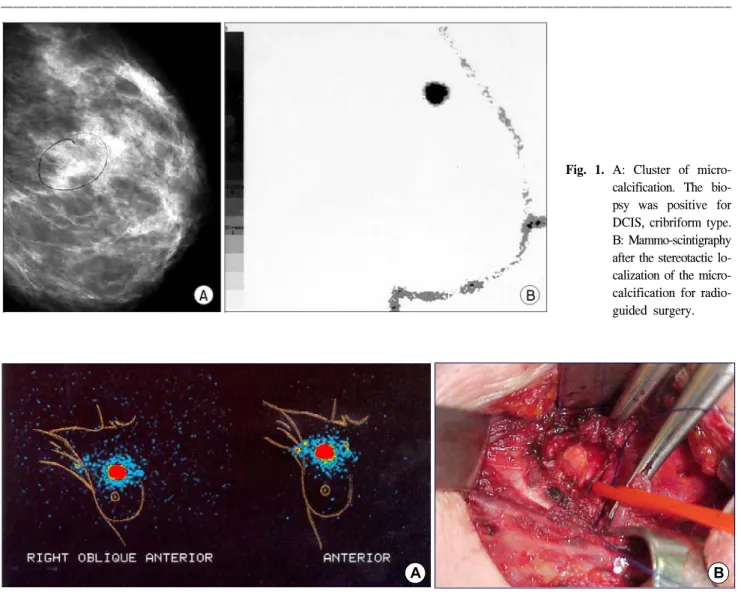
Accuracy of preoperative localization in nonpalpable lesions is essential for both completeness of excision and postoperative cosmesis. Complete non-removal of the suspicious lesion was described in 2.0% to 3.4% of operated cases, especially when the localization is suboptimal.(12,13) Some new localization methods are described in order to most accurately guide the surgeon for excision. One method was described by the European Institute of Oncology in Milan.(7) A day before excision, patients were injected with particles of human serum albumin, 10 to 150 nanometers in diameter (Macrotec; Sorin Biomedica, Saluggia, Italy), labeled with 3.7 MBq (0.1 mCi) Tc-99m at a specific activity of 74 MBq/mg. The excision biopsy was performed the following day guided by a handheld y ray detection probe. This system was proved to be superior to the wire localization in terms of accuracy and concentricity of the lesion in the specimen.(7)
The Tampa Breast Group described another radio-guided method-a titanium seed containing 125I was placed at the site of the lesion by using radio-graphical guidance. The surgeon used a handheld gamma detector to locate and excise the seed and lesion. A randomized study showed reduced incidence of pathologically involved margins of excision.(14)
SENTINEL NODE BIOPSY
The results of the Proceedings of the Consensus Conference on the role of sentinel lymph node biopsy in carcinoma of the breast (April 19∼22, 2001, Philadelphia, Pennsylvania) were recently published.(3) The premise of the conference was that surgery has witnessed few procedures that have been as rapidly adopted into clinical practice as the sentinel node biopsy (SLNB) in patients with breast carcinoma. Critics note that sentinel node biopsy has not been validated by any randomized clinical trials that are the customary sine qua non for the
adoption of innovations in medicine. Advocates maintain that, as a diagnostic procedure, it does not require the same lengthy, randomized trials that the adoption of a new treatment man- dates, and that its accuracy has already been validated by studies comparing SLNB with traditional axillary dissection in the same patient. This is a justifiable reason for this routine approach.
The results of many published experiences around the world show that radio-guided biopsy, blue dye, or combined methods of the sentinel node in breast cancer are effective and useful procedures. The high rate of identified sentinel lymph nodes, the ease of probe-guided node dissection, the reliability of the new multi-level method of frozen-section examination, the ab- sence of risk of exposure to radioactivity by staff, and the acceptably low rate of false negatives (particularly in relation to the non-negligible rate of false negatives in complete axillary dissection) suggest that the procedure represents an important step forward in the staging of the axilla in breast cancer.
Giuliano(15) reported that 42.3% of negatives by hematoxylin eosin were positive by use of anticytokeratin antibodies; similar Figures were reported by Reintgen and Krag.(16,17) From this we can assume that sentinel node biopsy can probably improve axillary staging by revealing micrometastases in such patients.
An open problem is the case in which the sentinel node is minimally involved.(18) Our data show that sentinel nodes involved by microfoci of cancer cells are, however, associated with a considerable rate of metastatic involvement in the remaining axillary nodes (27 of 51; 53.0%; 95%CI, 38.5% to 67.1%). It is not clear what the benefit will be in performing an axillary dissection in those patients who will receive systemic treatment anyway. For this reason, there are three clinical trials being done around the world in which the patient with micrometastases is randomized for axillary dissection, for no intervention, or for axillary radiotherapy.
Another open problem is the biopsy of the sentinel nodes that appear at the lymphoscintigraphy other than the axilla. The axillary sentinel lymph node (SLN) approach in the manage- ment of breast cancer patients may be superseded in the near future by the more comprehensive concept of complete regional lymph node mapping. Increased confidence in the SLN tech- nique and certain recently introduced variations in lymphoscin- tigraphic techniques have allowed the detection of sentinel nodes outside of the axilla, and surgeons have been faced with the decision of removing hot extra-axillary nodes. The benefit of removing non-axillary SLNs is not yet clear. More complete staging of the disease may lead medical and radiation oncolo- gists to pursue different treatment approaches, which in turn
would likely influence survival. Maximally accurate staging should improve the “individualization” of treatment, contri- buting to reduced incidence of over- or under-treatment. Many papers published in the past few years have addressed the issue of internal mammary (IM) biopsy, citing older papers on inter- nal mammary dissection that support the use of IM biopsy, at least in clinical trial setting, based on differences in survival reported according to degree of axillary and IM involvement.
The technique of IM-SLN biopsy should be as nonaggressive as possible in order to minimize potential complications or cosmetic sequelae. Such sequelae are unacceptable in a pro- cedure for which the overall-survival benefits remain hypo- thetical and as yet unconfirmed.(19)
Fig. 1. A: Cluster of micro- calcification. The bio- psy was positive for DCIS, cribriform type.
B: Mammo-scintigraphy after the stereotactic lo- calization of the micro- calcification for radio- guided surgery.
Fig. 3. Intraoperative Radiotherapy by mean of the HAMM applicator ant the brachytherapy Iridium source.
Fig. 2. A: lympho-scintigraphy showing the axillary and internal mammary sentinel node. B: surgical field of the internal mammary sentinel node biopsy. The sentinel node is evident. The internal mammary vessels were encircle.
A B
ꠏꠏꠏꠏꠏꠏꠏꠏꠏꠏꠏꠏꠏꠏꠏꠏꠏꠏꠏꠏꠏꠏꠏꠏꠏꠏꠏꠏꠏꠏꠏꠏꠏꠏꠏꠏꠏꠏꠏꠏꠏꠏꠏꠏꠏꠏꠏꠏꠏꠏꠏꠏꠏꠏꠏꠏꠏꠏꠏꠏꠏꠏꠏꠏꠏꠏꠏꠏꠏꠏꠏꠏꠏꠏꠏꠏꠏꠏꠏꠏꠏꠏꠏꠏꠏꠏꠏꠏꠏꠏꠏꠏꠏꠏꠏꠏꠏꠏ INTRAOPERATIVE RADIOTHERAPY
Interest in intraoperative radiation therapy for breast cancer (IORT) is increasing as the possible benefits of this technique for the patient become apparent. The ability to deliver a single therapeutic dose of radiation to the tumor bed during surgery, thereby avoiding the standard 6-week course of external-beam treatment, may benefit patients through alleviating psycho- logical distress caused by the need for a relatively protracted treatment course, allowing earlier return to normal life and reducing the financial burden of the treatment to both the patient and the health care system.
The rationale for the use of this segmental radiation therapy in place of whole-breast irradiation is based on the finding that approximately 85% of breast relapses are confined to the same quadrant of the breast as the primary tumor.(1) Tumoral foci are usually in close proximity to the primary tumor; and residual microscopic disease occurring in the same quadrant as the resection is often the cause of local disease recurrence. Phase I and II trials have demonstrated that single-dose IORT for localized breast cancers can be applied without increasing the normal rate of complications after surgery. Longer follow-up is needed to assess the cosmetic outcome, which may be impaired by fibrotic changes in the breast tissue secondary to irradiation with this high dose of radiation without fractionation.(6-20)
MANAGEMENT OF HIGH RISK SUBJECTS
BRCA mutations are the new and most important risk factors for breast cancer. The second most important factor with major impact in sporadic breast cancer in the population is age. Other risk factors, such as previous breast biopsies, number of pre- gnancies, age at the fist childbirth, breast-feeding, and mammo- graphic density, have less importance in the definition of the breast cancer risk.
Presently, there are no consolidated data to design a statement for the management of high-risk women, and the advice given is based more on common sense based than on studies. In cases of general family history for breast cancer, physical examination is recommended once a year starting at 20, and a mammogram is recommended for every 2 years starting at 35. BRCA mutation carriers should be screened at age 20, with a physical examination every 3 to 6 months, and with mammography beginning at 25 and repeated annually thereafter. Other examinations should include pelvic evaluation and transvaginal ultrasound, with color Doppler and CA-125
semi-annually beginning at age 25 to 35.(21) The lower speci- ficity of mammography in younger women is the major limit at this intensive follow-up. The role of ultrasound and MRI are under evaluation in prospective trials.
Prophylactic simple mastectomy, usually with reconstruction, is an option to discuss with patients for reducing the risk of breast cancer by approximately 96%. The failure rate is due to residual breast tissue left behind after the mastectomies (espe- cially subclavicular and parasternal glandular foci). On average, 30-year-old women who carry BRCA1 or BRCA2 mutations gain from 2.9 to 5.3 years of life expectancy from prophylactic mastectomy and from 0.3 to 1.7 years of life expectancy from prophylactic oophorectomy, depending on their cumulative risk of cancer.(22) No absolute criterion for which patients should undergo prophylactic mastectomy exists. Each patient should be treated on an individual basis with a psychological assessment.
Chemoprevention is another intervention procedure in high-risk women. Drugs interfering with the initiation and promotion of breast cancer have recently allowed for the development of a new strategy for the reduction of the incidence of this disease.
Large chemoprevention studies(23) showed that tamoxifen was able to prevent breast cancer in high-risk populations and in BRCA mutation carriers.(24)
Other chemoprevention agents, such as retinoic acid deriva- tives and the anti-estrogen raloxifene, are under evaluation in clinical trials.(25)
REVISED AJCC STAGING SYSTEM FOR BREAST CANCER
Last May, The American Joint Committee on Cancer pub- lished the 6th edition of its cancer staging system.(26) The TNM definitions and stage groupings for carcinoma of the breast have been modified from those found in the 5th edition of the Cancer Staging Manual to more closely reflect current medical practice and published outcome data. These changes include:
(1) Distinguishing micrometastases from isolated tumor cells on the basis of size and histologic evidence of malignant activity.
(2) Adding identifiers to indicate use of sentinel lymph node biopsy and immunohistochemical or molecular techniques.
(3) Designating major classifications of lymph node status according to the number of involved axillary lymph nodes as determined by routine hematoxylin and eosin staining (pre- ferred method) or by immunohistochemical staining.
(4) Reclassifying metastases to the internal mammary nodes as N2 if they are detected by imaging studies (not including
lymphoscintigraphy) or clinical examination and if they occur in the absence of metastases to the axillary lymph nodes or as N1 if they are detected by sentinel lymph node biopsy but not by imaging studies or clinical examination and if they occur in the absence of metastases to the axillary lymph nodes.
(5) Reclassifying metastases to the supraclavicular lymph nodes as N3 rather than M1. This staging system for carcinoma of the breast applies to infiltrating (including microinvasive) and in situ carcinomas. Microscopic confirmation of the dia- gnosis is mandatory and the histologic type and grade of carcinoma should be recorded.
REFERENCES
1) Fisher B, Jeong JH, Anderson S, Bryant J, Fisher ER, Wolmark N. Twenty-five-year follow-up of a randomized trial comparing radical mastectomy, total mastectomy, and total mastectomy followed by irradiation. N Engl J Med 2002;
347(8):567-75.
2) Veronesi U, Marubini E, Mariani L, Galimberti V, Luini A, Veronesi P, et al. Radiotherapy after breast-conserving surgery in small breast carcinoma: long-term results of a randomized trial. Ann Oncol 2001;12(7):997-1003.
3) Schwartz GF, Giuliano AE, Veronesi U. Proceedings of the consensus conference on the role of sentinel lymph node biopsy in carcinoma of the breast, April 19-22, 2001, Phila- delphia, Pennsylvania. Cancer 2002;94(10):2542-51.
4) Veronesi U, Paganelli G, Galimberti V, Viale G, Zurrida S, Bedoni M, et al. Sentinel-node biopsy to avoid axillary dis- section in breast cancer with clinically negative lymph-nodes.
Lancet. 1997;349(9069):1864-7.
5) Giuliano AE, Jones RC, Brennan M, Statman R. Sentinel lym- phadenectomy in breast cancer. J Clin Oncol 1997;15(6):
2345-50.
6) Veronesi U, Orecchia R, Luini A, Gatti G, Intra M, Zurrida S, et al. A preliminary report of intraoperative radiotherapy (IORT) in limited-stage breast cancers that are conservatively treated.Eur J Cancer. 2001;37(17):2178-83.
7) Luini A, Zurrida S, Paganelli G, Galimberti V, Sacchini V, Monti S, et al. Comparison of radioguided excision with wire localization of occult breast lesions. Br J Surg 1999;86(4):522-5.
8) Gray RJ, Giuliano R, Dauway EL, Cox CE, Reintgen DS.
Radioguidance for nonpalpable primary lesions and sentinel lymph node(s). Am J Surg 2001;182(4):404-6.
9) Tubiana M, Holland R, Kopan DB, Kurtz JM, Petit JY, Rilke F, et al. Management of non-palpable and small lesions found in mass breast screening. Eur J Cancer 1994;30:538-47.
10) Vargas HI, Agbunag RV, Khaikhali I. State of the Art of Minimally Invasive Breast Biopsy: Principles and Practice.
Breast Cancer 2000;7(4):370-9.
11) Devia A, Murray KA, Nelson EW. Stereotactic core needle
biopsy and the workup of mammographic breast lesions: Arch- Surg 1997; 132(5): 512-5; discussion 515-7.
12) Snell MJ, Ostrow LB, DuBois JJ, Boyle LM, Calfee LW.
Needle localized biopsy of occult breast lesions: an update.
mil-Med 1992;157:61-4.
13) Kaelin CM, Smith TJ, Homer MJ, Taback B, Azurin D, Sch- mid CH, et al. Safety, accuracy, and diagnostic yield of needle localization biopsy of the breast performed using local anes- thesia. J Am Coll Surg 1995;180:509-10.
14) Gray RJ, Salud C, Nguyen K, Dauway E, Friedland J, Berman C, et al. Randomized prospective evaluation of a novel tech- nique for biopsy or lumpectomy of nonpalpable breast lesions:
radioactive seed versus wire localization. Ann Surg Oncol 2001;8(9):711-5.
15) Giuliano AE. Sentinel lymphadenectomy in primary breast car- cinoma: an alternative to routine axillary dissection. J Surg Oncol 1996;62(2):75-7.
16) Reintgen D. What is the role and impact of the sentinel node sampling technique in breast cancer staging? Cancer Contr 1997;4(3):5-8.
17) Krag DN, Ashikaga T, Harlow SP, Weaver DL. Development of Sentinel Node Targeting Technique in Breast Cancer Pa- tients. Breast J 1998;4(2):67-74.
18) International Breast Cancer Study Group. Prognostic impor- tance of occult axillary micrometastases from breast cancer.
Lancet 1990;335:1565-8.
19) Sacchini G, Borgen PI, Galimberti V, Veronesi P, Zurrida S, Luini A, et al. Surgical approach to internal mammary lymph node biopsy. J Am Coll Surg 2001 Dec;193(6):709-13.
20) Vicini F, Baglan K, Kestin L, Chen P, Edmundson G, Martinez A. The emerging role of brachytherapy in the management of patients with breast cancer. Semin Radiat Oncol 2002 Jan;
12(1):31-9
21) Burke W, Daly M, et al. Recommendation for follow-up care of individuals with an inherited predisposition to cancer II.
BRCA1 and BRCA2. JAMA 1997;277(12):997-1003.
22) Schrag-D, Kuntz-KM, Garber-JE, Weeks-JC. Decision analy- sis-effects of prophylactic mastectomy and oophorectomy on life expectancy among women with BRCA1 or BRCA2 muta- tions. N Engl J Med 1997;336(20):1448-9.
23) Fisher B, Powles TJ, Pritchard KJ. Tamoxifen for the preven- tion of breast cancer. Eur J Cancer 2000;36(2):142-50.
24) Narod SA, Brunet JS, Ghadirian P, Robson M, Heimdal K, Neuhausen SL, et al. Tamoxifen and risk of contralateral breast cancer in BRCA1 and BRCA2 mutation carriers: a case- control study. Hereditary Breast Cancer Clinical Study Group.
Lancet 2000;356(9245):1876-81.
25) Veronesi U, De Palo G, Marubini E, Costa A, Mariani L, For- melli F, et al. Vitamin A analogue for breast cancer prevention:
a grade of F or incomplete? J Natl Cancer Inst 2000;92(3):274.
26) American Joint Committee on Cancer: AJCC Cancer Staging Manual, sixth edition. Springer ed, New York, November 2002.