37(8), 1044~1048(2008) DOI: 10.3746/jkfn.2008.37.8.1044
유산간균인
Bacillus polyfermenticus
KJS-2의 안정화김강민1․이진영1․홍용근2․이상길1․강재선1†
1인제대학교 제약공학과
2인제대학교 물리치료학과
The Stabilization of Lactic Acid Bacteria, Bacillus polyfermenticus KJS-2
Kang Min Kim1, Jin Young Lee1, Yonggeun Hong2, Sangkil Lee1, and Jae Seon Kang1†
1Dept. of Pharmaceutical Engineering and 2Dept. of Physical Therapy, Inje University, Gimhae 621-749, Korea
Abstract
Bacillus polyfermenticus KJS-2 (Bp2) was isolated from Bispan
Ⓡ, a commercially available probiotics consisting of more than 4 strains. The objective of this study was to investigate the effect of three-layer coating on the stabilty of Bp2. Bp2 was microencapsulated with sodium alginate using an air atomizer. The Bp2 loaded pellets were also coated with HFP-chitosan and HPMCP for oral delivery system. When compared to the uncoated Bp2, the survival of the three-layer coated Bp2 increased to approximately 63% (p<0.01) in a 30% ethanol solution, 54% (p<0.05) in an artificial gastric juice (pH 2), and 53% (p<0.05) in the bile acid (pH 5). When coated beads were stored at 100
oC and 130
oC, Bp2 in coated beads was very stable (p<0.01) compared to uncoated Bp2.
Key words: Bacillus polyfermenticus KJS-2, three-layer coating, alginate, stability
†Corresponding author. E-mail: [email protected]
†Phone: 82-55-320-3918, Fax: 82-55-327-4955
서 론
생균제(probiotics)란 살아있는 미생물 공급원으로써 장 내 균총의 정상화는 물론 장내 병원성 미생물 감염의 예방, 콜레스테롤 대사개선, 면역체계의 정상화 및 lactic acid 공 급 등을 통한 신체기능 개선의 목적으로 사용된다(1,2). 우수 한 생균제는 소화기관 및 장내로 도달할 때까지 생존력, 안 정성 및 활성이 유지되어야 한다(3). 이러한 면에서 여러 생 균제 중 유산균은 유해미생물의 억제, 설사 방지, 장내의 생 존력의 개선을 통한 산업적 측면에서 관심이 증대되고 있다.
또한 식품을 캡슐화시킴으로써 여러 질병 예방은 물론 치료 목적으로 사용되어진다(4).
Terakado는 1933년에 몇 가지 내생포자를 형성하는 균주 를 공기 중에서 분리하였으며(5)
Bacillus polyfermenticusSCD(Bp SCD)를 포함한 4가지 균주를 혼합하여 만든 제제 인 Bispan
Ⓡ이 현재 의약품 및 동물용 약품으로 판매되고 있 다. Bp SCD는 유전자 수준과 생화학적으로
Bacillus subtilis와 유사하며 인공위액 및 인공담즙산에 대한 내성을 가지고 있으며 장내 유해균의 증식을 억제한다고 보고되었다(6). 이 4가지 균주 중에서 안정성과 항균성이 우수한
Bacillus poly- fermenticusKJS-2(Bp2)를 선별하여 본 연구에 사용하였다.
생균제는 보관기간 동안의 온도와 습도에 의한 안정성의 문제와 인체에 섭취 시에 위액이나 담즙산에 의한 생존력 감소가 산업화시킬 때 많은 단점으로 작용한다. 산업적으로 이용하기 위한 생균제의 microencapsulation은 여러 방법이 보고되었는데 그 중에서 sodium alginate를 이용한 micro- encapsulation의 기술이 많이 보고되었다(7-9). Alginate는 여러 종류의 조류로부터 추출한 D-mannuronic acid와 L-guluronic acid로 이루어진 선형의 copolymer이다(10).
이것이 고형화가 되기 위해서는 Ca
2+, Mg
2+과 같은 2가의
이온들과 결합이 되어야하며 특히 Ca
2+과 친화성이 우수하
다. 하지만, 양이온과 phosphate, citrate 및 lactate에 착화물
을 형성하여 불안정한 형태로 유지된다(11). 이것을 보완하
고자 polylysine, polyvinylamine 및 chitosan 등을 이용하여
polymer 코팅을 하였을 때 alginate capsule의 안정성이 유
지되었다. Bovine serum albumin(BSA)을 1차로 alginate로
코팅 후 chitosan으로 2차 코팅하였을 경우 인공위액 및 인
공담즙산에 대한 BSA의 안정성이 증가되었음을 보고하였
다(12). Chitosan은 glycosaminoglycan과 유사한 poly-
saccharide이며 독성이 없고 생분해성을 가지고 있으며 낮
은 pH에서도 안정하여 경구용제제로 사용되고 있다(13). 또
한, hydroxypropyl methylcellulose phthalate(HPMCP)는
산성조건에서는 잘 방출되지 않고 pH 7.2 이상의 알카리 용 액에서 방출이 잘 되는 장용성 코팅제제로서의 사용이 효과 적이라고 보고되었다(14).
본 연구에서는 Bp2를 pan coating 방법을 이용하여 algi- nate-Ca
2+코팅을 실시하였고 다음 단계로 soluble chitosan 과 HPMCP 2910을 이용하여 코팅을 실시하여 3중 coating 하여 고온 및 에탄올에서의 안정성을 조사한 결과를 보고하 고자 한다.
재료 및 방법
균주 및 배양조건
본 연구에서 사용된
Bacillus polyfermenticusKJS-2 KCCM 10769P(Bp2)는 일본 TOA제약에서 상업적으로 판 매되고 있는 ‘Bispan’으로부터 분리하여 3∼4회 계대배양 하 여 활성화하였으며 10% glycerol stock법으로 -80
oC에서 보 존하였고 한 달에 1회씩 계대배양 하여 사용하였다. 배양배 지는 내생포자를 완전히 형성시키기 위하여 Cazemier 등 (15)과 Oomes 등(16)의 내생포자 형성 배지를 변형하여 만 든 고체배지를 사용하였으며 이 배지에서 37
oC로 4일간 배 양한 다음 동결건조 후 사용하였다. 포자형성 고체배지의 조성은 다음과 같다. 1.3% nutrient broth, 0.051% MgSO
4․ 7H
2O, 0.097% KCl, 0.02% CaCl
2․2H
2O, 0.003% MnSO
4․ H
2O, 0.00055% FeSO
4․7H
2O, 10% skim milk, 1.5% agar.
Bacillus polyfermenticus
KJS-2의 미세캡슐화
동결건조 된 2×10
10CFU/g을 함유하는 Bp2 5 g을 1%
lactic acid, 1% Tween-80 100 mL에 혼합한 뒤 2% sodium alginate(Qingdao Jiaonan Bright Moon Seaweed Industrial Co., Ltd., China) 1 L에 재혼합하였다. 이 현탁액은 공기분무 식장치(Jounjin tech Co., Ltd., Korea)를 이용하여 0.1 M CaCl
2용액에 분무하고 완전한 겔상태를 만들기 위하여 30 분 동안 저온에서 방치하였다. 미세캡슐화된 alginate beads 는 멸균수로 씻어 낸 후 시험에 사용하였다.
Chitosan 및 HPMCP에 의한 alginate bead의 코팅
Alginate bead는 멸균된 0.1% HFP-Chitosan(Jakwang Co., Ltd., Korea)용액에 넣은 후 코팅을 위하여 orbital shaker에서 100 rpm, 30분 동안 유지하였다. Chitosan으로 코팅된 beads는 여과기로 여과한 후 동결건조 하여 실험에 사용하였다. 동결건조 된 beads는 3차 코팅을 위하여 4%
HPMCP 2910(Shin-Etsu chemical Co. Ltd., Japan) sol- ution을 소량씩 넣으면서 혼합한 후 건조하였고, HPMCP 2910으로 코팅된 beads는 60
oC에서 송풍 건조하여 검체로 사용하였다(3중 코팅된 Bp2).
레이저입도분석기(particle size analyzer)를 이용한 bead의 분석
3중 코팅된 Bp2의 입자 크기를 분석하기 위하여 레이저입
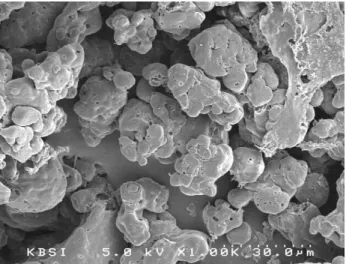
도분석기(PSA, 90 Plus, Brookhaven Instruments Co., USA) 및 분말의 형태를 관찰하기 위해서 전계 방출 주사전 자현미경(Field Emission Scanning Electron Microscope, S-4300 SE, HITACHI, Japan)을 이용하여 관찰하였다.
균수의 측정
3중 코팅된 Bp2의 총 균수는 다음과 같이 측정하였다. 10 mM potassium phosphate 용액(pH 7.2)에 2차, 3차 코팅된 chitosan과 HPMCP를 녹여 제거하고 55 mM sodium cit- rate(pH 7.4)를 이용하여 1차 코팅된 sodium alginate를 녹여 제거하였다. 0.1% peptone 용액으로 10배씩 연속적으로 희 석하여 tryptic soy agar(TSA, Difco, USA) 배지에 0.1 mL 씩 분주하여 도말한 뒤 최적온도인 37
oC에서 배양하여 콜로 니 형성단위(colony forming unit, CFU)를 측정한 후 총 코 팅된 균수를 계산하였다.
에탄올처리에 의한 3중 코팅된
Bacillus polyfermenticusKJS-2의 안정성
3중 코팅된 Bp2를 0.1 g을 취하여 30% 에탄올 용액에 4시 간 처리하고 각각을 1 mL씩 취하여 멸균된 0.1% peptone 용액으로 10배씩 계열 희석하여 TSA 배지에 0.1 mL씩 분주 하여 도말한 뒤 최적온도인 37
oC에서 배양하여 CFU를 측정 한 후 총 균수를 계산하였다. 대조군으로는 코팅하지 않은 내생포자균을 이용하였다(코팅처리하지 않은 Bp2).
100
oC 용액으로 처리한 3중 코팅된
Bacillus polyfer- menticusKJS-2의 안정성
3중 코팅된 Bp2를 0.1 g을 취하여 100
oC의 끓는 물에 5분, 10분, 15분씩 처리하고 각각을 1 mL씩 취하여 멸균된 0.1%
peptone 용액으로 10배씩 계열 희석하여 TSA 배지에 0.1 mL씩 분주하여 도말한 뒤 최적온도인 37
oC에서 배양하여 CFU를 측정한 후 총 균수를 계산하였다. 대조군으로는 코팅 처리하지 않은 Bp2을 이용하였다.
130
oC 증기로 처리한 3중 코팅된
Bacillus polyfer- menticusKJS-2의 안정성
Tunnel 방식의 convey belt상에서 이동하면서 130
oC 수 증기를 이용하여 5분간 멸균처리를 하였다. 코팅된 균주를 시중의 pellets 형태의 일반사료에 흡착시켜 건조 후 실험에 사용하였다. 대조군으로는 코팅처리하지 않은 Bp2와 1차 코 팅에 사용한 sodium alginate의 사용량을 1/10로 줄여 코팅 한 것을 사용하였다(완전히 코팅되지 않은 Bp2).
인공위액 및 인공담즙산에 대한 3중 코팅된
Bacillus polyfermenticusKJS-2의 안정성
인공위액은 1 N HCl을 사용하여 pH 2로 조절한 tryptic
soy broth(TSB)를 사용하였다. 3중 코팅된 Bp2 1 g을 pH
2로 조절된 TSB(20 mL)에 넣은 뒤 4시간 후 총 균수를 측정
하였다. 인공담즙산은 0.6% oxgall(pH 5)이 첨가된 배지를
제조하여 사용하였다. pH 2로 조절된 TSB(20 mL)에 3중 코팅된 Bp2 1 g을 넣은 뒤 4시간 후 인공담즙산 배지에 다시 옮겨 1시간 처리 후 용액에서 일정량을 취하여 희석방법에 의하여 총 균수를 측정하였다.
통계분석
통계학적 유의성을 판단하기 위하여 코팅처리하지 않은 Bp2, 완전히 코팅처리하지 않은 Bp2와 3중 코팅된 Bp2 사이 의 유의수준 p<0.01와 p<0.05로
t-test를 이용하여 통계분석 을 시행하였다.
결과 및 고찰 Bacillus polyfermenticus
KJS-2의 미세캡슐화
온도에 잘 견딜 수 있도록 Bp2의 endospore를 증식용 배 지에서 만들어 사용하였으며 sodium alginate를 사용하여 1차 코팅 미세캡슐을 제조하였다. Beads를 레이저입도분석 기 및 전계 방출 주사전자현미경으로 측정하였을 경우 약 15±2 μm의 입도 크기를 나타내었다(Fig. 1, 2). 또한 사용된 lactic acid는 산성조건을 유지함으로써 endospore의 안정성 을 높이고자 하였으며, 2차 코팅물질로서 chitosan을 사용한 것은 1차 코팅물질인 alginate와의 친화성이 높음을 이용한 것으로 alginate와의 가교 결합으로 더욱 견고한 bead를 제 조할 목적으로 사용하였다. 3차로 HPMCP를 사용한 것은 HPMCP가 pH 6 이하에서는 녹지 않는 성질을 이용한 것으 로 pH 6이하에서 코팅된 bead가 용해하지 않게 하기 위하여 장용성 코팅 재료인 HPMCP를 사용하였다. 이것은 위를 통 과할 때 안정성을 유지할 수 있게 사용된 것이다.
3중 코팅된
Bacillus polyfermenticusKJS-2의 에탄 올에 대한 안정성
식품첨가제로 많이 이용되는 에탄올에 대한 안정성 여부 를 조사할 목적으로 3중 코팅 beads의 안정성에 대하여 시험 하였다. 코팅처리하지 않은 Bp2(2±0.08×10
10CFU/g)와 3
Fig. 1. Particle size distribution curve of the three-layer coated Bacillus polyfermenticus KJS-2.
Fig. 2. Field emission scanning electron microscope micro- graph of the three-layer coated Bacillus polyfermenticus KJS-2.
중 코팅된 Bp2(5±0.06×10
9CFU/g)를 30% ethanol 용액에 4시간 처리 후 10배씩 계열 희석하여 도말하였을 경우 코팅 처리하지 않은 Bp2의 생존율은 3%(6±0.08×10
8CFU/g)이 었고 3중 코팅된 Bp2는 66%(3.3±0.06×10
9CFU/g)이었다 (Fig. 3, p<0.01).
3중 코팅된
Bacillus polyfermenticusKJS-2의 100
oC 에 대한 안정성
대부분의 유산균은 40
oC이상의 온도에서 급격히 사멸되 기 때문에 제형의 공정에서 사멸율의 개선에 대한 개발을 하여야 한다. 비록 endospore로 구성된 경우에도 고온에서 의 사멸이 예상되어 3차 코팅과의 비교시험을 수행함으로써 온도에 대한 안정성을 조사하였다. 코팅처리하지 않은 Bp2(2±0.08×10
10CFU/g)와 3중 코팅된 Bp2(5±0.06×10
9CFU/g)를 각각 끓는 물에 5분, 10분, 15분 처리한 후 계열
5 6 7 8 9 10 11
1 2
Log cell count (CFU/g) . *
1 2 3 4
Fig. 3. Stability of the three-layer coated Bacillus poly- fermenticus KJS-2 in 30% ethanol solution.
1, cell number of uncoated Bp2; 2, cell number of uncoated Bp2 treated with alcohol; 3, cell number of three-layer coated Bp2;
4, cell number of three-layer coated Bp2 treated with alcohol.
*p<0.01.
6 7 8 9 10 11
0 5 10 15
Min
Log cell count (CFU/g) .
Uncoated Bp2 Three-layer coated Bp2
* * *
Fig. 4. Stability of the three-layer coated Bacillus poly- fermenticus KJS-2 at 100oC. *p<0.01.
희석하여 도말하였을 경우, 코팅처리하지 않은 Bp2의 생존 율은 5분 처리 시 4.1%(8.2±0.15×10
8CFU/g), 10분 처리 시 3.7%(7.3±0.06×10
8CFU/g), 15분 처리 시 3.2%(6.4±
0.08×10
8CFU/g)이었고 3중 코팅된 Bp2는 5분 처리 시 76%(3.8±0.06×10
9CFU/g), 10분 처리 시 70%(3.5±0.05
× 10
9CFU/g), 15분 처리 시 68%(3.4±0.01×10
9CFU/g)이 었다(Fig. 4, p<0.01). 처리시간의 경과에 따라 생존율은 코 팅처리하지 않은 Bp2와 3중 코팅된 Bp2에서 모두 감소하였 지만 코팅처리하지 않은 Bp2의 경우에는 4% 이하의 낮은 생존율을 보였으나 3중 코팅된 Bp2에서는 약 70% 내외의 생존율을 나타내었다. 이것은 유사균주인 Bp SCD를 3중 코 팅하였을 경우 100
oC에서의 안정성이 코팅처리하지 않은 Bp SCD보다 증대됨과 일치하는 결론을 얻었다(17). 이는 고온처리를 하는 식품 및 의약품 제조 시에 사용할 수 있는 유산균으로 3중 코팅된 것이 이용될 수 있을 것이다.
3중 코팅된
Bacillus polyfermenticusKJS-2의 130
oC 에 대한 안정성
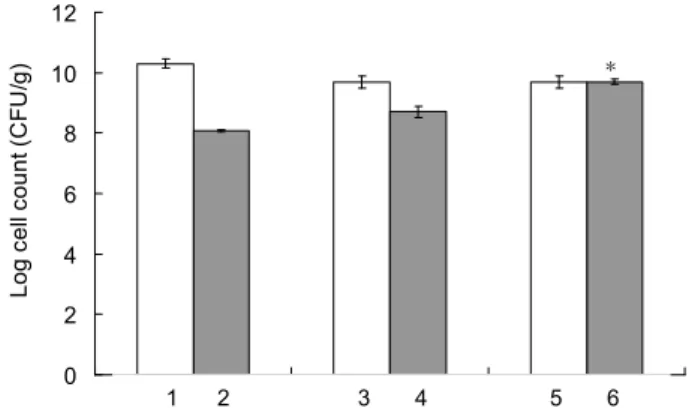
코팅처리하지 않은 Bp2(2±0.08×10
10CFU/g)를 이용하 여 실험을 수행하였을 경우에 생존력은 약 1%(약 1.2±
0.15×10
8CFU/g)를 나타낸 반면에 완전히 코팅처리하지 않 은 Bp2(5±0.2×10
9CFU/g)의 경우에는 10%(약 5±0.3×
10
8CFU/g) 내외의 생존력을 보였다. 3중 코팅된 Bp2 (5±0.06×10
9CFU/g)의 경우에는 99%(약 4.9±0.07×10
9CFU/g)의 생존력을 보였다(Fig. 5, p<0.01). 즉, 대조군 중 코팅처리하지 않은 Bp2의 내생포자는 생존율이 약 1%이었 으나 1차 코팅이 완전하지 못할 경우에도 최대 10%까지 증 가되었고 본 연구에서 사용된 sodium alginate 농도에서 99%까지의 대단히 높은 생존율을 나타내었다. 이 결과는 3중 코팅된 Bp SCD를 이용하여 130
oC에서 5분 처리 시에 생존율이 10% 미만인 것과 비교하면 코팅양이 매우 중요하 다는 것을 알 수 있었다(데이터 미제시). 순간 고온처리나 고형의 식품 및 동물용 사료 등에서의 멸균조건은 130
oC 증 기 멸균을 실시하는 것이 일반적이며, 유산균의 3중 코팅에
0 2 4 6 8 10 12
1 2 3
Log cell count (CFU/g) .
*
1 2 3 4 5 6 Fig. 5. Stability of the three-layer coated Bacillus poly- fermenticus KJS-2 at 130oC.
1, cell number of uncoated Bp2; 2, cell number uncoated Bp2 treated at 130oC; 3, cell number of incompletely coated Bp2; 4, cell number of incompletely coated Bp2 treated at 130oC; 5, cell number of three-layer coated Bp2; 6, cell number of three-layer coated Bp2 treated at 130oC. *p<0.01.
의한 안정화로 이 분야에서도 유산균이 이용될 수 있는 기술 을 제공할 수 있음을 보여주고 있다.
3중 코팅된
Bacillus polyfermenticusKJS-2의 인공 위액 및 인공담즙산에 대한 안정성
생균제들의 위액, 담즙산 등에 대한 안정성을 높이기 위한 sodium alginate를 통한 생균제의 microencapsulation에 대 한 많은 연구가 보고되었다(8,17). 생균제로서의 특징은 물 론 식품용 생균제로서 가져야 할 여러 가지 특징 중 음식물 이 위를 통하여 십이지장에서 장까지 도달할 때의 생존율이 높아야 한다는 것이다. 다음에서는 Bp2가 생균제로서의 특 성을 확인하고 장까지 도달하기 위한 높은 생존율을 위하여 endospore를 형성시켜 인공위액 및 인공담즙산에서 안정성 을 검토하고 endospore를 형성시킨 균을 이용, 코팅하여 인 공위액 및 인공담즙산에서의 안정성을 비교하였다. 코팅처
0 2 4 6 8 10
1
Log cell count (CFU/g) .
* *
1 2 3 4 5 6 Fig. 6. Stability of the three-layer coated Bacillus poly- fermenticus KJS-2 at gastric juice and bile acid.
1, cell number of three-layer coated Bp2; 2, cell number of three-layer coated Bp2 treated at gastric juice; 3, cell number of three-layer coated Bp2 treated at bile acid; 4, cell number of un- coated Bp2; 5, cell number of uncoated Bp2 treated at gastric juice; 6, cell number of uncoated Bp2 treated at bile acid. *p<0.05.
리하지 않은 Bp2(2±0.08×10
10CFU/g)와 3중 코팅된 Bp2 (5±0.06×10
9CFU/g)를 각각 인공위액에 4시간 처리한 후 계열 희석하여 도말하였을 경우, 코팅처리하지 않은 Bp2의 생존율은 42%(8.3±0.13×10
9CFU/g)이었고 3중 코팅된 Bp2는 96%(4.8±0.03×10
9CFU/g)이었다. 인공위액에서 4 시간 처리 후 인공담즙산 용액에 1시간 처리하였을 경우는 코팅처리하지 않은 Bp2의 생존율은 41%(8.1±0.01×10
9CFU/g)이었고 3중 코팅된 Bp2는 94%(4.7±0.06×10
9CFU/
g)이었다(Fig. 6, p<0.05). 이것은 유사균주인 Bp SCD의 3중 코팅에 의한 인공위액 및 인공담즙산에 대한 1시간 처리 후 의 안정성이 80% 및 90%에 비해 Bp2는 보다 높은 90%이상 의 안정성이 나타났음을 확인할 수 있었다(17,18).
요 약
유산균인 Bp2를 3중 코팅으로 미세캡슐화 시켜 에탄올, 온도, 인공위액 및 인공담즙산에 대한 안정성을 검토하였다.
코팅된 bead의 크기는 약 15 μm로 나타났으며 코팅된 Bp2 의 내생포자의 온도에 대한 내성에서는 100
oC 끓는 물에서 5분간 방치하였을 경우 생존률이 76%, 10분에서 70%, 15분 에서 68%로 나타났으며 130
oC 증기에서는 코팅처리하지 않 은 Bp2는 1%의 생존율에 비해 코팅을 하였을 시 99%의 높 은 생존율을 보였다. 위액 및 담즙산에 대한 안정성에서는 코팅처리하지 않은 Bp2는 42%, 41%에 비해 3중 코팅된 Bp2 는 96%, 94%로 아주 높은 생존율을 보였다. 이것은 alginate, chitosan 및 HPMCP를 이용한 코팅방법은 Bp2에 대한 높은 안정성을 제공하였고 alginate의 양을 적절히 사용함으로써 Bp2의 미세캡슐화로 안정성이 증대되었다고 볼 수 있다. 또 한 에탄올에 대한 생존율을 증가시킴으로써 식품첨가제로 사용할 수 있음을 나타내었다. 이 기술을 적용할 경우 3중 코팅된 생균제 Bp2는 산업적으로 확대되고 있는 pellet형 사 료에도 사용할 수 있어서 그 효용성이 높다고 사료된다.
감사의 글
이 논문은 2005년도 인제대학교 학술연구조성비 보조에 의하여 수행되었으며 이에 감사를 드립니다.
문 헌
1. Fuller R. 1989. Probiotics in man and animals.
J Appl Bacterio
66: 365-378.2. Salminen S, Bouley C, Boutron-Ruault MC, Cummings JH, Franck A, Gibson GR, Isolauri E, Moreau MC, Roberfroid M, Rowland I. 1998. Functional food science and gastro- intestinal physiology and function.
Br J Nutr
80: 147-171.3. Gilliland SE. 1989. Acidophilus milk products: a review of
potential benefits to consumers.
J Dairy Sci
72: 2483-2494.4. Park, BG, Lee JH, Shin HK, Lee JH, Chang PS. 2006.
Optimization of conditions for the double layer micro- encapsulation of lactic acid bacteria.
Korean J Food Sci Technol
38: 767-772.5. Lee KH, Jun KD, Kim WS, Paik HD. 2001. Partial charac- terization of polyfermenticin SCD, a newly identified bac- teriocin of
Bacillus polyfermenticus
.Lett Appl Microbiol
32: 146-151.6. Park KY, Jung HY, Woo KL, Jun KD, Kang JS, Paik HD.
2002. Effects of
Bacillus polyfermenticus
SCD admin- istration on fecal microflora and putrefactive metabolites in healthy adults.J Microbiol Biotechnol
12: 657-663.7. Bregni C, Degrossi J, Garcia R, Lamas MC, Firenstein R, D'Aquino M. 2000. Alginate microspheres of
Bacillus subtilis
.Ars Pharmaceutica
41: 245-248.8. Sultana K, Godward G, Reynolds N, Arumugaswamy R, Peiris P, Kailasapathy K. 2000. Encapsulation of probiotic bacteria with alginate-starch and evaluation of survival in simulated gastrointestinal conditions and in yoghurt.
Int J Food Microbiol
62: 47-55.9. Koo SM, Cho YE, Huh CS, Baek YJ, Park JY. 2001.
Improvement of the stability of
Lactobacillus casei
YIT 9018 by microencapsulation using alginate and chitosan.J Microbiol Biotechnol
11: 376-383.10. Remunan-Lopez C, Bodmeier R. 1997. Mechanical, water uptake and permeability properties of crosslinked chitosan glutamate and alginate films.
J Controlled Release
44:215-225.
11. Yoo IK, Seong GH, Chang HN, Park JK. 1996. Encapsulation of
Lactobacillus casei
cells in liquid-core alginate micro- capsules for lactic acid production.Enzyme Microbiol Technol
19: 428-433.12. Hari PR, Chandy T, Sharma CP. 1996. Chitosan/calcium- alginate beads for oral delivery of insulin.
J Appl Polymer Sci
59: 1795-1801.13. Muzzarelli R, Baldassarre V, Conto F, Ferrara P, Biagini G, Gazzanelli G, Vasi V. 1988. Biological activity of chito- san: ultrastructural study.
Biometerials
9: 247-252.14. Kim MS, Kim JS, Kang SH, Yoo YH, Lee SB, Park JS, Woo JS, Hwang SJ. 2007. Influence of water soluble addi- tives and HPMCP on drug release from Surelease-coated pellets containing tamsulosin hydrochloride.
Arch Pharm Res
30: 1008-1013.15. Cazemier AE, Wagenaars SFM, Steeg PET. 2001. Effect of sporulation and recovery medium on the heat resistance and amount of injury of spores from spoilage bacilli.
J Appl Microbiol
90: 761-770.16. Oomes SJCM, van Zuijlen ACM, Hehenkamp JO, Witsenboer H, Van der Vossen JMBM, Brul S. 2007. The character- isation of Bacillus spores occurring in the manufacturing of (low acid) canned products.
Int J Food Microbiol
120:85-94.
17. Lee JO, Jun KD, Kang JS, Lee JH. 2004. Increased stability of
Bacillus polyfermenticus
SCD in low pH, high temper- ature and high glucose concentration via three layer coating.Korean J Biotechnol Bioeng
19: 221-225.18. Krasaekoopt W, Bhandari B, Deeth H. 2004. The influence of coating materials on some properties of alginate beads and survivability of microencapsulated probiotic bacteria.
Int Dairy J
14: 737-743.(2008년 5월 21일 접수; 2008년 7월 23일 채택)